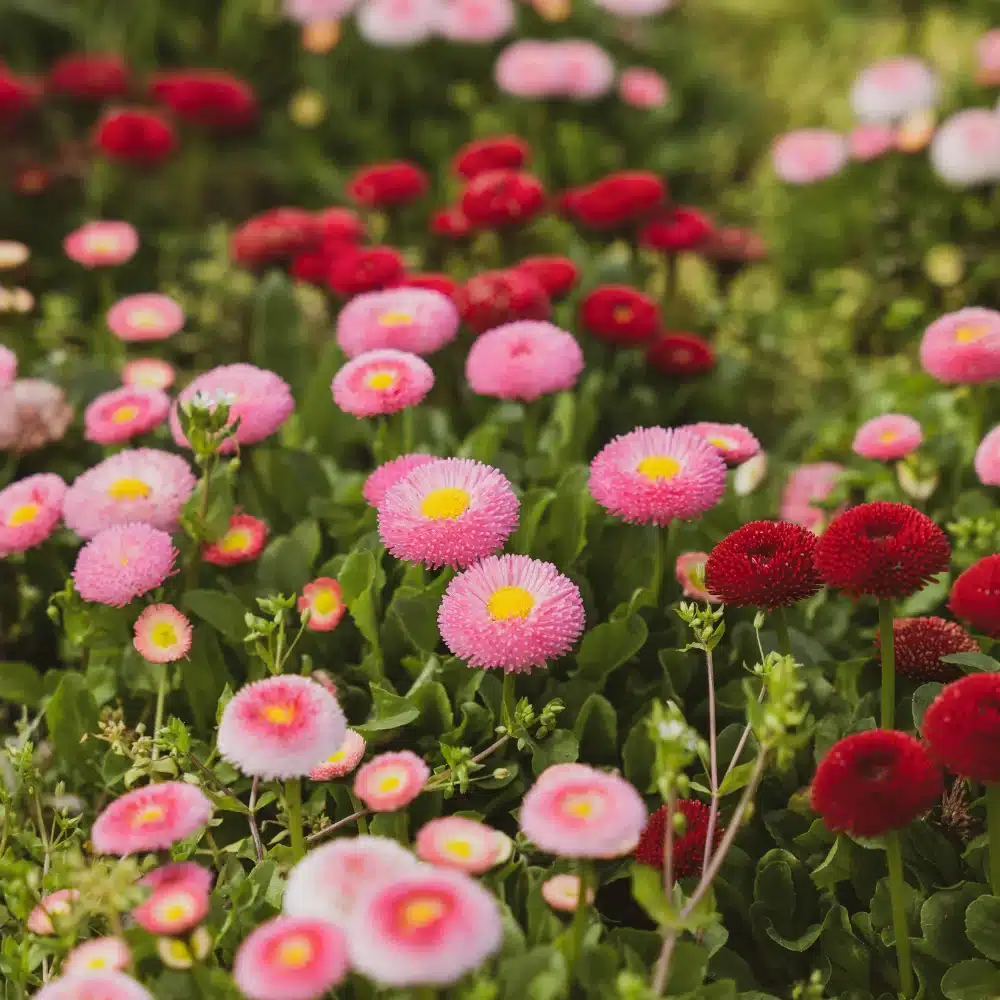
Explore our vibrant flower collection featuring seasonal favorites and timeless classics. Whether you’re planting cutting gardens, borders, or containers, find flowers that deliver stunning color from spring through fall.
Flower categories determine how a plant lives, how long it lasts, and what role it plays in your garden. An annual blooms hard for one season then dies. A perennial disappears in winter and comes back stronger each spring. A bulb stores its energy underground and delivers precision-timed blooms year after year. A shrub builds permanent structure that holds the garden together.
Most garden problems trace back to misidentifying what type of plant you have — and therefore giving it the wrong care at the wrong time. This guide covers every major flower category in full, with specific examples and practical growing guidance for each.
Annuals complete their entire life cycle — germination, growth, flowering, seed production, and death — in a single growing season. The word comes from the Latin annus, meaning year. They are the hardest-working color plants in the garden, blooming continuously from planting until frost kills them.
Annuals fall into 3 groups based on cold tolerance:
Annual | Height | Sun | Bloom Season | Best Use |
|---|---|---|---|---|
Marigold (Tagetes) | 8–36 inches | Full sun | Summer–Frost | Edging, vegetable garden companion, containers |
Zinnia | 12–48 inches | Full sun | Summer–Frost | Cut flowers, pollinator garden, hot beds |
Petunia | 6–18 inches | Full sun | Spring–Frost | Hanging baskets, window boxes, containers |
Cosmos | 24–60 inches | Full sun | Summer–Fall | Back of border, cottage gardens, cutting garden |
Impatiens | 6–18 inches | Shade–Part shade | Spring–Frost | Shade beds, containers under trees |
Snapdragon | 6–48 inches | Full sun | Spring–Early Summer | Cut flowers, cool-season color |
Larkspur | 24–72 inches | Full sun | Spring–Early Summer | Cottage gardens, cutting garden |
Sweet Pea | 4–8 ft (climbing) | Full sun | Spring–Early Summer | Trellises, fragrant cutting garden |
Nasturtium | 6–12 inches | Full sun | Summer–Frost | Edible flowers, containers, slopes |
Bachelor’s Button | 12–30 inches | Full sun | Spring–Summer | Cutting garden, naturalizing |
Deadheading: Remove spent flowers before they set seed. This is the single most effective way to extend an annual’s bloom season. When annuals set seed, they stop producing flowers — they have accomplished their biological goal. Deadheading fools them into continuing to bloom.
Fertilizing: Annuals are heavy feeders. Apply a balanced liquid fertilizer every 2–3 weeks through the growing season, or use a slow-release granular fertilizer at planting. Container annuals need more frequent feeding — nutrients leach out faster.
Succession planting: Sow seeds every 2–3 weeks for crops like zinnias and sunflowers to extend the cutting garden season from June through October.
Perennials are non-woody plants that live for more than 2 years. Most herbaceous perennials die back to the ground in fall or winter — their tops disappear but their root systems survive and push up new growth each spring. With each passing year, the root system grows larger and the plant becomes more vigorous.
Perennials are the backbone of sustainable garden design. Plant them once, and they come back every year with minimal intervention. The typical bloom period is 2–4 weeks per season, which is shorter than annuals — but the 4-season structural interest and increasing size make up for it. A well-planned perennial border peaks 3–5 years after planting.
Perennial | Zones | Sun | Bloom Season | Key Feature |
|---|---|---|---|---|
Black-eyed Susan (Rudbeckia) | 3–9 | Full sun | Summer–Fall | Drought tolerant, deer resistant, self-seeds |
Coneflower (Echinacea) | 3–9 | Full sun | Summer–Fall | Pollinator magnet, medicinal, seedheads for birds |
Daylily (Hemerocallis) | 3–9 | Full–Part sun | Summer | Hundreds of cultivars, near-indestructible |
Peony (Paeonia) | 3–8 | Full–Part sun | Late Spring | Fragrant, long-lived (50+ years), spring focal point |
Lavender (Lavandula) | 5–8 | Full sun | Summer | Fragrant, drought tolerant, repels deer and pests |
Salvia (perennial types) | 4–9 | Full sun | Summer–Fall | Hummingbird favorite, drought tolerant |
Hosta | 3–9 | Part–Full shade | Summer (foliage) | Best shade perennial, hundreds of leaf colors/sizes |
Ornamental Sage | 4–8 | Full sun | Summer | Long bloomer, low maintenance, attracts butterflies |
Sedum (Stonecrop) | 3–9 | Full sun | Late Summer–Fall | Succulent-like, drought tolerant, fall interest |
Yarrow (Achillea) | 3–9 | Full sun | Summer | Flat flower clusters, drought tolerant, cuts well |
Division: Divide perennial clumps every 3–4 years to maintain vigor. Division is best done in spring for summer bloomers and fall for spring bloomers. Dig the entire clump, split into sections of 3–5 shoots each, and replant. Discard the exhausted center and replant the outer sections.
Cutting back: Cut herbaceous perennials back to the ground in late fall after frost, or leave stems standing over winter to provide bird habitat and visual structure, then cut back in early spring. Both approaches work.
Pinching: Pinch the growing tips of tall perennials (chrysanthemums, asters, phlox) in late spring to encourage bushier plants with more stems and more flowers. Stop pinching by mid-July.
Bulbs, corms, tubers, and rhizomes are all underground storage structures that allow plants to survive dormant periods and emerge on a predictable seasonal schedule. The term ‘bulb’ is commonly used for all types. They are among the easiest and most rewarding plants in the garden.
Structure | What It Is | Examples | Planting Depth |
|---|---|---|---|
True bulb | Layered scales around a central bud (like an onion) | Tulip, daffodil, hyacinth, lily, allium | 3x the bulb’s diameter |
Corm | Solid stem base (no layers) | Crocus, gladiolus, freesia, crocosmia | 3–4 inches deep |
Tuber | Swollen underground stem with growth points (eyes) | Dahlia, tuberous begonia, anemone | Varies by plant |
Rhizome | Horizontal underground stem with growing points | Iris, ginger, canna, lily of the valley | At or just below surface |
Flowering shrubs are woody perennial plants with multiple stems growing from the base. They provide permanent structure in the garden, often serve as wildlife habitat, and bloom on a reliable seasonal schedule. Unlike herbaceous perennials, they do not die back to the ground in winter — they retain their woody framework year-round.
Shrubs are the single most valuable investment in a garden. They grow larger and more productive with each year, and many remain beautiful landscape features for 20–50 years with minimal care.
Shrub | Bloom Season | Zones | Sun | Notable Feature |
|---|---|---|---|---|
Forsythia | Early spring (before leaves) | 4–8 | Full–Part sun | First shrub to bloom, vivid yellow |
Lilac (Syringa) | Mid-spring | 3–7 | Full sun | Extraordinary fragrance, long-lived |
Azalea / Rhododendron | Spring | 4–9 (varies) | Part shade | Massive color display, acidic soil |
Rose (Rosa) | Summer (repeat bloomer) | 3–9 | Full sun | Most symbolic flowering shrub |
Butterfly Bush (Buddleja) | Summer–Fall | 5–9 | Full sun | Attracts butterflies, long bloom season |
Crape Myrtle (Lagerstroemia) | Summer–Fall | 6–10 | Full sun | 90–120 day bloom, multi-season interest |
Hydrangea | Summer–Fall | 3–9 (varies) | Part shade | Dramatic flower heads, many forms |
Abelia | Summer–Fall | 5–9 | Full–Part sun | Semi-evergreen, attracts pollinators |
Beautyberry (Callicarpa) | Fall (berries) | 5–8 | Full–Part sun | Vivid purple berries in fall |
Witch Hazel (Hamamelis) | Winter | 3–8 | Full–Part sun | Blooms January–March, fragrant |
Climbers and vines grow vertically — by twining, by gripping with tendrils, by hooking with thorns, or by adhesive pads — using structures as support. They maximize vertical space, transform bare fences and walls into living features, and provide canopy cover for pergolas and arbors.
Climber | Type | Zones | Sun | Bloom | Best Support |
|---|---|---|---|---|---|
Clematis | Perennial vine | 4–9 | Full–Part sun | Spring–Fall (varies) | Trellis, fence, arbor |
Climbing Rose | Perennial shrub | 4–9 | Full sun | Summer (repeat) | Arch, fence, pergola |
Honeysuckle (Lonicera) | Perennial vine | 4–9 | Full–Part sun | Summer | Fence, trellis |
Wisteria | Perennial vine | 4–9 | Full sun | Spring | Strong pergola or arbor |
Trumpet Vine (Campsis) | Perennial vine | 4–9 | Full sun | Summer | Fence, masonry wall |
Morning Glory | Annual vine | All zones | Full sun | Summer–Fall | Trellis, wire fence |
Sweet Pea | Annual vine | All zones (cool season) | Full sun | Spring | Wire mesh, trellis |
Bougainvillea | Tender perennial | 9–11 | Full sun | Spring–Fall | Fence, wall, arbor |
Native wildflowers evolved alongside local insects, birds, and soil microbiomes over thousands of years. They require no amendment, minimal watering once established, and no pesticides — because local predators and beneficial insects are already adapted to managing native pests. For pollinators especially, native flowers provide the specific pollen and nectar chemistry that local bee species evolved to process.
Region | Top Native Wildflowers | Bloom Season |
|---|---|---|
Northeast (zones 4–6) | Wild lupine, columbine, bloodroot, trillium, Joe Pye weed | Spring–Summer |
Southeast (zones 7–9) | Purple coneflower, black-eyed Susan, coral honeysuckle, bee balm | Summer–Fall |
Midwest (zones 4–7) | Prairie blazing star, compass plant, prairie dropseed, goldenrod | Summer–Fall |
Southwest (zones 8–11) | California poppy, desert marigold, penstemon, globe mallow | Spring–Summer |
Pacific Northwest (zones 7–9) | Camas, red columbine, Douglas aster, Pacific bleeding heart | Spring–Summer |
Great Plains (zones 4–7) | Purple coneflower, black-eyed Susan, butterfly weed, wild bergamot | Summer–Fall |