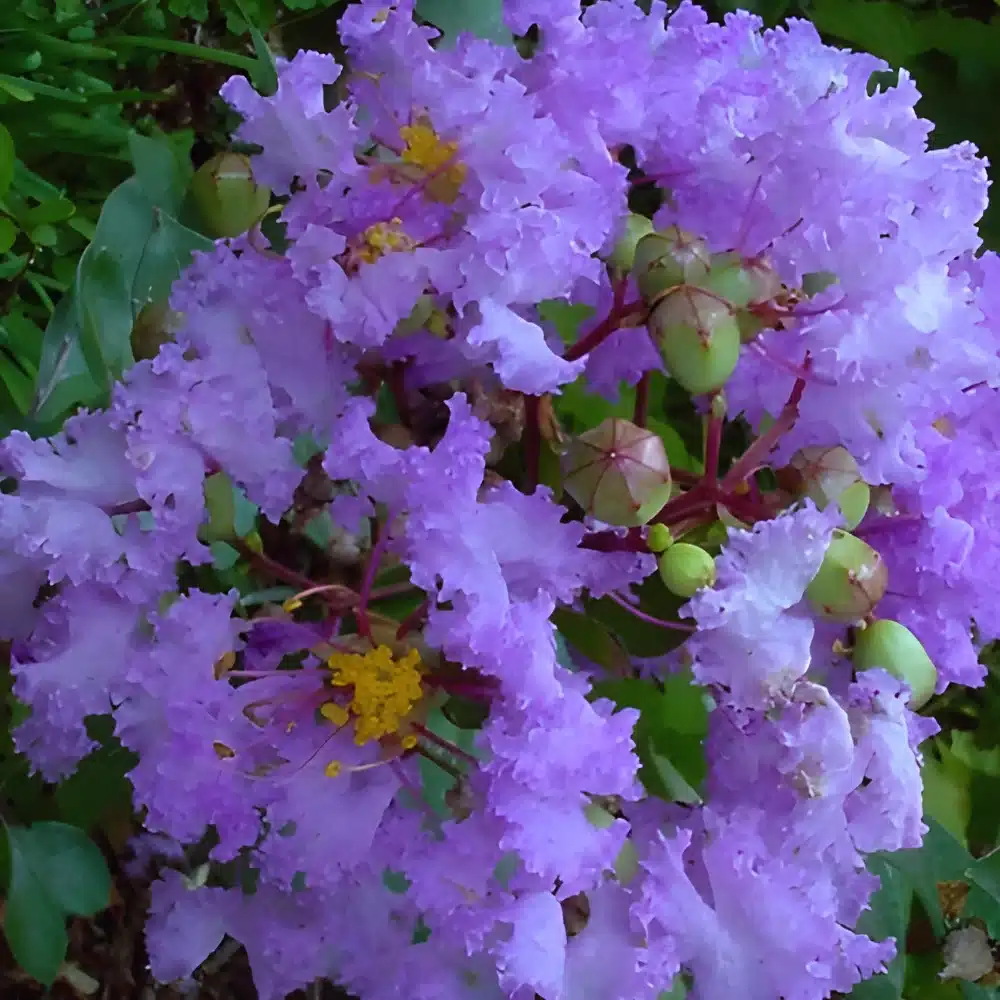
Lavender crape myrtle is the most sophisticated color option in the genus. While red and pink varieties dominate nursery shelves, the lavender and purple forms offer something different: a cooler, more complex palette that works across formal and informal garden styles and combines naturally with a wider range of companion plants.
There is no true blue crape myrtle. Lavender is as close as the genus gets — and the best lavender varieties get remarkably close. In early morning or evening light, the silvery undertones in Muskogee’s flowers shift toward a genuine blue-lavender that stops visitors in their tracks.
Tone | Varieties | Character |
|---|---|---|
Soft lavender / silver-lilac | Muskogee | Pale lavender with silvery-blue undertones. Closest to blue of any variety. |
Medium lavender / violet | Zuni, Caddo | Richer and more saturated than Muskogee. Versatile middle ground. |
Deep purple / violet | Catawba, Twilight | Clearly reads as purple in full sun. Classic intense purple, not lavender. |
Spec | Detail |
|---|---|
Height | 20–25 feet |
Width | 15–20 feet |
Bloom Color | Soft lavender / silver-lilac |
Bloom Period | Late May – October (up to 120 days) |
Hardiness Zones | 7–11 |
Origin | National Arboretum hybrid (L. indica × L. fauriei), Dr. Donald Egolf |
Disease Resistance | Excellent — among the most mildew-resistant large crape myrtles available |
Muskogee is the longest-blooming crape myrtle available, with flowers beginning as early as late May in zone 8 and continuing through October in warm years. The 16-inch flower panicles in soft lavender hold their color in humid heat without fading to pink — a problem with some lavender varieties.
Bark develops in shades of gray and soft orange as it matures. Fall foliage turns red-orange. Multi-trunk specimens show bark features dramatically in winter.
Best Landscape Uses — Muskogee
Not suited for: Small residential yards, foundation planting, or any space under 20 feet wide.
Spec | Detail |
|---|---|
Height | 10–12 feet |
Width | 8–10 feet |
Bloom Color | Medium lavender / violet |
Bloom Period | July – September (60–90 days) |
Hardiness Zones | 6–9 |
Origin | National Arboretum hybrid (L. indica × L. fauriei), Dr. Donald Egolf |
Disease Resistance | Good — fauriei parentage provides strong mildew resistance |
The most widely recommended compact lavender crape myrtle for residential landscapes where Muskogee would grow too large. Bloom color ranges from medium lavender to violet — richer in full sun, lighter in partial shade. Can be trained as a multi-stem shrub or small single-trunk tree.
Fall foliage turns orange, red, and bronze. Exfoliating bark reveals smooth patches of gray, tan, and cinnamon as the plant matures.
Zuni vs. Catawba: Both are medium-sized lavender/purple varieties. Zuni is smaller (10–12 ft) with lighter lavender color; Catawba grows 10–15 feet with deeper purple blooms and more dramatic fall color. If space is tight, Zuni fits better. If deep purple is the specific goal, Catawba delivers more intensity.
Spec | Detail |
|---|---|
Height | 10–15 feet |
Width | 8–12 feet |
Bloom Color | Deep purple / violet |
Bloom Period | July – September |
Hardiness Zones | 6–9 |
Introduced | 1967 — one of Dr. Egolf’s earliest National Arboretum releases |
Disease Resistance | Strong. Specifically cited for cercospora leaf spot resistance |
Catawba produces a genuine deep purple — darker and more saturated than Zuni or Muskogee. Fall foliage turns brilliant orange-red, among the strongest fall color of any crape myrtle variety. The bark develops to attractive gray-brown with clear exfoliation patterns. Best choice when rich purple is the design target.
Spec | Detail |
|---|---|
Height | 15–20 feet |
Width | 12–15 feet |
Bloom Color | Dark purple / indigo |
Bloom Period | July – September |
Hardiness Zones | 7–9 |
Growth Rate | Fast — 3–5 feet per year until maturity |
Twilight produces the darkest purple flowers of any widely available crape myrtle. The blooms shift toward indigo in certain light — a distinctive color that attracts attention in any landscape. Best suited to larger landscape spaces where its size can develop naturally.
Spec | Detail |
|---|---|
Height | 8–10 feet |
Width | 6–8 feet |
Bloom Color | Bright pink-lavender |
Bloom Period | July – September |
Hardiness Zones | 6–9 (specifically selected for cold hardiness) |
Selected for zone 6 performance. Bloom color sits between pink and lavender — warmer than Zuni, cooler than most pink varieties. One of the most reliable lavender-range options for transitional zone gardens.
Spec | Detail |
|---|---|
Height | 15–20 feet |
Width | 12–15 feet |
Bloom Color | Lavender |
Bloom Period | July – September |
Hardiness Zones | 7–9 |
A large, upright lavender variety with good disease resistance and attractive peeling bark. Useful as an alternative to Muskogee when a slightly different lavender tone is desired or when regional availability of Muskogee is limited.
All lavender crape myrtle varieties require full sun — minimum 6 hours daily, 7–8 hours preferred. In partial shade, flower production drops significantly, the lavender color becomes paler and less saturated, and susceptibility to powdery mildew increases.
Well-drained soil with pH 5.0–6.5. All lavender varieties tolerate a range of soil types as long as drainage is adequate. If soil tests alkaline (above 7.0), foliage may yellow — lower pH with sulfur or acidifying fertilizer.
Deep weekly watering for the first 2 growing seasons. All lavender varieties, once established, are drought-tolerant. Muskogee is particularly noted for its heat and drought tolerance — a key advantage through July and August in Southern gardens.
Balanced fertilizer (10-10-10) in early spring. Muskogee and other large varieties in fertile soil may need no supplemental fertilizer after the second year. If leaves appear pale or growth is minimal, a spring application addresses most deficiencies.
Variety | Zone Range | Notes |
|---|---|---|
Muskogee, Twilight, Byers Hardy Lavender | Zones 7–11 | Not reliable below zone 7 |
Zuni, Catawba, Caddo | Zone 6–9 | Need mulched roots in zone 6 |
Container-grown lavender varieties | Any zone | Move indoors before hard frost |
Same rule as all crape myrtles — never top them. Scale of pruning varies by variety:
What happens if you top a Muskogee: Multiple large wound points develop into clusters of weak narrow shoots each year. The natural vase shape is permanently compromised. Aggressive suckering from the roots increases. The tree never fully recovers its original form.
Design Style | Lavender Crape Myrtle Partner Plants | Effect |
|---|---|---|
High contrast | White-flowering plants (Natchez crape myrtle, white hydrangea, white Japanese anemone) | Crisp and elegant |
Warm-cool complementary | Yellow rudbeckia, black-eyed Susan, coreopsis | Most energetic color relationship on the wheel |
Silver-gray harmony | Russian sage, artemisia, lamb’s ear | Mediterranean palette — sophisticated and relaxed |
Ornamental grass pairing | Karl Foerster feather reed grass, blue oat grass | Vertical structure contrasts rounded canopy |
Formal allée | Matched Muskogee pairs, 8–10 ft apart | Lavender tunnel from May through October |
Against dark structures | Dark fencing, evergreen hedges | Bloom color appears more saturated against dark backgrounds |
Is there a true blue crape myrtle?
No. Muskogee is the closest available — its silvery lavender flowers read as blue-lavender in certain light — but no genuinely blue-flowered variety exists.
How long does Muskogee bloom?
Up to 120 days (4 months) in zones 8–10. In zone 7, expect 90–100 days. One of the longest-blooming crape myrtle varieties available.
Will lavender crape myrtle grow in zone 6?
Zuni, Catawba, and Caddo are reliable in zone 6 with root mulching. Muskogee is borderline — it may die back to the ground in harsh zone 6 winters but typically regenerates from the roots.
Do lavender crape myrtles grow as fast as other colors?
Growth rate depends more on variety size than color. Muskogee grows 3–5 feet per year. Zuni and Catawba grow at moderate rates of 1–2 feet per year until near maturity.
Can I grow lavender crape myrtle in a container?
Compact varieties (Zuni, Caddo) grow well in 25–30 gallon containers in full sun. Muskogee is too large for long-term container culture. In zones below 7, move containers to a protected location before hard frost.