Growing carrots comes down to three things: loose, rock-free soil, planting seeds at the right depth, and keeping the bed consistently moist while they germinate. Home gardeners across the US can get sweet, straight carrots in both spring and fall using basically the same process, just shifted to match local frost dates. Below is the full process, soil prep through storage, with the actual measurements and timing that make the difference between a good harvest and a bunch of forked, stubby roots.
When to Plant Carrots in the USA
Plant seeds two to three weeks before your last spring frost, or about ten weeks before the first fall frost. Carrots are a cool-season crop and handle a light frost far better than they handle summer heat. Gardeners in southern states often get two harvest windows a year. Up north, most people stick to one spring planting and a fall crop timed to finish before hard freezes set in.
USDA Hardiness Zones and Planting Windows
Planting dates shift by roughly two to four weeks per USDA hardiness zone. In Zone 9 or 10 (southern Florida, coastal California), you can sow as early as January and again in September. In Zone 4 or 5 (the Upper Midwest, New England), most gardeners wait until April for the spring crop and aim for a late-July sowing in fall. A quick check of a local frost date calculator against a zone map takes most of the guesswork out of it.
Spring vs. Fall Planting
Fall-planted carrots taste sweeter than spring ones. Cold soil pushes the plant to convert starches into sugars as a kind of natural antifreeze, and that concentrates flavor in the root. A gardener in Minnesota who sows in late July for an October harvest will usually notice a crisper, sweeter carrot than one pulled back in June. Spring plantings still give reliable yields and mature faster, since rising soil temperatures speed things along, but the flavor payoff isn’t quite the same.
How to Prepare Soil for Carrots
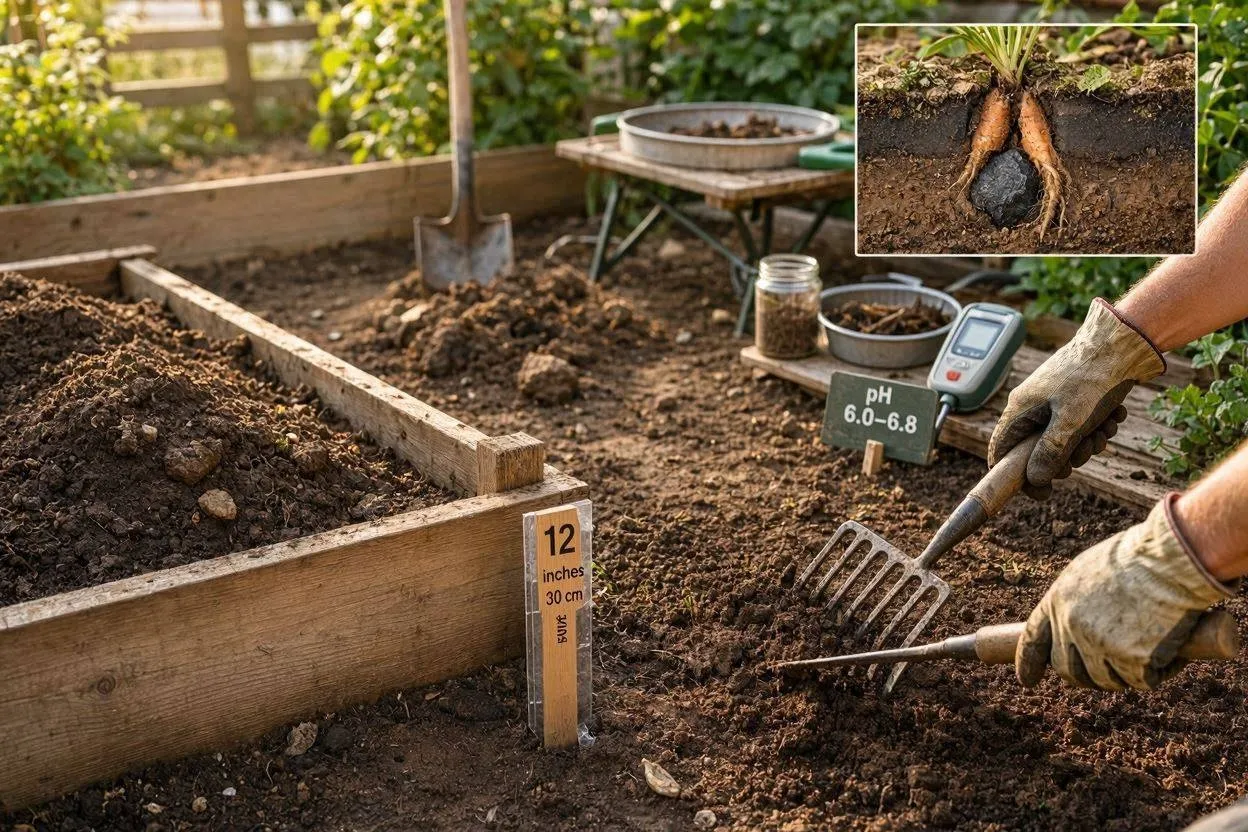
Carrots need loose, well-draining soil, free of rocks, sticks, and compacted clay, to a depth of at least 12 inches (30 cm). Hit an obstruction below the surface and the root splits, forks, or curls instead of growing straight down. If you’re working with heavy native soil, a raised bed or a deep container sidesteps the problem entirely.
Ideal Soil pH and Texture
Carrots do best in soil with a pH between 6.0 and 6.8. Outside that range, nutrient uptake suffers even if you’re fertilizing correctly. A soil test kit, usually under $15 at any garden center, will confirm pH before planting season starts. Work two to three inches (5 to 7.5 cm) of finished compost or well-rotted leaf mold into the top 10 to 12 inches of soil, ideally two weeks before sowing.
Fixing Heavy or Rocky Soil
Amend clay-heavy or rocky soil with coarse sand, perlite, or extra compost before you sow. Still compacted after amending? Build a raised bed at least 10 inches deep rather than spending months rehabilitating the existing soil. And skip fresh manure. It’s too high in nitrogen and tends to produce forked, hairy roots instead of one clean taproot.
How to Plant Carrot Seeds
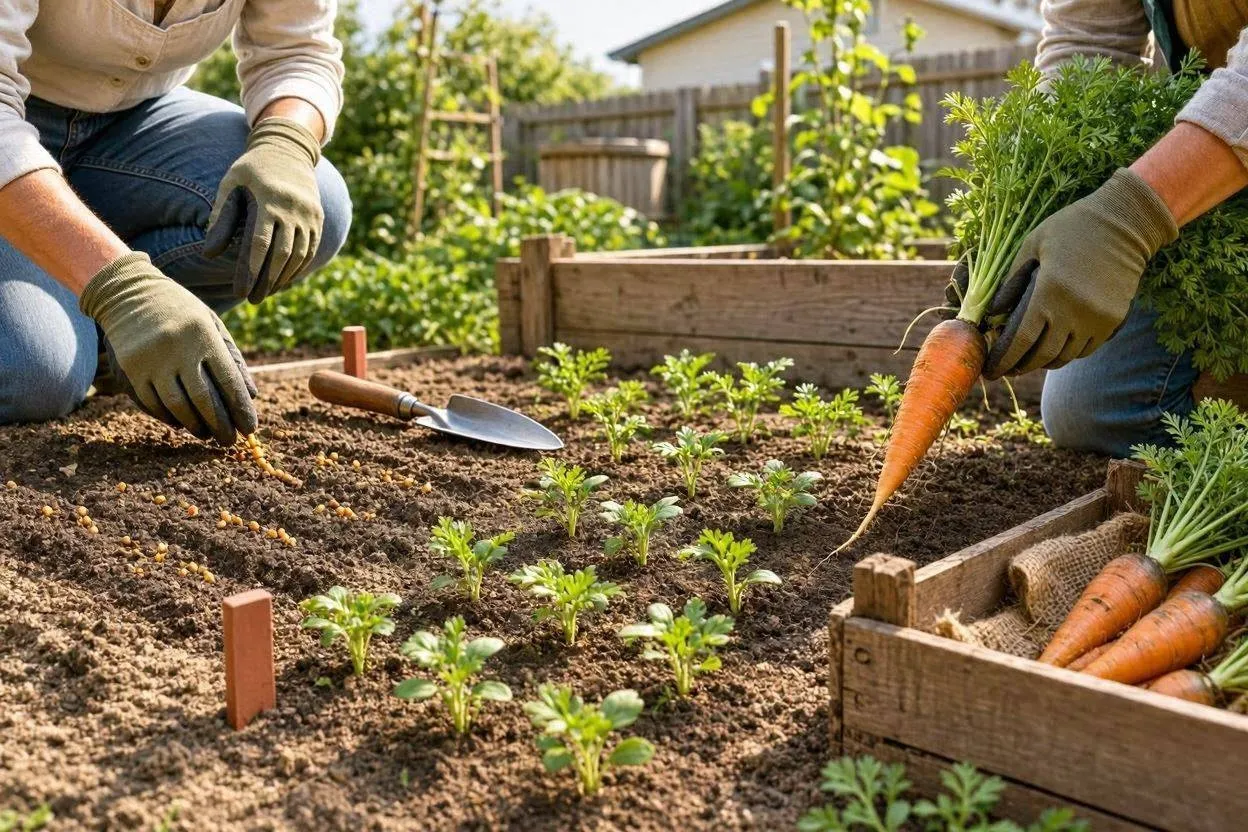
Sow seeds a quarter-inch deep (0.6 cm), about an inch apart, in rows spaced 12 to 18 inches apart. Carrot roots don’t tolerate transplanting, so seeds go straight into the garden bed rather than starting indoors. Since the seeds are roughly poppy-seed sized, a lot of gardeners switch to pelleted seed just to get more even spacing.
Seed Depth and Spacing
Plant 1/4 to 1/2 inch deep in average soil, up to 3/4 inch in sandy soil that dries out fast. The extra depth in sandy conditions protects the seed from drying out before it germinates. Spacing rows 12 to 18 inches apart leaves enough room for thinning and weeding without disturbing the roots next door.
Germination Temperature and Timing
Carrot seeds germinate best between 45°F and 85°F (7°C and 29°C), and germination slows sharply below 50°F. Expect seedlings in 14 to 21 days under average conditions, though warm, consistently moist soil can shrink that to closer to 10 days. A thin layer of straw mulch or burlap over the seedbed holds moisture during that slow stretch without blocking light once seedlings break through.
How to Thin Carrot Seedlings
Thin to a final spacing of 2 to 3 inches once seedlings reach about 2 inches tall. Crowded carrots compete for root space and end up thin, twisted, or stunted. Most gardeners thin in two rounds: an initial pass two weeks after germination to remove the weakest seedlings, then a second pass two weeks later to lock in final spacing. Snip unwanted seedlings at soil level with scissors rather than pulling them, so you don’t disturb the roots you’re keeping.
Watering Carrots Correctly
Water the seedbed daily, or close to it, to keep the top inch of soil consistently moist until germination finishes. Once seedlings are established, cut back to one inch (2.5 cm) of water a week. As roots mature and dig deeper, bump that up to 2 inches a week to prevent stress and premature bolting.
Deep, infrequent watering produces longer, straighter roots than shallow, frequent watering, since carrots grow downward chasing moisture. Shallow watering keeps roots near the surface, where they’re more prone to stunting and cracking whenever moisture swings suddenly.
Fertilizing Carrots
Once carrot tops reach 4 inches tall, apply a low-nitrogen, phosphorus-light fertilizer, side-dressed between the rows rather than directly on the plants. Too much nitrogen and you get lush green tops with weak root development. Too much phosphorus and roots split or throw out extra side shoots. A balanced organic fertilizer, or just an extra inch of compost worked into the row middles, is usually plenty for home garden soil.
Best Carrot Varieties for Home Gardens
| Variety | Root Length | Days to Maturity | Best For |
| Danvers | 6–8 inches | 65–75 days | Heavy or clay soil |
| Imperator | 7–8 inches | 70 days | Classic grocery-store shape |
| Bolero | 7–8 inches | 75 days | Disease resistance |
| Atlas | 1.5–2 inches | 70 days | Shallow or rocky soil |
| Dragon | 7 inches | 70–90 days | Purple skin, high lycopene content |
| Yellow Moon | 6–7 inches | 80 days | Yellow color variety |
| Thumbelina | Round, coin-sized | 60–70 days | Containers and small spaces |
Danvers and Bolero are good starting points for beginners since both tolerate imperfect soil. If you’re gardening in containers or a shallow raised bed where a long taproot has nowhere to go, Thumbelina and Atlas are the better fit.
Common Carrot Pests and Diseases
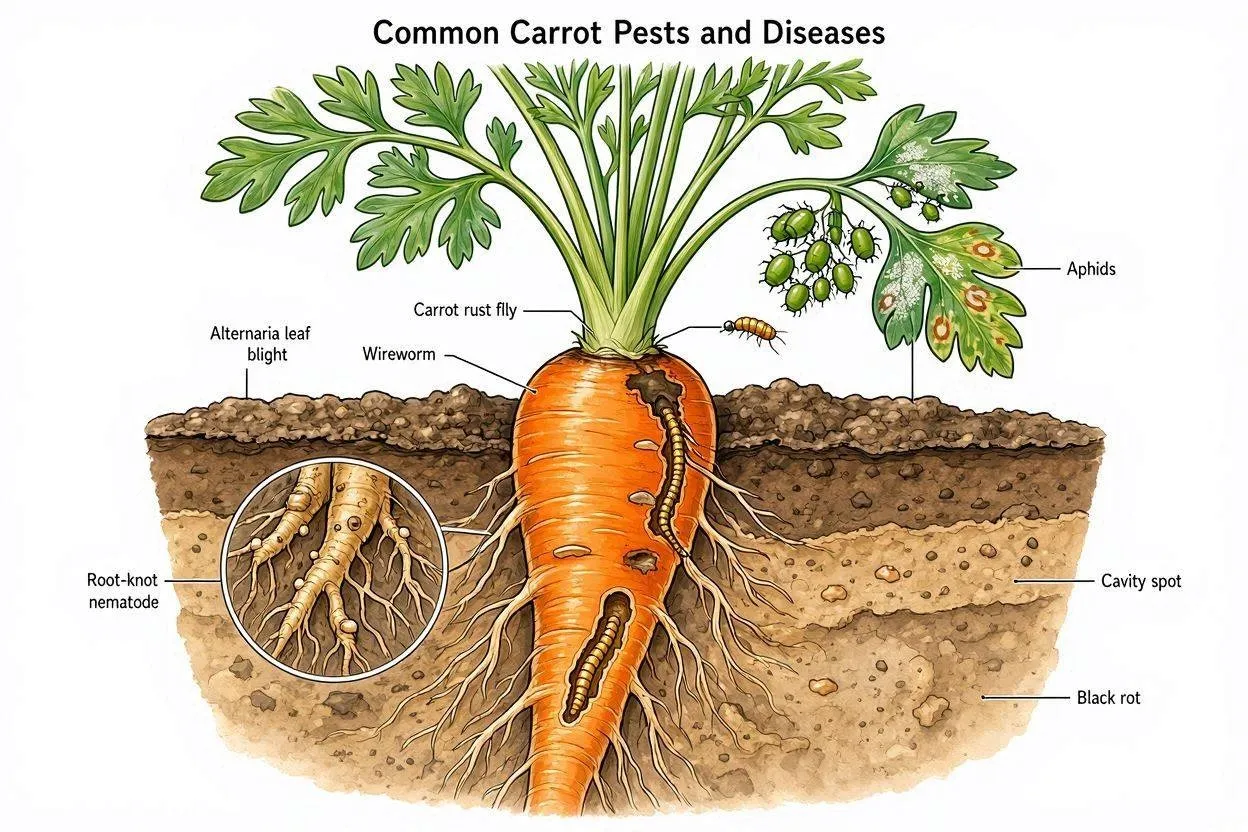
| Pest or Disease | Symptom | Control Method |
| Carrot rust fly | Tunneling maggots, mushy roots | Floating row cover from germination onward |
| Carrot weevil | Feeding damage on roots and foliage | Clear fall debris; apply beneficial nematodes |
| Flea beetles | Small shotholes in leaves | Row cover; trap crop of radishes nearby |
| Leafhoppers | Piercing damage, disease spread | Row cover throughout the growing season |
| Root-knot nematodes | Galls, forked or hairy roots | Crop rotation; interplant marigolds |
| Wireworms | Holes bored into roots | Potato-trap test before planting; soil turning |
| Black canker | Dark lesions on shoulders and crown | Crop rotation; remove infected plants promptly |
A floating row cover installed at germination handles most insect pressure in one step. Carrots don’t need pollinators, so the bed can stay covered for the whole season without costing you anything.
Why Carrots Split, Fork, or Grow Stunted
Split carrots usually come down to inconsistent watering. Forked carrots come from rocks, clumps, or compacted soil blocking the taproot. A heavy watering after a dry stretch makes the root expand faster than the skin can stretch, and it cracks open. Forking happens when the root tip hits an obstruction and splits around it instead of pushing straight down, which is exactly why clearing stones and breaking up compacted layers matters more than any fertilizer schedule ever will.
Stunted carrots usually trace back to overcrowding, too much nitrogen, or soil that’s too shallow for the variety you planted. If your soil depth tops out at 6 inches, a short variety like Atlas or Thumbelina will beat a longer variety like Imperator every time.
How to Harvest Carrots
Harvest within three weeks of reaching full maturity, once the shoulders (the top of the root, visible right at soil level) hit roughly 3/4 inch in diameter. If the ground is compacted, loosen it with a garden fork before pulling. Forcing a carrot out of hard soil usually just snaps it. Grab the base of the foliage close to the soil line when you pull, not higher up on the leaves, which tend to tear away from the root under pressure.
Carrots left in the ground through a light frost taste noticeably sweeter, since cold temperatures trigger more sugar storage in the root. In colder zones, a cold frame or a thick mulch layer can stretch the harvest window well past when temperatures start dropping.
How to Store Carrots After Harvest

Cut the tops back to within an inch of the root and store fresh carrots in the fridge crisper drawer for up to three weeks. Removing the tops right after harvest stops the greens from pulling moisture out of the root, which is what makes carrots go limp within days if you skip this step.
For longer storage, layer unwashed carrots in slightly damp sand inside a box or bin and keep it somewhere between 32°F and 40°F (0°C and 4°C), a root cellar or unheated garage works fine. Stored that way, carrots keep for four to six months. In regions where the soil doesn’t freeze solid, you can also just leave carrots in the ground all winter under a thick layer of straw mulch.
Companion Planting for Carrots
Plant carrots near onions, leeks, or chives to cut down on carrot rust fly pressure. The strong allium scent masks the smell that attracts the pest in the first place. Skip planting near dill, though, since it draws similar pests and can cross-pollinate if it’s allowed to flower nearby. Celery and lettuce make solid neighbors too, since they share similar watering needs without competing hard for root space.
Growing good carrots really just comes down to soil prep, steady moisture, and correct spacing at every stage. Gardeners who nail these three before worrying about fertilizer brands or specialty tools consistently end up with straighter, sweeter roots than those who jump straight to advanced techniques.
FAQs
How long does it take to grow carrots from seed?
Most varieties mature in 60 to 80 days from seeding, depending on the cultivar and soil temperature. Cooler fall conditions can stretch that out by a week or two compared to a spring planting.
Can carrots grow in containers?
Yes. Containers at least 12 inches deep work for most varieties, and shorter types like Thumbelina or Atlas do fine in containers as shallow as 6 to 8 inches.
Why are my carrots small and stunted?
Overcrowding, compacted soil, or too much nitrogen fertilizer are the usual culprits. Thinning to 2 to 3 inches apart and checking your soil depth solves it most of the time.
Do carrots need full sun?
Carrots do best with 6 to 8 hours of direct sunlight a day, though they’ll tolerate light afternoon shade in hot climates. Less than 4 hours of sun typically means weak, thin roots.
When should I plant carrots for a fall harvest?
Sow seeds about 10 weeks before the first expected fall frost. That gives roots enough time to mature before freezing temperatures stop growth.
Conclusion
Growing carrots from seed to harvest takes some patience during germination and some precision during soil prep, but the process itself is predictable: loosen the soil to at least 12 inches, sow seeds a quarter-inch deep, thin to 2 to 3 inches apart, and water deeply rather than often. Stick to USDA zone-appropriate timing, pick a variety suited to your soil depth, and you’ll avoid most of the split, forked, and stunted roots that trip up beginners. Check twice a season for pests and moisture, and a well-planned carrot bed will deliver a reliable harvest in both spring and fall almost anywhere in the country.