Austin Watering Schedule is not optional — it is regulated by Austin Water year-round. Water too much or on the wrong day, and fines start at $75 per violation. Water too little in 100°F (38°C) Central Texas summers, and Bermuda goes dormant and St. Augustine develops take-all root rot within 2 weeks.
This guide covers current Austin Water restrictions, your assigned watering day by address, watering schedules by grass type across all 4 seasons, and exactly how to keep a lawn alive under restriction limits.
| Current Restriction Status (May 2026) Austin is under Conservation Stage Water Use Restrictions as of September 2, 2025. Automatic irrigation systems: 1 day per week. Hose-end sprinklers and drip irrigation: 2 days per week. Allowed hours: Midnight to 10:00 AM and 7:00 PM to Midnight. No watering between 10:00 AM and 7:00 PM. Source: austintexas.gov |
Austin Water Restrictions 2026: What You Need to Know
Austin Water manages outdoor irrigation through a tiered Drought Contingency Plan (DCP). The city moves between stages based on combined storage levels in Lakes Travis and Buchanan — the two Highland Lakes that supply Austin’s water.
Current Stage: Conservation
As of September 2, 2025, Austin returned to Conservation Stage after heavy July 2025 rains replenished Highland Lakes. As of late April 2026, Lake Buchanan sits at 96.5% full and Lake Travis at 73.5% full — combined storage near 1.64 million acre-feet, above the 1.4 million acre-foot threshold that triggers Stage 1.
All Drought Stages at a Glance
| Stage | Trigger | Irrigation Allowed | Hours | Fines |
| Conservation | Normal baseline | Auto systems: 1 day/wk | Drip/hose: 2 days/wk | Midnight–10 AM, 7 PM–Midnight | $0 (currently active) |
| Stage 1 | Lakes below 1.4M acre-ft | Auto systems: 1 day/wk | Drip/hose: 2 days/wk | Midnight–10 AM, 7 PM–Midnight | $75–$500 |
| Stage 2 | Lakes below 1.2M acre-ft | Auto systems: 1 day/wk only | Drip: 1 day/wk | Midnight–10 AM, 7 PM–Midnight | $75–$1,000 |
| Stage 3 | Lakes below 0.9M acre-ft | Auto systems: 1 day/2 weeks | Drip: 1 day/wk | 7 PM–Midnight only | $200–$1,000 |
| Stage 4 | Emergency | Outdoor irrigation banned | None allowed | Up to $1,000/day |
| Monitor Lake Levels Check current Highland Lake levels at lcra.org or austintexas.gov/water before setting irrigation schedules. Levels can shift after heavy rain or extended drought within days. Austin moved from Stage 2 to Conservation Stage in under 2 weeks in September 2025 after significant rainfall. |
What Is Exempt from Austin Water Restrictions
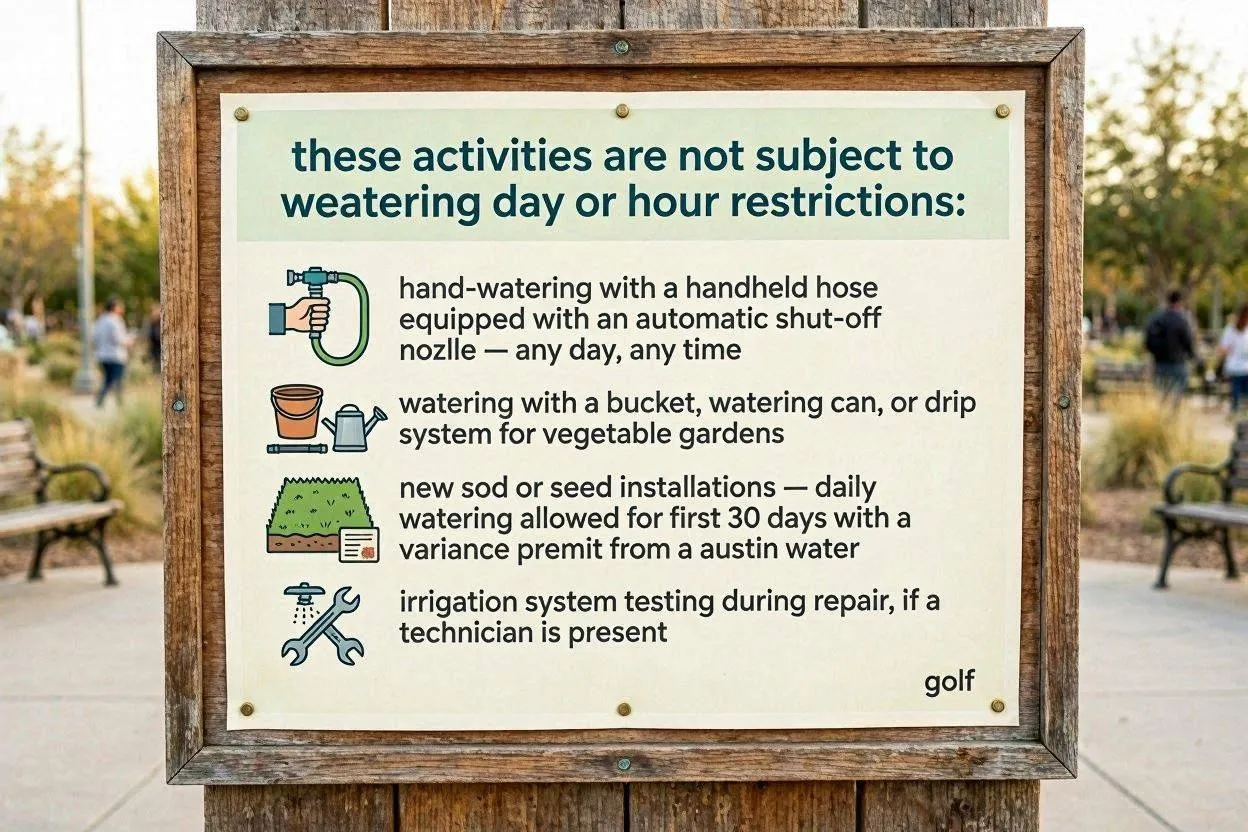
These activities are not subject to watering day or hour restrictions:
- Hand-watering with a handheld hose equipped with an automatic shut-off nozzle — any day, any time
- Watering with a bucket, watering can, or drip system for vegetable gardens
- New sod or seed installations — daily watering allowed for first 30 days with a variance permit from Austin Water
- Irrigation system testing during repair, if a technician is present
- Golf course tees and greens — every other day with notice to Austin Water
Your Austin Watering Day by Address
Austin assigns watering days based on the last digit of your street address. This system distributes citywide water demand evenly across the week and prevents peak-load pressure drops in the distribution system.
Residential Watering Day Schedule
| Address Type | Assigned Watering Day | Allowed Hours |
| Odd address (ends in 1, 3, 5, 7, 9) | Friday | Midnight–10:00 AM and 7:00 PM–Midnight |
| Even address (ends in 0, 2, 4, 6, 8) | Tuesday | Midnight–10:00 AM and 7:00 PM–Midnight |
Under Conservation Stage, automatic irrigation systems are limited to 1 day per week on your assigned day. Hose-end sprinklers and drip irrigation are allowed on 2 days per week — your assigned day plus one additional day of your choice — within the same allowed hours.
| How to Check Your Day Visit austintexas.gov/water/find-your-watering-day and enter your address for confirmation. Some properties in MUD (Municipal Utility District) areas — such as West Travis County PUA or North Austin MUD — have different schedules. Always check with your specific utility provider. |
Fines for Violating Austin Watering Rules
Austin Water staff patrol neighborhoods and respond to 3-1-1 complaints. Watering outside your assigned day or outside allowed hours — even by minutes — is a citable violation. Residential fines start at $75 per violation and escalate with each subsequent offense. Commercial fines start at $250. Violations are reportable via the 3-1-1 mobile app or by calling 311.
Best Grass Types for Austin Lawns and Their Water Needs
Austin sits in USDA Plant Hardiness Zone 8b-9a. Average summer highs exceed 95°F (35°C) regularly, and the city receives about 34 inches (864 mm) of rainfall per year — but rainfall arrives unevenly in spring storms and occasional fall showers, not as steady summer moisture. The 4 dominant grass types in Austin each handle these conditions differently.
Bermuda Grass — Best for Full Sun
Bermuda grass is the most drought-tolerant warm-season grass in Austin. TifTuf and Celebration Bermuda are the top varieties for Central Texas — both handle extreme heat with lower water needs than St. Augustine. Bermuda requires 6-8 hours of direct sun daily. In shade, Bermuda thins and weakens within 1-2 seasons.
- Mowing height: 1-2 inches (2.5-5 cm) during warm season.
- Water need: 0.75-1.0 inch (19-25 mm) per week in summer. Every 5-7 days with deep watering.
- Drought response: Goes dormant and turns tan — recovers fully when watering resumes. Does not die from short-term drought.
- Under restriction: Performs best on 1 deep session per week. Deeper roots than St. Augustine allow longer intervals.
St. Augustine Grass — Best for Shade
St. Augustine is the only warm-season grass that genuinely tolerates shade in Austin. Palmetto and Raleigh are the recommended cultivars for Central Texas. St. Augustine needs more water than Bermuda — it is more vulnerable to chinch bugs, fungal disease (particularly take-all root rot), and heat stress when underwatered.
- Mowing height: 2.5-3 inches (6.4-7.6 cm). Shaded St. Augustine benefits from 3-4 inch (7.6-10 cm) height.
- Water need: 1.0-1.5 inches (25-38 mm) per week in summer. More frequent watering in sandy soil.
- Drought response: Goes dormant and turns brown. Recovers when watered but is more slow to recover than Bermuda.
- Under restriction: Struggles most on 1-day-per-week restrictions during extreme heat. Apply the full allowed water volume in one deep session.
Zoysia Grass — Best for Low Maintenance
Zoysia — particularly Palisades and Empire varieties — produces a dense, carpet-like lawn with good heat, shade, and drought tolerance. Zoysia grows slower than St. Augustine and Bermuda, which means less mowing but slower recovery from damage. Zeon Zoysia is the only fine-bladed variety that tolerates shade.
- Mowing height: 1.5-2.5 inches (3.8-6.4 cm).
- Water need: 0.75-1.0 inch (19-25 mm) per week — less than St. Augustine, similar to Bermuda.
- Drought response: Tolerates drought better than St. Augustine. Slow to go fully dormant — one of the last warm-season grasses to turn brown in fall.
- Under restriction: Handles 1-day-per-week watering well. Good choice for properties with tight water restrictions.
Buffalo Grass — Best for Ultra-Low Water
Buffalo grass is a Texas native and the most drought-tolerant lawn option available in Austin. It needs 50-60% less water than Bermuda or St. Augustine. The tradeoff: it does not produce the dense, lush appearance of other warm-season grasses and is not suited for high-traffic areas.
- Mowing height: 2-4 inches (5-10 cm). Can be left unmowed for a natural meadow appearance.
- Water need: 0.5 inch (13 mm) per week or less. Native to Texas, it survives on rainfall alone in non-drought years.
- Under restriction: Performs fine on restriction schedules with no supplemental watering in most seasons.
Quick Reference: Austin Grass Water Requirements
| Grass Type | Weekly Water Need | Deep Water Interval | Run Time (Rotary Head) | Drought Tolerance |
| Bermuda (TifTuf/Celebration) | 0.75–1.0 in (19-25 mm) | Every 5–7 days | 2.5–3 hrs | High |
| St. Augustine (Palmetto/Raleigh) | 1.0–1.5 in (25-38 mm) | Every 4–5 days | 3–4 hrs | Medium |
| Zoysia (Palisades/Empire) | 0.75–1.0 in (19-25 mm) | Every 5–7 days | 2.5–3 hrs | High |
| Buffalo Grass | 0.25–0.5 in (6-13 mm) | Every 10–14 days | 1–1.5 hrs | Very High |
Austin Lawn Watering Schedule by Season
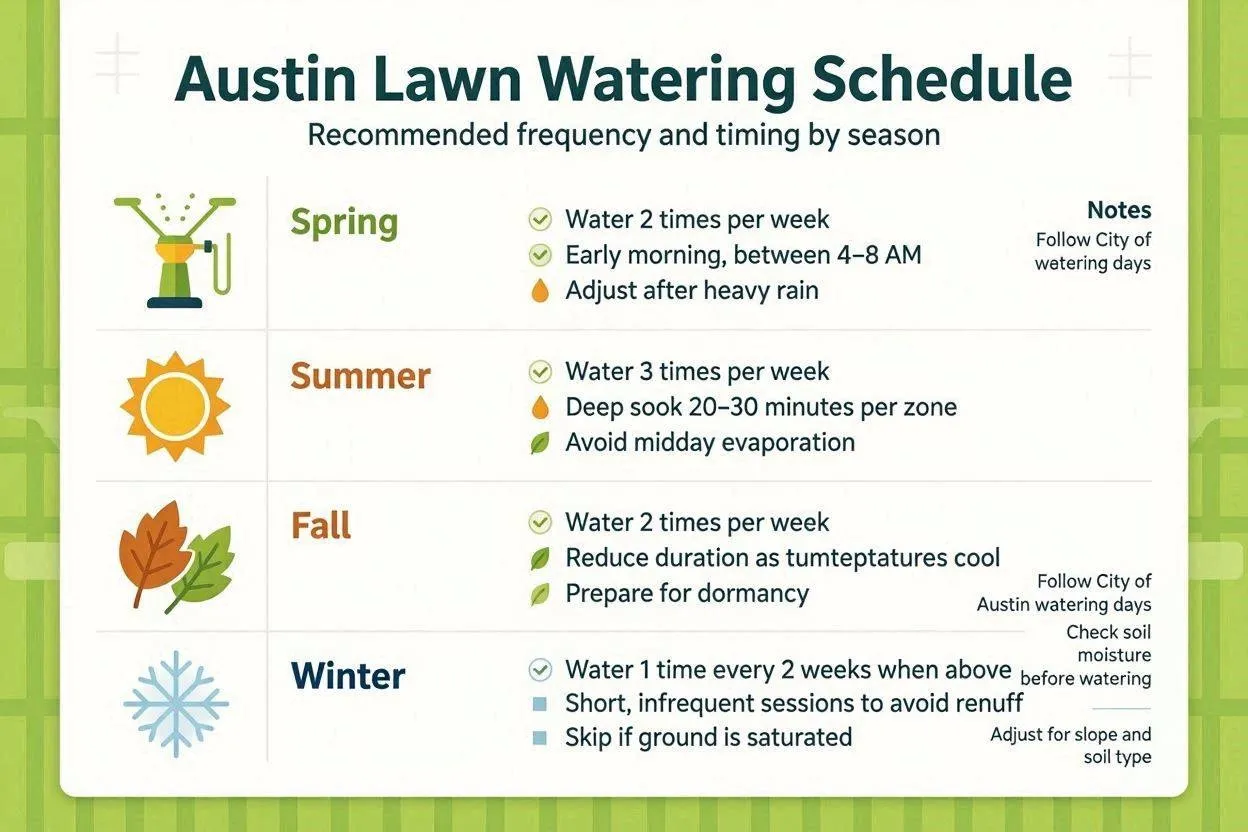
Austin’s climate creates 4 distinct lawn care seasons. Spring and fall offer the best growing conditions. Summer requires careful management under restrictions. Winter brings dormancy for all warm-season grasses.
Spring Watering Schedule (March – May)
Spring is Austin’s most unpredictable season. Heavy rainstorms can deliver 2-3 inches (50-75 mm) in a single day, followed by 3 weeks of no rainfall. Check rainfall totals weekly before running irrigation.
- March: Most warm-season grasses are still coming out of dormancy. Water once per week at 0.5 inch (13 mm) to encourage green-up. Do not fertilize until grass reaches 50% green coverage.
- April: Supplement rainfall only when weekly total drops below 0.75 inch (19 mm). Bermuda needs 1 inch (25 mm) per week once actively growing. St. Augustine needs 1-1.25 inches (25-32 mm).
- May: Water demand increases as temperatures climb above 80°F (27°C). Water your full allowed volume on your assigned watering day. Check soil moisture at 3-inch (7.6 cm) depth before irrigating.
| Spring Pest Alert Chinch bugs attack St. Augustine in late spring. They cause irregular yellow-brown patches that spread outward from hot, dry areas of the lawn. Inspect weekly from April onward. Early detection prevents lawn-wide damage that requires weeks of recovery. |
Summer Watering Schedule (June – September)
Austin’s summers are the hardest test for any lawn. Temperatures exceed 100°F (38°C) for weeks at a time. Evapotranspiration (ET) rates are among the highest in the continental United States during July and August. Under 1-day-per-week restrictions, maximize each session.
- Water your full allowed volume in one session. Apply 1-1.5 inches (25-38 mm) in a single session to push water 6-8 inches (15-20 cm) deep. This is more effective than splitting a smaller amount across two sessions.
- Water as close to midnight as possible. Austin’s allowed window starts at midnight. Watering at 12:00 AM on your assigned day minimizes evaporation loss that increases with rising temperatures after sunrise.
- Accept dormancy in extreme heat. When temperatures stay above 100°F (38°C) for more than 2 weeks without rain, all warm-season grasses will partially or fully go dormant regardless of watering. Dormant grass is alive — water enough to prevent permanent death (0.5 inch / 13 mm per week minimum), not to maintain color.
- Do not fertilize in summer. Fertilizer applied during extreme Texas heat burns grass roots and worsens drought stress. Fertilize in fall (September-October) and spring (April-May) only.
- Mow higher in summer. Raise mowing height by 0.5 inch (13 mm) above normal. Taller grass shades the soil, reduces evaporation, and recovers from heat stress faster.
Fall Watering Schedule (October – November)
Fall is the best recovery season for Austin lawns. Temperatures drop, rainfall increases, and warm-season grasses actively repair summer damage. Water restrictions remain in effect at Conservation Stage levels, but natural rainfall often supplements adequately.
- October: Water once per week on your assigned day at 0.75-1.0 inch (19-25 mm). St. Augustine and Zoysia repair summer damage most aggressively in this window. This is the ideal month to apply fertilizer — a slow-release product with balanced NPK ratio prepares grass for winter.
- November: Reduce to once every 10-14 days as temperatures drop below 65°F (18°C). Bermuda begins dormancy first, followed by St. Augustine, then Zoysia. Buffalo grass may stay green until December.
- Overseeding with ryegrass: Some Austin homeowners overseed with annual ryegrass in October for winter color. Ryegrass needs daily misting for 10-14 days to germinate, which requires a new sod/seed variance permit from Austin Water.
Winter Watering Schedule (December – February)
All warm-season grasses in Austin go dormant by December. Brown dormant grass is normal — it is not dead. Dormancy protects grass from freeze damage.
- December – February: Water once every 3-4 weeks at 0.5 inch (13 mm) only during dry spells exceeding 4 weeks. Austin’s mild winters (rarely below 28°F / -2°C) mean soil does not freeze, so occasional deep watering prevents desiccation of dormant root systems.
- Freeze preparation: Water deeply 1-2 days before a forecast hard freeze below 28°F (-2°C). Moist soil retains heat better than dry soil and protects roots from freeze damage.
- Do not fertilize: Winter fertilization on dormant grass promotes weak, frost-susceptible growth. Resume in spring when grass reaches 50% green coverage.
Austin Seasonal Watering Quick Reference
| Month | Water Volume | Frequency | Notes |
| March | 0.5 in (13 mm)/wk | 1x/week | Coming out of dormancy — minimal water |
| April | 0.75–1.0 in (19-25 mm)/wk | 1x/week | Supplement only when rainfall below 0.75 in |
| May | 1.0–1.25 in (25-32 mm)/wk | 1x/week (full volume) | Check soil at 3 in depth before irrigating |
| June | 1.0–1.5 in (25-38 mm)/wk | 1x/week (full volume) | Heat rising — water at midnight on assigned day |
| July | 1.25–1.5 in (32-38 mm)/wk | 1x/week (max allowed) | Extreme heat — accept partial dormancy |
| August | 1.25–1.5 in (32-38 mm)/wk | 1x/week (max allowed) | Hottest month — minimum 0.5 in to prevent death |
| September | 1.0–1.25 in (25-32 mm)/wk | 1x/week | Temperatures dropping — recovery begins |
| October | 0.75–1.0 in (19-25 mm)/wk | 1x/week | Best recovery month — fertilize this month |
| November | 0.5 in (13 mm)/wk | Every 10–14 days | Grasses entering dormancy |
| December–February | 0.5 in (13 mm) | Every 3–4 weeks only | Dormant — water only in dry spells |
How to Set Your Sprinkler System for Austin Restrictions
Getting maximum water into the soil from one weekly session requires correct sprinkler settings. Most Austin residential zones use rotary heads (0.4-0.5 inch / 10-13 mm per hour) or fixed spray heads (1.0-1.5 inch / 25-38 mm per hour).
Calculating Run Time for Austin Restrictions
To deliver 1 inch (25 mm) of water with a rotary head sprinkler (0.5 inch/hr rate): 1 / 0.5 = 2 hours per zone. For a fixed spray head (1.5 inch/hr rate): 1 / 1.5 = 40 minutes per zone.
Austin lawns typically have 3-6 irrigation zones. Start each zone at midnight on your assigned day and run consecutive zones through the allowed morning window. A 4-zone lawn with rotary heads needs approximately 8 hours of total run time to deliver 1 inch per zone — well within the midnight-to-10 AM window.
Splitting Sessions to Reduce Runoff
Austin’s limestone-heavy clay soil absorbs water at approximately 0.2-0.3 inch (5-7.6 mm) per hour. Fixed spray heads applying 1.5 inches per hour will produce runoff within 15-20 minutes on compacted clay. To prevent waste and comply with restrictions, use a cycle-and-soak method: run each zone for 10-15 minutes, pause for 30 minutes, then run again. This stays within your single assigned session.
Smart Controller Settings for Austin
Program smart controllers with Austin’s ET-based data to automatically adjust run times as temperatures change through summer. Set the controller to:
- Watering day: Your assigned address day only (Tuesday or Friday for most residents).
- Start time: Midnight (12:00 AM) to maximize the allowed morning window.
- Rain sensor threshold: 0.25 inch (6 mm) — skip irrigation after any rainfall above this amount.
- Seasonal adjust: 60-70% in spring and fall, 100% in summer, 20-30% in winter.
Austin Water offers rebates for smart irrigation controllers that are EPA WaterSense certified. Visit austintexas.gov/water for current rebate amounts. For additional water-saving guidance tailored to Central Texas gardens and landscapes, visit ZonedGarden.com.
Signs Your Austin Lawn Is Underwatered or Overwatered
Signs of Underwatering in Austin’s Heat
- Footprint test: Walk across the lawn in the morning. Footprints that remain visible after 30 seconds indicate drought stress. The grass blades lack the turgor pressure to spring back.
- Blue-gray color shift: Bermuda and St. Augustine both develop a silver-blue tint before going fully dormant. This is the first visible sign of water stress — act within 1-2 days before dormancy sets in.
- Wilting and blade rolling: St. Augustine leaves fold lengthwise. Bermuda lies flat. Both reduce surface area to conserve moisture.
- Dry soil below 2 inches (5 cm): Push a screwdriver into the lawn. Resistance before 3 inches (7.6 cm) means the root zone is dry. After proper deep watering, a screwdriver should penetrate 6 inches (15 cm) easily.
Signs of Overwatering
- Fungal disease patches: Dollar spot (silver-dollar-sized circles), brown patch (large irregular rings with dark borders), and take-all root rot (yellowing that spreads from one point) all develop in excessively wet conditions. Austin’s summer humidity worsens fungal spread when grass stays wet.
- Chinch bug multiplication: Overwatered St. Augustine lawns create ideal conditions for chinch bugs. Water-stressed St. Augustine also attracts chinch bugs. The target is consistent moisture — not too wet, not too dry.
- Runoff during irrigation: Water sheeting off the lawn instead of absorbing indicates soil saturation or excessive application rate. Use cycle-and-soak instead of one continuous run.
- Thatch buildup: Excess moisture accelerates thatch accumulation above the 0.5 inch (13 mm) threshold. Thatch above 0.75 inch (19 mm) blocks water from reaching roots — exactly the opposite of the intended effect.
Watering New Sod and New Seed in Austin
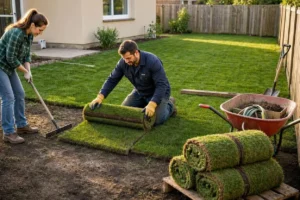
New sod and newly seeded lawns require a variance permit from Austin Water before installation. Once approved, daily watering is allowed for the first 30 days.
New Sod Watering Schedule
- Days 1-7: Water daily for 20-30 minutes per zone. Sod must stay consistently moist at 4-inch (10 cm) depth to establish contact with soil and begin rooting. Lift a corner every 3 days — rooted sod resists pulling.
- Days 8-14: Reduce to every other day if rooting is progressing. Soil at 4 inches (10 cm) should feel moist but not waterlogged.
- Days 15-30: Water every 2-3 days, increasing session length to deliver 0.75-1.0 inch (19-25 mm) per session.
- After 30 days: Transition to the standard Austin restriction schedule — 1 day per week on your assigned day.
- Best installation months: April-June for Bermuda, Zoysia, and St. Augustine. Avoid installing sod in July and August — summer heat makes establishment much harder and riskier.
New Seed Watering Schedule
Bermuda grass from seed is the most common option for Austin homeowners seeding a new lawn. St. Augustine is not available from seed.
- Days 1-14 (germination): Mist 2-3 times daily for 5-10 minutes per session. Keep top 1 inch (25 mm) consistently moist. Use a fine mist — jet spray displaces seeds.
- Days 15-30 (establishment): Once germination is visible, reduce to once daily. Increase session depth to keep 2 inches (5 cm) moist.
- After first mow: Bermuda reaches mowing height at 3 inches (7.6 cm) — typically 4-6 weeks from seeding in warm conditions. Switch to the established lawn schedule after the first mow.
Water Conservation Tips for Austin Lawns
Austin Water offers rebates, incentives, and free resources for water-efficient landscaping. These 6 practices reduce water use without sacrificing lawn health.
- Mow high: Raise mowing height by 0.5 inch (13 mm) above the minimum for your grass type. Taller grass shades soil and reduces evaporation by 20-25%. Bermuda at 2 inches vs. 1 inch: measurably lower water loss.
- Mulch clippings: Leave mowed clippings on the lawn. They decompose in 3-5 days and return nitrogen and moisture to the soil. Mulched lawns need 20-25% less supplemental irrigation.
- Aerate in fall: Core aeration in September-October removes plugs of compacted Austin clay, improving water penetration by 30-40%. Compacted clay causes runoff even at low application rates.
- Install a rain sensor: A basic rain sensor (cost: $15-40 / roughly £12-32) skips scheduled irrigation after 0.25 inch (6 mm) of rainfall. Required by Texas law on all new automatic irrigation systems installed after September 2009.
- Apply a wetting agent: Austin’s limestone-heavy soil can become hydrophobic — water beads and runs off instead of absorbing. A soil wetting agent (liquid or granular) applied in spring and summer improves water penetration in affected areas. A few drops of Dawn dish soap diluted in water works as a short-term alternative.
- Collect rainwater: A 50-gallon (189-liter) rain barrel connected to a roof downspout provides free supplemental water exempt from watering restrictions. Hand-watering from a rain barrel with a handheld hose is allowed any time.
Austin Lawn Troubleshooting: Brown Spots and Dry Patches
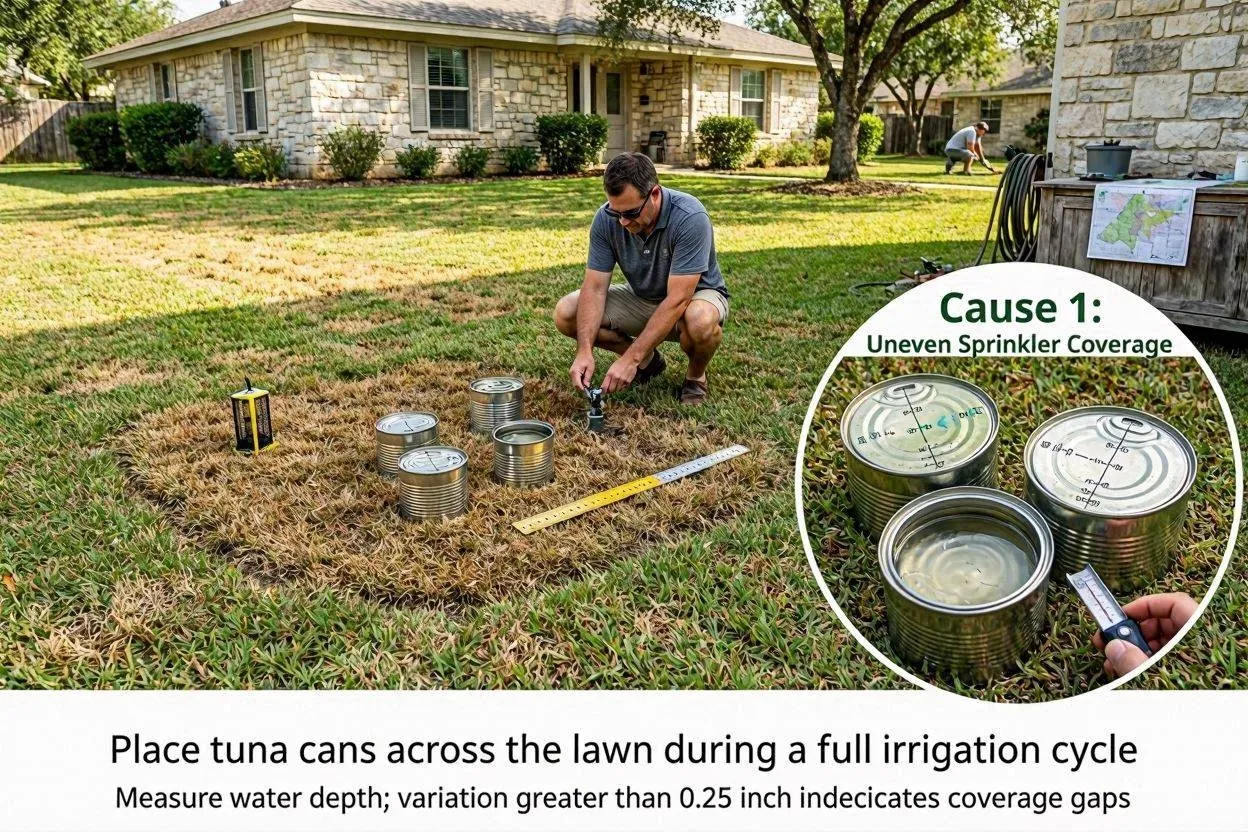
Brown patches in Austin lawns have 5 common causes — not all are watering-related.
Cause 1: Uneven Sprinkler Coverage
Place tuna cans across the lawn during a full irrigation cycle. Measure water depth in each can. Depth variation of more than 0.25 inch (6 mm) between cans indicates coverage gaps. Adjust sprinkler heads to eliminate dry zones before increasing overall water volume.
Cause 2: Chinch Bug Damage
Chinch bugs in St. Augustine create irregular yellow-to-brown patches that spread outward from hot, dry spots near driveways and sidewalks. Confirm: part the grass in an affected area and look for 1-2mm black and white insects near the soil surface. Treatment: bifenthrin or permethrin-based insecticide applied in the morning.
Cause 3: Take-All Root Rot
Take-all root rot causes yellowing that spreads outward, often appearing after wet spring conditions followed by summer heat. Infected St. Augustine roots are black and rotted. Treatment: peat moss applied at 1 inch (25 mm) depth across affected areas plus improved drainage. No fungicide completely eliminates take-all once established.
Cause 4: Soil Compaction or Thatch
Heavy foot traffic and clay soil compact over time, preventing water from reaching roots even during irrigation. Test: pour 1 cup (240 ml) of water in a dry spot. If it pools instead of absorbing within 30 seconds, the soil is compacted. Fix: core aeration in fall followed by top-dressing with compost.
Cause 5: Pet Damage
Dog urine creates circular brown spots with a green ring around the edge — the high nitrogen in urine burns grass at the center but fertilizes the perimeter. Fix: flush affected areas immediately with 1 gallon (3.8 liters) of water. Reseed or re-sod the dead center once flushed.
For detailed guides on diagnosing and fixing specific lawn and plant problems, visit ZonedGarden’s plant care guides at zonedgarden.com. The diagnostic methods for root rot, pest damage, and soil problems are consistent across turf and ornamental plants.
Frequently Asked Questions
What is the current Austin watering schedule for 2026?
Austin is under Conservation Stage Water Use Restrictions as of September 2, 2025. Automatic irrigation systems are limited to 1 day per week on your assigned address day (odd addresses: Friday, even addresses: Tuesday), during the hours of midnight to 10:00 AM or 7:00 PM to midnight. Hose-end sprinklers and drip irrigation are allowed 2 days per week within the same hours.
What are the watering hours in Austin?
Irrigation is allowed from midnight to 10:00 AM and from 7:00 PM to midnight — any watering between 10:00 AM and 7:00 PM is a violation under current Conservation Stage restrictions. The best time to start is midnight to maximize the allowed morning window and minimize evaporation.
What day can I water in Austin?
Your watering day depends on your street address last digit. Odd-numbered addresses (ending in 1, 3, 5, 7, or 9) water on Friday. Even-numbered addresses (ending in 0, 2, 4, 6, or 8) water on Tuesday. Verify your address at austintexas.gov/water/find-your-watering-day. Properties served by MUD utilities may have different assigned days.
How much water does a Bermuda lawn need in Austin’s summer?
Bermuda grass in Austin needs 0.75-1.0 inch (19-25 mm) per week in summer. Under 1-day-per-week restrictions, apply the full 1 inch in one deep session starting at midnight on your assigned day. Bermuda can tolerate going dormant during extreme heat — it recovers when watering resumes.
Can I water my Austin lawn every day?
No. Under current Conservation Stage restrictions, automatic irrigation systems are limited to 1 day per week. Hand-watering with a handheld hose equipped with an automatic shut-off nozzle is allowed any day, any time. Drip irrigation and hose-end sprinklers are allowed 2 days per week.
What happens if I water on the wrong day in Austin?
Austin Water staff patrol and respond to 3-1-1 complaints. Watering outside your assigned day is a citable violation. Residential fines start at $75 per violation and increase with each subsequent offense. Commercial fines start at $250. Violations are not waived for first-time offenders.
How do I water new sod in Austin under restrictions?
New sod installations require a variance permit from Austin Water before installation. Once approved, daily watering is allowed for the first 30 days. Water new sod daily for 20-30 minutes per zone during the first week, reducing frequency as rooting establishes. After 30 days, transition to the standard 1-day-per-week schedule.
What is the best grass for Austin under water restrictions?
Bermuda grass (TifTuf or Celebration varieties) is the best choice for full-sun Austin lawns under water restrictions. It needs less water than St. Augustine, handles dormancy and recovery better, and performs well on 1-day-per-week irrigation. For shaded areas, Zoysia (Palisades or Empire) is the second-best option. St. Augustine works but requires more water and is more vulnerable to heat stress under restrictions.
Conclusion
Austin’s lawn watering schedule is shaped by 3 realities that don’t change: a hot, dry climate, a regulated water supply from Highland Lakes, and warm-season grasses that need consistent deep watering to stay healthy.
Work within the current Conservation Stage restrictions — 1 day per week for automatic systems, midnight to 10:00 AM on your assigned address day — by maximizing the volume delivered in each session. One deep watering of 1-1.5 inches (25-38 mm) beats 3 shallow sprinkles every time, especially for Bermuda and Zoysia roots that extend 6-8 inches (15-20 cm) into Austin’s limestone soil.