Plant types describe how a plant grows, how long it lives, and what role it plays in an ecosystem. Knowing the difference between a shrub and a perennial, between a corm and a rhizome, or between a deciduous and an evergreen tree determines how you plan, plant, water, prune, and maintain everything in your garden.
There are 9 major plant types every gardener should understand before making a single purchase. Get these right and the rest of gardening becomes dramatically easier.
Trees are woody, perennial plants with a single dominant trunk (or occasionally multiple trunks) that grow taller than 13 feet (4 meters) at maturity. They are the longest-lived plants in most landscapes — many garden trees outlive the people who planted them by generations.
Trees provide 4 things that no other plant type can deliver at the same scale: shade, vertical structure, wildlife habitat (especially for nesting birds), and seasonal transformation.
Shrubs are multi-stemmed woody plants shorter than trees — typically under 13 feet — that grow from the base rather than from a central trunk. They are the backbone of most garden designs, providing permanent structure, seasonal interest, and habitat throughout the year.
A well-chosen shrub in the right position may need only light annual pruning and occasional fertilizing for 20–40 years. A poorly chosen shrub that is too large for its space will require constant fighting.
Type | Characteristics | Best Examples | Key Use |
|---|---|---|---|
Deciduous flowering shrubs | Lose leaves; bloom seasonally | Hydrangea, rose, forsythia, lilac, viburnum | Seasonal color, fragrance |
Evergreen shrubs | Retain foliage year-round | Boxwood, holly, azalea, camellia, laurel | Year-round screening, hedges |
Ornamental bark shrubs | Notable stems in winter | Redtwig dogwood, kerria, paperbark maple | Winter garden interest |
Berry-producing shrubs | Colorful fruit in fall/winter | Beautyberry, winterberry holly, pyracantha | Wildlife food, winter color |
Dwarf shrubs | Compact, slow-growing forms | Dwarf crape myrtle, dwarf mugo pine, Little Lime hydrangea | Small spaces, front borders |
Perennials are non-woody plants that live for more than 2 years. Most herbaceous perennials die back to the ground in fall or winter, with their root systems surviving underground to push up new growth each spring. They are the most sustainable long-term investment in a flower garden.
Hardy perennials survive cold winters and return reliably each spring. Examples: coneflower, black-eyed Susan, daylily, hostas, peonies, ornamental grasses.
Half-hardy perennials survive only light frost and must be protected or lifted in cold winters. Examples: dahlias (lift tubers), agapanthus (mulch heavily), pentas.
Evergreen perennials retain foliage through mild winters. Examples: hellebore, bergenia, some sedums, coral bells (Heuchera).
Annuals complete their entire life cycle in one growing season: germinate, grow, flower, set seed, and die. They are the most prolific color producers available, blooming continuously from planting until frost.
True annuals complete their cycle in one year regardless of climate. Examples: marigold, zinnia, cosmos, larkspur, sweet peas.
Tender perennials grown as annuals are technically perennials in their native tropical climates but cannot survive frost in cold zones and are therefore treated as annuals. Examples: petunia, impatiens, snapdragon, geranium (Pelargonium), coleus.
Biennials take exactly 2 growing seasons to complete their life cycle. Year one: they germinate and produce only foliage. Year two: they flower, set seed, and die. Their garden role falls between annuals and perennials.
Biennial | Year 1 | Year 2 (Bloom) | Zones | Notes |
|---|---|---|---|---|
Foxglove (Digitalis) | Rosette of leaves | Tall spikes of tubular flowers | 4–9 | Self-seeds readily once established |
Hollyhock (Alcea) | Large basal leaves | Tall spikes, 6–8 ft, many colors | 3–8 | Traditional cottage garden plant |
Sweet William (Dianthus barbatus) | Spreading foliage | Fragrant flat-headed flowers | 3–9 | Short-lived but self-seeds easily |
Forget-me-not (Myosotis) | Small leafy rosette | Masses of blue-sky flowers | 3–9 | Spreads freely, cool-season bloomer |
Canterbury Bells (Campanula) | Leafy mound | Large bell-shaped flowers | 4–8 | Classic cottage biennial |
To have biennials blooming every year, plant them in two consecutive years during the first establishment phase. After that, they typically self-seed and maintain a continuous cycle without intervention.
These are underground energy storage structures that allow plants to go dormant during unfavorable seasons and re-emerge with precision timing. All 4 types are commonly called ‘bulbs’ in everyday garden language, but they are botanically distinct.
Structure | Internal Structure | Key Examples | When to Plant | Depth |
|---|---|---|---|---|
True bulb | Layered fleshy scales around central bud | Tulip, daffodil, hyacinth, lily, allium | Fall (spring bloomers) | 3x bulb diameter |
Corm | Solid compressed stem base, no layers | Crocus, gladiolus, freesia | Fall or spring (by type) | 3–4 inches |
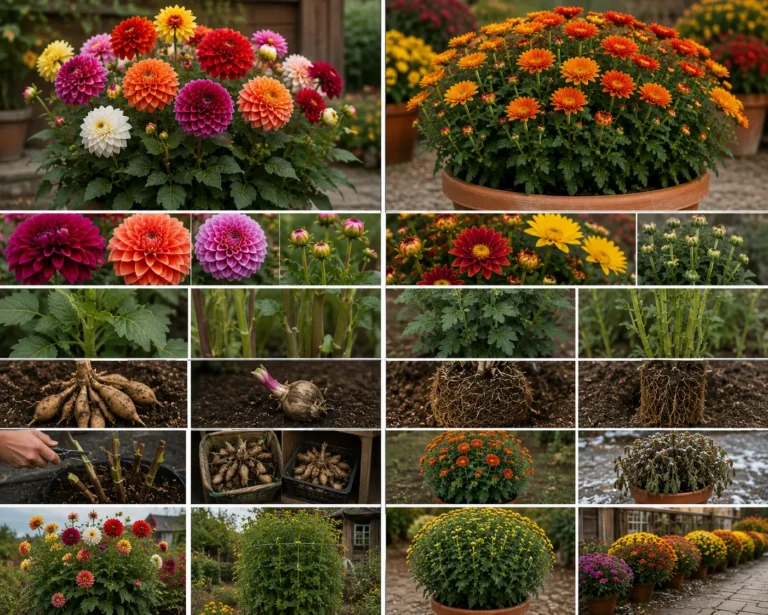
Tuber | Swollen underground stem with growth eyes | Dahlia, tuberous begonia, anemone | Spring, after last frost | 4–6 inches |
Rhizome | Horizontal underground stem | Bearded iris, ginger, canna, lily of the valley | Spring or fall | Just below surface |
Succulents are plants that store water in specially adapted thick leaves, stems, or roots. This water-storage capability evolved as an adaptation to arid, drought-prone environments. Cacti are a family within the succulent category, distinguished by areoles — specialized structures that produce spines, flowers, and offsets.
The one rule for succulents: drainage above everything else. Roots sitting in wet soil for more than a day or two will rot. Well-drained sandy or gravelly soil, a container with drainage holes, and watering only when completely dry are the 3 requirements that determine whether succulents live or die.
Group | Examples | Zones (outdoor) | Indoor suitability | Key trait |
|---|---|---|---|---|
Hardy succulents | Sedum, sempervivum, ice plant, yucca | 3–9 (varies) | Yes | Survive frost; ideal rock gardens |
Tender succulents | Echeveria, aeonium, kalanchoe | 9–11 outdoor | Excellent | Indoor collections, container gardens |
Cacti | Saguaro, prickly pear, barrel cactus | 7–11 (most) | Yes (smaller types) | Maximum drought tolerance |
Aloe | Aloe vera, aloe arborescens | 9–11 outdoor | Excellent | Medicinal; fast-growing |
Agave | Agave americana, agave parryi | 7–11 (varies) | Large specimens only | Dramatic architectural form |
Ornamental grasses are some of the most versatile and underused plants in residential gardens. They provide movement — swaying in the lightest breeze — which no other plant category delivers. They bridge the seasons, remaining attractive long after perennial flowers have finished, and most improve in appearance through fall and into winter.
Grass | Height | Zones | Sun | Key Feature |
|---|---|---|---|---|
Karl Foerster feather reed grass | 4–5 ft | 4–9 | Full–Part sun | Vertical accent; upright, architectural form |
Blue oat grass (Helictotrichon) | 2–3 ft | 4–9 | Full sun | Silvery-blue color; evergreen in mild winters |
Maiden grass (Miscanthus sinensis) | 4–8 ft | 4–9 | Full sun | Feathery plumes; fall/winter interest |
Fountain grass (Pennisetum) | 3–5 ft | 5–9 | Full sun | Arching form; bottlebrush flower heads |
Blue fescue (Festuca glauca) | 8–12 inches | 4–8 | Full sun | Compact, tufted; blue-gray color |
Switch grass (Panicum virgatum) | 3–6 ft | 4–9 | Full sun | Native North America; fall color |
Japanese forest grass (Hakonechloa) | 12–18 inches | 5–9 | Shade–Part shade | Best ornamental grass for shade |
Groundcovers are low-growing plants — typically under 18 inches — that spread to form a dense mat, suppressing weeds and covering soil that would otherwise be difficult to plant. They solve the two most common landscape problems: steep slopes where mowing is impossible, and deep shade under trees where grass refuses to grow.
Groundcover | Height | Sun | Zones | Best Use |
|---|---|---|---|---|
Creeping phlox (Phlox subulata) | 4–6 inches | Full sun | 3–9 | Rock gardens, slopes, walls; spring flowers |
Vinca (Vinca minor) | 6–8 inches | Part–Full shade | 4–9 | Shade under trees; evergreen |
Ajuga (Bugleweed) | 4–6 inches | Part–Full shade | 3–9 | Shade; colorful foliage; spring flowers |
Pachysandra | 6–8 inches | Full shade | 4–8 | Deep shade under trees; evergreen |
Creeping thyme | 2–4 inches | Full sun | 4–9 | Between pavers; aromatic; drought tolerant |
Lily of the valley (Convallaria) | 8–12 inches | Part–Full shade | 2–9 | Fragrant spring flowers; spreads readily |
Epimedium | 8–12 inches | Part–Full shade | 4–8 | Dry shade; deer resistant; semi-evergreen |
Situation | Best Plant Type(s) | Reason |
|---|---|---|
New garden needing instant color | Annuals | Bloom from planting; low cost; fill space fast |
Long-term low-maintenance garden | Perennials + shrubs | Come back annually; grow with minimal input |
Spring color with no summer work | Bulbs | Plant once in fall; reliable spring display |
Year-round screening or privacy | Evergreen shrubs or trees | Retain foliage in all seasons |
Dry, low-water garden | Succulents, ornamental grasses, native wildflowers | Evolved for drought; minimal watering |
Slope stabilization | Groundcovers | Root systems hold soil; low maintenance once established |
Vertical garden / fence coverage | Climbing perennials (clematis, honeysuckle) | Perennial vines return annually; cover structures quickly |
Wildlife and pollinator habitat | Native perennials, shrubs with berries | Locally adapted; food source for birds and insects |