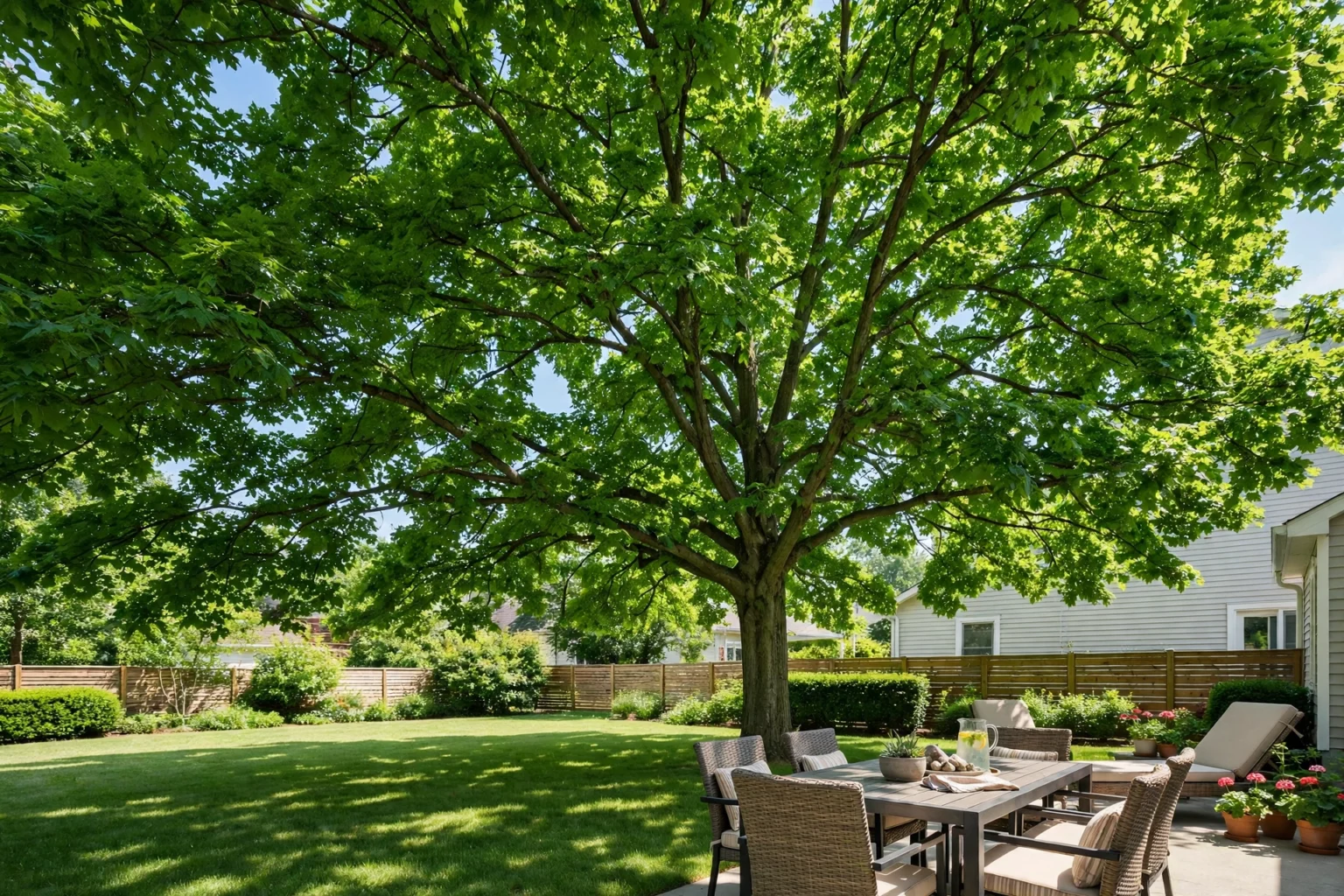
Fast growing shade trees add 25 inches (64 cm) or more of height per year and cast useful shade within about 5 to 10 years. Speed isn’t the whole story. The best picks for US yards are tulip poplar, red maple, Autumn Blaze maple, Nuttall oak and American sycamore, because each one pairs fast growth with decades of reliable shade.
Key Takeaways
- The Arbor Day Foundation classifies a tree as fast growing when it adds 25 inches (64 cm) or more of height per year.
- Tulip poplar, red maple, Nuttall oak, willow oak and northern red oak deliver fast shade and live for many decades.
- Hybrid poplar, silver maple, weeping willow, Callery pear and princess tree grow fast but bring weak wood, aggressive roots or invasive spread.
- Match every species to your zone on the 2023 U.S. Department of Agriculture (USDA) Plant Hardiness Zone Map before buying.
- Plant large shade trees at least 20 feet (6 m) from a house, and call 811 before digging any planting hole.
- Shade-tolerant trees such as eastern redbud and serviceberry grow at a medium rate in partial shade, not at full-sun speed.
What Is a Fast Growing Shade Tree?
A fast growing shade tree is a tree that adds 25 inches (64 cm) or more of height per year and forms a broad canopy that blocks summer sun over a yard, patio or roof. The Arbor Day Foundation draws that 25-inch line to split fast growers from medium and slow ones. Speed alone doesn’t qualify a tree.
Anyone who’s asked what’s a fast growing shade tree needs an answer covering both traits. Height is easy. A tall, narrow tree can shoot up quickly and still cast very little shade on the ground below it. Width without speed fails too, since a broad tree gaining only 6 inches (15 cm) a year can take decades to cool a house.
This table compares the three growth-rate categories the Arbor Day Foundation uses.
| Growth Category | Yearly Growth (in / cm) | Example Trees |
|---|---|---|
| Slow | 12 or less / 30 or less | White oak, American beech |
| Medium | 13-24 / 33-61 | Cedar elm, eastern redbud |
| Fast | 25 or more / 64 or more | Red maple, tulip poplar, river birch |
Growth rates shift with climate. A red maple in Georgia, thanks to its long growing season, usually outpaces the same species planted up north in Minnesota.
Full sun and steady water, paired with loose, well-drained soil, push any species toward the top of its growth range. Compacted clay drags it down. So do drought and shade.
What Is the Fastest Growing Shade Tree?
Hybrid poplar is widely ranked as the fastest growing shade tree sold in the US, but it is short-lived and prone to cankers and storm breakage. Tulip poplar, Nuttall oak and red maple are better choices for fast shade that lasts, because they grow quickly and keep their structure for decades.
Ask anyone what trees grow the fastest and the same names keep surfacing on nearly every list: hybrid poplar, willows and silver maple. All three share soft wood. Their roots run aggressive, and they decline early.
The fastest tree is rarely the best one for a home. Speed costs longevity in most species. That’s why the best fast growing shade trees for a yard sit one step below the very top speed tier.
The 12 Fastest Growing Shade Trees Compared
The 12 fastest growing shade trees for US yards range from very fast, short-lived hybrid poplar to fast, long-lived oaks such as Nuttall oak and willow oak. Growth rate, mature height and hardiness zone decide which species fit a yard, and wood strength decides how long the tree stays safe.
This table compares growth rate, mature height, USDA zones and main risk for each tree.
| Tree | Growth Rate | Mature Height (ft / m) | USDA Zones | Main Risk |
|---|---|---|---|---|
| Hybrid poplar | Very fast | 40-50 / 12-15 | 3-9, varies by clone | Short life, cankers |
| Silver maple | Very fast | 50-80 / 15-24 | 3-9 | Brittle limbs, surface roots |
| Weeping willow | Very fast | 30-50 / 9-15 | 6-8 | Roots invade pipes |
| American sycamore | Fast | 75-100 / 23-30 | 4-9 | Anthracnose, heavy litter |
| Tulip poplar | Fast | 70-90 / 21-27 | 4-9 | Needs a large yard |
| Red maple | Fast | 40-60 / 12-18 | 3-9 | Chlorosis in alkaline soil |
| Autumn Blaze maple | Fast | 40-55 / 12-17 | 3-8 | Weak branch unions |
| River birch | Fast | 40-70 / 12-21 | 4-9 | Leaf drop in drought |
| Nuttall oak | Fast | 40-60 / 12-18 | 5-9 | Acorn litter |
| Willow oak | Fast | 40-60 / 12-18 | 5-9 | Acorn litter |
| Northern red oak | Medium to fast | 60-75 / 18-23 | 4-8 | Oak wilt |
| Thornless honeylocust | Fast | 30-70 / 9-21 | 4-9 | Webworm, overplanting |
This table compares lifespan, root behavior and wood strength for the same 12 trees.
| Tree | Lifespan | Root Behavior | Wood Strength |
|---|---|---|---|
| Hybrid poplar | Short | Shallow, aggressive | Weak |
| Silver maple | Moderate | Shallow, aggressive | Brittle |
| Weeping willow | Short | Water-seeking, aggressive | Weak |
| American sycamore | Long | Large, spreading | Moderate |
| Tulip poplar | Long | Deep, wide | Moderate |
| Red maple | Moderate | Shallow surface roots | Moderate |
| Autumn Blaze maple | Moderate | Shallow surface roots | Moderate, narrow unions |
| River birch | Moderate | Shallow, moisture-seeking | Moderate |
| Nuttall oak | Long | Deep | Strong |
| Willow oak | Long | Moderate spread | Strong |
| Northern red oak | Long | Deep | Strong |
| Thornless honeylocust | Moderate to long | Moderate | Strong |
Trees with long lifespans and strong wood return the most shade for every single dollar you spend at the nursery. Cheap speed rarely pays.
Best Fast Growing Shade Trees for Lasting Shade
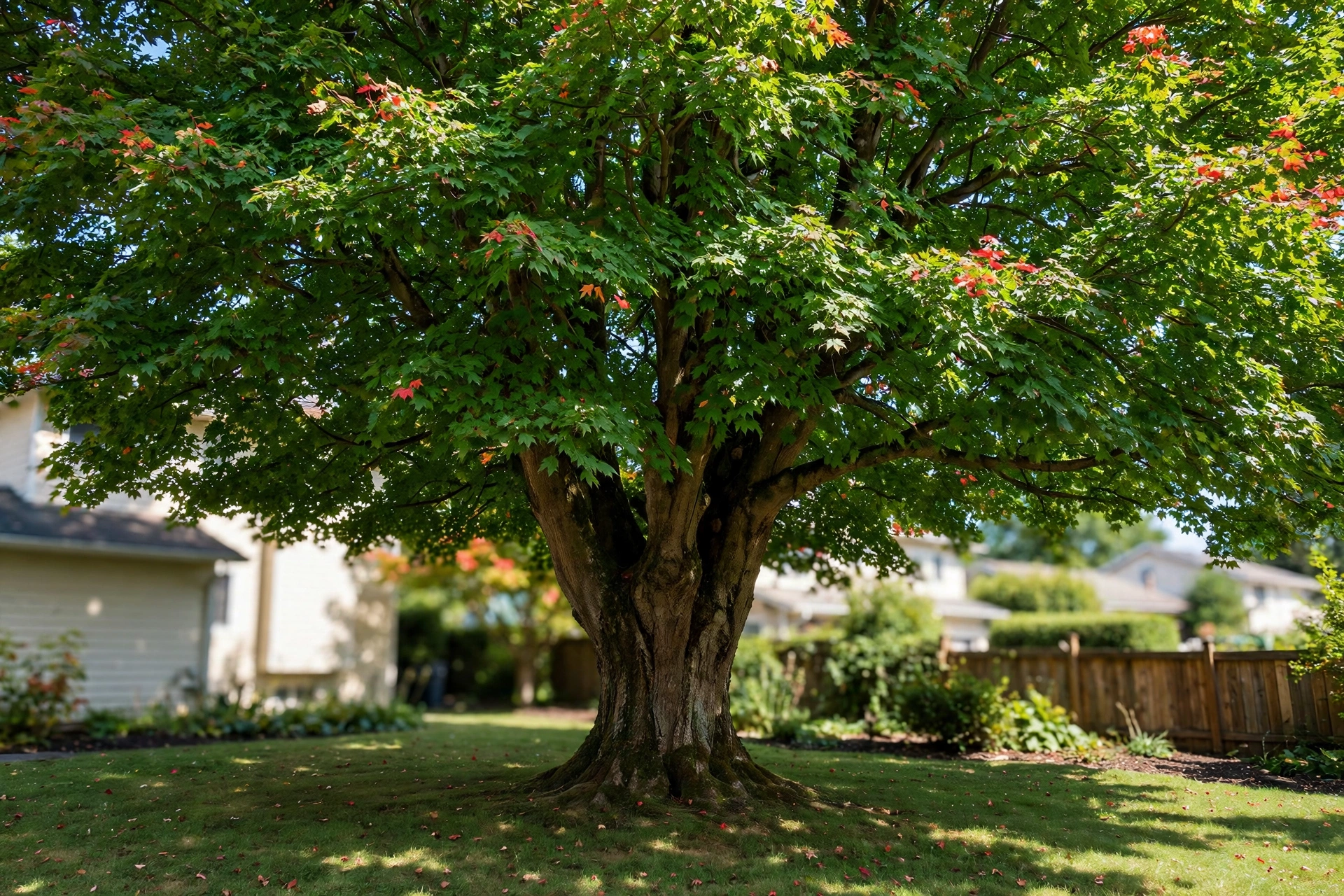
The best fast growing shade trees for lasting shade are tulip poplar, red maple, Autumn Blaze maple, Nuttall oak, willow oak, northern red oak, American sycamore, river birch and thornless honeylocust. Each one grows at a fast or medium-fast rate and lives long enough to shade a home for decades.
Zone and soil decide fit. Each species below suits its own conditions, and yard size matters just as much for the biggest ones in the group.
Tulip Poplar
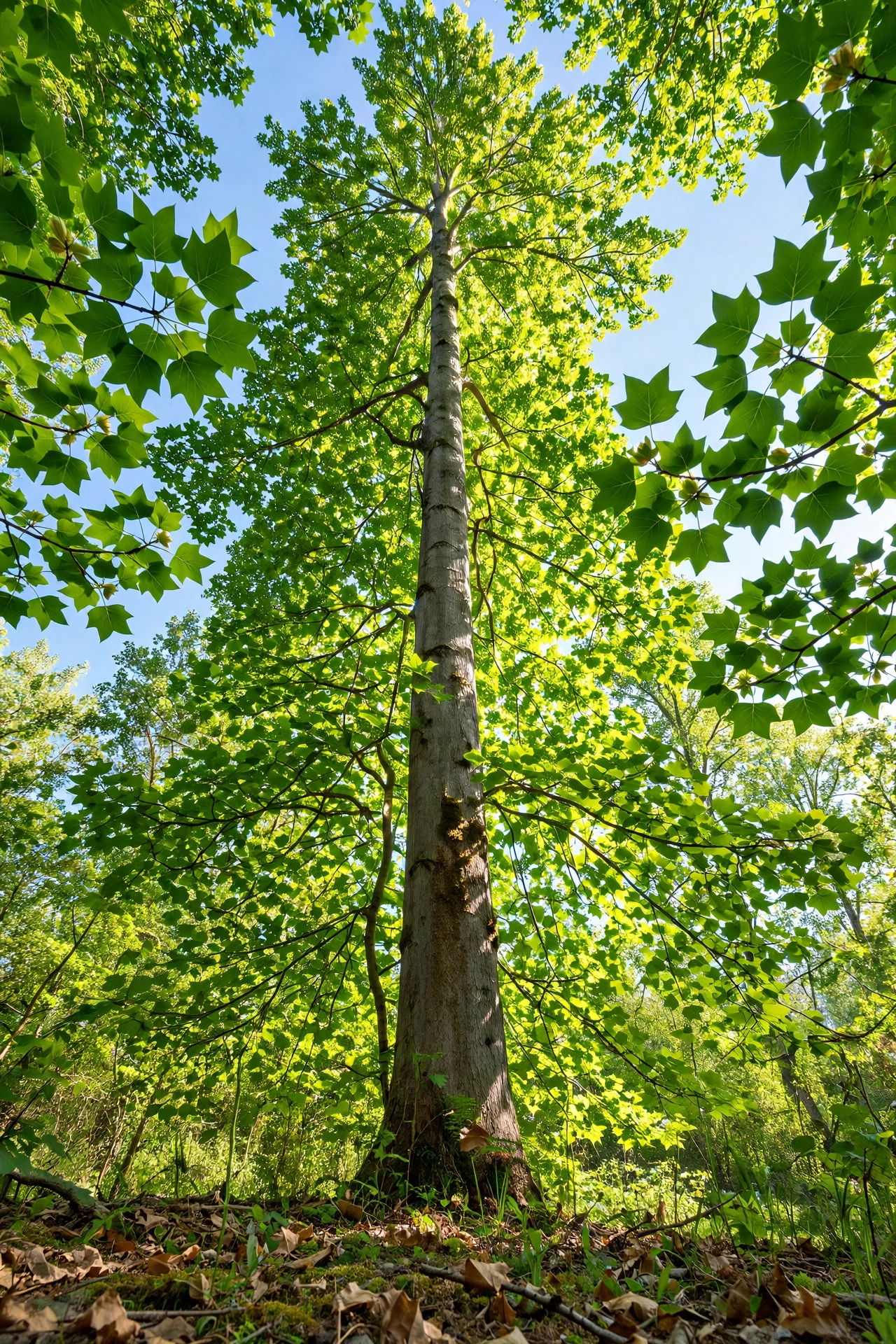
Tulip poplar (Liriodendron tulipifera) is a fast, tall eastern native that reaches 70 to 90 feet (21 to 27 m) in zones 4 to 9. Despite the name, it isn’t a true poplar at all. The species belongs to the magnolia family.
Tulip poplar opens green and orange tulip-shaped flowers in late spring, then turns gold in fall. Give it room. Its straight trunk and broad crown need deep, moist soil plus a large yard to spread out properly over the years. Kentucky, Indiana and Tennessee all claim it as their state tree.
Red Maple and Autumn Blaze Maple
Red maple (Acer rubrum) is a fast growing native that ranges across zones 3 to 9 and reaches 40 to 60 feet (12 to 18 m). Wet soil doesn’t faze it. Young trees tolerate partial shade, and the payoff each autumn is scarlet fall color.
Alkaline soil is red maple’s weak spot. In those soils the leaves yellow from iron chlorosis, so test soil pH before planting one in much of the West and the Great Plains.
Autumn Blaze maple is a cultivar of Freeman maple (Acer x freemanii), a cross between red maple and silver maple. You get silver maple speed with red maple fall color. The catch is structural. Its branches form narrow angles that can split, so have an International Society of Arboriculture (ISA) Certified Arborist shape its structure while the tree is young.
Nuttall Oak and Willow Oak
Nuttall oak (Quercus texana) is one of the fastest oaks for southern yards and reaches 40 to 60 feet (12 to 18 m) in zones 5 to 9. It’s a lower Mississippi River valley native. Wet clay suits it fine, and the leaves turn red each fall.
Willow oak (Quercus phellos) reaches 40 to 60 feet (12 to 18 m) in zones 5 to 9 and carries narrow, willow-like leaves. Cities across the Southeast plant it as a street tree because it shrugs off heat and pollution, along with compacted soil. Both oaks are strong and long-lived.
Northern Red Oak
Northern red oak (Quercus rubra) grows faster than most oaks and reaches 60 to 75 feet (18 to 23 m) in zones 4 to 8. It’s a long-lived native. The wood is strong, and fall color runs deep red.
Prune northern red oak only in the dormant season. Timing matters here. Pruning wounds made in spring and early summer attract the sap beetles that carry oak wilt from tree to tree.
American Sycamore
American sycamore (Platanus occidentalis) is one of the largest native hardwoods in the eastern US, reaching 75 to 100 feet (23 to 30 m) in zones 4 to 9. The white, mottled bark stands out. Its wide canopy needs a big lot, a park or a rural property.
Expect cleanup. Sycamore sheds leaves and bark flakes, and seed balls pile up too. In wet years, a fungal disease called anthracnose can strip the spring leaves right off the tree before summer arrives. London planetree, a sycamore hybrid, offers better anthracnose resistance in some cultivars.
River Birch
River birch (Betula nigra) is a fast growing native that reaches 40 to 70 feet (12 to 21 m) in zones 4 to 9. Compared with white-barked birches, it takes wet soil and clay in stride, and summer heat bothers it less. It also resists bronze birch borer.
The bark peels in cinnamon-colored curls that add winter interest long after the last leaves are gone from the branches. Drought is its weak point. Water it during dry spells, since dry soil triggers early leaf drop.
Thornless Honeylocust
Thornless honeylocust (Gleditsia triacanthos var. inermis) grows fast to 30 to 70 feet (9 to 21 m) in zones 4 to 9. The shade it casts is filtered. Its tiny leaflets let enough light through that lawn grass keeps growing underneath, and fall cleanup stays light.
Tough sites suit it. Drought and road salt don’t slow honeylocust down, and neither does compacted urban soil along busy streets and in parking lots. Pick a podless or nearly podless cultivar such as ‘Shademaster’ or ‘Skyline’. In summer, watch for mimosa webworm.
Which Fast Growing Trees Should You Avoid?
Avoid planting hybrid poplar, silver maple, weeping willow and invasive species such as Callery pear and princess tree near homes. These fast growing trees combine brittle wood, aggressive roots, short lifespans or invasive seeding, so they often cost more in removal and repairs than they return in shade.
Know the risk first. Each species carries its own problem, and the fix ranges from careful siting far from buildings to skipping the tree entirely.
Hybrid Poplar
Hybrid poplar (Populus hybrids) is the classic answer for raw speed, but it’s short-lived and prone to stem cankers that kill limbs. The roots cause trouble too. Shallow and spreading, they crack pavement and seek out water lines.
Treat hybrid poplar as a stopgap. Use it only as a temporary windbreak or screen while slower trees mature. Never plant it as a long-term shade tree beside a house, where falling limbs and roots can do real damage.
Silver Maple
Silver maple (Acer saccharinum) grows very fast, but its brittle wood splits apart in ice storms and during high wind. Roots are the other problem. They run shallow, lifting sidewalks and slipping into cracked sewer lines. Plant silver maple only on large rural lots, far from buildings and driveways and clear of buried pipes.
Weeping Willow
Weeping willow (Salix babylonica) grows very fast in zones 6 to 8 and needs constant moisture. Water drives everything about it. Its roots hunt for water aggressively, clogging septic fields and sewer pipes. Plant weeping willow only beside a pond or stream on a large property, at least 50 feet (15 m) from pipes, septic systems and foundations.
Invasive Species to Skip
Princess tree (Paulownia tomentosa) and Callery pear (Pyrus calleryana), including ‘Bradford’ pear, grow fast but escape into forests and fields and along roadsides. Many state agencies list both as invasive.
Ohio banned the sale and planting of Callery pear starting in 2023, and Pennsylvania began phasing out its sale in 2024. Rules are changing. Check your state invasive plant list or your Cooperative Extension office before buying any tree marketed as a quick fix.
This table compares common invasive fast growers with native trees that fill the same role.
| Invasive Tree | Main Problem | Native Alternative |
|---|---|---|
| Callery pear | Seeds into thorny thickets, splits in storms | Serviceberry |
| Princess tree | Seeds into forests and roadsides | Tulip poplar |
| Norway maple | Shades out forest understory plants | Red maple |
| Siberian elm | Brittle limbs, aggressive seeding | Hackberry |
| Tree of heaven | Root suckers, hosts spotted lanternfly | Thornless honeylocust |
How to Choose a Shade Tree by USDA Hardiness Zone
Choose a shade tree by finding your zone on the 2023 USDA Plant Hardiness Zone Map, then picking a species rated for that zone and for your local summer heat, rainfall and soil pH. The zone measures winter cold only, so heat and soil decide which hardy trees actually thrive.
The 2023 map divides the US into 13 zones, and each one is based on the average annual extreme minimum winter temperature for that area. Half zones refine it. Each zone splits into “a” and “b” halves 5°F (2.8°C) apart.
Many areas shifted to a warmer half zone compared with the 2012 map, so an old lookup can now point you toward the wrong trees. Recheck your zone today.
This table compares top fast growing shade tree picks for each group of USDA zones.
| USDA Zones | Top Fast Picks | Planting Note |
|---|---|---|
| 3-4 | Red maple, Autumn Blaze maple, river birch | River birch needs zone 4 or warmer |
| 5-6 | Tulip poplar, northern red oak, American sycamore | Buy from regional nurseries |
| 7-8 | Willow oak, Nuttall oak, tulip poplar | Water river birch in drought |
| 9 | Nuttall oak, live oak, Chinese pistache | Favor heat and drought tolerance |
Dry climates change the math. In the arid West, many eastern natives need more summer water than the local climate supplies, so lean on your state extension tree list for drought-adapted species.
- Enter your ZIP code on the USDA Plant Hardiness Zone Map website.
- Note your zone and half zone, such as 7a or 7b.
- Check your summer heat, average rainfall and soil pH.
- Compare candidate species against your state Cooperative Extension tree list.
How Many Years Does a Shade Tree Take to Give Shade?
A fast growing shade tree usually casts useful shade over a patio or window within 5 to 10 years of planting, and it forms a broad, roof-cooling canopy in roughly 15 to 20 years. Medium and slow growers take noticeably longer to reach the same canopy size.
Shoppers who search for fast shade growing trees want a timeline, not just a species name. Here’s the baseline. These estimates assume full sun and steady water, plus a young tree with a trunk 1 to 2 inches (2.5 to 5 cm) thick at planting.
This table compares the typical growth stages of a fast shade tree after planting.
| Years After Planting | Typical Stage | Shade Delivered |
|---|---|---|
| 1-2 | Root establishment, little top growth | Minimal |
| 3-5 | Rapid height gain | Spot shade |
| 5-10 | Canopy widens | Patio and window shade |
| 15-20+ | Mature crown forms | Roof and yard shade |
Root growth comes first. Nursery growers sum up the first three years with an old saying: the first year it sleeps, the second year it creeps, the third year it leaps.
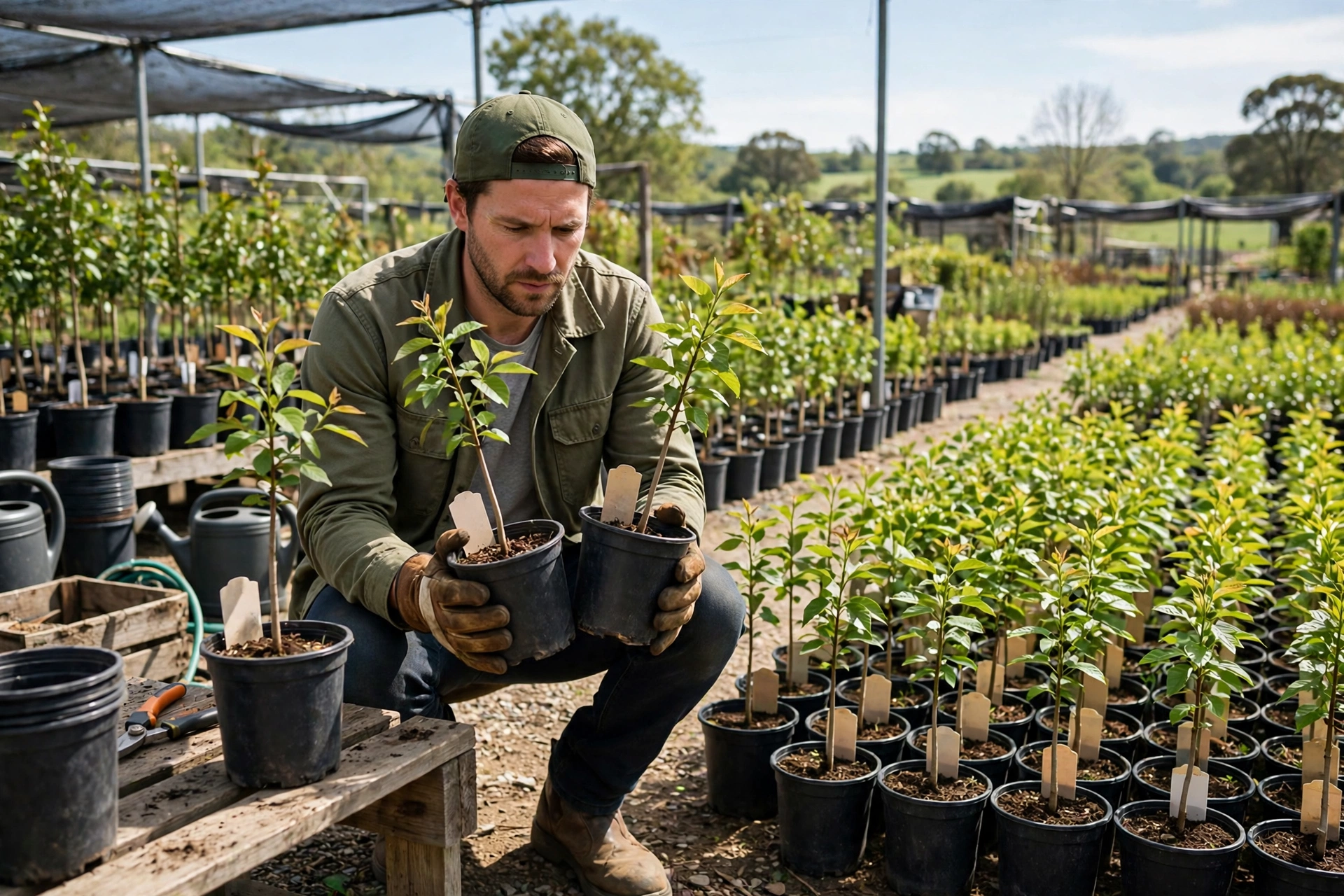
Plant a smaller tree to speed up early shade. It sounds backward. A 1- to 2-inch (2.5 to 5 cm) caliper tree recovers from transplant shock faster than a large balled-and-burlapped tree and often catches up within a few years.
Remove lawn grass from the root zone. Turf competes with young tree roots for water and nitrogen, and a clear circle of mulch removes that competition from the zone.
What Trees Grow Fast in the Shade?
No tree grows at full-sun speed in the shade, but shade-tolerant trees such as eastern redbud, serviceberry, flowering dogwood and American hornbeam keep growing at a slow to medium rate beneath taller trees. These shade loving trees evolved as forest understory species and handle partial shade well.
Searches for trees that grow in the shade fast usually come from gardeners filling a gap under existing oaks or beside a north-facing wall. Shade slows growth for every species. Expect smaller yearly gains.
This table compares shade-tolerant trees for spots that get partial shade.
| Tree | Mature Height (ft / m) | USDA Zones | Growth Rate |
|---|---|---|---|
| Eastern redbud | 20-30 / 6-9 | 4-9 | Medium |
| Serviceberry | 15-25 / 4.5-7.6 | 4-9 | Medium |
| Flowering dogwood | 15-30 / 4.5-9 | 5-9 | Slow to medium |
| American hornbeam | 20-35 / 6-11 | 3-9 | Slow to medium |
| Pawpaw | 15-30 / 4.5-9 | 5-8 | Slow to medium |
Red maple seedlings tolerate partial shade too. Once their crowns break into full sun, they speed up sharply and start growing like the fast species they are.
What Is the Best Fast Growing Shade Tree for a Small Yard?
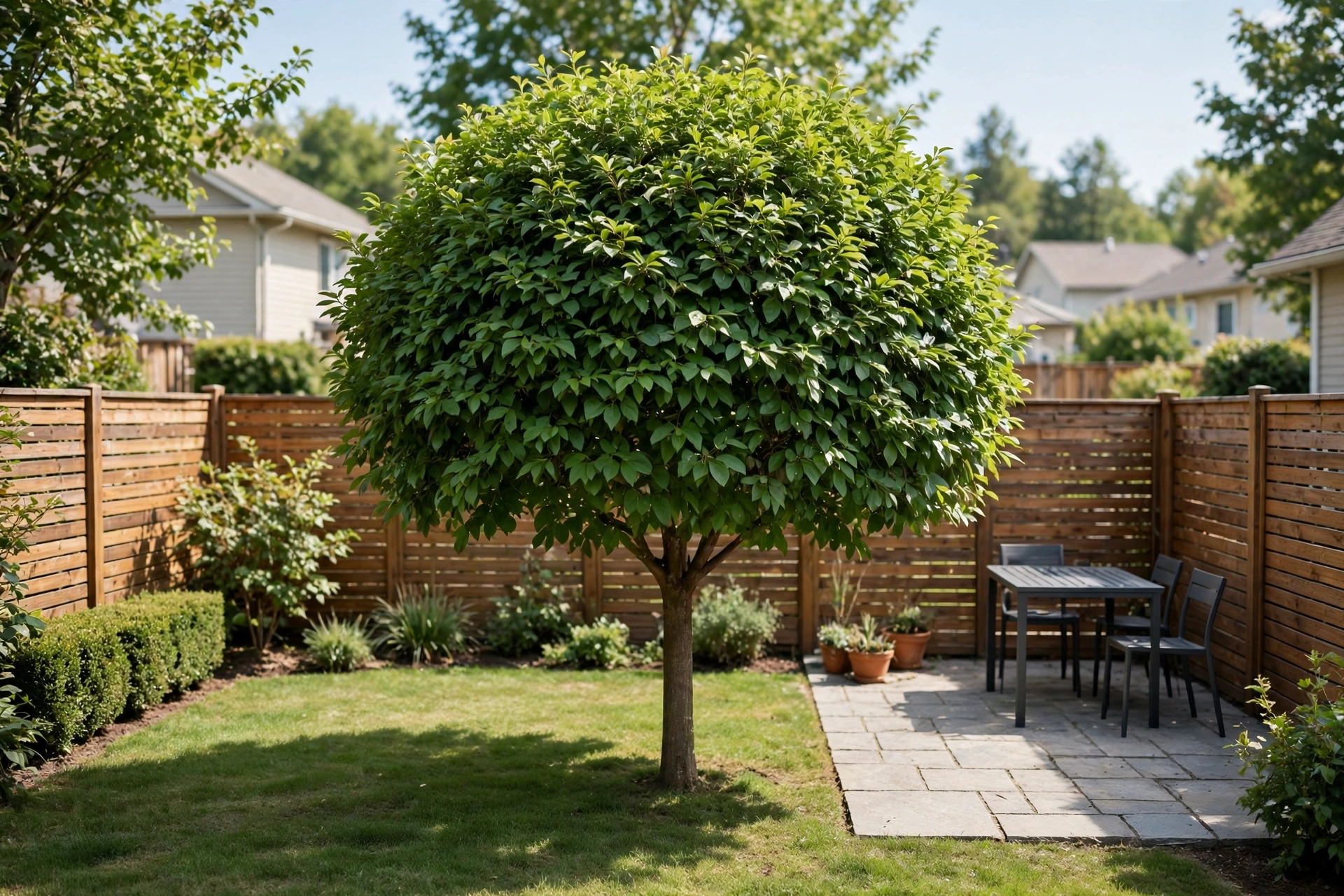
The best fast growing shade tree for a small yard is eastern redbud in most of the country and crape myrtle in zones 7 to 9. Both stay under about 30 feet (9 m), grow at a medium to fast rate and cast patio-sized shade without crowding a house or a neighbor’s lot.
Great trees for shade in tight spaces trade raw height for a wide, low canopy. Scale matters. A 90-foot (27 m) tulip poplar planted on a 0.2-acre (809 m²) lot will outgrow the space and end up needing costly pruning to stay in bounds.
This table compares small shade trees that stay at or near 30 feet (9 m).
| Tree | Mature Height (ft / m) | USDA Zones | Best Feature |
|---|---|---|---|
| Eastern redbud | 20-30 / 6-9 | 4-9 | Pink spring flowers |
| Crape myrtle | 15-25 / 4.5-7.6 | 7-9 | Long summer bloom |
| Serviceberry | 15-25 / 4.5-7.6 | 4-9 | Berries that feed birds |
| Chinese pistache | 25-35 / 7.6-11 | 6-9 | Drought tolerant, red fall color |
Never top a crape myrtle. Instead, pick a cultivar whose mature height already fits the space, so the tree never needs a drastic cut to control its size.
How Far from a House Should You Plant a Shade Tree?
Plant a large shade tree at least 20 feet (6 m) from a house, a medium tree at least 15 feet (4.6 m) and a small tree at least 8 to 10 feet (2.4 to 3 m) away. Spacing based on mature canopy spread keeps roots clear of foundations and branches off the roof.
This table compares minimum planting distances by mature tree size.
| Mature Tree Size | Distance from House (ft / m) | Example Trees |
|---|---|---|
| Small, under 30 ft (9 m) | 8-10 / 2.4-3 | Redbud, serviceberry |
| Medium, 30-50 ft (9-15 m) | 15 / 4.6 | River birch, honeylocust |
| Large, over 50 ft (15 m) | 20 or more / 6 or more | Tulip poplar, oaks, sycamore |
Keep trees with aggressive roots, such as silver maple and willows, well away from sewer lines and septic fields, since their roots seek out water. Overhead wires matter too. Ask your electric utility which trees it allows under power lines.
Place deciduous shade trees on the west and east sides of a house to block low morning and afternoon summer sun. Winter brings a bonus. Bare branches let sunlight warm the house once the leaves drop.
How to Plant a Fast Growing Shade Tree
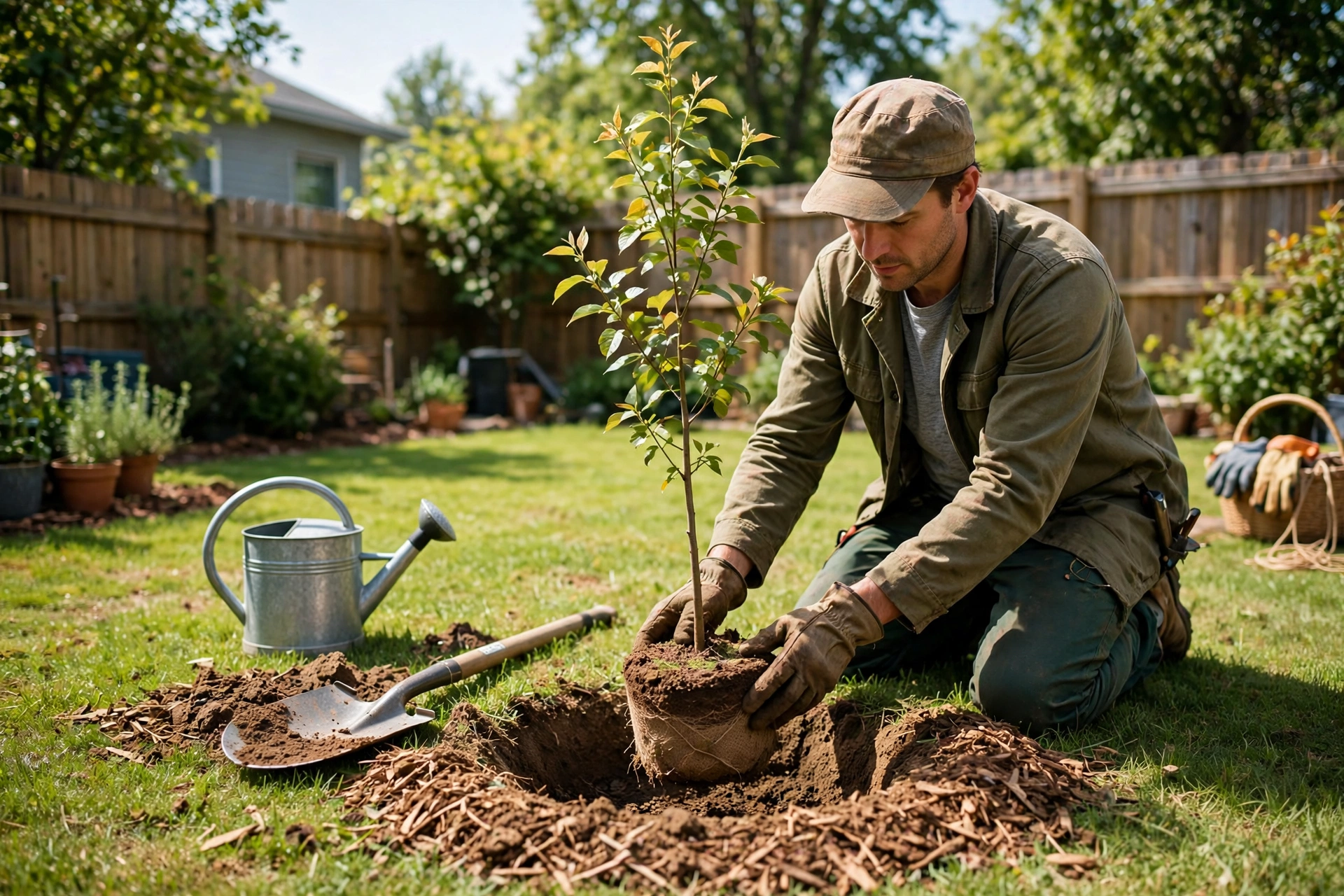
Plant a fast growing shade tree in early spring or fall by calling 811, digging a hole two to three times wider than the root ball and no deeper, setting the root flare at ground level, and watering deeply. A wide mulch ring and weekly watering for two years finish the job.
- Call 811 at least a few business days before you dig so utilities can mark buried lines for free.
- Test soil pH and drainage through your Cooperative Extension soil lab.
- Choose a spot with full sun exposure of at least 6 hours a day.
- Dig a hole 2 to 3 times as wide as the root ball and no deeper than the root ball.
- Locate the root flare, where the trunk widens into roots, and set it at or slightly above grade.
- Remove burlap, twine and the top of any wire basket, then cut any circling roots.
- Backfill with the native soil you removed, without adding compost or fertilizer.
- Water slowly until the backfill is soaked to the full depth of the root ball.
- Spread a mulch ring 2 to 4 inches (5 to 10 cm) deep and at least 3 feet (0.9 m) wide, keeping mulch 3 inches (7.6 cm) off the trunk.
- Water deeply once a week for the first two growing seasons whenever rainfall falls short.
Skip staking unless strong wind or a top-heavy root ball requires it, and even then treat the support as strictly temporary. Pull any stakes after one year.
Frequently Asked Questions
Are Fast Growing Trees Weak or Short-Lived?
Yes, many are. Hybrid poplar, silver maple and willows trade dense wood for speed, and they decline early. Still, the rule isn’t universal, since Nuttall oak, northern red oak and tulip poplar break the pattern by pairing quick growth with long lives.
Which Fast Shade Tree Has the Least Invasive Roots?
Thornless honeylocust and northern red oak cause the fewest root problems among fast shade trees. Placement still matters. Plant either one 20 feet (6 m) from foundations, and keep silver maple and willows far away from any buried pipes.
What Is the Best Fast Growing Shade Tree for Zone 9?
Nuttall oak is the top fast pick for zone 9. Heat doesn’t bother it. Clay and wet winters don’t either, and for drier zone 9 yards, southern live oak and Chinese pistache are the better fit.
What Shade Tree Grows Fast in Texas Heat?
Nuttall oak, Shumard oak and cedar elm handle Texas heat well. Region matters, though. The Texas A&M Forest Service planting guide sorts suitable species by region, since East Texas soils differ sharply from West Texas caliche.
Does Fertilizer Make a New Shade Tree Grow Faster?
No. Fertilizer does little for a tree that hasn’t yet grown new roots. Water and mulch drive early growth along with full sun, so feed a young tree only when a soil test shows a deficiency.
Conclusion
The fast growing shade trees worth planting today are the ones still standing strong in 50 years. Speed is only half of it. Tulip poplar, red maple, Nuttall oak, willow oak and northern red oak deliver both speed and staying power across most US zones.
Warmer half zones on the 2023 map open new options for southern species in some northern areas. That shift helps. Still, native, long-lived trees matched to your zone and soil are the ones that will keep cooling your home as summers grow hotter.
Pick one tree this season and plant it right, then give it two full years of steady water while the roots settle into the soil. Shade arrives sooner than you’d think.