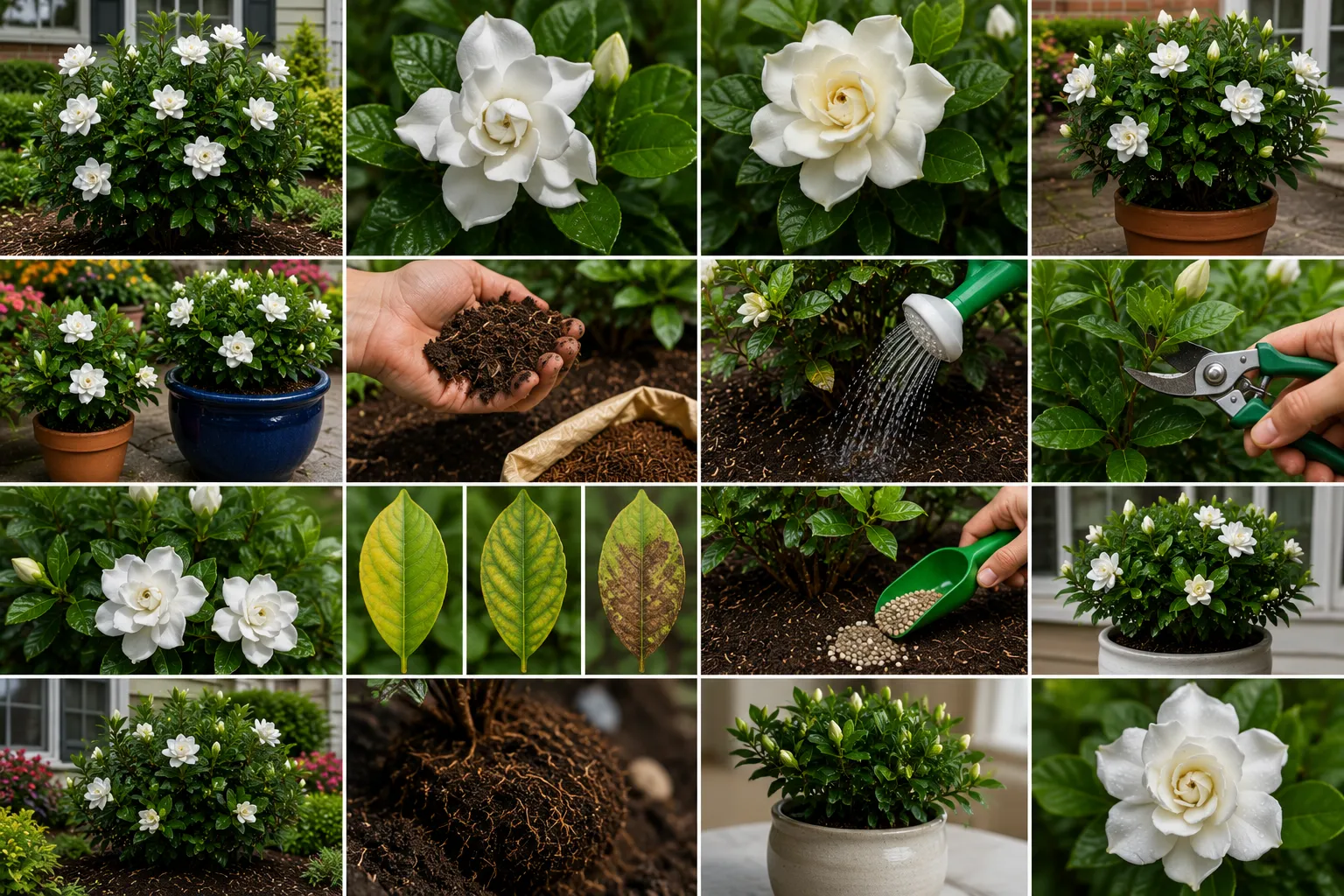
Gardenias grow best in acidic soil with a pH of 5.0–6.0, consistent moisture, and 4–6 hours of indirect sunlight daily. Get these 4 conditions right — soil pH, water, light, and temperature — and Gardenia jasminoides (cape jasmine) rewards you with fragrant white blooms from spring through summer.
Gardenia care has a reputation for difficulty because most growers skip the soil pH step. A pH above 6.5 locks out iron and magnesium, causing yellow leaves and bud drop before a single flower opens. This guide gives you exact numbers, seasonal timing, and fast fixes for every common problem.
Gardenia Care Requirements: Soil, Light, Temperature, and Humidity
Gardenias demand precision across 4 growing conditions. Compromise on any 1 and the plant declines — usually within weeks.
How to Prepare Soil for Gardenias
To prepare soil for gardenias, target a pH of 5.0–6.0 and work in a 2–3 inch (5–7.5 cm) layer of organic matter such as pine bark fines, peat moss, or composted leaves before planting.
Test your soil with a digital pH meter or a home test kit before adding amendments. Sandy and clay soils both need different corrections:
- Sandy soil: Add peat moss at a 1:2 ratio to slow drainage and retain moisture.
- Clay soil: Add coarse pine bark and perlite in equal parts to open up compaction.
- Neutral or alkaline soil (pH above 6.5): Apply granular sulfur at 1 oz per square foot (28 g/0.09 m²) and retest after 2 weeks.
For container gardenias, use a pre-mixed azalea and camellia potting mix. Both Miracle-Gro Acid Mix and Black Gold Natural & Organic are formulated at the correct pH range.
Light and Temperature Requirements for Gardenias
Gardenias need 4–6 hours of bright, indirect sunlight per day. Direct midday sun above 85°F (29°C) scorches leaves and accelerates soil drying.
Place outdoor gardenias on the east or north side of a structure where morning sun reaches the plant. Move indoor gardenias within 3 feet (90 cm) of a south-facing window from October through March.
Temperature targets: 65–70°F (18–21°C) during the day and 60–65°F (15–18°C) at night. Night temperatures below 55°F (13°C) trigger bud drop. Temperatures above 80°F (27°C) reduce flowering duration.
Gardenias grow outdoors in USDA Hardiness Zones 7–11. In Zone 6, grow gardenias in containers and move the container indoors before the first frost. Maintain indoor humidity at 50–60% using a pebble tray filled with water or a cool-mist humidifier.
Gardenia Watering Guide: How Much and How Often
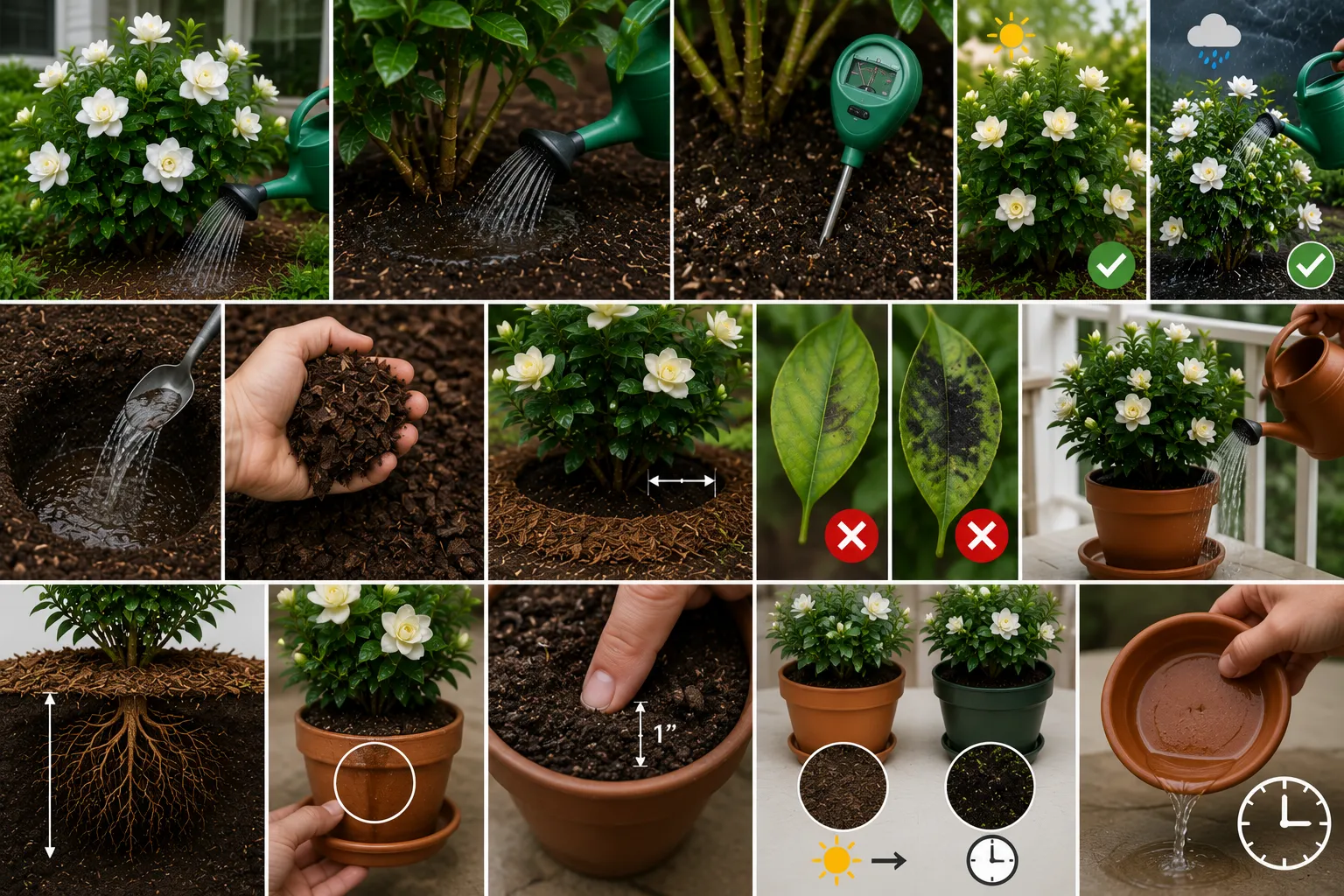
Water gardenias once per week with 1 inch (2.5 cm) of water during mild weather. Increase to 2 times per week when temperatures exceed 85°F (29°C) or during drought.
Always water at the base of the plant, not overhead. Overhead watering promotes leaf spot and sooty mold — 2 fungal diseases that weaken the shrub. Check soil moisture 2 inches (5 cm) below the surface before each watering session.
Indoor Gardenia Watering vs. Outdoor Gardenia Watering
Indoor and outdoor gardenias have different moisture needs because air circulation, pot drainage, and light intensity differ between settings.
- Outdoor gardenias: Water deeply once per week. Soak the soil to 12 inches (30 cm) depth. Apply 2–3 inches (5–7.5 cm) of pine bark mulch around the base to retain moisture and regulate soil temperature. Keep mulch 3 inches (7.5 cm) away from the stem to prevent rot.
- Indoor gardenias: Water when the top 1 inch (2.5 cm) of soil feels dry. Terra cotta pots dry out faster than plastic — check every 3–4 days. Always empty saucers 30 minutes after watering to prevent root rot.
Visit the watering schedule tips on Zoned Garden for a zone-specific watering calendar that adjusts for your local climate.
How to Fertilize Gardenias for Maximum Bloom
To fertilize gardenias for maximum bloom, apply an acid-formulated slow-release fertilizer every 4 weeks from March through August. Stop fertilizing in September to avoid pushing late growth that cold temperatures will damage.
Choose a fertilizer formulated for acid-loving plants. Effective products include Espoma Holly-tone (4-3-4 NPK), Miracle-Gro Water Soluble Azalea, Camellia, Rhododendron Plant Food (30-10-10), and Jobe’s Organics Azalea, Camellia & Rhododendron Fertilizer (4-4-4).
How to Fix Iron and Magnesium Deficiency in Gardenias
To fix iron deficiency in gardenias, apply chelated iron (FeEDTA) as a foliar spray at 1 tablespoon per gallon (15 ml per 3.8 L) of water. Spray directly on yellowed leaves in the morning. Repeat every 2 weeks until new growth shows normal green color.
To fix magnesium deficiency, dissolve 1 tablespoon (15 g) of Epsom salt (magnesium sulfate) in 1 gallon (3.8 L) of water. Apply as a soil drench around the root zone. Both deficiencies produce similar symptoms — yellowing between leaf veins — but iron deficiency appears on young leaves first, while magnesium deficiency starts on older, lower leaves.
Gardenia Pruning: When and How to Prune Without Harming Bloom
Prune gardenias immediately after the main bloom cycle ends, typically in late May or June. Pruning after July removes next season’s flower buds, which set in late summer.
Remove faded or browned flowers by cutting just below the leaf node with clean bypass pruners such as Fiskars Bypass Pruning Shears or Felco F-2. Deadheading spent blooms redirects energy into new growth and future bud formation.
- Remove dead or crossing branches first — they block airflow and harbor fungal spores.
- Trim leggy stems back by one-third of their length to maintain a compact shape.
- Sterilize pruning blades with 70% isopropyl alcohol between cuts to stop disease spread.
- Never remove more than one-third of total foliage in a single session.
For zone-specific pruning timing across all shrub types, read the pruning timing guide on Zoned Garden.
Gardenia Varieties: 5 Top Types for Home Gardens
All gardenias belong to the Rubiaceae (coffee) family. Gardenia jasminoides is the primary species grown in North American landscapes. Within this species, 5 varieties suit most home gardeners:
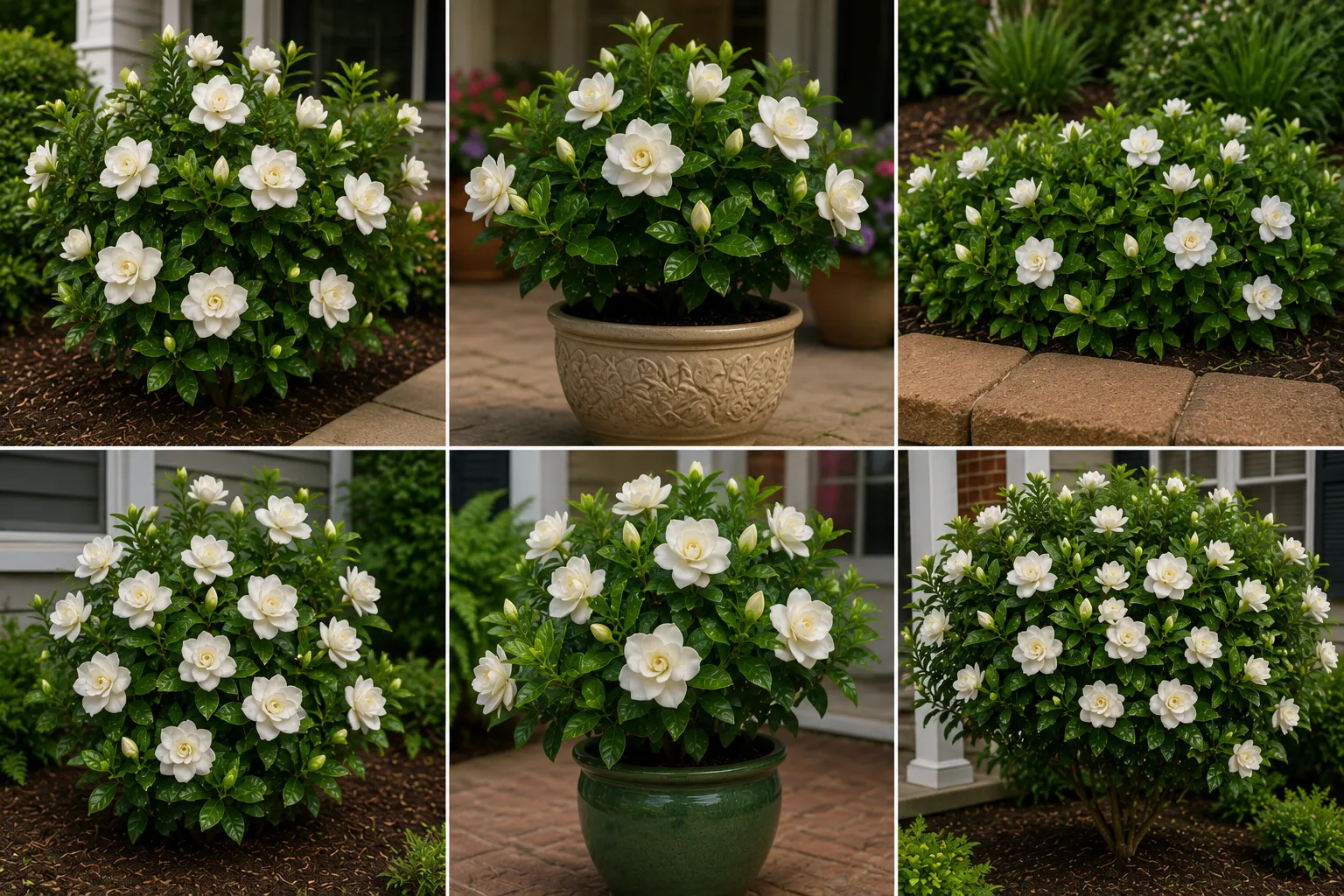
- August Beauty — Grows 4–6 feet (1.2–1.8 m) tall. Double white blooms appear in spring and summer. Suitable for Zones 7–11.
- Veitchii — A compact variety reaching 3–4 feet (90 cm–1.2 m). Reblooms from spring through fall. Ideal for containers.
- Radicans — A dwarf groundcover type at 12–24 inches (30–60 cm) tall. Spreads 2–3 feet (60–90 cm) wide. Works in Zone 7b and warmer.
- Summer Snow — A cold-hardy cultivar rated to Zone 6 with heavy mulching. Grows 3–4 feet (90 cm–1.2 m) tall.
- Sweet Tea — A larger landscape shrub reaching 6 feet (1.8 m) tall. Produces abundant blooms with an intensely sweet fragrance.
For placement and pairing ideas with other landscape plants, see the shrubs guide on Zoned Garden.
Gardenia Care Quick-Reference Table
Use this table to track every seasonal gardenia care task at a glance.
| Task | When | Method | Frequency | Difficulty |
| Watering | Year-round | Deep soak at base | Weekly (mild); 2x/week (summer) | Easy |
| Fertilizing | Spring–Summer | Acid fertilizer (e.g., Espoma Holly-tone) | Monthly | Moderate |
| Pruning | After bloom (late spring/early summer) | Remove dead blooms below leaf node | Once per year | Easy |
| Soil pH Check | Spring | pH meter or test kit | 2x per year | Easy |
| Mulching | Spring & Fall | Pine bark or pine needles, 2–3 in (5–7.5 cm) | Twice per year | Easy |
| Repotting (indoors) | Spring | One pot size up; refresh acidic mix | Every 2–3 years | Moderate |
| Pest Inspection | Year-round | Check stems and leaf undersides | Weekly | Easy |
| Humidity Boost | Year-round (indoors) | Mist or pebble tray | Daily (indoors) | Easy |
How to Fix the 4 Most Common Gardenia Problems
Gardenias show 4 recurring problems: yellow leaves, bud drop, no blooming, and pest infestation. Each has a specific, correctable cause.
Why Gardenia Leaves Turn Yellow
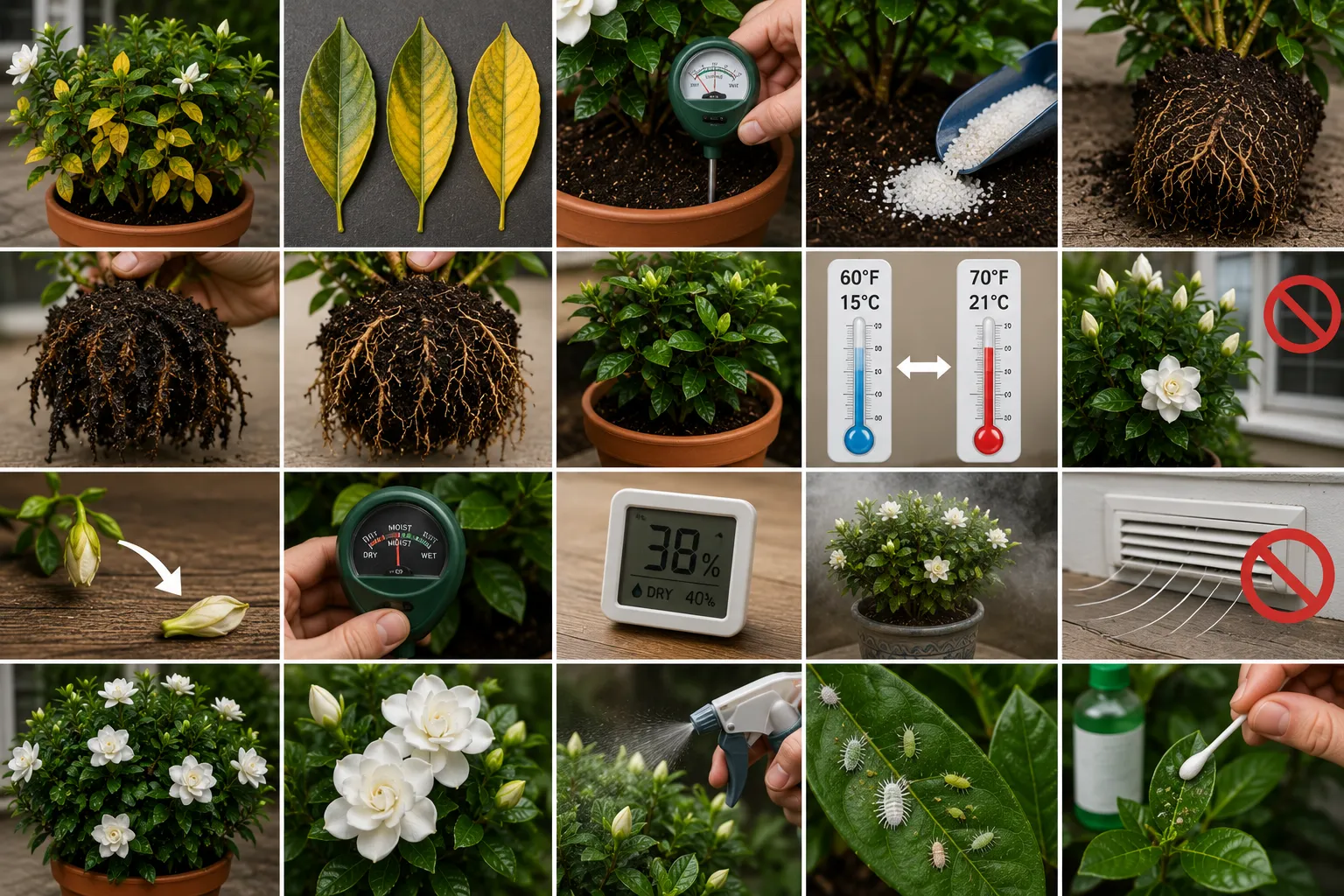
Gardenia leaves turn yellow from 3 causes: soil pH above 6.5 (iron lockout), overwatering (root rot), or magnesium deficiency.
Test pH first. A pH above 6.5 prevents iron uptake even when iron is present in the soil. Lower pH with aluminum sulfate at 1 lb per 10 square feet (450 g per 0.9 m²). Confirm root rot by unpotting the plant and checking for dark, mushy roots. Cut affected roots with sterilized scissors and repot into fresh, well-draining mix.
How to Prevent Gardenia Bud Drop
To prevent gardenia bud drop, keep temperatures stable between 60–70°F (15–21°C) and never move the plant after buds form.
Bud drop has 4 main triggers: temperature fluctuations greater than 10°F (5.5°C) in a single day, inconsistent watering (letting soil dry out completely between waterings), humidity below 40%, and direct drafts from heating or air conditioning vents. Address all 4 before buds set each year.
How to Treat Spider Mites and Scale Insects on Gardenias
To treat spider mites on gardenias, blast the undersides of leaves with a strong water stream from a hose. Follow with a spray of horticultural oil such as SunSpray Ultra-Fine at the label-recommended rate of 2 tablespoons per gallon (30 ml per 3.8 L). Repeat every 5 days for 3 applications.
Scale insects appear as waxy, immobile brown bumps on stems and leaf undersides. Apply the same horticultural oil spray at dawn. Do not use neem oil on indoor gardenias — neem causes phytotoxicity (leaf burn) in enclosed spaces with low air circulation.
How to Grow Gardenias Indoors Successfully
To grow gardenias indoors, place the plant within 3 feet (90 cm) of a south- or east-facing window, maintain 50–60% relative humidity, and keep night temperatures at 60–65°F (15–18°C).
Indoor gardenias require deliberate humidity management. Centrally heated homes drop below 30% humidity in winter — a level that prevents bud formation. Use 3 methods together for best results:
- Place a pebble tray filled with 1 inch (2.5 cm) of water under the pot. The pot sits on the pebbles, above the water line.
- Group the gardenia with other humidity-loving houseplants such as peace lilies, Boston ferns, or anthuriums.
- Run a cool-mist humidifier within 5 feet (1.5 m) of the plant for 4–6 hours per day.
Move indoor gardenias outdoors in summer when nighttime temperatures stay above 60°F (15°C). Summer outdoor exposure — in a sheltered, part-shade spot — triggers strong bud set for the following bloom season.
Frequently Asked Questions About Gardenia Care
Do gardenias need full sun or shade?
No. Gardenias do not need full sun. They perform best in 4–6 hours of bright, indirect light. Full afternoon sun above 85°F (29°C) scorches leaves and dries soil too quickly.
How often should I water a gardenia plant?
Water outdoor gardenias once per week in mild weather and twice per week in summer heat above 85°F (29°C). Indoor gardenias need water when the top 1 inch (2.5 cm) of soil feels dry — roughly every 3–5 days.
Why is my gardenia not blooming?
Gardenias stop blooming for 4 reasons: pruning too late in the season (after July), insufficient light, soil pH above 6.5, or night temperatures above 65°F (18°C). Check all 4 conditions before the next bloom season.
What fertilizer is best for gardenias?
Acid-formulated fertilizers work best for gardenias. Espoma Holly-tone (4-3-4), Miracle-Gro Azalea Plant Food (30-10-10), and Jobe’s Organics Azalea Fertilizer (4-4-4) are all reliable options. Apply monthly from March through August only.
Can gardenias survive winter outdoors?
Yes — in USDA Zones 7–11. In Zone 6, gardenias survive winter with 4–6 inches (10–15 cm) of mulch around the base and burlap frost wrapping. In Zones 5 and below, grow gardenias in containers and move them indoors before the first frost.
Start Your Gardenia Care Routine Today
Gardenia care rewards precision over guesswork. Test your soil pH before planting. Water deeply but never let roots sit in standing water. Fertilize monthly from spring through midsummer with an acid-formulated product. Prune only after the bloom cycle ends. Address yellow leaves and bud drop the moment they appear — both problems reverse quickly with the right fix.
Every gardenia variety from compact Veitchii to landscape-scale Sweet Tea thrives when the growing conditions match its needs. For more guidance on selecting and pairing flowering shrubs with your gardenias, explore the shrubs guide on Zoned Garden — where every plant recommendation is matched to your exact USDA hardiness zone.