
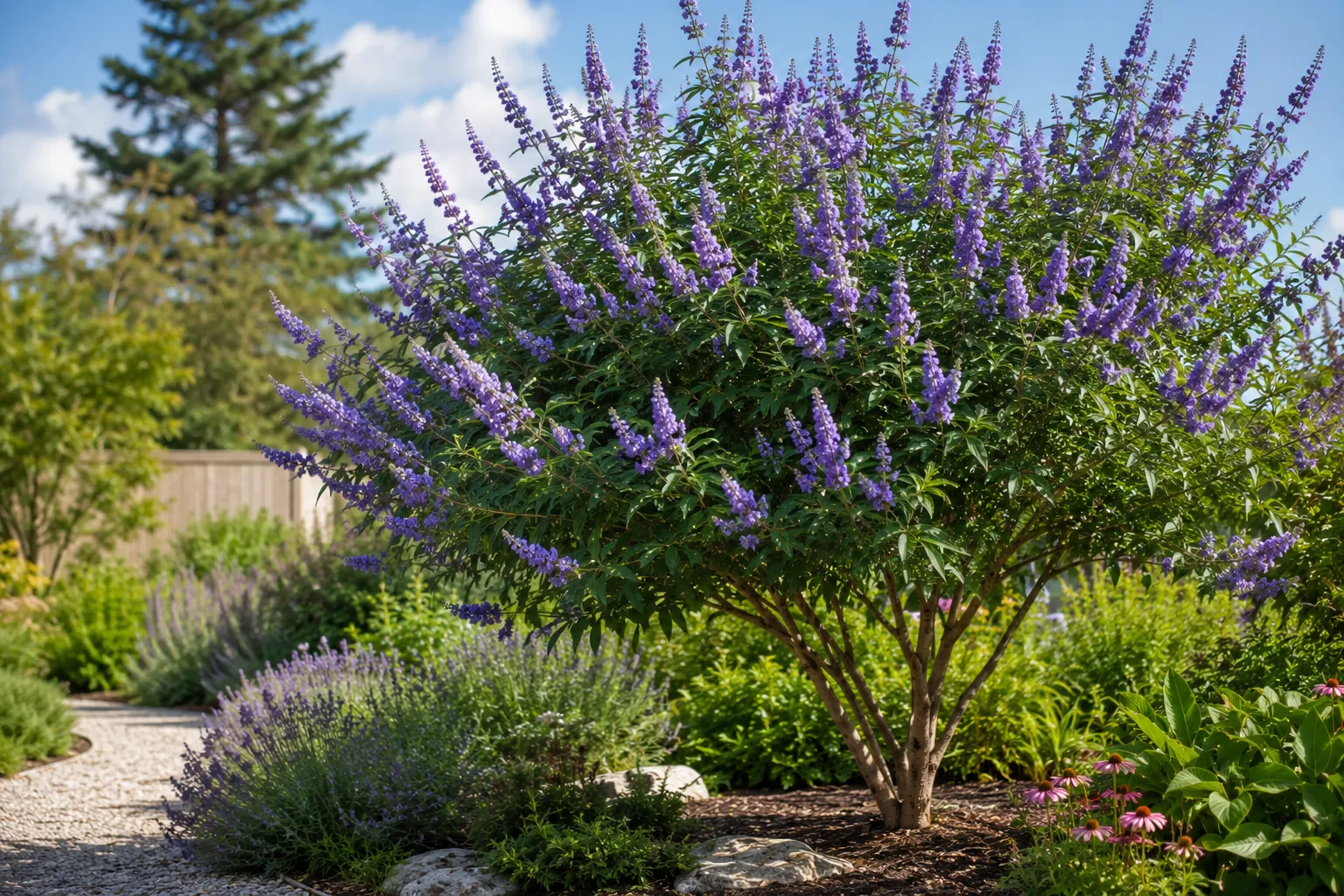
Vitex tree care requires 3 main tasks: annual late-winter pruning, infrequent deep watering, and 4 fertilizer applications per year. Get those 3 right and a Vitex (Vitex agnus-castus, also called chaste tree or Texas lilac) grows 7 feet (2.1 m) in a single season and blooms from June through September in USDA Zones 5–9.
Vitex blooms on new wood — the current season’s growth — so pruning timing directly controls flower production. Prune too late and you cut off the buds forming on new shoots. This guide covers the exact timing, technique, and schedule for every Vitex care task.
What Is Vitex Tree Care and Why Does It Matter?
Vitex tree care is the set of 5 annual tasks — siting, watering, fertilizing, pruning, and pest monitoring — that keep a chaste tree healthy and flowering. Skip pruning and the tree becomes leggy with reduced bloom. Overwater and root rot kills the tree within one season.
Vitex agnus-castus is native to the Mediterranean and Central Asia. The plant evolved in dry, rocky, well-drained soils with long hot summers. That origin explains every care rule: less water, more sun, lean soil, and hard pruning.
In the US landscape, Vitex fills the gap between July and September when most other flowering trees have finished. The lavender-blue flower spikes attract bees, butterflies, and hummingbirds. A well-cared-for specimen reaches 15 feet (4.5 m) tall and 12 feet (3.7 m) wide at maturity.
How to Plant Vitex for Long-Term Health
Choosing the Right Site
Plant Vitex in full sun — a minimum of 6 hours of direct sunlight per day. Partial shade produces fewer blooms and a leggy, open habit. Vitex tolerates poor, rocky, and slightly alkaline soil (pH 6.0–8.0). Good drainage is non-negotiable: Vitex dies in soggy or clay-heavy soil within one season.
Check your USDA hardiness zone before choosing your planting spot. In Zones 5–6, plant Vitex near a south-facing wall or structure to add radiant heat and improve winter survival. In Zones 7–9, Vitex grows in open landscape positions with no protection needed.
Before planting, check whether Vitex is invasive in your region. In parts of Central Texas and the Southeast, Vitex seeds aggressively into native habitats. Use the zone-matched shrub selection guide at Zoned Garden to confirm Vitex suits your landscape before committing.
Planting Steps for Zones 5–9
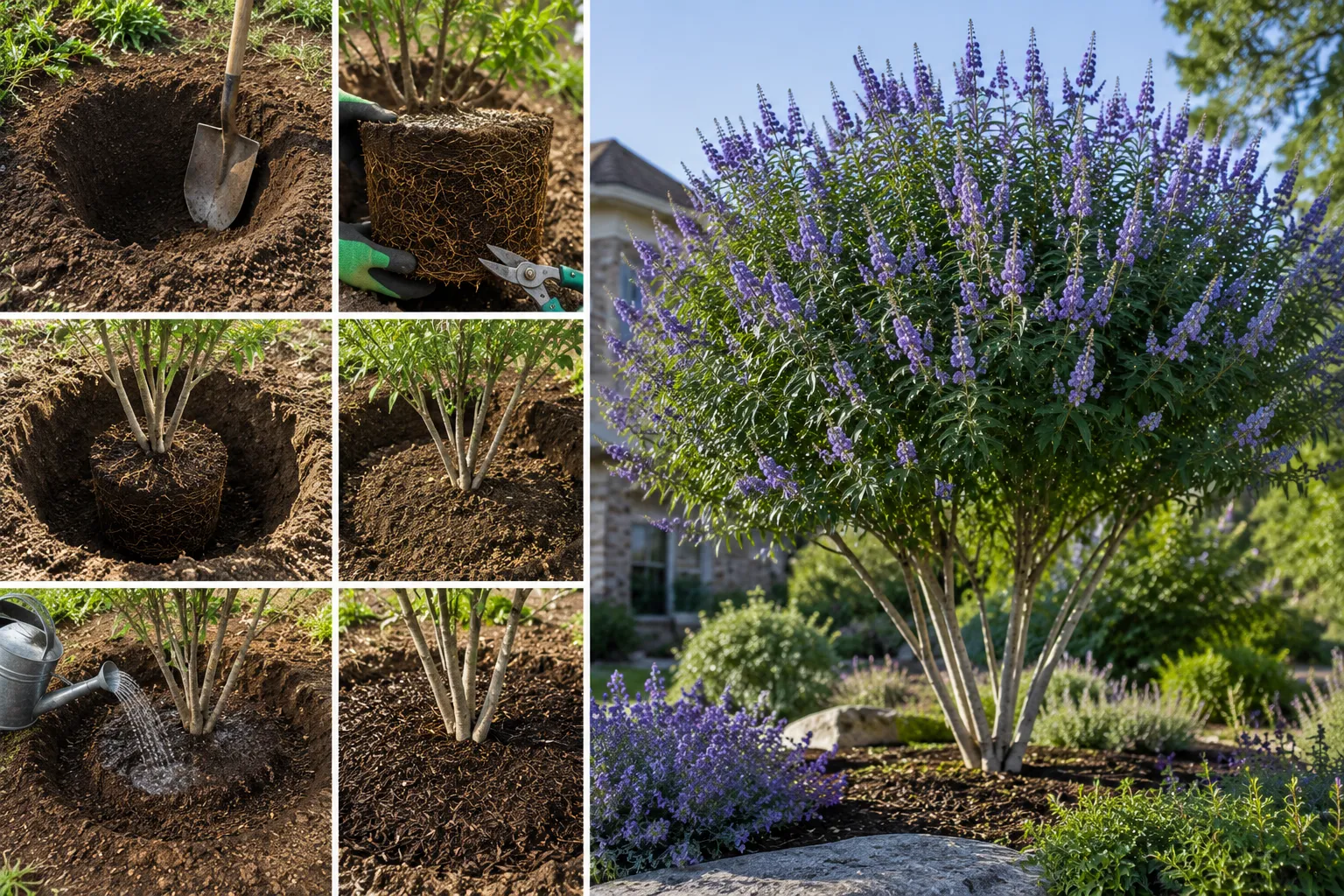
To plant Vitex, follow these 6 steps:
- Dig a hole 2–3 times the width of the root ball but the same depth as the container.
- Score the sides and bottom of the root ball with pruners to release circling roots.
- Place the root ball so the top sits level with the surrounding soil — never below grade.
- Backfill with native soil. Do not add compost to the fill; Vitex performs better in lean soil.
- Water deeply after planting — soak the root zone until water drains freely from the base.
- Apply 3 inches (7.6 cm) of organic mulch over the root zone, keeping mulch 2 inches (5 cm) away from the trunk.
Plant in early spring or early fall. Fall planting in Zones 7–9 allows root establishment before summer heat. Spring planting in Zones 5–6 gives the tree a full growing season before the first frost.
Vitex Tree Care: Watering the Right Way
Watering Newly Planted Trees (Year 1)
Water a newly planted Vitex 2 times per week for the first 8 weeks. Soak the root zone fully each time — apply enough water so the soil stays moist 6 inches (15 cm) deep. After 8 weeks, reduce to once per week for the rest of the first growing season.
Use a slow, deep soak rather than a brief spray. A 5-gallon (19-liter) slow drip over 30 minutes reaches the root ball better than a 2-minute hose blast. Deep watering develops a deep root system, which drives Vitex’s drought tolerance in future years.
Watering Established Vitex Trees
Established Vitex trees need water every 10–14 days during active growth (April–October) only if rainfall is below 1 inch (2.5 cm) per week. From November through March, water twice per month or less — only during extended dry spells.
Mature Vitex in Zones 8–9 often survive entirely on rainfall after the third growing season. Nearly every Vitex problem — yellowing leaves, drooping, root rot — comes from overwatering, not underwatering. Check the custom watering schedule for a zone-specific watering calendar.
Never water when soil moisture is still present at 2 inches (5 cm) depth. Push a finger or soil probe into the ground near the drip line — water only when the top 2 inches feel dry.
How to Fertilize Vitex for Maximum Blooms
Fertilize Vitex 4 times per year with a balanced, slow-release shrub fertilizer (7-4-4 NPK or similar). Over-fertilizing — especially with high-nitrogen products — produces lush foliage at the expense of flowers.
Follow this 4-application schedule:
- Spring (March–April): Apply 7-4-4 fertilizer at the label rate plus soil sulfur if soil pH exceeds 7.5.
- Early summer (June): Apply 7-4-4 fertilizer plus a humic acid soil conditioner to improve nutrient uptake.
- Late summer (September): Apply 7-4-4 fertilizer only — no soil amendments at this stage.
- Winter (December): Apply 7-4-4 fertilizer to support root development during the dormant season.
Skip fertilizer in the first year if Vitex is planted in spring. The first growing season focuses on root establishment, not bloom production. Start the full 4-application schedule in year 2.
How to Prune Vitex Trees Correctly
To prune Vitex, cut all main stems back by one-third to one-half their length in late winter before new growth begins. Vitex blooms on new wood, so this hard annual pruning directly produces more flower spikes each summer.
Use 3 tools for Vitex pruning:
- Bypass pruners — for stems up to ½ inch (1.3 cm) in diameter
- Loppers — for stems ½ inch to 1.5 inches (1.3–3.8 cm) in diameter
- Pruning saw — for stems over 1.5 inches (3.8 cm). Disinfect all tools with a 1:9 bleach-to-water solution before pruning each tree. See shrub pruning timing for a complete pruning calendar.
When to Prune Vitex by USDA Zone
In Zones 7–9, prune in late February to mid-March. In Zones 5–6, wait until mid-March to early April — after the last frost date — to avoid exposing fresh cuts to freezing temperatures.
In Zones 5–6, Vitex often dies back to ground level in winter. This is normal, not fatal. The root system survives and sends up vigorous new shoots in spring. Cut all dead canes to ground level in early April when new basal growth begins. These new canes will flower by July.
Never prune Vitex in fall. Fall pruning stimulates tender new growth that freezes in Zone 5–7 winters and reduces next summer’s bloom.
3 Types of Vitex Pruning Cuts
To get the best structure and flower count from Vitex, use these 3 cut types:
- Heading cuts: Shorten main stems by one-third to one-half to stimulate multiple flowering shoots below the cut. This is the primary annual cut for Vitex.
- Thinning cuts: Remove entire crossing, rubbing, or dead branches back to their point of origin. These open the canopy to light and air circulation.
- Deadheading cuts: Remove spent flower spikes just above the next set of leaves once blooms fade. This triggers a second and sometimes third flush of flowers.
Deadheading Spent Flower Spikes for Repeat Bloom
Deadhead Vitex by cutting spent flower spikes back to the first pair of healthy leaves below the faded bloom. Do this in July after the first flush fades. A second bloom flush appears within 4–6 weeks. Some gardeners get 3 flushes between June and September using this technique.
Skip deadheading only if you want seed production or plan to leave berries for birds through winter. The dried seed clusters (monk’s pepper berries) have ornamental value and attract songbirds.
Quick-Reference Vitex Tree Care Table
| Care Task | Timing | Tool / Product | Difficulty |
| Initial planting | Early spring or fall | Spade, mulch | Easy |
| Watering (Year 1) | 2× per week, 8 weeks | Hose / drip line | Easy |
| Watering (established) | Every 10–14 days, Apr–Oct | Deep soak | Easy |
| Spring fertilizing | March–April | 7-4-4 + soil sulfur | Easy |
| Summer fertilizing | June, September | 7-4-4 + humic acid | Easy |
| Winter fertilizing | December | 7-4-4 fertilizer | Easy |
| Annual pruning | Late Feb–April (by zone) | Bypass pruners, loppers | Moderate |
| Deadheading | After each bloom flush | Bypass pruners | Easy |
| Pest inspection | Monthly Apr–Sep | Neem oil (if needed) | Easy |
| Frost dieback cut | Early April (Zones 5–6) | Loppers or pruning saw | Moderate |
Vitex Pests, Diseases, and 4 Common Problems
Vitex resists most pests and diseases — but 4 problems affect chaste trees regularly: root rot, leaf spot, aphid infestations, and whitefly colonies.
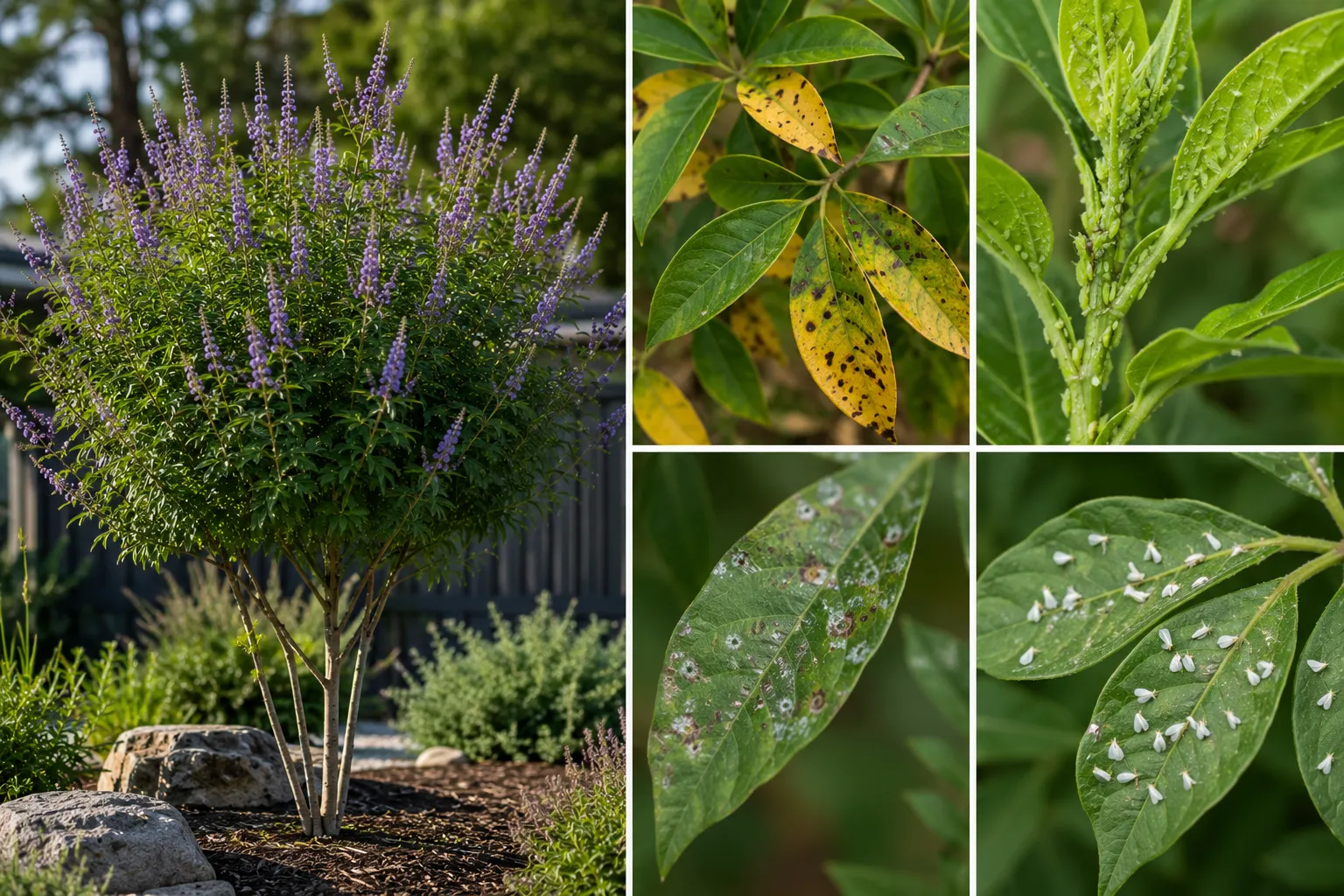
- Root rot: Yellow leaves that drop early signal overwatering or poor drainage. Root rot develops in soil that stays wet for more than 3 days. Fix drainage at planting and reduce watering frequency. Root rot cannot be reversed — remove and replace the tree.
- Leaf spot: Brown or tan circular spots on leaves appear in humid conditions. Remove affected leaves and improve air circulation through thinning cuts. Leaf spot rarely kills Vitex — it is cosmetic in most cases.
- Aphids: Sticky honeydew on leaves and distorted new growth indicate aphid colonies on new shoots. Knock aphids off with a strong jet of water first. Apply neem oil spray if infestation persists after 2 jet treatments.
- Whiteflies: Clouds of tiny white insects rising when foliage is disturbed signal whitefly pressure. Apply neem oil spray at dawn or dusk, covering the undersides of leaves where whiteflies feed.
Inspect Vitex monthly from April through September. Early treatment with neem oil controls most pest pressure before it becomes damaging. Vitex treated well never requires systemic pesticides.
5 Vitex Cultivars and Their Ideal Growing Zones
Choose a Vitex cultivar by mature size and flower color. All 5 cultivars listed here share the same core care requirements — only mature size and cold tolerance differ.
| Cultivar | Height | Flower Color | Zones | Best Use |
| Shoal Creek | 12–15 ft (3.7–4.5 m) | Blue-purple | 6–9 | Specimen, screen |
| Montrose Purple | 20–25 ft (6–7.6 m) | Deep purple | 7–9 | Focal point, shade |
| Blue Diddley | 5–6 ft (1.5–1.8 m) | Blue | 6–9 | Foundation, hedge |
| Alba | 12–15 ft (3.7–4.5 m) | White | 6–9 | Mixed borders |
| Blue Puffball | 3–4 ft (0.9–1.2 m) | Blue | 6–9 | Containers, small gardens |
How to Propagate Vitex from Softwood Cuttings
To propagate Vitex, take 4–6 inch (10–15 cm) softwood cuttings from new growth in late spring or early summer. Choose green, flexible stems that snap under firm pressure. Remove all lower leaves, leaving 2–3 leaves at the tip.
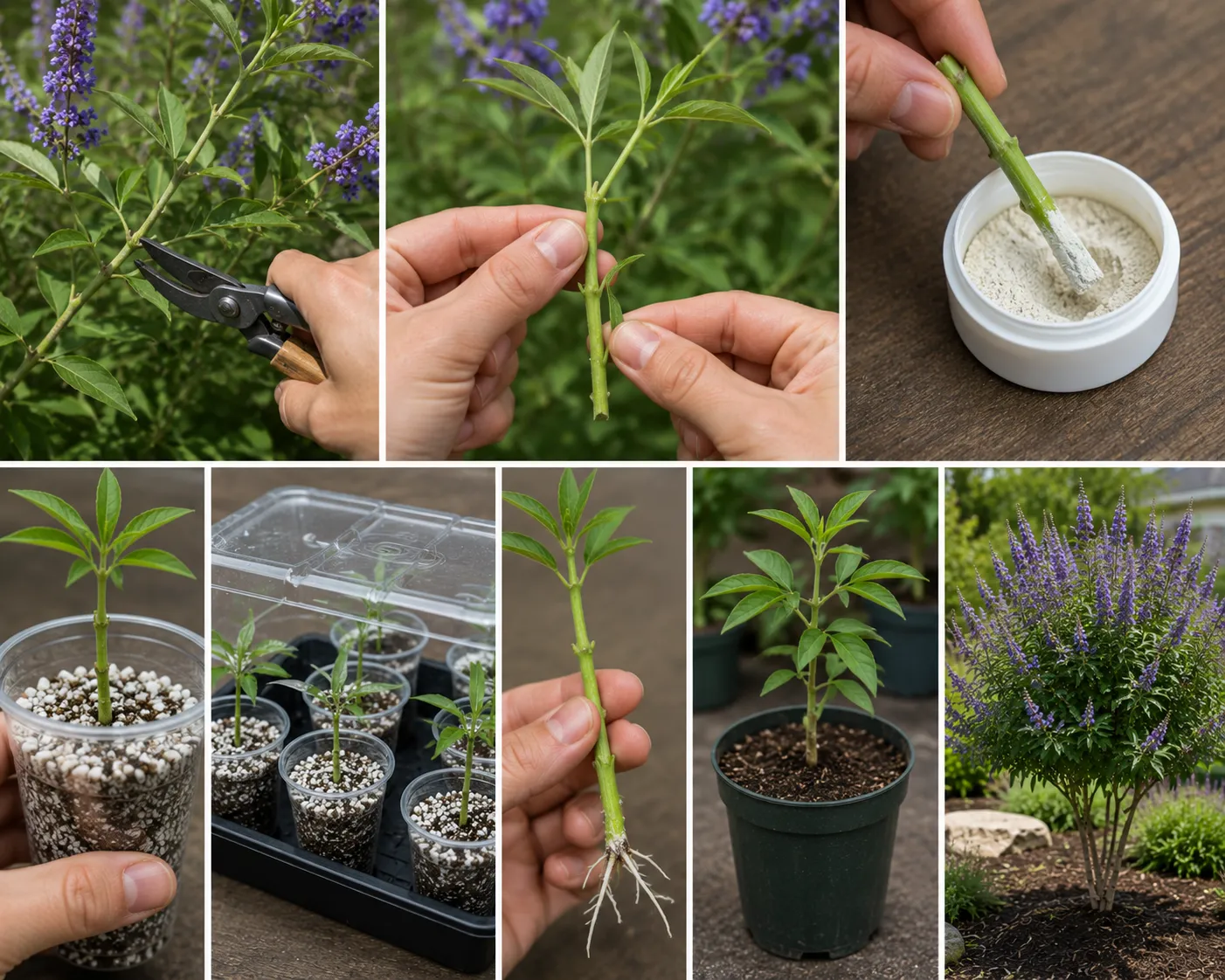
Follow these 5 steps:
- Cut a 4–6 inch (10–15 cm) tip from a green, actively growing stem using disinfected bypass pruners.
- Strip lower leaves from the bottom 2 inches (5 cm) of the cutting.
- Dip the cut end in rooting hormone powder or gel.
- Insert the cutting 2 inches (5 cm) deep into a mix of equal parts perlite and peat moss.
- Keep the cutting in bright indirect light at 70–75°F (21–24°C). Roots develop in 3–6 weeks.
Transplant the rooted cutting into a 4-inch (10 cm) pot with well-draining potting mix once roots reach 1–2 inches (2.5–5 cm) long. Harden the young plant off over 10–14 days before planting outdoors.
The best time to plant rooted cuttings outdoors is early spring in Zones 5–7 or early fall in Zones 8–9.
Frequently Asked Questions About Vitex Tree Care
When should I prune my Vitex tree?
Prune Vitex in late February to early April, depending on your USDA zone. Zones 7–9: prune in late February to mid-March. Zones 5–6: wait until mid-March to early April after the last frost. Annual hard pruning by one-third to one-half triggers the new wood that carries summer blooms.
Why is my Vitex not blooming?
3 causes stop Vitex from blooming: pruning at the wrong time (cutting new wood after May), too much shade (less than 6 hours of sun), or excess nitrogen fertilizer producing foliage instead of flowers. Fix the cause and blooms return the following season.
Is Vitex drought-tolerant?
Yes, established Vitex trees tolerate extended dry periods once their root system develops — typically after 2 full growing seasons. During year 1, water twice per week. In years 2 and beyond, water every 10–14 days from April through October only if rainfall is below 1 inch (2.5 cm) per week.
Can Vitex survive winter in Zone 5?
Yes, Vitex agnus-castus survives Zone 5 winters as a root-hardy perennial. The above-ground stems die back to ground level in hard freezes. Cut dead canes to ground level in early April. New canes emerge from the root crown and bloom by July.
How big does a Vitex tree get?
Mature size depends on the cultivar. Standard varieties like Shoal Creek reach 12–15 feet (3.7–4.5 m) tall and 12 feet (3.7 m) wide. Compact types like Blue Diddley stay at 5–6 feet (1.5–1.8 m). Montrose Purple, the largest cultivar, reaches 20–25 feet (6–7.6 m) tall in Zones 7–9.
Conclusion: Start Your Vitex Care Routine This Season
Vitex tree care comes down to 4 non-negotiable habits: plant in full sun with well-drained soil, prune hard each late winter, water deeply but infrequently, and fertilize 4 times per year.
Vitex rewards the gardener who does less, not more. The 2 biggest mistakes — overwatering and over-fertilizing with nitrogen — both strip the tree of its best quality: summer flowers when nothing else is blooming.
Choose the right cultivar for your space. Blue Diddley at 5 feet (1.5 m) works in foundation plantings. Shoal Creek at 15 feet (4.5 m) anchors a mixed shrub border. Montrose Purple fills the back of a large landscape. Every cultivar delivers the same lavender-blue flower spikes and sage-fragrant foliage from June through September.