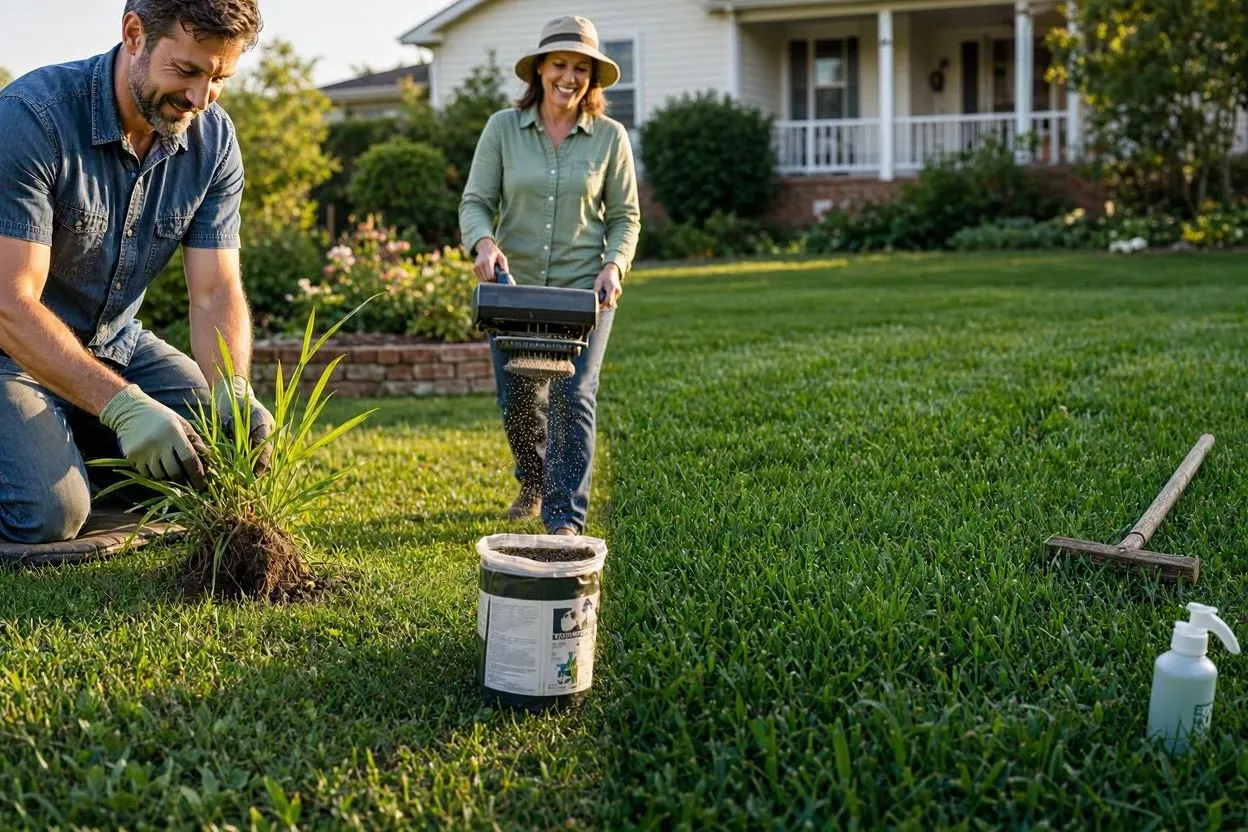
To get rid of crabgrass, kill the plants you see with a selective post-emergent herbicide such as quinclorac or mesotrione, then stop next year’s crop by spreading a pre-emergent when soil reaches 50 to 55°F (10 to 13°C). Crabgrass is an annual. Every plant dies at the first hard frost, yet each one leaves behind thousands of seeds that sprout the following spring, which is why pulling or spraying on its own keeps failing. The best way to get rid of crabgrass pairs a kill step with prevention, plus a fall reseeding of the bare spots the dead plants leave behind. Plan on 2 to 3 seasons before the seed bank in your soil runs low.
Reading this in fall? That works in your favor. Your crabgrass is weeks from dying, and early fall is the one window when you can claim that ground with new grass before next spring’s seedlings arrive.
What Is Crabgrass, and Why Has It Taken Over Your Lawn?
Crabgrass is a warm-season annual grass that moves into thin, sunny, bare turf and reseeds itself every year. Two species cause most of the trouble across the USA and Canada: smooth crabgrass (Digitaria ischaemum) and large, or hairy, crabgrass (Digitaria sanguinalis). Both sprout in spring, sprawl through July and August, and set seed until frost.
The seed is the real problem. A crabgrass lawn that looks clean after frost still holds a soil seed bank that stays viable for several years, so one skipped season restarts the cycle.
How to Identify Crabgrass Before You Treat It
To identify crabgrass, look for light green, wide blades that radiate flat from a central crown, topped by finger-like seed heads from midsummer on. Misidentification wastes money fast. Goosegrass, for example, gets mistaken for crabgrass constantly, and quinclorac barely touches it.
| Weed | Life cycle | Key ID feature | Does a crabgrass killer work? |
| Crabgrass | Annual | Flat, star-shaped clump; lighter green than turf; finger-like seed heads | Yes |
| Goosegrass | Annual | Silvery-white center; tough, flattened stems; sprouts a few weeks later | Partly (mesotrione or topramezone, not quinclorac) |
| Tall fescue clumps | Perennial | Coarse, dark blades; green in early spring before crabgrass sprouts | No |
| Quackgrass | Perennial | Claw-like auricles at the leaf base; white spreading rhizomes | No |
| Nimblewill | Perennial | Thin, wiry blades; tan patches through winter; greens up late | Mesotrione only |
| Dallisgrass | Perennial (South) | Coarse clumps; seed heads dotted with dark specks | No |
A quick check: if the “crabgrass” is green in March, it isn’t crabgrass.
5 Reasons Crabgrass Is Taking Over Your Lawn
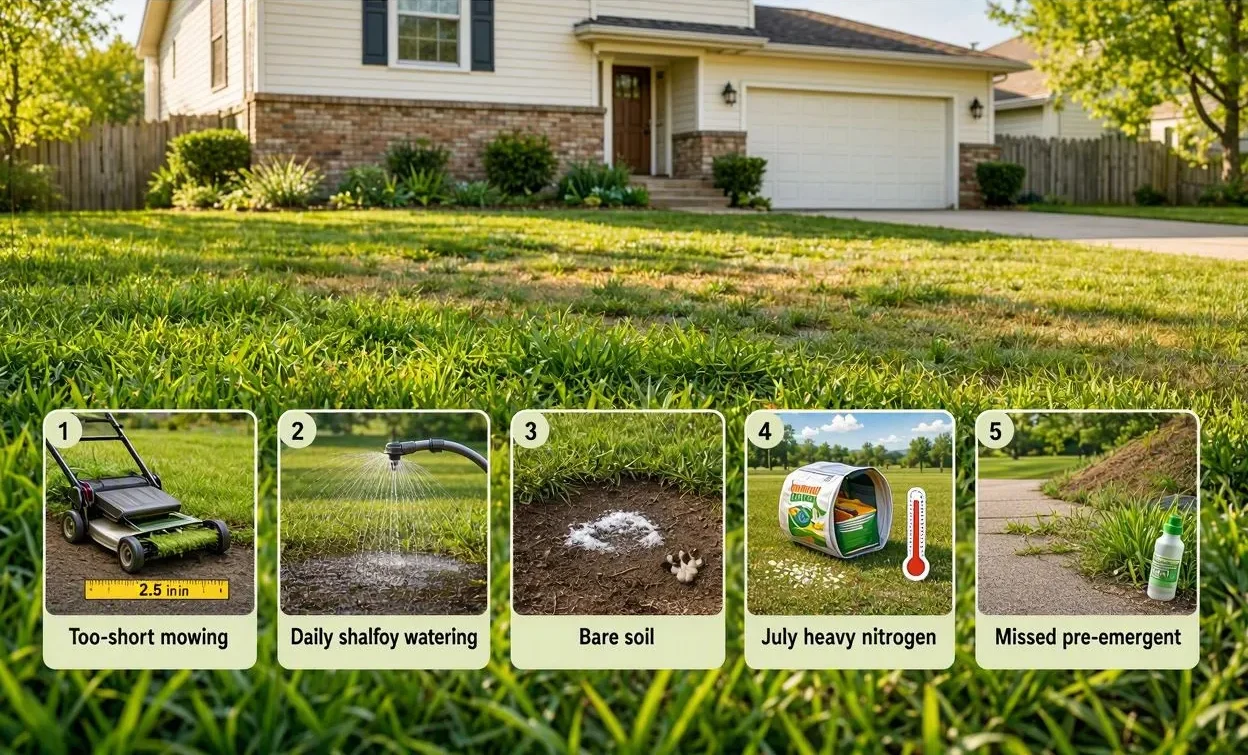
Crabgrass takes over lawns where sunlight reaches bare soil in late spring. Five habits open that door most often:
- Mowing below 2.5 inches (6 cm), which lets sun warm the soil surface.
- Watering lightly every day, which favors shallow-rooted crabgrass over turf.
- Leaving bare spots from winter damage, dog urine, or salt open in spring.
- Feeding cool-season grass heavy nitrogen in July heat, when crabgrass uses it better than bluegrass does.
- Skipping or mistiming pre-emergent, especially along driveways and south-facing slopes that warm up 1 to 2 weeks early.
A yard full of crabgrass usually traces back to 2 or more of these at once.
How to Get Rid of Crabgrass: Match the Method to the Season
To choose the right method, match it to the plant’s growth stage, because a tactic that works in May fails in September. Most advice on how to rid lawn of crabgrass assumes it’s spring. It rarely is when crabgrass gets noticed.
| Season | What crabgrass is doing | Best action | Avoid |
| Early spring | Seeds dormant; soil warming | Pre-emergent at 50-55°F (10-13°C) soil temperature | Seeding the same area with most pre-emergents |
| Late spring to early summer | Seedlings at 1-4 leaves | Hand-pull; dithiopyr or mesotrione | Waiting until plants tiller |
| Mid to late summer | Tillering; seed heads forming | Quinclorac spot spray; bag clippings | Summer nitrogen on cool-season turf |
| Fall | Seeded out; dying at frost | Clear dead mats; overseed; plan spring | Dormant-seeding spots you’ll treat with preventer |
Stage matters more than product choice. A herbicide that kills a 3-leaf seedling in 10 days often just yellows a 12-inch (30 cm) clump in August.
How to Kill Crabgrass Without Killing Grass
To kill crabgrass without killing grass, spray a selective post-emergent herbicide labeled for your turf species, since what will kill crabgrass in a bluegrass lawn can wreck St. Augustine. Selective products target grassy weeds while sparing desirable turf, but only the species listed on the label. That label is the whole answer to how to get rid of crabgrass without killing grass.
Non-selective herbicides such as glyphosate kill everything green. They’re useful for clearing a solid patch before reseeding, never for scattered plants in good turf.
What Will Kill Crabgrass but Not Grass?
Quinclorac, mesotrione, and topramezone kill crabgrass but not most cool-season grasses, and quinclorac spares Bermuda and zoysia as well. What to use to kill crabgrass depends on 2 things: your grass type and whether you plan to seed.
| Active ingredient | Example products | Best crabgrass stage | Tolerant grasses | Do not use on | Seeding note |
| Quinclorac | Drive XLR8, many homeowner “crabgrass killer” sprays | Up to about 5 tillers with methylated seed oil | Kentucky bluegrass, tall fescue, perennial ryegrass, Bermuda, zoysia | St. Augustine, centipede, bahiagrass, carpetgrass | Follow the label’s interval by seed species |
| Mesotrione | Tenacity | Under 4 tillers; 2 applications | Kentucky bluegrass, tall fescue, perennial ryegrass | Bermuda, zoysia, new fine fescue seedings | Labeled at seeding on bluegrass, tall fescue, ryegrass |
| Topramezone | Pylex (professional) | Under 4 tillers | Most cool-season turf | Bermuda | Before seeding or 28 days after |
| Dithiopyr | Dimension | Before tillering | Most cool- and warm-season turf | Check label | Blocks grass seed |
Mesotrione has a signature look. Treated crabgrass turns bright white for 2 to 3 weeks, then collapses.
How to Spray Crabgrass for the Best Kill
To spray crabgrass for the best kill, treat young, actively growing plants with the surfactant the label calls for, then repeat on schedule. Skipping the follow-up is the most common reason a second flush survives.
- Confirm the weed is crabgrass, not goosegrass or a perennial.
- Skip mowing for 2 days before and after spraying so the plant has leaf to absorb product.
- Spray when air temperatures sit between 60 and 85°F (16 and 29°C) and no rain is forecast within the label’s rain-free window.
- Add methylated seed oil to quinclorac or a nonionic surfactant to mesotrione.
- Repeat quinclorac after 14 to 21 days, or mesotrione after 2 to 3 weeks.
- Keep kids and pets off treated areas until the spray has dried.
Quinclorac needs 10 to 14 days to kill crabgrass. Don’t respray on day 5 because the clumps still look green.
How Do You Remove Crabgrass by Hand?
To remove crabgrass by hand, pull young plants at the crown after rain or a deep watering, lifting the whole root mass, then drop grass seed into the hole. Hand-pulling is the best way to remove crabgrass when you’re dealing with a few dozen plants, not a few thousand.
Timing makes it easy or miserable. Seedlings in their first 1 to 2 weeks slide out cleanly, while an August clump with rooted stems takes a forked weeder and several minutes. Use a claw-style weeder for anything past the 4-leaf stage, and bag every plant you pull if seed heads are showing.
Here’s the math that decides it. On a 5,000 sq ft (465 m²) lawn with scattered crabgrass, pulling works in an afternoon. Once crabgrass has taken over your lawn in solid patches, pulling just tears open bare soil for next spring’s seed.
What to Do When Crabgrass Is Going to Seed
When crabgrass is going to seed, bag your clippings, spot-treat the largest clumps with quinclorac, and shift your effort toward fall reseeding and spring prevention. Mature plants resist most herbicides. Quinclorac with seed oil still handles larger crabgrass, while mesotrione and dithiopyr lose most of their punch after tillering.
A freshly mowed crabgrass lawn hides the problem. Crabgrass adapts to low mowing by flattening out and pushing seed heads below the mower blade, so cutting shorter only feeds it more light.
Crabgrass gone to seed changes the goal. The seeds from this year are already in the soil, and nothing you spray now removes them, so stop fighting this season’s plants and start protecting next season’s lawn. Pulling seed-laden plants without bagging them scatters thousands of seeds across clean turf.
How to Get Rid of Crabgrass in Fall and Fix the Bare Spots
In fall, let frost finish off scattered crabgrass, but kill and clear large patches that would block new seed, then overseed cool-season lawns at least 45 days before your first frost. That’s the step every competitor skips, and it’s the difference between bare mud in April and a thick lawn that shades crabgrass out.
If you’ve been asking, “How can I kill crabgrass in my lawn this late in the year?”, the answer depends on whether you’re reseeding. For patches you’ll seed, you have 3 options:
- Spray mesotrione, which is labeled for use at seeding on Kentucky bluegrass, tall fescue, and perennial ryegrass.
- Spray quinclorac, then wait the label’s interval for your seed species before sowing.
- Spray glyphosate on solid patches, since it leaves no active residue in soil and seeding can follow within days.
After the kill, scalp the dead crabgrass with a string trimmer or rake it out so seed reaches soil. Sow at the bag rate, add starter fertilizer, and keep the top 1 inch (2.5 cm) of soil moist until germination.
Take a common scenario. Crabgrass took over my lawn in a 400 sq ft (37 m²) back corner of a Kentucky bluegrass yard in Ohio: that corner gets glyphosate in early September, a trim and rake 7 days later, and bluegrass-ryegrass seed by mid-September. By late October, it’s mowable turf.
Too late for fall seeding in your area? Dormant seeding in late fall or winter beats waiting until spring. Just don’t spread a standard crabgrass preventer on those dormant-seeded spots next spring, because it’ll stop your grass seedlings too.
How to Prevent Crabgrass Next Spring
To prevent crabgrass next spring, apply a pre-emergent herbicide before seeds germinate and water it into the soil within 3 to 5 days. Pre-emergents don’t kill seeds sitting in the soil. They form a barrier that kills seedlings as they sprout, which is why timing decides everything.
When to Apply Crabgrass Preventer
Apply crabgrass preventer when soil at a 2-inch (5 cm) depth holds 50 to 55°F (10 to 13°C) for 3 to 5 days, usually as forsythia drops its blooms and redbuds start to color. Calendar dates vary widely by region:
| Region | Typical application window |
| Gulf Coast and Deep South | Mid-February to early March |
| Mid-Atlantic and transition zone | Mid-March to early April |
| Midwest and Northeast | April |
| Northern USA and southern Canada | Late April to mid-May |
| Prairies | Mid-May |
Use a soil thermometer or a free soil temperature map instead of the calendar. Growing degree day (GDD) models do the same job with more precision in cold springs. Water in the product with ½ inch (13 mm) of rain or irrigation within 3 to 5 days.
Which Pre-Emergent Should You Use?
Use prodiamine or dithiopyr on most established lawns, siduron or mesotrione when you’re seeding in spring, and corn gluten meal when provincial rules or organic goals rule out synthetics.
| Pre-emergent | Main strength | Main limitation |
| Prodiamine | Longest residual; ideal for split applications | Blocks grass seed; no effect on sprouted crabgrass |
| Dithiopyr | Kills young crabgrass until it tillers | Blocks grass seed |
| Pendimethalin | Widely sold in weed-and-feed products | Shorter residual; stains concrete yellow |
| Siduron | Safe at spring seeding | Short residual; hard to find |
| Mesotrione | Pre- and post-emergent activity at seeding | Not for most warm-season lawns |
| Corn gluten meal | Organic; roughly 10% nitrogen | Weak in year 1; delays grass seed |
Split applications close the late-season gap. Put down half the label rate at the usual timing and the second half 6 to 8 weeks later, so the barrier lasts through the July flush.
5 Reasons Your Pre-Emergent Failed
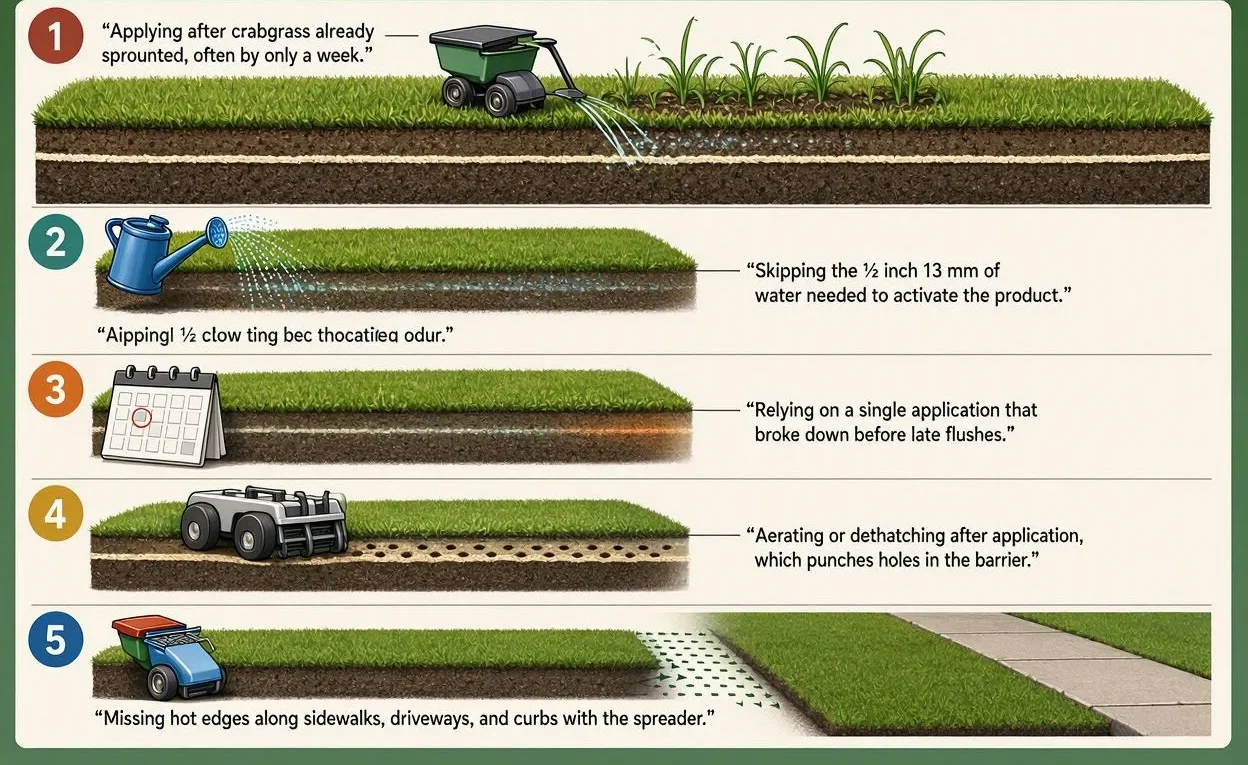
Pre-emergent fails when the barrier isn’t in place or intact during germination. Five causes account for nearly every failure:
- Applying after crabgrass already sprouted, often by only a week.
- Skipping the ½ inch (13 mm) of water needed to activate the product.
- Relying on a single application that broke down before late flushes.
- Aerating or dethatching after application, which punches holes in the barrier.
- Missing hot edges along sidewalks, driveways, and curbs with the spreader.
How to Get Rid of Crabgrass Naturally
To get rid of crabgrass naturally, combine spring corn gluten meal, hand-pulling, and solarization for large patches with turf habits that keep soil shaded. Organic control works, but slowly. Corn gluten meal needs 2 to 3 years of repeat applications at about 20 lb per 1,000 sq ft (9.8 kg per 100 m²) before results match synthetic products.
Solarization handles the worst patches. Mow the area to the soil, soak it, and cover it with clear plastic during the hottest 4 to 6 weeks of summer, then reseed or sod.
Cultural habits do most of the long-term work:
- Mow at 3 to 4 inches (7.5 to 10 cm) for tall fescue and bluegrass.
- Water deeply to 1 inch (25 mm) per week, wetting soil 4 to 6 inches (10 to 15 cm) down.
- Fertilize cool-season lawns mainly in fall rather than in summer heat.
- Overseed thin areas every fall until the turf stays dense.
Skip the kitchen remedies. Boiling water and vinegar burn the grass around the crabgrass, and neither one reliably reaches the seed bank.
Crabgrass Control in Canada: What Is Legal Where
Canadian homeowners can use crabgrass products registered by Health Canada’s Pest Management Regulatory Agency (PMRA) unless their province restricts them, and Ontario bans cosmetic use of most synthetic lawn herbicides. Ontario’s ban has applied since April 2009. Only active ingredients on the province’s Allowable List can be used on lawns, and the rule covers homeowners and licensed applicators alike.
For an Ontario crabgrass lawn, that means corn gluten meal in late March or early April, dense fall overseeding, and hand removal. Quebec and several Atlantic provinces run their own restrictions, so check your provincial list before buying. Across the Prairies and most of Canada, pre-emergent timing lands in May, not April.
How to Treat Crabgrass in Warm-Season Lawns
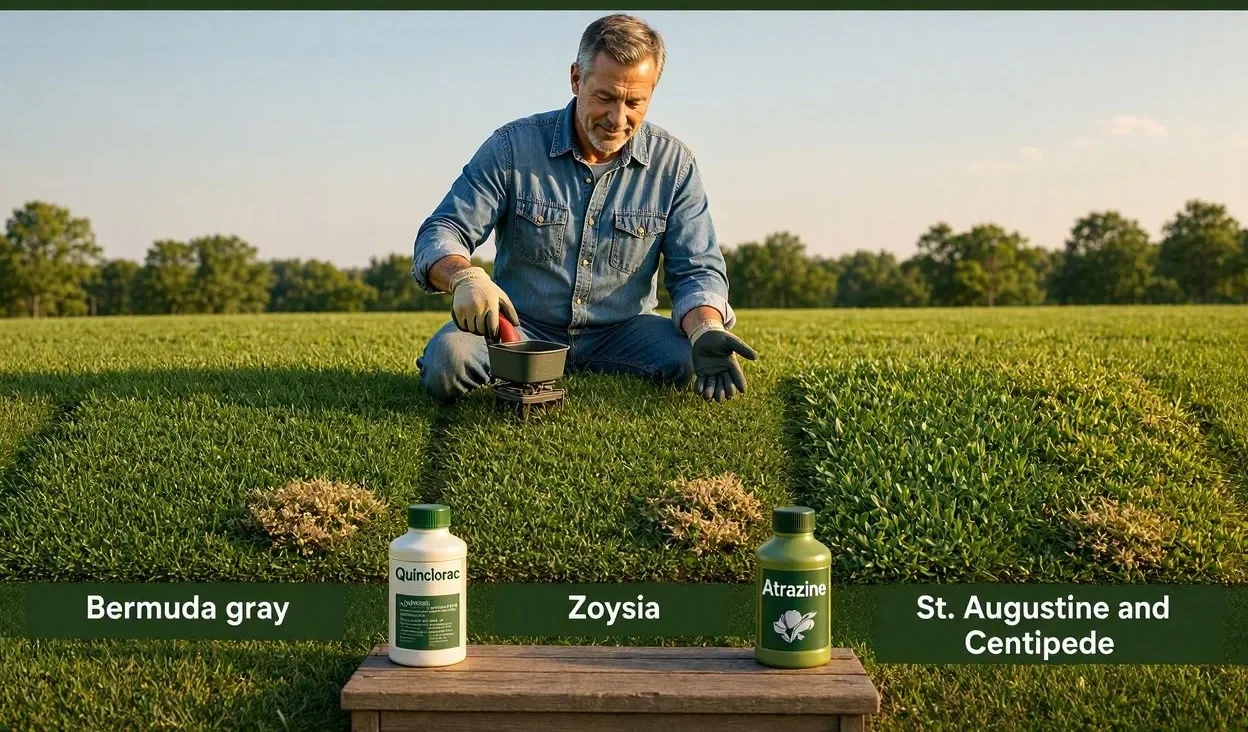
To treat crabgrass in warm-season lawns, match the product to your grass: Bermuda and zoysia tolerate quinclorac, while St. Augustine and centipede need products labeled for them, such as atrazine. How to treat crabgrass in the South comes down to reading that species list.
Pre-emergent carries most of the load on warm-season turf. Prodiamine or dithiopyr applied in February across the Gulf states, with a split application about 8 weeks later, stops the bulk of crabgrass before it starts. Avoid crabgrass sprays combined with 2,4-D during peak summer heat, since the combination can burn warm-season grasses.
FAQs
Does crabgrass die in winter?
Yes. Crabgrass dies at the first hard frost because it’s an annual. Its seeds survive winter in the soil, though, and sprout once spring soil warms past 55°F (13°C).
Can you overseed after using crabgrass killer?
Yes, with timing that depends on the active ingredient. Mesotrione allows seeding the same day on cool-season grasses, while quinclorac labels set waiting periods by seed species.
Will mowing get rid of crabgrass?
No. Low mowing helps crabgrass by letting sunlight reach the soil. Cutting cool-season turf at 3 to 4 inches (7.5 to 10 cm) shades out new seedlings instead.
Can you pull crabgrass after it goes to seed?
Yes, but bag every plant immediately. Shaking mature clumps scatters seed across clean turf, so fall reseeding and spring pre-emergent matter more at that stage.
Is crabgrass killer safe for pets?
Yes, once the spray has fully dried and the label’s re-entry directions are followed. Keep dogs and cats off treated grass until then, and store concentrates out of reach.
Conclusion
Crabgrass won’t disappear after one spray, and it doesn’t need to. Kill what’s growing this season with a product labeled for your grass, fill the gaps with seed in early fall, and put down pre-emergent when spring soil hits 50 to 55°F (10 to 13°C). Stick with that cycle for 2 to 3 years. A thick, tall, well-fed lawn does the rest.