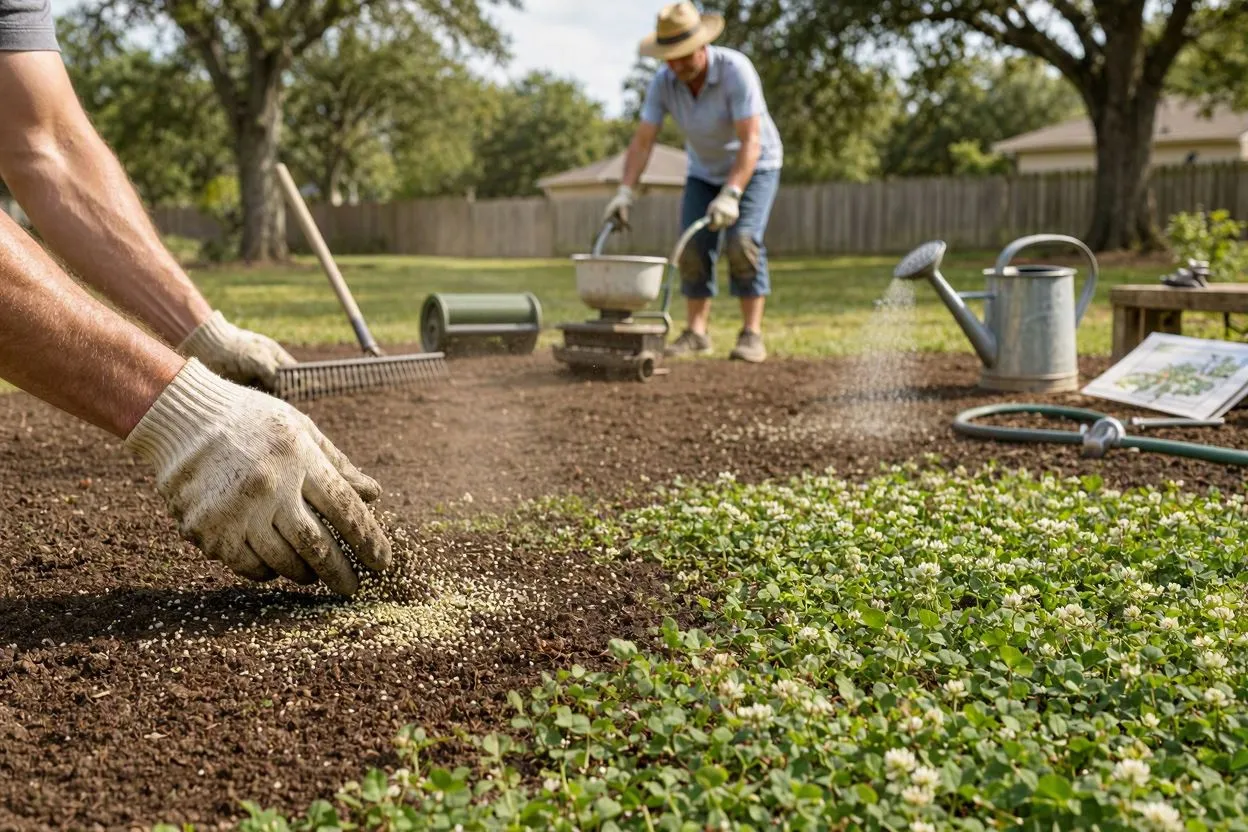
To plant a clover lawn, sow white Dutch clover at 4 to 8 ounces (113 to 227 g) per 1,000 square feet (93 m²) on bare soil, press it in no deeper than ⅛ to ¼ inch (3 to 6 mm), and keep the surface moist until sprouts appear. Plant in early spring or late summer, and expect germination in 7 to 14 days.
Clover isn’t fussy. Seed that dies usually fails for one of 3 small reasons: soil pH below 6.0, seed buried too deep, or a weed-and-feed product put down a few weeks before sowing. Anyone learning how to plant clover lawn seed for the first time can dodge all three with about an hour of prep. What follows covers every step for US yards in USDA Hardiness Zones 3 to 10, with seed rates, regional planting windows, and an honest look at the drawbacks.
Clover Lawn or Clover-Grass Mix: Which One Fits Your Yard?
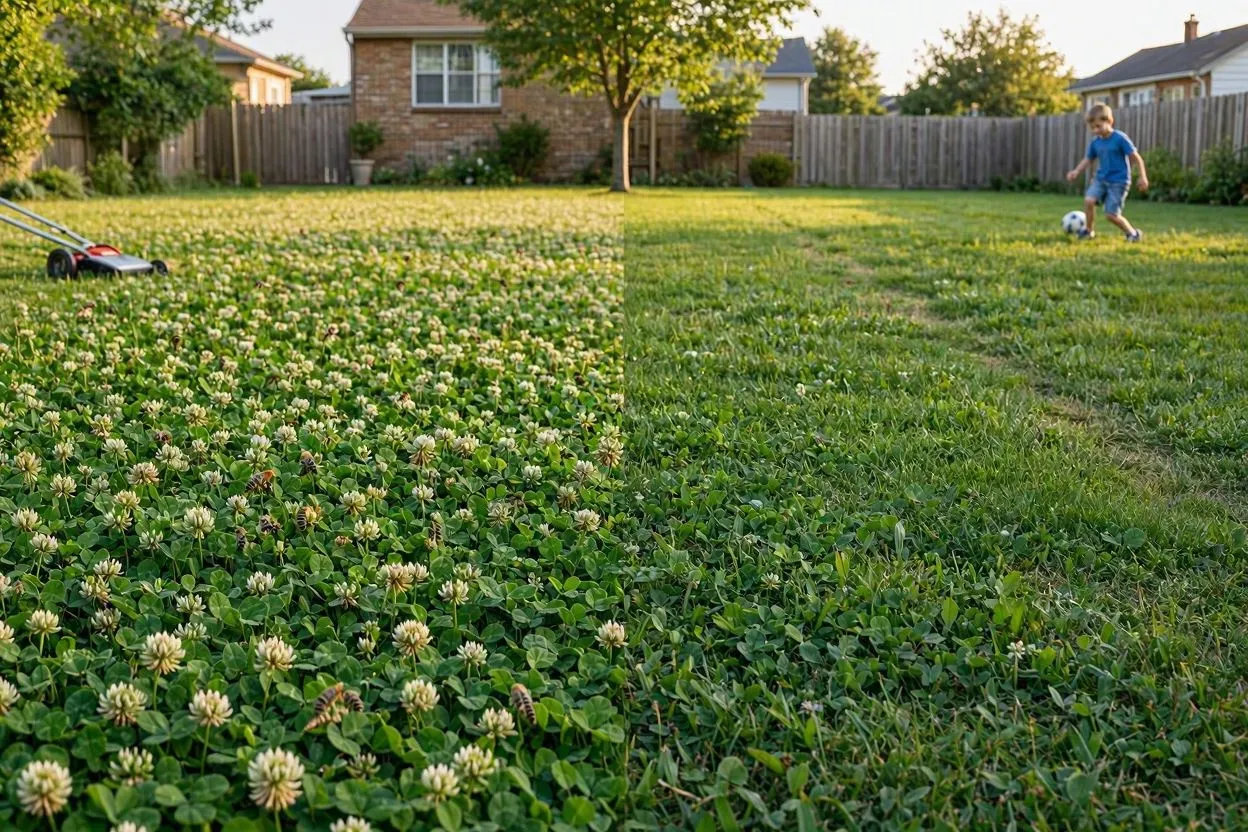
A clover-grass mix suits most households, while a pure clover lawn fits low-traffic yards where the goals are pollinators and minimal mowing. Pure clover looks softer and greener in drought, but it wears down faster under daily play.
Clover wears down faster than tough turf such as tall fescue or Bermudagrass, and it can brown or thin out during hard winters in cold zones. Mixing it into existing grass covers that weakness. The grass handles foot traffic. The clover feeds the grass nitrogen and fills bare patches.
Consider 2 quick scenarios. A family with two kids and a Labrador running laps every afternoon should overseed clover into the grass rather than replace it. A retired couple converting a sunny side yard nobody walks on can go all clover and let it bloom for bees.
| Factor | Pure Clover Lawn | Clover-Grass Mix |
| Foot traffic | Light | Moderate to heavy |
| Mowing | 2 to 4 times per year | Every 1 to 3 weeks |
| Fertilizer | None | Little to none |
| Look | Flowers, soft texture | Traditional lawn with green patches |
| Best for | Side yards, pollinator areas | Family yards, play areas |
Which Clover Is Best for a Lawn?
White Dutch clover (Trifolium repens) and microclover are the 2 best clovers for lawns. Both are low-growing perennials that spread by creeping stems called stolons. Red clover and crimson clover grow too tall for mowed turf and belong in meadows instead.
Microclover is a dwarf selection of white clover. It has leaves under half the size of standard Dutch white, and it blooms less, so it blends into grass and draws fewer bees near bare feet. ‘Pirouette’ is one tested microclover cultivar used in Virginia research on tall fescue lawns. White Dutch costs far less and flowers heavily, which makes it the better pick when pollinators matter most.
| Variety | Height | Flowers | Best Use | Traffic Tolerance |
| White Dutch clover | 4 to 8 in (10 to 20 cm) | Heavy | Pure clover lawns, pollinator yards | Low to moderate |
| Microclover | 3 to 6 in (8 to 15 cm) | Light | Overseeding grass, tidy lawns | Moderate (mixed with grass) |
| Red clover | Up to 24 in (60 cm) | Heavy, pink | Meadows only | Low |
| Crimson clover | 12 to 20 in (30 to 50 cm) | Heavy, red | Cover crops, meadows | Low |
Bob Vila contributor and Master Gardener Lauren Landers sowed Dutch white, crimson and red clover together, then concluded she’d plant only white clover next time because the other two grow tall and suit meadows better. That’s a lesson worth learning before buying seed rather than after.
When Is the Best Time to Plant a Clover Lawn?
The best time to plant a clover lawn is early spring or late summer to early fall, when soil temperatures sit between 50 and 65°F (10 and 18°C). Clover seed starts germinating once soil reaches about 55°F (13°C), and fall sowing works when it’s done 6 to 8 weeks before the first hard frost.
Region shifts those windows. Southern yards get two windows, late winter to early spring and late summer to early fall; northern yards plant from late winter to early spring, or once nighttime temperatures hold at 40°F (4°C) or higher.
| US Region | USDA Zones | Spring Window | Fall Window |
| Northern states (Minnesota, Maine, Montana) | 3 to 5 | Late April to May | Mid-August to early September |
| Mid-Atlantic and Midwest (Ohio, Virginia, Missouri) | 6 to 7 | March to April | Late August to September |
| Southeast and Gulf (Georgia, Texas, Louisiana) | 8 to 9 | February to March | September to October |
| Desert Southwest (Arizona, Southern California) | 9 to 10 | February | October to November, with irrigation |
Summer heat kills seedlings. Landers sowed in late autumn by accident, and her clover still came back in spring, but she’d choose spring next time for better germination and less watering. Skip July in every region unless you’re ready to water twice a day.
How Much Clover Seed Do You Need?
You need 4 to 8 ounces (113 to 227 g) of white Dutch clover per 1,000 square feet (93 m²) for a pure lawn, and 1 to 4 ounces (28 to 113 g) to overseed existing grass. Rates change with variety and shade, so check the table before buying.
| Planting Goal | Seed Type | Rate per 1,000 sq ft (93 m²) |
| Pure clover lawn | White Dutch | 4 to 8 oz (113 to 227 g) |
| Pure clover lawn, partial shade | White Dutch | 8 to 16 oz (227 to 454 g) |
| Overseed existing grass | White Dutch | 1 to 4 oz (28 to 113 g) |
| Pure clover lawn | Microclover | 1 to 2 lb (454 to 907 g) |
| Overseed existing grass | Microclover | 2 to 8 oz (57 to 227 g), per label |
| New grass lawn with clover | Microclover | 3 to 5% of grass seed weight |
Doubling the white Dutch rate in partial shade improves germination where sunlight is limited. For new lawns, University of Maryland Extension advises mixing microclover at 3 to 5% by weight into tall fescue seed, which works out to roughly 0.2 to 0.3 pounds of clover with 6 pounds of fescue.
More isn’t better when overseeding. Fairfax Master Gardeners found that seeding ‘Pirouette’ microclover above 10% by weight lets it take over the stand. A single pound holds about 800,000 white clover seeds, so a small bag goes a long way.
How to Plant Clover Lawn in 8 Steps
To plant a clover lawn, fix the soil pH, clear competing weeds, then sow shallow, well-spread seed into moist, loosened ground. Each step below takes less than a day, and most take under an hour on a typical 5,000-square-foot (465 m²) yard.
1. Test Your Soil and Adjust pH
To test soil for clover, send a sample to your state’s Cooperative Extension office and aim for a pH between 6.0 and 7.0. Penn State Extension notes that white clover grows best in cool, moist weather on well-drained, fertile soil in that pH range.
Acidic soil needs lime. University of Maine Extension advises applying lime at least two weeks before planting. Give it far longer if the reading is well below 6.0: Texas A&M’s AggieClover guide suggests testing 6 months ahead in that case so lime has time to raise the pH. Most state labs charge $15 to $30 for a basic test, and results arrive within 2 weeks.
2. Clear Weeds and Stop Herbicides
To clear weeds before planting, pull or dig them by hand and stop all broadleaf weed killers one full season ahead. University of Kentucky forage specialists warn that most herbicides damage clover seedlings, so weeds are best controlled the season before seeding.
Pre-emergents are the other trap, since they stop clover seed before it ever sprouts. Read the label on any “weed and feed” bag you’ve used this year, because products containing 2,4-D, dicamba or MCPP target broadleaf plants, and clover is a broadleaf plant.
3. Mow Low and Loosen the Surface
To prepare the surface, mow existing grass to about 1 to 2 inches (2.5 to 5 cm) and rake out thatch until bare soil shows through. Clover seed is too fine to reach soil through dense grass or a thick thatch layer, and skipping this step is the top cause of patchy results.
Bare-ground projects need a little more work. Loosen the top ½ inch (1.3 cm) with a hard rake, and spread ¼ inch (6 mm) of compost over poor or compacted spots. Tilling isn’t required.
4. Use Inoculated Seed
To make sure clover fixes nitrogen, buy pre-inoculated seed or coat raw seed with a Rhizobium inoculant labeled for clover. University of Maine Extension strongly advises seed inoculated with Rhizobium trifolii bacteria. These bacteria form nodules on clover roots and turn nitrogen from the air into plant food.
Check the bag before buying. Many clover seeds come pre-inoculated, often sold as “coated” seed. Inoculant powder costs a few dollars and stays viable only until the date printed on the package.
5. Mix Seed With Sand
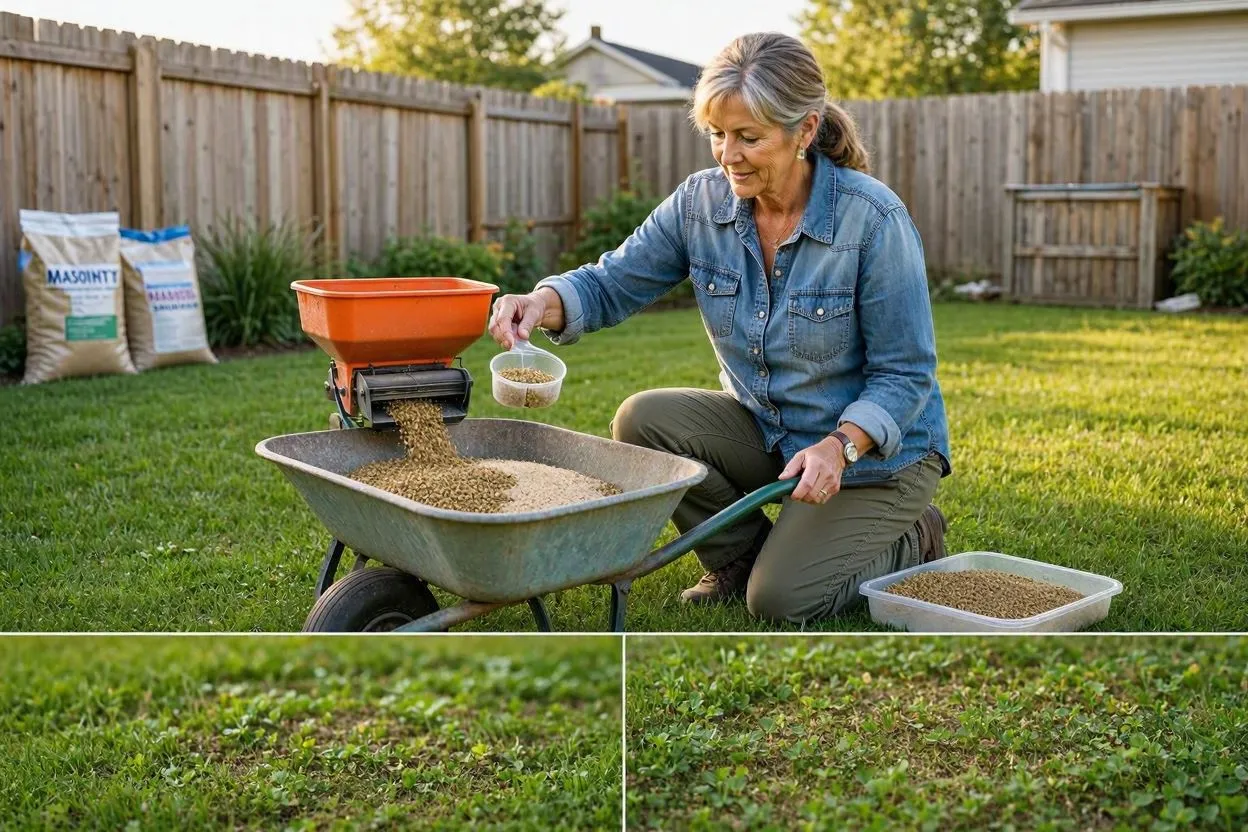
To spread tiny clover seed evenly, blend it with an equal amount of dry sand. The added bulk lets a standard grass-seed spreader drop seed at an even rate. Play sand or masonry sand both work.
It’s the fix for a problem that shows up in real yards. Barb Young of The Big Little Garden in Nashua, New Hampshire, hand-sowed 2 pounds (907 g) over her backyard and could still see where the hand sprinkling was uneven once the sprouts came up.
6. Spread Seed in Two Passes
To get full coverage, split the seed-sand mix in half and spread one half walking north to south, then the other walking east to west. A broadcast spreader set to its lowest opening handles it, and so does a hand-crank spreader for yards under 2,000 square feet (186 m²).
Watch the edges. Bare patches near fences and walkways get skipped most often, so give those spots a light second toss by hand.
7. Press Seed In Without Burying It
To set the seed, rake very lightly, then walk over the area or roll it with an empty lawn roller. Clover seed needs light to germinate, and some seed should still be visible after raking.
Depth kills more clover than drought does. Anything deeper than ¼ inch (6 mm) cuts germination sharply, so resist the urge to top-dress with soil after sowing.
8. Water Lightly Until Sprouts Appear
To germinate clover seed, keep the top ½ inch (1.3 cm) of soil damp, not soaked, for the first 10 to 14 days. Two to three light waterings a day during that period work well, and short sprinkler cycles of 5 to 10 minutes prevent seed from washing away.
Irrigation systems make this easy. Young ran her backyard sprinkler zone twice daily for a week and saw sprouts in under 10 days. Once most seedlings show 2 to 3 true leaves, cut back to one deeper watering every few days.
How to Frost Seed Clover in Late Winter
To frost seed clover, broadcast it over dormant lawn in late winter while the ground freezes at night and thaws during the day. University of Missouri Extension notes that natural freeze-thaw cycles work the seed into the soil with minimal disturbance. No raking or rolling is needed.
Timing depends on latitude. Missouri growers broadcast in February, while Michigan State Extension targets mid-March to early April, after snow has melted. Penn State Extension rates red, white and sweet clover as the most successful species for this method.
Frost seeding suits Zones 4 to 7 best. It saves hours of prep, but germination runs lower than spring sowing into raked soil, so use the upper end of your seed rate range.
What Happens in the First Year?
A clover lawn sprouts in 1 to 2 weeks, handles its first mowing at about 3 weeks, and usually fills in fully by the second summer. Weather and seed rate shift that timeline by a few weeks either way.
| Time After Seeding | What You’ll See |
| 7 to 14 days | First sprouts, often with just 2 rounded seed leaves |
| 3 weeks | Seedlings sturdy enough for a first high mow |
| 2 to 3 months | Visible green patches, gaps between plants |
| 12 months | Around 70% coverage in sunny areas |
| 2nd summer | Clover dominant in most of the lawn |
Real yards back up those numbers. Young mowed at the 3-week mark and found clover had mostly taken over by the second summer. Yue, who writes Sensible Sustainability, saw her first batch germinate in 7 days after an April sowing and estimated 70% or more of the lawn was covered at her one-year update. She’d also noticed in October that the clover stayed green while warm-season St. Augustine grass had begun to brown.
Northern gardeners should know one quirk. In cold climates, clover foliage dies back to the ground over winter while the roots stay alive. A brown lawn in January isn’t a dead lawn.
How to Care for a New Clover Lawn
To care for a new clover lawn, mow high, skip nitrogen fertilizer, and overseed thin spots every 2 to 3 years. Clover needs far less attention than turfgrass once it’s rooted.
Mowing is flexible. Keep the deck at 3 to 4 inches (7.5 to 10 cm) for a tidy look, or let it grow and bloom for bees. Landers mows only once in midsummer after the flowers fade, then again a few weeks before fall frosts.
Fertilizer does more harm than good. Nitrogen feeding interferes with clover’s own biological nitrogen fixation, and extra nitrogen favors grass, which crowds clover out. Phosphorus and potassium are fine when a soil test calls for them.
Reseeding keeps a clover lawn dense. Penn State describes white clover as a short-lived perennial that reseeds under the right conditions, and Landers now sows smaller amounts of seed every 2 to 3 years to fill empty spaces. Spring is the easiest time to do it.
Clover Lawn Pros and Cons
Clover lawns save water, fertilizer and mowing time, but they handle heavy traffic poorly and attract bees when they flower. Weigh both columns against how you use the yard.
| Pros | Cons |
| Adding microclover to tall fescue cuts the lawn’s yearly nitrogen needs by 1 to 2 pounds per 1,000 sq ft (about 0.5 to 1 kg per 100 m²) | Wears down under daily sports or dog runs |
| Stays green through summer drought | Flowers draw bees, a risk for anyone with a sting allergy |
| Holds up better to pet urine than turfgrass | Browns or goes dormant in cold-zone winters |
| Needs 2 to 4 mowings a year as a pure stand | Needs reseeding every 2 to 3 years |
| Feeds bees and butterflies | Killed by common weed-and-feed products |
| Grows in partial shade and poor soil | Some HOAs list clover as a weed |
Rabbits are a mixed bag. Young and Landers both noticed rabbits eating the clover and leaving garden beds alone, which counts as a benefit for most vegetable growers.
How Much Does a Clover Lawn Cost?
A clover lawn costs about $2 to $7 in white Dutch seed per 1,000 square feet (93 m²), or $18 to $56 for pure microclover. White Dutch runs about $8 to $14 per pound, while microclover sells for $18 to $28 per pound.
| Project (5,000 sq ft / 465 m²) | Seed Needed | Approximate Seed Cost |
| Overseed grass with white Dutch | 5 to 20 oz (142 to 567 g) | $5 to $18 |
| Pure white Dutch lawn | 1.25 to 2.5 lb (0.6 to 1.1 kg) | $10 to $35 |
| Overseed grass with microclover | 10 to 40 oz (284 to 1,134 g) | $12 to $70 |
| Pure microclover lawn | 5 to 10 lb (2.3 to 4.5 kg) | $90 to $280 |
Add $15 to $30 for a soil test, a few dollars for inoculant if your seed is raw, and the cost of lime when pH runs low. Water bills drop after the first season, since established clover rarely needs irrigation outside long droughts.
6 Common Clover Planting Mistakes
The 6 most common clover planting mistakes are burying seed, sowing into thatch, using weed killers, over-fertilizing, letting seed dry out, and choosing tall clover species. Each one has a simple fix.
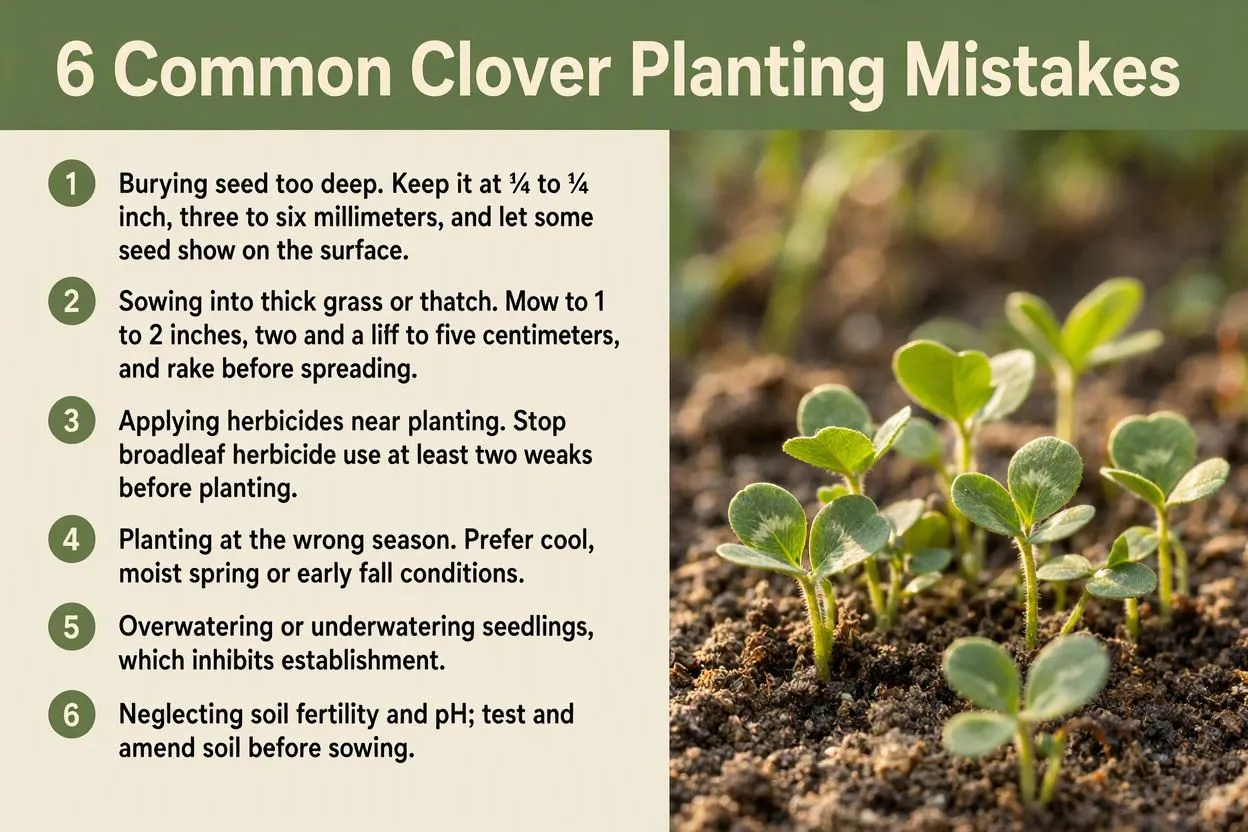
- Burying seed too deep. Keep it at ⅛ to ¼ inch (3 to 6 mm), and let some seed show on the surface.
- Sowing into thick grass or thatch. Mow to 1 to 2 inches (2.5 to 5 cm) and rake before spreading.
- Applying herbicides near planting. Stop broadleaf and pre-emergent products one season ahead.
- Feeding with high-nitrogen fertilizer. Skip it, because nitrogen favors grass over clover.
- Letting the surface dry out. Water lightly 2 to 3 times a day for the first 2 weeks.
- Picking red or crimson clover. Choose white Dutch or microclover for anything you plan to mow.
Birds cause a seventh, smaller headache. Yue found her husband’s heavier-handed section looked far better than hers, partly because birds and non-germinating seed thin out light sowings. Stay in the upper half of your rate range where birds gather.
FAQs
Can you plant clover over existing grass?
Yes. Mow grass to 1 to 2 inches, rake out thatch, then spread 1 to 4 ounces of white Dutch clover per 1,000 square feet. Existing turf protects seedlings while clover fills bare spots.
Do you need to till before planting clover?
No. Clover germinates on the surface. Raking bare soil lightly or dethatching grass creates enough seed-to-soil contact, and tilling brings buried weed seeds up where they’ll compete.
Can you plant clover in the fall?
Yes. Sow 6 to 8 weeks before your first hard frost so roots settle before winter. Southern states can plant into October; northern states should finish by early September.
How long does a clover lawn take to fill in?
Most clover lawns fill in by the second summer. Sprouts show within 2 weeks, and sunny areas typically reach about 70% coverage within 12 months of sowing.
Does a clover lawn come back every year?
Yes. White clover is a perennial that spreads through creeping stems and self-seeds from spent flowers. Light overseeding every 2 to 3 years keeps coverage thick.
Conclusion
Planting a clover lawn comes down to 3 decisions: the right pH, the right seed rate, and the right sowing window. Get those right, and the rest is light raking and a couple of weeks of steady watering.
Pick white Dutch clover for flowers and low cost, or microclover for a tidy blend with grass. Test soil first. Clear herbicides a season early, keep seed shallow, and sow in early spring or late summer in your region. Once you know how to plant clover lawn seed correctly, the payoff shows up by the second summer: fewer mowings, no nitrogen bills, and a yard that stays green after the grass next door turns tan.