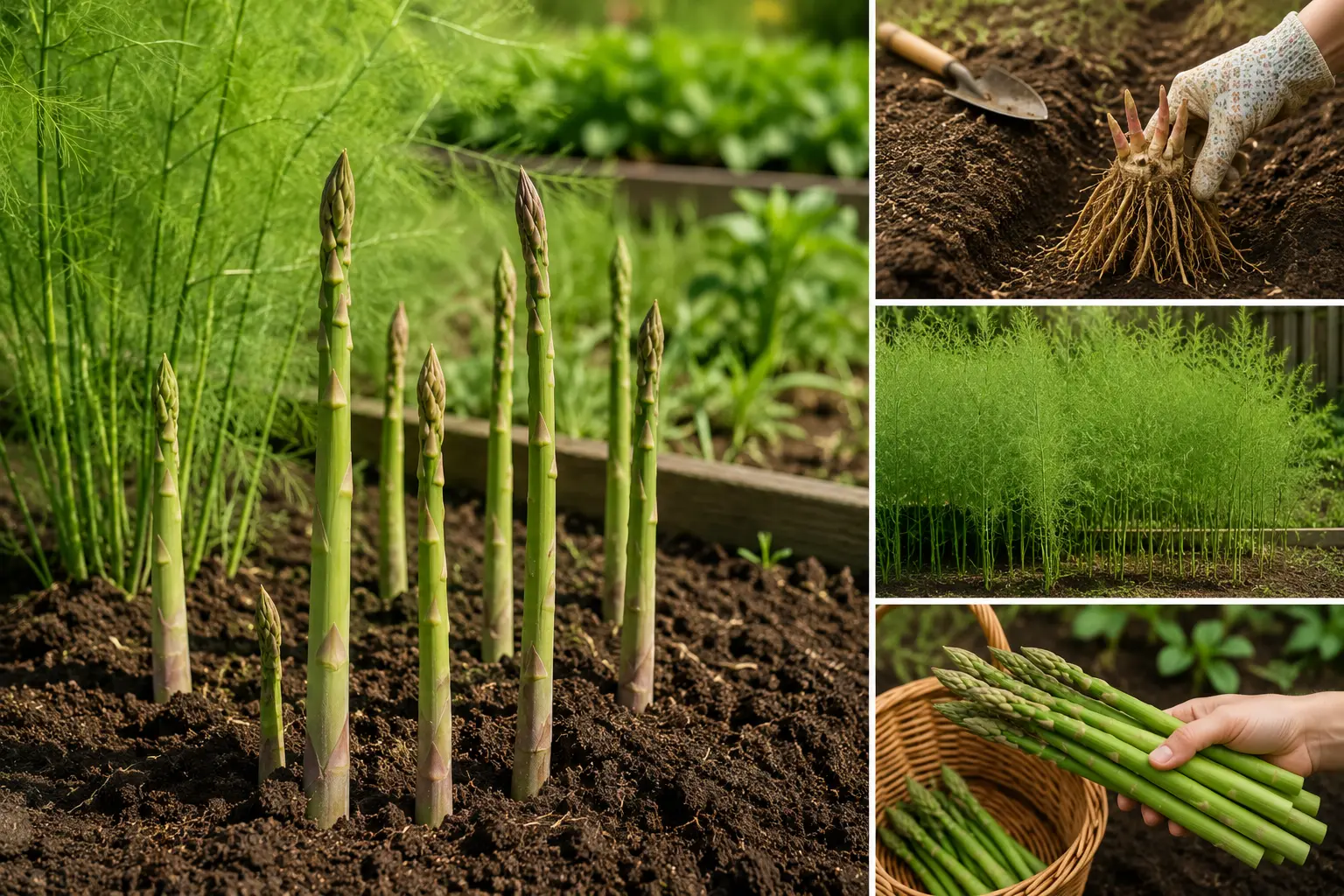
Asparagus (Asparagus officinalis) rewards patience with one of the longest production windows of any vegetable in a home garden. A single bed, planted correctly, produces spears for 15 to 25 years. That timeline scares off a lot of first-time growers. But the actual planting and care work is straightforward once you know the steps. This guide covers site prep, planting depth, variety selection, watering, pest control, and the harvest schedule you need for a bed that performs for two decades.
What Asparagus Is and Why Gardeners Plant It
Asparagus is a cold-hardy perennial vegetable grown from crowns or seed, prized for its early spring harvest and multi-decade productivity. Unlike tomatoes or squash, which you replant every year, a well-maintained asparagus bed keeps sending up spears every spring without replanting. Twenty-five crowns, spaced correctly, produce roughly 20 pounds (9 kilograms) of spears annually once established. The plant’s ferny summer foliage also works as a backdrop for shorter vegetables. Female plants produce small red berries that some gardeners find ornamental, though those berries pull energy away from spear production.
When to Plant Asparagus
Plant asparagus crowns in early spring, once soil temperature reaches 50°F (10°C). Gardeners in warm-winter regions (USDA zones 8 and higher) can plant from fall through winter instead. Check soil temperature with a soil thermometer rather than guessing from air temperature; soil warms more slowly than the air around it. If you’re starting from seed, sow indoors 12 to 14 weeks before your last spring frost date, then transplant seedlings outdoors after hardening them off over about 10 days.
Asparagus Crowns vs. Seed: Which Should You Choose
Crowns get you a harvestable bed one year faster than seed. Crowns are one-year-old roots with buds, and planting them lets you start harvesting lightly in year two, with full harvests by year three or four. Seed-grown asparagus needs an extra year: sow in spring, transplant the following year, then begin harvesting in year three or later. Seed costs less per plant, and it’s the only reliable route if you need Fusarium-free stock, since disease-free seed is easier to find than disease-free crowns. Most home gardeners choose crowns for the faster payoff. Market growers and gardeners rebuilding after a Fusarium outbreak often choose seed instead.
How to Prepare an Asparagus Bed
Asparagus needs full sun, well-drained soil, and a permanent spot it won’t share with other crops for 15 to 20 years. Pick a site on the north or east side of the garden so the mature ferns, which reach 4 to 5 feet (1.2 to 1.5 meters) tall, don’t shade shorter vegetables. Test soil pH before planting; asparagus performs best between 6.5 and 7.5. A local cooperative extension office can run this test and flag any micronutrient deficiencies at the same time.
Work 4 inches (10 centimeters) of compost or well-rotted manure into the top 12 inches (30 centimeters) of soil. Remove perennial weeds and their roots completely at this stage. Asparagus beds are hard to weed thoroughly once the crowns are established, so this is your one real chance to get ahead of them. Heavy clay soils benefit from raised beds, which improve drainage and cut the risk of crown rot.
How to Plant Asparagus Crowns (Trench Method)
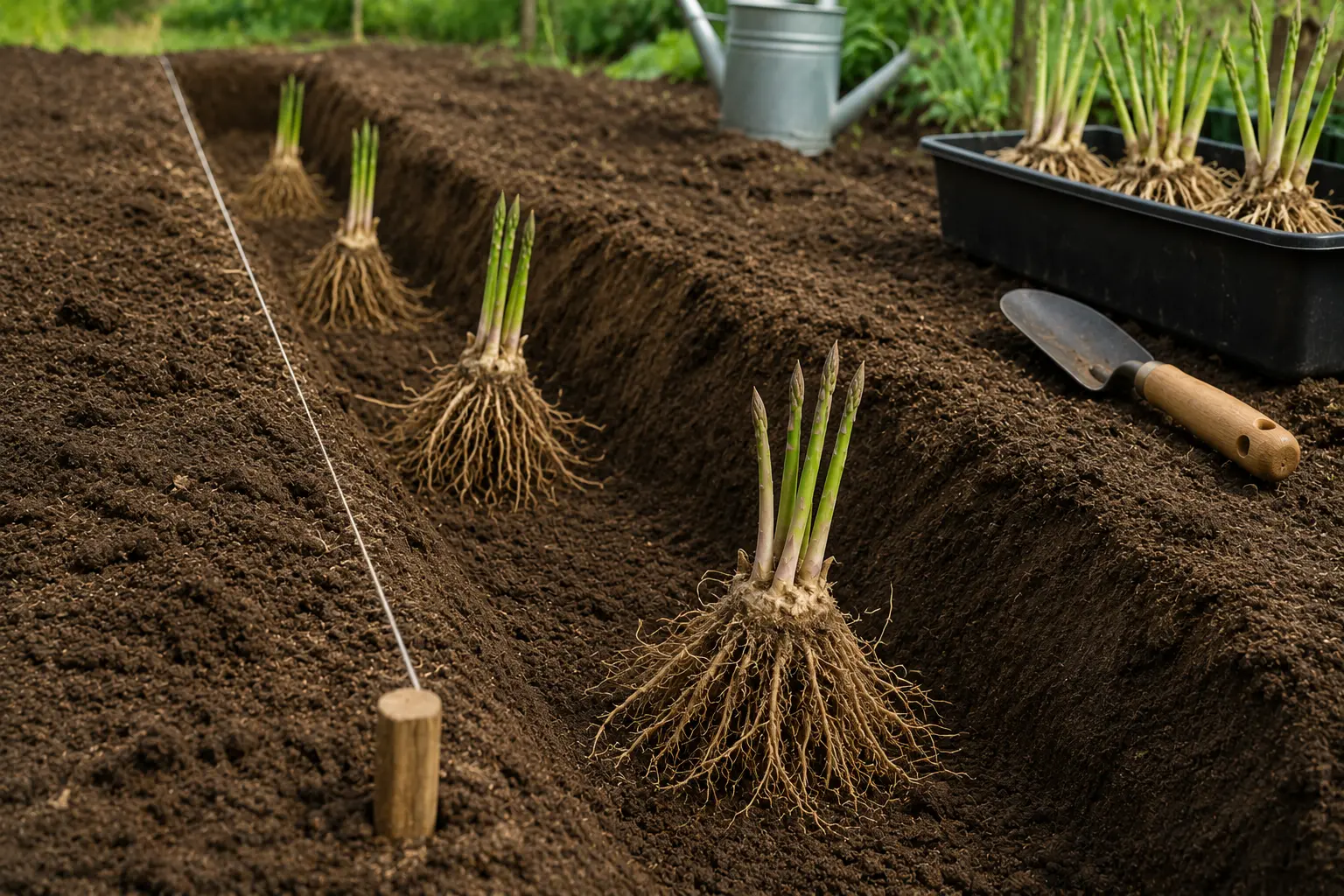
Dig a trench 6 to 8 inches (15 to 20 centimeters) deep and 12 inches (30 centimeters) wide, then space crowns 12 to 18 inches (30 to 46 centimeters) apart with rows 3 to 5 feet (90 to 150 centimeters) apart. Build a small mound in the center of the trench, spread the crowns’ roots over the mound, and point the buds upward. Cover crowns with 2 to 3 inches (5 to 8 centimeters) of soil at planting time. As shoots emerge, add another 2 inches (5 centimeters) of soil every one to two weeks until the trench is level with the surrounding bed.
Planting Depth by Soil Type
Planting depth depends on soil texture, not a single fixed number. Sandy soils drain fast and dry out quickly near the surface, so crowns go deeper, at 8 inches (20 centimeters), with the mound built lower in the trench. Heavier, moisture-retentive soils need shallower placement, closer to 5 or 6 inches (13 to 15 centimeters), since deep planting in dense soil traps excess moisture around the crown and raises rot risk. This distinction resolves a disagreement that shows up constantly in gardening forums, where growers report success anywhere from 2 to 8 inches deep without mentioning the soil difference that’s actually driving the range.
Best Asparagus Varieties to Grow
All-male hybrid varieties produce more spars than open-pollinated types, because male plants don’t spend energy on seed production. Here’s how the main options compare:
- Jersey Knight—large green spears, highly resistant to rust, tolerant of fusarium, suited to most U.S. climates.
- Jersey Giant — medium to large green spears with purplish bracts, cold-tolerant and rust-resistant.
- Jersey Supreme—slim green spears, high yielding, adapted to cool and warm regions alike.
- Guelph Millennium—developed at the University of Guelph in Ontario, cold-tolerant, and a holder of the RHS (Royal Horticultural Society) Award of Garden Merit.
- Purple Passion—large purple spears, sweeter and more tender than green varieties, though the color fades during cooking.
- Mary Washington Improved—open-pollinated green variety with strong flavor, but it doesn’t handle heat well; harvest before temperatures pass 70°F (21°C).
Match the variety to your climate zone before ordering. The Jersey series handles U.S. zones 3 through 8 well, while Pacific Purple and Guelph Millennium suit cooler northern regions.
How to Grow Asparagus in Containers or Raised Beds
Yes, asparagus grows in containers, but only as a short-term holding strategy, not a permanent planting method. Asparagus roots extend 10 to 15 feet (3 to 4.6 metres) deep once established, and a container stalls that root development indefinitely. Gardeners who move frequently, including military families relocating between duty stations, use large pots or tree containers to hold crowns for a season or two before transplanting into permanent ground. A 10-gallon (38-liter) pot fits roughly 14 small crowns temporarily. Once you’re ready to commit to a permanent site, transplant into an in-ground bed or a raised bed at least 12 inches (30 centimeters) deep. Container-grown crowns won’t reach full production until they’re actually in the ground.
Watering and Fertilizing Asparagus
Asparagus needs consistent moisture during its first growing season and roughly 1 inch (2.5 centimeters) of water per week afterward. Water at ground level rather than overhead, since wet foliage invites fungal disease. Drip irrigation suits asparagus particularly well because both the tubing and the plants stay put for years without disruption. Established beds show real drought tolerance: gardeners in regions getting 20 to 22 inches (51 to 56 centimeters) of annual rainfall report watering mature, mulched beds only two or three times per season.
Fertilize with a balanced organic source, such as fish emulsion, compost, or well-rotted manure, applied in late winter before spears emerge and again after harvest ends. Asparagus responds well to potassium in particular, so a fertilizer with a higher potassium ratio (the third number in an N-P-K, or nitrogen-phosphorus-potassium, formulation) supports stronger spear development than a nitrogen-heavy blend would.
Companion Plants for Asparagus
Tomatoes, parsley, and marigolds grow well next to asparagus and support its long-term health. Tomatoes and asparagus actually help each other: asparagus repels certain nematodes that damage tomato roots, while tomatoes produce solanine, a compound that helps deter the asparagus beetle. Parsley planted along asparagus rows attracts beneficial insects that prey on aphids, and marigolds add further nematode suppression in the soil. Skip planting asparagus near onions, garlic, or potatoes; these crops compete for the same soil nutrients and can slow asparagus establishment.
Common Asparagus Pests and Diseases
Asparagus beetles and rust are the two most common problems, and both respond better to prevention than to after-the-fact treatment.
- Common asparagus beetle — feeds on and lays eggs on spears, causing deformity; controlled with floating row cover during the emergence period and by handpicking adults.
- Spotted asparagus beetle—feeds on spears but lays eggs on fern foliage instead; less destructive than the common beetle, though still worth monitoring.
- Asparagus aphids—sucking insects that stunt growth and excrete honeydew, which attracts ants; controlled with a strong water spray or insecticidal soap.
- Japanese beetles—skeletonize fern foliage, cutting into photosynthesis. Adults run about 3/8 inch (9.5 millimeters) long with metallic copper-green wing covers; their grubs are controlled with Bacillus thuringiensis galleriae (Btg), milky spore, or parasitic nematodes.
- Rust—a fungus producing orange spore masses on stalks; resistant varieties like Jersey Knight and Jersey Giant cut the risk significantly.
- Fusarium—a soilborne or seedborne fungus causing crown rot and wilting; avoided by starting with certified disease-free crowns or seed and rotating away from previously infected soil.
- Purple spot—a fungus causing sunken purple lesions on stalks and brown lesions on foliage, usually tied to excess moisture on foliage from overhead watering.
When and How to Harvest Asparagus
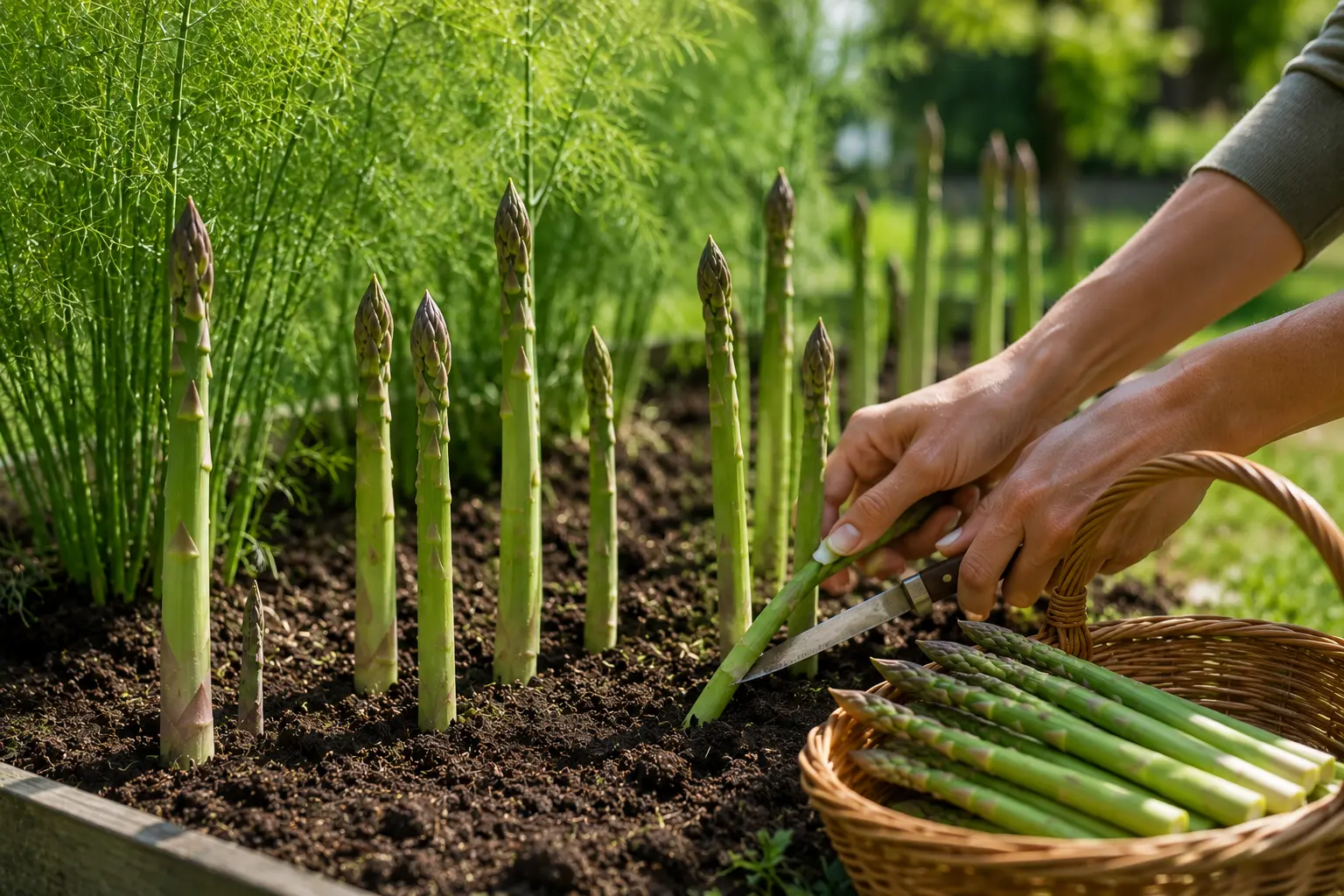
Harvest starting in year two after planting crowns, or year three after planting seed. Take no more than two or three spears per plant during that first light harvest, and let the rest grow into ferns to recharge the crown. From the year three onward, harvest pencil-thick spears once they reach 6 to 8 inches (15 to 20 centimeters) tall, snapping each spear near its base rather than cutting it. The lower portion of the stalk is tough and fibrous anyway.
One heuristic used by extension programs, known as the 2-4-6 rule, sets harvest duration by plant age: two weeks in the second year of production, four weeks in the third year, six weeks in the fourth year, and beyond. Stop harvesting once spear diameter drops below 3/8 inch (9.5 millimeters) or new spears start opening into ferny buds instead of staying tight. Cutting past that point weakens the crown for the following season.
End-of-Season Care: Cutting Back Asparagus Ferns
Cut back asparagus ferns in fall, once they’ve turned brown and brittle, not while they’re still green. Green ferns are still photosynthesizing and sending stored energy down to the crown, so cutting them early costs you next year’s yield. Leave the cut foliage in place as mulch, or remove it if disease pressure, particularly rust or purple spot, was a problem that season. Fall is also the right time to retest soil pH and work in more compost before covering the bed with straw or shredded leaf mulch for winter.
Troubleshooting Thin or Weak Asparagus Spears
Thin spears in an established bed usually point to insufficient crown recharge, overharvesting, poor fertility, or overcrowding. Check these in order:
- Overharvesting—cutting spears past the point where diameter drops below 3/8 inch (9.5 millimeters) forces the crown to keep producing without rebuilding its energy reserve.
- Insufficient fern growth—cutting back ferns too early in fall, before they’ve fully browned, shortens the window the crown has to store energy.
- Low potassium levels—a soil test identifies this directly; correct it with a potassium-focused organic fertilizer rather than a general all-purpose blend.
- Overcrowding—Beds inherited from a previous owner, or older female-plant beds that reseed themselves, often need thinning every few years to keep spear size consistent.
Fix the specific cause, and expect spear thickness to improve over one to two growing seasons, not overnight.
FAQs
How long does asparagus take to grow before harvest?
Crown-planted asparagus takes two years to first harvest; seed-planted asparagus takes three. Full production starts by year three or four for crowns.
Can asparagus grow in shade?
No. Asparagus needs full sun, at least 6 to 8 hours daily, to produce thick spears and build strong crown reserves for future seasons.
Does asparagus come back every year?
Yes. Asparagus is a perennial that regrows from its crown annually for 15 to 25 years once established, without replanting.
What’s the difference between male and female asparagus plants?
Male plants put all their energy into spear production. Female plants divert energy into red berries, which means fewer, thinner spears overall.
Why is my asparagus bed producing fewer spears each year?
Overharvesting, early fern cutback, low potassium, and overcrowding are the four leading causes. Test your soil and adjust harvest timing first.
Conclusion
A productive asparagus bed comes down to four decisions made correctly at the start: site selection with full sun and drainage, planting depth matched to soil type, variety choice suited to your climate zone, and a harvest schedule that respects crown recharge. Get those four right, and the bed pays you back with fresh spears every spring for the next two decades, with little ongoing work beyond watering, an annual fertiliser application, and fall cleanup.