

Peonies live for 50 to 100 years. Plant one correctly today, and your grandchildren will still be cutting blooms from the same root. That is not a promise most garden plants can make.
This guide covers everything a home gardener or flower farmer needs — correct planting depth, soil preparation, seasonal care, disease prevention, and exactly why peonies fail to bloom and how to fix it.
Which Type of Peony Should You Grow?
Herbaceous peonies are the right choice for most home gardeners. Stems die back to the ground each winter and push up fresh growth every spring. These are the classic bowl-shaped blooms you see at farmers markets from May through June. Best for Zones 3–8.
Tree peonies are woody shrubs that stay above ground year-round. They tolerate warmer climates than herbaceous varieties — useful for gardeners in Zone 8 and parts of Zone 9. Grow 4 to 6 feet tall. Never cut green stems.
Itoh (intersectional) peonies are a hybrid of herbaceous and tree types. They produce large blooms but die back to the ground like herbaceous varieties. More expensive, more disease-resistant, and produce more blooms per plant. Best for Zones 4–9, and the only reliable choice in Zone 8.
The rest of this guide focuses on herbaceous peonies — the most widely grown type across the United States. Most care principles apply to Itoh types as well.
Best USDA Zones for Growing Peonies
Peonies grow best in USDA Zones 3 through 8. Herbaceous peonies need at least 500 hours below 40°F (4°C) in winter — called vernalization — to trigger the bloom cycle the following spring. No chill hours, no flowers.
Zone-specific notes:
Zones 3–4 (Minnesota, Montana, Wisconsin): Herbaceous peonies thrive here. Cold winters are an advantage. Mulch roots lightly after the ground freezes to prevent frost heave. Itoh types need 4 inches (10 cm) of mulch protection. Tree peonies rarely survive Zone 3.
Zones 5–6 (Ohio, Pennsylvania, Missouri): Ideal growing conditions. Peonies bloom reliably from mid-May through mid-June. All 3 peony types perform well.
Zone 7 (North Carolina, Virginia, Tennessee): Blooms arrive in April and early May. Herbaceous peonies still bloom but produce fewer flowers than in Zones 5–6. Itoh types outperform herbaceous here. Choose early-blooming varieties to maximize the season before summer heat sets in.
Zone 8 (Pacific Northwest, parts of the South): Herbaceous peonies struggle. Switch to Itoh varieties bred for lower chill requirements — Bartzella, Cora Louise, or Julia Rose. Tree peonies do well with afternoon shade.
Zone 9 and warmer: Herbaceous peonies do not grow reliably. Tree peonies are the only workable option, and even then bloom production stays inconsistent.
To find your zone: enter your zip code at the USDA Plant Hardiness Zone Map at planthardiness.ars.usda.gov.
Choosing the Right Garden Site
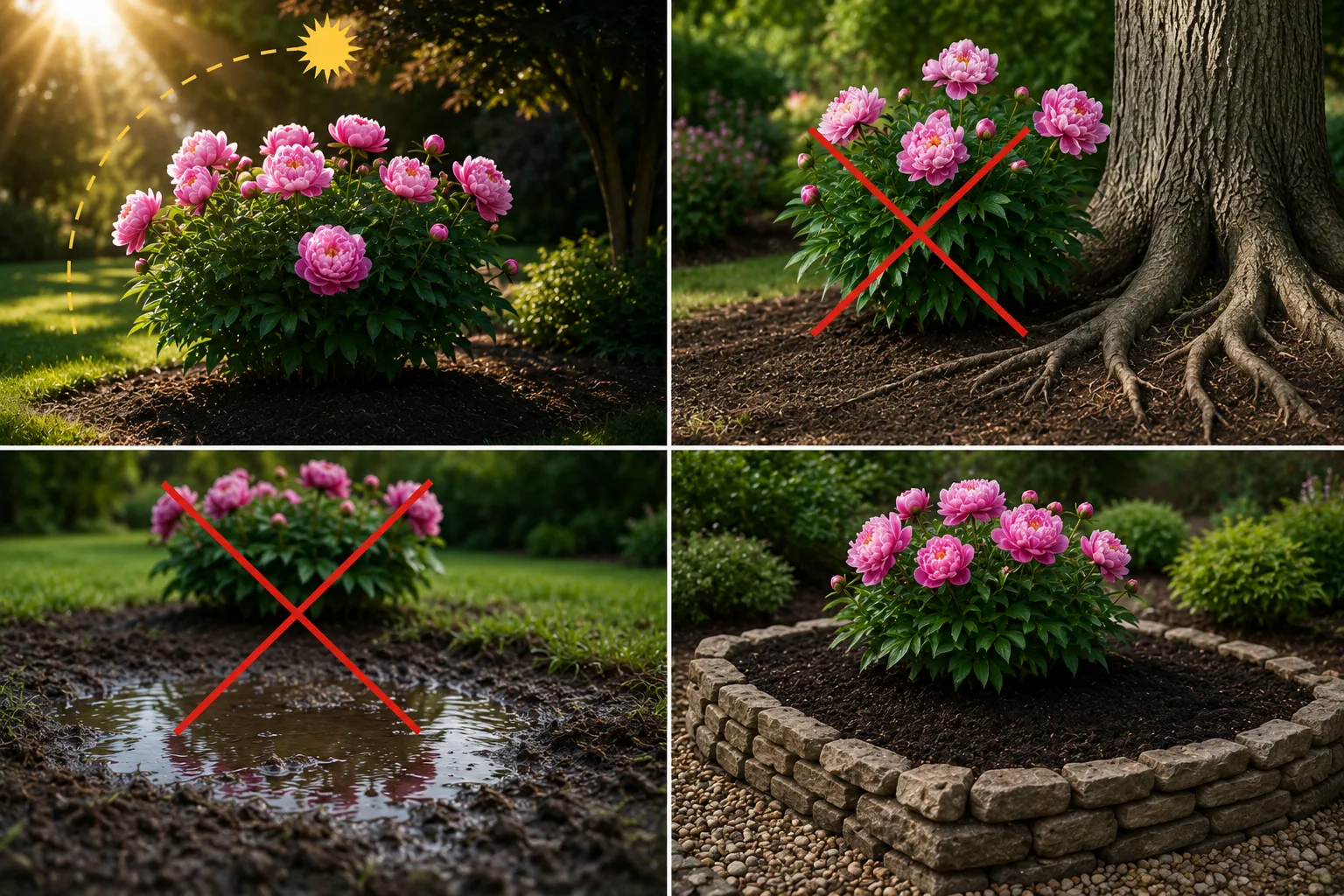
Sunlight: Peonies need 6 to 8 hours of direct sunlight daily. In Zones 6 and warmer, afternoon shade from 2 p.m. onward protects blooms from heat damage and extends bloom life on the plant by 2 to 3 days.
Tree and shrub competition: Keep peonies away from large trees and established shrubs. Tree roots compete aggressively for water and nutrients within a 10-foot (3-meter) radius. A peony planted inside that zone produces fewer stems and smaller blooms every year.
Drainage: Avoid low spots where water pools after rain. Peony fleshy roots rot quickly in saturated soil. If your yard drains poorly, raise the planting bed 6 to 10 inches (15–25 cm) using amended soil before planting. In heavy clay gardens, build raised beds 10 to 12 inches (25–30 cm) high filled with a loam-compost-grit mixture.
Airflow: Space plants 3 to 4 feet (90–120 cm) apart. Dense planting promotes botrytis cinerea (gray mold) — the most common and damaging peony disease.
How to Prepare Soil Before Planting
Target soil conditions before planting: well-drained loam, pH 6.5 to 7.0, organic matter above 5%.
Preparation steps:
- Remove all existing vegetation — weeds and grass roots compete with young peonies
- Loosen soil to 18 to 24 inches (45–60 cm) deep with a garden fork or spade
- Test soil pH with a garden center kit ($5 to $15). Apply garden lime at 5 to 10 lb per 100 sq ft to raise pH; elemental sulfur at 1 to 2 lb per 100 sq ft to lower it
- Incorporate 3 to 4 inches (8–10 cm) of finished compost plus bone meal or superphosphate per planting hole — phosphorus supports root development and flower bud initiation
Clay soil: Mix coarse sand and compost into clay at a 1:1:1 ratio (one part clay, one part sand, one part compost) to improve drainage before planting.
University extension offices test soil for free or at low cost in most states. The North Carolina State University Cooperative Extension, for example, offers free soil testing for NC residents.
Planting Depth — The Most Critical Step
Plant peony eyes exactly 1 to 2 inches (2.5 to 5 cm) below the soil surface.
This is the single most important rule in peony growing. Eyes buried deeper than 2 inches produce healthy foliage every year but no flowers — sometimes for 3 to 5 consecutive years. After backfilling, water thoroughly and check depth after soil settles.
The “eyes” are the small red crown buds at the top of the tuberous root. Each bare root should carry 3 to 5 eyes. Fewer than 3 eyes means slow establishment.
Do not mulch directly over the crown. Mulch piled against the stem mimics deep planting and delays or prevents bloom.
How to Plant Bare Root Peonies — Step by Step
Best planting time: Fall — September through October. Fall planting gives roots 6 to 10 weeks to develop feeder roots before the ground freezes, producing stronger first-year growth than spring planting.
Selecting quality bare roots: Firm, plump roots with no soft spots. 3 to 5 clearly visible eyes minimum. Roots 6 to 10 inches (15–25 cm) long.
Planting steps:
- Soak bare roots in water for 2 to 4 hours to rehydrate
- Dig a hole 18 inches (45 cm) deep and wide
- Build a firm soil mound in the hole center; set root on top with eyes pointing upward
- Verify eyes sit 1 to 2 inches (2.5–5 cm) below final soil surface
- Backfill in 3 to 4 inch (8–10 cm) layers, firming each layer to eliminate air pockets
- Water deeply — 1 to 2 gallons (3.8–7.6 liters) per plant
- Mulch with 2 inches (5 cm) straw or shredded bark, kept 2 inches clear of the crown
For container-grown peonies from a nursery: Plant so the top of the root ball sits level with the surrounding soil. Do not bury the crown.
Garden Spacing Reference
| Garden Application | Plant Spacing | Notes |
| Mixed perennial border | 3 ft (90 cm) | Mid-border placement, behind catmint or salvia |
| Cut flower garden rows | 18–24 in (45–60 cm) within rows | Rows 3 ft (90 cm) wide for harvest access |
| Foundation planting | 4 ft (120 cm) from walls | Maintains airflow, prevents mildew |
| Container garden | 15–20 gallon pot minimum | 4 parts potting mix to 1 part coarse perlite |
| Tree peonies | 4–5 ft (120–150 cm) apart | Woody stems, bloom 3 to 4 weeks earlier |
When Do Peonies Bloom?
Herbaceous peonies bloom once per year in spring, with each variety flowering for 7 to 10 days.
| Zone | Bloom Window |
| Zones 3–4 | Late May through June |
| Zones 5–6 | Mid-May through mid-June |
| Zone 7 | April through mid-May |
| Zone 8 | March through April (tree peonies only) |
Cool springs (55–65°F / 13–18°C) extend blooms to 10 days. Heat above 80°F (27°C) shortens blooms to 4 to 5 days.
To extend the season: Plant 3 varieties with staggered bloom times — early, mid-season, and late. In Zone 6, this strategy produces continuous peony blooms from May 10 through June 20.
How Long Until Peonies Bloom After Planting?
Peonies planted from bare root take 2 to 3 years to produce a full flush of blooms. Year 1 typically produces no flowers or 1 to 2 small blooms. Year 2 produces a handful. Year 3, the plant hits its stride.
Container-grown peonies from a nursery establish faster — a gallon-container plant often produces 2 to 4 blooms in the first season.
Patience is non-negotiable. The payoff is a plant that blooms reliably for 50 years or more with minimal intervention.
Seasonal Garden Maintenance
Spring (March–April)
Remove winter mulch when red shoots emerge. Install grow-through support hoops or wire rings before stems reach 6 inches (15 cm) — heavy double cultivars like Sarah Bernhardt produce bloom heads weighing 4 to 6 oz (115–170 g) that flatten unsupported stems after rain.
Apply 10-10-10 granular fertilizer at 2 to 3 tablespoons per plant at the drip line. Water in thoroughly.
Summer (May–June)
Deadhead spent flowers within 1 to 2 days of petal drop — cut to the first healthy leaf below the bloom with clean garden shears. Seed pod formation diverts 15% to 25% of root energy needed for next year’s buds.
Water deeply once per week during dry periods — 1 to 1.5 inches (2.5–3.8 cm) per session via drip irrigation or soaker hose at soil level. Overhead irrigation promotes botrytis cinerea and powdery mildew on foliage.
Do not cut peony stems back in summer immediately after blooming. The foliage spends July through September feeding carbohydrates into the root system. That stored energy powers next year’s bloom count. Cut too early and next year’s flowers drop significantly.
Fall (September–October)
Cut all herbaceous stems to 2 to 3 inches (5–8 cm) above soil with clean pruners after the first hard frost. Bag all cuttings in the trash — never compost peony debris. Botrytis spores overwinter in dead stems and reinfect the garden bed in spring.
Topdress with 2 to 3 inches (5–8 cm) of finished compost. Apply fresh mulch — straw or shredded bark — 2 to 3 inches deep, kept clear of the crown.
Winter (November–February)
No active care needed. Peonies require 500 to 1,000 hours below 40°F (4°C) for flower bud initiation — cold winters are a benefit, not a problem.
In Zones 3–4, a light layer of mulch (2 inches maximum) over the crown protects new plantings after the ground freezes. Remove fully in early spring before new shoots emerge.
Fertilizing Peonies — 3 Annual Applications
Application 1 — Spring (shoots at 3 inches / 8 cm):
Balanced 10-10-10 or 5-10-10 at 2 to 3 tablespoons per plant at the drip line. Avoid high-nitrogen products — excess nitrogen builds foliage at the expense of flower buds.
Application 2 — Post-bloom June (most important):
5-10-10 immediately after flowers finish. Phosphorus and potassium fed now support root carbohydrate storage and embryonic bud formation that determines next year’s bloom count.
Application 3 — Fall October:
Topdress 2 to 3 inches (5–8 cm) of finished compost around each plant. Improves soil structure over winter, feeds soil microbiome, releases slow organic nutrients in spring.
Many experienced flower farmers skip fertilizer entirely after establishment. Peonies in good soil with proper pH produce abundantly without annual feeding.
Watering Guide
Water peonies 1 inch (2.5 cm) per week during the growing season. During dry spells, increase to 1.5 inches (3.8 cm) per week.
Always water at the base of the plant, not overhead. Wet foliage sitting overnight creates ideal conditions for botrytis blight.
Established peonies (3 years or older) are drought-tolerant once roots are developed. New plantings need consistent moisture for the first 2 seasons.
Staking and Support
Double-flowered herbaceous peonies need staking. Blooms on double varieties grow large and heavy — 4 to 6 inches (10–15 cm) across — and stems bend or snap under the weight, especially after rain.
Install peony support rings or wire cages in early spring, when stems are 4 to 6 inches (10–15 cm) tall. Staking mature stems causes more damage than it prevents.
Varieties that do not need staking: Coral Charm, Coral Sunset, Red Charm, Buckeye Belle, Do Tell, Scarlett O’Hara, Krinkled White, all Itoh types, Bowl of Beauty.
How to Divide Peonies
Divide in fall — September through October — when plants are fully dormant. Signs a clump needs dividing: reduced bloom count, hollow dead center, or 15-plus years in the same garden site. Peonies rarely need division — a well-planted peony blooms 50 years or more without being disturbed.
Division steps:
- Cut stems to 3 inches (8 cm) and clear all debris from the bed
- Mark a circle 12 to 18 inches (30–45 cm) from the crown with a spade
- Work a garden fork inside the circle to lever the full root mass free
- Wash roots with a garden hose to expose eyes clearly
- Cut crown into divisions with a sanitized sharp knife — minimum 3 to 5 eyes per division
- Dust cut surfaces with powdered horticultural sulfur to prevent fungal entry
- Rest divisions in shade 3 to 4 hours for callus formation
- Replant immediately at 1 to 2 inch (2.5–5 cm) depth in amended soil
- Water thoroughly after planting
Divisions with 5 eyes bloom in 1 to 2 seasons. Divisions with 3 eyes bloom in 2 to 3 seasons.
Pests and Diseases
Botrytis Cinerea (Gray Mold Blight)
Most common peony disease. Buds collapse before opening, gray fuzzy sporulation on stems and foliage.
Prevention: Proper 3 to 4 foot spacing, drip irrigation only, complete fall sanitation — remove and trash all stem debris.
Treatment: Copper-based fungicide or mancozeb every 10 to 14 days during cool wet spring periods.
Powdery Mildew
White coating on foliage in late summer. Primarily cosmetic at that stage — does not affect next year’s bloom production.
Treatment: Potassium bicarbonate or neem oil spray every 7 days. Improve airflow and reduce overhead irrigation.
Ants on Buds
Completely harmless. Ants feed on sugary nectar that peony buds secrete as they develop — they cause zero damage to plant or blooms. The old myth that ants are required for peonies to open is false. No treatment needed. To bring cut stems indoors, hold stem upright and shake firmly twice.
Root Knot Nematodes (Meloidogyne species)
Stunted growth, yellowing foliage, swollen root galls. Most common in warm sandy Southern soils.
Treatment: Beneficial nematodes (Steinernema carpocapsae) applied to moist soil; heavy compost amendment; soil solarization with clear plastic for 4 to 6 weeks in summer heat for severe infestations.
5 Reasons Your Peonies Won’t Bloom
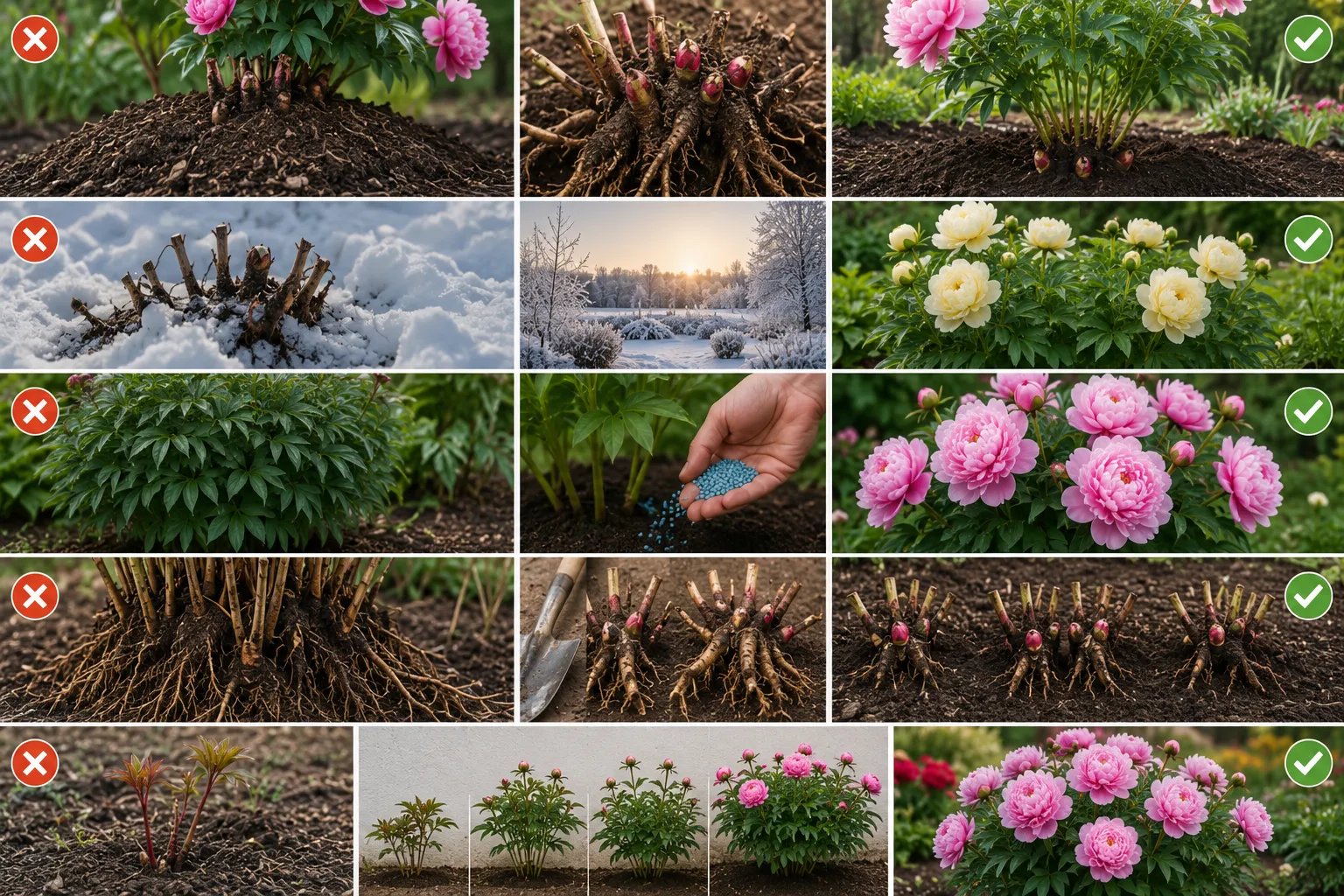
1. Eyes Planted Too Deep
More than 2 inches (5 cm) below soil surface — or mulch piled against the crown creating the same effect.
Fix: Dig in fall, wash crown, replant at correct depth. Remove excess mulch from crown immediately. Blooms return the following spring.
2. Insufficient Winter Chill
Below 500 hours at 40°F (4°C) in Zone 8b and warmer.
Fix: Switch to Itoh varieties Bartzella, Cora Louise, or Julia Rose — bred for lower chill requirements.
3. Excess Nitrogen
Lush dark green foliage, few or zero flowers.
Fix: Skip fertilizer for one full season. Switch all future feedings to 5-10-10. Eliminate lawn fertilizer applications near the garden bed.
4. Root Overcrowding
Peonies planted 15 to 20 years in the same spot sometimes stop blooming as the root clump becomes too dense.
Fix: Divide the clump in fall — cut into sections with 3 to 5 eyes each and replant at the correct depth.
5. Too Young
First and second-year plantings rarely bloom at full capacity.
Fix: No intervention needed — just time. Full bloom production peaks in garden years 3 to 5.
Growing Peonies in Containers
Peonies grow in containers with the right setup — a good option for urban gardeners without in-ground beds.
Container requirements:
- Minimum 24 inches (61 cm) wide and 18 inches (45 cm) deep
- Fill with 60% high-quality potting mix, 30% compost, 10% perlite for drainage
- Plant eyes at same 1 to 2 inch (2.5–5 cm) depth rule — no exceptions
- Check soil moisture every 2 to 3 days during growing season
Winter care for containers: In Zones 5 and colder, containers sitting above ground can freeze solid and damage roots. Move into an unheated garage, shed, or basement where temperatures stay between 25°F and 45°F (-4°C to 7°C) for at least 6 to 8 weeks. The root needs cold — just not a damaging hard freeze in an exposed container.
Best container variety: Itoh types. They produce more stems per plant than herbaceous varieties and tolerate confined root space better over time.
Garden Design — 4 Landscape Uses
Mixed perennial border: Plant peonies in the mid-border zone behind low-growing catmint (Nepeta ‘Walker’s Low’), salvia, or hardy geraniums. Behind peonies, Russian sage, Echinacea, or ornamental grasses take visual dominance after June.
Cut flower garden: A 10-foot (3 m) production row of 5 mature plants produces 40 to 80 cut stems per season. Plant Coral Charm (early), Sarah Bernhardt (mid), Bartzella (late) in consecutive rows for a 6-week harvest window.
Foundation planting: Keep plants minimum 4 feet (120 cm) from walls. Pair with evergreen groundcovers — pachysandra or vinca — for winter garden interest when peonies are dormant.
Companion planting: Allium ‘Purple Sensation’ blooms simultaneously with mid-season peonies, adding vertical contrast. Bearded iris opens 2 to 3 weeks before peonies, extending the border flowering sequence from April through June. Salvia nemorosa fills the visual gap in June after peonies fade.
Avoid: Planting peonies near large ornamental grasses or shrubs that grow tall enough to shade peonies for more than 2 to 3 hours daily — this reduces bloom production measurably.
How to Cut Peonies for a Vase
Cut peonies at the marshmallow stage for the longest vase life — when the bud feels like a soft marshmallow when gently squeezed. A bud at this stage opens fully indoors over 3 to 5 days.
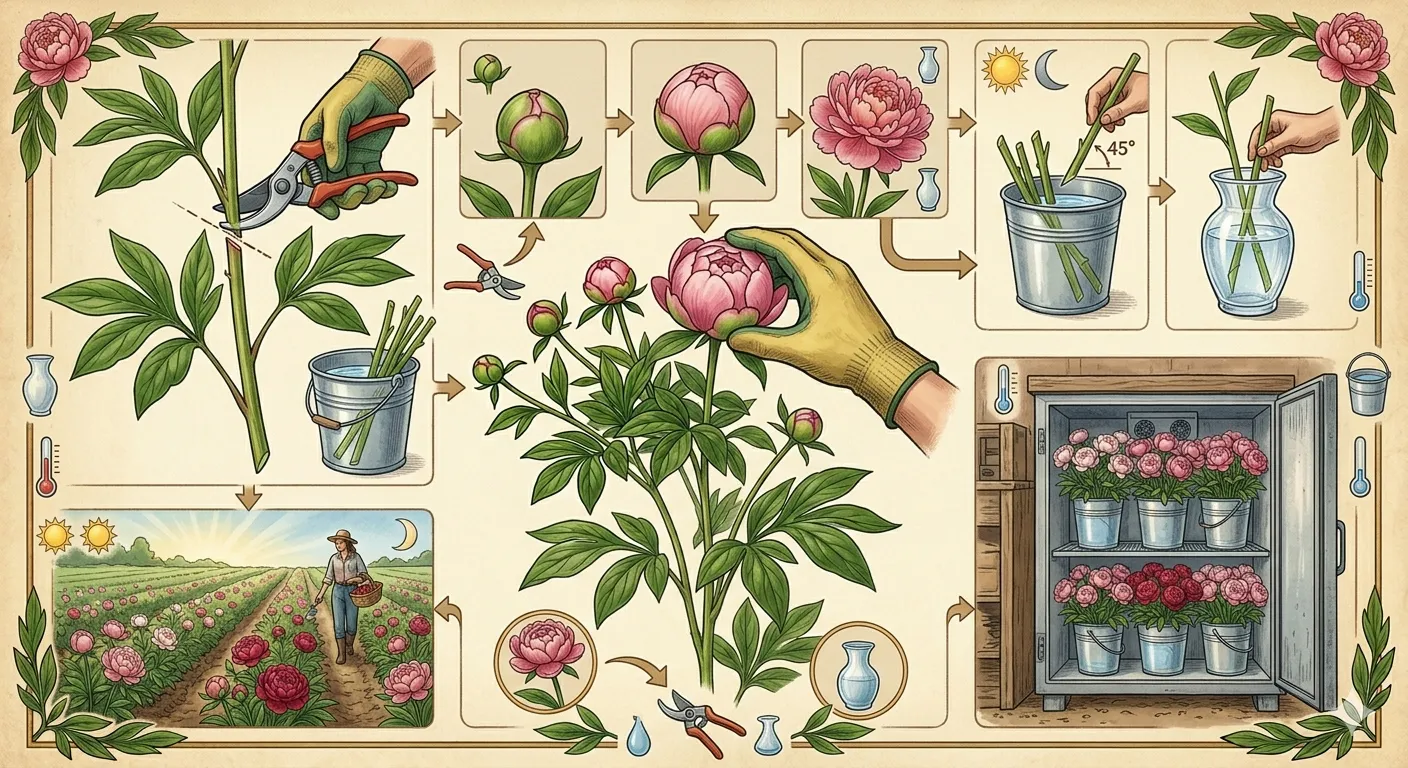
Buds cut too tight sometimes fail to open. Buds cut fully open last only 2 to 3 days.
Cutting steps:
- Cut in the early morning when temperatures are cool
- Use sharp, clean pruners — dull blades crush stem tissue
- Cut stems 12 to 18 inches (30–45 cm) long, just above a set of leaves
- Leave at least 2 sets of leaves below the cut — foliage feeds the root for next year’s bloom
- Place stems immediately into a bucket of cool water
- Recut stems at a 45-degree angle before arranging
Cold storage for cut flower farmers: Refrigerate cut stems at 34–38°F (1–3°C) to store for up to 6 weeks — this extends the selling season well past the 7 to 10 day bloom window.
FAQ
How deep should I plant peony roots?
1 to 2 inches (2.5 to 5 cm) below the soil surface. Deeper than 2 inches is the number one reason peonies produce leaves every year but no flowers.
Do peonies spread on their own?
No. The root clump grows slowly outward over 10 to 15 years. To propagate, divide the root clump in fall — cut into sections with 3 to 5 eyes each and replant at the correct depth.
Can I grow peonies in Zone 9?
Tree peonies are the only reliable option. Some gardeners chill bare roots in the refrigerator for 6 weeks before planting to simulate dormancy, with inconsistent results.
Do I need to divide peonies every year?
No. Divide only if the plant stops blooming after 15 to 20 years in the same spot. A well-planted peony blooms 50 years or more without division.
When is the best time to plant peonies?
Fall — September through early November. Bare roots need 6 to 8 weeks in the ground before the first hard freeze to establish properly. Fall-planted peonies bloom 4 to 6 weeks sooner in year 2 than spring-planted ones.
Are ants on peony buds a problem?
No. Ants feed on bud nectar and cause zero damage. Shake stems before bringing indoors.
Conclusion
Most peony problems trace back to two mistakes made on planting day — eyes buried too deep, or a site with poor drainage. Get those two things right and peonies are among the lowest-maintenance perennials in any US garden. They do not need replanting, they do not need dividing for 15 to 20 years, and they ask for almost nothing beyond one fertilizer application in spring and clean fall sanitation.
The payoff for getting it right is disproportionate. A single bare root planted this fall at the correct 1 to 2 inch depth, in well-drained soil with 6 hours of sun, becomes a full-producing plant by year 3 and keeps blooming for 50 years or more without being touched again. No other perennial in a US garden makes that trade.
Fall is the best planting window — September through October in most zones. Order bare roots with 3 to 5 healthy eyes, prepare the soil to a pH of 6.5 to 7.0, plant at the correct depth, and let the first winter do its work. Everything else this guide covers is maintenance. The foundation is that first planting decision.