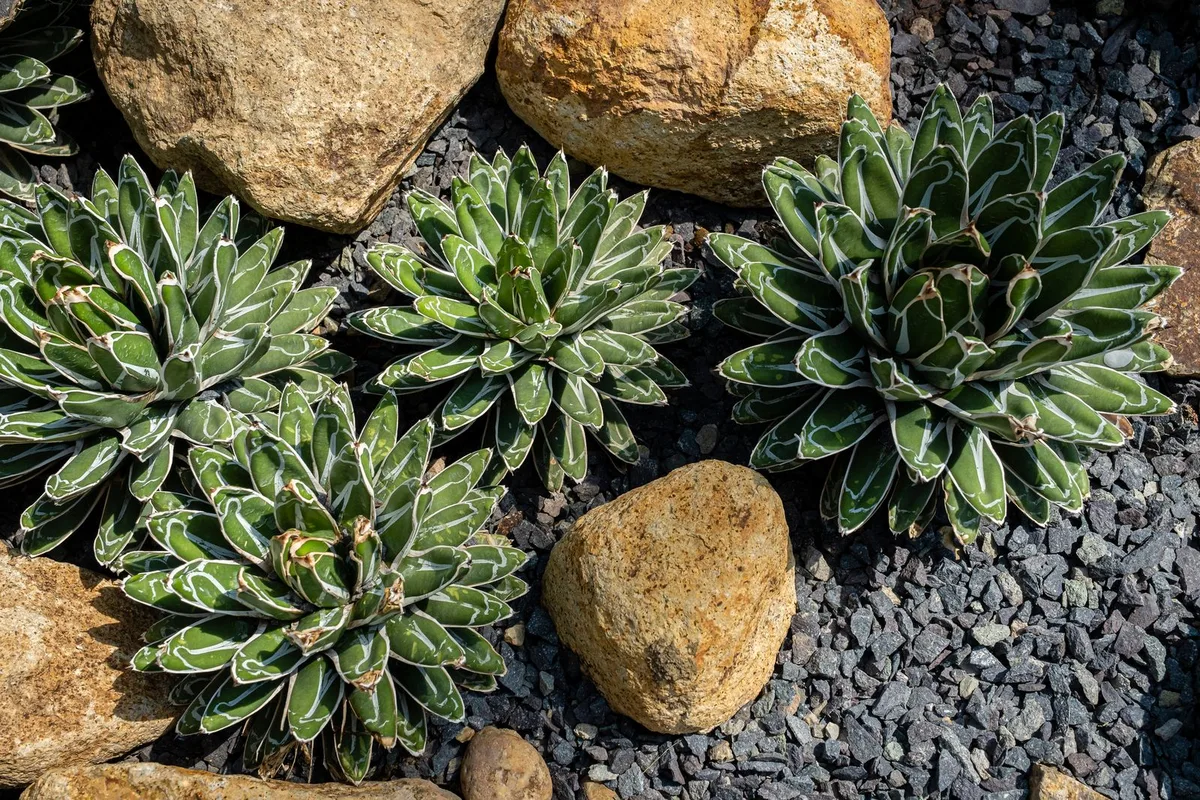
Low maintenance small rock garden ideas pair drought-tolerant plants with 3 inches (7.5 cm) of gravel over well-drained soil, then add one or two boulders for structure. That’s the whole formula. A 3 x 3 ft (0.9 x 0.9 m) corner or a 4 x 8 ft (1.2 x 2.4 m) front bed can look finished in one weekend. Narrow side strips go just as fast.
Key Takeaways
- A small rock garden stays low maintenance when it gets 6 or more hours of sun, sits on well-drained soil and carries 2 to 3 in (5 to 7.5 cm) of gravel.
- One cubic yard of gravel covers 108 sq ft (10 m²) at 3 in (7.5 cm) deep, so a 4 x 8 ft (1.2 x 2.4 m) bed needs about 0.3 cu yd.
- Sedum, hens and chicks, creeping thyme, creeping phlox and blue fescue grow in U.S. Department of Agriculture (USDA) zones 4 through 8.
- Planted rock beds don’t need weed barrier fabric. Deep gravel and early spring hand-weeding control weeds without trapping soil on top of a fabric layer.
- A rock bed in front of a house must slope away from the foundation and sit below the siding. That placement protects the home from water damage and hidden pests.
- A new rock garden needs weekly water in its first growing season. After that, it needs water only during long dry spells.
What Is a Low Maintenance Small Rock Garden
A low maintenance small rock garden is a compact planting bed, usually under 100 sq ft (9.3 m²), that uses stone, gravel and drought-tolerant plants in place of lawn or bare soil. Mowing disappears. The bed needs little watering and only a few weeding sessions each year once its plants settle in.
Rock gardens began as homes for alpine plants, small and tough species that grow in thin, gritty soil on mountain slopes. The North American Rock Garden Society (NARGS) still promotes that tradition. Most US homeowners have a simpler goal. They want less yard work.
A small rock garden borrows from xeriscaping. That water-wise design approach groups drought-tolerant plants together and swaps thirsty turf for mulch and hardscape so the yard asks for less water.
Gravel acts as a permanent inorganic mulch. Bark breaks down, but stone doesn’t, so a gravel layer never needs the full annual replacement that rotting organic mulch eventually demands.
Three conditions make a rock garden truly low maintenance:
- Sun: Most rock garden plants need 6 or more hours of direct sun per day.
- Drainage: The soil must drain standing water from a test hole by the next day.
- Plant choice: Every species must match the local USDA Plant Hardiness Zone, so no plant needs winter wrapping or constant summer watering.
7 Low Maintenance Small Rock Garden Ideas
The best low maintenance small rock garden ideas are a boulder corner, a driveway-edge bed, a foundation gravel border, a side yard strip, a mini crevice garden, a raised berm and a dry creek bed. Each of these seven ideas leans on stone for structure and needs only a handful of hardy plants to look complete. Pick by location.
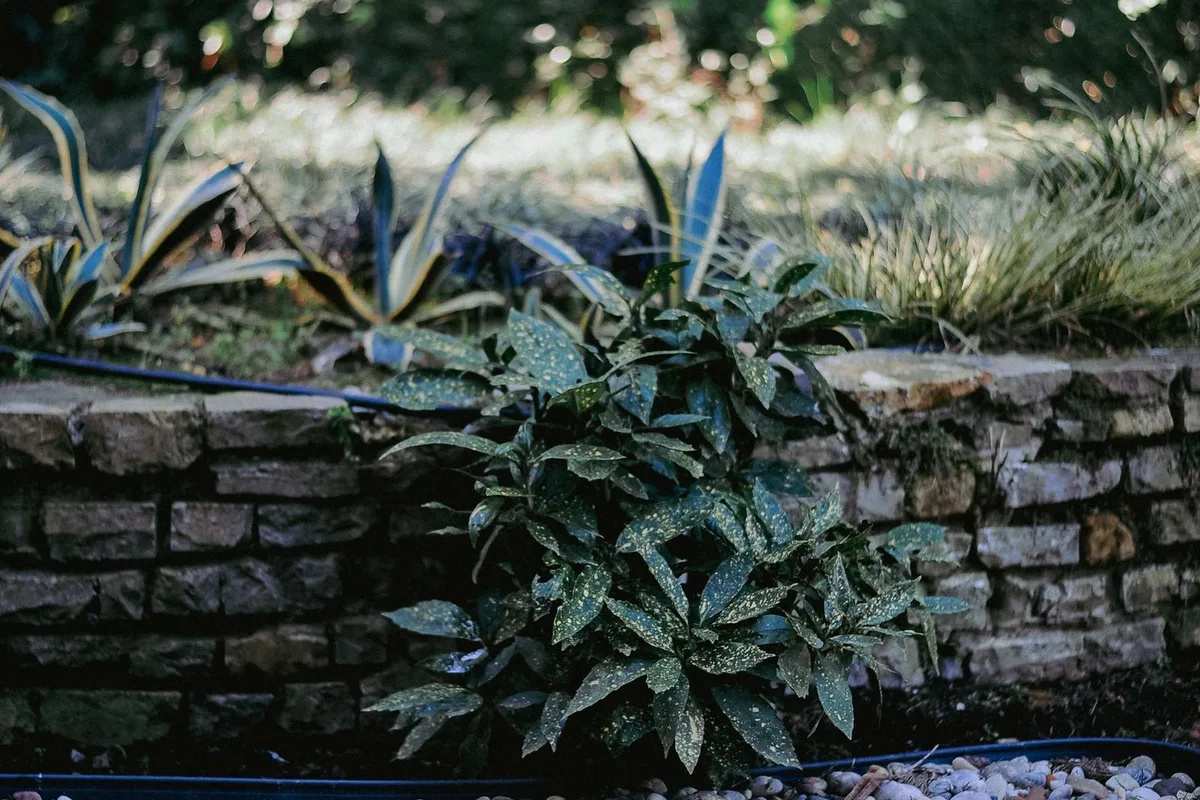
This table compares the seven ideas by best location, typical footprint and upkeep level.
| Idea | Best Spot | Footprint (ft / m) | Upkeep Level |
|---|---|---|---|
| Boulder corner | Fence or wall corner | 3 x 3 / 0.9 x 0.9 | Very low |
| Driveway-edge bed | Along concrete or asphalt | 2 x 10 / 0.6 x 3 | Low |
| Foundation border | Front of house | 2 x 12 / 0.6 x 3.7 | Very low |
| Side yard strip | Narrow side passage | 3 x 20 / 0.9 x 6 | Very low |
| Mini crevice garden | Sunny focal point | 3 x 4 / 0.9 x 1.2 | Low |
| Raised berm | Flat front lawn | 4 x 8 / 1.2 x 2.4 | Low |
| Dry creek bed | Downspout or low spot | 2 x 15 / 0.6 x 4.6 | Very low |
Boulder Corner Rock Garden
A small corner rock garden fits the triangle where a fence meets a wall or where a walkway turns. It’s the easiest starting point.
Set one boulder 18 to 24 in (45 to 60 cm) across at the back of the corner and bury about one third of it. Partly buried stone looks native. A boulder resting on the surface just looks dropped there.
Ring the boulder’s base with 3 to 5 plants, such as hens and chicks and creeping thyme, spacing them so the stone still reads as the focal point. Gravel gets tucked around each plant last.
Driveway-Edge Rock Bed
A 2 ft (0.6 m) wide strip of gravel and plants along a driveway replaces the lawn edge that’s hardest to mow and keep watered. No more edging, either.
Pavement throws off heat. Concrete and asphalt both reflect it, so pick heat-loving plants such as sedum and hardy ice plant that can handle a baking afternoon.
Snowy states need a buffer. Keep plants 12 in (30 cm) back from the pavement edge, since plowed snow and deicing salt pile up in that zone all winter.
Rock Garden for the Front of the House
A foundation gravel border is the simplest rock garden for the front of the house. Think stone plus a few shrubs.
Lay 1 to 2 in (2.5 to 5 cm) river rock in a band 2 ft (0.6 m) wide along the foundation. Then add evergreens. Three dwarf types, such as dwarf mugo pine, spaced evenly along that band give the house year-round structure and curb appeal.
Height belongs at the corners. Placed there, the tallest plants frame the entry and stay clear of windows, which keeps light coming into the front rooms.
Side Yard Gravel Strip
Narrow side yards tend to stay muddy and shaded, which makes them one of the poorest spots on a lot for keeping lawn alive. Grass struggles there.
A 3 ft (0.9 m) wide strip of pea gravel with a line of 18 in (45 cm) stepping stones turns that space into a clean, dry path. Mud stops being a problem.
Sunny sides suit creeping thyme. Shade calls for ajuga, a groundcover that handles part to full shade and fills the gaps between stones just as well.
Mini Crevice Garden
A crevice garden sets flat stones on edge, packed 1 to 2 in (2.5 to 5 cm) apart, with gritty soil filling the gaps. Those gaps are the point.
Roots chase the cool, moist channels between the stones. That’s the growing environment alpines and small succulents want, since both groups dislike soggy soil sitting around their crowns.
Even on flat ground, a 3 x 4 ft (0.9 x 1.2 m) crevice bed adds height. It brings a modern, sculptural look too.
Raised Berm on Flat Ground
A berm is a low mound of soil that creates the slope most rock gardens rely on. Flat yards need one.
Build the mound 12 to 18 in (30 to 45 cm) high from a mix of topsoil and gravel so it drains well from the first rain onward. Two or three boulders go in next, partly buried in its sides.
Give the sunny south face of the berm the most drought-tolerant species you have. The north face runs cooler. Creeping phlox suits that side.
Dry Creek Bed Accent
A dry creek bed is a shallow channel lined with river rock. During storms, it carries roof runoff away from the house, and the rest of the time it looks like a natural streambed.
Dig the channel 6 to 8 in (15 to 20 cm) deep and line it with 2 to 4 in (5 to 10 cm) river rock. Larger stones go along the edges. Sedum fills the banks.
Three Small Rock Garden Plans by the Numbers
Three plans cover most small spaces: a 3 x 3 ft (0.9 x 0.9 m) corner, a 4 x 8 ft (1.2 x 2.4 m) front bed and a 3 x 20 ft (0.9 x 6 m) side strip. Every figure in these plans assumes gravel 3 in (7.5 cm) deep, bought in standard 0.5 cu ft (14 L) bags.
This table compares the three plans by area, gravel volume, bag count, stones and plant count.
| Plan | Area (Sq Ft / m²) | Gravel (Cu Ft / L) | Bags (0.5 Cu ft) | Stones and Plants |
|---|---|---|---|---|
| Corner | 9 / 0.84 | 2.25 / 64 | 5 | 1 boulder, 3 to 5 plants |
| Front bed | 32 / 3.0 | 8 / 227 | 16 | 2 boulders, 8 to 12 plants |
| Side strip | 60 / 5.6 | 15 / 425 | 30 | 10 stepping stones, 10 to 15 plants |
The corner plan fits a small corner rock garden beside a patio or fence, and a garage corner works just as well. Raised berms and driveway edges match the front bed numbers. Use the side strip for narrow passages.
Sizing any bed takes simple math. Multiply length by width by depth, all in feet, and the result is cubic feet. Divide that by 27 for cubic yards, then add 10 percent to cover settling and uneven ground before you place the order.
Small groundcovers, such as hens and chicks, go 8 to 12 in (20 to 30 cm) apart. Spreaders need more room. Give creeping phlox and similar spreading plants 12 to 18 in (30 to 45 cm) between them.
Leave at least one third of the surface as open stone. That visible gravel between plants is what makes a bed read as a rock garden instead of a crowded flower bed. Don’t fill it in.
What Plants Are Best for a Small Rock Garden
The best plants for a small rock garden are low, drought-tolerant perennials such as sedum, hens and chicks, creeping thyme, creeping phlox and blue fescue. All five stay under 12 in (30 cm) tall and survive poor soil. Once they’re established, they need water only during long dry spells.
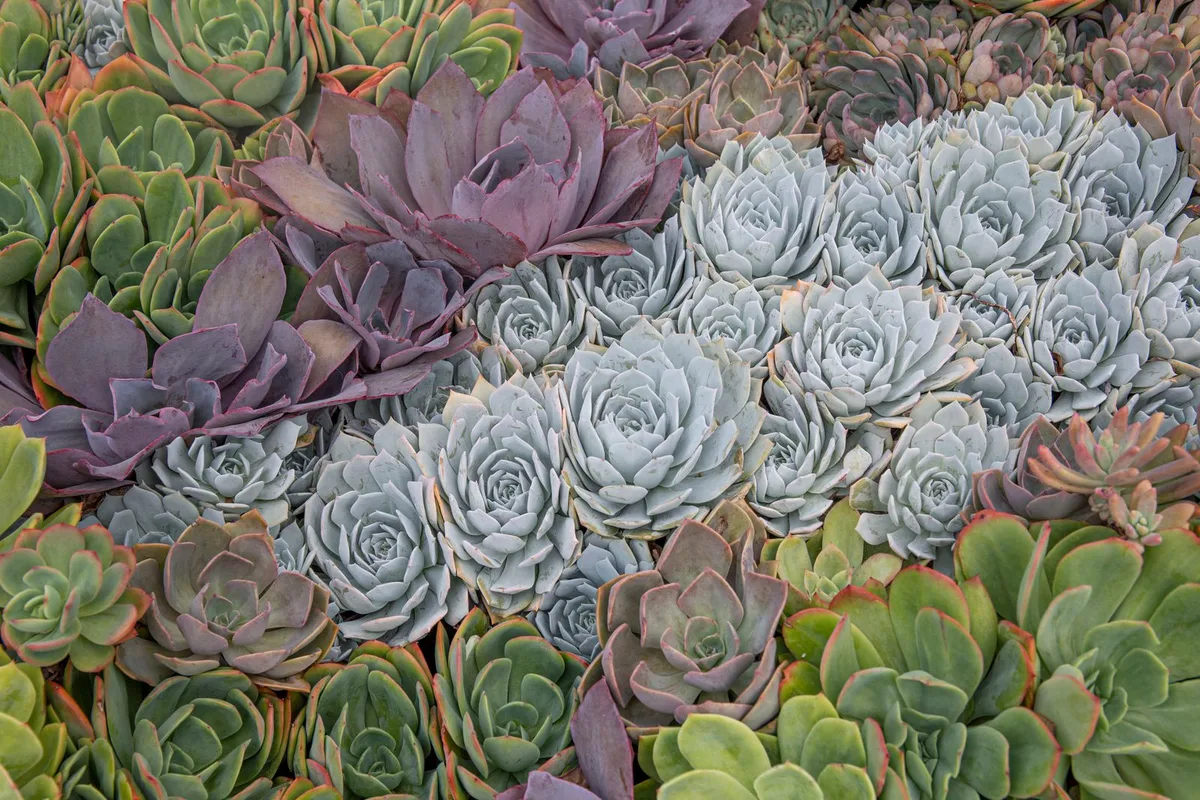
Good plants for rock gardens tolerate fast-draining soil and stay compact. They also keep their looks without regular pruning, which matters in a bed where every gap shows. Foliage counts too. Evergreen and succulent leaves carry the bed through seasons when nothing is in bloom.
Rock Garden Plants by Zone, Height and Sun
This table compares ten reliable rock garden plants by USDA zone range, mature size and light needs.
| Plant | USDA Zones | Height (in / cm) | Spread (in / cm) | Sun |
|---|---|---|---|---|
| Low sedum (stonecrop) | 3 to 9 | 2 to 6 / 5 to 15 | 12 to 24 / 30 to 60 | Full sun |
| Hens and chicks | 4 to 8 | 3 to 6 / 8 to 15 | 6 to 12 / 15 to 30 | Full sun |
| Creeping thyme | 4 to 9 | 2 to 4 / 5 to 10 | 12 to 18 / 30 to 45 | Full sun |
| Creeping phlox | 3 to 9 | 4 to 6 / 10 to 15 | 12 to 24 / 30 to 60 | Full to part sun |
| Blue fescue | 4 to 8 | 8 to 12 / 20 to 30 | 8 to 12 / 20 to 30 | Full sun |
| Hardy ice plant | 6 to 10 | 3 to 6 / 8 to 15 | 12 to 24 / 30 to 60 | Full sun |
| Munstead lavender | 5 to 9 | 12 to 18 / 30 to 45 | 12 to 18 / 30 to 45 | Full sun |
| Dwarf mugo pine | 3 to 7 | 24 to 48 / 60 to 120 | 36 to 60 / 90 to 150 | Full sun |
| Ajuga (bugleweed) | 3 to 9 | 3 to 6 / 8 to 15 | 12 to 24 / 30 to 60 | Part to full shade |
| Heuchera (coral bells) | 4 to 9 | 8 to 18 / 20 to 45 | 12 to 18 / 30 to 45 | Part shade |
Size ranges vary by cultivar. Before buying, check each plant tag against your zone on the USDA Plant Hardiness Zone Map rather than relying on a general store display.
Best Picks by US Region
This table matches rock garden plants to four broad US climate regions.
| Region | Example Areas | Top Picks | Main Risk |
|---|---|---|---|
| Cold North | Minnesota, Michigan, Maine | Hens and chicks, creeping phlox, dwarf mugo pine | Wet winter soil rotting crowns |
| Humid Southeast | Georgia, Carolinas, Tennessee | Sedum, creeping phlox, Adam’s needle yucca | Heavy clay and summer humidity |
| Arid Southwest | Arizona, Nevada, New Mexico | Hardy ice plant, penstemon, agave | Reflected heat and alkaline soil |
| Coastal West | California and Oregon coasts | Sedum, blue fescue, thrift | Salt spray and steady wind |
Clay is the Southeast’s real problem. In those humid states, raise beds at least 6 in (15 cm) above the surrounding clay so roots never sit in water after a summer storm.
Rock Garden Plants That Survive Cold Winters
Hens and chicks, low sedums, creeping phlox and dwarf mugo pine all handle zone 3 or zone 4 winters.
Most winter losses in rock gardens come from wet soil around plant crowns. Cold alone rarely does the damage. A collar of gravel tucked right up to each crown keeps that area dry through every freeze and thaw cycle.
Shade Plants That Grow Among Rocks
Shade doesn’t rule out a rock garden. The plant list just changes: ajuga, heuchera, dwarf hostas and native ferns such as Christmas fern all grow well among rocks in part to full shade.
Shady beds collect fallen leaves, so use 2 to 3 in (5 to 7.5 cm) river rock in place of pea gravel. Bigger stones rake clean.
What Kind of Rocks Are Best for a Rock Garden
The best rocks for a small rock garden are local stone in two or three sizes: boulders for structure, 1 to 3 in (2.5 to 7.5 cm) river rock or crushed stone for coverage, and pea gravel or decomposed granite (DG) for paths. Matching stone colors and sizes keeps a rock garden looking natural. Random mixes rarely do.
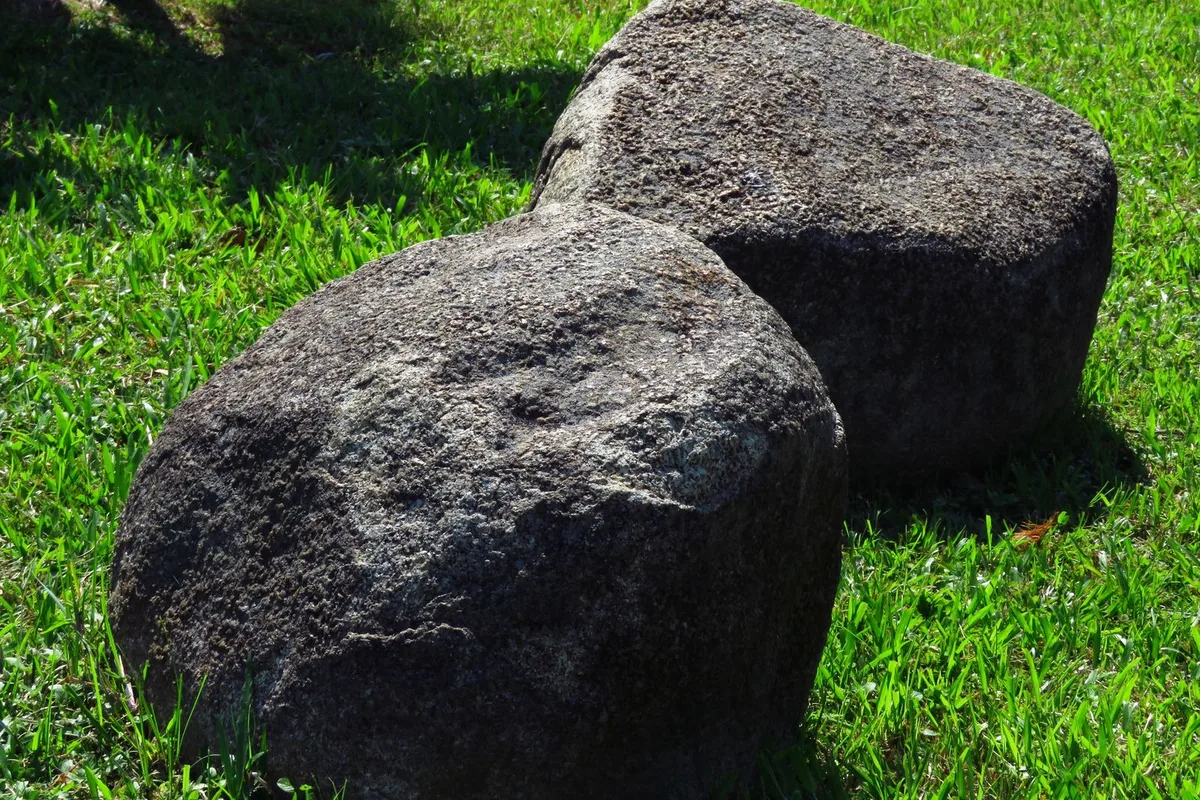
This table compares common rock garden materials by size, best use and main drawback.
| Material | Typical Size (in / cm) | Best Use | Main Drawback |
|---|---|---|---|
| Pea gravel | 3/8 / 1 | Paths, budget cover | Rolls underfoot, spreads into lawn |
| River rock | 1 to 3 / 2.5 to 7.5 | Foundation borders, dry creeks | Smooth stones shift on slopes |
| Crushed stone | 3/4 / 2 | Base layers, planted beds | Plain, angular look |
| Decomposed granite | Under 1/4 / 0.6 | Firm paths, desert styles | Washes out without edging |
| Boulders | 12 to 36 / 30 to 90 | Focal points, berm structure | Heavy, may need delivery |
| Flagstone | 1 to 2 thick / 2.5 to 5 | Crevice gardens, stepping stones | Costs more per square foot |
River Rock vs Pea Gravel
River rock wins for planted beds and foundation borders. For walkable paths on a tight budget, pea gravel is the smarter pick.
Heavy rain won’t wash river rock away, and the bigger stones shade the soil surface more completely, which slows weed germination. Pea gravel feels better underfoot. It usually costs less too, though it migrates into lawns without firm edging.
How to Build a Rock Garden in 9 Steps
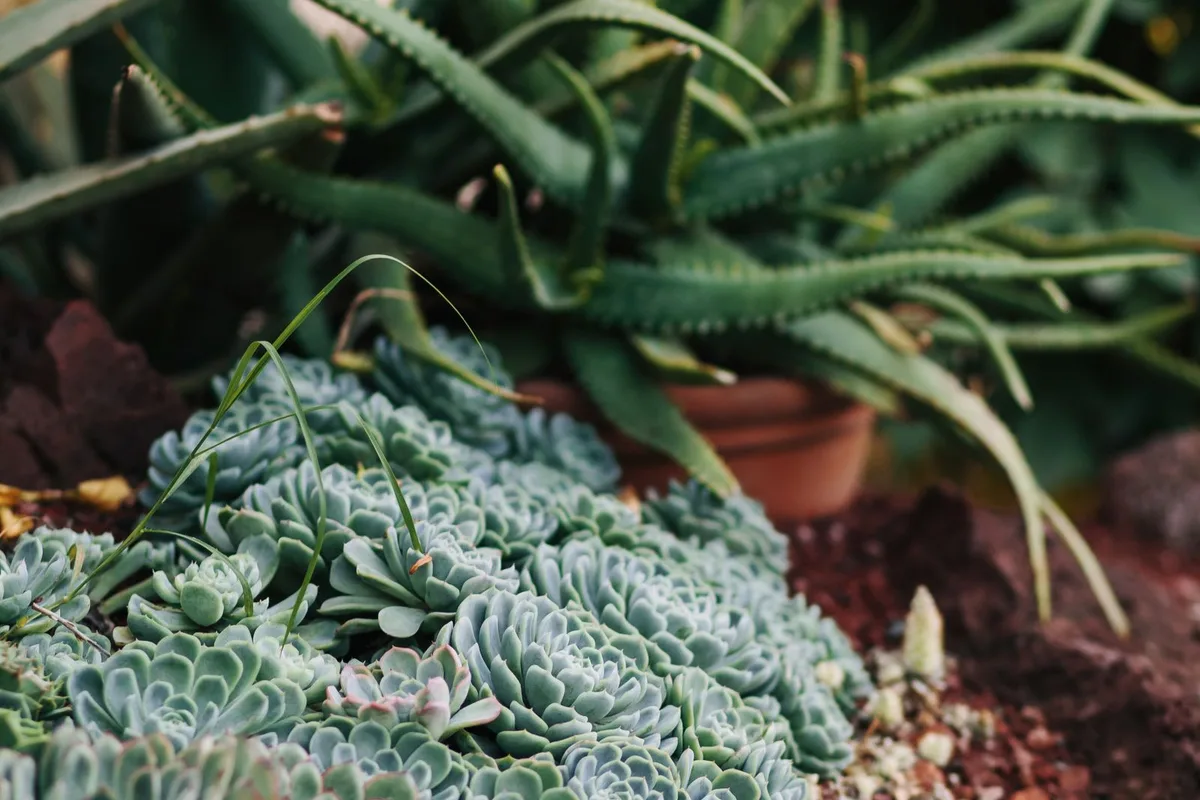
To build a small rock garden, mark the bed, clear turf and weeds, check drainage, add edging, set boulders, mix gritty soil, plant, top-dress with 2 to 3 in (5 to 7.5 cm) of gravel and water deeply. A 3 x 3 ft (0.9 x 0.9 m) corner bed takes one afternoon.
Order matters here. Knowing how to construct a rock garden in the right sequence saves you from moving heavy stone twice, which nobody wants after hauling a boulder across the yard once.
- Call 811 a few days before digging so local utilities can mark buried lines for free.
- Mark the bed outline with a garden hose or marking paint, and confirm the spot gets 6 or more hours of sun.
- Remove turf and weeds, dig out the roots of perennial weeds such as bindweed, and excavate 4 to 6 in (10 to 15 cm) deep.
- Fill the hole with water to test drainage. If water still stands the next day, build a raised berm instead of planting at ground level.
- Install steel, aluminum or buried-stone edging to hold gravel in place and stop grass from creeping in.
- Set the boulders first, with the widest side down, burying each one by about one third.
- Mix equal parts native soil, coarse sand and fine gravel, refill the bed, and rake it to shape.
- Plant from largest to smallest, keeping each plant crown slightly above the surrounding soil.
- Top-dress with 2 to 3 in (5 to 7.5 cm) of gravel, tuck stone right up to each crown, and water deeply.
Rocks dug from the site make good edging or filler stones, so don’t haul them away. Keep them.
New stone can come from a local stone yard or from garden centers such as Home Depot and Lowe’s. National parks are off limits. Removing rocks there is prohibited.
How Deep Should Gravel Be in a Rock Garden
Gravel in a planted rock garden should be 2 to 3 in (5 to 7.5 cm) deep. That depth blocks light from most weed seeds and keeps plant crowns dry. Paths differ. Walkways and unplanted gravel areas work best at 3 to 4 in (7.5 to 10 cm) over a compacted base.
This table compares how far one cubic yard of gravel spreads at common depths.
| Depth (in / cm) | Coverage (Sq Ft / m²) | Best For |
|---|---|---|
| 2 / 5 | 162 / 15 | Beds with very small plants |
| 3 / 7.5 | 108 / 10 | Most planted rock gardens |
| 4 / 10 | 81 / 7.5 | Paths and unplanted areas |
To find how much gravel a small bed needs, multiply the square footage by the depth in inches and divide by 324. You’ll get cubic yards.
Take a 32 sq ft (3.0 m²) front bed at 3 in (7.5 cm) deep: 32 x 3 ÷ 324 comes to about 0.3 cu yd (0.23 m³). That’s roughly 16 bags.
One 0.5 cu ft (14 L) bag of gravel covers 2 sq ft (0.19 m²) at 3 in (7.5 cm) deep. Bigger beds change the math. Price out the total bag count, then compare that figure against a bulk quote that includes delivery.
Do You Need Weed Barrier Fabric Under Rocks
No, a planted small rock garden does not need weed barrier fabric. Fabric blocks plants from spreading and makes later planting a chore. Worse, soil builds up on top. Windblown dirt settles on the fabric, and new weeds sprout in it, while 3 in (7.5 cm) of gravel over a thoroughly weeded bed controls weeds with less long-term work.
Fabric still has a place. Under unplanted gravel paths and dry creek beds, woven commercial-grade fabric works well, and it resists tearing better than the thin spun kind.
Best Alternatives to Weed Barrier Fabric
This table compares common weed control methods for small rock gardens.
| Method | Best Use | Drawback |
|---|---|---|
| Deep gravel (3 in / 7.5 cm) | Planted beds | Slowly sinks into soil |
| Plain cardboard under gravel | New beds over lawn | Breaks down within seasons |
| Woven fabric | Unplanted paths, creek beds | Traps soil on top over time |
| Spring hand-weeding | All beds | Needs short regular sessions |
The best alternative to weed barrier fabric is a single layer of plain cardboard under the gravel when converting lawn. It smothers grass for a season. Then the cardboard breaks down, leaving plants free to spread wherever they like.
Front of House Rules for Drainage, Foundations and HOAs
A rock garden in front of a house must slope away from the foundation, sit below the siding and follow any Homeowners Association (HOA) rules. Bad grading pushes water toward the basement. Siding buried under stone invites moisture and termite damage, and an HOA can fine owners for projects it never approved.
The International Residential Code (IRC), adopted in many US jurisdictions, calls for ground to fall at least 6 in (15 cm) within the first 10 ft (3 m) from a foundation where site conditions allow. Grade the soil first. Gravel won’t fix a slope that runs toward the house.
Leave 6 in (15 cm) of foundation visible above the top of the stone. That strip of bare concrete matters more than it looks, because termite mud tubes stay easy to spot and the siding above stays dry.
Downspouts need a route too. Extend each one into a dry creek bed or a rock-lined splash area so roof water flows away from the foundation.
Before starting any front yard landscaping project, send your HOA a sketch with the plant list attached. Include a material sample as well. California and Colorado have laws that limit HOA bans on water-wise plantings, so check what your own state allows.
Many water utilities, especially in Western states, offer turf replacement rebates. Call yours before pulling up any lawn. Rebate programs often require pre-approval, and ripping out grass first can cost you the payment.
Is a Rock Garden Cheaper Than Grass
Yes, a small rock garden is cheaper than grass over the long term because it needs no mowing, fertilizer or regular irrigation. Stone and edging cost more upfront than sod or seed. Plants add to that bill. No verified national cost figure is available, so local quotes set the real price for any rock garden.
This table compares the main costs of a small rock garden and a small lawn.
| Cost Item | Rock Garden | Lawn |
|---|---|---|
| Upfront materials | Stone, edging, plants | Seed or sod |
| Watering | First season and droughts only | Regular through growing season |
| Mowing | None | Weekly in season |
| Fertilizer | Rarely or never | Several times a year |
| Repairs | Occasional gravel top-up | Reseeding bare patches |
Cheap Rock Garden Ideas on a Budget
These cheap rock garden ideas cut the upfront bill. Upkeep stays just as low.
- Reuse stone dug from the site or offered free by neighbors.
- Buy plants in small pots, which establish quickly in gritty soil.
- Divide sedum and hens and chicks each spring to fill new gaps for free.
- Use free cardboard instead of fabric when converting lawn.
- Choose crushed stone from a local quarry instead of imported decorative rock.
Year-Round Rock Garden Maintenance Calendar
A small rock garden needs about five short tasks a year: spring weeding and cleanup, late spring trimming, summer drought watering, fall leaf removal and a winter check for salt and frost damage. Writing those five tasks into a calendar turns the low maintenance promise into a plan you can follow.
This table compares rock garden tasks and watering needs by season.
| Season | Main Tasks | Watering |
|---|---|---|
| Early spring | Pull weeds, cut dead foliage, re-press heaved plants | None unless dry |
| Late spring | Shear creeping phlox after bloom, top up gravel | Weekly for new plants |
| Summer | Deadhead lavender, pull stray seedlings | Only during long dry spells |
| Fall | Rake leaves off crowns, plant divisions | Water new plantings before freeze |
| Winter | Keep deicing salt off plants | None |
New plants need deep watering once or twice a week through their first growing season. After that, things change. Established drought-tolerant plants rarely need supplemental water outside heat waves.
Frequently Asked Questions
How Long Does a Small Rock Garden Take to Build?
A 3 x 3 ft (0.9 x 0.9 m) corner takes one afternoon. Plan on one to two days for a 4 x 8 ft (1.2 x 2.4 m) front bed, though the plants themselves need a full growing season to fill in.
Do Rock Gardens Attract Snakes or Pests?
Yes, deep gaps between large rocks can shelter snakes. Lizards and insects move in too. Set stones tightly and fill any voids with gravel, and keep woodpiles well away so the bed offers little hiding space.
Can You Build a Rock Garden on Flat Ground?
Yes. A berm 12 to 18 in (30 to 45 cm) high, or a crevice bed of upright flat stones, adds the height and drainage a natural slope provides.
How Do You Keep Weeds Out Between Rocks?
Start with a weed-free bed and keep the gravel 3 in (7.5 cm) deep. Early spring is weeding time. Seedling roots are still shallow then, and a narrow hand weeder reaches tight gaps without disturbing stone.
How Often Should You Water a New Rock Garden?
Give new plantings a deep soak once or twice weekly during their first growing season. Then ease off. Water only during extended droughts or heat waves once that first season ends.
Conclusion
Low maintenance small rock garden ideas fit where many US yards are heading, as water utilities in many regions restrict lawn watering and offer turf replacement rebates. A small rock garden built now gives you a head start on that shift, whatever size your yard allows.
Start with one measured plan, such as the 3 x 3 ft (0.9 x 0.9 m) corner, and match every plant to your USDA zone. Give it a season. You’ll learn which plants thrive in your soil and light, and divisions from those proven performers can fill a larger bed for free.
The next wave of rock garden landscaping ideas favors crevice beds and native alpines. Dry creek beds that manage stormwater belong to it as well. Every one of those styles still starts with drainage. Deep gravel and site-matched plants do the rest.