
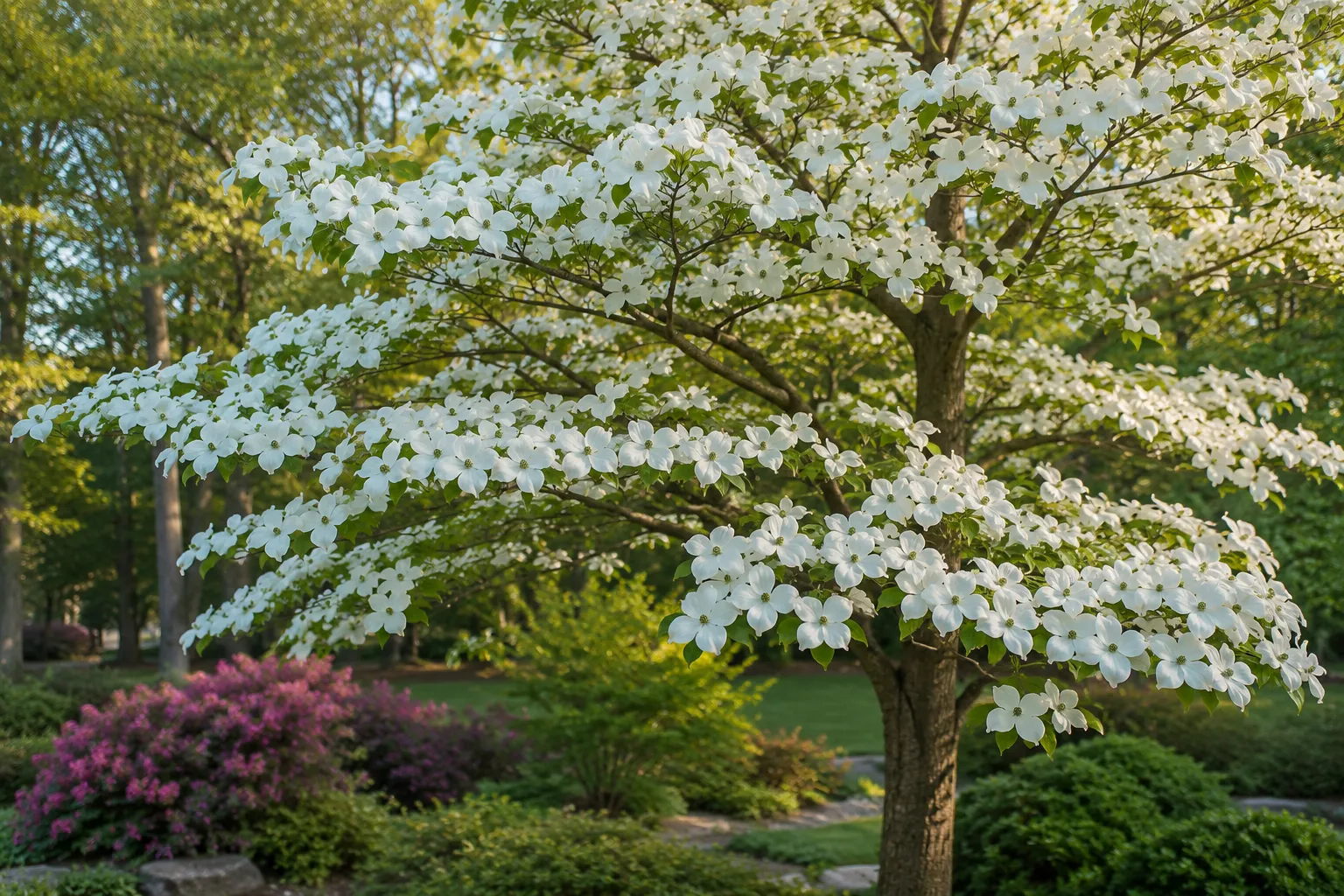
Dogwood tree care requires: partial shade to filtered sunlight, moist well-drained acidic soil (pH 5.5–6.5), 1–2 inches of water per week, and light fertilizing in spring only. These 4 conditions keep dogwoods healthy for 50–80 years. Get any one wrong — especially drainage — and problems follow fast.
Dogwood trees (Cornus spp.) are small deciduous trees that bloom in spring, produce colorful fall berries, and turn red-purple in autumn. Most top out at 20–30 feet tall, making them ideal for small yards, woodland borders, and under utility lines. This guide covers everything: 6 varieties, planting steps, watering schedules, pruning rules, fertilizing, and 8 common problems with fixes. Planning a full yard layout? See our guide on Best Shrubs for Landscaping
Dogwood Tree Varieties: 6 Types for Every Landscape
Choose the right species before planting — each variety has different zone requirements, disease resistance, and mature size.
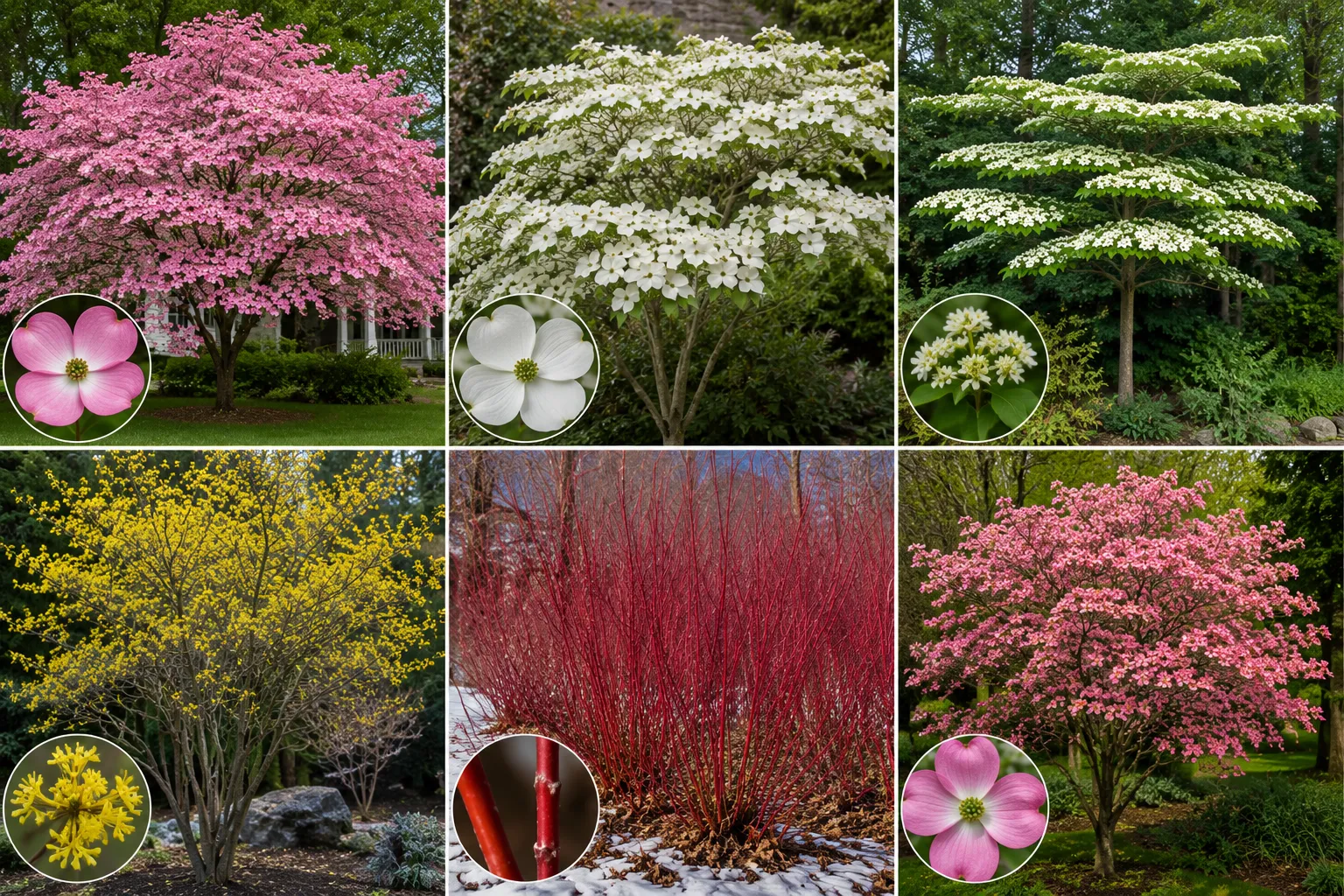
Flowering Dogwood — Cornus florida
Native to eastern North America. Hardy in Zones 5–9. Grows 15–30 feet tall and wide. Produces white or pink flower bracts in early spring (April). Most ornamental species — but also the most disease-prone. Choose disease-resistant cultivars like ‘Appalachian Spring’ or ‘Cherokee Brave’ to reduce anthracnose risk.
Kousa Dogwood — Cornus kousa
Native to eastern Asia. Hardy in Zones 5–8. Blooms 2–4 weeks later than Cornus florida (late May to June). More drought-tolerant and significantly more resistant to anthracnose and powdery mildew. Distinctive mottled bark in gray, brown, and tan. Best choice for gardeners in hot or humid regions.
Pagoda Dogwood — Cornus alterniflora
Native North American species. Hardy down to Zone 3. Stays compact at 10–15 feet. Flat clusters of white flowers in spring, near-black berries in fall. Excellent for woodland and naturalistic gardens. Horizontal branching gives a tiered, architectural look.
Cornelian Cherry Dogwood — Cornus mas
One of the first trees to bloom in late winter (February–March), with small yellow flowers. Hardy in Zones 4–8. Grows 20–25 feet tall and 15–20 feet wide. Extremely long-lived — can exceed 100 years. Red berries are edible and attract birds. More tolerant of dry conditions than other dogwood species.
Red-Osier Dogwood — Cornus sericea
Shrub form, not a tree. Bright red stems provide winter interest. Hardy to Zone 2. Resistant to dogwood anthracnose. Used in rain gardens and wet soil areas where tree dogwoods would fail.
Hybrid Dogwood — Cornus florida × kousa
Crosses between flowering and Kousa dogwoods. Named varieties like ‘Stellar Pink’ and ‘Aurora’ combine the showy spring blooms of Cornus florida with the disease resistance of Cornus kousa. Best all-around choice for most gardeners.
Compare dogwood to other landscape choices in our Types of Shrubs guide
Dogwood Tree Growing Zones
Flowering dogwood (Cornus florida): Zones 5–9. Marginally hardy in Zone 5 — plant in a sheltered spot away from wind.
Kousa dogwood (Cornus kousa): Zones 5–8. Handles summer heat better than Cornus florida.
Pagoda dogwood (Cornus alterniflora): Zones 3–7. Best cold-hardy option for northern gardens.
Cornelian cherry (Cornus mas): Zones 4–8. Most heat and drought tolerant of the group.
In Zones 8–9, choose Kousa or Cornelian cherry — Cornus florida struggles with sustained summer heat in the deep South.
Sunlight: The Most Misunderstood Part of Dogwood Care
Dogwood trees prefer partial shade to dappled light, not full sun. In cooler climates (Zones 5–6), full sun is acceptable. In hot climates (Zones 7–9), full sun causes leaf scorch, increases anthracnose risk, and stresses the tree.
- Ideal: 4–6 hours of morning sun with afternoon shade
- Acceptable in cool climates: full sun with consistent moisture
- Avoid: afternoon sun in Zones 7–9 — increases leaf scorch and disease pressure
The woodland edge — where trees receive bright light but are shaded by taller canopy in the afternoon — is the natural habitat of most dogwood species. Mimic this in your garden for best results.
Soil Requirements for Dogwood Trees
Dogwoods require well-drained, slightly acidic soil with a pH of 5.5–6.5 and rich organic content. They do not tolerate waterlogged or constantly soggy conditions. Poor drainage kills more dogwoods than drought.
- Ideal soil type: moist, loamy, rich in organic matter
- Soil pH: 5.5 to 6.5 (test before planting)
- Avoid: heavy clay without amendment, or wet low-lying spots
- Amendment: work 3–4 inches (7.5–10 cm) of compost into the planting area before setting the tree
Dogwoods have shallow root systems — 90% of roots stay in the top 2–3 feet (60–90 cm) of soil. This makes them sensitive to soil compaction, heavy foot traffic near the root zone, and lawn equipment damage.
Set the right soil moisture routine with our Watering Schedule tool
How to Plant a Dogwood Tree: 7 Steps
- Step 1: Choose the right spot — partial shade, well-drained soil, away from paved surfaces
- Step 2: Plant in spring or fall — allow 4–6 weeks before first frost if planting in fall
- Step 3: Dig a hole 2–3 times the width of the root ball, but no deeper than the root ball height
- Step 4: Set the tree so the root flare (where trunk meets roots) sits at or slightly above ground level
- Step 5: Backfill with native soil mixed with compost — do not add fertilizer to the planting hole
- Step 6: Water thoroughly to settle soil around roots
- Step 7: Apply 3–4 inches (7.5–10 cm) of mulch in a ring extending to the drip line — keep mulch 3 inches away from the trunk
Never plant dogwood deeper than the root flare. Burying the trunk base causes crown rot and trunk disease within 2–3 years.
Watering Dogwood Trees: Schedule by Growth Stage
Water dogwood trees 1–2 inches (2.5–5 cm) per week during the growing season. Deep, infrequent watering is better than frequent shallow watering. Always water at the base — never overhead — to keep bark and foliage dry.
First 2 Years After Planting
- Water every 2–3 days for the first 2 weeks after planting
- Then water twice a week through the first growing season
- In the second season, water weekly if rainfall is below 1 inch per week
Established Trees (3+ Years)
- Water only during dry spells — when rainfall drops below 1 inch per week for 2+ weeks
- Deep soak monthly in summer heat; shallow daily watering is harmful
- Morning watering only — leaves and bark must dry before nightfall
Overwatering kills more dogwood trees than drought. Symptoms of overwatering: leaf edges brown and blacken starting at the tips, working inward. If this occurs, check soil moisture and reduce watering immediately.
Fertilizing Dogwood Trees
Dogwoods planted in organically rich soil rarely need fertilizer. When fertilizer is needed, use a balanced slow-release formula.
Year 1: Skip fertilizer entirely. Focus on root establishment. Adding fertilizer in the first year pushes leaf growth at the expense of roots.
Year 2 onward: Apply a complete fertilizer (12-4-8 or 16-4-8) once in March and again in early July for young trees. Established trees need fertilizing only if growth or leaf color is poor.
- Use acid-forming organic fertilizers for natural pH management
- Do not fertilize after August — late feeding stimulates soft growth that frost kills
- Never fertilize a stressed, drought-damaged, or diseased tree until recovery
Mulching: How to Do It Right
Mulch is one of the most effective tools for dogwood care. It retains moisture, moderates soil temperature, suppresses weeds, and protects shallow roots from mechanical damage.
- Apply 3–4 inches (7.5–10 cm) of wood chips, pine bark, or shredded leaves
- Extend the mulch ring to the drip line (edge of the canopy)
- Keep mulch 3 inches (7.5 cm) away from the trunk — mulch touching bark causes rot and disease
- Top up with 1 inch of fresh mulch each fall to account for decomposition
Do not use dyed or rubber mulch. These hold excess heat and do not improve soil biology as organic mulch does.
Pruning Dogwood Trees
Dogwoods are naturally well-shaped trees — they need minimal pruning. Annual pruning in late winter or early spring before new growth starts removes dead wood and maintains structure.
When to Prune
- Best time: late winter to early spring, before buds swell
- Acceptable: immediately after spring flowering
- Never prune in late summer or fall — wounds heal slowly and invite borers
What to Remove
- Dead, diseased, or broken branches — cut flush to the branch collar
- Branches crossing or rubbing against each other
- Suckers growing from the base
- Water sprouts (vigorous vertical shoots)
Dogwoods have thin bark that wounds easily. Keep lawn mowers and string trimmers away from the trunk. Even minor trunk wounds create entry points for dogwood borers and fungal disease.
Learn proper cutting technique in our How to Prune Shrubs step-by-step
8 Common Dogwood Tree Problems (With Fixes)
1. Dogwood Anthracnose
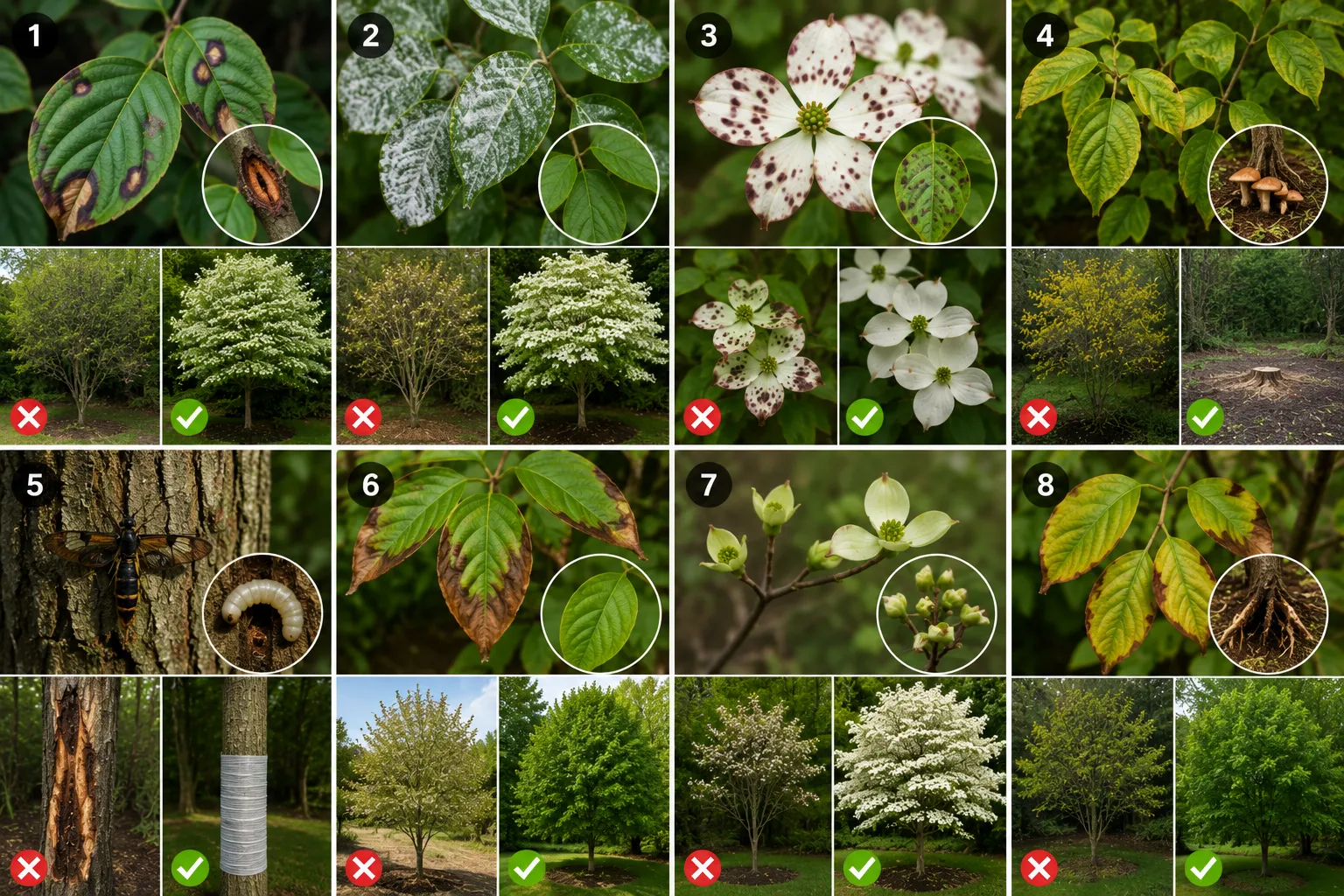
The most serious dogwood disease. Caused by the fungus Discula destructiva. Symptoms: tan spots with purple borders on leaves, dieback of lower branches, cankers on stems. Most severe in cool, wet springs and shaded locations. Fix: prune infected wood immediately, improve air circulation, apply fungicide in early spring. Choose resistant varieties: Kousa dogwood and hybrid Cornus florida × kousa have strong resistance.
2. Powdery Mildew
White powdery coating on leaves in summer and fall. Thrives in shaded, humid conditions with poor air circulation. Not usually fatal but weakens the tree. Fix: plant in adequate sunlight, space trees for airflow, apply fungicide if severe. ‘Appalachian Spring’ and Kousa varieties show resistance.
3. Spot Anthracnose
Small spots with purple halos on flower bracts and leaves. Caused by Elsinoe corni. More cosmetic than damaging. Fix: collect and destroy fallen leaves, improve drainage, apply fungicide in spring during wet weather.
4. Root Rot (Armillaria)
Caused by Armillaria fungi. No cure exists. Symptoms: yellowing leaves smaller than normal, premature leaf drop, branch dieback, honey-colored mushrooms at the base in fall. Remove and destroy infected trees — do not replant a dogwood in the same spot.
5. Dogwood Borer
Synanthedon scitula larvae tunnel under the bark, causing gradual tree decline. Entry via trunk wounds from mowers and trimmers. Prevention is the best strategy: keep equipment away from the trunk, maintain tree health, wrap young trunks with tree wrap in the first 2 years.
6. Leaf Scorch
Browning and crisping of leaf edges in summer. Caused by too much direct afternoon sun, drought, or root damage. Fix: mulch heavily, increase watering during heat, consider relocating to a shadier spot if in Zones 7–9.
7. No Flowers
4 causes: tree under 3 years old (normal — dogwoods bloom at maturity), insufficient sunlight, over-fertilizing with nitrogen, or pruning at the wrong time (removing next year’s flower buds). Fix: ensure 4–6 hours of light, reduce nitrogen feeds, prune only in late winter before bud break.
8. Overwatering / Root Problems
Brown-black leaf edges that spread inward signal overwatering or poor drainage. Check soil — if wet, stop watering and improve drainage. Root rot sets in within weeks of constant saturation. Young trees in their first 2 years are most vulnerable.
Pair dogwoods with Evergreen Shrubs for year-round structure
Dogwood Tree Care by Season
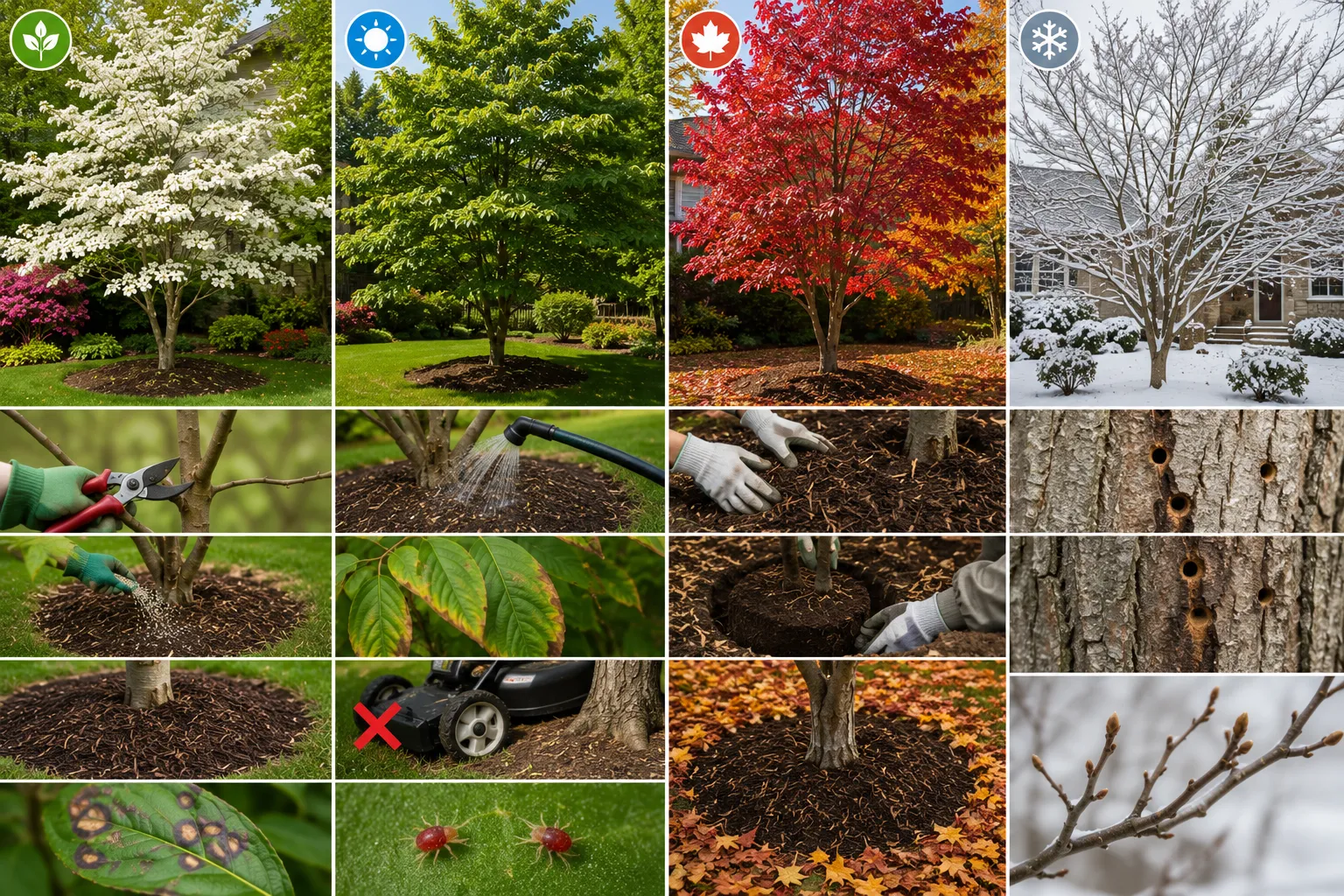
Spring: Prune dead wood before buds open. Apply fertilizer (Year 2+). Refresh mulch ring. Monitor for anthracnose during cool wet spells.
Summer: Water deeply during dry periods. Watch for leaf scorch and spider mites. Keep lawn equipment away from trunk.
Fall: Top up mulch to 3–4 inches for winter root protection. Plant new trees 4–6 weeks before first frost. Do not fertilize.
Winter: No active care needed. Inspect bark for borer entry holes or cankers. Plan any pruning for late winter.
Dogwood Tree Care Quick Reference
Sunlight: Partial shade to dappled light; morning sun preferred in hot zones
Water: 1–2 inches/week growing season; deep soak, low frequency
Soil pH: 5.5–6.5, well-drained, rich in organic matter
Fertilizer: Skip Year 1; balanced 12-4-8 in March and July for young trees
Pruning: Late winter/early spring; remove dead wood only
Mulch: 3–4 inches, kept 3 inches from trunk, refresh annually in fall
Hardiness Zones: Varies by species: Zone 3 (Pagoda) to Zone 9 (Flowering)
Lifespan: 50–80 years with proper care; Cornelian cherry can exceed 100 years
Frequently Asked Questions
How fast do dogwood trees grow?
Slow to moderate — 1–2 feet (30–60 cm) per year under good conditions. Full size is reached in 10–15 years. Kousa dogwood grows slightly slower than Cornus florida.
Are dogwood berries poisonous?
Cornus florida berries are mildly toxic to humans and pets — they can cause stomach upset if eaten in quantity. Birds eat them without harm. Cornelian cherry berries are edible and used in jams and syrups.
Can I grow a dogwood in a container?
Not recommended long-term. Dogwoods develop wide shallow root systems that quickly outgrow containers. Dwarf varieties like ‘Little Poncho’ can survive in large containers (25+ gallons / 95+ liters) for a few years, but ground planting gives the best results.
Why are my dogwood leaves turning red in summer?
Summer leaf reddening on a stressed dogwood signals drought stress, root compaction, or disease. Normal fall color change (red-purple) occurs in September–October. If red color appears in July or August, water deeply and check for root problems.
Do dogwood trees need full sun?
No. Dogwoods perform best in partial shade, especially in Zones 7–9. In cool northern zones (5–6), full sun is tolerated if soil moisture is maintained. Full sun in hot climates increases disease pressure and shortens tree life.
Conclusion
Dogwood tree care comes down to 4 things — the right location, the right soil, the right watering, and a little protection. Get these right, and your dogwood will thrive for decades.
Here’s what to remember:
Plant in partial shade, especially in warmer zones. Keep soil pH between 5.5–6.5 and make sure drainage is good — because waterlogged soil kills dogwoods faster than anything else. Pay close attention during the first 2 years — after that, an established dogwood becomes much more self-sufficient. Prune in late winter, keep mulch away from the trunk, and never let lawn equipment near the base of the tree.
If you go with Cornus florida, choose a disease-resistant cultivar like ‘Appalachian Spring’. If your area runs hot and humid, Kousa dogwood is your best bet for long-term success.
A healthy dogwood can live 50 to 80 years — offering spring blooms, summer shade, fall color, and winter berries all in one tree. A little effort up front pays off for a lifetime.