
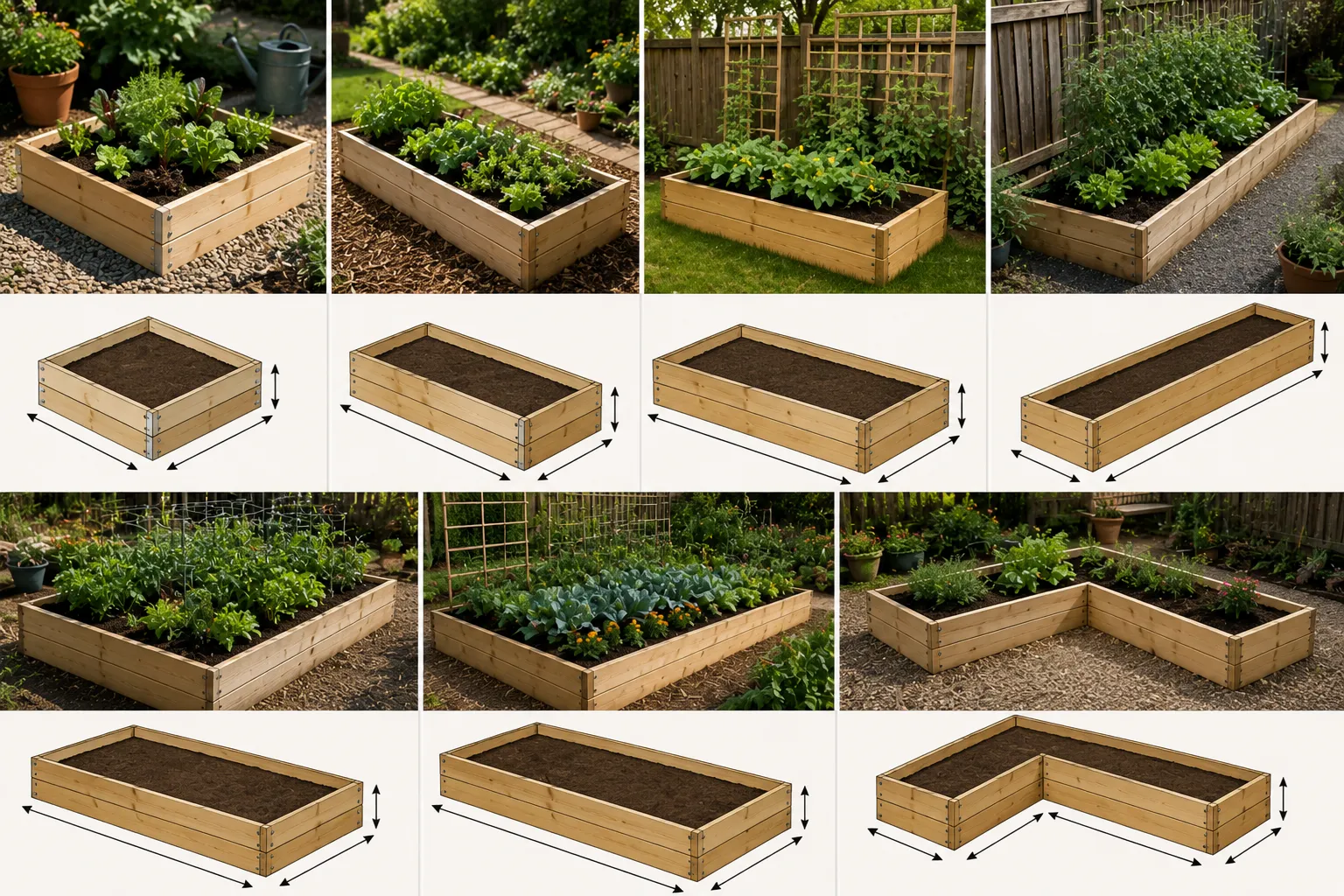
A raised garden bed needs 4 boards, 4 corner posts, and 24 screws for the most common 4×8 ft (1.2×2.4m) size. This guide gives you 7 ready-to-use raised garden bed plans, exact cut lists in inches and centimeters, and a printable PDF you can take straight to the lumber yard.
Most raised garden bed plans online skip the math. They tell you to buy lumber without telling you which lengths avoid waste, how much soil you need, or how the height changes what you can grow. This guide fixes that with 7 specific plans, a soil volume formula, and a materials list for each size.
Which Raised Garden Bed Size Should You Build?
Download PDF
Build a 4×8 ft (1.2×2.4m) bed for a standard vegetable garden, or choose from 6 other named sizes based on your space and goals. Standard lumber comes in 8-, 10-, and 12-foot lengths. Matching your bed dimensions to these lengths cuts material waste to zero.
3 factors decide your size: available space, board length on hand, and what you plan to grow. A 4-foot width is the maximum for single-side reach without stepping on the soil. Anything wider forces you to compact the bed by walking in it.
| Bed Size | Best For | Soil Needed | Board Length Used |
| 4×4 ft (1.2×1.2m) | Herbs, small patios | 0.5 cubic yards (0.4 m3) | 8-ft boards, no waste |
| 4×8 ft (1.2×2.4m) | Standard vegetable garden | 1 cubic yard (0.76 m3) | 8-ft boards, no waste |
| 3×6 ft (0.9×1.8m) | Children, narrow yards | 0.35 cubic yards (0.27 m3) | 12-ft boards, no waste |
| 2×8 ft (0.6×2.4m) | Wall-side, single access | 0.3 cubic yards (0.23 m3) | 8-ft boards, no waste |
| 4×4 ft x 6 in (1.2×1.2m x 15cm) | Shallow-root greens | 0.25 cubic yards (0.19 m3) | 8-ft boards, no waste |
| 4×4 ft elevated on legs | Wheelchair/standing access | 0.4 cubic yards (0.3 m3) | 8-ft boards + 4 legs |
| 4×8 ft x 18 in (1.2×2.4m x 46cm) | Root vegetables, raised comfort | 1.5 cubic yards (1.15 m3) | 8-ft boards, double-stacked |
How to Choose Bed Width for Easy Reach
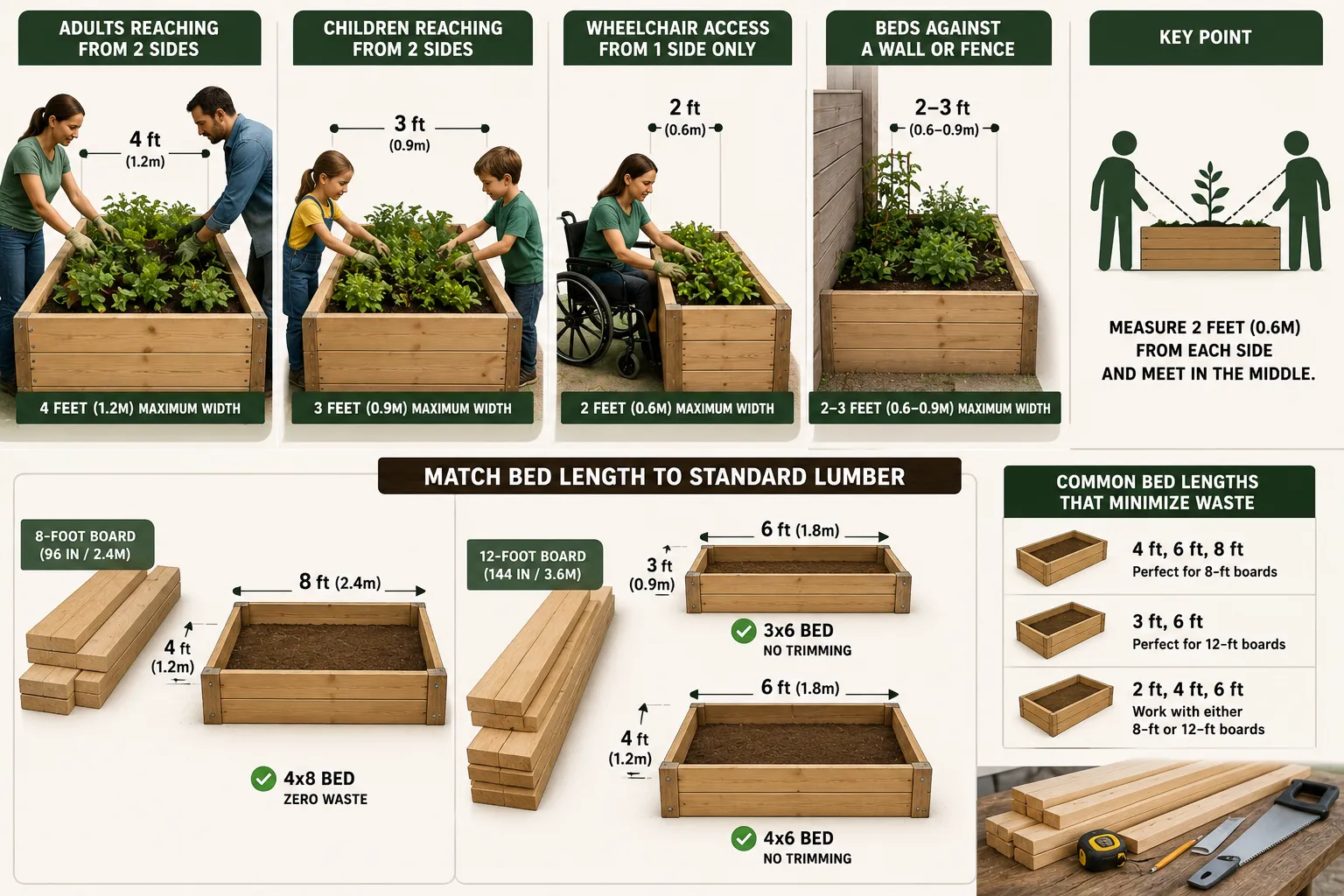
To choose bed width for easy reach, measure 2 feet (0.6m) from each side and meet in the middle. A 4-foot (1.2m) wide bed lets an adult reach the center from either side without stepping in. Children need a narrower 3-foot (0.9m) width for the same comfortable reach.
- Adults reaching from 2 sides: 4 feet (1.2m) maximum width
- Children reaching from 2 sides: 3 feet (0.9m) maximum width
- Wheelchair access from 1 side only: 2 feet (0.6m) maximum width
- Beds against a wall or fence: 2-3 feet (0.6-0.9m) maximum width
How to Match Bed Length to Standard Lumber
To match bed length to standard lumber, size your beds in multiples of 2 or 3 feet. An 8-foot board cuts perfectly into a 4×8 bed with zero waste. A 12-foot board suits a 3×6 or 4×6 bed without trimming.
How to Build a 4×8 Raised Garden Bed
To build a 4×8 raised garden bed, cut 2 boards at 96 inches (243.8cm), 2 boards at 48 inches (121.9cm), and join all 4 corners with 12-inch (30.5cm) corner posts. This single size produces 32 square feet (3 m2) of growing space using one standard 8-foot board with no offcuts.
| Board | Quantity | Length (inches) | Length (cm) |
| 2×6 side boards | 2 pieces | 96 in | 243.8 cm |
| 2×6 end boards | 2 pieces | 48 in | 121.9 cm |
| 4×4 corner posts | 4 pieces | 12 in | 30.5 cm |
| 3-inch deck screws | 24 screws | N/A | N/A |
- Cut 2 side boards at 96 inches (243.8cm) using a circular saw or hardware store cutting service.
- Cut 2 end boards at 48 inches (121.9cm).
- Cut 4 corner posts at 12 inches (30.5cm) from 4×4 lumber.
- Attach each side board to 2 corner posts using 3 deck screws per joint.
- Square the frame using a tape measure across both diagonals — equal measurements confirm a true square.
- Line the bottom with hardware cloth if burrowing animals are a concern in your area.
- Fill with 1 cubic yard (0.76 m3) of soil mix.
How to Calculate Soil Volume for Your Bed
To calculate soil volume for your bed, multiply length by width by height, then divide by 27 to convert cubic feet to cubic yards. A 4×8 ft bed at 12 inches (30.5cm) deep needs 32 cubic feet, or 1.2 cubic yards (0.9 m3) of soil mix.
3 named soil mix components work for most vegetables: 60% high-quality topsoil, 30% compost, and 10% perlite or coarse sand for drainage. Avoid pure native garden soil — it compacts and drains poorly inside a frame.
What Wood Should You Use for Raised Garden Bed Plans?
Cedar, redwood, and cypress resist rot naturally and last 10-15 years without chemical treatment. Pine and hemlock cost less but last only 4-6 years before replacement.
- Cedar boards: naturally rot-resistant, lasts 10-15 years, moderate cost
- Redwood boards: naturally rot-resistant, lasts 12-15 years, highest cost
- Cypress boards: naturally rot-resistant, lasts 10-12 years, moderate cost
- Pine boards: budget option, lasts 4-6 years untreated, lowest cost
- Composite boards: weather-resistant, lasts 20+ years, highest upfront cost
Avoid chemically treated lumber for food crops. Older pressure-treated wood contained arsenic compounds that leach into soil. Modern treated lumber uses copper-based preservatives that are safer but still unnecessary when cedar is available.
How to Pick Board Thickness for Durability
To pick board thickness for durability, choose 2-inch (5cm) nominal lumber over 1-inch (2.5cm) boards. Thinner boards bow outward once 32 cubic feet of wet soil presses against them. A 2-inch board resists this pressure for the life of the bed.
How Deep Should a Raised Garden Bed Be?
Build your bed 12 inches (30.5cm) deep for most vegetables, or 6 inches (15cm) deep for shallow-root greens only. Root vegetables like carrots and potatoes need 18 inches (45.7cm) of depth to develop properly.
- Lettuce, herbs, and salad greens: 6 inches (15cm) minimum depth
- Tomatoes, peppers, and bush beans: 12 inches (30.5cm) minimum depth
- Carrots, potatoes, and parsnips: 18 inches (45.7cm) minimum depth
- Wheelchair-height elevated beds: 28 inches (71.1cm) total height with 12 inches (30.5cm) of soil
Deeper beds cost more in soil. An 18-inch (45.7cm) deep 4×8 bed needs 1.5 cubic yards (1.15 m3) of soil mix, roughly 50% more than a 12-inch (30.5cm) bed of the same footprint.
How to Build a Raised Garden Bed With Legs
To build a raised garden bed with legs, attach 4 legs at 28-32 inches (71-81cm) tall to a standard frame and add a solid bottom panel with drainage holes. This design eliminates bending for gardeners with back pain or mobility limits.
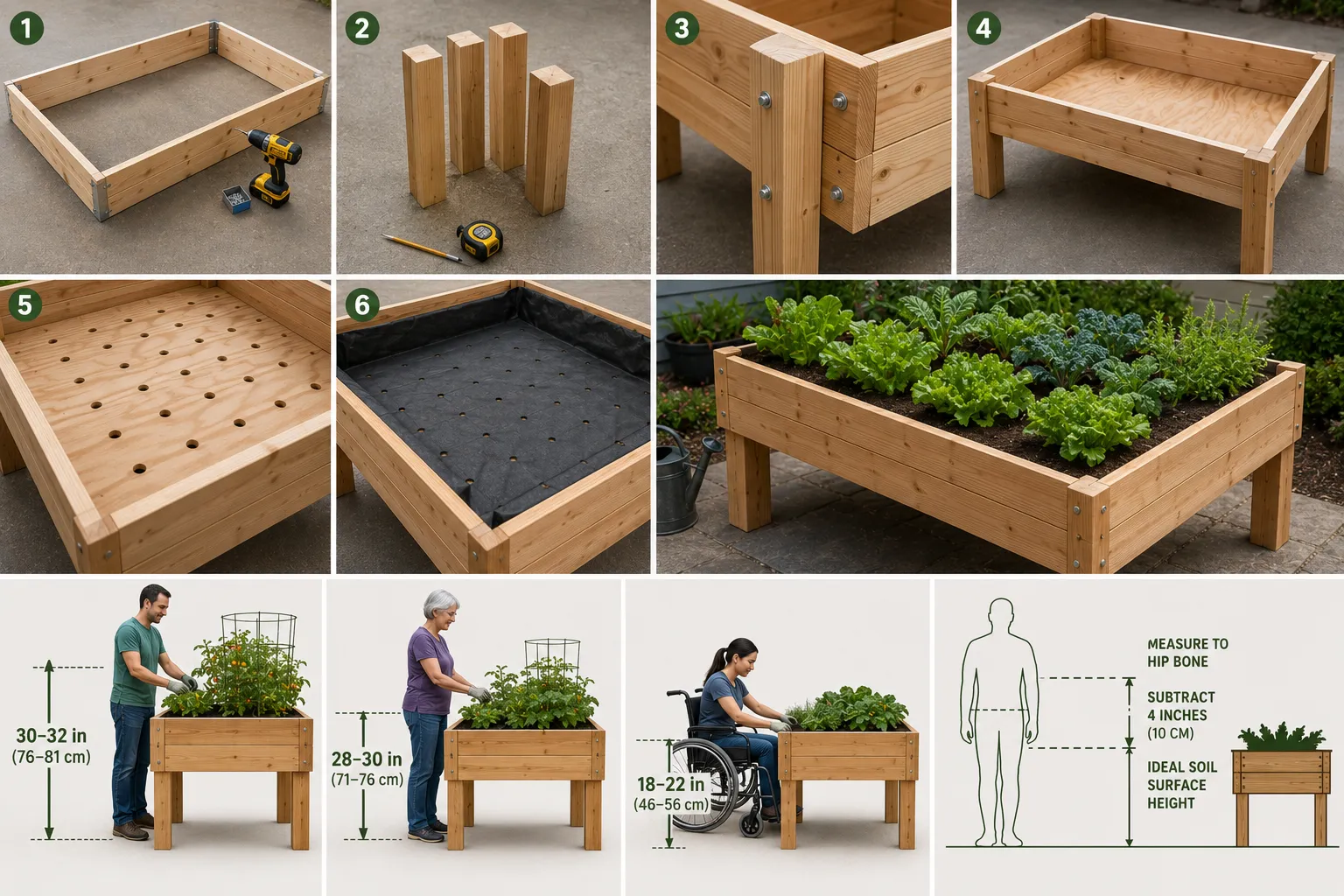
- Build a standard rectangular frame using the 4×8 or 4×4 cut list above.
- Cut 4 legs from 4×4 lumber at 28 inches (71.1cm) for standing height, or 18 inches (45.7cm) for seated height.
- Attach legs to the inside corners using carriage bolts, not screws, for weight support.
- Add a solid plywood bottom panel rated for outdoor use.
- Drill drainage holes every 4 inches (10cm) across the bottom panel.
- Line the bottom with landscape fabric before adding soil.
How to Choose Leg Height for Standing Comfort
To choose leg height for standing comfort, measure from the floor to your hip bone and subtract 4 inches (10cm) for the soil surface. Most adults find 30-32 inches (76-81cm) comfortable for standing garden work without bending.
How to Make Your Raised Bed Wheelchair Accessible
To make your raised bed wheelchair accessible, build the frame to 28 inches (71.1cm) total height with a 2-foot (0.6m) maximum width. This height places the soil surface at lap level for a seated gardener, and the narrow width keeps every plant within arm’s reach.
- Total bed height: 28 inches (71.1cm) from ground to rim
- Bed width: 2 feet (0.6m) maximum for single-side wheelchair access
- Bed length: up to 8 feet (2.4m), limited only by lumber cost
- Leg spacing: reinforced corner brackets every 4 feet (1.2m) to support wet soil weight
What Tools Do You Need to Build Raised Garden Bed Plans?
You need 6 named tools to build any raised garden bed plan: a drill, a circular saw, a tape measure, a spirit level, a square, and a screwdriver bit set. A miter saw replaces the circular saw for cleaner corner cuts but is not required.
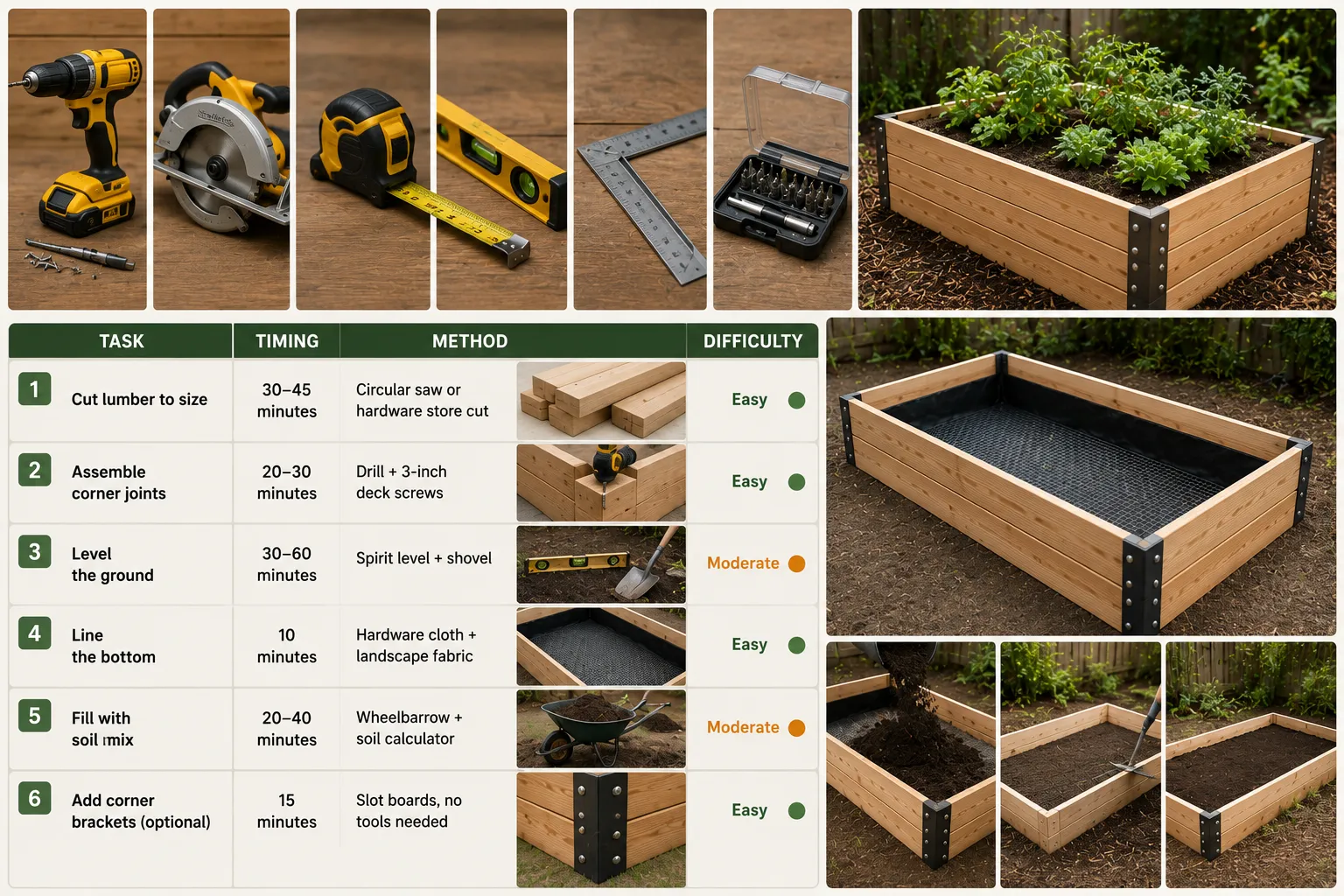
Quick-reference table for the full build process:
| Task | Timing | Method | Difficulty |
| Cut lumber to size | 30-45 minutes | Circular saw or hardware store cut | Easy |
| Assemble corner joints | 20-30 minutes | Drill + 3-inch deck screws | Easy |
| Level the ground | 30-60 minutes | Spirit level + shovel | Moderate |
| Line the bottom | 10 minutes | Hardware cloth + landscape fabric | Easy |
| Fill with soil mix | 20-40 minutes | Wheelbarrow + soil calculator | Moderate |
| Add corner brackets (optional) | 15 minutes | Slot boards, no tools needed | Easy |
Before cutting any lumber, measure your planting area. The ZonedGarden garden area calculator converts your yard measurements into square feet or square meters in under a minute, which helps you decide how many beds fit your space.
How to Level Ground Before Placing Your Bed
To level ground before placing your bed, remove high spots with a shovel and fill low spots with paver sand. An unlevel bed causes water to pool on one side, leading to root rot in that section while the opposite side dries out.
How to Line the Bottom of a Raised Bed
To line the bottom of a raised bed, place hardware cloth first if burrowing animals are present, then add landscape fabric on top. Skip both layers only if the bed sits on a hard surface like a patio or deck.
Where Should You Place Your Raised Garden Bed?
Place your raised garden bed where it receives 6-8 hours of direct sunlight daily, ideally facing south. North-facing spots in shaded yards reduce vegetable yields by up to 50%.
Watering schedule changes based on bed placement and local climate zone. The ZonedGarden complete lawn care guide covers irrigation timing principles that apply directly to raised bed watering, including the 6-10am window that reduces evaporation loss.
Soil in a raised bed warms up 2-3 weeks earlier in spring than ground-level soil, which lets you start planting sooner regardless of your specific climate zone.
Plant timing still depends on your specific region. ZonedGarden’s zone-specific growing strategies cover frost dates and seasonal planting windows for every USDA hardiness zone in North America.
Build Your Raised Garden Bed This Weekend
7 plans, 4 wood options, and 3 depth ranges cover every common raised garden bed need. Pick the 4×8 standard size if you are unsure where to start — it uses one 8-foot board per side with zero waste and suits most vegetables at 12 inches (30.5cm) deep.
Download the printable PDF below to take exact measurements and cut lists straight to the lumber yard, skip the math, and start building today.
FAQs About Raised Garden Bed Plans
Do raised garden beds need drainage holes in the bottom?
Yes. Open-bottom frame beds placed on soil drain naturally and need no holes. Closed-bottom beds, tubs, or troughs need drainage holes every 4 inches (10cm) to prevent root rot.
Can you build a raised garden bed without power tools?
Yes. Most hardware stores cut lumber to your exact measurements for free or a small fee. A hand screwdriver and corner brackets replace a drill for assembly, though the process takes longer.
How long do wooden raised garden beds last?
Cedar and redwood beds last 10-15 years. Untreated pine lasts 4-6 years before boards need replacement due to rot.
Is a 12-inch deep raised bed enough for tomatoes?
Yes. Tomatoes develop a strong root system in 12 inches (30.5cm) of quality soil mix. Deeper beds of 18 inches (45.7cm) benefit root vegetables more than tomatoes specifically.
Do raised garden bed plans work on a sloped yard?
Yes. Stepped or terraced raised beds handle slopes up to 15 degrees using partial frames and soil retention methods. Beyond 15 degrees, retaining walls become necessary before adding bed frames.