

Water your lawn between 6 a.m. and 10 a.m. This is the best time to water grass. Morning temperatures are cooler, wind is calm, and water soaks into the soil before midday heat causes evaporation. Grass blades dry before nightfall, which prevents fungal disease.
| Key Takeaways ✓ Best time: 6–10 a.m. — cool temperatures, low evaporation, dry blades by nightfall. ✓ Second-best: 4–6 p.m. — blades dry before dark. Never water after 6 p.m. ✓ Avoid midday (10 a.m.–4 p.m.) — up to 50% of water evaporates before reaching roots. ✓ Avoid night watering — wet grass overnight invites fungal disease like brown patch and dollar spot. ✓ Grass needs 1–1.5 inches (25–38mm) of water per week from rain or irrigation. ✓ Water deeply 2–3 times per week, not shallowly every day — deep roots handle drought better. ✓ Seasonal adjustments: Spring and fall need less water; summer needs more; winter needs almost none. |
1. Morning vs Evening vs Night Watering — What the Data Shows

Timing determines how much water actually reaches your grass roots. The 3 windows — morning, afternoon, and night — produce very different outcomes.
| Watering Window | Evaporation Loss | Disease Risk | Root Absorption | Verdict |
| 6–10 a.m. | Low | Very Low | Excellent | Best — do this |
| 10 a.m.–4 p.m. | Up to 50% | Low | Poor | Avoid — water waste |
| 4–6 p.m. | Moderate | Low–Medium | Good | Acceptable — second best |
| After 6 p.m. | Very Low | High | Good | Avoid — disease risk |
| Night / overnight | None | Very High | Good | Never — fungus grows |
Why 6–10 a.m. Works Best
At 6–10 a.m., 3 conditions align: low air temperature, calm wind, and rising sun. Water penetrates the top 6–8 inches (15–20cm) of soil and reaches the root zone before heat increases. Grass blades dry within 2–3 hours, eliminating the wet-surface conditions that fungal spores need to germinate.
Why Evening Watering Causes Problems
Evening watering after 6 p.m. keeps grass wet for 8–12 hours overnight. That creates ideal conditions for 3 common lawn diseases: brown patch fungus, dollar spot, and melting-out disease. All 3 spread fastest when grass blades stay wet at temperatures above 50°F (10°C).
If morning watering isn’t possible, 4–6 p.m. is acceptable — blades still have 2–3 hours of sunlight to dry before dark. After 6 p.m., the risk increases sharply.
The Midday Myth
Many homeowners avoid midday watering believing it burns grass. Water droplets don’t burn grass. The real problem is evaporation: up to 50% of water evaporates in midday heat before it reaches the root zone. You use twice the water for half the result. That’s the reason to avoid it — not burning.
2. How Much Water Does Grass Need Per Week?
Most lawns need 1–1.5 inches (25–38mm) of water per week, from rainfall or irrigation combined. Hot, dry summers push that to 2 inches (50mm). Cool, wet springs may need zero supplemental irrigation.
The simplest way to measure: set an empty tuna can or rain gauge in your lawn while the sprinkler runs. When it holds 1 inch (25mm) of water, you’ve hit the weekly target for one session.
Deep Watering vs Daily Watering
Water deeply 2–3 times per week instead of shallowly every day. Daily shallow watering keeps moisture in the top 1–2 inches (2.5–5cm) of soil. Roots follow water — they stay shallow. Shallow roots fail in drought, heat, and heavy foot traffic.
Deep watering 2–3 times per week pushes water down to 6–8 inches (15–20cm) where roots chase it. Deep roots tolerate drought 3–4x longer than shallow roots and recover from summer stress faster.
Screwdriver Test: Push a standard screwdriver 6 inches (15cm) into your lawn soil. If it goes in easily, moisture is adequate. If it resists, the lawn needs water. Check this before each watering session.
How Long to Run Sprinklers
Sprinkler output varies by system. To find your sprinkler’s output rate:
- Place 3–4 empty tuna cans around the watering zone.
- Run your sprinkler for exactly 30 minutes.
- Measure the water in each can (in inches or mm).
- Average the readings. Double it to get your hourly output rate.
- Divide 1 inch by your hourly rate to find minutes needed per session.
Example: if 30 minutes collects 0.5 inches (13mm), your system outputs 1 inch (25mm) per hour. Run it 60 minutes per week total, split across 2–3 sessions.
3. Seasonal Lawn Watering Schedule
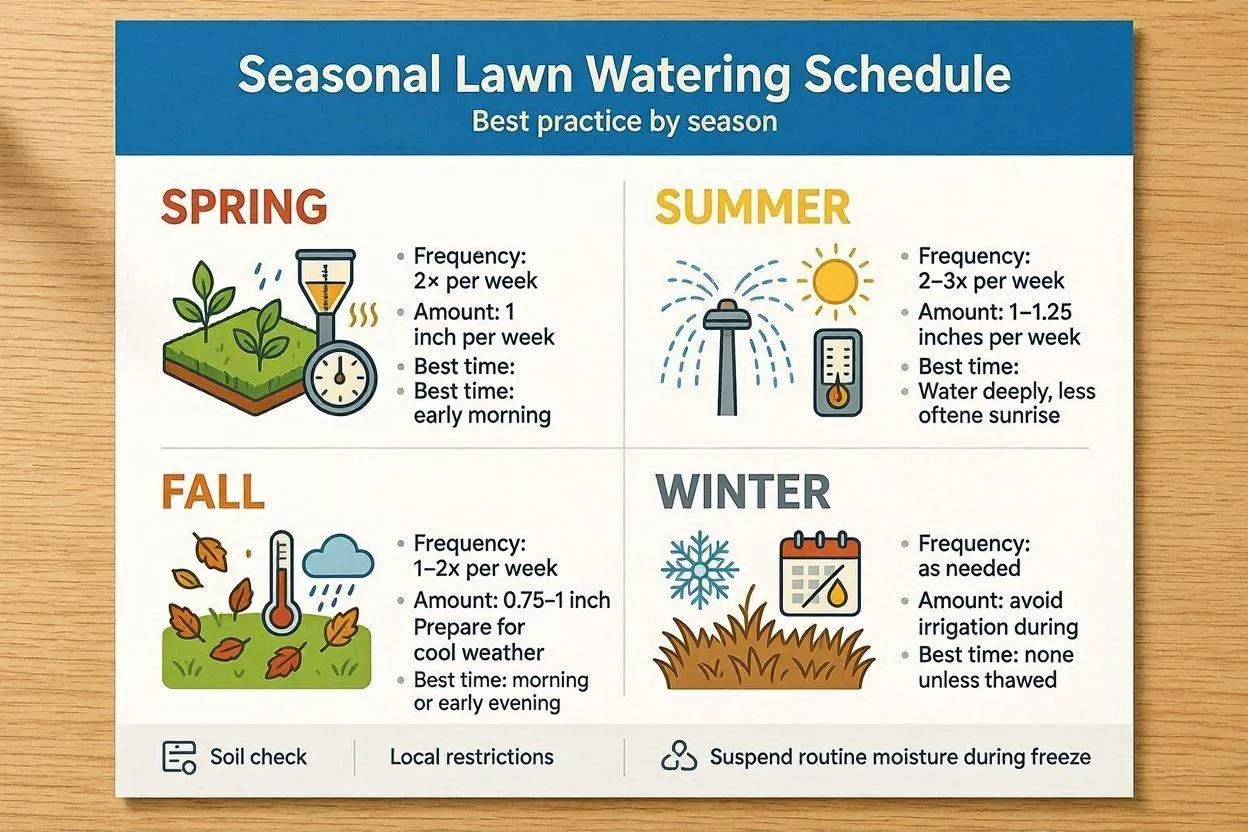
Grass water needs shift by season. Watering the same amount year-round wastes water in cool months and stresses your lawn in summer.
| Season | Watering Frequency | Water Amount | Notes |
| Spring | 1–2x per week (if no rain) | 0.5–1 inch / 13–25mm | Rainfall usually sufficient. Watch for dry spells. |
| Summer | 2–3x per week | 1–2 inches / 25–50mm | Early morning critical. Increase in heat waves. |
| Fall | 1–2x per week | 0.5–1 inch / 13–25mm | Mirrors spring. Pair with aeration and overseeding. |
| Winter (warm climates) | Once per month if dry | 0.5 inch / 13mm | Only if soil looks dry. Stop below 40°F / 4°C. |
| Winter (cold climates) | None | N/A | Grass dormant. Resume in spring. |
Spring Watering
Spring rainfall usually covers most of the lawn’s needs in USDA zones 4–7. Start supplemental watering only when the lawn goes 7+ days without significant rain. Overwatering in spring promotes thatch buildup and shallow root development before summer stress arrives.
Summer Watering — The Critical Window
Summer is when timing matters most. Once soil temperature rises above 75°F (24°C), grass loses moisture rapidly — sometimes losing up to half its water content in a single hot day. Signs your lawn needs immediate water:
- Grass turns blue-gray or dull green
- Footprints stay visible for 30+ seconds (blades won’t spring back)
- Soil feels dry and hard more than 2 inches (5cm) below the surface
- Edges of lawn curl or fold inward on individual grass blades
During extreme heat above 95°F (35°C), some lawns may need watering every 2 days. Soak to 6–8 inches (15–20cm) depth each time, not a light sprinkle.
Fall Watering
Fall mirrors spring in water requirements. Cool-season grasses — Kentucky bluegrass, tall fescue, perennial ryegrass — actively grow in fall and need consistent moisture. Pair watering with aeration and overseeding for the best root establishment before winter.
Winter Watering
Stop watering when temperatures drop below 40°F (4°C) or when frost begins. In cold climates, grass goes dormant and needs no supplemental irrigation. In warm climates like USDA zones 8–10, water once per month if soil looks dry and temperatures stay above 40°F.
4. Watering by Grass Type — Cool-Season vs Warm-Season
Grass type is one of the 3 biggest factors in watering decisions, alongside climate and soil type. Cool-season and warm-season grasses have opposite peak growth periods and different drought strategies.
Cool-Season Grasses
Cool-season grasses grow actively in spring and fall, go semi-dormant in summer heat. They need more water during their growth windows and less during summer stress. Common types:
- Kentucky bluegrass — needs 1.5–2 inches (38–50mm) per week in summer, drought-sensitive
- Tall fescue — deep root system, most drought-tolerant cool-season grass, needs 1–1.5 inches (25–38mm)
- Perennial ryegrass — needs 1.5 inches (38mm) per week, less heat-tolerant
- Fine fescue — lowest water needs of cool-season types, tolerates dry shade
Warm-Season Grasses
Warm-season grasses peak in summer and go dormant in winter. They generally need 0.5–1 inch (13–25mm) per week — less than cool-season types. They handle heat and drought better. Common types:
- Bermuda grass — extreme drought tolerance, needs 0.5–0.75 inch (13–19mm) per week
- Zoysia grass — low water needs, slow to establish, goes dormant early in fall
- Augustine grass — higher water needs among warm-season types, 1 inch (25mm) per week
- Centipede grass — low maintenance, needs 0.5–1 inch (13–25mm), dislikes overwatering
- Buffalo grass — native grass, most drought-tolerant of all, survives on rainfall alone in most regions
Pro Tip: You don’t need to know your exact grass type to water correctly. Watch the lawn: if footprints disappear within 30 seconds, moisture is fine. If the lawn turns blue-gray or footprints stay visible, water it regardless of the schedule.
5. Soil Type and How It Changes Your Watering Schedule
Soil type determines how fast water drains, how long moisture stays available to roots, and whether your lawn suffers from runoff or pooling. 3 main soil types behave very differently:
| Soil Type | Drainage Speed | Water Retention | Watering Adjustment |
| Sandy soil | Very fast (30–60 min) | Low | Water more often — 3x per week, smaller amounts each time |
| Clay soil | Slow (several hours) | High | Water less often — 1–2x per week, watch for pooling |
| Loam soil | Moderate (1–2 hours) | Medium | Standard schedule — 2–3x per week, 1–1.5 inches |
| Silt soil | Moderate–slow | Medium–High | Similar to loam but compacts easily — aerate annually |
The Cycle-and-Soak Method for Clay Soil
Clay soil absorbs water slowly. Watering at full rate causes runoff before water reaches the roots. The cycle-and-soak method fixes this:
- Run sprinklers for 10 minutes.
- Stop and wait 10 minutes (water soaks in).
- Run for another 10 minutes.
- Repeat until the total target time is reached.
This method delivers the same amount of water but gives clay soil time to absorb each cycle, reducing runoff by up to 50%.
Sandy Soil Needs More Frequent Watering
Sandy soil drains within 30–60 minutes of watering. Moisture doesn’t stay available long enough for a twice-weekly deep watering schedule. Water sandy soil 3 times per week with slightly smaller amounts per session — targeting 0.33 inch (8mm) three times instead of 1 inch (25mm) once.
6. Signs of Overwatering vs Underwatering
Both overwatering and underwatering look similar at first — brown or yellow grass. Identifying which problem you have prevents the wrong fix making things worse.
| Sign | Overwatering | Underwatering |
| Grass color | Yellow or pale green | Blue-gray or dull green |
| Soil surface | Soggy, spongy underfoot | Dry, cracked, hard |
| Footprints | Disappear slowly (soggy) | Stay visible 30+ seconds (wilted) |
| Fungal growth | Mushrooms, mold patches | None |
| Thatch layer | Thick, spongy layer builds up | Thin or normal |
| Root depth | Shallow (under 2 inches / 5cm) | Shallow (drought stress) |
| Weed pressure | Crabgrass, algae, moss increase | Drought-tolerant weeds increase |
| ⚠ Overwatering kills more lawns than underwatering. Established grass survives weeks without water by going dormant. It does not survive root rot from chronic overwatering. When in doubt, water less. |
The Footprint Test
Walk across your lawn and look back at your footprints. If the grass springs back within 30 seconds, moisture is adequate. If footprints remain visible, the lawn is dehydrated and needs water. This test works regardless of grass type or season.
What Dormancy Looks Like vs Dying
Lawns turn brown and dormant during drought — this is normal, not dead. Dormant grass survives 4–6 weeks without water and recovers when rain returns. Dead grass doesn’t recover. Pull a handful of grass: if roots are firm and white, the grass is dormant. If roots are brown and mushy, the area is dead.
7. Watering Newly Seeded and Newly Sodded Lawns
New grass — seeded or sodded — needs a completely different watering schedule from established lawns. The priority shifts from root depth to surface moisture until germination and establishment are complete.
Newly Seeded Lawn — 4-Phase Watering Schedule
Phase 1 (Germination — Days 1 to 10): Keep the top 1 inch (2.5cm) of soil consistently moist. Water lightly 2 times per day (morning and early afternoon). Never let the seed bed dry out — germination stops if seeds dry out even briefly. Use a gentle mist setting, not a full stream.
Phase 2 (First shoots visible — Days 10 to 21): Continue twice-daily watering but increase depth slightly. Keep the top 2 inches (5cm) moist. Reduce to once per day if overcast or cool.
Phase 3 (Grass reaches 3 inches / 7.5cm — Week 3 to 6): Shift to 2 deep waterings per week. Target 6 inches (15cm) depth. This transition forces roots to grow downward.
Phase 4 (Established — Week 6+): Follow the standard adult lawn schedule: 2–3 times per week, 1–1.5 inches (25–38mm) total.
Newly Sodded Lawn
Sod needs heavy watering immediately after installation. Water within 30 minutes of laying each section. The sod should feel spongy but not create standing water. For the first 2 weeks:
- Water twice daily — morning and late afternoon
- Soak to at least 3–4 inches (7.5–10cm) depth to reach the soil beneath the sod
- Check by peeling back a corner of the sod — the soil underneath should be damp, not dry
- Avoid foot traffic for 2–3 weeks while roots knit into the soil below
Reduce to once daily in weeks 3–4, then transition to the standard schedule by week 6.
8. Sprinkler Systems and Smart Irrigation Tips
The right irrigation system saves water, time, and money. 3 main options exist for home lawns: manual hose-end sprinklers, in-ground irrigation systems, and smart controllers.
In-Ground Sprinkler Systems
In-ground systems cover the lawn evenly and run on a timer. The most efficient setup for lawns over 2,000 sq ft (185 sq m). Set the timer to run between 6–10 a.m. Divide zones — lawn areas need different amounts than garden beds. Check heads seasonally for blockages and misalignment.
Smart Irrigation Controllers
Smart controllers connect to local weather data and skip watering cycles when rain is forecast or soil moisture is adequate. They reduce water usage by 30–50% compared to fixed-schedule timers. Well-suited for homeowners who want automated watering without manual monitoring.
Hose-End Sprinklers
Hose-end sprinklers work for smaller lawns under 2,000 sq ft (185 sq m). Oscillating sprinklers cover rectangular areas. Impact sprinklers cover circular areas. Move the sprinkler to overlap coverage zones by 25–30% to avoid dry strips.
Water Conservation: Water your lawn only when it needs it — not on a rigid calendar. Use the footprint test and screwdriver test. Skipping unnecessary watering cycles saves 20–30 gallons (75–115 liters) per average session.
9. The ZonedGarden Lawn Watering Schedule — By Month
This schedule covers USDA zones 5–8, which includes most of the continental United States. Adjust frequency up in hotter/drier climates and down in cooler/wetter ones.
| Month | Frequency | Target Depth | Notes |
| January | 0–1x if needed | N/A (dormant) | Skip unless warm climate, no rain for 30+ days |
| February | 0–1x if needed | N/A | Begin monitoring for green-up in zones 8+ |
| March | 1–2x per week | 1 inch / 25mm | Spring green-up. Supplement only if dry. |
| April | 1–2x per week | 1–1.5 inches / 25–38mm | Rain usually adequate. Watch for dry spells. |
| May | 2x per week | 1–1.5 inches / 25–38mm | Increase as temperatures rise. |
| June | 2–3x per week | 1.5 inches / 38mm | Switch firmly to morning-only watering. |
| July | 3x per week | 1.5–2 inches / 38–50mm | Peak heat stress period. Check daily. |
| August | 3x per week | 1.5–2 inches / 38–50mm | Often hottest month. Never skip morning window. |
| September | 2x per week | 1–1.5 inches / 25–38mm | Cool-season grasses recovering. Great time to seed. |
| October | 1–2x per week | 1 inch / 25mm | Reduce as temperatures drop. |
| November | 0–1x per week | 0.5 inch / 13mm | Stop when ground freezes or frost arrives. |
| December | 0x (most zones) | N/A | Grass dormant. Drain and winterize irrigation. |
10. Related Lawn and Garden Guides on ZonedGarden
Understanding when to water is one piece of a complete lawn care system. These guides from ZonedGarden cover the adjacent topics that affect watering decisions directly:
Garden Area Calculator — Calculate your lawn area in square meters, square feet, or square yards before sizing an irrigation system or ordering turf.
Complete Lawn Care and Landscape Design Guide — Daniel Copsey’s full resource library covering soil preparation, grass selection, seasonal maintenance, and sustainable garden design for every USDA hardiness zone.
Crepe Myrtle Bark Care and Problem Guide — Proper watering affects all landscape plants, not just grass. Learn how irrigation decisions impact tree and shrub health in your yard.
| Explore More Lawn & Garden Guides at ZonedGarden.com From soil health and grass types to seasonal lawn care schedules — ZonedGarden has practical guides built on 20+ years of hands-on gardening experience. |
Frequently Asked Questions
What is the best time to water your lawn?
Water your lawn between 6 a.m. and 10 a.m. Cooler temperatures, calmer wind, and rising sun allow water to soak 6–8 inches (15–20cm) into the soil before midday heat causes evaporation. Grass blades dry within 2–3 hours, which prevents fungal disease.
Can you water grass in the evening?
Yes, but only between 4–6 p.m. At this window, blades still get 2–3 hours of sun to dry before dark. Avoid watering after 6 p.m. — grass stays wet overnight, which creates ideal conditions for brown patch fungus, dollar spot, and other lawn diseases.
How often should you water your lawn?
Water established lawns 2–3 times per week in summer and 1–2 times per week in spring and fall. Water deeply each session — targeting 6–8 inches (15–20cm) of soil depth — rather than daily light watering. Daily shallow watering produces shallow roots that fail in drought.
How much water does grass need per week?
Most grasses need 1–1.5 inches (25–38mm) of water per week from rain and irrigation combined. Hot summer weeks may push this to 2 inches (50mm). Use an empty tuna can as a rain gauge — when it holds 1 inch of water during a sprinkler session, you’ve hit the target.
Is it bad to water grass at night?
Yes. Watering at night keeps grass blades wet for 8–12 hours. That wet surface at temperatures above 50°F (10°C) accelerates 3 common fungal diseases: brown patch, dollar spot, and melting-out. Morning watering avoids this entirely because blades dry within hours.
Why does my lawn look gray-blue in the morning?
A blue-gray or dull green color signals drought stress. The grass needs water. Water it the same morning if possible. If you also see footprints staying visible for 30+ seconds after walking across the lawn, those are 2 confirmed signs of dehydration.
How do I know if I’m overwatering my lawn?
6 signs of overwatering: spongy or soggy soil underfoot, yellow or pale green grass despite regular watering, mushroom growth, thickening thatch layer, shallow roots (under 2 inches / 5cm when you dig a small test hole), and increased crabgrass or moss. Reduce watering frequency and let soil dry between sessions.
How long should I run my sprinklers to get 1 inch of water?
Place empty tuna cans in the watering zone. Run your sprinkler for 30 minutes and measure the collected water. If 30 minutes collects 0.5 inch (13mm), run the sprinkler for 60 minutes total per week. Most in-ground systems deliver 1 inch (25mm) in 30–60 minutes depending on head type and spacing.
Should I water my lawn every day in summer?
No. Water deeply 2–3 times per week instead of shallowly every day. Daily watering keeps moisture in the top 1–2 inches (2.5–5cm) of soil, producing shallow roots that fail under heat and drought stress. Deep watering 2–3 times per week pushes roots to 6–8 inches (15–20cm) depth, where they access more stable moisture.
Conclusion: Timing Is the Easiest Win in Lawn Care
Water between 6 and 10 a.m. That single change fixes the most common lawn watering mistakes — wasted water from midday evaporation, fungal disease from overnight wetness, and shallow roots from daily light watering.
Adjust these rules for your grass type, soil type, and season — the tables in this guide cover every combination. A lawn watered correctly at the right time needs less water overall, develops deeper roots, resists drought and disease better, and looks better through summer stress without extra effort.