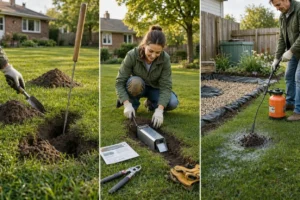
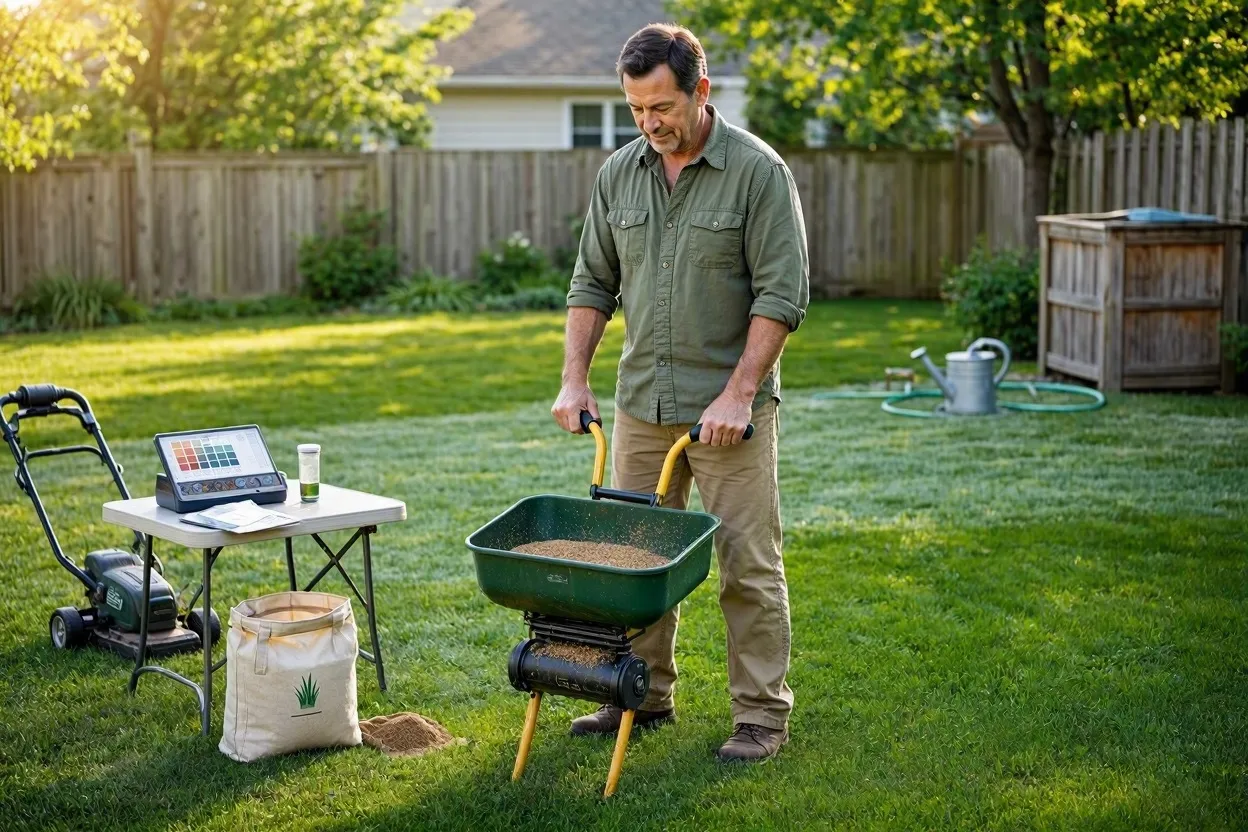
To fertilize lawn grass correctly, test your soil first, apply 1 pound (0.45 kg) of nitrogen per 1,000 square feet (93 square meters) during active growth, and water it in within 30 minutes. Cool-season grass wants spring and fall applications. Warm-season grass wants late spring through summer. Get the timing wrong, and even the right product won’t save a patchy yard. Get it right, and a basic spreader plus one bag of fertilizer can turn thin, yellowing turf into something a neighbor stops to ask about.
This guide walks through every part of the process: soil testing, square footage math, spreader technique, liquid application, hand-spreading for small yards, and the mistakes that cause brown patches two days after you thought you did everything right. Anyone searching for how to fertilize lawn grass properly usually lands here after a spreader mishap or a bag of the wrong NPK ratio, so the sections below start with the basics and build toward the details that actually change results. Fertilizing sits alongside mowing, watering, aerating, and seeding as one of the core yard maintenance tasks that keeps a lawn healthy season after season, and it also covers timing differences worth knowing for lawn care routines in Canada.
When Is the Best Time to Fertilize Your Lawn?
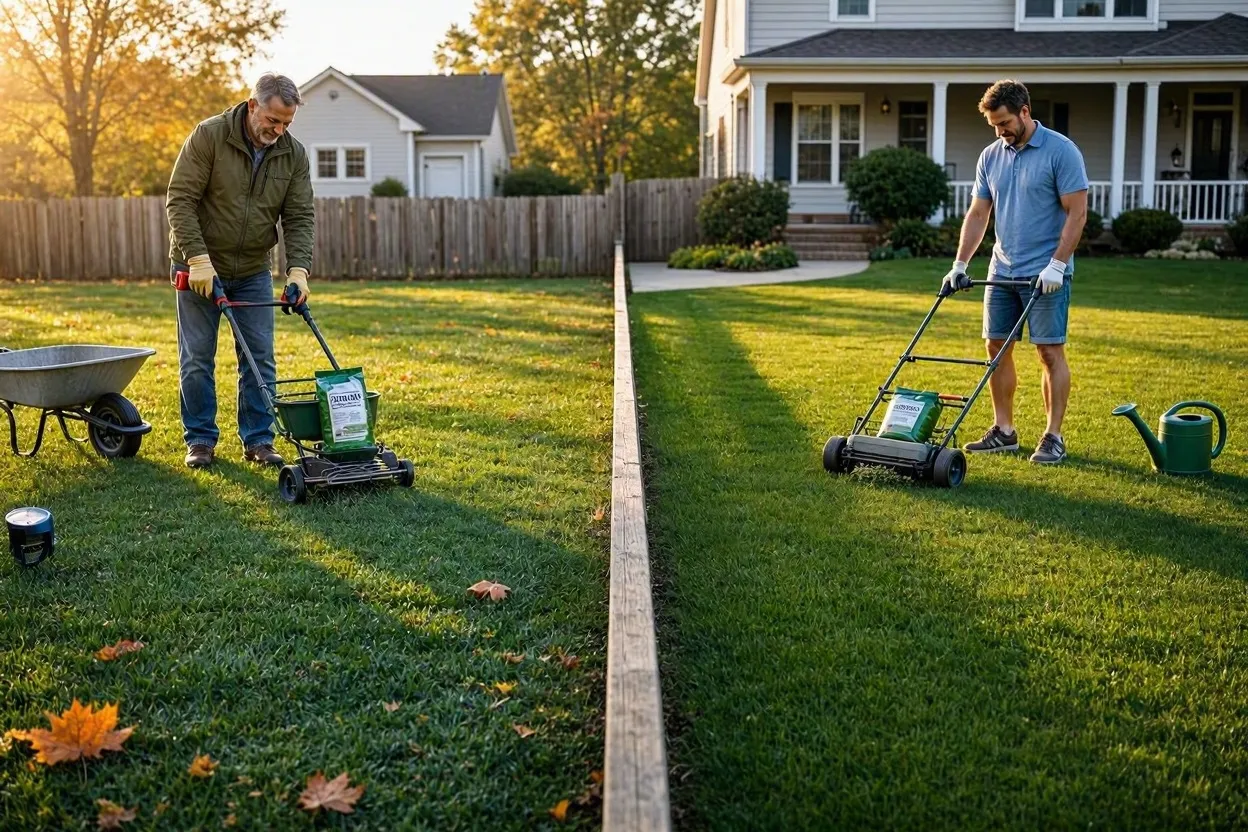
The best time to fertilize your lawn is during its active growing season, which depends entirely on whether you have cool-season or warm-season grass. Feed grass while it’s dormant, and the roots can’t use the nutrients. Worse, unused nitrogen just sits in the soil and eventually washes into storm drains.
Cool-Season Grass Fertilizing Schedule
Cool-season grass grows most actively in early spring and again in fall, so those are the two windows for fertilizing. Kentucky bluegrass, tall fescue, and perennial ryegrass fall into this group. Apply the first feeding in March or April, then a second round in September through November. Skip the deep summer months entirely; heat stress plus a nitrogen boost is a fast way to scorch grass that’s already struggling.
Warm-Season Grass Fertilizing Schedule
Warm-season grass grows most actively from late spring through summer, so that’s when it needs fertilizer. Bermuda, St. Augustine, zoysia, and centipede grass all fit here. Feed in April or May, then again in June or July. Centipede grass is the exception worth remembering: it needs far less nitrogen than the others, closer to a 15-0-15 ratio, because too much pushes weak, floppy growth.
What Equipment Do You Need to Fertilize a Lawn?
Fertilizing a lawn requires a spreader or sprayer, protective gear, a garden hose, and a way to measure the lawn’s square footage. Skipping any one of these turns a 20-minute task into a frustrating afternoon.
A broadcast spreader handles most yards over 5,000 square feet (465 m²) efficiently, while a drop spreader gives tighter control near flower beds and sidewalks. Gloves, closed-toe shoes, and safety goggles matter more than people expect, since dust from granular product irritates skin and eyes on windy days. A garden hose or sprinkler activates granules after application, and a simple tape measure or measuring wheel gets the square footage close enough for accurate dosing. None of this equipment is expensive; a basic push spreader runs $30 to $50 (roughly CAD 41 to 68), which pays for itself after a single season compared to hiring it out.
How Do You Test Your Soil Before Fertilizing?
To test your soil before fertilizing, use a home kit for $10 to $30 (roughly CAD 14 to 41), or send a sample to a local extension office for a lab result costing $15 to $50. A soil test reveals pH and nutrient levels, so you’re not guessing at what your lawn already has plenty of.
Results typically show four things:
- Nitrogen, phosphorus, and potassium (NPK) levels
- Soil pH, ideally between 6.0 and 7.0 for most grass types
- Organic matter content
- Micronutrients such as iron and magnesium
If your pH sits below 6.0, the soil’s too acidic and needs lime. Above 7.0, it’s too alkaline, and sulfur usually brings it back down. Skip this step, and you risk buying a fertilizer that adds phosphorus your lawn already has too much of, which does nothing for growth and can run off into nearby waterways.
How Much Fertilizer Does Your Lawn Need?
Most lawns need 1 pound (0.45 kg) of nitrogen per 1,000 square feet (93 m²) per application, though the exact bag amount depends on the fertilizer’s NPK percentage. Getting this number wrong in either direction causes problems: too little and the grass barely responds, too much and you’re looking at burn within days.
How to Calculate Your Lawn’s Square Footage
Measure the lawn using basic shape formulas, then add the sections together for oddly shaped yards.
- Rectangle: length times width
- Circle: 3.14 times radius squared
- Triangle: base times height, divided by two
A 5,000-square-foot lawn (roughly 465 m²) needs 5 pounds of actual nitrogen per feeding. That’s the number to keep in mind while reading a fertilizer bag, not the total weight of the bag itself.
How to Read an NPK Ratio
An NPK ratio tells you the percentage of nitrogen (N), phosphorus (P), and potassium (K) in a bag, in that order. A 20-5-10 bag is 20% nitrogen by weight. To hit 5 pounds of actual nitrogen, divide the nitrogen needed by the percentage: 5 ÷ 0.20 equals 25 pounds of that specific product. Skip this math, and it’s easy to under- or overfeed a lawn without realizing it until the color changes.
Granular vs Liquid Fertilizer: Which Should You Choose?
Choose granular fertilizer for longer-lasting results with fewer applications, and choose liquid fertilizer when you need faster results or a quick nutrient fix. Neither one is universally better; the right pick depends on your timeline and how hands-on you want to be.
| Feature | Granular | Liquid |
| Results timeline | 7-14 days | 2-5 days |
| Feeding duration | 6-8 weeks | 2-4 weeks |
| Burn risk | Higher if misapplied | Lower with correct dilution |
| Typical cost | Lower | Higher |
| Equipment | Spreader, $30-$200 (CAD 41-274) | Sprayer, $20-$100 (CAD 27-137) |
Granular products work well for routine, seasonal feeding. Liquid fertilizer suits spot corrections, quick green-ups before an event, or lawns with a nutrient deficiency that needs fast correction. Plenty of professional crews use both: granular for the regular schedule, liquid whenever a section needs immediate help.
How to Fertilize Lawn Grass With a Spreader (Step by Step)
To fertilize lawn grass with a spreader, mow first, check the fertilizer bag for the correct spreader setting, feed the perimeter, then fill in the middle in straight, overlapping passes. Follow these seven steps in order:
- Mow the lawn two to three days before fertilizing and clear away debris.
- Water lightly one to two days beforehand so roots are moist but grass blades are dry.
- Check the weather; skip application if more than 1 inch (2.5 cm) of rain is expected within 24 hours.
- Set the spreader according to the bag’s recommended setting, not a guess.
- Fill the hopper on a hard surface with the chute closed, to avoid spilling on grass.
- Walk the perimeter first, then cross the rest of the lawn in parallel, slightly overlapping rows; close the hopper on turns to prevent piling.
- Water within 30 minutes using about half an inch (1.3 cm) of water, unless the label says otherwise.
Wait 24 to 48 hours before mowing again, and keep pets and kids off the grass until it’s been watered in. A broadcast spreader throws product in a wide arc and suits larger yards; a drop spreader releases fertilizer straight down between its wheels, which makes it a better fit near flower beds where overspray would be a problem.
How to Apply Liquid Fertilizer to Your Lawn
To apply liquid fertilizer, mix the concentrate exactly as the label directs, spray in even, overlapping passes while walking backward, then keep the lawn dry for two to four hours. Ready-to-spray bottles attach directly to a garden hose, no mixing required, while concentrates need precise measuring, since even a small overdose here can scorch grass fast.
Start at one edge and sweep the sprayer side to side as you move. Avoid re-spraying spots that already look wet; uneven coverage is the most common cause of striped or patchy results with liquid products. Most formulas don’t need watering in the next day, though checking the label matters more than assuming.
How to Fertilize a Small Lawn by Hand
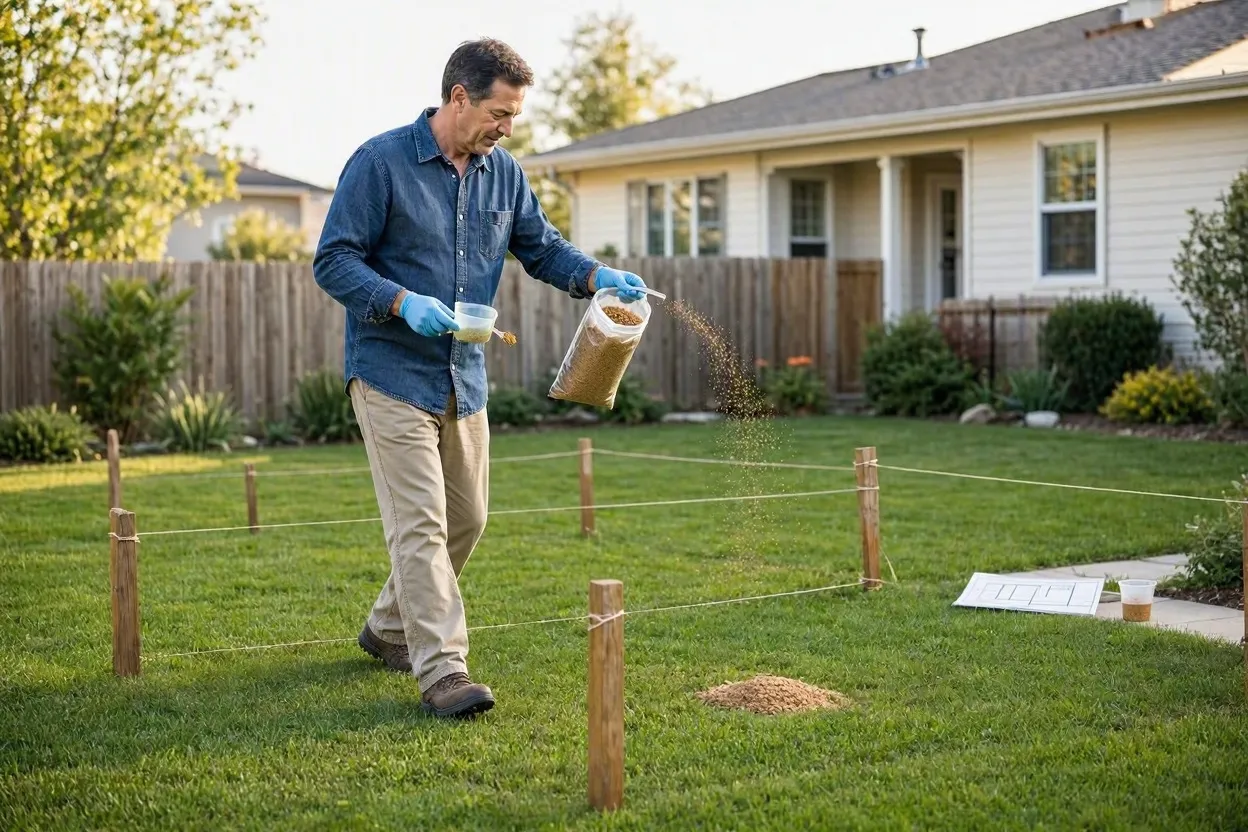
Hand-fertilizing works for lawns under 1,000 square feet (93 m²) or for spot treatments where a spreader feels like overkill. Mark the yard into 100- to 250-square-foot sections using stakes and string, then pre-measure the fertilizer for each one before starting.
Wear gloves, since granular fertilizer irritates bare skin on contact. Walk backward through each section, casting the product side to side in a steady motion, then repeat the whole area in the opposite direction to fill in gaps the first pass missed. Water heavily right after, since hand application spreads less evenly than a spreader and carries a higher burn risk as a result.
What Happens If You Over-Fertilize Your Lawn?
Over-fertilizing causes fertilizer burn, which shows up as brown or yellow patches within two to three days of application. The fix moves fast once symptoms appear:
- Water heavily, about 1 to 2 inches (2.5-5 cm), to dilute the excess nitrogen sitting in the soil.
- Remove any visible granules still sitting on top of the grass with a rake.
- Check the roots by gently tugging on affected blades; if they pull free easily, the damage runs deeper than the surface.
- Reseed severely burned patches once the soil has recovered, usually within one to two weeks.
Burn happens fastest on hot, dry days, when nitrogen concentrates instead of soaking in evenly.
Can You Fertilize and Apply Weed Killer at the Same Time?
Yes, some weed-and-feed products combine both, though timing still matters and pre-emergent herbicides need their own window separate from a straight nitrogen feeding. Pre-emergent products like crabgrass preventer must go down before weed seeds germinate, usually when soil temperatures hit 55°F (13°C) for several consecutive days. Apply a nitrogen-heavy fertilizer on top of a fresh pre-emergent, and the combination can stress new grass or reduce the herbicide’s effectiveness. Post-emergent weed killers, by contrast, pair more safely with regular feeding since they target existing weeds rather than blocking germination.
Check the product label for a required waiting period between a herbicide application and any other lawn treatment, including grub control. Some combinations need 24 hours between them; others need weeks.
How to Fertilize Lawn Grass in Canada
Fertilizing lawn grass in Canada follows the same nitrogen math as the US, but weed-and-feed products are less common on store shelves in several provinces. Ontario, Quebec, and Nova Scotia lean toward straight fertilizer and separate weed treatments rather than combination bags, so a yard maintenance routine north of the border often splits feeding and weed control into two passes instead of one.
Canadian hardiness zones also run colder than most US zones, which shortens the yard work season. A lawn in Zone 4 or 5, covering much of southern Ontario and the Maritimes, needs its last feeding of the season done earlier in fall than a comparable US lawn in a warmer zone, since frost arrives sooner and grass stops absorbing nutrients once the ground cools. Checking a garden center’s current product lineup before planning the season’s lawn care schedule saves a wasted trip for anyone used to shopping south of the border.
Organic Lawn Fertilizer Options
Organic lawn fertilizer options include compost, corn gluten meal, grass clippings left on the lawn after mowing, and Milorganite, all of which add nitrogen without synthetic chemicals. Each one releases nutrients more slowly than synthetic fertilizer, which lowers burn risk but means results take longer to show, and each fits a slightly different yard maintenance habit.
| Organic Option | Extra Benefit | Burn Risk | Cost Note |
| Compost | Improves soil structure while feeding grass | Very low | Often free or low-cost if homemade |
| Corn gluten meal | Doubles as a natural pre-emergent, suppressing weed seed germination | Very low | Comparable to mid-range synthetic bags |
| Grass clippings (grasscycling) | Returns roughly 25% of a lawn’s nitrogen needs back into the soil for free | Very low | Free, no product to buy |
| Milorganite | Heat-dried and slow-release; forgiving for beginners | Almost zero, even at double the recommended rate | 20% to 40% higher per pound of nitrogen than synthetic |
For homeowners avoiding synthetic inputs near wells, septic fields, or waterways, organic products are worth the tradeoff in speed. Milorganite is sold at garden centers across the US and Canada, which makes it one of the easier options for anyone still learning how to fertilize lawn areas without synthetic chemicals.
6 Lawn Fertilizing Mistakes That Ruin Good Grass
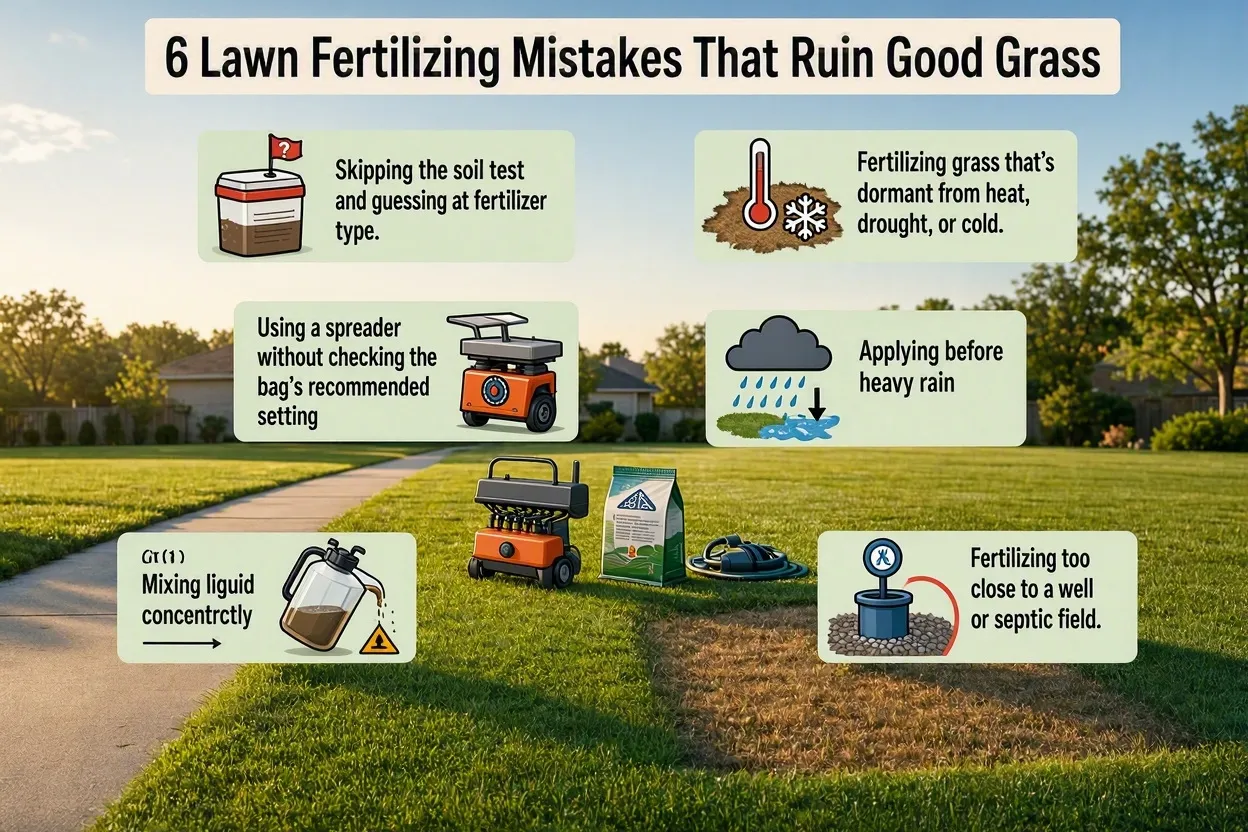
The 6 most common lawn fertilizing mistakes are skipping the soil test, fertilizing dormant grass, ignoring spreader settings, applying before heavy rain, mixing liquid concentrate incorrectly, and fertilizing too close to a well or septic field.
- Skipping the soil test and guessing at fertilizer type.
- Fertilizing grass that’s dormant from heat, drought, or cold.
- Using a spreader without checking the bag’s recommended setting first.
- Applying granular fertilizer right before more than an inch of rain.
- Mixing liquid concentrate off-label, which risks scorching grass within hours.
- Applying fertilizer within the buffer distance recommended around a well or septic system, often 25 to 100 feet (7.6-30 m) depending on local regulation.
Each of these mistakes is avoidable with five extra minutes of prep before the spreader ever touches the lawn. Mistake three deserves extra attention because it’s the one most people skip out of impatience. A spreader set too high dumps double the intended nitrogen in half the passes, and by the time the stripes show up, the damage is already done. Reading the bag’s setting chart takes thirty seconds and prevents a problem that takes weeks to grow out.
How Does Weather Affect Fertilizer Timing?
Weather affects fertilizer timing because heat, drought, and heavy rain each interfere with how nutrients reach the roots. Applying fertilizer during a heat wave, generally above 90°F (32°C), stresses grass that’s already struggling to survive, and adding nitrogen on top of that stress often does more harm than good. Drought conditions cause a similar problem: dry soil can’t absorb granules properly, so watering before and after application becomes non-negotiable rather than optional.
Cloudy, mild days in the 60 to 75°F range (16 to 24°C) tend to give the best results, since the soil stays moist without direct sun baking the fertilizer before it dissolves. Checking a seven-day forecast before buying fertilizer saves a wasted trip if a heat wave or downpour is about to roll through.
FAQs
How often should you fertilize a lawn?
Most lawns need feeding 2 to 4 times a year, timed to the grass’s growing season rather than a fixed calendar date. Cool-season grass gets two feedings; warm-season grass often needs three.
Can you fertilize a lawn in the rain?
No, heavy rain washes granular fertilizer away before roots absorb it. Light rain within a day of application can actually help activate granules, so timing matters more than avoiding moisture entirely.
What is the best NPK ratio for lawns?
It depends on grass type and soil test results, though 20-5-10 suits many cool-season lawns. St. Augustine typically does better with 3-1-2 or 4-1-2 ratios instead.
How long after fertilizing can you mow?
Wait 24 to 48 hours before mowing, giving granular products time to settle and liquid products time to absorb. Mowing too soon can track fertilizer onto pavement.
Do you need to water after fertilizing?
Yes, granular fertilizer needs about half an inch of water within 30 minutes to prevent burn. Most liquid fertilizers skip this step, so check the specific label.
Conclusion
Fertilizing a lawn well comes down to four things done in order: test the soil, match the timing to the grass type, calculate the correct amount, and apply it evenly with the right tool. Skip any one of those steps, and even premium fertilizer struggles to deliver thick, even color. Pairing fertilizer with the rest of a regular yard maintenance routine, mowing on schedule, watering deeply, and clearing debris before each application, does more for lawn health than any single product on its own. Get the sequence right once, and repeating it each season becomes routine rather than guesswork.