
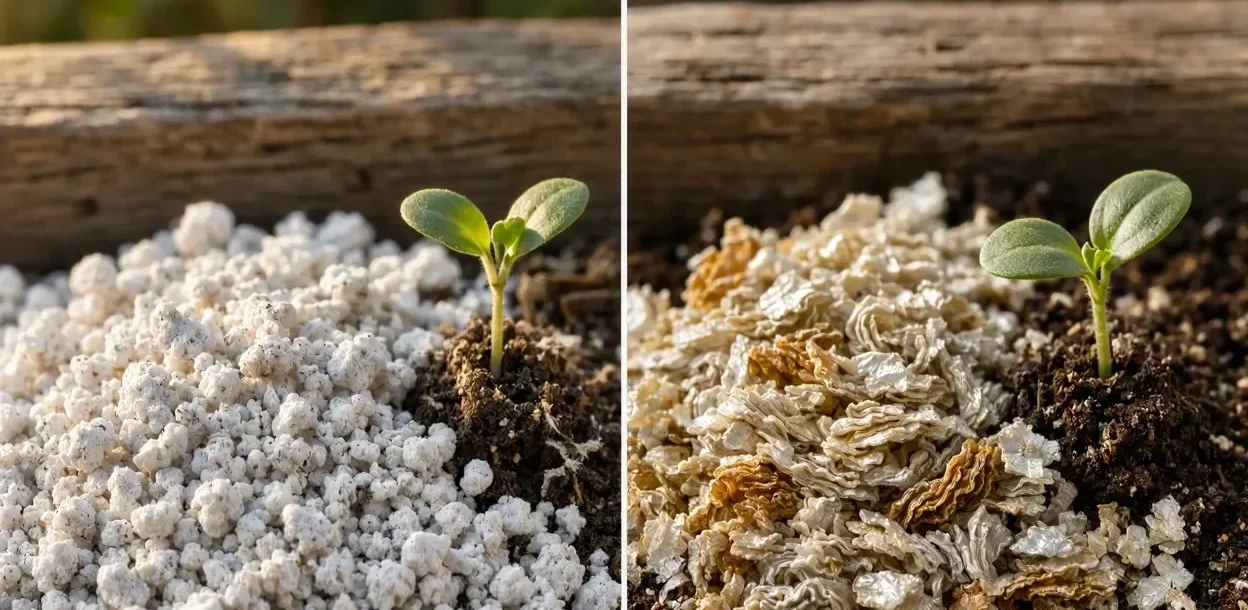
Perlite vs vermiculite comes down to one trade-off: perlite drains fast and adds air, while vermiculite holds water and nutrients. For cacti and other succulents, perlite is the pick, and the same goes for almost any pot sitting in a wet climate. Seedlings are another story. If you’re starting seeds or gardening somewhere dry, vermiculite is the better buy, and a blend of the two suits tropical houseplants that want steady moisture without soggy roots.
Perlite is a heat-expanded volcanic glass soil amendment that increases drainage and aeration in potting mixes. Its partner works the opposite way. Vermiculite is a heat-expanded silicate mineral that holds water and nutrients for plant roots, releasing both slowly as the mix dries.
Key Takeaways
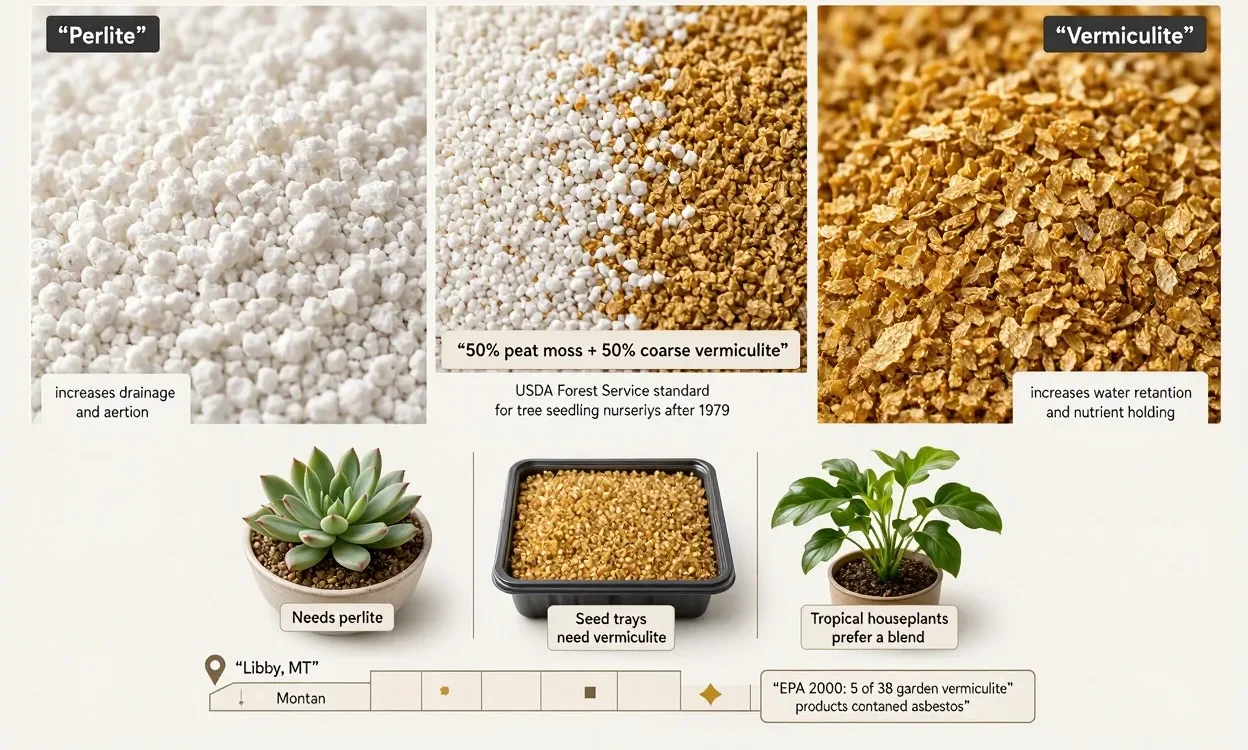
- Perlite increases drainage and aeration, while vermiculite increases water retention and nutrient holding.
- Succulents and cacti need perlite, seed trays need vermiculite, and tropical houseplants do best with a blend of both.
- The USDA Forest Service reports that a 50% sphagnum peat moss and 50% coarse vermiculite mix became the standard container medium for tree seedling nurseries after 1979.
- U.S. Environmental Protection Agency (EPA) testing in 2000 found 5 of 38 garden vermiculite products with asbestos at levels that could pose a potential for exposure, all of them straight vermiculite, and rated consumer risk as very low.
- A mine near Libby, Montana, supplied over 70% of all vermiculite sold in the United States from 1919 to 1990, and that ore was contaminated with asbestos (EPA).
What Is the Difference Between Perlite and Vermiculite?
Perlite adds air and drains water, while vermiculite absorbs water and holds nutrients. Both start out as mined rock. Under high heat, perlite’s volcanic glass and vermiculite’s layered silicate mineral each expand, and that difference in parent rock explains every practical gap you’ll see in the table below.
Heat makes perlite’s volcanic glass pop into porous white granules. Those granules hold a thin film of water on their surface, but they let everything else drain straight through to the bottom of the pot. Air fills the gaps.
Vermiculite is a hydrated magnesium-aluminum-iron silicate. Once heated, its layers split apart into golden-brown flakes that soak up water between them and hold dissolved nutrients for roots.
| Property | Perlite | Vermiculite |
| Source rock | Volcanic glass | Layered silicate mineral |
| Look | White, rounded, porous granules | Golden-brown, layered flakes |
| Main job | Drainage and aeration | Water retention and nutrient holding |
| Water behavior | Holds water on its surface and drains fast | Holds water between its layers and releases it slowly |
| Cation exchange capacity (CEC) | Very low | Holds nutrients such as potassium, magnesium, and calcium |
| Breaks down in soil | No | No |
| Best known role | Succulent and cactus mixes | Seed-starting and nursery mixes |
Vermiculite’s nursery role goes back decades. According to the USDA Forest Service (Landis and Morgan, 2009), it traces to the Cornell “Peat-Lite” mixes of the 1960s, which blended vermiculite and perlite into peat moss in varying proportions.
Does Perlite Hold Water?
Yes, perlite holds water, but only a thin film on the surface and inside its open pores. Everything else drains away. Vermiculite works the other way, since its flakes pull water in between their layers and give it back to roots as the potting mix dries out.
That gap shapes every mix you’ll build. Because perlite keeps a mix airy and quick to dry, it suits plants that rot in wet soil, such as cacti. Seeds and moisture-loving plants need the reverse, and vermiculite delivers it by holding the mix evenly moist.
In a pot, vermiculite acts like a sponge, while perlite holds only a little water and passes the rest along. Don’t take that on faith. A simple test in your own pots, with your usual potting mix and watering habits, shows the difference plainly.
How Can You Test Perlite and Vermiculite at Home?
You’ll need just a kitchen scale and 3 identical pots. Over several days of weighing, the 3-pot drying test below shows exactly how each amendment behaves with the potting mix you already use. Start with dry pots.
- Fill 3 identical 1-quart (0.95 L) pots: one with 3 parts potting mix and 1 part perlite, one with 3 parts potting mix and 1 part vermiculite, and one with plain potting mix.
- Weigh each pot dry and write down the weight in ounces or grams.
- Water each pot until water drains from the bottom, then weigh it again.
- Weigh each pot at the same time every day until it returns to its dry weight.
| Pot | What to record | What it tells you |
| 3 parts potting mix + 1 part perlite | Wet weight and days to dry | How much perlite speeds up drying |
| 3 parts potting mix + 1 part vermiculite | Wet weight and days to dry | How much vermiculite extends moisture |
| Plain potting mix | Wet weight and days to dry | Your baseline for comparison |
Which Is Better for Seed Starting, Perlite or Vermiculite?
Vermiculite is the better choice for seed starting because it keeps seeds evenly moist through germination. Fine grade works best. Mix it into the seed-starting medium or spread a thin layer over sown seeds, and add a small share of fine perlite only when your trays stay wet for days after watering.
Commercial nurseries lean on the same logic. The USDA Forest Service (Landis and Morgan, 2009) reports that a mix of 50% sphagnum peat moss and 50% coarse vermiculite became the standard container growing medium for tree seedling nurseries after Tinus and McDonald published it in 1979.
Over the sown surface, a thin layer of fine vermiculite holds moisture right where the seed sits and evens out the drying and wetting swings that stall germination. That’s the whole trick.
Perlite still earns its spot. A seed mix that stays soggy invites damping off, a fungal disease that makes seedlings collapse at the soil line, and a small share of fine perlite opens up air space around young roots.
Perlite vs Vermiculite for Succulents: Which Should You Use?
Perlite is the right choice for succulents and cacti because these plants need a mix that drains fast and dries out fully between waterings. For desert plants, vermiculite holds far too much water and raises the risk of root rot. Skip it entirely.
The perlite vs vermiculite for succulents question comes down to one deciding factor, and it’s how fast the pot dries after watering. Speed wins.
Start at 1 part perlite to 3 or 4 parts potting mix. Plastic pots change the math. Since plastic dries more slowly than terra cotta, cacti growing in it need a bigger perlite share than the starting ratio gives them.
Pumice is the heavier stand-in. Like perlite, it’s a volcanic rock, but it’s denser, so it stays mixed in instead of floating to the surface after watering.
Perlite vs Vermiculite for Raised Beds: How Much Should You Add?
Start with perlite or vermiculite at 10% of a raised bed’s soil volume, which is 3.2 cubic feet (91 L) for a 4 x 8 ft bed filled 12 in (30 cm) deep. Heavy, wet soil takes perlite. Vermiculite belongs in sandy, dry soil. Either way, mix the amendment through the top 6 to 12 inches (15 to 30 cm).
For perlite vs vermiculite for raised beds, climate settles most choices. Rain-soaked regions favor perlite, because the granules give up water easily and help beds drain between storms instead of sitting soggy for days. In arid regions, the logic flips. Vermiculite’s habit of holding water lets a bed there go longer between irrigations.
Volume drives cost in a raised bed. A standard 4 x 8 ft (1.2 x 2.4 m) bed filled 12 in (30 cm) deep holds 32 cubic feet (906 liters) of soil.
| Share of bed volume | Amendment needed for a 4 x 8 x 1 ft bed |
| 10% | 3.2 cu ft (91 L) |
| 25% | 8 cu ft (227 L) |
| 50% | 16 cu ft (453 L) |
In that bed, a 10% blend uses most of one 4-cubic-foot (113 L) bag. Begin there. If the bed drains poorly after its first season, raise the share in later seasons based on how it handles water.
Can You Mix Perlite and Vermiculite?
Yes, mixing perlite and vermiculite gives a potting mix both fast drainage and steady moisture. Each covers the other’s weakness. Use equal parts for tropical houseplants, since perlite holds the air spaces open while vermiculite stores water, then tilt the ratio toward perlite for dry-loving plants or toward vermiculite for moisture lovers.
Blending isn’t new. Back in the 1960s, the Cornell “Peat-Lite” mixes worked vermiculite and perlite into peat moss at different ratios, the USDA Forest Service (Landis and Morgan, 2009) notes.
| Plant or use | Starting recipe (parts by volume) |
| Tree and shrub seedlings in containers | 1 part sphagnum peat moss, 1 part coarse vermiculite (USDA Forest Service standard) |
| Tropical foliage plants | 2 parts potting mix, 1 part perlite, 1 part vermiculite |
| Moisture-loving houseplants, such as ferns | 1 part potting mix, 1 part vermiculite |
| Succulents and cacti | 3 to 4 parts potting mix, 1 part perlite |
| Seed starting | 1 part peat moss or coir, 1 part fine vermiculite |
Follow these 4 steps to build any recipe in the table:
- Measure every component with the same container, such as a 1-gallon (3.8 L) bucket.
- Dampen the perlite and vermiculite before mixing to keep dust down.
- Combine the base and amendments in a tub until the color looks even.
- Water the finished mix in its pot and check that water drains from the hole instead of pooling on the surface.
Which One Should You Use for Each Growing Job?
Use perlite for drainage-hungry plants and wet conditions, and use vermiculite for moisture-hungry plants and dry conditions. The matrix below matches 8 common growing jobs, from seed trays to outdoor containers, to the better amendment and the reason behind each pick. Scan it before you buy.
| Growing job | Better choice | Reason |
| Seed starting | Vermiculite | Keeps seeds evenly moist during germination |
| Tree and shrub seedlings in containers | Vermiculite | Half of the USDA Forest Service standard nursery mix |
| Rooting cuttings | Perlite | Stays airy and resists rot around new roots |
| Succulents and cacti | Perlite | Drains fast and dries out between waterings |
| Ferns and other moisture lovers | Vermiculite | Keeps the root zone evenly moist |
| Heavy clay soil | Perlite | Opens air spaces and reduces compaction |
| Outdoor containers in hot sun | Vermiculite | Slows drying between waterings |
| Wet or humid climates | Perlite | Prevents waterlogging |
Does Vermiculite Contain Asbestos?
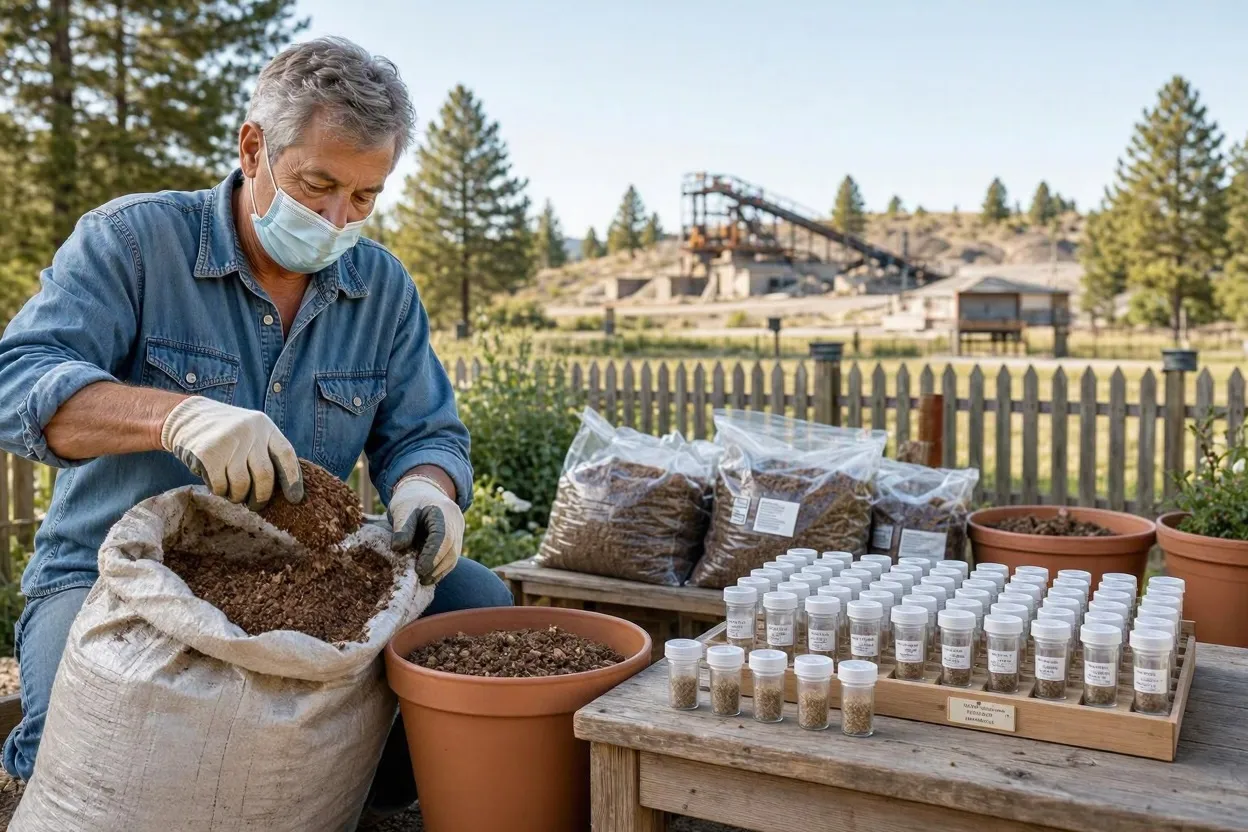
Yes, some vermiculite has contained asbestos, but the EPA rated the risk to home gardeners as very low. Most of it traces to one mine near Libby, Montana. EPA testing in 2000 found asbestos at levels of concern in 5 of 38 garden products, all of them straight vermiculite rather than premixed potting soil. Premixed soil wasn’t on that list.
What Happened in Libby, Montana?
A mine near Libby was the source of over 70% of all vermiculite sold in the United States from 1919 to 1990, according to the EPA. That ore was tainted. Because the mine also held a deposit of asbestos, the vermiculite pulled from Libby came out contaminated with asbestos.
Vermiculite from Libby went into the majority of vermiculite insulation in the United States, often under the brand name Zonolite (EPA). Attics took the brunt. That history explains why today’s asbestos worry centers on old insulation, not on the garden bags sold now.
What Did the EPA Find in Garden Products?
The EPA tested bagged garden products in 2 phases and announced the results in August 2000, after an initial round in the Seattle area expanded into a nationwide sample. Here’s the breakdown.
| EPA test phase (2000) | Products tested | Result |
| Phase 1, Seattle area | 16 | 1 product had asbestos at a level that could pose a potential for exposure |
| Phase 2, nationwide | 38 | 5 products could pose a potential for exposure, all straight vermiculite; 17 had trace amounts |
| Agency conclusion | 54 total | Risk to consumers rated very low; workers who use vermiculite products regularly may face greater exposure |
According to the EPA (2000), vermiculite can carry a range of other minerals, including low levels of asbestos in some cases. Workers who handle the material every day drew the agency’s real concern. Occasional home use wasn’t the focus.
How Do You Handle Vermiculite Safely?
The EPA (2000) recommends premixed potting soil for home gardeners. Dust is the reason. Because premixed soils ordinarily contain more moisture and much less vermiculite than straight vermiculite bags, they’re less likely to send particles into the air.
- Buy premixed potting soil when a recipe allows it.
- Work outdoors or in a well-ventilated area.
- Keep vermiculite damp while you mix it.
- Leave old vermiculite attic insulation undisturbed.
Is Perlite Dust Harmful to Breathe?
No, perlite dust is not known to cause lasting harm in normal garden use, but breathing large amounts irritates the nose, throat, and eyes. Perlite contains no asbestos. Wetting the bag before you pour cuts the dust, and a mask covers the rest when you’re mixing large batches.
Perlite’s dust problem is mechanical. Dry granules break into fine particles during shipping and handling, and the finest bits settle at the bottom of the bag.
The same steps work for both minerals. Wetting and ventilation, the practices the EPA (2000) recommends for vermiculite, cut perlite dust just as well, so one routine covers both bags.
- Pour 1 cup (240 ml) of water into the bag before scooping.
- Mix outdoors or beside an open window.
- Wear a dust mask rated for fine particles.
- Wear safety glasses to keep grit out of your eyes.
Vermiculite vs Perlite Insulation: How Do They Compare?
Perlite and vermiculite both serve as pour-in loose-fill insulation, but old vermiculite insulation carries an asbestos risk that perlite does not. Most vermiculite insulation in US homes came from the Libby mine, the EPA reports. Treat it as contaminated. If you find it in an old attic, leave it undisturbed.
Both minerals insulate for the same reason they work in pots. Trapped air does the work. When the raw rock expands, each granule or flake fills with tiny air pockets, and that trapped air slows the movement of heat through an attic floor.
| Feature | Perlite insulation | Vermiculite insulation |
| Look | White, rounded granules | Gray-brown or gold, layered flakes |
| Asbestos history | None | Libby-sourced Zonolite contained asbestos (EPA) |
| Home safety step | Handle with a dust mask | Leave undisturbed; hire a trained professional for removal |
The vermiculite vs perlite insulation question matters in the garden for one reason, and it’s simple: the 2 product types aren’t interchangeable. Buy vermiculite for plants from the garden aisle, and check that the bag says horticultural grade. Attic insulation never goes in a bed.
Which Grade of Perlite or Vermiculite Should You Buy?
Buy fine vermiculite for seed sowing, medium grades for general potting mixes, and coarse perlite or coarse vermiculite for chunky, fast-draining mixes. On US bags, grade numbers run from #1 (fine) to #4 (super coarse). Size changes drainage. Larger particles open bigger air spaces and drain faster, while fine particles hold more water.
| Grade | Typical use |
| #1 Fine | Seed sowing and top dressing over seeds |
| #2 Medium | Cuttings and general potting mixes |
| #3 Coarse | Containers, raised beds, and nursery mixes |
| #4 Super coarse | Succulents, cacti, and chunky aroid mixes |
Coarse vermiculite is the grade named in the USDA Forest Service standard nursery mix of 50% sphagnum peat moss and 50% coarse vermiculite (Landis and Morgan, 2009). Start there for container trees.
Fine dust matters as much as grade. Dust at the bottom of the bag fills air spaces and makes a mix stay wet, so sift or rinse the last few cups before they go into a fast-draining blend.
Are Perlite and Vermiculite Organic?
Yes, perlite and vermiculite are allowed in organic growing when the product carries the Organic Materials Review Institute (OMRI) Listed seal. Neither is carbon-based organic matter. As natural mined minerals, they’re reviewed by OMRI against USDA National Organic Program (NOP) standards, and that seal carries more weight than the word “organic” on the bag.
Home gardeners without certification can use any horticultural-grade perlite or vermiculite in an organic garden. Certified farms can’t. Those growers need a product their certifier accepts, and in practice that usually means a current OMRI listing on the bag.
OMRI listings carry expiration dates. Before you buy for a certified farm, look up the product at omri.org and confirm its listing is still current.
What Can You Use Instead of Perlite or Vermiculite?
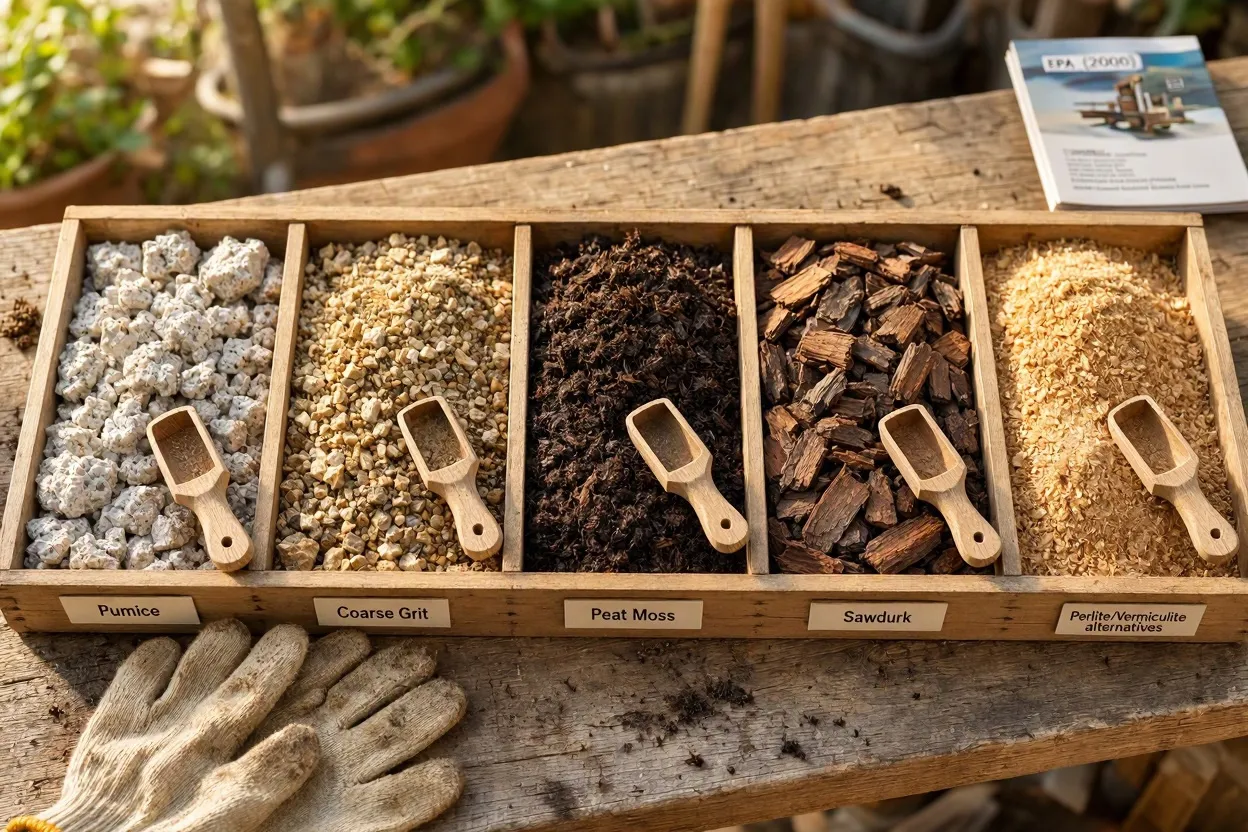
Use pumice or coarse grit in place of perlite, and use peat moss, bark, or sawdust in place of vermiculite. The EPA (2000) named peat, sawdust, perlite, and bark as soil supplements for gardeners who prefer to avoid vermiculite. Pumice drains like perlite. It doesn’t float or shed dust.
| Alternative | Replaces | Reason growers use it |
| Pumice | Perlite | Denser, so it stays mixed in and produces little dust |
| Coarse grit | Perlite | Adds fast drainage to cactus and succulent mixes |
| Peat moss | Vermiculite | Holds moisture; named by the EPA (2000) as an alternative |
| Bark | Vermiculite | Adds structure; named by the EPA (2000) as an alternative |
| Sawdust | Vermiculite | Low-cost filler; named by the EPA (2000) as an alternative |
Even commercial growers hunt for substitutes. The USDA Forest Service (Landis and Morgan, 2009) reviewed growing media alternatives for forest and native plant nurseries, looking past the classic peat and vermiculite blend.
Frequently Asked Questions
Can You Reuse Perlite After a Growing Season?
Yes. After you rinse out old roots and debris, pasteurize the used perlite with steam or boiling water before you replant anything in it. Clean granules keep draining for many seasons, because perlite doesn’t break down.
Why Does Perlite Rise to the Top of the Pot?
Blame its low weight. Perlite weighs so little that every watering nudges the granules upward until they collect on the surface, while pumice, a denser volcanic rock, stays mixed in and solves the problem for good.
Do Perlite and Vermiculite Break Down Over Time?
No. Because neither mineral decomposes in soil, a single application keeps working for the full life of the potting mix you’ve made. The organic matter around them, such as peat, breaks down instead.
Is Perlite the Same as Styrofoam?
No. Though the two share a white look, perlite is expanded volcanic glass, while Styrofoam is a plastic foam that has no place in a garden mix.
Can Seedlings Grow in Vermiculite Alone?
Yes. Straight vermiculite holds steady moisture for germinating seeds and anchors young roots. Once the seedlings outgrow the tray, transplant them into a nutrient-bearing mix that can feed them through the next stage of growth.
Conclusion
Every bag you buy next season should answer one question: does this plant need air at the root, or does it need water? Air means perlite or pumice. For water, reach for vermiculite or peat.
Measuring beats guessing. Weigh 3 test pots daily after watering until each one dries, and let that count set the ratio for every container you fill.
Then build in 3 habits. Check the OMRI listing on any bag you buy for organic beds, and keep the dust down with water and a mask whenever you pour. Old attic vermiculite stays a job for a professional. With those habits in place, perlite vs vermiculite stops being a guess and becomes a recipe you can repeat.