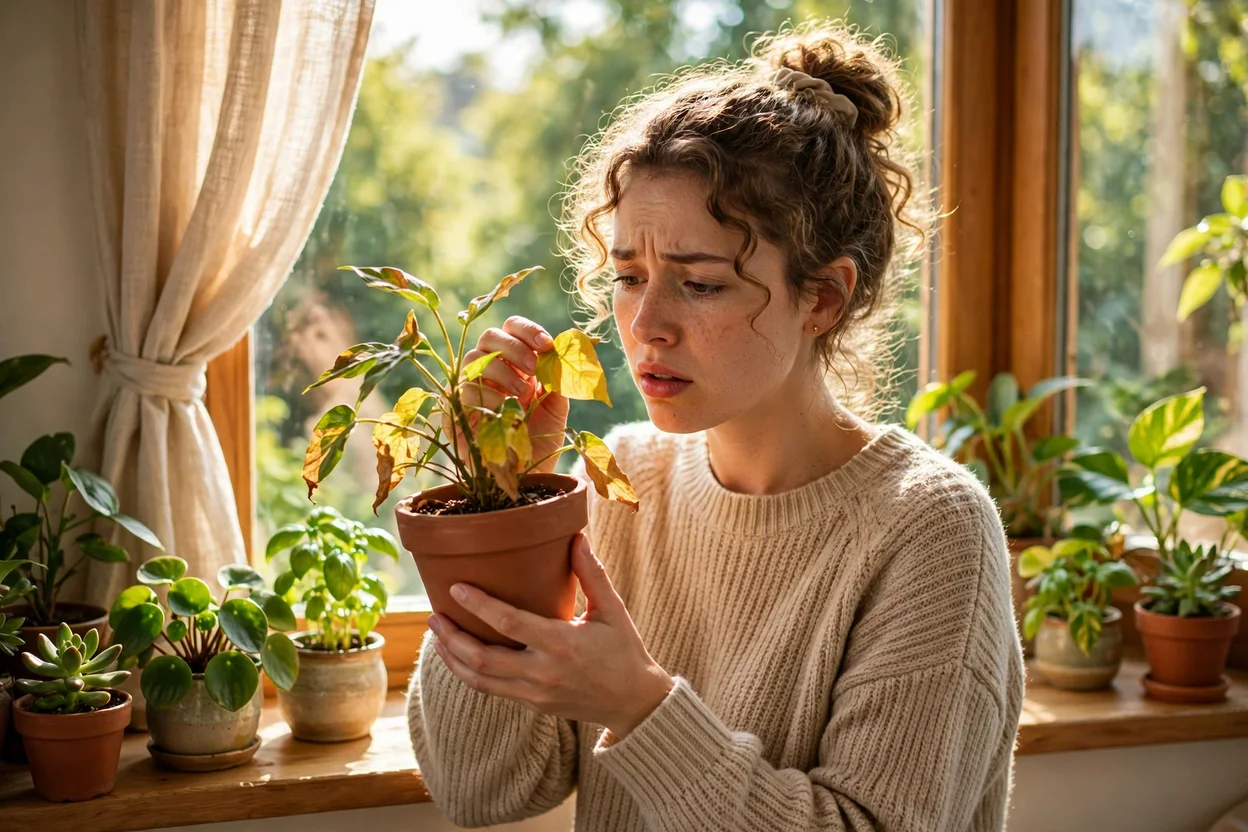
Plant leaves turn yellow when the plant loses chlorophyll, the green pigment that powers photosynthesis. Most cases trace back to overwatering, nitrogen deficiency, poor light, wrong soil pH, pests or disease. Location is the giveaway. Where the yellow shows up (old leaves, new leaves, or the tissue between green veins) points to the exact cause and the right fix.
Key Takeaways
- Yellow leaves signal chlorophyll loss, and the position of the yellow on the plant identifies the cause faster than any other clue.
- Overwatering is a leading cause of house plant leaves turning yellow because waterlogged soil suffocates roots and leads to root rot.
- Yellow older leaves usually mean nitrogen deficiency. Yellow new leaves with green veins usually mean iron deficiency or high soil pH.
- Yellow lower tomato leaves with brown, ringed spots point to early blight, not a nutrient problem.
- A soil test from a state Cooperative Extension office shows soil pH and nutrient levels before any fertilizer goes on.
- Fully yellow leaves rarely turn green again, so judge recovery by the color of new growth.
What Yellow Leaves on Plants Mean
Yellow leaves on plants are a symptom called chlorosis, which means the leaves have lost chlorophyll, the green pigment plants use to turn sunlight into food. Chlorosis is never the root problem. It’s a signal that water, nutrients, light, roots or pests have slipped out of balance, and the yellow pattern shows which one.
The yellow color isn’t new. As green chlorophyll breaks down under stress, yellow and orange pigments called carotenoids become visible, though those carotenoids sat in the leaf all along, hidden under the green.
Mobile nutrients explain why older leaves often yellow first. Nitrogen moves freely inside the plant, as do magnesium and potassium, so a plant running short pulls those nutrients out of old leaves to feed new growth. The old leaves pay the price.
Iron and sulfur work the opposite way. Neither nutrient moves once the plant deposits it, so a shortage of iron or sulfur shows up first on the newest leaves at the shoot tips.
Some yellowing needs no fix. On a healthy, actively growing plant, a few of the oldest, lowest leaves yellow and drop through leaf senescence, the normal aging process of a leaf.
Diagnose Yellow Leaves by Where the Yellow Starts
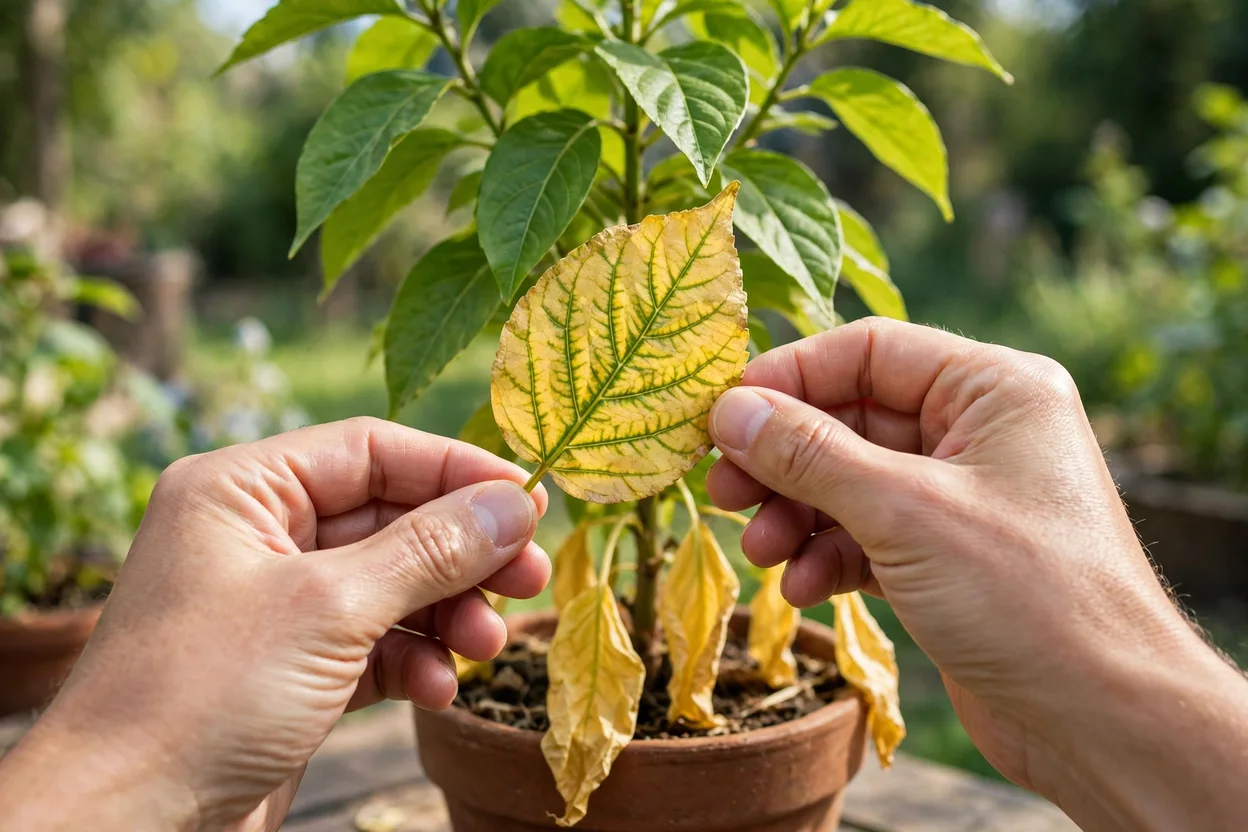
The location of the yellow on a plant identifies the cause faster than any other clue. Older leaves turning yellow point to nitrogen. When the newest leaves fade but their veins stay green, iron shortage or high soil pH is the likely cause, and a yellowing plant sitting in wet soil points to overwatering.
The fastest way to answer “why are the leaves on my plant turning yellow?” takes three quick checks. Start with the leaves. Note which ones are yellow and what the yellow looks like, then feel how wet the soil is 2 inches (5 cm) down.
This table matches each yellowing pattern to its likely cause and the first fix to try.
| Yellow Pattern | Likely Cause | First Fix |
|---|---|---|
| Oldest leaves evenly yellow | Nitrogen deficiency or natural aging | Feed with a balanced fertilizer |
| Older leaves yellow between green veins | Magnesium deficiency | Confirm with soil test, then add magnesium |
| Older leaves with yellow or brown edges | Potassium deficiency | Apply potassium per soil test |
| Newest leaves yellow, veins stay green | Iron deficiency or high soil pH | Lower pH or apply chelated iron |
| Whole plant yellow, soil soggy | Overwatering and root rot | Stop watering and check the roots |
| Whole plant yellow, soil dry, wilting | Underwatering | Soak thoroughly, then water consistently |
| Fine yellow speckles, light webbing | Spider mites | Rinse leaves, apply insecticidal soap |
| Yellow leaves with brown spots | Fungal or bacterial leaf disease | Remove infected leaves, improve airflow |
| One side of plant yellow and wilting | Fusarium wilt | Remove plant, grow resistant varieties |
| Pale leaves, long stretched stems | Too little light | Move to brighter light |
| Bleached patches on the sunny side | Sunscald | Shade from harsh afternoon sun |
Check soil moisture before acting on any nutrient cause. Damaged roots can’t absorb nutrients even from fertile soil, which is why a watering mistake so often passes for a nutrient deficiency. Moisture comes first.
Why Are My Plant Leaves Turning Yellow? The Main Causes
Plant leaves turn yellow for nine main reasons: overwatering, underwatering, nitrogen deficiency, iron or magnesium deficiency, wrong soil pH, poor light, pests, temperature stress and natural aging. Rule out watering first. Watering errors cause yellowing in houseplants and garden plants alike.
Most answers to “why are my plant leaves turning yellow?” fall into one of these nine causes. Stressed plants often carry two of them at once, such as soggy soil plus low light, so finding one cause doesn’t mean the search is over.
Overwatering and Root Rot
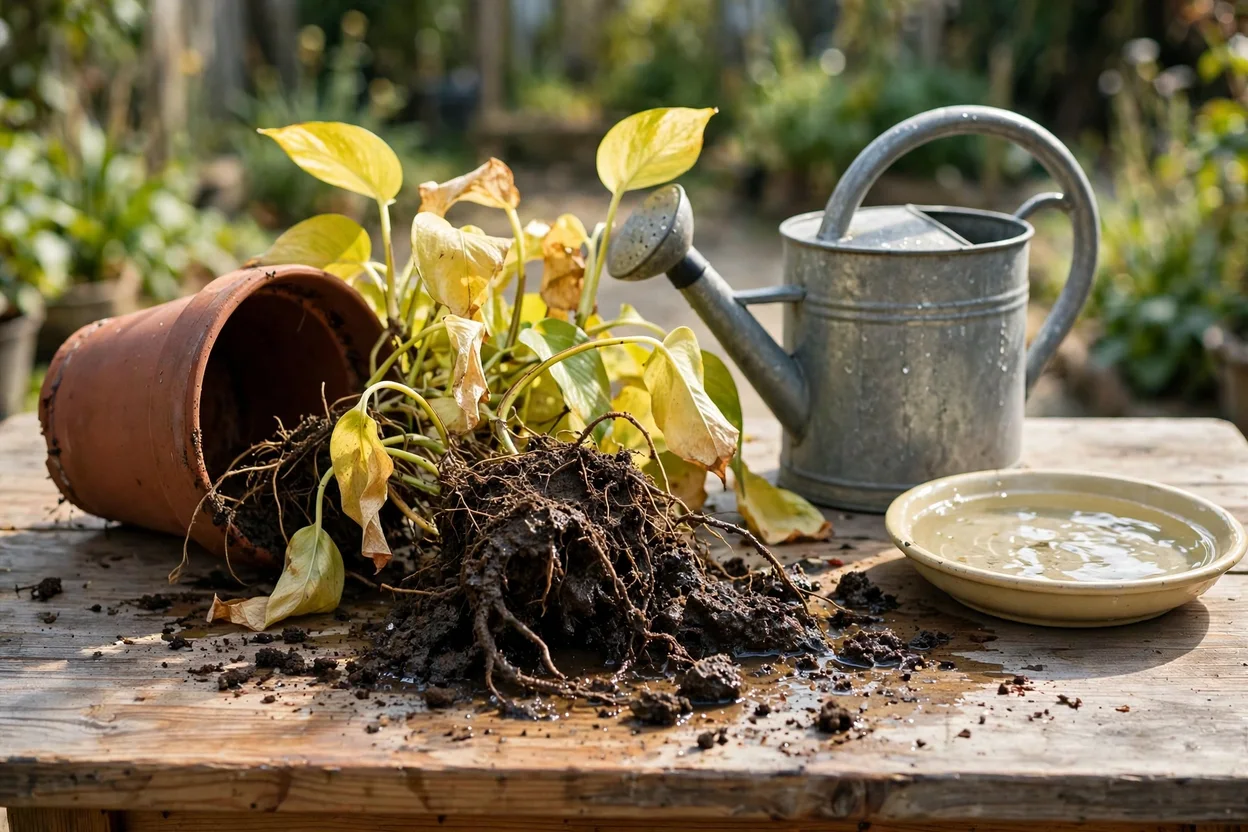
Overwatering turns leaves yellow because soggy soil pushes out the oxygen roots need, and oxygen-starved roots rot. Rotted roots can’t absorb water or nutrients. That’s why an overwatered plant yellows and wilts even while its soil is still wet, a combination that looks backward at first glance.
Root rot comes from water molds and fungi, including Pythium and Phytophthora, which thrive in soil that stays saturated. The setup usually invites it. Typical triggers include pots without drainage holes and saucers left full of water, along with heavy garden soil packed into containers and watering by the calendar instead of by need.
To check for root rot, slide the plant out of its pot and look at the roots, gently teasing apart the outer layer if the root ball is dense. Healthy roots are firm, white or tan. Anything brown or black, mushy and sour-smelling has rotted.
Overwatering can also trigger edema, a disorder in which roots take up water faster than leaves release it. Swollen leaf cells burst and form small blisters or corky bumps, usually on leaf undersides, before the leaves yellow. Don’t be fooled. Edema resembles a disease, but it’s purely a watering problem.
This table compares the signs of overwatering and underwatering.
| Sign | Overwatering | Underwatering |
|---|---|---|
| Soil feel | Wet days after watering | Dry, pulling away from pot edge |
| Leaf texture | Soft, limp, yellow | Dry, crispy, yellow then brown |
| Leaves affected | Lower and inner leaves first | Lower leaves, then whole plant |
| Roots | Brown, mushy, sour smell | Dry and shriveled |
| Pot weight | Heavy | Light |
Underwatering
Underwatering yellows leaves because a dry plant pulls water and mobile nutrients out of older leaves to protect new growth. Lower leaves go first. They yellow, then turn brown and crispy, while the soil shrinks away from the pot edge and the whole pot feels light when lifted.
Water a dry plant slowly until water runs out of the drainage holes. Watch for runoff. If water rushes straight through bone-dry potting mix, set the pot in a basin of water until the mix rehydrates, then let it drain fully.
Prevent repeat stress by watering based on soil moisture, not the calendar. Summer is the risky season. Garden beds in sandy soil dry out fastest then, and so do hanging baskets and containers sitting in full summer sun.
Nitrogen Deficiency
Nitrogen deficiency yellows the oldest, lowest leaves first, evenly across the whole leaf, because the plant moves its limited nitrogen to new growth. Growth slows. New leaves come in small and pale green.
Nitrogen runs short most often in containers and sandy soil, because every watering flushes a little of it out of the root zone. Hungry crops burn through it. Tomatoes and corn use nitrogen quickly in midsummer, as do leafy greens.
The three numbers on a US fertilizer label, called the NPK ratio, list the percentage by weight of nitrogen (N), phosphate (P2O5) and potash (K2O). A 10-10-10 product is 10% nitrogen. Stick to the label rate exactly, since excess fertilizer burns roots and causes brown leaf edges.
Iron and Magnesium Deficiency
Yellow leaves with green veins, called interveinal chlorosis, point to iron deficiency when the newest leaves are affected and magnesium deficiency when the older leaves are affected. The veins stay green while the tissue between them fades.
Iron deficiency usually traces back to high soil pH, not to a shortage of iron in the soil itself, because alkaline soil holds iron in forms roots can’t absorb. Acid lovers suffer first. Azaleas and blueberries typically show iron chlorosis early, and gardenias do too.
Chelated iron corrects iron chlorosis faster than plain iron sulfate. The label matters. Look for iron chelate marked Fe-EDDHA, which stays available to roots in alkaline soil where other iron forms lock up quickly.
Magnesium deficiency appears on older leaves and turns up more often in acidic, sandy soil. Dolomitic limestone adds magnesium while raising pH, but it belongs in the garden only when a soil test shows both low pH and low magnesium. Test first.
Wrong Soil pH
Soil pH outside a plant’s preferred range locks nutrients in the soil, so leaves yellow even when fertilizer is present. Most vegetables and many houseplants grow best in slightly acidic soil, somewhere between pH 6.0 and 7.0 on the standard scale. Blueberries are different. Like other acid-loving plants, blueberries need a much lower pH.
Soil pH varies sharply across the USA. Arid regions of the West and Southwest, including parts of Arizona, Utah, Colorado and Texas, often have alkaline soil that triggers iron chlorosis. Many soils in the rainy East and Southeast are naturally acidic.
Lower soil pH with elemental sulfur and raise it with garden lime, using the rates printed on a soil test report. Patience pays here. Soil chemistry shifts slowly, so expect improvement over months, not days.
Too Little or Too Much Light
Too little light yellows the lower and inner leaves first, because the plant drops the leaves that no longer pay for themselves in food production. Stems stretch toward the light source. New leaves also come in smaller.
Too much light causes sunscald, which shows up as bleached white or yellow patches on whichever side of the plant faces the sun. Later, those patches go brown and papery.
Houseplants moved outdoors in spring often scald within the first few days. Ease them in. Harden plants off over about a week, starting in full shade and adding a little more sun each day until they’re fully adjusted.
Sap-Sucking Pests
Sap-sucking pests such as spider mites, aphids, whiteflies, scale and mealybugs turn leaves yellow by draining plant fluids and damaging leaf cells. Spider mites leave fine yellow speckles called stippling, plus light webbing. They multiply fastest in hot, dry conditions.
For a quick test, tap a yellowing branch over a sheet of white paper and watch closely for tiny specks that start to move. Then smear them. A streak confirms spider mites.
Knock pests off with a strong spray of water, then treat with insecticidal soap or horticultural oil labeled for that plant. Quarantine helps too. Keep infested houseplants apart so the pests don’t spread to nearby plants.
Temperature Stress and Transplant Shock
Cold drafts, heat waves and transplanting all yellow leaves by stressing roots and slowing nutrient uptake. Many tropical houseplants yellow and drop leaves after exposure to temperatures below about 50°F (10°C), such as a chilly windowsill or an open door in winter. Watch the thermometer.
Transplant shock causes temporary yellowing after a move to a new pot or bed, because the roots have been disturbed. It passes. Water transplants well and keep them out of harsh afternoon sun for a few days. Skip heavy fertilizer until new growth appears.
Natural Leaf Aging
A few yellow leaves at the base of a healthy plant are normal aging, not a problem. Before letting its oldest leaves drop, the plant recycles the nutrients stored in them and sends those nutrients to newer growth higher up.
Natural aging affects only a handful of the oldest leaves at a time. Everything else looks vigorous. A plant shedding a few old leaves while it keeps putting out healthy new growth needs no treatment at all.
Why Are the Leaves Turning Yellow on My Tomato Plant?
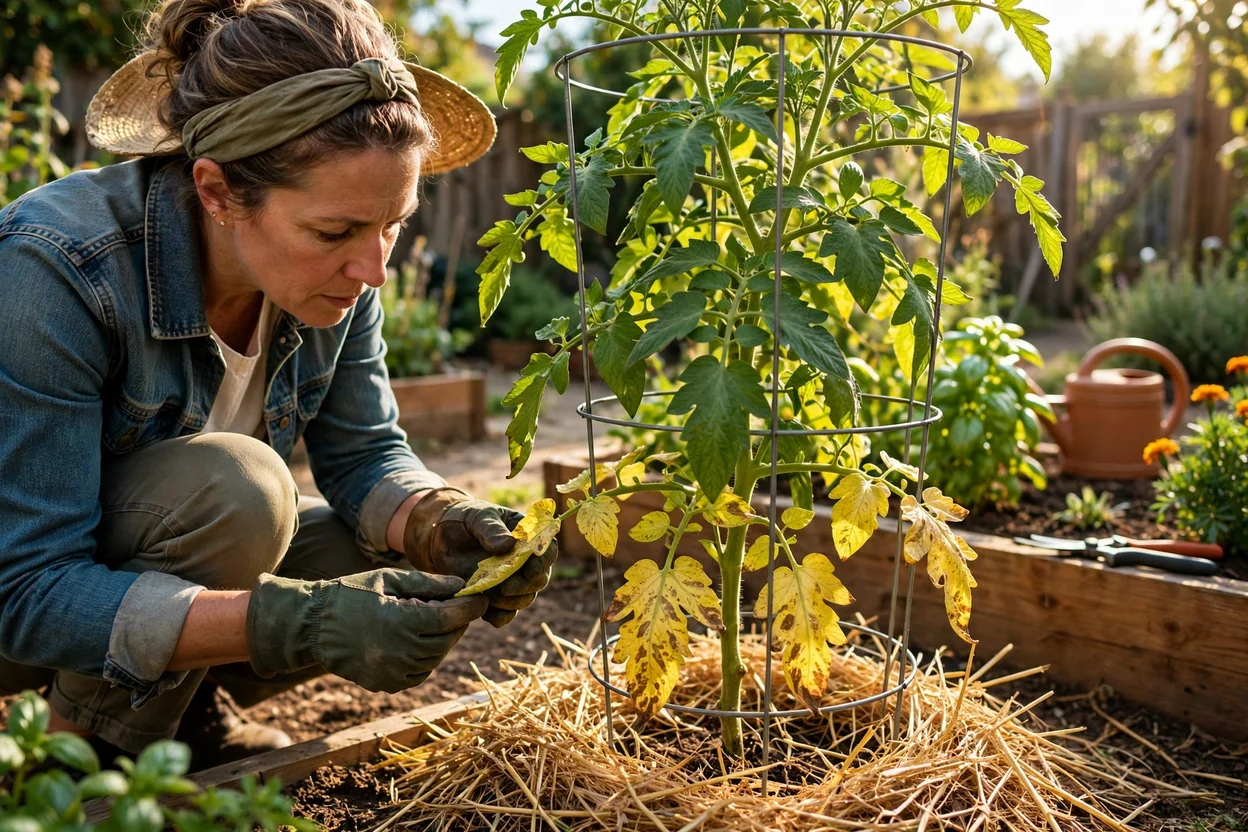
Tomato plant leaves turn yellow most often from nitrogen deficiency, early blight, Septoria leaf spot, Fusarium wilt, overwatering or natural aging of the lowest leaves. Spots on yellow leaves mean disease. If the yellow is even and spotless, look at nutrients or water instead, and treat one-sided wilting as a sign of Fusarium wilt.
Start low. Gardeners asking “why are my tomato plant leaves turning yellow?” should inspect the bottom of the plant first, where most problems begin, and work upward from there.
This table compares the six common causes of yellow tomato leaves.
| Cause | Where It Starts | Key Sign | Fix |
|---|---|---|---|
| Nitrogen deficiency | Lowest leaves | Even yellow, no spots | Side-dress with nitrogen fertilizer |
| Early blight | Lower leaves | Brown spots with concentric rings | Remove leaves, mulch, labeled fungicide |
| Septoria leaf spot | Lower leaves | Many small spots, dark borders | Remove leaves, water at the base |
| Fusarium wilt | One side or branch | Wilting, brown streaks inside stem | Remove plant, grow resistant varieties |
| Overwatering | Whole plant | Limp yellow leaves, soggy soil | Water deeply but less often |
| Natural aging | Oldest bottom leaves | Few leaves, plant otherwise vigorous | Remove leaves, no treatment needed |
Early Blight vs Nitrogen Deficiency
Early blight leaves brown spots with concentric rings on yellowing lower leaves, while nitrogen deficiency yellows lower leaves evenly with no spots at all. Both problems start at the bottom of the plant. Spots settle it.
Early blight is a fungal disease caused by Alternaria species. Picture a target. Each spot has rings inside and a yellow halo around it, and spores splash from the soil onto lower leaves during rain or overhead watering before the disease climbs the plant.
Manage early blight with these steps:
- Remove infected leaves and bag them as trash instead of composting them.
- Spread 2-3 inches (5-8 cm) of straw or shredded leaf mulch to stop soil splash.
- Water at the base of the plant in the morning, not over the leaves.
- Stake or cage plants and prune the lowest leaves up to about 12 inches (30 cm) once plants are tall, which improves airflow.
- Rotate tomatoes, peppers, eggplant and potatoes to a different bed each year.
- Apply a fungicide labeled for tomatoes, such as chlorothalonil or copper, and follow the label exactly.
The label is the law. Under federal pesticide law, the product label is a legal document, which means it sets the application rate and timing as well as the harvest interval.
Correct nitrogen deficiency by side-dressing tomatoes with a balanced or nitrogen-rich fertilizer when the first fruits form. Timing matters. Go easy on nitrogen early in the season, because too much of it produces lush leaves at the expense of fruit.
Septoria Leaf Spot
Septoria leaf spot covers lower tomato leaves with many small round spots, about 1/16 to 1/8 inch (1.5-3 mm) across, with dark brown borders and tan or gray centers. Infected leaves turn yellow, then brown. They drop from the bottom of the plant upward.
Tiny black specks in the center of each spot separate Septoria leaf spot from early blight. Look closer. Compared with early blight spots, Septoria spots are smaller and far more numerous across each leaf, and they never develop target rings.
Septoria thrives in warm summers that are wet and humid, which makes it a frequent problem in the East and Midwest. The fungus overwinters on plant debris. Clear away all tomato debris at the end of the season, then rely on the mulching and watering steps that control early blight, along with crop rotation.
Fusarium Wilt
Fusarium wilt yellows tomato leaves on one side of a leaf, one branch or one side of the plant, followed by wilting that is worst during midday heat. Slice the lower stem lengthwise to confirm. Brown streaks show up in the water-conducting tissue.
Fusarium wilt is a soilborne fungus that persists in soil for years. No spray cures an infected plant. Pull the plant and put it in the trash, then avoid planting tomatoes in that spot again.
Prevent Fusarium wilt by choosing resistant varieties. Seed packets and plant tags mark Fusarium resistance with the letter “F,” and “FF” or “FFF” indicates resistance to more than one race of the fungus. Warm soils see it more often, especially in Southern states.
Watering, Heat and Regional Factors
Uneven watering and extreme temperatures yellow tomato leaves by stressing roots and disrupting nutrient uptake. Consistency counts. Tomatoes in garden beds generally need about 1 inch (2.5 cm) of water per week from rain or irrigation, with more during heat waves and in sandy soil.
Water deeply and less often to encourage deep roots. Containers are another story. Potted tomatoes dry out much faster than tomatoes in the ground and may need water every single day in midsummer heat.
Planting too early causes pale or purplish young leaves, because cold soil slows root activity. Don’t rush it. Time planting with the USDA Plant Hardiness Zone Map and your local last-frost date, and wait until nights stay above 50°F (10°C).
Regional climate shapes the most likely cause. Humid Southeast and Mid-Atlantic summers favor early blight and Septoria. In the hot, dry Southwest, the usual suspects shift to spider mites and heat stress, with iron chlorosis common wherever the soil is alkaline.
Why Are My House Plant Leaves Turning Yellow?
House plant leaves turn yellow most often because of overwatering, low light, cold drafts or a pot without drainage holes, because indoor plants grow in a closed container where excess water has nowhere to go. Nutrients matter too. Indoor plants use up the nutrients in potting mix faster than garden plants do.
The question “why are my plants leaves turning yellow” has a different answer for a pothos on a bookshelf than for a tomato in a raised bed. Indoors, check water and light first.
Check the Pot and Potting Mix
A pot without drainage holes is the single biggest setup error behind yellow houseplant leaves. With nowhere to drain, water pools at the bottom of the pot and rots the lowest roots, which is why the lower leaves yellow before the rest. Drainage is non-negotiable.
Keep plants in a nursery pot with holes, set inside a decorative pot if needed, and empty any water left standing after watering. Mix matters too. Use bagged potting mix from a garden center, Home Depot or Lowe’s, never garden soil, which compacts in containers.
Repot when roots circle the pot or grow out of the drainage holes. Size up modestly. A new pot should be only 1-2 inches (2.5-5 cm) wider than the old one, because a much larger pot holds extra wet mix that roots can’t reach.
Match Light to the Plant
Yellow lower leaves on a houseplant with long, stretched stems mean the plant needs more light. Low light suits pothos and snake plants, along with ZZ plants, while fiddle-leaf figs need bright light alongside succulents and citrus. Know which group yours is in.
East-facing windows get gentle morning sun. That softer light suits many tropical plants, while south- and west-facing windows in the USA deliver the strongest light and north-facing windows the weakest.
Winter days cut indoor light sharply. An LED grow light set a few inches to a foot (about 5-30 cm) above plants, per the maker’s instructions, fills the gap.
Watch Temperature, Drafts and Feeding
Cold drafts and missed feedings both yellow houseplant leaves, often in winter and late summer. Keep tropical plants well away from exterior doors and cold windows in winter, and steer clear of air-conditioning or heating vents blowing directly on the foliage. Check every vent nearby.
Feed houseplants with a diluted liquid fertilizer during spring and summer growth. Winter is different. Cut back or stop feeding entirely once growth slows, because unused fertilizer salts build up in the potting mix over time.
How to Fix Yellow Leaves on Plants
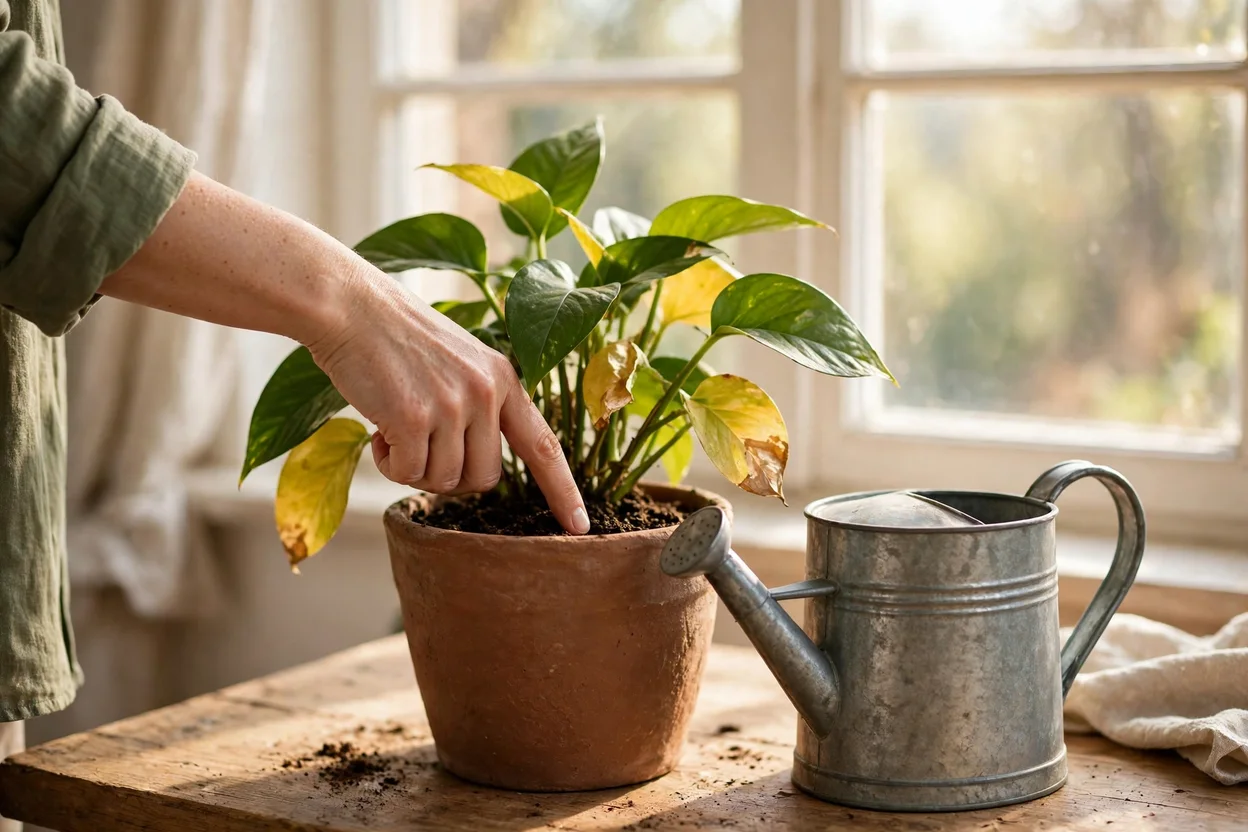
Fix yellow leaves on plants by finding the cause first, then correcting water, light, nutrients, pH or pests in that order, because watering and light problems are the most common and the fastest to fix. Fertilizer doesn’t help a waterlogged or pest-infested plant. It can even burn weak roots.
Follow these steps for any plant, indoors or out:
- Push a finger 2 inches (5 cm) into the soil to check moisture.
- Slide the plant out of its pot and inspect the roots if the soil is wet.
- Note where the yellow starts: older leaves, new leaves, between veins, or in spots.
- Inspect leaf undersides with a magnifying glass for mites, aphids, whiteflies or scale.
- Move the plant to the light level its species needs.
- Test soil pH and nutrients before adding fertilizer, lime or sulfur.
- Apply the matching fix: adjusted watering, fertilizer, chelated iron, pH correction or pest control.
- Cut off leaves that are mostly yellow using clean, sharp pruners.
- Judge success by the color of the next new leaves, not the old ones.
Get a Soil Test from Cooperative Extension
A soil test from your state’s Cooperative Extension service is the most accurate way to confirm pH and nutrient problems before you spend money on amendments. Every state has one. Cooperative Extension offices operate through land-grant universities in every US state.
Many Extension offices sell mail-in soil test kits or accept samples at county offices, and results typically report pH, phosphorus and potassium along with lime or fertilizer recommendations. Fees vary by state. No verified national figure is available.
Nitrogen is the exception. Labs often skip it on home garden samples because soil nitrogen changes quickly, so leaf color and growth rate remain the best guide for nitrogen. Store-bought home test kits give rough readings, but they’re less precise than lab results.
Match the Fertilizer to the Deficiency
This table compares common deficiencies, their symptoms and the standard fix.
| Deficiency | Symptom | Common Fix |
|---|---|---|
| Nitrogen | Older leaves evenly yellow | Balanced or nitrogen-rich fertilizer |
| Iron | Newest leaves yellow, veins green | Chelated iron, lower soil pH |
| Magnesium | Older leaves yellow between veins | Magnesium source after soil test confirms |
| Potassium | Older leaf edges yellow, then brown | Potassium fertilizer per soil test |
Can Yellow Leaves Turn Green Again?
No, a leaf that has turned fully yellow almost never turns green again, because the plant has already broken down its chlorophyll and moved nutrients out of that leaf. Mild cases are different. Leaves with light yellowing from an iron or nitrogen shortage can partly regreen after the fix, though new growth is where true recovery shows.
Recovery speed depends on how fast the plant grows. Summer helps. Tomatoes and pothos push out green new leaves within the growing season far sooner than slow growers such as snake plants, and any plant slows down in winter.
Should I Cut Off Yellow Leaves?
Yes, cut off leaves that are mostly yellow, diseased or dead, because those leaves no longer feed the plant and diseased leaves spread spores to healthy foliage. Partly yellow leaves can stay. When the cause is nutrients or water, the green portion of each leaf still makes food for the plant.
Cut each leaf at the base of its leaf stem, called the petiole, where it meets the main stem. Clean tools matter. On diseased plants, wipe the blades of your sharp pruners or scissors with 70% isopropyl alcohol between every cut.
Avoid removing more than about one-third of a plant’s leaves at once. Diseased tomato leaves belong in the trash, not the compost pile.
Is Epsom Salt Good for Yellow Leaves?
No, Epsom salt is not a general fix for yellow leaves, because Epsom salt supplies only magnesium and sulfur and helps only when a soil test confirms a magnesium deficiency. Adding Epsom salt to soil with enough magnesium does nothing for the plant. It only raises soil salt levels.
Epsom salt is magnesium sulfate. Too much magnesium can compete with calcium uptake, and that works against tomatoes and peppers, both of which depend on a steady calcium supply.
Magnesium earns its place in one situation. If older leaves show yellow between green veins and a soil test reports low magnesium, apply magnesium at the rate the soil test report recommends.
Why Do Plant Leaves Turn Brown?
Plant leaves turn brown when leaf tissue dies, most often from underwatering, low humidity, fertilizer salt buildup, sunburn, root rot or fungal disease. Yellowing often comes first. Texture tells the rest of the story, since brown, crispy tips point to dry conditions or salts while brown, mushy patches point to too much water.
Brown tips usually trace back to watering, but not always. Dry winter air from home heating can scorch leaf tips just as badly as uneven watering, and so can salt buildup from fertilizer.
This table compares common browning patterns, their causes and fixes.
| Brown Pattern | Likely Cause | Fix |
|---|---|---|
| Crispy brown tips | Underwatering or low humidity | Water evenly, group plants together |
| Brown edges after feeding | Fertilizer burn | Flush soil with plain water |
| Brown, mushy patches | Overwatering or root rot | Trim rot, repot in fresh mix |
| Dry brown patches on sunny side | Sunburn | Move to filtered light |
| Brown spots with yellow halos | Fungal or bacterial leaf spot | Remove leaves, keep foliage dry |
| Brown tips on spider plants, dracaenas | Fluoride and salts in tap water | Water with distilled or rainwater |
Frequently Asked Questions
What Causes Plant Leaves to Turn Yellow?
Chlorophyll loss causes the yellow color. Usually something triggers it, whether soggy or bone-dry soil, too little nitrogen, iron or magnesium, or soil pH outside the plant’s range. Poor light, sap-sucking pests, cold drafts and normal leaf aging can also set it off.
Does Overwatering Cause Yellow Leaves?
Yes. Saturated soil starves roots of oxygen and invites root rot, which leaves the plant unable to absorb water or food. The result is soft, yellow leaves, often starting low on the plant, while the soil stays damp.
Why Are My Tomato Plant’s Bottom Leaves Turning Yellow?
Nitrogen shortage, early blight, Septoria leaf spot or simple aging are the usual culprits. Check for spots. Rings or dark borders mean fungal disease, while uniform yellow without any spots means the tomato plant needs nitrogen.
What Deficiency Causes Yellow Leaves with Green Veins?
Iron deficiency causes this pattern on the newest leaves, usually because soil pH is too high. Older, lower leaves tell a different story. On those leaves, the same pattern signals magnesium deficiency, and a lab soil test separates the two.
How Do I Fix Yellow Leaves on Houseplants?
Let the top 1-2 inches (2.5-5 cm) of potting mix dry before watering. Use a pot with drainage holes. Then move the plant into brighter indirect light and feed it lightly during spring and summer.
Conclusion
The next time you ask “why are my plant leaves turning yellow?”, start with the leaf itself. Pattern narrows it fast. The position of the yellow cuts the list of causes in seconds, and a finger pushed into the soil confirms or rules out watering.
Plan ahead for next season. Order a Cooperative Extension soil test before spring planting, and pick disease-resistant tomato varieties marked with “F” and other resistance codes. Indoors, set up houseplants in pots with drainage holes and give each one the light it needs.
Watch new growth after every fix. Green new leaves are the clearest proof of recovery. Catch the next yellow leaf early, and a small problem won’t get the chance to spread.