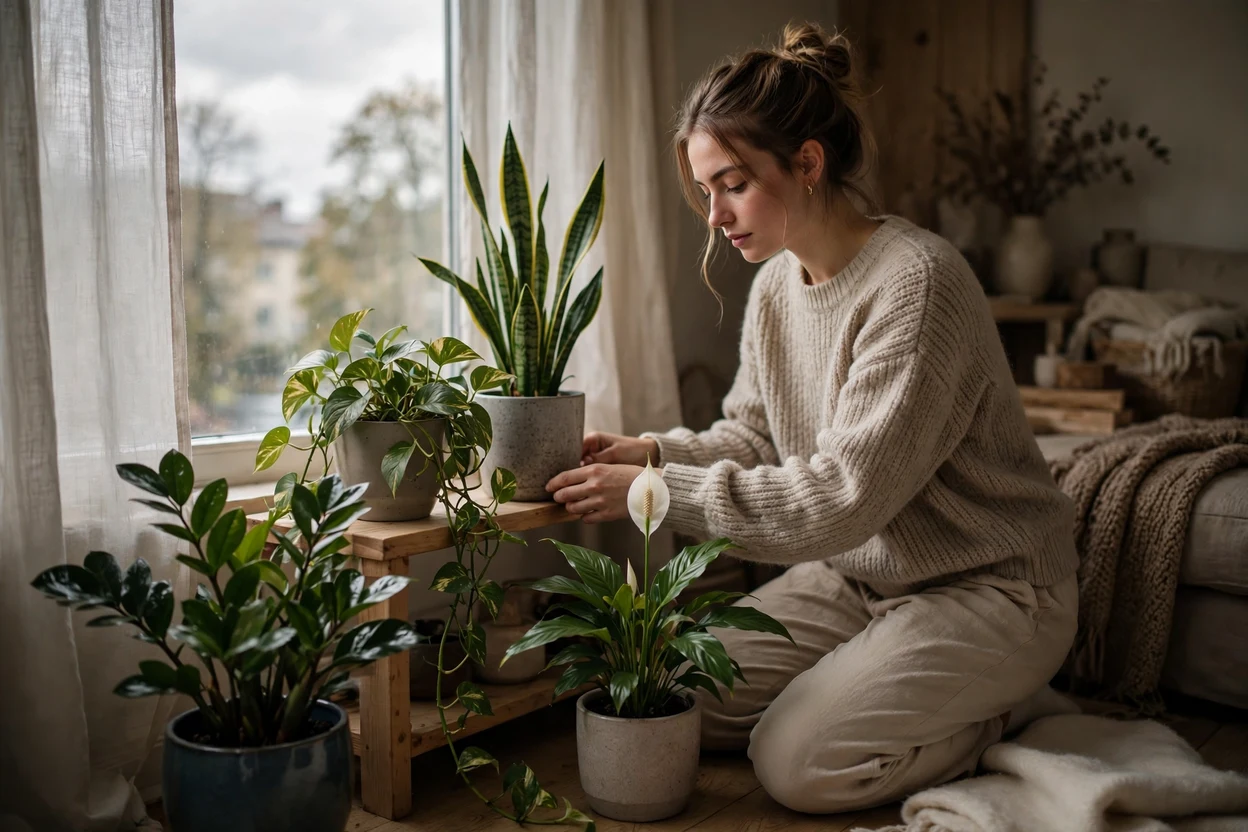
The best indoor plants for low light are shade-tolerant houseplants that keep growing in spots receiving roughly 50 to 250 foot-candles (fc) of light. Five stand out. ZZ plant, snake plant, pothos, cast iron plant and peace lily cope with north-facing windows and dim corners in typical US homes, and they shrug off irregular watering too.
Key Takeaways
- Low light for houseplants means roughly 50 to 250 foot-candles, or about 540 to 2,700 lux, measured at leaf height.
- ZZ plant and snake plant are the easiest of the best indoor plants for low light for beginners who forget to water.
- Cast iron plant, parlor palm and Kentia palm are listed as non-toxic to cats and dogs by the American Society for the Prevention of Cruelty to Animals (ASPCA).
- Kentia palm and corn plant are the strongest tall picks for dim corners, reaching about 4 to 10 feet (1.2 to 3 meters) indoors.
- Houseplants don’t measurably clean the air in a normal home. Ventilation and removing pollution sources do far more.
- Overwatering kills more low-light plants than darkness does, because dim light slows how fast soil dries.
What Counts as Low Light for Plants?
 Low light for houseplants means roughly 50 to 250 foot-candles, or about 540 to 2,700 lux, measured at leaf height during the brightest part of the day. That level matches a spot near a north-facing window or several feet back from an east or west window. You can read there without a lamp.
Exact cutoffs aren’t universal. University extension guides and nurseries each draw the lines a little differently, so treat the ranges below as working tiers rather than fixed rules.
A plant labeled “low light” tolerates these conditions. It doesn’t prefer them. Give nearly any plant on this list medium or bright indirect light, and it’ll grow faster and fuller than it ever will in a dim corner.
Light Levels in Foot-Candles and Lux
This table compares common indoor light tiers in both foot-candles and lux, using the conversion 1 fc = 10.76 lux.
| Light Tier | Foot-Candles (Fc) | Lux | Typical Spot |
|---|---|---|---|
| Too dark | Under 50 | Under 540 | Windowless room, lights off most of the day |
| Low light | 50-250 | 540-2,700 | Near a north window, dim corner |
| Medium light | 250-1,000 | 2,700-10,800 | Near an east window |
| Bright indirect | 1,000+ | 10,800+ | Near a south or west window, out of sun |
How Window Direction Changes Light
Window direction sets the light ceiling. In the continental USA, south-facing windows receive the most direct sun of any exposure, while north-facing windows receive the least and suit shade plants best.
Most shade houseplants belong near a north window or well back from a brighter one. The distances below are starting points only. Trees, buildings, roof overhangs, window screens and sheer curtains all cut light, so confirm every spot with a meter.
This table compares window directions and where low light typically falls inside the room.
| Window Direction | Light Quality | Low Light Spot (ft / m) |
|---|---|---|
| North | Soft, indirect all day | Within 3-5 ft (0.9-1.5 m) of glass |
| East | Gentle morning sun | 6-8 ft (1.8-2.4 m) back from glass |
| West | Hot afternoon sun | 6-8 ft (1.8-2.4 m) back, out of sun |
| South | Strongest, longest sun | 8+ ft (2.4+ m) back or side walls |
How Do You Measure Light at Home?
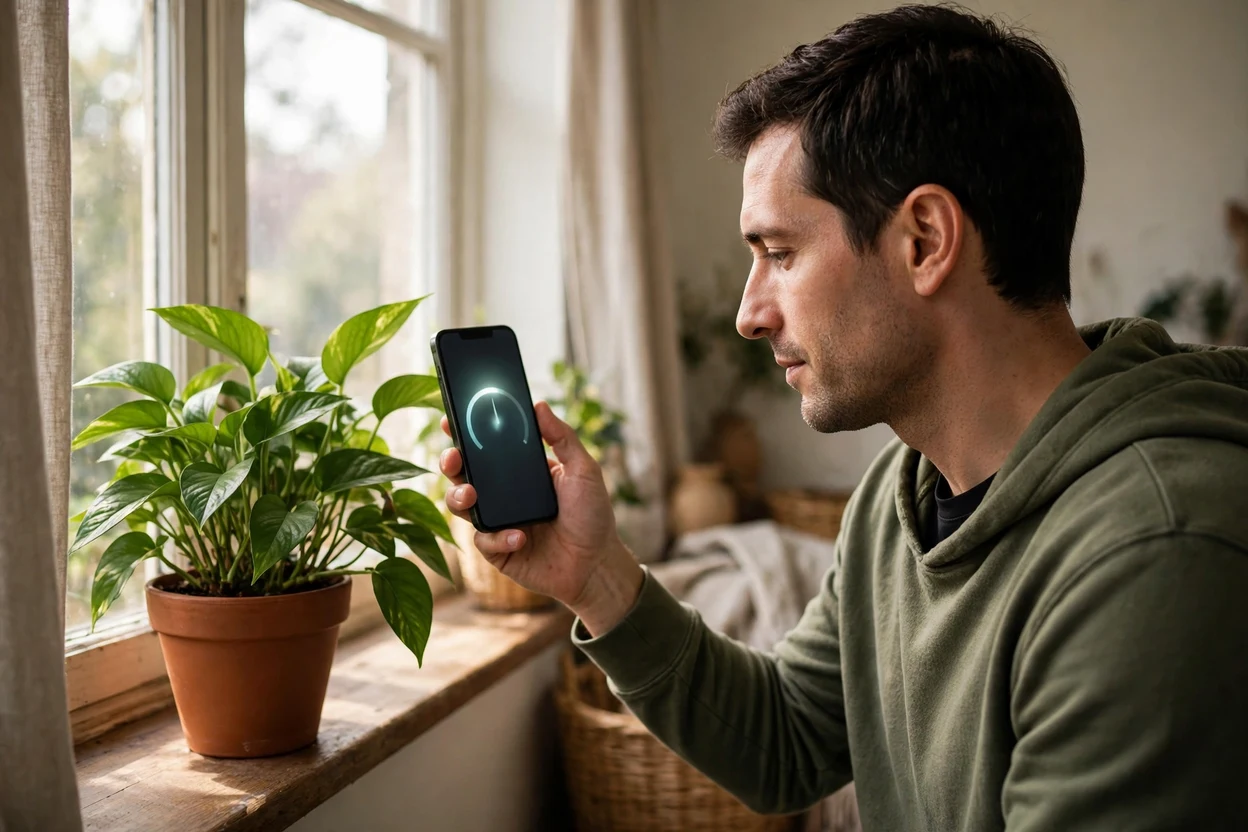
Measure light at home with a handheld light meter or a free phone lux app, holding the sensor at leaf height and facing the window around midday. Divide a lux reading by 10.76 to get foot-candles. That’s the number that matters. The foot-candle figure then shows whether a spot suits low-light plants or needs a grow light.
Choosing the best low light plants for indoors starts with a light reading, not with whatever the plant tag at the store happens to say. Phone apps are approximate. Still, they’re accurate enough to tell low light from medium light.
- Download a lux meter app or use a handheld light meter.
- Pick a clear day and take the reading between 11 a.m. and 2 p.m.
- Hold the sensor where the leaves will sit, pointed toward the brightest window.
- Record the reading in lux, then divide by 10.76 to convert it to foot-candles.
- Repeat the reading on an overcast day to find the low end of the range.
- Compare both readings to the light tier table and choose plants rated for that tier.
Seasons matter too. Winter readings in northern states such as Minnesota or Maine run lower than summer ones, so measure again in December if a plant starts to decline.
The 10 Best Indoor Plants for Low Light
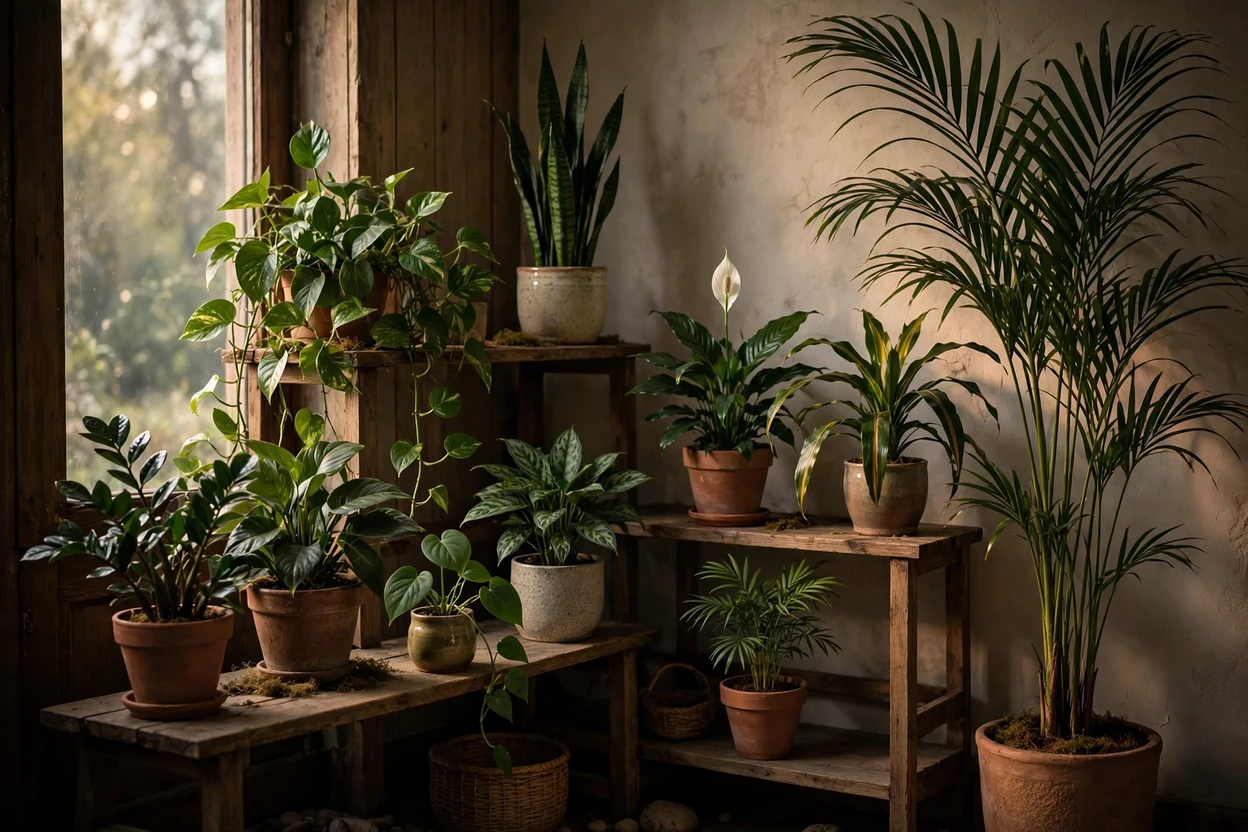 The 10 best indoor plants for low light are ZZ plant, snake plant, pothos, cast iron plant, heartleaf philodendron, Chinese evergreen, peace lily, parlor palm, corn plant and Kentia palm. Each of these plants tolerates readings near the bottom of the low-light range and bounces back from an occasional missed watering. All ten are easy to find. US garden centers and big-box stores stock them, and so do online plant shops.
The best plants for low light indoors share three traits. Slow growth comes first. They also use little water, and their leaves capture dim light efficiently enough to keep them green in spots where most houseplants would fade.
This table compares all 10 plants by light range, mature indoor height, watering trigger and pet safety.
| Plant | Light Range | Height (ft / m) | Water When | Pet Safety |
|---|---|---|---|---|
| ZZ plant | Low to bright indirect | 2-3 ft (0.6-0.9 m) | Soil fully dry | Treat as toxic |
| Snake plant | Low to bright indirect | 2-4 ft (0.6-1.2 m) | Soil fully dry | Toxic (ASPCA) |
| Pothos | Low to bright indirect | Vines 6-10 ft (1.8-3 m) | Top 1-2 in (2.5-5 cm) dry | Toxic (ASPCA) |
| Cast iron plant | Very low to medium | 2-3 ft (0.6-0.9 m) | Top 1 in (2.5 cm) dry | Non-toxic (ASPCA) |
| Heartleaf philodendron | Low to medium | Vines 4+ ft (1.2+ m) | Top 1 in (2.5 cm) dry | Toxic (ASPCA) |
| Chinese evergreen | Low to medium | 1-3 ft (0.3-0.9 m) | Top 1 in (2.5 cm) dry | Toxic (ASPCA) |
| Peace lily | Low to medium | 1-3 ft (0.3-0.9 m) | Leaves start to droop | Toxic (ASPCA) |
| Parlor palm | Low to medium | 2-4 ft (0.6-1.2 m) | Top 1 in (2.5 cm) dry | Non-toxic (ASPCA) |
| Corn plant | Low to medium | 4-6 ft (1.2-1.8 m) | Top 1-2 in (2.5-5 cm) dry | Toxic (ASPCA) |
| Kentia palm | Low to bright indirect | 5-10 ft (1.5-3 m) | Top 1-2 in (2.5-5 cm) dry | Non-toxic (ASPCA) |
1. ZZ Plant
ZZ plant (Zamioculcas zamiifolia) is the most forgiving choice for dim rooms. It barely needs you. Underground rhizomes store water, so the plant goes weeks between waterings without complaint, even in a dark office.
Water only when the soil is completely dry. In low light, that point usually arrives every two to four weeks.
ZZ plant sap contains calcium oxalate crystals. Keep it out of reach. Cats and dogs shouldn’t chew it, and neither should small children who grab at low leaves.
2. Snake Plant
Snake plant (Dracaena trifasciata, formerly Sansevieria trifasciata) grows stiff, upright leaves that fit narrow spaces beside doors and dressers. It tolerates low light. Growth there is very slow, though, so a new leaf every few months is normal rather than a sign of trouble.
Root rot from wet soil is the main way people lose this plant. Prevent it early. A gritty cactus or succulent mix in a pot with drainage holes lets excess water escape before roots start to suffer.
The ASPCA lists snake plant as toxic to cats and dogs.
3. Pothos
Pothos (Epipremnum aureum) is the classic trailing plant for shelves and hanging baskets. Its vines move fast in medium light. In low light they still grow steadily, just with a bit more space between each leaf.
Solid green types such as ‘Jade’ hold their color in dim rooms. Variegation behaves differently. Heavily variegated types such as ‘Marble Queen’ lose their white streaking as light drops.
Water when the top 1 to 2 inches (2.5 to 5 cm) of soil feel dry. The ASPCA lists pothos as toxic to cats and dogs.
4. Cast Iron Plant
Cast iron plant (Aspidistra elatior) earns its name by surviving the darkest spots on this list. Drafts and temperature swings don’t faze it. Missed waterings rarely bother it either.
Growth is slow. Buy a full pot rather than a small starter, because a thin plant can take years to fill in. Its dark green, strap-shaped leaves suit hallways and stairwells.
The ASPCA lists cast iron plant as non-toxic to cats and dogs.
5. Heartleaf Philodendron
Heartleaf philodendron (Philodendron hederaceum) trails like pothos but has thinner, heart-shaped leaves. The look is softer. On bookshelves and kitchen cabinets, those delicate leaves drape more gently than the thicker foliage of a pothos.
Pinch the vine tips every few months to keep the plant bushy. Watch the stems. Long, bare stretches between leaves signal that this philodendron wants more light than its current spot provides.
The ASPCA lists heartleaf philodendron as toxic to cats and dogs.
6. Chinese Evergreen
Chinese evergreen (Aglaonema) adds patterned silver, green and pink foliage to dim rooms. Color affects light needs. Dark green varieties tolerate the lowest light, while pink and red varieties need medium light to keep their color.
Keep the plant above 60°F (16°C). Cold winter windows and exterior doors chill the leaves, so set it well away from both.
The ASPCA lists Chinese evergreen as toxic to cats and dogs.
7. Peace Lily
Peace lily (Spathiphyllum) is the only plant on this list that regularly flowers indoors. Low light changes that. It keeps healthy leaves in a dim room but produces fewer white blooms.
Thirst is easy to spot. The plant droops visibly when it’s dry and recovers within hours of watering, which makes it a useful signal plant for beginners. It’s sensitive to fluoride in tap water, which causes brown leaf tips.
The ASPCA lists peace lily as toxic to cats and dogs.
8. Parlor Palm
Parlor palm (Chamaedorea elegans) brings a soft, feathery palm look to rooms where most palms fail. It grows slowly. Years can pass before this compact palm outgrows a tabletop or a small floor pot.
Keep the soil lightly moist but never soggy. Winter air is the bigger threat. Forced-air heating dries the room, so mist the fronds or group the palm with other plants.
The ASPCA lists parlor palm as non-toxic to cats and dogs.
9. Corn Plant
Corn plant (Dracaena fragrans) grows thick canes topped with arching leaves. It’s a classic tall floor plant for offices and living rooms.
Brown leaf tips often come from fluoride in tap water. The fix is simple. Switch to filtered or distilled water if the tips keep browning after you’ve ruled out dry soil.
The ASPCA lists corn plant as toxic to cats and dogs.
10. Kentia Palm
Kentia palm (Howea forsteriana) is the premium pick for a tall, elegant plant in a dim corner. Few palms compare. It tolerates low light far better than areca or majesty palms, which tend to brown and thin out away from a bright window.
Kentia palms grow very slowly. Large specimens cost more than most houseplants, so buy the height you want at the start.
The ASPCA lists Kentia palm as non-toxic to cats and dogs.
What Tall Plants Grow in Low Light?
Tall plants that grow in low light include Kentia palm, corn plant, snake plant and parlor palm, with mature indoor heights from about 3 to 10 feet (0.9 to 3 meters). These floor plants fill dim corners and stairwells. Growth is slow in low light. Buying a plant close to the final size you want is the better plan.
This table compares tall low-light plants by indoor height, growth rate and placement.
| Plant | Indoor Height (ft / m) | Growth in Low Light | Best Spot |
|---|---|---|---|
| Kentia palm | 5-10 ft (1.5-3 m) | Very slow | Living room corner |
| Corn plant | 4-6 ft (1.2-1.8 m) | Slow | Office or entryway |
| Snake plant | 2-4 ft (0.6-1.2 m) | Very slow | Beside doors or dressers |
| Parlor palm | 2-4 ft (0.6-1.2 m) | Slow | Bedroom or reading nook |
For tall indoor plants, low light at floor level is the main challenge. Measure twice. Light often reads 30 to 50 percent lower at the base of a corner than at the top of the leaves, so take readings at both heights. Place tall plants where the upper leaves catch window light, and give the pot a quarter turn every month to prevent leaning.
Which Low Light Plants Are Safe for Cats and Dogs?
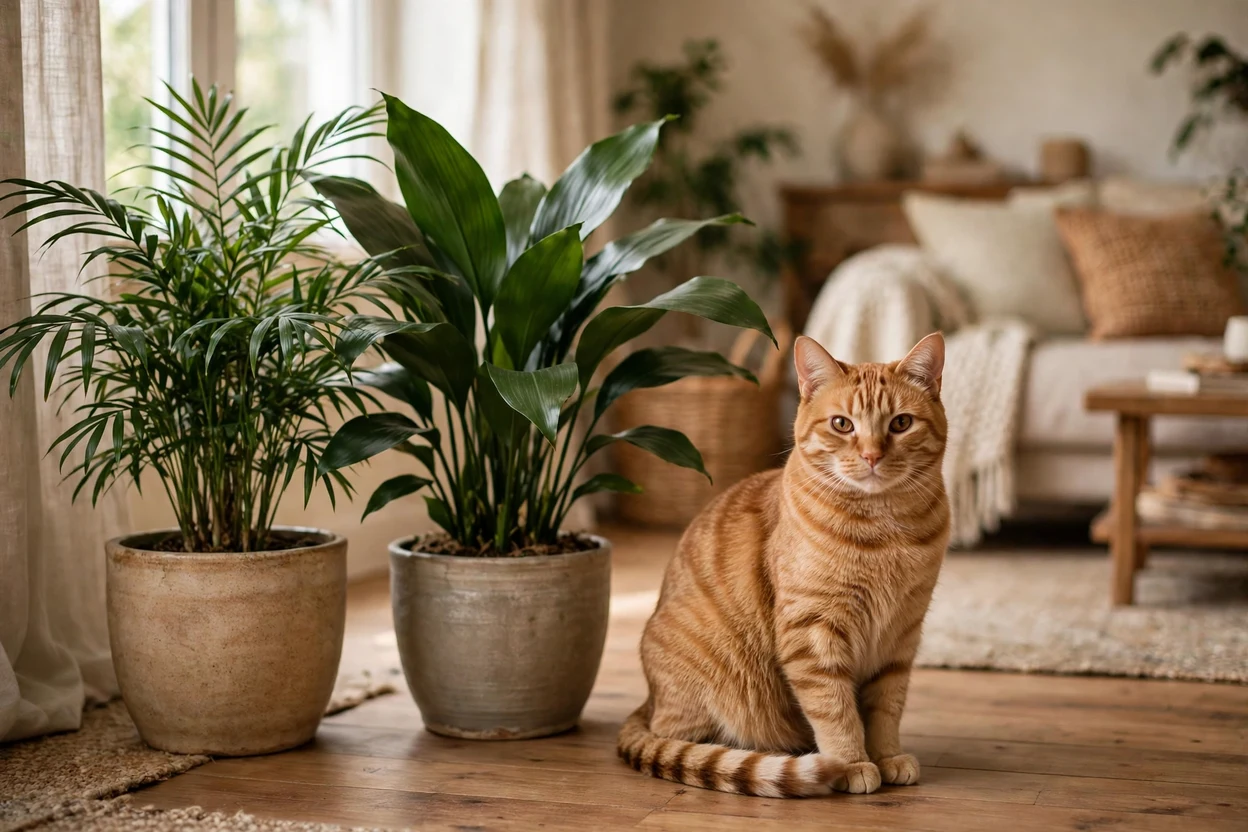 Cast iron plant, parlor palm and Kentia palm are the low light plants on this list that the ASPCA classifies as non-toxic to cats and dogs. Snake plant, pothos, peace lily, Chinese evergreen, heartleaf philodendron and corn plant appear on the ASPCA toxic list for both pets. ZZ plant contains calcium oxalate. Keep ZZ plant out of reach as well.
This table compares pet safety and the main toxic compound for each plant, based on ASPCA listings where available.
| Plant | Cats | Dogs | Main Concern |
|---|---|---|---|
| Cast iron plant | Non-toxic | Non-toxic | None listed |
| Parlor palm | Non-toxic | Non-toxic | None listed |
| Kentia palm | Non-toxic | Non-toxic | None listed |
| ZZ plant | Treat as toxic | Treat as toxic | Calcium oxalate crystals |
| Snake plant | Toxic | Toxic | Saponins |
| Pothos | Toxic | Toxic | Insoluble calcium oxalates |
| Peace lily | Toxic | Toxic | Insoluble calcium oxalates |
| Chinese evergreen | Toxic | Toxic | Insoluble calcium oxalates |
| Heartleaf philodendron | Toxic | Toxic | Insoluble calcium oxalates |
| Corn plant | Toxic | Toxic | Saponins |
“Toxic” on the ASPCA list doesn’t always mean deadly. Calcium oxalate plants usually cause mouth irritation and drooling, sometimes with vomiting. Any chewing still deserves a call to a veterinarian.
The ASPCA Animal Poison Control Center answers at (888) 426-4435, and a consultation fee may apply. Prevention is easier. Hanging baskets and high shelves keep trailing toxic plants such as pothos away from curious pets.
Do Low Light Plants Clean the Air?
No, low light plants do not measurably clean the air in a typical home at normal plant densities. A 1989 National Aeronautics and Space Administration (NASA) study showed plants removing chemicals inside small sealed chambers. Homes aren’t sealed. A 2019 research review later estimated that a home would need 10 to 1,000 plants per square meter to match ordinary ventilation.
What the NASA Clean Air Study Tested
The NASA Clean Air Study, led by B.C. Wolverton, placed individual plants in small sealed test chambers. Researchers then tracked how quickly each chamber’s levels of benzene, formaldehyde and trichloroethylene fell.
Several plants on this list appeared in the study, including peace lily, snake plant, golden pothos, Chinese evergreen and a corn plant variety. The results were real. Still, a sealed chamber has no fresh air exchange, and a house or apartment trades air with the outdoors constantly.
What Later Research Found
A 2019 review by Bryan Cummings and Michael Waring of Drexel University analyzed decades of plant studies on volatile organic compounds (VOCs). Their conclusion was blunt. Typical buildings already exchange air far faster than plants can filter it.
Their estimate of 10 to 1,000 plants per square meter equals roughly 1 to 93 plants per square foot. No home reaches that density.
Shoppers looking for the best indoor plants for low light and clean air should treat plants as decor and wellbeing boosters, not air purifiers. The US Environmental Protection Agency (EPA) takes a different approach. It points to source control and ventilation as the main ways to improve indoor air quality.
Best Low Light Plants by Room
Match each room to a plant by its light reading and conditions: snake plant and ZZ plant for bedrooms, pothos for bathrooms with a small window, cast iron plant for hallways and Chinese evergreen for offices under overhead lights. Humidity, temperature and foot traffic matter as much as light when choosing a spot.
This table compares common US rooms and the plants that suit each one.
| Room | Typical Light | Best Picks | Why It Works |
|---|---|---|---|
| Bedroom | Low, curtains often closed | Snake plant, ZZ plant, parlor palm | Tolerate dim light and rare watering |
| Bathroom with window | Low, high humidity | Pothos, heartleaf philodendron, peace lily | Enjoy humid air from showers |
| Hallway or stairwell | Very low | Cast iron plant | Survives the lowest light and drafts |
| Office with overhead lights | Low, steady artificial light | Chinese evergreen, ZZ plant, pothos | Grow under fluorescent or LED panels |
| North-facing living room | Low to medium | Kentia palm, corn plant, peace lily | Tall or flowering focal points |
The best houseplants for low light in shared spaces are the ones that also survive neglect. ZZ plant and cast iron plant fit that role. Choose either one for vacation rentals, dorm rooms or offices where nobody waters on a schedule.
Can a Pothos Live in a Windowless Bathroom?
Yes, a pothos can live in a windowless bathroom if the room lights stay on for many hours a day or a grow light runs on a timer. Pothos grows under the fluorescent and LED fixtures common in US bathrooms and offices.
Short showers aren’t enough. A bathroom that stays dark the rest of the day won’t support any houseplant long term. In that case, add a small LED grow bulb on a timer, or rotate the plant to a brighter room every few weeks.
How Do You Know a Plant Needs More Light?
A plant needs more light when it shows long gaps between leaves, smaller new leaves, stems leaning toward the window, fading variegation or no new growth through spring and summer. Soil that stays wet for more than two weeks is another warning sign. Wet soil that lingers means the plant is using water too slowly to stay healthy.
This table compares common low-light symptoms with their meaning and the fix.
| Symptom | What It Means | Fix |
|---|---|---|
| Long, stretched stems | Plant is reaching for light | Move closer to a window |
| Small new leaves | Too little energy for full growth | Add a grow light |
| Leaning toward window | Light comes from one side | Rotate pot a quarter turn monthly |
| Fading variegation | Plant makes more green to compensate | Move to medium light |
| Soil stays wet for weeks | Plant uses little water | Water less often |
| Yellow lower leaves | Plant sheds leaves it cannot support | Increase light, reduce watering |
Try relocating first. If a brighter spot exists anywhere in the home, move the plant there before buying equipment. A grow light makes sense when every window is already taken or the room has no window at all.
Can Plants Grow Without Sunlight?
Yes, plants can grow without sunlight when an artificial source supplies enough light, and a full-spectrum light-emitting diode (LED) grow light is the most energy-efficient option for homes. Low-light foliage plants such as pothos, ZZ plant and Chinese evergreen grow well under LED grow lights placed close to the leaves and run on a timer.
Regular household lamps help a little. Most of them, though, deliver too little light at leaf level to keep a plant growing. A dedicated grow bulb concentrates output where the plant needs it.
How to Set up a Grow Light
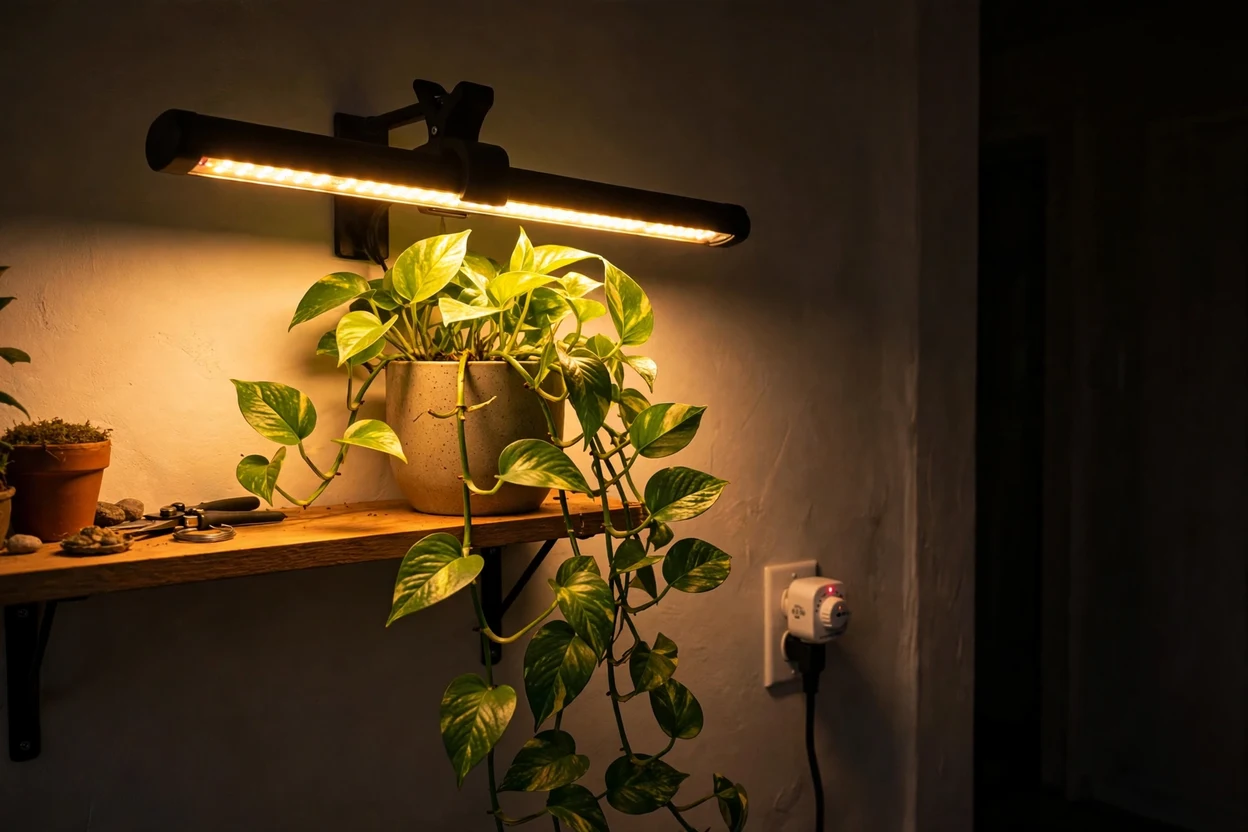 Follow these steps to give a dim-room plant enough artificial light.
- Choose a full-spectrum LED grow bulb, clip light or panel sized to cover the plant.
- Mount the light at the distance the manufacturer recommends, commonly 12 to 24 inches (30 to 60 cm) above the leaves.
- Plug the light into an outlet timer so it runs the same hours every day.
- Set the timer for about 12 to 14 hours of light per day for foliage plants.
- Check the leaves after two weeks for scorching or bleaching, and raise the light if either appears.
- Measure the light at leaf level with a lux app and aim for at least the low-light tier.
How to Care for Houseplants in Low Light
Care for houseplants in low light by watering less often, using pots with drainage holes, skipping most fertilizer and dusting the leaves so they absorb every bit of available light. Dim light slows growth and water use. As a result, overwatering and root rot are the most common causes of plant loss in shady rooms.
Houseplants for low light need the same basic care as other houseplants. They just need less of it. Follow these steps to keep them healthy.
- Pot every plant in a container with drainage holes, never directly in a decorative pot without them.
- Push a finger 1 to 2 inches (2.5 to 5 cm) into the soil before every watering.
- Water only when that depth feels dry, then let excess water drain completely.
- Empty the saucer 15 to 30 minutes after watering so roots never sit in water.
- Feed with a diluted houseplant fertilizer only in spring and summer, and only if new growth appears.
- Wipe the leaves with a damp cloth every month to remove dust that blocks light.
- Repot only when roots circle the pot or grow out of the drainage holes.
Frequently Asked Questions
What Is the Best Indoor Plant for Low Light?
The ZZ plant is the best indoor plant for low light for most beginners. Water-storing rhizomes let it go two to four weeks between waterings, and its glossy leaves stay green in dim offices.
Is a Snake Plant Good for Low Light?
Yes. Snake plant survives low light, although it grows faster in medium light. Plant it in a gritty mix inside a pot with drainage holes to avoid root rot.
How Often Should You Water a Snake Plant?
Wait until the soil dries completely, usually two to four weeks in dim rooms and longer during winter. Test by pushing a finger 2 inches (5 cm) deep before adding water.
What Plant Does Well in a Dark Room?
Cast iron plant handles the dimmest rooms that still get some daylight, with ZZ plant a close second. A space with no window at all requires a grow light for any houseplant.
Is a Peace Lily Okay in Low Light?
Yes. Peace lily keeps lush foliage in low light but flowers less often. If blooms matter, move it closer to a window or add a grow light.
Conclusion
Dim apartments and north-facing rooms don’t limit plant choices once light is measured in foot-candles instead of guessed. Readings settle it. A $0 phone lux app and a few minutes at each spot show exactly which of the best indoor plants for low light will thrive in each corner.
Affordable LED grow lights now fit standard lamp sockets and shelf clips. With one of them, even windowless bathrooms and interior offices can support pothos or ZZ plant.
Start small. Pick one forgiving plant, such as ZZ plant or cast iron plant, and learn its watering rhythm before adding tall palms or flowering peace lilies. Pet owners can build a fully non-toxic collection from cast iron plant, parlor palm and Kentia palm.