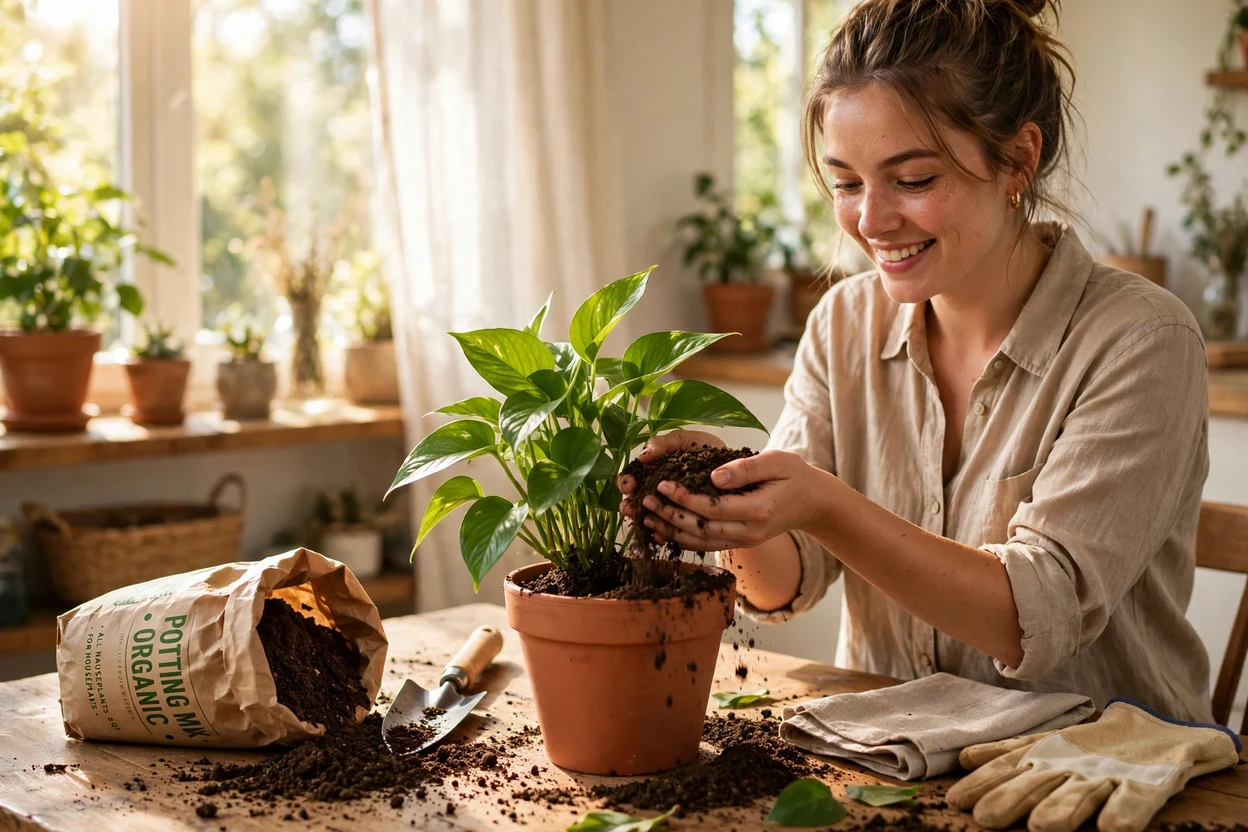
Repotting is one of the core skills of container gardening and indoor gardening. Every gardener who grows plants in pots eventually faces roots that have run out of soil, and a well-timed repotting keeps those plants growing strong through the gardening season. To repot a plant, water it 1 to 2 days ahead and move it into a pot 1 to 2 inches (2.5 to 5 cm) wider that has a drainage hole. Loosen any circling roots before you set the plant at its old depth in fresh potting mix. Then water it in. Spring suits most houseplants best, since active growth speeds recovery.
Key Takeaways
- Repot most houseplants in spring or early summer, when active growth helps new roots form quickly.
- Choose a pot 1 to 2 inches (2.5 to 5 cm) wider than the old one, with at least one drainage hole.
- Use bagged indoor potting mix, never garden soil. Add perlite or use cactus mix for succulents and rhizome plants.
- Water spider plants and other leafy plants right after repotting. Keep jade, snake, and ZZ plants dry for 5 to 7 days.
- Expect mild drooping for 1 to 2 weeks, and skip fertilizer for 4 to 6 weeks after the move.
What Is Repotting a Plant?
Repotting is a container gardening task that moves a potted plant into fresh potting mix, and usually a slightly larger pot, so its roots regain space, air, and nutrients. Timing depends on growth rate. Fast-growing indoor plants need repotting every 1 to 2 years, while slow growers can go 2 to 3 years, because old mix compacts and drains poorly over time.
Repotting isn’t the same as potting an indoor plant. When you’re potting an indoor plant, you place a new cutting or division into its first container. Nursery starts count too. Repotting, by contrast, lifts an established plant that has already grown into one container and settles it into fresh mix.
Old potting mix falls apart with age. Its peat and coir break down, and bark does too. As the particles shrink and air pockets collapse, roots end up sitting in a dense, soggy mass that invites root rot.
Salt is a quieter problem. Tap water and fertilizer both leave mineral salts behind. A white crust on the soil surface or the pot rim signals that buildup, and fresh mix clears those salts out of the root zone.
Repotting doesn’t always mean a bigger pot. A mature plant that already fills its space can go right back into the same pot after a light root trim and a batch of fresh mix.
Learning how to repot a plant correctly matters, because the job itself stresses roots. Some stress is unavoidable. It stays short with the right pot size and mix, plus careful root handling and patient aftercare in the weeks that follow.
How Do I Know If My Plant Needs Repotting?
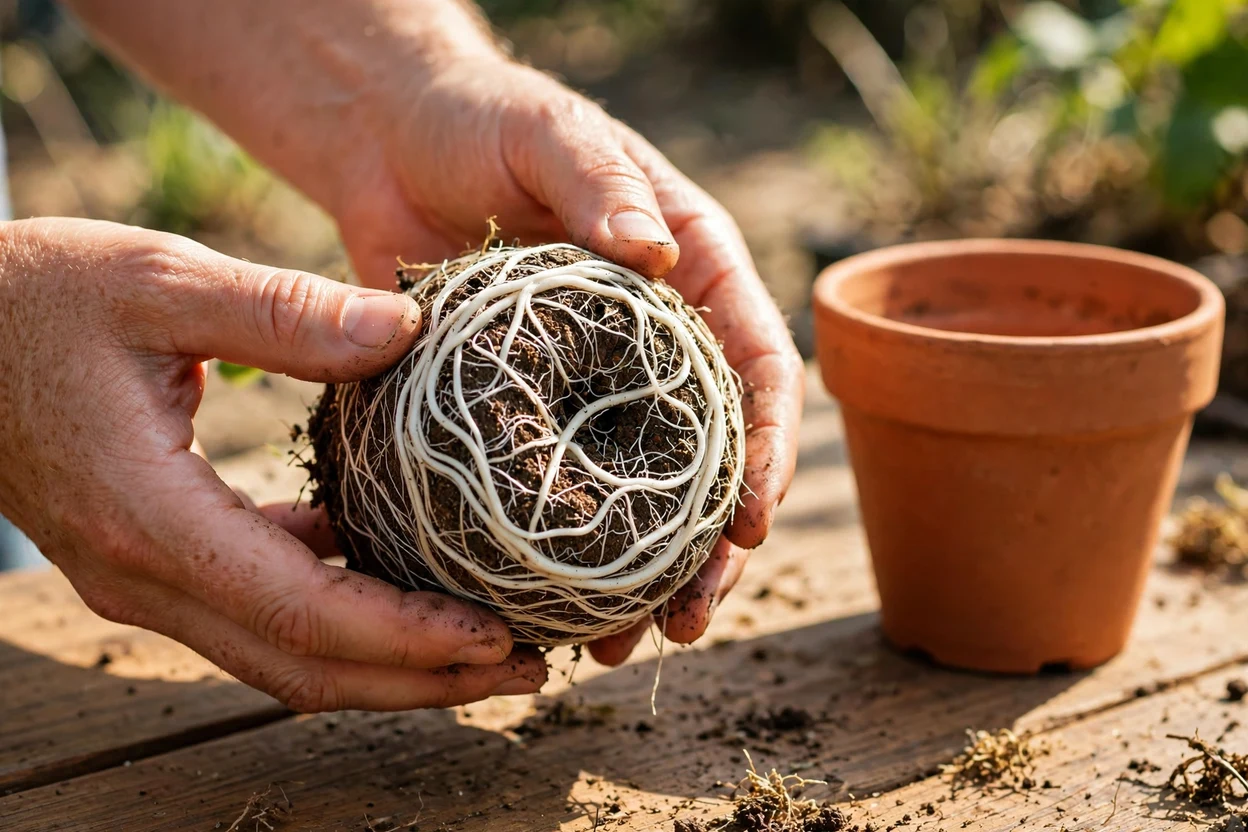
A plant needs repotting when roots circle the inside of the pot, push out of the drainage hole, or lift the plant above the rim. Watch the water, too. Mix that dries out within 2 to 3 days, or water that runs straight through the pot, points to the same need for repotting. So does growth that stalls in spring and summer despite good light.
This table compares the most common repotting signs with what each one means and the right response.
| Sign | What It Means | Action |
|---|---|---|
| Roots exit drainage hole | Roots have filled the pot | Repot in spring |
| Roots circle the surface | Plant is root-bound | Repot and loosen roots |
| Water runs straight through | Little mix left to hold water | Repot into fresh mix |
| Mix dries in 2 to 3 days | Roots outnumber potting mix | Move up one pot size |
| White crust on mix | Mineral and fertilizer salts | Refresh the mix |
| Cracked or bulging pot | Roots or rhizomes pushing outward | Repot right away |
| Mushy stems, sour smell | Likely root rot | Repot now and trim rot |
The quickest check takes about a minute. Tip the plant on its side and ease the root ball partway out of the pot. If roots cover most of the outside of the soil ball, it’s time to move the plant up to a larger pot.
Growth rate sets the schedule. Fast growers such as spider plants and pothos outgrow their pots quickly. Slower plants like jade and snake plants, along with ZZ plants, often stay put in one pot for 2 to 3 years or longer.
When Is the Best Time to Repot a Plant?
The best time to repot a plant is spring through early summer, when longer days trigger new root and leaf growth. In most temperate gardening climates, that window runs from March through June. Active growth is the advantage. Plants repotted then root into fresh mix faster and show less transplant shock than ones moved in late fall or winter.
Indoor plants respond more to day length and light intensity than to outdoor temperature. That shifts the gardening calendar by climate. In warm, sunny regions, new growth shows up earlier, so gardeners can start repotting plants in late February. In cooler regions with short spring days, waiting until April gets better results.
A plant’s own situation matters too. Give a new plant 1 to 2 weeks to adjust to its new growing conditions before repotting, unless roots are already pouring out of the nursery pot.
Skip repotting while a plant is in full bloom. Christmas cactus and African violets can drop buds when roots get disturbed mid-flower, and orchids can react the very same way. Wait until blooming ends.
Can You Repot in Winter?
Yes, but save winter repotting for emergencies, such as root rot or pests living in the mix. A cracked pot counts too. From November through February, short days slow root growth in most climates, so a plant repotted then sits in damp mix longer and faces a higher rot risk.
For a winter emergency, keep the plant in a room above 60°F (16°C), well away from cold windows and heating vents. Water lightly. Hold off on feeding until spring.
What Size Pot Should I Repot Into?
Repot into a pot 1 to 2 inches (2.5 to 5 cm) wider than the current pot for plants in containers under 10 inches (25 cm) across. Larger floor plants can step up 2 to 4 inches (5 to 10 cm). Keep the jump modest. A small increase gives roots fresh room without surrounding them in a mass of excess wet mix they can’t use yet.
This table shows common pot size upgrades for container plants, measured across the inside of the rim.
| Current Pot (in / cm) | New Pot (in / cm) | Typical Plant |
|---|---|---|
| 4 / 10 | 6 / 15 | Young spider plant |
| 6 / 15 | 8 / 20 | Tabletop snake plant |
| 8 / 20 | 10 / 25 | Mature jade plant |
| 10 / 25 | 12 to 14 / 30 to 36 | Large ZZ plant |
| 12 / 30 | 14 to 16 / 36 to 41 | Floor plants |
A pot that’s too big causes more trouble than one that’s too small. Its extra mix holds water the roots can’t reach and stays wet for days on end, creating the low-oxygen conditions that lead to root rot. Bigger isn’t kinder.
Garden pots are measured by diameter. Measure the old pot across the top before choosing a new one, so the new container ends up exactly one size larger and the root ball has just enough fresh soil around it.
Do You Need a Pot with Drainage Holes?
Yes, nearly every houseplant needs a pot with at least one drainage hole. Roots need to breathe. Without a hole, excess water collects at the bottom and starves the roots of air, so rot can set in even when the top of the mix looks dry.
Gravel won’t save a pot without holes. Neither will pot shards. Coarse material under fine potting mix actually raises the saturated zone instead of draining it, which keeps wet mix closer to the roots.
Cover the drainage hole with a square of mesh screen or a coffee filter before adding mix, so soil stays in the pot while water still drains out the bottom. Either works fine.
Terracotta vs Plastic Pots
Choose terracotta for snake, jade, and ZZ plants, and plastic for moisture-loving plants such as spider plants. Unglazed terracotta is porous, so it wicks water out of the soil and lets roots dry between waterings. Plastic holds soil moisture longer, which suits plants that like evenly damp roots.
This table matches common garden pots with the plants that grow best in them.
| Pot Type | Soil Moisture | Best For |
|---|---|---|
| Terracotta | Dries fast | Jade, snake, ZZ plants, succulents |
| Plastic | Stays moist | Spider plants, ferns |
| Self-watering | Constantly moist | Thirsty tropical plants |
What Potting Mix Should You Use?
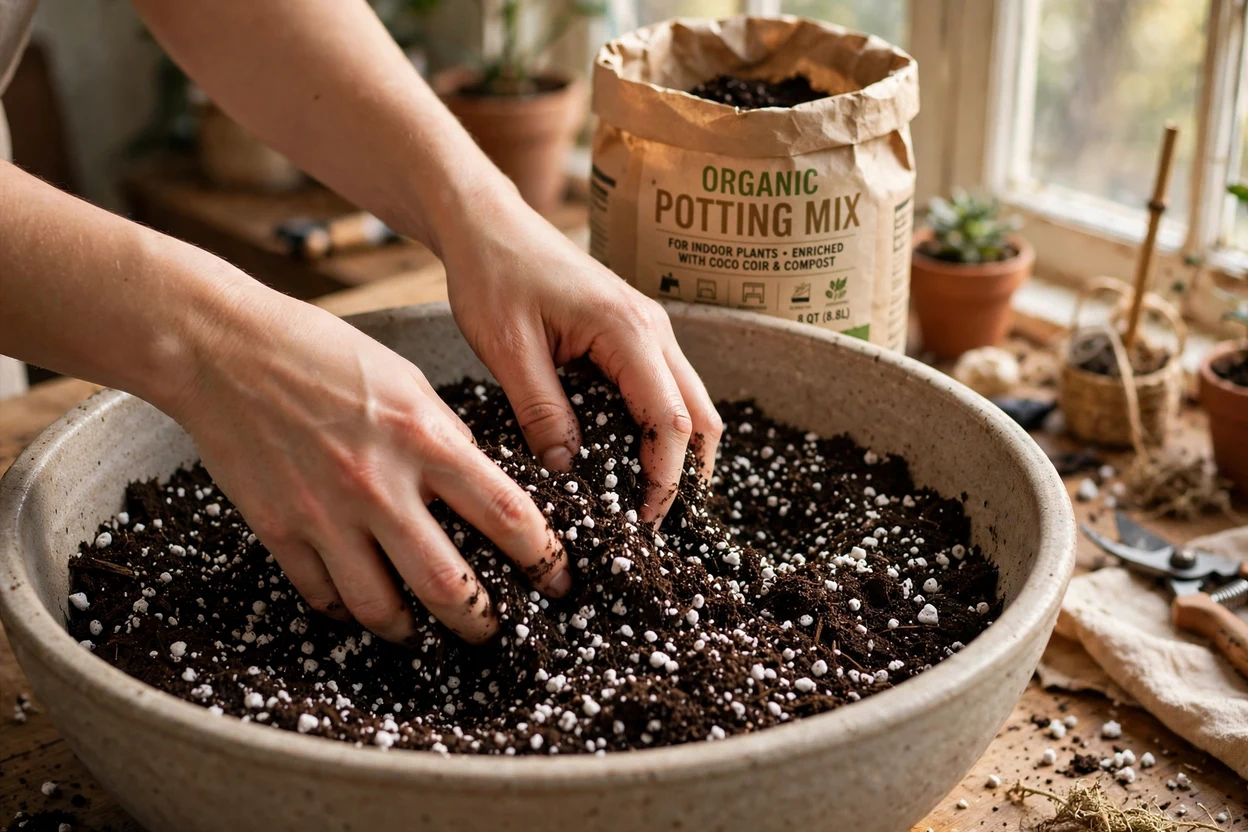
Use a bagged indoor potting mix for leafy houseplants and a cactus or succulent mix for jade, snake, and ZZ plants. Never use garden soil in containers. Garden soil compacts and drains poorly, and it can carry weed seeds, insect pests, and soilborne plant disease into your containers.
A good potting mix balances three things roots need: moisture, air, and nutrients. Most indoor mixes combine peat or coir for water retention, composted bark for structure, and perlite for drainage. Gardeners growing succulents and rhizome plants lean toward grittier mixes that dry quickly between waterings.
Perlite is the simplest upgrade. The white, lightweight volcanic material opens up air spaces and speeds drainage, and unlike peat or bark it won’t break down over time.
This table matches each plant type with a base mix and an amendment.
| Plant Type | Base Mix | Amendment |
|---|---|---|
| Leafy tropicals | Indoor potting mix | Optional handful of perlite |
| Succulents such as jade | Cactus or succulent mix | Extra perlite or pumice |
| Rhizome plants (snake, ZZ) | Cactus mix or potting mix | One-third perlite by volume |
| Aroids (pothos, monstera) | Indoor potting mix | Orchid bark and perlite |
Can I Reuse Old Potting Soil?
No, not if the plant had root rot, fungus gnats, mealybugs, or other pests living in it. Bag that mix for the trash. Keeping it out of the compost pile matters, because that’s how the problem ends up spreading to the rest of your plants.
Healthy used mix deserves a refresh. Break up the clumps and pull out old roots, then blend 1 part old mix with 2 parts fresh mix plus a handful of perlite. Save the refreshed batch for tough, established plants. New cuttings should get fresh bagged mix.
Supplies for Repotting Houseplants
Repotting houseplants takes five essentials: a pot one size larger with a drainage hole, fresh potting mix, perlite, clean pruners or scissors, and a small trowel. A few extras help. Gardening gloves and a tarp or old newspaper keep the job cleaner, and a square of mesh screen stops mix from washing out of the drainage hole.
Clean your pruners before every repotting job. Sterilizing the blades keeps you from carrying plant disease from one root system to the next.
This table lists each gardening supply and its purpose.
| Supply | Purpose |
|---|---|
| Pot with drainage hole | Gives roots fresh room |
| Potting mix | Holds water, air, and nutrients |
| Perlite | Adds drainage and air |
| Pruners or scissors | Trims dead roots |
| Trowel | Scoops and fills mix |
| Mesh screen or coffee filter | Keeps mix in the pot |
| Gardening gloves | Protects hands from sap |
How to Repot a Plant in 8 Steps
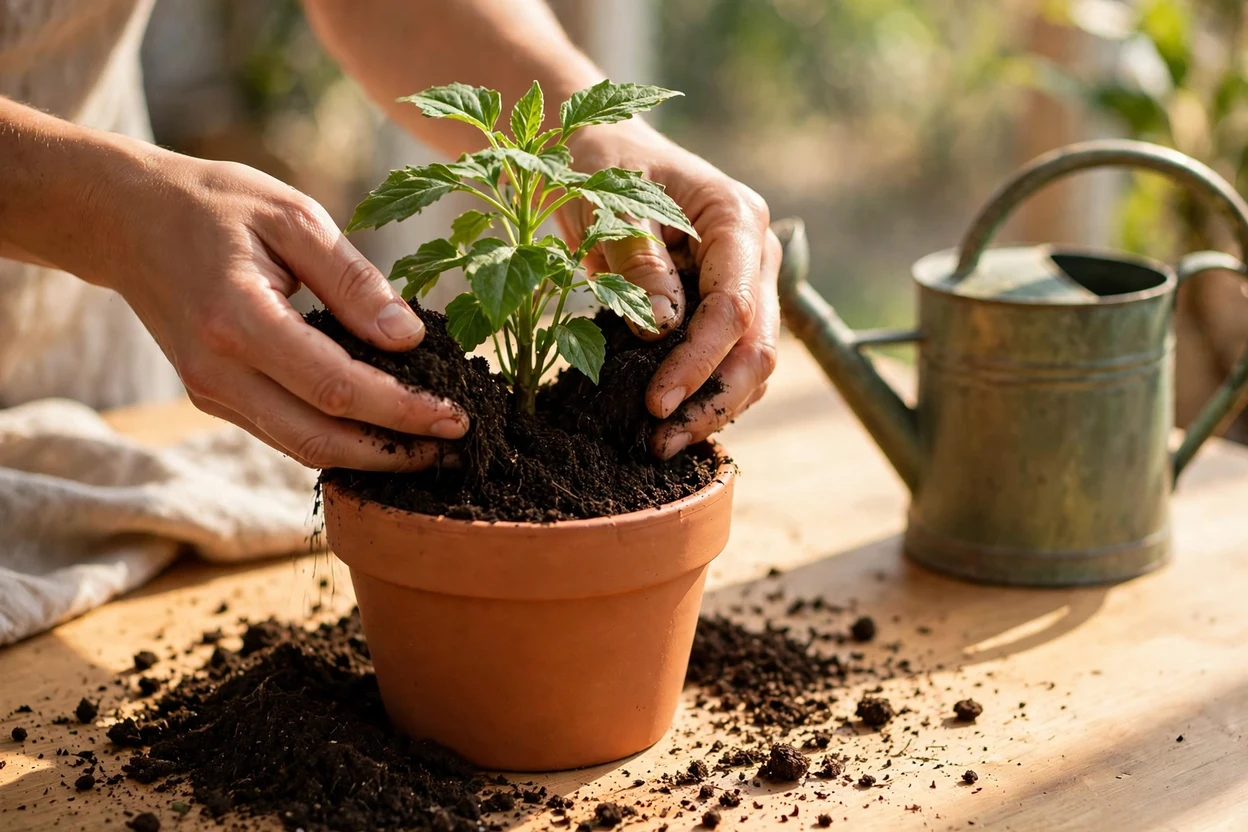
To repot a plant, water it ahead of time, slide it out of the old pot, loosen circling roots, trim dead ones, and set it at its old depth in fresh mix inside a pot 1 to 2 inches (2.5 to 5 cm) wider. Then water it in. Keep the plant out of direct sun for a week afterward.
One method covers most plants. These eight steps answer the common question “how do you repot a plant” for nearly every houseplant, from a 4-inch (10 cm) pothos to a 12-inch (30 cm) snake plant.
- Water leafy plants 1 to 2 days before repotting so the root ball slides out intact. Leave succulents such as jade dry.
- Prepare the new pot by covering the drainage hole with mesh and adding enough mix so the top of the root ball sits 1 inch (2.5 cm) below the rim.
- Remove the plant by tipping the pot sideways, supporting the base of the stems, and sliding the root ball out. Squeeze plastic pots or run a butter knife around the inside of rigid pots to free stuck roots.
- Inspect the roots. Healthy roots are firm and white, tan, or orange. Rotten roots are brown or black, mushy, and smell sour.
- Loosen circling roots with your fingers and trim any dead, mushy, or broken roots with clean pruners.
- Position the plant in the center of the new pot at the same depth it grew before. Burying stems deeper invites stem rot.
- Fill around the root ball with fresh mix, tapping the pot and pressing lightly to settle it. Do not pack the mix hard.
- Water slowly until it runs from the drainage hole, then place the plant in bright, indirect light. Wait 5 to 7 days to water succulents and rhizome plants.
Should I Break up Roots When Repotting?
Yes, loosen the roots gently, but cut only roots that are dead, mushy, or broken. Spare the healthy ones. Roots that circle the pot will keep growing in circles unless you tease them outward, and that slows the plant’s spread into fresh mix.
For a severely root-bound plant with a solid mat of roots, make 3 or 4 vertical cuts about 1/2 inch (1.3 cm) deep down the sides of the root ball with a clean knife. Then gently pull the bottom roots apart. Those cuts push new roots to branch into the fresh potting mix.
Repot, Top-Dress, or Divide: Which Is Right?
Repot when roots fill the pot and the plant still has room to grow, top-dress when a large plant is too heavy to move, and divide when a clumping plant such as a snake plant has outgrown the size you want. Each option refreshes the root zone differently.
Top-dressing suits large floor plants in pots 14 inches (36 cm) or wider. Once a year in spring, scrape away the top 1 to 2 inches (2.5 to 5 cm) of old mix and replace it with fresh mix. The plant never leaves its pot.
Dividing splits one crowded plant into several smaller ones, and every section needs its own roots plus at least one cluster of leaves or stems. Snake and spider plants divide easily, as do ZZ plants. Jade plants won’t. A jade grows from a single trunk, so propagate it from stem or leaf cuttings instead.
This table compares the three ways to refresh a potted plant.
| Method | When to Use | Best For | Pot Size Change |
|---|---|---|---|
| Repot | Roots fill the pot | Most growing houseplants | 1 to 2 in (2.5 to 5 cm) larger |
| Top-dress | Plant too heavy to lift | Large floor plants | None |
| Divide | Clump outgrew its space | Snake, spider, ZZ plants | Same size or smaller pots |
Repotting Rules for Snake, Jade, Spider, and ZZ Plants
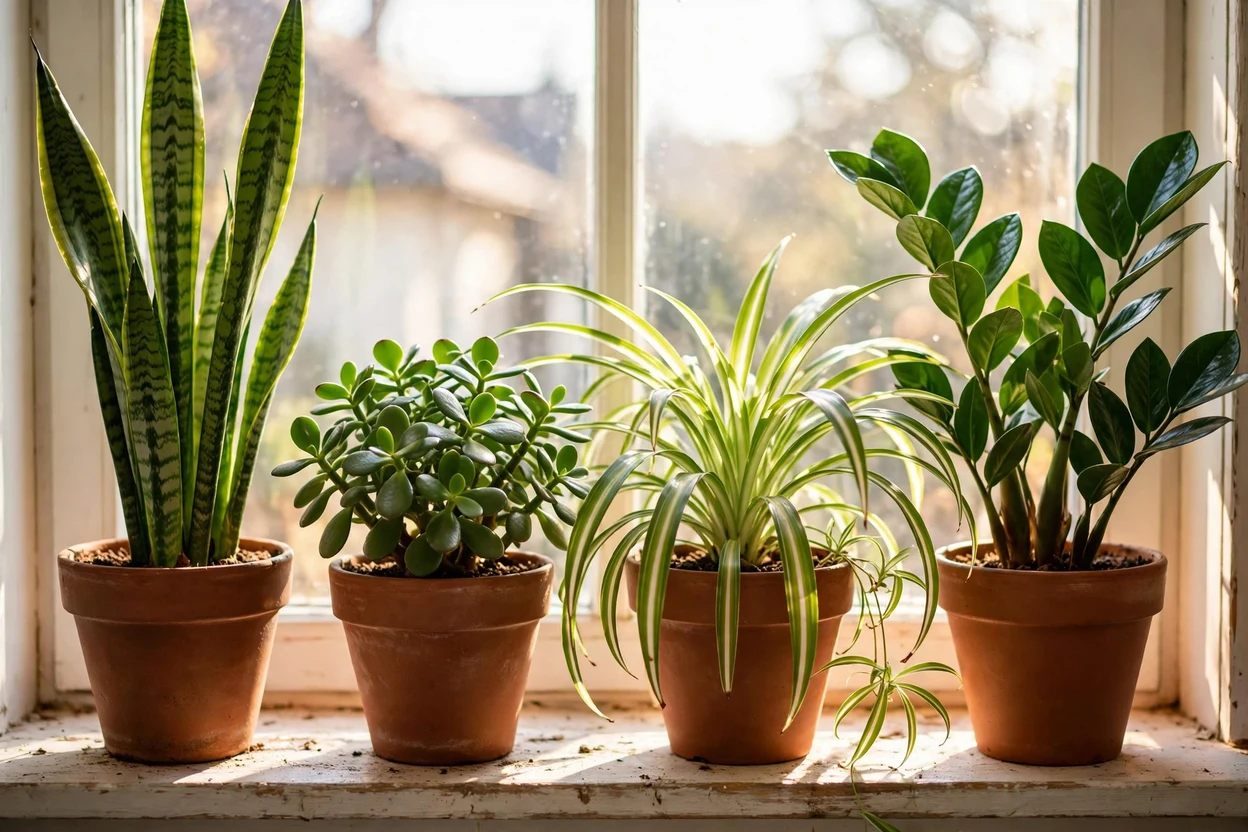
Snake, jade, and ZZ plants need fast-draining cactus-style mix, snug pots, and 5 to 7 dry days after repotting, while spider plants need regular indoor potting mix and water right away. All four popular houseplants follow the same core method for how to repot a plant, but they part ways on soil and pot material. Aftercare differs too.
This table compares repotting needs for the four plants.
| Plant | Best Mix | Best Pot | Repot Every | Water After |
|---|---|---|---|---|
| Snake plant | Cactus mix plus perlite | Terracotta with heavy base | 2 to 3 years | Wait about 1 week |
| Jade plant | Cactus or succulent mix | Wide, shallow terracotta | 2 to 3 years | Wait 5 to 7 days |
| Spider plant | Indoor potting mix | Plastic or glazed ceramic | 1 to 2 years | Water right away |
| ZZ plant | Cactus mix plus perlite | Terracotta or plastic | 2 to 3 years | Wait about 1 week |
How to Repot a Snake Plant
To repot a snake plant (Dracaena trifasciata, formerly Sansevieria trifasciata), wait until the rhizomes crowd the pot or crack its sides. Snake plants tolerate tight roots. Most need a new pot only every 2 to 3 years.
- Ease the plant out of its pot. Cut away a plastic nursery pot if the roots are wedged in.
- Shake off the old mix and check the rhizomes for soft, brown spots.
- Divide the plant, if you want more plants, by cutting through the rhizome with a clean knife. Keep roots and at least one leaf cluster on each piece.
- Plant each piece at its old depth in a terracotta pot filled with cactus mix plus perlite.
- Wait about 1 week before the first watering.
Tall snake plants topple easily. Pick a heavy terracotta or ceramic pot with a wide base, since that extra weight at the bottom is what keeps them upright.
How to Repot a Jade Plant
To repot a jade plant (Crassula ovata), let the mix dry out completely first, then move the plant in spring into a wide, shallow terracotta pot 1 to 2 inches (2.5 to 5 cm) larger. Dry roots break less. They also shed old mix easily.
- Let the mix dry fully for several days before you start.
- Lift the plant by the base of the trunk, never by the branches.
- Knock off the old mix and trim any rotten roots.
- Plant at the same depth in cactus or succulent mix with extra perlite.
- Keep the plant dry for 5 to 7 days, then water thoroughly.
Mature jade plants grow top-heavy. A wide terracotta pot keeps them from tipping over, and it dries out fast enough to protect the roots from rot.
How to Repot a Spider Plant
To repot a spider plant (Chlorophytum comosum), move it up one pot size in spring once thick white roots fill the container or push the plant upward. Spider plant roots are fleshy and store water. They crowd a pot fast. Left too long, they can even crack thin plastic.
- Squeeze the nursery pot to release the root ball.
- Divide large clumps by pulling or cutting the crowns apart.
- Pot rooted plantlets, often called spider plant babies, into 3 to 4 inch (8 to 10 cm) pots.
- Plant the main clump at its old depth in indoor potting mix.
- Water right away until water drains from the bottom.
How to Repot a ZZ Plant
To repot a ZZ plant (Zamioculcas zamiifolia), move it into a pot 1 to 2 inches (2.5 to 5 cm) wider once the potato-like rhizomes press against the sides or bend a plastic pot. Those rhizomes store water. That stored water makes ZZ plants prone to rot when they sit in soggy mix.
- Put on gloves, because ZZ plant sap can irritate skin.
- Slide the plant out, or cut away a bulging plastic pot.
- Separate rhizome clusters by hand if you want to divide the plant.
- Plant with the tops of the rhizomes just below the surface in cactus mix plus perlite.
- Wait about 1 week before watering.
Should I Water a Plant After Repotting?
Yes, water most houseplants thoroughly right after repotting so the fresh mix settles around the roots and air pockets close. Succulents and rhizome plants are the exception. Keep jade, snake, and ZZ plants dry for 5 to 7 days so any damaged roots can seal before they touch moisture.
Pour slowly at the soil line until water flows from the drainage hole. After 15 minutes, empty the saucer. Never leave the pot standing in water, since soggy mix around freshly disturbed roots is exactly what leads to rot.
Mix often sinks after the first watering. Top it up with a little fresh mix to bring it back to level, taking care not to bury the stems any deeper than before.
Is It Normal for Plants to Droop After Repotting?
Yes, mild drooping, curling, or a few yellow lower leaves after repotting is normal transplant shock, and most healthy houseplants recover within 1 to 2 weeks. Shock happens because disturbed roots absorb less water until new root tips grow into the fresh mix. Once they do, the droop lifts.
Transplant shock and root rot look different. A shocked plant goes limp but keeps firm stems. Rot is another story: stem bases turn mushy and roots go black, a sour smell develops, and the plant gets worse after watering.
Keep a recovering plant out of direct sun and away from drafts, and resist the urge to move it again. Water only when the top 1 inch (2.5 cm) of mix is dry. Extra water won’t fix drooping.
Week-By-Week Aftercare Timeline
This table outlines aftercare for the first 6 weeks after repotting.
| Week | Watering | Light and Care |
|---|---|---|
| Week 1 | Leafy plants once; succulents none | Bright, indirect light; do not move |
| Week 2 | Water when top inch (2.5 cm) is dry | Watch for firmer, perkier leaves |
| Week 3 | Return to normal schedule | Move back to usual spot |
| Week 4 | Normal schedule | Look for new growth |
| Weeks 5 to 6 | Normal schedule | Start fertilizer at half strength |
Common Repotting Mistakes to Avoid
The most common repotting mistakes are jumping more than 2 inches (5 cm) in pot size, using garden soil, burying stems deeper, and fertilizing too soon. Every one of these mistakes raises the risk of root rot or prolonged transplant shock, yet the right pot and mix plus good timing prevent them. They’re easy to avoid.
Water is the common thread. Most problems with repotting plants trace back to excess moisture sitting around roots that have just been disturbed and can’t take it up yet.
This table pairs each mistake with its result and fix.
| Mistake | Result | Fix |
|---|---|---|
| Pot far too large | Wet mix and root rot | Go up 1 to 2 in (2.5 to 5 cm) |
| No drainage hole | Waterlogged roots | Use a pot with a hole |
| Garden soil | Compaction and pests | Use bagged potting mix |
| Planting too deep | Stem rot | Keep the original soil line |
| Watering succulents immediately | Rot in damaged roots | Wait 5 to 7 days |
| Fertilizing right away | Burned new roots | Wait 4 to 6 weeks |
| Repotting in winter | Slow recovery | Wait for spring |
Frequently Asked Questions
How Long Does Repotting Take?
A single tabletop plant takes about 15 to 30 minutes from unpotting to watering. Big jobs run longer. Large floor plants, or plants you’re dividing, can take an hour when the roots are wedged tightly into the old container.
How Often Should Houseplants Be Repotted?
Fast growers such as spider plants and pothos usually need fresh mix every 1 to 2 years. Slow growers can wait. Jade and snake plants, and ZZ plants as well, can stay in one container for 2 to 3 years or longer.
Do Snake Plants Like to Be Root-Bound?
Yes, snake plants grow well in snug pots and dislike excess mix around their roots. Don’t rush a move. Step one up a size only when the rhizomes bend or crack the pot, or when they leave almost no room for mix.
Can You Divide a Plant While Repotting?
Yes, repotting is the best time to divide clumping plants. Snake plants, spider plants, and ZZ plants can be split into sections, each with healthy roots and leaves, then planted in their own pots of fresh potting soil to grow on as new plants.
Should I Fertilize After Repotting?
No, wait 4 to 6 weeks. Many bagged mixes already include starter fertilizer, and the tender new roots that form after repotting burn easily under extra feeding. Then use a balanced houseplant fertilizer at half strength.
Conclusion
Knowing how to repot a plant turns a stressful chore into a simple spring gardening routine. Mark each repotting date on a plant label or in a garden journal, then check the roots every March, before the growing season speeds up. Circling roots mean a pot one size up. Large plants just need fresh top-dressing. Crowded snake and spider plants, along with packed ZZ plants, turn into brand-new plants through division. Don’t skip the basics. A drainage hole and the right mix, followed by patient aftercare, send every repotted plant into the summer growing season with healthy roots, fresh soil, and room to grow.