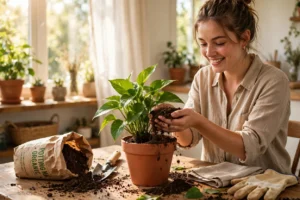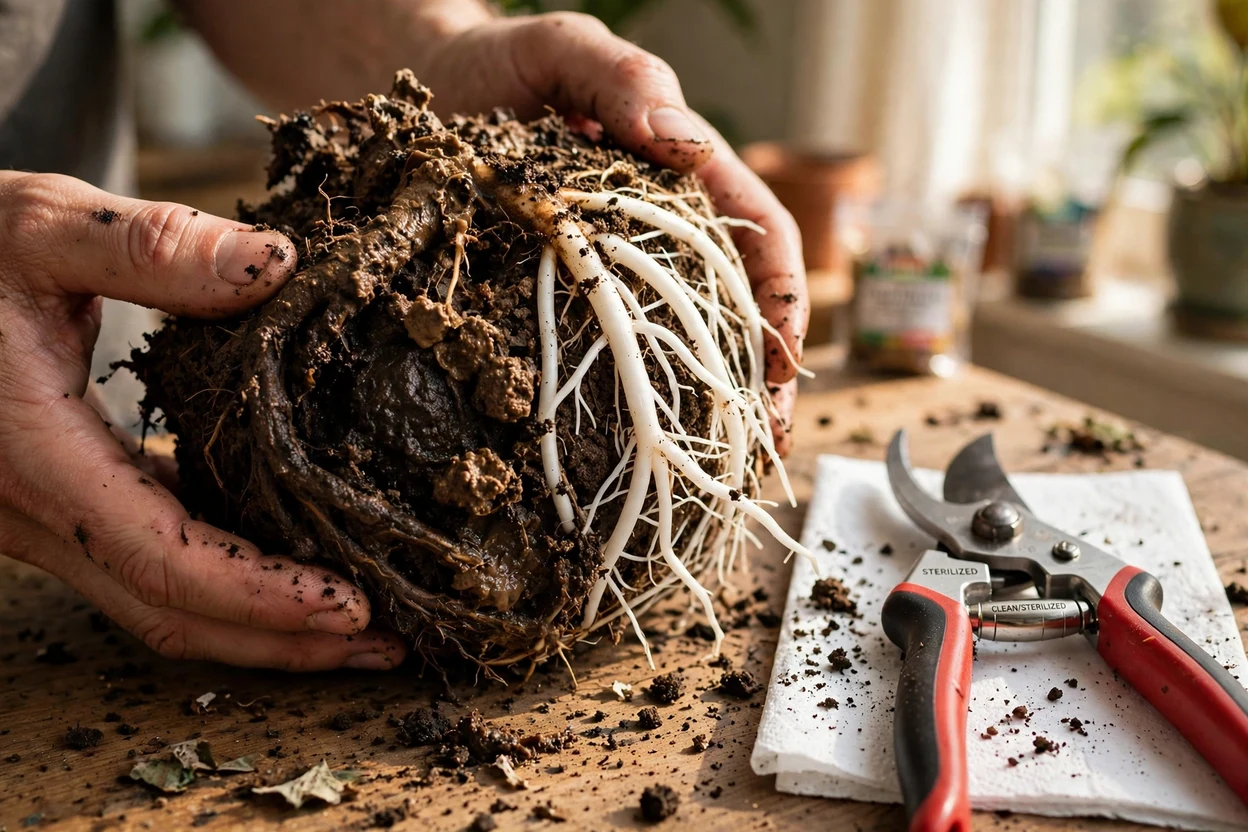
To fix root rot, remove the plant from its pot, cut away every brown, mushy root with sterilized shears, and repot the healthy roots in fresh, well-draining potting mix. Wait to water again until the top 1 to 2 inches (2.5 to 5 cm) of soil feel dry. Outdoor plants need drainage fixes, not repotting.
Key Takeaways
- Root rot starts when waterlogged soil starves roots of oxygen. Water molds and fungi then invade the weakened roots.
- Healthy roots are white or tan and firm. Rotten roots are brown or black, mushy and smell foul.
- A plant with more than half of its roots still healthy has strong odds of recovery after trimming and repotting.
- Repotting is mandatory when the pot has no drainage hole, the soil smells sour or the stem base is soft.
- Outdoor root rot is fixed mainly by improving drainage. Fungicides alone don’t solve it.
- Rotten roots never heal, but a treated plant can grow new roots and fully recover.
What Is Root Rot?
Root rot is a plant disease that destroys roots when waterlogged soil cuts off oxygen and lets soilborne water molds and fungi such as Pythium, Phytophthora, Rhizoctonia and Fusarium attack the weakened tissue. Damaged roots stop absorbing water and nutrients. The plant then wilts and yellows even while the soil stays wet.
Learning how to fix root rot starts with one fact: roots need oxygen as much as they need water. Soggy soil drowns them. When soil stays wet for days, water fills the air pockets around each root and the tissue starts to suffocate.
Root rot strikes houseplants, garden vegetables, shrubs and mature trees across the United States. Pots raise the stakes. Container plants are especially vulnerable indoors, because a pot without a drainage hole gives excess water nowhere to go at all.
Is It Fungus or Overwatering?
Root rot is both. Overwatering sets the stage, and pathogens do the actual damage. Waterlogged soil turns anaerobic, which means it holds too little oxygen to keep living roots going, and the starved root cells weaken and die.
That’s when Pythium and Phytophthora move in. Both are oomycetes, better known as water molds. Though they look and act like fungi, these organisms belong to a separate group, and their spores swim through wet soil to reach the roots.
True fungi cause root rot too, with Rhizoctonia and Fusarium often hitting seedlings and vegetables. The takeaway is simple. No product can fix root rot as long as the soil around the roots stays waterlogged and short on the oxygen they need.
Common Root Rot Pathogens
This table compares the five pathogens most often behind root rot in US homes and gardens.
| Pathogen | Type | Typical Hosts | Key Sign |
|---|---|---|---|
| Pythium | Water mold | Houseplants, seedlings | Root outer layer slips off |
| Phytophthora | Water mold | Shrubs, trees, rhododendrons | Reddish-brown tissue at crown |
| Rhizoctonia | Fungus | Seedlings, vegetables, turf | Dry brown lesions at soil line |
| Fusarium | Fungus | Vegetables, bulbs | Brown streaks, crown rot |
| Armillaria | Fungus | Oaks, fruit trees, conifers | White fungal fans under bark |
How to Identify Root Rot
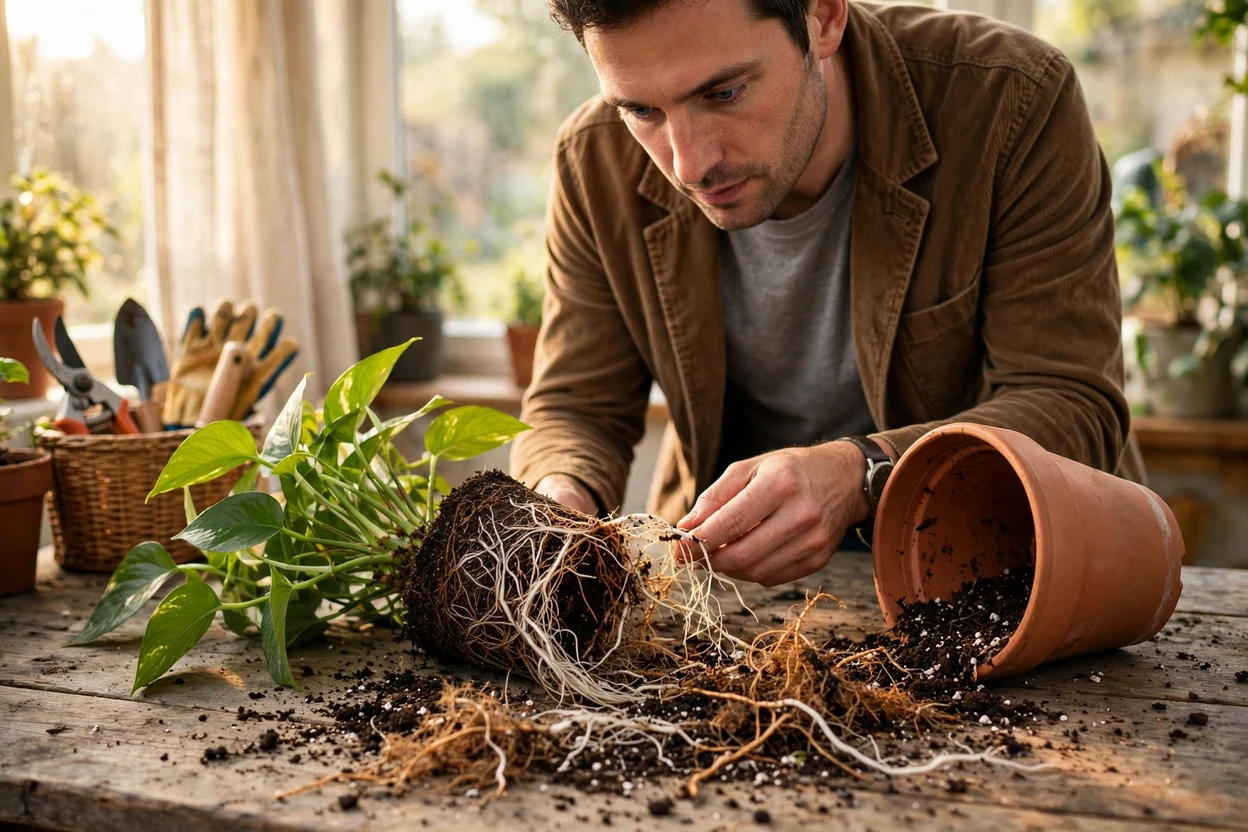
To identify root rot, unpot the plant and inspect the roots: brown or black, mushy roots that smell foul confirm it. Above the soil, yellowing lower leaves and wilting despite wet soil are the usual warnings. A soft, dark stem base at the soil line points the same way. Only a root check confirms root rot.
Above-Ground Symptoms
These symptoms suggest root rot, though several other plant problems can produce exactly the same signs above the soil line. Treat them as clues, not proof. Check the roots to be sure.
- Yellowing lower leaves that drop easily
- Wilting or drooping even though the soil is wet
- Brown, soft patches spreading on leaves
- A dark, mushy stem base at the soil line
- A sour or rotten-egg smell from the soil
- Fungus gnats hovering over constantly damp soil
- Stalled growth during spring and summer
Wet-soil wilting is the clearest clue. Thirsty plants droop only once the soil dries out. A plant with root rot droops in wet soil, because its dead roots can’t move water up to the leaves anymore.
What Healthy Roots Look Like
Healthy roots feel firm and run from white to light tan. They smell like clean earth. Some plants, such as dracaenas, grow naturally orange roots, so judge them by texture and smell rather than by color alone.
This table compares healthy roots with roots damaged by rot.
| Feature | Healthy Roots | Rotten Roots |
|---|---|---|
| Color | White, cream or light tan | Brown, black or gray |
| Texture | Firm and springy | Soft, mushy or slimy |
| Smell | Earthy or none | Sour, foul or rotten |
| Outer Layer | Stays attached when tugged | Slides off, leaving a thin string |
| Root Tips | Pale and growing | Dark or missing |
Not sure about a root? Try the tug test. Pinch it gently and pull, and if the outer sheath slides away to leave a thin, stringy core behind, that root is dead.
Can This Plant Be Saved?
Yes, many plants with root rot can be saved if at least a quarter of the roots are still firm and white, or if the stem above the soil is still firm enough to take cuttings. Root count decides the next step. A plant with plenty of white roots gets repotted, while one with very few is better propagated from cuttings or thrown out.
This table maps root condition to the action most likely to save the plant.
| Healthy Roots (%) | Root Condition | Smell | Best Action |
|---|---|---|---|
| Over 50 | A few soft tips or patches | Earthy | Trim and repot |
| 25 to 50 | Large brown, mushy sections | Sour | Trim hard, repot in smaller pot |
| Under 25 | Mostly black and slimy | Foul | Propagate stem cuttings |
| 0, stem soft | Rot has reached the crown | Foul | Discard and sanitize pot |
These percentages come from hands-on plant care, not research. They’re working thresholds. A plant in the 25 to 50 percent range is worth the effort, but starting a few cuttings at the same time gives you insurance if the parent plant fails anyway.
How to Fix Root Rot in Indoor Plants
Fix root rot in indoor plants by unpotting the plant, rinsing the roots, cutting off every soft or dark root with sterilized shears and repotting into fresh, well-draining mix in a pot with drainage holes. Pothos, snake plants, peace lilies and Monstera all respond to this same method. Only the soil mix varies.
Supplies You Need
Gather these supplies before treating root rot, so the roots spend as little time exposed to the air as possible. Speed helps.
- Pruning shears or sharp scissors
- 70% isopropyl alcohol
- Fresh bagged potting mix
- Perlite or orchid bark for extra drainage
- A clean pot with at least one drainage hole
- Paper towels and a bucket of room-temperature water
- Optional: 3% hydrogen peroxide or a fungicide labeled for root rot
Home Depot, Lowe’s, Walmart and independent garden centers across the USA stock perlite and potting mix. They carry terracotta pots too.
Step-By-Step Repotting Method
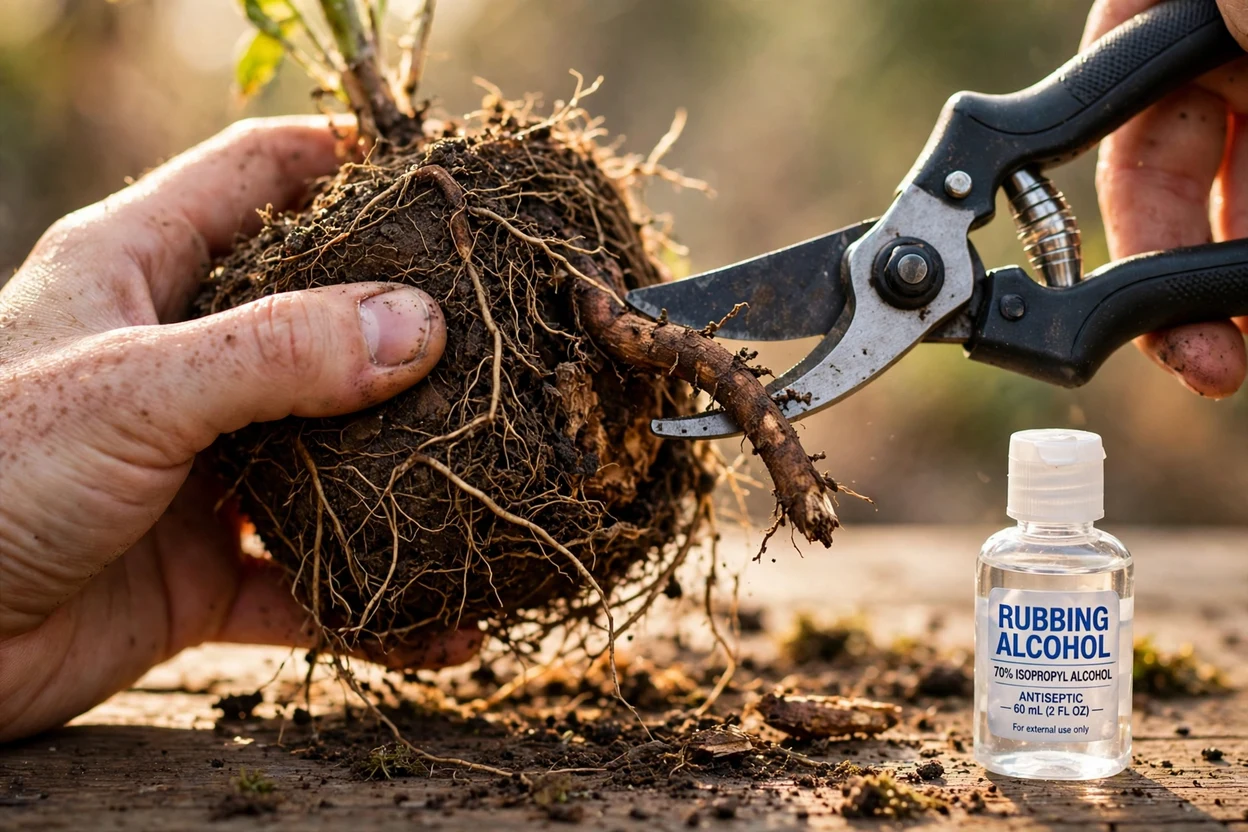
Work through these steps in order. The method suits most houseplants, no matter how big the plant or how old the pot happens to be.
- Sterilize your shears by wiping the blades with 70% isopropyl alcohol.
- Remove the plant from the pot by tipping it sideways, squeezing or tapping the pot and sliding the root ball out. Cut through a plastic nursery pot if the roots cling to the walls.
- Rinse the old soil off the roots under a gentle stream of room-temperature water so every root is visible.
- Trim away the rotten roots, cutting about 1 inch (2.5 cm) into healthy tissue above each damaged section.
- Wipe the blades with alcohol again after every few cuts to avoid spreading pathogens.
- Cut back some foliage if you removed more than a third of the roots, so the smaller root system supports fewer leaves.
- Rinse the trimmed roots in diluted hydrogen peroxide or a labeled fungicide if you choose to use one.
- Choose a pot no more than 1 to 2 inches (2.5 to 5 cm) wider than the remaining root mass, with drainage holes.
- Repot in fresh potting soil mixed with perlite, keeping the stem at its original soil depth.
- Water the plant lightly once, let it drain completely and empty the saucer.
- Place the plant in bright, indirect light away from cold drafts, and skip fertilizer until new growth appears.
Skip the old soil entirely. Used mix still carries the pathogens and the poor structure that caused the rot, so a rescued plant goes straight back into trouble if it returns there.
Does Hydrogen Peroxide Cure Root Rot?
No, hydrogen peroxide does not cure root rot by itself, because it cannot revive dead roots or fix the soggy conditions that caused the rot. A diluted 3% solution can rinse trimmed roots before repotting. Removing rotten tissue and improving drainage do the real work. Hydrogen peroxide is a helper, nothing more.
Hydrogen peroxide breaks down into water and oxygen. That’s its appeal. University Extension guidance on root rot centers on drainage and sanitation, and it treats removing infected tissue as equally important. No verified research figure is available showing that hydrogen peroxide cures established root rot.
Safe Dilution for Roots
Stick to the 3% hydrogen peroxide sold in brown bottles at pharmacies such as CVS and Walgreens. Nothing stronger. Mix 1 part 3% hydrogen peroxide with 2 parts water, a ratio widely used by houseplant growers, and dip or rinse the trimmed roots for a few minutes before repotting.
This table compares common hydrogen peroxide strengths and whether each is safe for roots.
| Product | Strength (%) | Root Use |
|---|---|---|
| Drugstore hydrogen peroxide | 3 | Dilute 1:2 with water first |
| Diluted drugstore solution | About 1 | Safe rinse for trimmed roots |
| Food-grade hydrogen peroxide | 35 | Unsafe, burns skin and roots |
Food-grade 35% hydrogen peroxide is a hazardous chemical that burns skin and roots, so it has no business anywhere near a houseplant. Leave it on the shelf.
Cinnamon and Other Home Remedies
Many growers dust cinnamon on cut roots because of its reputation as a natural antifungal. Evidence is another matter. No verified evidence shows that cinnamon cures root rot, so treat it as an optional extra and never as the actual fix.
Activated charcoal and chamomile tea draw fans for the same reason, yet the evidence behind both is just as thin as it is for cinnamon. They’re extras. None of them replaces trimming rotten roots and fixing drainage.
Can You Fix Root Rot Without Repotting?
Yes, mild root rot can be fixed without repotting if the pot has drainage holes, the soil smells earthy and only the lower leaves show yellowing. The fix is simple. Stop watering and get air moving through the soil. Wait for the top 2 inches (5 cm) to dry fully before watering again.
These steps show how to fix root rot without repotting the plant:
- Stop watering immediately.
- Remove any decorative outer pot or saucer that is holding water.
- Tip the pot sideways for a few minutes to drain trapped water.
- Poke 4 to 6 holes into the soil with a chopstick or wooden skewer to let air reach the roots.
- Move the plant to a warmer, brighter spot with good air circulation.
- Let the top 2 inches (5 cm) of soil dry, testing with your finger or a soil moisture meter.
- Resume watering slowly, giving smaller amounts and checking moisture first each time.
Keep a close eye on the plant for the next few weeks. Look for two warning signs. If yellowing spreads or the stem softens, trim the rotten roots and repot the plant in fresh mix right away.
When Is Repotting Mandatory?
Repotting is mandatory whenever the rot is severe or the container itself causes the problem, because no amount of drying fixes either one. Don’t wait. Unpot the plant right away if any of these apply:
- The pot has no drainage hole
- The soil smells sour, foul or like rotten eggs
- The stem base is soft, dark or mushy
- The soil stays soggy for more than a week after watering
- Yellowing spreads to new leaves after the soil dries
- Roots poking from the drainage holes look brown or black
How to Save a Monstera with Root Rot
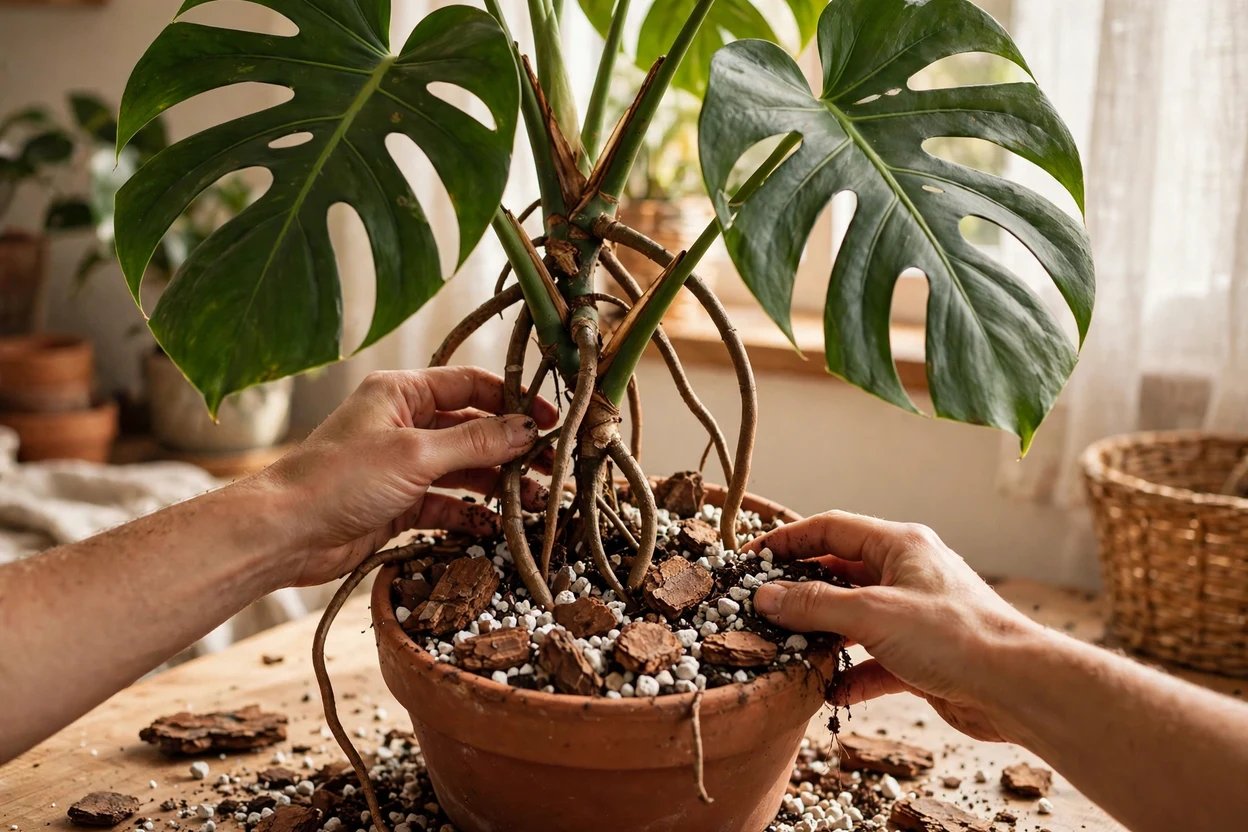
Save a Monstera deliciosa with root rot by unpotting it, cutting away every mushy root, keeping firm aerial roots and repotting into a chunky aroid mix of potting soil, orchid bark and perlite. A soft Monstera stem changes the plan. Take cuttings with at least one node from any firm section and root them in water.
Monstera root rot usually traces back to watering habits and pot choice. An oversized pot is a frequent culprit, since it holds extra wet soil that a Monstera’s roots can’t use. Holeless decorative pots do too. So does watering on a schedule instead of by soil moisture.
Spare the thick aerial roots. They’re healthy unless they look shriveled or mushy, and once the plant is repotted they often turn into brand-new soil roots.
A common Monstera mix blends potting soil and orchid bark in roughly equal parts, with the same share of perlite added. That chunky texture drains fast. It also lets air reach the roots.
Propagating a Rotting Monstera
Yes, a rotting Monstera can be propagated. The stem just needs firm sections with nodes. A node is the bump on the stem where a leaf and an aerial root emerge, and it’s the only place new roots will grow.
- Sterilize a sharp knife or shears with 70% isopropyl alcohol.
- Cut the stem into sections, each with at least one node and one leaf.
- Remove any soft or discolored tissue until the cut surface is clean and firm.
- Place each cutting in a glass of room-temperature water with the node submerged.
- Change the water every few days to keep it clear.
- Pot the cutting in fresh aroid mix once the new roots reach 2 to 3 inches (5 to 8 cm).
How to Fix Root Rot in Outdoor Plants
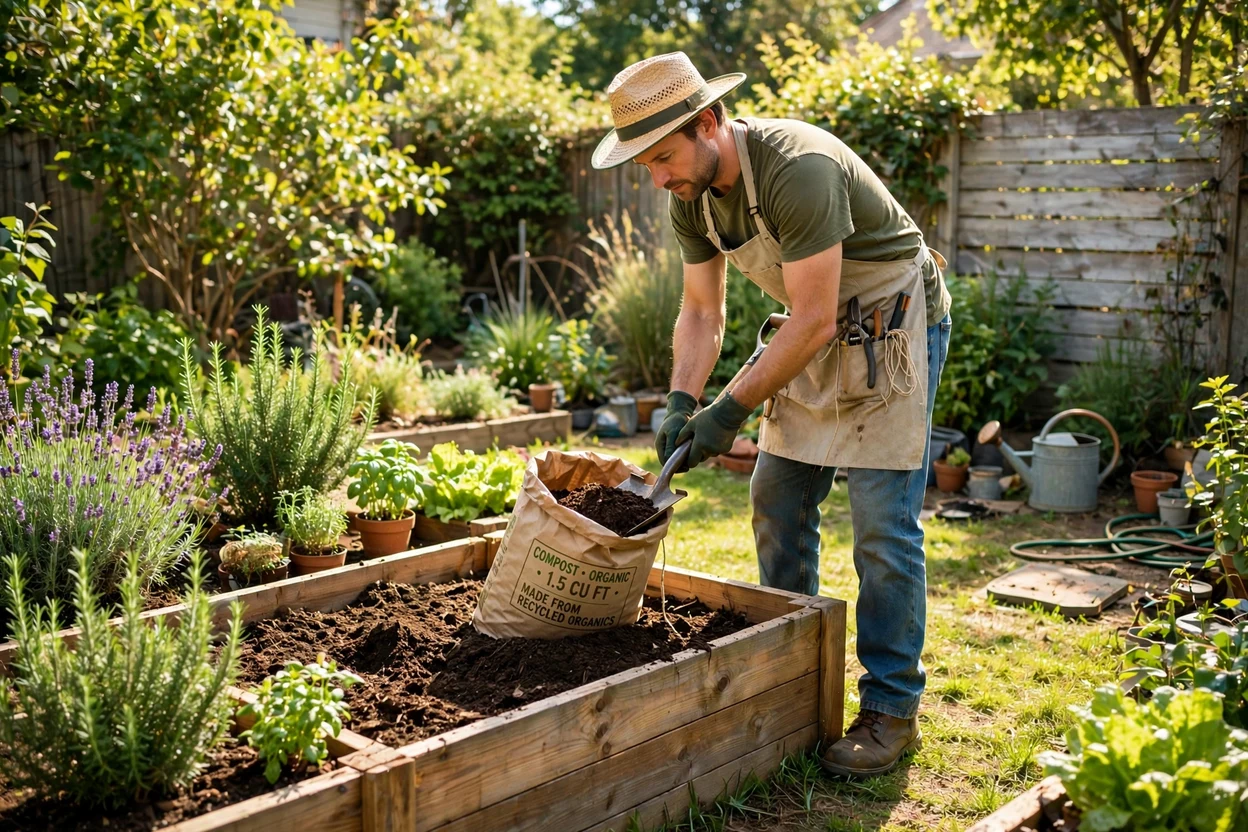
Fix root rot in outdoor plants by removing badly infected plants, improving drainage with raised beds or wide soil amendment, redirecting runoff and replanting with species suited to wet ground. Fungicides only protect healthy roots. That makes drainage changes the main root rot treatment for shrubs, perennials, vegetables and trees.
Outdoor root rot starts in the soil. Heavy clay, compacted ground, low spots and downspouts that dump water near plants keep roots wet for days after rain.
The United States Department of Agriculture (USDA) Plant Hardiness Zone Map shows which plants survive your winters, but it doesn’t measure rainfall or drainage. That gap matters. A Zone 8 garden in the rainy Pacific Northwest and a Zone 8 garden in dry west Texas face very different root rot risk.
Local help is close by. Your county Cooperative Extension office is the best resource, and many state Extension services run plant disease diagnostic labs that can confirm which pathogen is in a root or soil sample.
Shrubs, Perennials and Vegetables in Clay Soil
Before replanting a spot where a plant died of root rot, test how fast the ground drains with a simple percolation check. Here’s how.
- Dig a hole about 12 inches (30 cm) deep and fill it with water.
- Let it drain completely, then fill it again.
- Measure how far the water level drops in one hour.
- Treat the spot as poorly drained if the water drops less than 1 inch (2.5 cm) per hour.
Fix poorly drained beds with these changes:
- Build raised beds 8 to 12 inches (20 to 30 cm) tall, filled with a blend of soil and compost.
- Amend the whole bed with compost instead of only the planting hole, because an amended hole in clay collects water like a bathtub.
- Plant shrubs with the top of the root ball slightly above the surrounding grade.
- Redirect downspouts and sump pump lines away from beds.
- Keep mulch 2 to 3 inches (5 to 8 cm) deep, and pull it back several inches from stems and trunks.
- Bag and remove infected vegetable plants rather than composting them.
- Rotate vegetable crops so the same plant family does not grow in the same bed each year.
Some spots never drain well. In those places, pick plants that actually tolerate wet ground, such as river birch, red maple, swamp milkweed and many sedges.
Root Rot in Trees and When to Call an Arborist
Tree root rot shows up as thinning canopies, branch dieback, smaller leaves, mushrooms at the base of the trunk, and cracked or oozing bark near the soil line. Armillaria has its own calling cards. It often produces clusters of honey-colored mushrooms at the base in fall and white, fan-shaped fungal growth under the bark.
No home treatment cures Armillaria root rot. The standard response is to remove the infected tree, pulling out as many of its large roots as you possibly can along with the trunk.
Call an International Society of Arboriculture (ISA) Certified Arborist when a tree shows root rot signs and stands near a house, driveway, power line or play area. Rotted roots weaken anchorage. A tree with root rot can fall without warning.
Fungicides Labeled for Root Rot
Fungicides shield healthy roots from new infection. No root rot treatment brings dead roots back. Under the Federal Insecticide, Fungicide, and Rodenticide Act (FIFRA), the product label is a legal document, so apply each product only to the plants and pathogens it lists.
This table compares common fungicide active ingredients used against root rot in the USA.
| Active Ingredient | Targets | Best Use | Limit |
|---|---|---|---|
| Mefenoxam | Pythium, Phytophthora | Preventive soil drench | No effect on true fungi |
| Potassium phosphite | Phytophthora, Pythium | Trees and shrubs | Suppresses, does not cure |
| Thiophanate-methyl | Rhizoctonia, Fusarium | Ornamentals and nursery plants | No effect on water molds |
| Any fungicide | Armillaria | N/A | No labeled cure available |
Availability is another hurdle. Many fungicides containing these ingredients are sold mainly to professional growers, and your county Extension office can tell you which ones are registered for use in your state.
Should You Water After Treating Root Rot?
Yes, most treated houseplants need one light watering right after repotting to settle the fresh mix, then no more water until the top 1 to 2 inches (2.5 to 5 cm) of soil dry out. Snake plants and succulents are the exception. They should wait a few days before that first drink.
Check moisture before every watering for the first month, using either a finger test or an inexpensive soil moisture meter. Push a finger into the soil to the second knuckle, about 2 inches (5 cm). Damp soil means wait.
Drying time depends on light, temperature, humidity and pot material. The range is wide. Terracotta in a sunny window dries within days, while plastic in a dim corner can stay wet for well over a week.
When watering day finally comes, soak the pot thoroughly until water runs freely from the drainage holes at the bottom. Empty the saucer within 15 minutes. Roots should never sit in standing water.
Can Root Rot Be Reversed?
No, root rot cannot be reversed in the roots it has already killed, because brown, mushy tissue never turns healthy again. The plant itself can still recover. It grows new white roots once the rotten parts are removed and the soil drains well.
Recovery has no fixed clock. Recovery time hinges on the species and the amount of healthy root left, plus the light and temperature around the plant. No verified figure is available for a standard recovery period.
Firm stems are a good sign. So is a stop to new yellow leaves. A gentle check may also reveal new white root tips, and since fresh leaves usually follow root growth, give the plant time before judging the result.
Season matters too. Plants bounce back faster in spring and summer, when most houseplants grow actively, while a plant treated in winter may show no change for weeks before new growth appears.
How to Prevent Root Rot
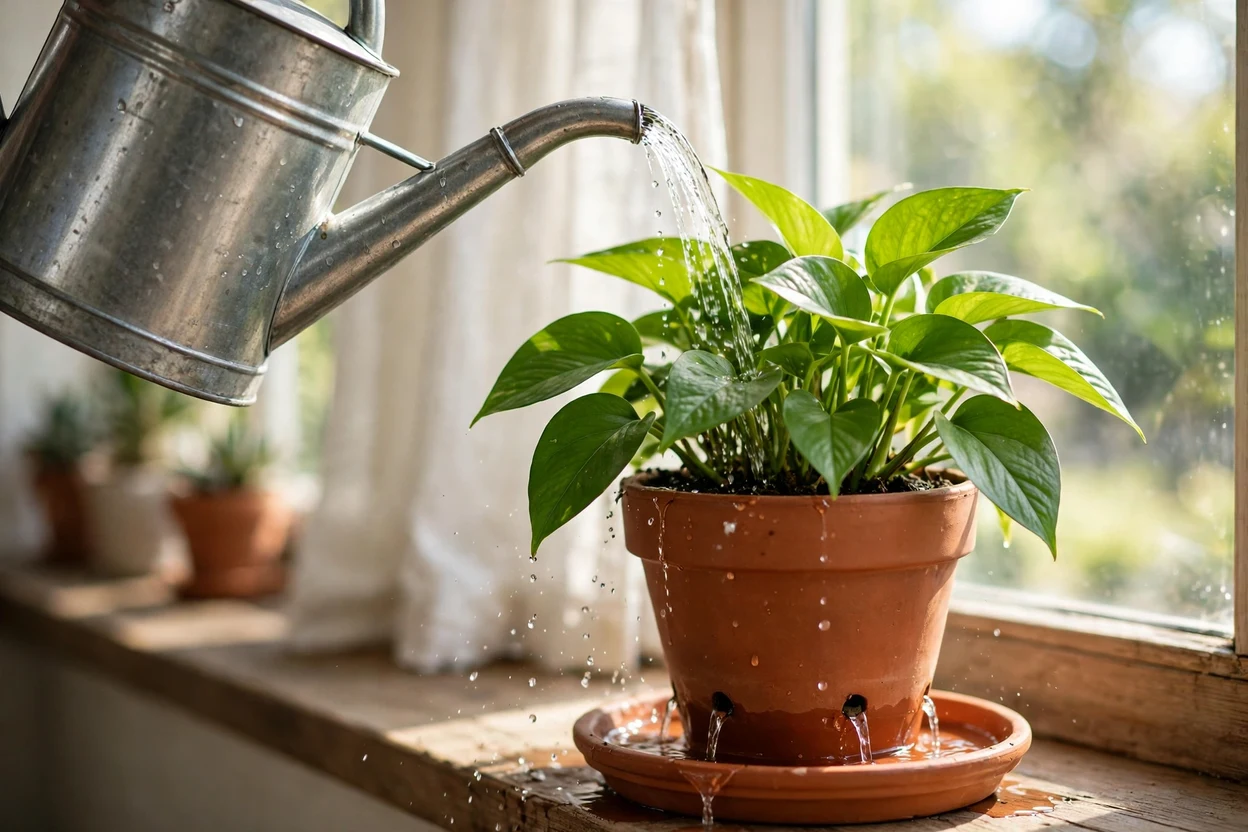
Prevent root rot by using pots with drainage holes, planting in well-draining soil, watering only when the top 1 to 2 inches (2.5 to 5 cm) are dry and never letting pots sit in standing water. Outdoor beds follow the same logic. Plant in raised beds or amended soil where water drains within hours, not days.
Build these habits into your routine:
- Choose pots with at least one drainage hole for every plant.
- Use decorative pots without holes only as outer covers, and empty them after each watering.
- Water by soil moisture, not by the calendar.
- Match pot size to root size, moving up only 1 to 2 inches (2.5 to 5 cm) at each repot.
- Add perlite or orchid bark to potting mix for plants that dislike wet roots.
- Reduce watering in fall and winter, when growth slows and days are shorter.
- Check the roots of new plants from stores, since overwatered nursery plants sometimes arrive with early rot.
Pots and Soil That Reduce Risk
This table compares common pot and soil choices by drying speed and root rot risk.
| Option | Drying Speed | Root Rot Risk | Best For |
|---|---|---|---|
| Terracotta pot | Fast | Low | Snake plants, succulents, cacti |
| Plastic pot with holes | Moderate | Moderate | Pothos, ferns, peace lilies |
| Glazed pot without holes | Very slow | High | Outer cover only |
| Self-watering pot | Stays moist | High for dry-lovers | Ferns, moisture lovers |
| Potting mix plus perlite | Moderate | Low | Most houseplants |
| Chunky aroid mix | Fast | Low | Monstera, philodendron, anthurium |
| Cactus and succulent mix | Fast | Low | Snake plants, succulents |
Frequently Asked Questions
Can Root Rot Spread to Other Plants?
Yes. Water molds travel through contaminated soil and runoff water, and shared saucers or trays carry them from pot to pot. Keep the sick plant isolated. Never reuse its drainage water, and wash your tools in hot, soapy water after every use.
Can You Reuse the Old Pot and Soil?
Yes for the pot, no for the soil. Scrub the pot with hot, soapy water, then soak it for 10 minutes in 1 part bleach to 9 parts water before rinsing it well. Throw the old soil away.
Can Snake Plants Recover from Root Rot?
Yes, snake plants recover if firm rhizomes or healthy leaves remain. Trim away the rotten roots and let the cuts dry for a day or two before repotting the plant in cactus mix. Firm leaf sections also root as cuttings.
Is Root Rot the Same as Crown Rot?
No. Root rot attacks roots below ground, while crown rot strikes the base of the plant where the stem meets the soil line. The same water molds often cause both. Crown rot usually kills a plant faster.
Do Self-Watering Pots Cause Root Rot?
No, self-watering pots don’t cause root rot by themselves, but they raise the risk for plants that prefer to dry out between drinks. Let the reservoir run empty between fills. Snake plants and cacti shouldn’t go in them at all, and neither should other succulents.
Conclusion
Every plant that survives root rot teaches one lesson. Roots need air as much as water. Knowing how to fix root rot helps you save a struggling plant today, and the habits behind the fix stop the problem from returning.
Make a soil moisture meter or the finger test part of every watering. Drainage holes are non-negotiable. Give each plant a pot that has them and a soil mix suited to its species, and outdoors, test drainage before planting and build raised beds wherever water lingers after rain.
Local help matters. As wet seasons shift across many US regions, your county Cooperative Extension office remains the most reliable local guide for diagnosis and treatment.