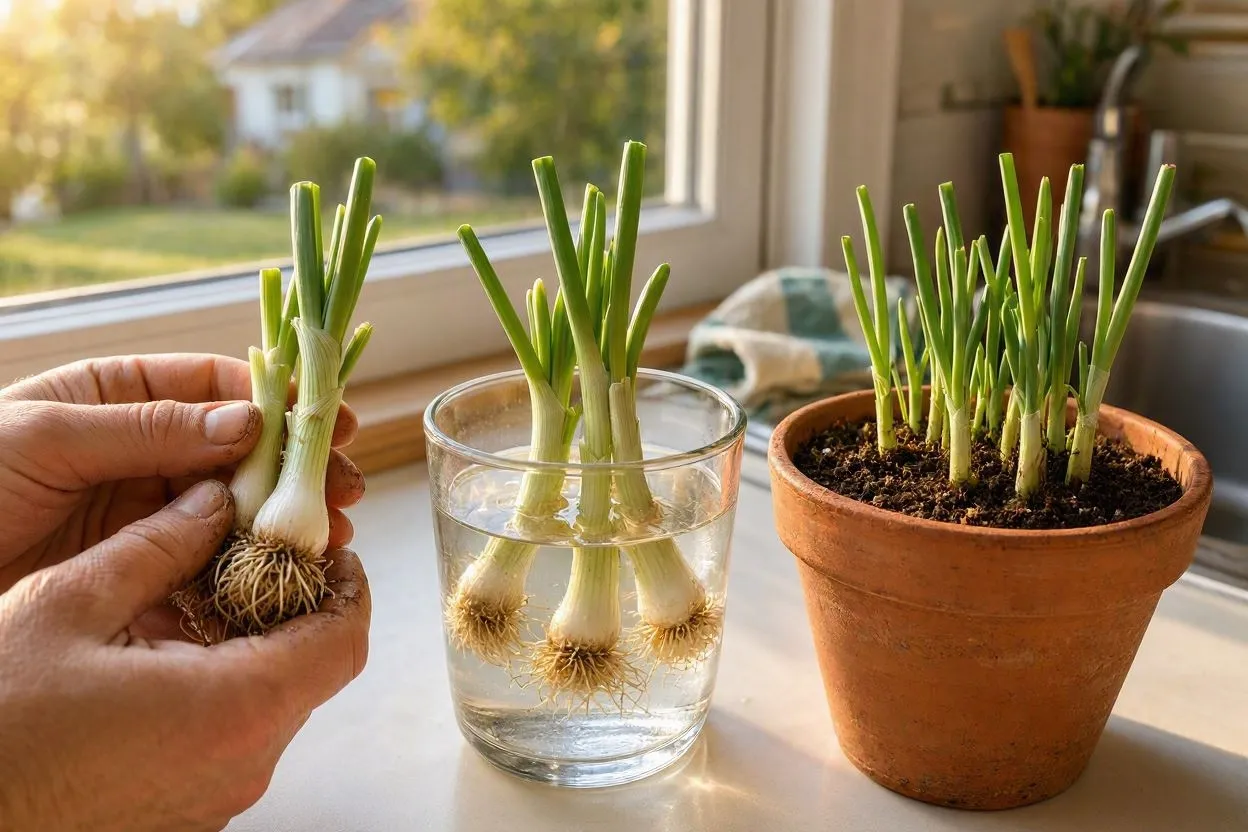
Growing green onions takes 5 to 7 days for regrowth from cuttings in water, or 60 to 90 days for a full crop from seed in a garden bed. The fastest route to a harvest is water propagation using the root end of a store-bought bunch, while seed-starting in the backyard or on a patio produces a larger, longer-lasting crop. Both methods work in USDA growing zones 2 through 11, and neither requires prior gardening experience.
This gardening guide covers all three growing methods (water, garden soil, and seed), plus the spacing, sunlight, and troubleshooting details most patio and lawn-and-garden articles skip.
What Are Green Onions?
Green onions are the young shoots of Allium fistulosum (bunching onion), a hardy garden vegetable harvested before the bulb matures into a round onion. The same plant is also sold as “scallions” or “spring onions,” and in most gardens and produce sections, all three names describe the same crop. A green onion plant has two parts a gardener works with: the white, cylindrical base near the roots and the hollow green stalks above it.
Chives look similar in the garden bed but belong to a different species (Allium schoenoprasum) and grow as thin, tubular leaves with no thickened white base. The distinction matters for propagation: chives can’t be regrown from a cut root the way green onions can. Seed catalogs sometimes use “spring onion” for a more mature garden variety with a small, rounded bulb. If a seed packet shows a bulb wider than a half-inch, that variety needs bulbing space in the garden row rather than the tight spacing used for scallions.
How Long Does It Take to Grow Green Onions?
Green onions regrown from cuttings reach harvestable size in 5 to 7 days in water, while seed-grown plants take 60 to 90 days from sowing to first harvest. Soil-transplanted cuttings fall in between, typically ready in 2 to 3 weeks once roots establish.
Three factors change this timeline: sunlight exposure, water temperature, and cutting size. A cutting with 1 inch (2.5 cm) of white base grows faster than one trimmed to a half inch, because more stored energy remains in the tissue. Gardeners in Zone 9 and above can start seeds nearly year-round, while Zone 5 gardeners are limited to spring and late-summer sowings.
Water vs. Soil vs. Seed: Which Method Should You Use?
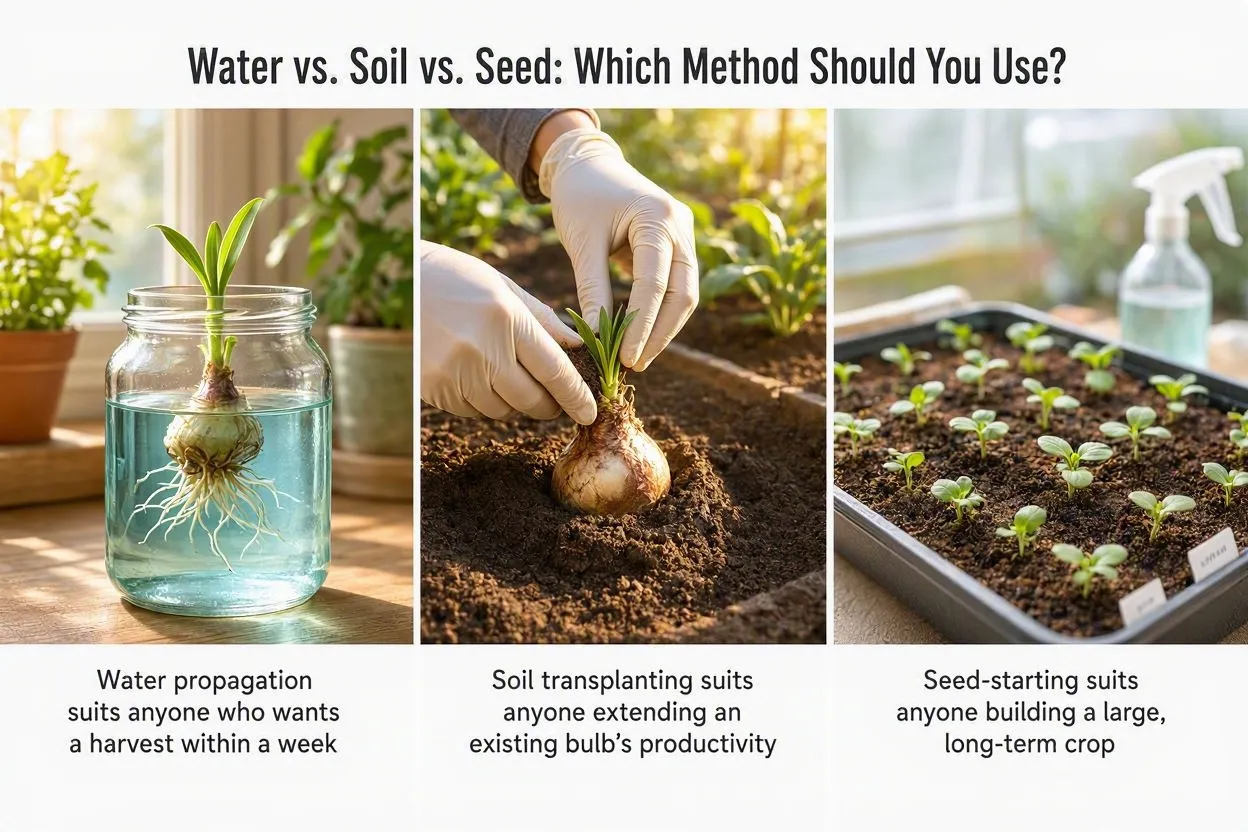
Water propagation suits anyone who wants a harvest within a week, soil transplanting suits anyone extending an existing bulb’s productivity, and seed-starting suits anyone building a large, long-term crop.
| Method | Time to Harvest | Best For | Yield Per Cycle |
| Water propagation | 5–7 days | Small kitchens, apartments, quick regrowth | 1–2 stalks per cutting |
| Soil transplant | 2–3 weeks | Extending a water-started bulb’s life | 2–4 stalks per plant |
| Seed starting | 60–90 days | Raised beds, large households, bulk supply | 6–10 stalks per plant |
What Green Onions Need to Grow Well
Before starting any method, three conditions determine success: light, soil, and water. Getting one of these wrong slows growth noticeably even when the other two are ideal.
Sunlight: Green onions need 6 to 8 hours of direct sun for the thickest stalks and fastest regrowth. Partial shade (4 hours) still works, just slower and thinner. Indoor growers relying on a windowsill alone often see leggy, pale growth after several weeks; a supplemental grow light for 4 hours daily corrects this.
Soil: Use well-draining garden soil with a pH between 6.0 and 7.0. Work 2 inches (5 cm) of compost into the top 6 inches (15 cm) of the garden bed before planting, using a hand trowel or garden fork to turn it in. A balanced 10-10-10 fertilizer at planting, then again at half strength 4–5 weeks later, produces thicker stalks, though skipping it entirely still produces a harvest.
Basic garden tools: A hand trowel, a small garden fork, and a pair of gardening gloves cover everything needed for transplanting and bed prep. A watering can or garden hose with a gentle spray nozzle avoids disturbing shallow-rooted seedlings. Garden mulch spread around transplants helps the garden bed hold moisture between waterings, and plant markers keep rows identified if green onions are planted alongside other backyard vegetable garden crops.
Tools & Supplies for a Green Onion Garden Bed
A short list of lawn and garden supplies covers most of what a backyard or patio setup needs:
- Hand trowel: for digging planting holes and working compost into a raised garden bed
- Garden gloves: protect hands during soil prep and weeding
- Pruning shears or garden scissors: for a clean harvest cut that doesn’t damage the base
- Watering can or garden hose: gentle, even watering for shallow roots
- Mulch: straw or bark mulch conserves moisture in outdoor garden beds
- Plant labels: useful when green onions share a raised bed or patio planter with other vegetables
- Raised bed or patio containers: either works; raised beds suit larger backyard gardens, while containers suit patios and balconies with no in-ground garden space
Water: Give green onions 1 inch (2.5 cm) per week, split across two waterings in hot weather. Overwatering causes root rot faster than underwatering causes wilting; soil that stays soggy for more than 2 days invites fungal problems. A finger pushed 1 inch into the soil should come out mostly dry before the next watering.
How to Grow Green Onions From Scraps in Water
Water propagation is the fastest method for starting a garden crop, turning a root end into a fresh harvest within a week without a garden bed at all. Save the root end and start the same day; roots dry out and lose viability after 24 hours outside water.
What you need:
- Green onion root ends with at least 1 inch (2.5 cm) of white base attached
- A clear glass jar or cup, 3–4 inches (7.5–10 cm) tall
- Room-temperature tap water
- A windowsill with 4+ hours of daily light
Steps:
- Cut the green onion 1 inch (2.5 cm) above the root end, keeping the white base and root threads intact.
- Place the cuttings root-side down in the jar, spaced at least a half inch apart.
- Add 1 inch (2.5 cm) of water, enough to submerge the roots without covering the cut top.
- Set the jar somewhere with indirect light most of the day (a north- or east-facing windowsill works well).
- Change the water every 2–3 days. Stagnant water grows bacteria fast, and a jar left untouched for a week often smells sour and slows root growth.
- Harvest when shoots reach 6–8 inches (15–20 cm) tall, usually by day 7. Snip what’s needed and leave an inch of base in the jar to keep growing.
For reference, water-grown bulbs typically support two to three harvest cycles over several weeks before regrowth slows, a useful benchmark for when to start a fresh cutting.
How to Grow Green Onions in Soil
Soil-grown green onions produce thicker, more flavorful stalks than water-grown ones, because roots access nutrients water alone can’t provide. Two paths lead to a soil crop: transplanting rooted cuttings, or sowing seed directly.
Transplanting rooted cuttings: Move a water-propagated cutting into soil once roots reach 1–2 inches (2.5–5 cm) long, typically after 4–5 days in water. Dig a hole 2 inches (5 cm) deep, set the bulb in root-first, and backfill so only the green tip shows above the soil line. Water immediately to settle the soil. A cutting transplanted at this stage reaches full size in 2–3 weeks; transplanting too early, before roots develop, adds weeks to that timeline.
Starting from seed: Sow seeds a quarter-inch (0.6 cm) deep and 1 inch (2.5 cm) apart, in garden rows 4 inches (10 cm) apart. Germination takes 7–14 days at soil temperatures between 50°F and 75°F (10°C–24°C). Thin seedlings to 2 inches (5 cm) apart once they reach 2 inches tall.
Seed-grown green onions take 60–90 days to reach harvest size, depending on variety. Common garden choices include fast-maturing white-stalk varieties bred for frost tolerance (roughly 65 days) and longer-shank varieties (roughly 70 days). Check the seed packet for your specific cultivar’s days-to-maturity and cold tolerance, since these vary by seed supplier.
Succession sowing every 3–4 weeks from early spring through midsummer keeps a continuous supply coming instead of one large harvest at once.
Best Time to Plant Green Onions by USDA Zone
Green onions go in the ground as soon as soil can be worked in early spring, with a second window in late summer for a fall harvest. Soil temperature, not the calendar, triggers reliable germination, so treat these as starting points and confirm against your local extension office’s frost dates.
| USDA Zone | Spring Planting | Fall Planting |
| 4–5 | Mid-April to early May | Early August |
| 6–7 | Late March to mid-April | Late August |
| 8–9 | Late February to March | September–October |
| 10–11 | Year-round, avoiding peak summer heat | Year-round |
Gardeners in Zone 9 and above can overwinter a fall planting for an early spring harvest, since green onions tolerate light frost better than most garden vegetables. Frost down to 25°F (-4°C) typically damages only the outer leaf tips, leaving the base and roots intact.
How to Grow Green Onions in Containers on a Patio
A patio container at least 6 inches (15 cm) deep with drainage holes grows a full crop on a balcony, patio, or windowsill, ideal for gardeners without a backyard garden bed. Choose a planter at least 12 inches (30 cm) wide to fit 8–10 plants at 1.5-inch (3.8 cm) spacing.
Use a well-draining potting mix, not garden bed soil, which compacts in containers and starves roots of oxygen. Plant bulbs or transplants root-down, 1–2 inches deep, and set the patio planter where it gets 6 hours of direct sun daily. With consistent watering and full sun, a container garden this size can support multiple cut-and-regrow cycles across a full growing season.
Can You Regrow Green Onions Indefinitely?
No. Green onions regrown from the same bulb typically produce 2–3 strong harvests before growth slows significantly. Each cutting cycle draws down stored energy in the white base, and water-only propagation depletes that reserve faster than soil growing does.
A bulb transplanted into soil after its first water-grown harvest often extends productivity to 4–5 cycles, since soil nutrients replace some of what the plant would otherwise pull from its own reserves. Once stalks come back visibly thinner or pale, replace the bulb rather than continuing to cut a depleted one.
Common Green Onion Growing Problems
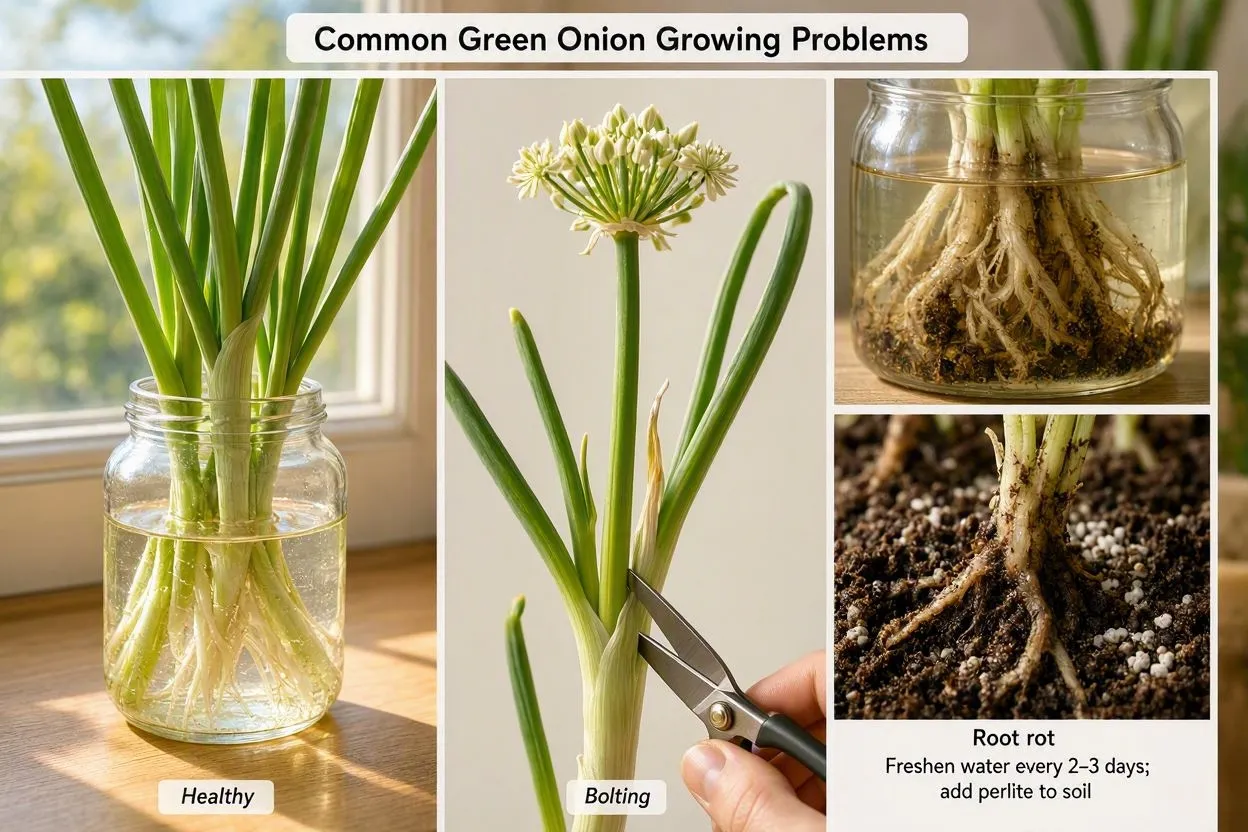
Bolting: A flower stalk shooting up early, usually triggered by a cold snap followed by warm weather. Bolted stalks turn tough and bitter. Cutting the flower stalk off as soon as it appears sometimes salvages a few more weeks of usable growth.
Root rot: Soggy soil or stagnant jar water causes roots to turn brown or black and feel mushy instead of firm. Fresh water every 2–3 days prevents rot in water-grown plants; in soil, adding perlite or coarse sand improves drainage in heavy clay.
Onion thrips: Tiny, pale-yellow insects that leave silvery streaks and stunted growth. An insecticidal soap spray every 5–7 days for two weeks controls light infestations. Removing nearby weeds helps too, since thrips overwinter in weedy areas next to garden beds.
Companion Planting for Green Onions
Green onions grow well next to carrots, tomatoes, and lettuce in a shared garden bed, and poorly next to beans and peas. The sulfur compounds they release into the soil repel several common garden pests, including carrot rust fly and aphids, making them a useful border plant along garden bed edges or lawn borders around more pest-prone crops. The fly locates carrots by scent, and green onions mask that signal.
Beans and peas host nitrogen-fixing bacteria in their root nodules that alliums like green onions actively suppress, stunting growth on both sides when planted too close together in the same garden row.
When and How to Harvest Green Onions
Harvest once stalks reach 6–8 inches (15–20 cm) tall and the white base measures at least a quarter-inch (0.6 cm) thick. Cut the green stalks 1 inch (2.5 cm) above the garden soil or waterline, using clean garden shears or scissors, to leave enough base for regrowth.
For a one-time harvest, pull the entire plant including the bulb, rinse off garden soil, and trim the roots. Staggering plantings across the garden bed by a week keeps a continuous supply coming rather than one large harvest all at once.
How to Store Green Onions After Harvest
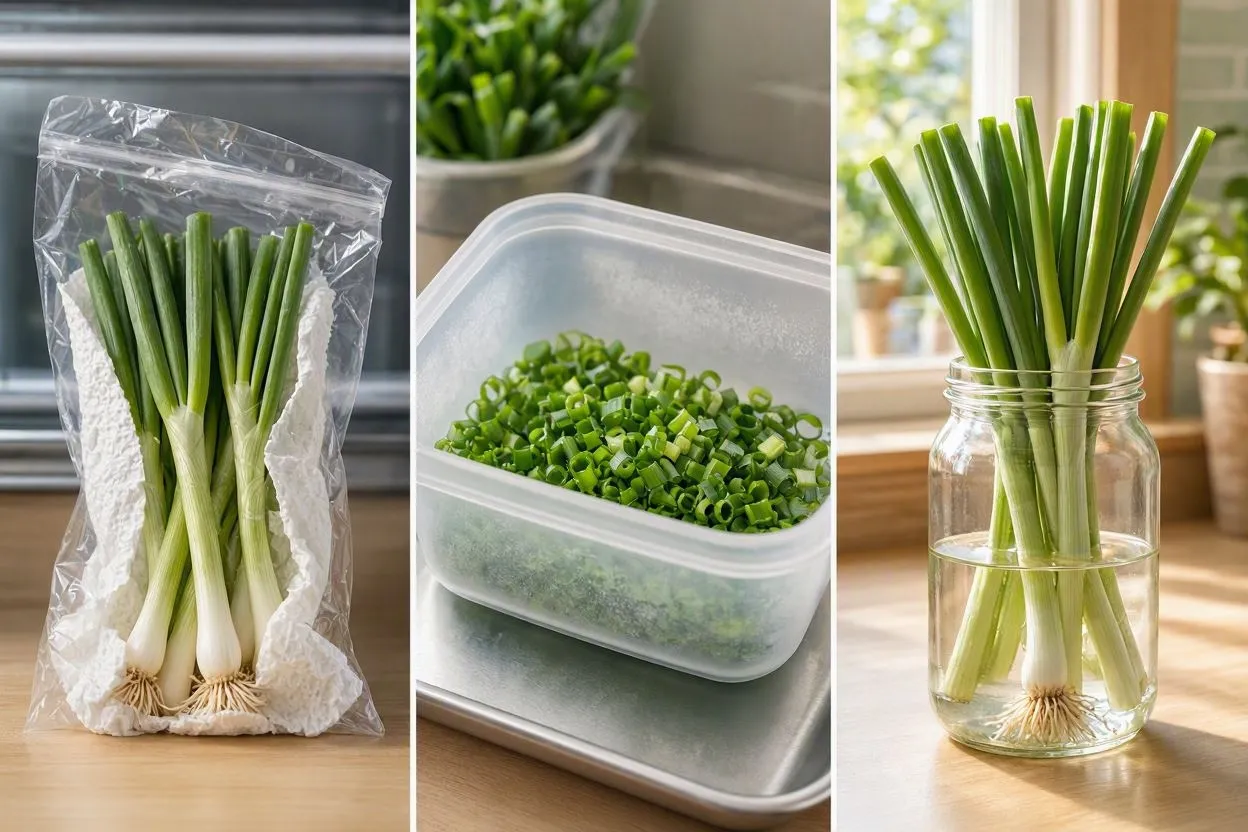
Once cut from the garden bed or patio container, fresh green onions stay usable for 7–10 days wrapped in a damp paper towel and refrigerated in a loosely sealed bag. The damp towel prevents drying out; the loose seal keeps humidity from building up enough to cause rot.
For longer storage, sliced green onions freeze well for 3–4 months in an airtight container. A third option: stand whole stalks root-down in a half-inch of water, changing the water every few days. This doubles as a slow regrowth setup if the roots are still attached, effectively extending the garden harvest indoors.
FAQs
Do green onions regrow after cutting?
Yes, if at least 1 inch (2.5 cm) of white base and roots remain intact and undamaged.
Can green onions grow in water only, with no soil?
Yes, for 2–3 harvest cycles before nutrient depletion slows regrowth noticeably.
How much sunlight do green onions need indoors?
4–6 hours of direct light daily; a supplemental grow light corrects leggy, pale growth.
Why did my green onions turn yellow?
Yellowing usually signals overwatering, nitrogen deficiency, or a bulb past its third regrowth cycle.
Is it cheaper to grow green onions in a home garden than buy them?
Yes. One bunch regrown 2–3 times in a garden bed or patio container replaces that many purchases at little additional cost beyond water or garden soil.
Conclusion
Water propagation delivers a harvest in under a week, soil transplanting stretches a single bulb across 4–5 cutting cycles, and seed-starting builds a larger, more resilient crop over 60–90 days in a garden bed or patio container. Matching the method to the timeline and growing space that fits, a fast windowsill regrowth versus a full backyard garden row, determines which approach makes sense for a given yard, patio, or lawn-and-garden setup. A single jar or a dedicated garden bed, tended every few days, is enough to keep a household in fresh green onions all season.