
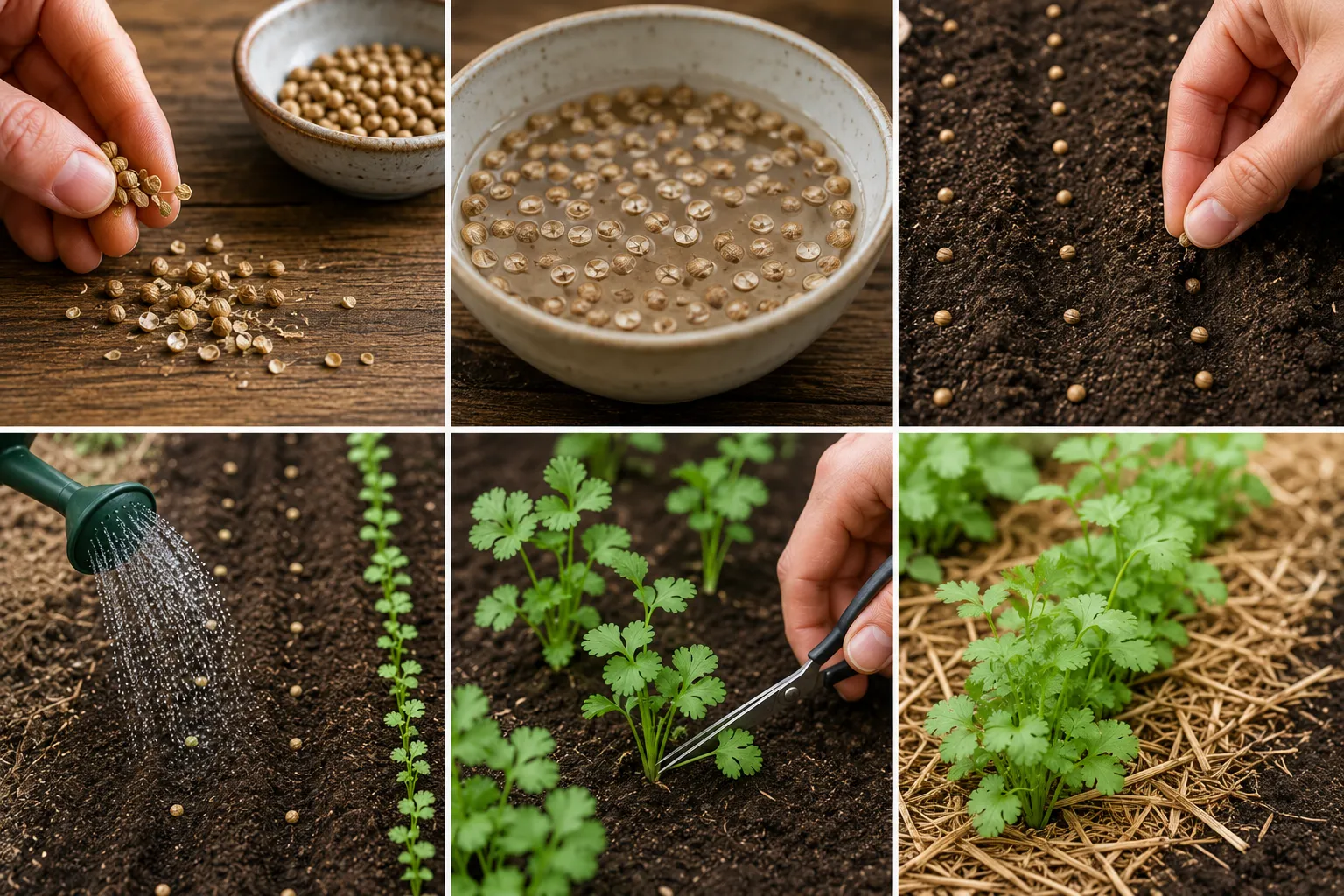
Grow cilantro by sowing seeds 1 cm (0.4 in) deep directly into well-drained soil, spacing plants 15 cm (6 in) apart, keeping the soil evenly moist, and giving the plants 4–6 hours of sun daily at temperatures between 10°C and 27°C (50°F–80°F). Seeds sprout in 7–14 days. You harvest the first leaves 3–4 weeks after sowing.
That is the whole method. Everything below explains the parts that trip people up: bolting, timing, and hot climates.
Quick Specs
| Detail | Value |
| Botanical name | Coriandrum sativum |
| Family | Apiaceae (carrot family) |
| Life cycle | Annual |
| Sowing depth | 1 cm (0.4 in) |
| Plant spacing | 15 cm (6 in) |
| Row spacing | 30 cm (12 in) |
| Germination | 7–14 days |
| First harvest | 21–28 days |
| Soil pH | 6.2–6.8 |
| Ideal temperature | 10–27°C (50–80°F) |
| Bolting trigger | Above 27°C (80°F) |
| Frost tolerance | Survives light frost to -4°C (25°F) |
| Minimum pot depth | 20 cm (8 in) |
What Cilantro Is
Cilantro is a fast-growing annual herb in the Apiaceae family, alongside 4 relatives: carrot, parsley, dill, and fennel. The botanical name is Coriandrum sativum.
One plant gives two ingredients. The green leaves are cilantro. The dried seeds are coriander. Both come from the same stem.
Cilantro grows a single deep taproot. That root explains most of the plant’s behaviour, since it hates being moved and refuses to recover from transplant shock. Sow the seed where the plant will live.
Cilantro vs Coriander vs Culantro
Three names confuse most gardeners. Here is the split:
Cilantro is the leaf, called “coriander leaf” or “dhania” outside North America.
Coriander is the dried seed, sold as a spice and ground into 3 common blends: garam masala, curry powder, and berbere.
Culantro (Eryngium foetidum) is a different plant entirely. The long, serrated leaves taste stronger, and the plant tolerates heat that kills cilantro within weeks. Grow culantro if you live in a tropical or subtropical region where cilantro bolts before you can harvest it.
When to Plant Cilantro
Plant cilantro when average daytime temperatures sit between 10°C and 27°C (50°F–80°F). In practice, that means very different months depending on where you live.
Most guides assume a North American spring. That advice fails roughly half the world.
Global Planting Calendar
| Climate | Example Regions | Sow During | Avoid |
| Temperate | UK, northern US, Germany, Canada | Early spring and late summer | Midsummer |
| Mediterranean | Spain, Italy, coastal California, Greece | Autumn through early spring | June–August |
| Subtropical | Northern India, Pakistan, Texas, Egypt | October through February | April–September |
| Tropical | Thailand, Kerala, Nigeria, Philippines | Cool dry season only | Wet season and peak heat |
| Arid | UAE, Arizona, Saudi Arabia | November through February | March–October |
| Cold continental | Minnesota, Poland, Ukraine | Late spring after frost | Deep winter outdoors |
| Southern hemisphere | Australia, South Africa, Chile | March–May, August–September | December–February |
Readers in Faisalabad, Delhi, Karachi, Dubai, or Houston should treat winter as the growing season. Cilantro sown in October produces steadily until March. Cilantro sown in April bolts within 21 days.
Succession Planting
Sow a small batch every 14–21 days. One plant produces roughly 2 useful harvests before it bolts. A household using one bunch weekly needs about 6 plants per sowing. Six plants every two weeks gives uninterrupted supply.
How to Grow Cilantro From Seed
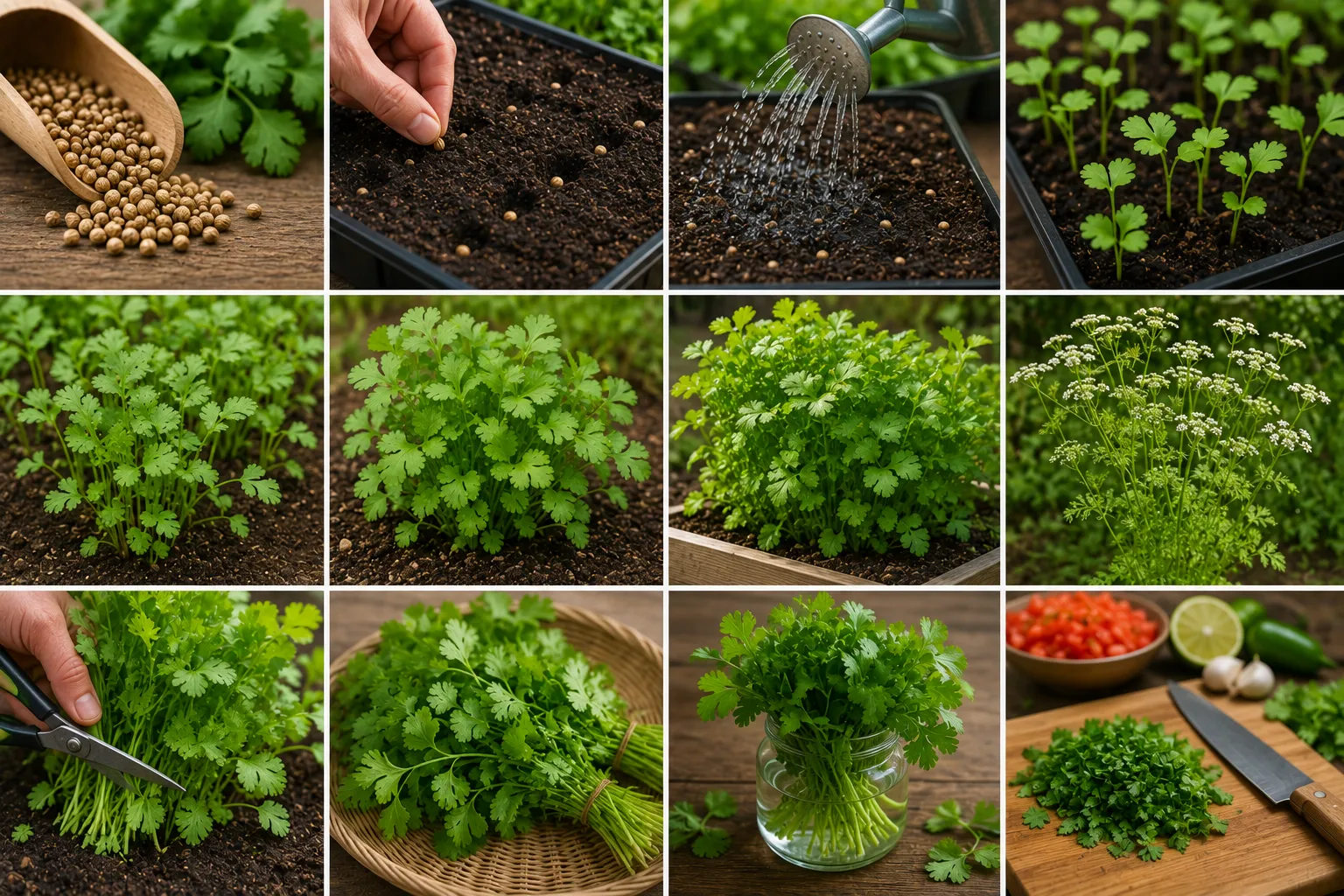
To grow cilantro from seed, follow these 6 steps.
Step 1: Prepare the Seed
Each cilantro “seed” is a schizocarp, meaning a dry husk that contains 2 actual seeds. Crush the husk gently between your fingers or roll it under a board. Soak the cracked halves in room-temperature water for 24 hours.
Cracking and soaking cuts germination time from 14 days to about 7.
Note the arithmetic: 20 husks equal 40 seedlings. Sow accordingly, or thin heavily later.
Step 2: Prepare the Soil
Cilantro wants loose, well-drained soil with a pH between 6.2 and 6.8. Work 5 cm (2 in) of compost into the top 20 cm (8 in) of bed.
Heavy clay drowns the taproot. Break clay soil with sand and compost, or grow in a raised bed.
Step 3: Sow Directly
Push seeds 1 cm (0.4 in) into the soil. Space them 5 cm (2 in) apart, in rows 30 cm (12 in) apart. Water gently with a fine rose so seeds stay buried.
Never start cilantro in trays and transplant it. The taproot snaps, the plant stalls, and it bolts early.
Step 4: Water Through Germination
Keep the top 2 cm (0.8 in) of soil damp for 14 days. Dry soil at this stage kills the embryo.
Step 5: Thin the Seedlings
When seedlings reach 5 cm (2 in) tall, thin them to 15 cm (6 in) apart. Snip the extras at soil level rather than pulling, since pulling disturbs neighbouring taproots.
Eat the thinnings. They taste identical to mature leaves.
Step 6: Mulch
Lay 2–3 cm (about 1 in) of straw, shredded leaves, or grass clippings around the plants. Mulch holds moisture, cools the root zone, and delays bolting by roughly 7–10 days in warm weather.
How to Grow Cilantro in Pots
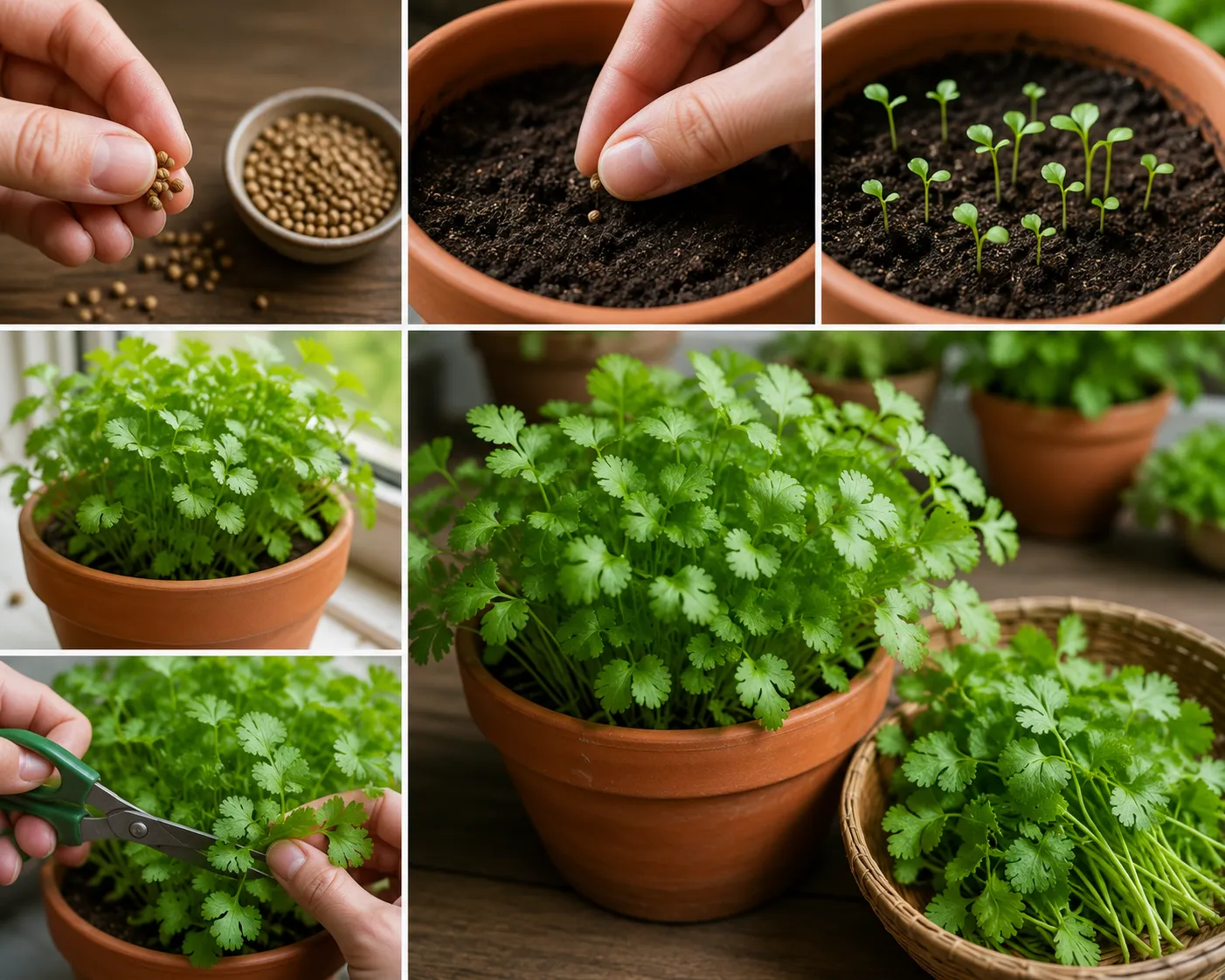
Yes, cilantro grows well in pots, provided the pot is at least 20 cm (8 in) deep. The taproot needs vertical room.
Follow these 5 container rules:
- Choose a pot 20–30 cm (8–12 in) deep with drainage holes.
- Fill it with potting mix, never garden soil, since garden soil compacts in containers.
- Sow 5–7 seeds per 20 cm (8 in) pot, then thin to 3 plants.
- Water when the top 2 cm (0.8 in) feels dry, usually daily in warm weather.
- Move the pot to afternoon shade when temperatures climb past 27°C (80°F).
Containers dry faster than beds. Check them every morning.
How to Grow Cilantro Indoors
Yes, cilantro grows indoors year-round, provided you supply 6 hours of direct light or 12 hours under a grow light. Indoor plants grow slower and stay smaller, but they never face the heat that triggers bolting.
Soil Method
Place the pot at a south-facing window in the northern hemisphere, or a north-facing window in the southern hemisphere. Rotate the pot 90 degrees every 3 days so stems grow straight.
Add a full-spectrum light-emitting diode (LED) grow light 20 cm (8 in) above the plants if your window delivers under 6 hours of sun.
Hydroponic Method
Cilantro suits the Kratky method, a passive hydroponic system requiring no pump.
- Fill a 4-litre (1-gallon) opaque container with nutrient solution at electrical conductivity (EC) 1.2–1.8.
- Suspend a net pot so the bottom 2 cm (0.8 in) sits in solution.
- Fill the net pot with rockwool or clay pebbles.
- Sow 3 cracked seeds per net pot.
- Run lights 14 hours daily.
Hydroponic cilantro reaches harvest size in 25 days.
Watering, Feeding, and Mulching
Watering
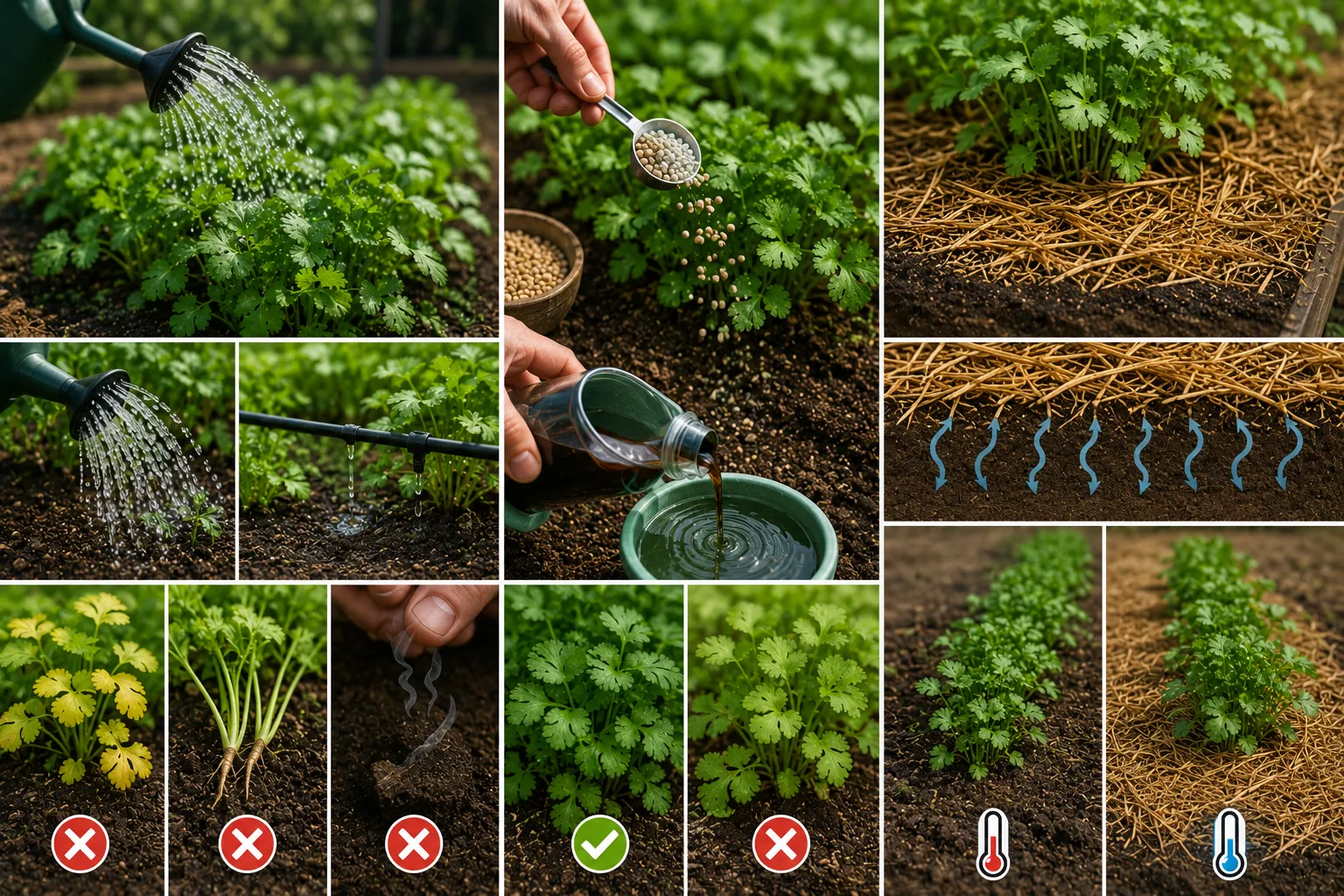
Give cilantro 2.5 cm (1 in) of water weekly, split across 2 sessions. Keep soil evenly moist, never waterlogged.
The 3 signs of overwatering are yellow lower leaves, soft stems, and a sour soil smell.
Feeding
Cilantro is a light feeder. Skip fertiliser entirely if you amended with compost.
Otherwise apply a diluted nitrogen source once, when plants reach 5 cm (2 in). Use fish emulsion at half strength, or 15 g (0.5 oz) of ammonium sulphate per 3 m (10 ft) of row.
Excess nitrogen produces soft leaves with weak flavour.
Mulching
Mulch lowers soil temperature by 3–5°C (5–9°F). Lower soil temperature delays bolting.
Why Cilantro Bolts
Bolting means the plant stops making leaves and sends up a flower stalk. Leaves turn thin and feathery, then bitter.
Most articles blame heat alone. Heat is only one of 5 triggers.
Cilantro bolts when day length, accumulated heat, root stress, water stress, or plant age signals the plant to reproduce.
The 5 Triggers
- Photoperiod. Cilantro is a long-day plant. Days longer than 12 hours push it toward flowering, regardless of temperature. This is why June cilantro bolts even in a cool summer.
- Accumulated heat. The plant totals its exposure above 27°C (80°F). Three hot afternoons add up.
- Root disturbance. Transplanting or careless weeding damages the taproot and triggers a stress response.
- Water stress. A single day of dry soil accelerates flowering.
- Plant age. Cilantro flowers at 40–60 days regardless of conditions. No trick prevents this permanently.
How to Delay Bolting
Apply these 6 measures:
- Sow in cool months matched to your climate zone.
- Select slow-bolt cultivars: Calypso, Slo-Bolt, Santo, Leisure, Long Standing.
- Shade plants from midday sun using 30% shade cloth.
- Water consistently, never letting soil dry out.
- Harvest outer leaves weekly, since regular cutting keeps the plant vegetative.
- Resow every 2 weeks so a young batch always waits.
Shade cloth alone will not save a June sowing, because day length still signals the plant to flower.
If It Bolts Anyway
Let it. Flowers feed hoverflies, ladybirds, and parasitic wasps, which eat aphids. The seeds become your coriander supply. Fallen seeds often self-sow the following season.
Troubleshooting Table
| Symptom | Cause | Fix |
| Tall stalk, thin feathery leaves | Bolting | Harvest immediately, resow |
| Yellow lower leaves | Overwatering or low nitrogen | Improve drainage, feed lightly |
| Pale, leggy, leaning stems | Insufficient light | Provide 6 hours sun or a grow light |
| Seedlings collapse at soil line | Damping off (Pythium) | Reduce watering, increase airflow |
| No sprouts after 21 days | Husk unbroken, soil above 26°C (79°F) | Crush husks, soak, sow in cooler soil |
| Bitter, soapy leaves on old plant | Post-bolt chemistry | Discard leaves, harvest seeds instead |
| Sticky leaves, curled tips | Aphids | Spray water, apply insecticidal soap |
| White powder on foliage | Powdery mildew | Space plants, water at soil level |
| Brown angular leaf spots | Bacterial leaf spot (Pseudomonas syringae) | Remove leaves, stop overhead watering |
| Plant stalls after moving | Transplant shock | None; sow directly next time |
Pests and Diseases
Cilantro suffers few problems. Watch for these 5:
- Aphids cluster under leaves and secrete sticky honeydew.
- Spider mites appear in dry heat, leaving fine webbing.
- Slugs chew seedlings overnight.
- Powdery mildew develops in humid, still air.
- Bacterial leaf spot spreads through splashing water.
Water at soil level, space plants 15 cm (6 in) apart, and most problems never start.
Cilantro flowers attract 4 beneficial insects: ladybirds, hoverflies, lacewings, and parasitic wasps. Letting one plant flower protects the rest of your garden.
How to Harvest Cilantro
Harvest cilantro when plants reach 15 cm (6 in) tall, usually 21–28 days after sowing.
Follow these 4 rules:
- Cut outer stems 2 cm (0.8 in) above soil with scissors.
- Leave the central growing point untouched.
- Remove no more than one third of the plant at once.
- Harvest in the morning, when leaf oils peak.
Yes, cilantro grows back after cutting, provided the crown survives. Expect 2–3 harvests per plant across 6 weeks.
Cut whole plants at soil level when they start bolting. Use the leaves within 48 hours.
How to Save Coriander Seeds
Let a bolted plant flower and set seed. Seed heads turn from green to tan over 3 weeks.
- Cut stalks when 80% of the heads have browned.
- Hang them upside down inside a paper bag.
- Wait 14 days in a dry, ventilated room.
- Shake the bag to release the seeds.
- Store the seeds in an airtight jar away from light.
Coriander seed stays viable for 4 years. Save seed from your slowest-bolting plants, and you develop a locally adapted strain within 3 seasons.
How to Store Fresh Cilantro
Three methods work:
Refrigerator, 14 days. Trim stem ends, stand the bunch in a jar with 3 cm (1.2 in) of water, cover loosely with a bag, and refrigerate.
Freezer, 6 months. Chop the leaves, pack them into an ice cube tray, top with olive oil or water, and freeze.
Paste, 3 months. Blend leaves with oil, salt, and garlic. Freeze in portions.
Drying destroys cilantro’s flavour. Freeze it instead.
Can You Regrow Cilantro From Grocery Store Cuttings?
No, cilantro does not reliably regrow from stem cuttings. Basil and mint root at their leaf nodes. Cilantro does not, because it lacks the adventitious rooting response, and the plant runs on a fixed bolting clock that no cutting resets.
Two better options exist:
- Sow coriander seed from your spice rack. Whole coriander seeds sold as spice germinate at roughly 50% if they were not heat-treated. Crush, soak overnight, and sow. This works in any country, with no seed supplier needed.
- Root the bunch’s base in water only to keep it fresh for a week. It will not become a producing plant.
Anyone promising a windowsill forest from supermarket stems is selling you a photograph, not a harvest.
Why Cilantro Tastes Like Soap to Some People
Roughly 4–14% of people perceive cilantro as soapy, with rates varying by ancestry: about 21% of East Asians, 17% of Europeans, and under 4% of South Asians report the effect.
The cause is genetic. A variant near the olfactory receptor gene OR6A2 heightens sensitivity to aldehyde compounds, which cilantro shares with certain soaps and lotions.
A 23andMe study of about 30,000 people confirmed the link.
Crushing or finely chopping the leaves breaks down those aldehydes and softens the soapy note. Cooked cilantro tastes different from raw, since heat degrades the same compounds.
Start Your First Sowing This Week
Cilantro asks for very little: a pot 20 cm (8 in) deep, damp soil, a few hours of sun, and correct timing for your climate. Crack the husks, sow directly, cut the outer leaves, and sow again two weeks later.
Check the global planting calendar above, find your climate row, and sow this week if the month matches. You will cut your first leaves before the month ends.
Growing other herbs too? Read our guides to [growing basil], [growing parsley], and [growing dill] for the same season-by-season detail.
Frequently Asked Questions
How long does cilantro take to grow?
Cilantro takes 21–28 days from sowing to first harvest. Seeds germinate in 7–14 days, or 7 days if you crack and soak the husks first.
Does cilantro grow back after cutting?
Yes, cilantro regrows after cutting, provided you leave the central crown intact. Cut only outer stems, removing no more than one third of the plant. Expect 2–3 harvests per plant.
Why is my cilantro flowering so fast?
Cilantro flowers early because day length above 12 hours and temperatures above 27°C (80°F) trigger it to reproduce. Root damage and dry soil accelerate the process. Sow in cool months and choose Calypso or Slo-Bolt.
Can you grow cilantro in hot climates?
Yes, grow cilantro in hot climates by treating winter as your growing season. Sow from October through February in subtropical regions. Grow culantro (Eryngium foetidum) instead if you need a heat-proof substitute.
How many cilantro plants do I need?
Sow 6 plants every 14 days for a continuous supply. One plant yields 2 harvests, and a typical household uses one bunch weekly.
Conclusion
Cilantro rewards gardeners who respect three simple truths: it hates being moved, it hates heat, and it lives fast. Sow the cracked seeds directly where the plants will grow, time your sowing to the cool months of your climate, and keep the soil consistently moist. Do those three things and the plant handles the rest, delivering fresh leaves within a month.
Treat bolting as part of the cycle rather than a failure. Every plant that flowers feeds beneficial insects, produces next season’s seed, and closes the loop between herb and spice. Combine steady succession sowing every two weeks with regular outer-leaf harvests, and one small patch or a single deep pot will keep your kitchen supplied year after year.
Check the global planting calendar above, find your climate row, and sow this week if the month matches. You will cut your first leaves before the month ends.
Growing other herbs too? Read our guides to [growing basil], [growing parsley], and [growing dill] for the same season-by-season detail.