
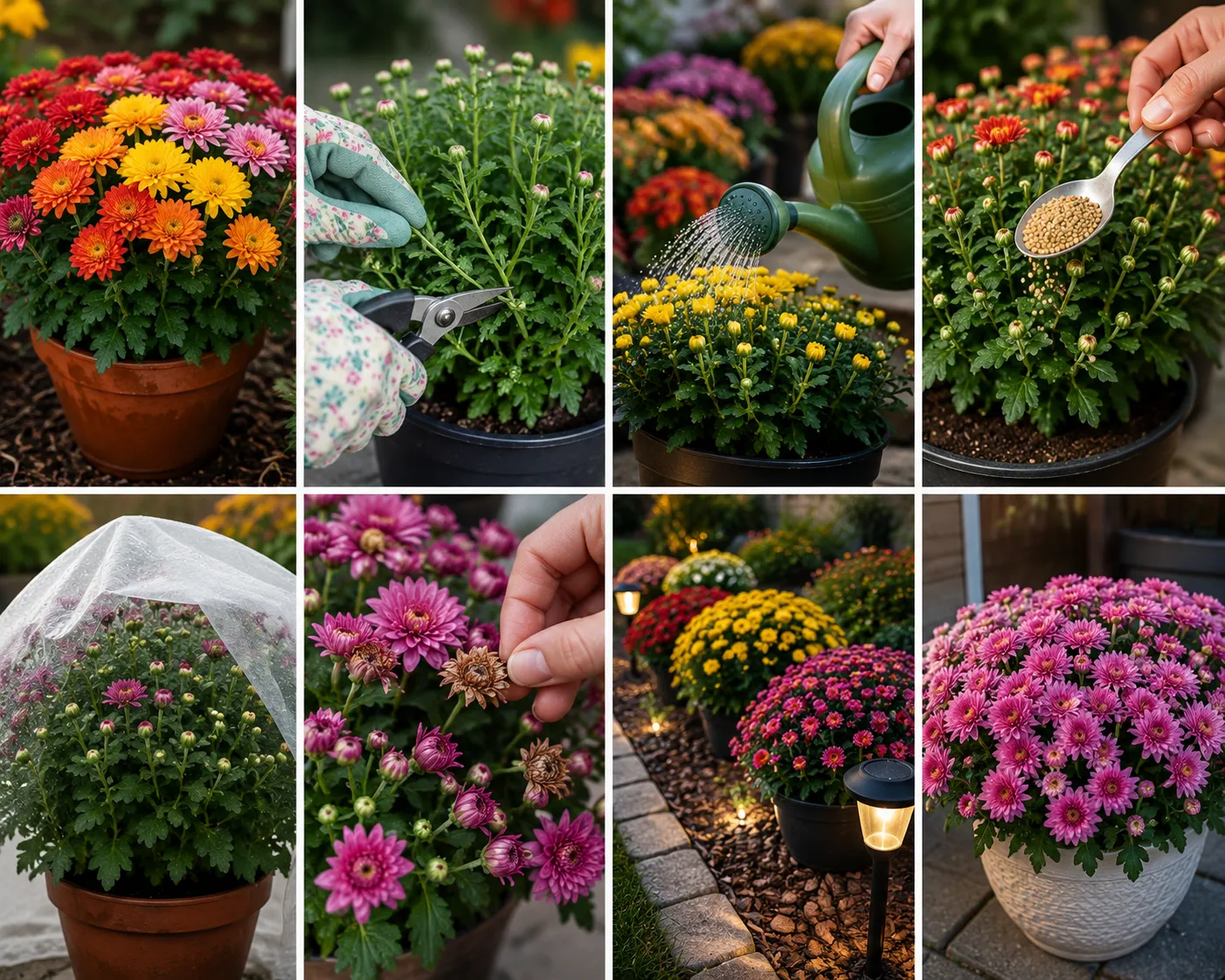
To keep chrysanthemums (mums) blooming longer, deadhead spent flowers every 3 to 4 days, pinch new growth back to 6 inches (15 cm) before mid-July, water 1 inch (2.5 cm) per week at the base, and feed with a low-nitrogen fertilizer once buds form. These 4 actions directly extend bloom time from 4 weeks up to 8 weeks in most USDA Zones 5–9.
Garden mums bloom from late summer through fall — typically August to November depending on variety and location. Most gardeners buy nursery mums already in bloom and watch them fade within 2 to 3 weeks. That happens because blooming mums divert all energy into seed production the moment flowers die on the plant. Stopping that seed cycle is the single fastest way to keep color going.
This guide covers 8 specific actions — with exact timing, measurements, and zone-based adjustments — so mums in your garden or containers stay in full flower as long as possible. Before diving in, note that bloom duration also depends on variety: cushion mums and hardy garden mums hold color far longer than florist mums bought from a supermarket. For a full breakdown of bloom durations by type, see chrysanthemum types and their bloom habits.
1. Deadhead Spent Blooms Every 3 to 4 Days
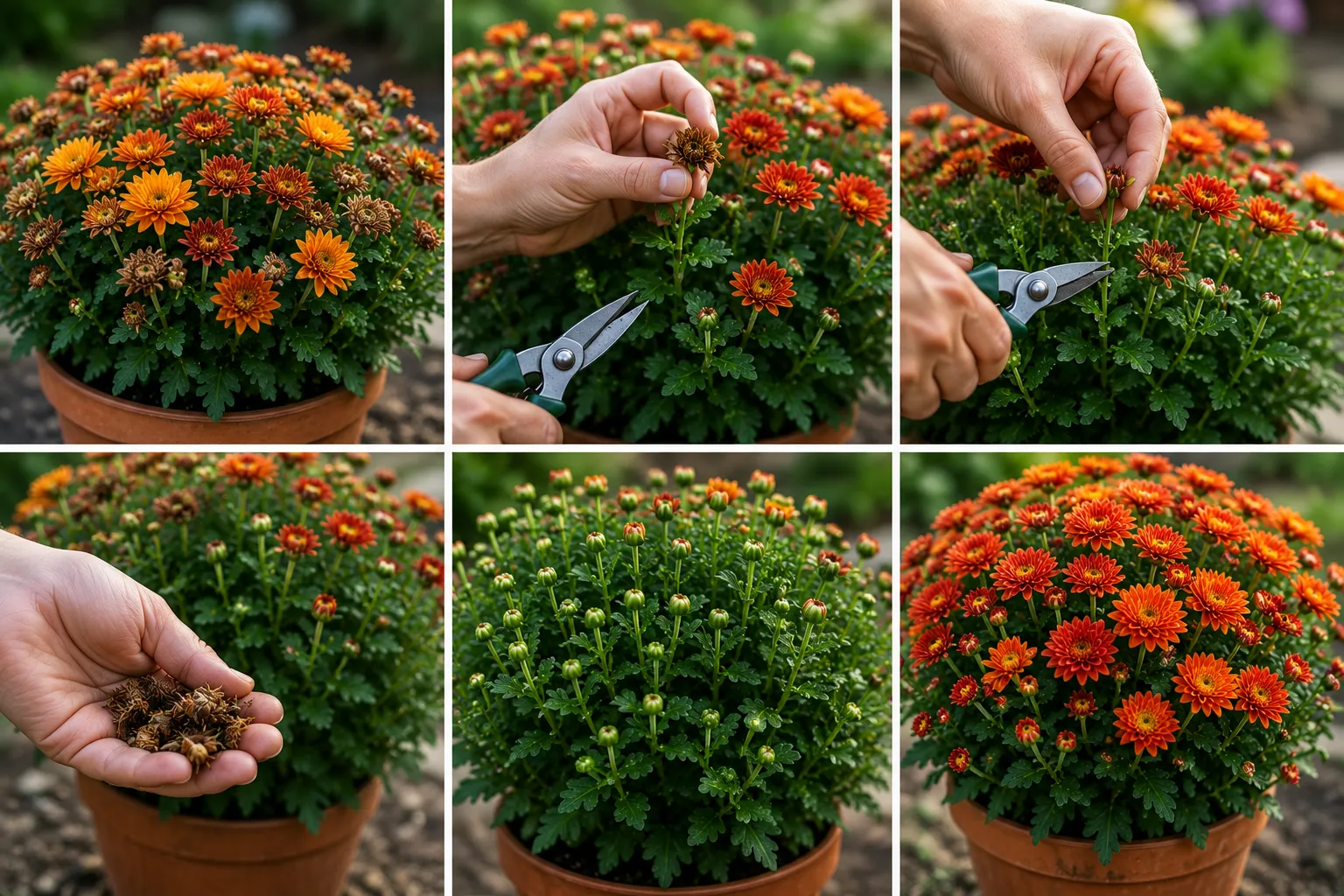
Deadheading — removing individual spent flowers as they fade — is the single most effective technique to extend chrysanthemum bloom time. When a flower dies on the plant, the mum shifts energy from producing new buds into forming seeds. Removing the dead flower before seed development starts redirects that energy back to the remaining buds.
To deadhead correctly, pinch or cut each spent bloom just above the next set of leaves or side shoot below it. Use clean, sharp scissors or pruning snips. Do not snap spent blooms off at the base of the stem — that removes the shoot node where new buds form.
Deadhead every 3 to 4 days during peak bloom. In warm weather above 80°F (27°C), flowers fade faster — check every 2 days. A mum with 50 open flowers will have 5 to 8 spent blooms ready for removal at any given check during active bloom.
Important: Deadheading delays seed formation but does not produce a second full flush of flowers. Chrysanthemums are short-day plants that bloom once per season in response to long nights. Deadheading extends the current bloom period — it does not trigger a new bloom cycle.
2. Pinch Plants Before Mid-July for More Buds
Pinching — removing the growing tip of each stem back to 6 inches (15 cm) — forces the mum to branch, producing 2 to 4 stems per pinch point instead of 1. More stems mean more bud sites and a longer, fuller bloom display.
Start pinching when new spring growth reaches 6 inches (15 cm), typically in late April or May. Pinch again in early July. Stop pinching by July 15 in most US zones — buds that form after mid-July may not have enough time to develop into full flowers before the first frost.
For spray chrysanthemum varieties, a second pinch in early July doubles the number of blooms per plant. For single-stem exhibition varieties, do not pinch — the terminal bud on a single-stem variety produces the main flower, and removing it eliminates the bloom entirely.
The pinching schedule by zone: Zone 5 and 6 gardeners should complete all pinching by July 10, since first frost arrives in late September or early October. Zone 7 to 9 gardeners can pinch until July 20, giving buds 10 to 12 extra development days. For guidance on matching your pinching schedule to your local frost dates, the watering schedule and seasonal timing guides cover zone-specific calendars.
3. Water 1 Inch Per Week — Never Overhead
Chrysanthemums produce the most blooms when the soil stays consistently moist but never waterlogged. Water 1 inch (2.5 cm) per week, split into 2 to 3 sessions. In temperatures above 85°F (29°C) or in sandy, fast-draining soil, increase to 1.5 inches (3.8 cm) per week.
Always water at the base of the plant. Overhead watering wets the foliage and flowers, which causes botrytis (gray mold) on petals in humid climates. Wet petals also fade 2 to 3 days faster than dry ones in hot weather.
To check soil moisture before watering, push one finger 2 inches (5 cm) into the soil. Water immediately if the soil feels dry at that depth. If the soil feels moist, skip that session. Overwatered mums drop flower buds before they open — yellow lower leaves combined with bud drop is the clearest sign of too much water.
| Condition | Weekly Water Amount | Sessions per Week |
| Normal weather, loamy soil | 1 inch (2.5 cm) | 2 |
| Hot weather above 85°F (29°C) | 1.5 inches (3.8 cm) | 3 |
| Sandy / fast-draining soil | 1.5 inches (3.8 cm) | 3 |
| Heavy clay soil | 0.75 inch (1.9 cm) | 2 |
| Container-grown mums | Check daily; water when top 1 in dry | Daily check |
4. Switch to Low-Nitrogen Fertilizer Once Buds Form
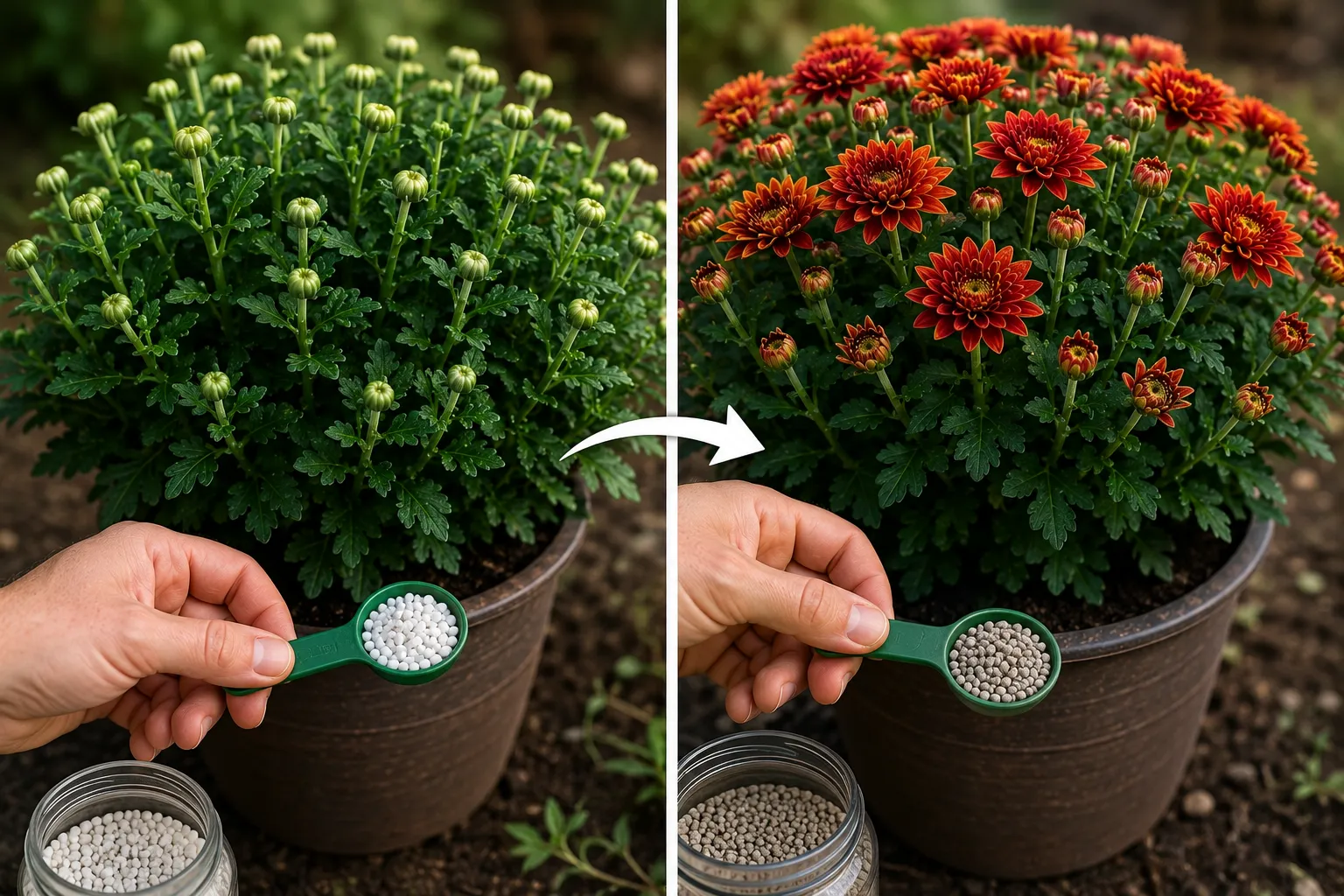
Feed chrysanthemums with a balanced 20-20-20 (N-P-K) water-soluble fertilizer in spring and early summer, then switch to a low-nitrogen, high-potassium formula — such as 4-12-4 or 5-10-10 — once buds begin to form in late summer. High nitrogen after bud set produces leafy growth at the expense of flowers.
Apply spring fertilizer on May 15. Apply summer fertilizer on July 15. Stop all fertilizing once flowers are fully open — feeding at that stage extends leaf growth but shortens individual flower life by accelerating the plant’s metabolism.
For organic gardening, fish emulsion applied as a foliar spray (sprayed directly onto leaves) in the early morning on an overcast day provides nitrogen without risk of leaf scorch. Apply fish emulsion at half the label rate for foliar feeding. Kelp meal or liquid kelp added to the watering can in August delivers potassium that strengthens stems and deepens flower color without pushing new vegetative growth.
Container-grown mums deplete nutrients faster than in-ground plants. Feed container mums with a diluted 20-20-20 solution every 10 to 14 days from May through bud set, then switch to the low-nitrogen formula for the bloom period.
5. Give Mums 6 Hours of Direct Sun Daily
Chrysanthemums need a minimum of 6 hours of direct sunlight each day to produce full, dense blooms. Plants that receive 4 hours or fewer become leggy, produce fewer stems for bud set, and bloom later in the season. In partial shade, mums stretch toward the light source and the natural cushion shape collapses.
In gardens where full sun is not available, morning sun is better than afternoon sun. Morning sun dries dew off the foliage quickly, reducing disease pressure. Afternoon sun in hot climates above Zone 7 can scorch petals on open flowers — light afternoon shade in Zones 8 and 9 actually extends individual flower life by reducing heat stress on the petals.
For container mums, this creates a management advantage: move pots to follow sun patterns as the season changes. A container on a south-facing patio gets full sun in September when the sun angle drops, even if that same spot was partially shaded in July.
Bloom trigger note: Chrysanthemums are short-day plants (photoperiodism). Buds form only when nights exceed 9.5 to 10 hours in length, typically from late August onward in most US zones. Artificial light at night — a streetlight, a porch light, or even a lit window nearby — can delay or prevent bud formation by interrupting the dark period. Site garden beds away from nighttime light sources for on-time fall blooms.
6. Choose Early, Mid, and Late Varieties for Continuous Color
Planting 3 chrysanthemum varieties with staggered bloom times — early, mid-season, and late — extends total color in the garden from 4 weeks to 10 to 12 weeks without any extra care effort. This strategy works because bloom time is genetically fixed per variety and cannot be changed by cultural practices.
Early-blooming varieties flower in mid-August through September. Examples include ‘Cheyenne’ (bronze, cushion form) and ‘Daisy’ (white, single form). Mid-season varieties bloom from September through October. ‘Sheffield Pink’ and ‘Hillside Pink Sheffield’ are two widely available mid-season options that perform across Zones 4 to 9. Late varieties extend color through October into November: ‘Will’s Wonderful’ (lavender-pink) and ‘Cambodian Queen’ (apricot-orange) regularly bloom past the first frost in Zone 6.
For more detail on which classes and varieties produce the longest individual bloom periods, the complete guide to chrysanthemum types and varieties covers all 13 NCS-defined classes with bloom duration data.
7. Mulch the Root Zone to Regulate Soil Temperature
Apply a 2 to 3 inch (5 to 7.5 cm) layer of mulch around chrysanthemum plants, keeping mulch 2 inches (5 cm) away from the stems, to maintain consistent soil moisture and moderate root zone temperature. Consistent root zone temperature directly supports consistent bud development and flower opening.
In fall, when day-night temperature swings exceed 20°F (11°C), mulch reduces root stress from rapid soil cooling at night. Stressed roots reduce water and nutrient uptake, which shortens the bloom period by 5 to 10 days in mid-autumn when temperatures drop quickly.
Organic mulches — shredded leaves, pine bark, or wood chips — work well for garden mums. Avoid fresh grass clippings, which compact and restrict air flow around the crown. In Zones 5 and 6, a 4 to 6 inch (10 to 15 cm) mulch layer applied after the first frost protects the root system through winter, allowing the mum to return as a perennial the following spring.
8. Protect Open Blooms from Hard Frost
Cover chrysanthemums with a breathable frost cloth or old bedsheet on nights when temperatures drop below 28°F (minus 2°C) to protect open flowers and extend the display by 1 to 3 additional weeks. Frost does not kill the plant — it kills the open flowers. The plant root system survives the first several hard frosts in most zones.
Remove the cover each morning once temperatures rise above 32°F (0°C). Frost cloth left on during daylight in sunny weather overheats the flowers and collapses petals faster than the frost would. A simple wire hoop frame over the plant keeps the cloth from resting on the flowers directly.
In Zone 5 and 6, the first killing frost typically arrives in early to mid-October. Protecting plants through the first 2 to 3 frost events often allows mums to bloom through Halloween and beyond. Late-blooming varieties like ‘Ryan’s Pink’ and ‘Cambodian Queen’ are specifically bred to push through light frosts without protection.
4 Common Mistakes That Cut Bloom Time Short
Most shortened bloom periods trace back to 4 specific errors. Each mistake has a direct consequence and a straightforward fix.
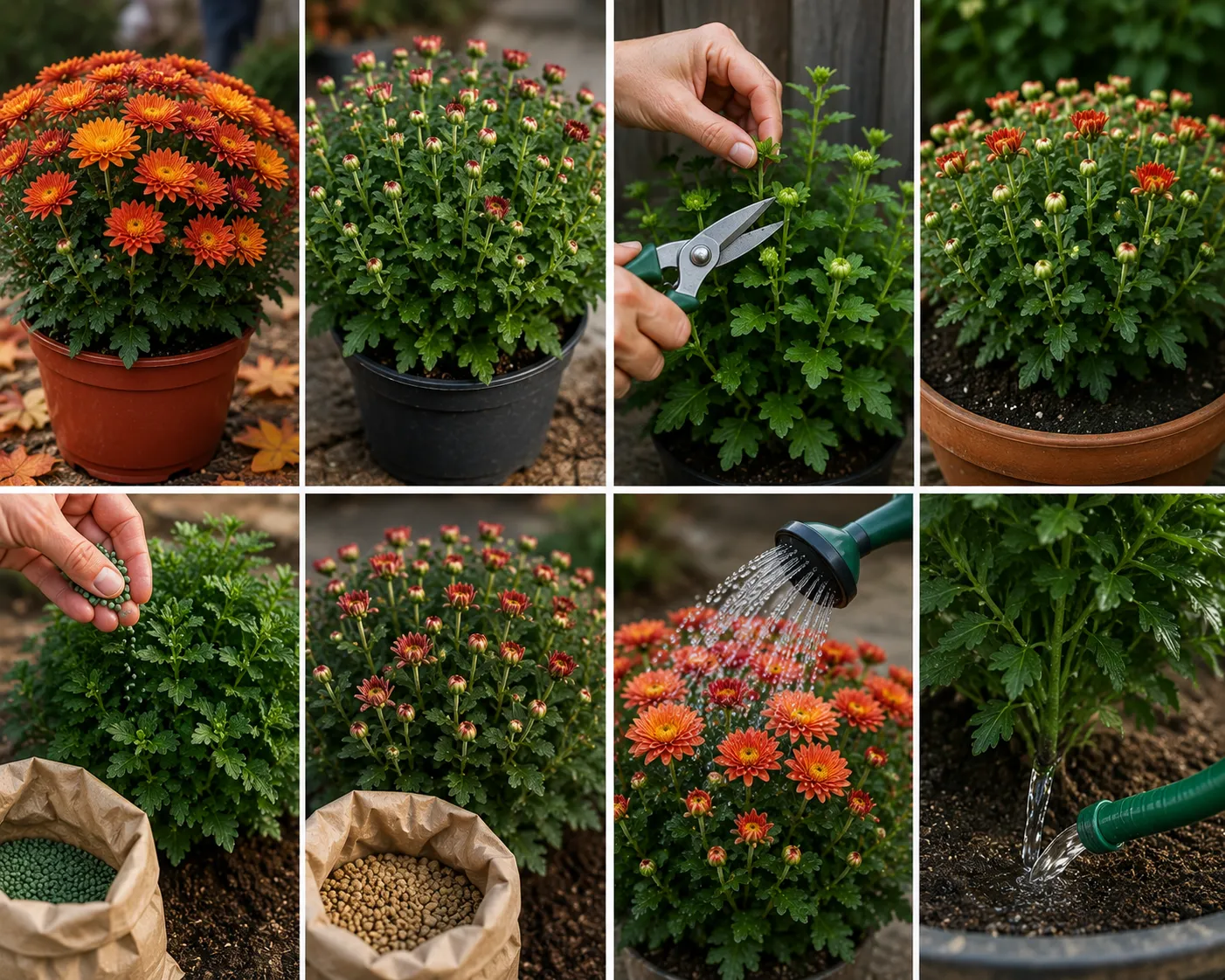
| Mistake | What Happens | Fix |
| Buying mums already in full bloom | Plant burns all energy on open flowers, fails to root properly before frost | Buy mums with mostly closed buds and a few open flowers |
| Pinching after July 15 | New buds form but cannot mature before first frost | Complete all pinching by July 10 to 15 depending on zone |
| Using high-nitrogen feed in late summer | Lush leaf growth at the expense of buds; delayed flowering | Switch to 4-12-4 or 5-10-10 formula once buds form |
| Overhead watering at midday | Wet petals fade faster; botrytis mold on flowers; root rot risk | Water at base, morning only, 1 inch per week |
Chrysanthemum Bloom Care Calendar
The 7 key actions by month for maximum bloom duration in US Zones 5 through 8:
| Month | Action | Purpose |
| March – April | Divide clumps; add compost to soil | Refresh vigor; improve drainage |
| May | First pinch at 6 in (15 cm); apply 20-20-20 | Promote branching; fuel spring growth |
| June | Second pinch; maintain 1 in (2.5 cm) water/week | Multiply bud sites; sustain moisture |
| July 1–15 | Final pinch before July 15; switch to low-N feed | Set maximum bud count; avoid late growth |
| August | Stop pinching; apply kelp/potassium feed | Protect forming buds; strengthen stems |
| Sept – Oct | Deadhead every 3–4 days; cover on frost nights | Extend bloom period; protect open flowers |
| Nov – Dec (Zones 5–6) | Apply 4–6 in (10–15 cm) mulch after first frost | Protect roots for perennial return |
Frequently Asked Questions
How long do chrysanthemums stay in bloom?
Chrysanthemums bloom for 4 to 8 weeks depending on variety, care, and weather. Hardy garden mums with proper deadheading and frost protection bloom for 6 to 8 weeks. Florist mums sold in supermarkets bloom for 2 to 4 weeks because they were grown under forced conditions and lack the root development to sustain a long bloom period outdoors.
Why do my mums stop blooming after 2 weeks?
Mums stop blooming early because of 3 problems: dead flowers left on the plant directing energy to seed production, root-bound plants from shallow nursery pots with insufficient water and nutrient uptake, or placement near artificial nighttime lighting that disrupts the dark period needed to sustain bud formation. Deadhead immediately, transplant to fresh soil with good drainage, and move plants away from nighttime light sources.
Should I cut back chrysanthemums after they finish blooming?
Yes — cut garden mums back to 4 to 6 inches (10 to 15 cm) above the ground after the first hard frost kills the foliage. Do not cut to the ground. The remaining stems mark the plant location and provide some insulation for the crown through winter. In spring, new basal shoots emerge from the base and the pruning cycle begins again.
Do chrysanthemums rebloom the same year?
No — chrysanthemums do not rebloom the same season because blooming is triggered by specific day-length conditions that occur only once per year in fall. Deadheading extends the current bloom — it does not produce a second bloom cycle. To have continuous mum color, plant early, mid, and late blooming varieties together.
Can mums survive frost?
Yes — the root system of garden mums (Chrysanthemum x morifolium) survives frost down to 0°F (minus 18°C) in USDA Zones 5 and warmer with mulch protection. The foliage and open flowers die at 28°F (minus 2°C), but the plant crown and roots survive well below freezing. Florist mums are not frost hardy and die at the first freeze in most outdoor settings.
Conclusion
Chrysanthemums bloom longer when the plant is not allowed to direct energy toward seed production. Deadheading every 3 to 4 days is the most immediate action — everything else builds on that foundation. Pinching before mid-July maximizes bud sites. Consistent base watering at 1 inch (2.5 cm) per week prevents stress that triggers early bud drop. Switching to low-nitrogen fertilizer at bud set keeps the plant in flowering mode rather than vegetative growth mode.
The biggest single improvement most gardeners can make is buying mums earlier in the season with buds still closed, rather than plants already in full bloom. A mum purchased in August with tight buds, properly pinched and fertilized through July, will produce more flowers over a longer period than any nursery mum purchased in peak bloom in September.
For gardeners in Zone 5 and 6, frost protection in October extends the season by 2 to 3 weeks — often the most color-saturated weeks of the fall garden, when open mums catch low autumn light alongside turning tree foliage. Combined with staggered early, mid, and late varieties, the strategies in this guide deliver chrysanthemum color from August through November without significant extra effort.