

There are 13 officially recognized types of chrysanthemum defined by the National Chrysanthemum Society (NCS), each classified by the shape, direction, and arrangement of its florets. Every chrysanthemum bloom — from the compact garden cushion mum on your front porch to the giant exhibition spider mum at a botanical show — belongs to one of these 13 classes.
Knowing which type you are growing changes how you care for it. Irregular incurve mums require disbudding to produce one large show bloom. Pompon types need no disbudding at all. Hardy Korean types tolerate USDA Zone 4 winters without mulch. Florist decorative types die in the first hard frost. The class determines the care — not the color, not the marketing name on the label.
Before diving into every class, it helps to understand what chrysanthemums actually are. Every bloom is a composite flower — a cluster of hundreds of tiny individual flowers called florets. Disc florets form the center. Ray florets form the “petals.” The shape and behavior of these ray florets define each of the 13 classes. For full growing and care detail, the complete chrysanthemum growing guide covers everything from soil prep to winter survival.
All 13 Chrysanthemum Types at a Glance
| Class | Type | Bloom Size | Best Use | USDA Zone |
| 1 | Irregular Incurve | 6–8 inches | Exhibition | 5–9 |
| 2 | Reflex | 4–6 inches | Cut flower / Exhibition | 5–9 |
| 3 | Regular Incurve | 4–6 inches | Exhibition / Football mums | 5–9 |
| 4 | Decorative | 1–4 inches | Garden / Florist / Cut flower | 4–9 |
| 5 | Intermediate Incurve | 4–6 inches | Exhibition / Garden | 5–9 |
| 6 | Pompon | 1–4 inches | Garden / Arrangements | 4–9 |
| 7 | Single & Semi-Double | 2–4 inches | Garden / Pollinators | 4–9 |
| 8 | Anemone | 2–4 inches | Garden / Arrangements | 5–9 |
| 9 | Spoon | 2–4 inches | Garden / Novelty | 5–9 |
| 10 | Quill | 3–5 inches | Exhibition / Cut flower | 5–9 |
| 11 | Spider | 4–8 inches | Exhibition / Cut flower | 5–9 |
| 12 | Brush & Thistle | 3–5 inches | Exhibition / Novelty | 5–9 |
| 13 | Unclassified / Exotic | Varies | Exhibition / Novelty | 5–9 |
The 13 Official Chrysanthemum Classes Explained
Class 1: Irregular Incurve
Irregular incurve chrysanthemums are the largest blooms in the entire genus — flower heads reach 6 to 8 inches (15–20 cm) across on stems up to 4 feet (120 cm) tall. Most florets curve upward and inward, creating a full dome, while the outermost florets hang loosely like a skirt. This irregular draping of lower petals is what separates this class from the more symmetrical regular incurve.
These are pure exhibition flowers. Each stem produces one bloom, achieved through disbudding — removing all side buds to direct all the plant’s energy into a single enormous head. They require staking, careful feeding, and protection from rain, which damages the petals. Bloom time is mid to late fall.
- Best for: Show gardens, exhibitions, single-bloom cut flower displays
- Popular cultivars: ‘Bola de Oro’, ‘Jessie Habgood’, ‘Gigantic’
- Care note: Disbud to one bloom per stem. Stake early. Protect from heavy rain.
Class 2: Reflex
Reflex chrysanthemums have florets that curve outward and downward from the center, creating a rounded bloom that resembles a ball or inverted mop head. The drooping petal direction is the defining feature — if the florets curve inward, it is not a reflex type.
Bloom diameter ranges from 4 to 6 inches (10–15 cm). Stems reach 2 to 3 feet (60–90 cm). These are excellent cut flowers with a long vase life and are widely used by florists. One of the most well-known cultivars is ‘Grandchild’, a mauve-pink reflex type that is also reliably hardy as a garden perennial.
- Best for: Cut flowers, florist arrangements, exhibition
- Popular cultivars: ‘Grandchild’, ‘Bronze Elegance’, ‘White Reflex’
- Care note: Disbud for large single blooms or allow to spray for multiple smaller heads
Class 3: Regular Incurve
Regular incurve chrysanthemums form a perfect, symmetrical sphere — all florets curve evenly inward to create a dense, round ball with no visible center. This class was previously named “Chinese” and produces what most people picture when they think of a classic show chrysanthemum.
Bloom diameter is 4 to 6 inches (10–15 cm). These are commonly called football mums due to their tight spherical shape. They require disbudding to develop their characteristic form and typically need staking. Bloom time is mid-fall. The symmetry demands careful cultivation — irregular growth breaks the round profile.
- Best for: Exhibition, corsages, single-bloom cut flowers
- Popular cultivars: ‘Lynn’, ‘Parade’, ‘Tracy Waller’
- Care note: Disbud to one bloom per stem. Symmetry requires consistent feeding and pinching.
Class 4: Decorative
Decorative chrysanthemums are the most common type in gardens, nurseries, and florist shops worldwide. Upper florets incurve while lower florets reflex — creating a flattened or slightly domed bloom profile rather than a perfect sphere. Bloom size ranges from 1 to 4 inches (2.5–10 cm) across depending on the cultivar.
Hardy decorative types grow reliably in USDA Zones 4 to 9 and return as perennials when planted in spring. Florist decorative types — the brightly colored mums sold at grocery stores in fall — are tender and bred for greenhouse forcing. They will not survive outdoor winters. Both types share the same bloom class but differ completely in hardiness. For a full breakdown of these differences, see the guide to growing chrysanthemums from scratch.
- Best for: Garden beds, containers, cut flowers, fall landscape color
- Popular cultivars: ‘Sheffield Pink’, ‘Hillside Sheffield’, ‘Mammoth Yellow Quill’
- Care note: Plant in spring for perennial return. Fall-planted florist types will not overwinter.
Class 5: Intermediate Incurve
Intermediate incurve types sit between the irregular incurve and regular incurve in form — smaller than Class 1 with shorter, partially incurving florets that give a looser, more open appearance than the tight sphere of Class 3. Bloom diameter ranges from 4 to 6 inches (10–15 cm).
These are versatile show flowers that also perform well as garden perennials in USDA Zones 5 to 9. They need light staking at full bloom. Bloom time is early to mid-fall. Because the florets do not close as tightly as regular incurve types, these are less demanding to cultivate to show standard.
- Best for: Exhibition, garden borders, cut flowers
- Popular cultivars: ‘Cheerleader’, ‘Golden Chalice’, ‘Emperor of China’
- Care note: Stake at 2 feet. Disbud for show blooms. No disbudding needed for garden use.
Class 6: Pompon
Pompon chrysanthemums produce small, globe-shaped blooms with fully incurving or reflexing florets that completely conceal the center. The flower starts flat when young and rounds into a perfect ball as it matures. Bloom size ranges from 1 to 4 inches (2.5–10 cm).
Button pompon types are the smallest — under 1 inch — and work as filler flowers in arrangements. Larger disbudded pompons reach nearly 4 inches and qualify for exhibition. Pompon types need no disbudding for garden use, making them the lowest-maintenance class for home gardeners. They are hardy in Zones 4 to 9, compact, and reliably prolific.
- Best for: Garden beds, containers, wedding floristry, filler arrangements
- Popular cultivars: ‘Snowflake’, ‘Bronze Elegance’, ‘Anastasia’
- Care note: No disbudding needed. Pinch in late spring for bushier growth and more blooms.
Class 7: Single and Semi-Double
Single and semi-double chrysanthemums are the most daisy-like in the genus — a flat, visible disc floret center surrounded by one row (single) or two to three rows (semi-double) of ray florets. Bloom diameter is 2 to 4 inches (5–10 cm).
The open center makes this the best class for pollinators — bees and hoverflies access the disc florets directly. Hardy in Zones 4 to 9 with minimal care. These types spread naturally over time to form wide, dense clumps. They are the most informal-looking chrysanthemum class and suit cottage gardens and naturalistic plantings.
- Best for: Pollinator gardens, cottage borders, naturalistic landscapes
- Popular cultivars: ‘Clara Curtis’, ‘Mary Stoker’, ‘Paul Boissier’
- Care note: Divide clumps every 2 to 3 years in spring to maintain vigor.
Class 8: Anemone
Anemone chrysanthemums have a raised, cushion-like center of tightly packed elongated disc florets surrounded by one or two flat rows of ray florets. The domed center is the defining feature — it looks like a pincushion sitting on top of a flat petal ring.
Bloom diameter is 2 to 4 inches (5–10 cm). The raised center creates strong visual contrast between the dome and the flat outer petals, making this class particularly striking in arrangements. Hardy in Zones 5 to 9. Anemone types are less commonly found at garden centers but are widely grown for exhibition and cut flower production.
- Best for: Cut flower arrangements, exhibition, mixed borders
- Popular cultivars: ‘Bolero’, ‘Chablis’, ‘Gompie Orange’
- Care note: Stake in exposed gardens. No disbudding required for multiple blooms.
Class 9: Spoon
Spoon chrysanthemums have ray florets with tubular shafts that open into a flat, spoon-shaped tip — the result is a bloom that looks like a semi-double with a ring of tiny spoons around the center. The disc floret center remains visible and round.
Bloom diameter is 2 to 4 inches (5–10 cm). The spoon tips often display bi-color patterns — a yellow or white tube with a differently colored spoon at the tip. This makes them one of the most visually distinctive chrysanthemum classes. Hardy in Zones 5 to 9. Popular in novelty arrangements and autumn wedding floristry.
- Best for: Novelty arrangements, wedding floristry, exhibition
- Popular cultivars: ‘Matchsticks’ (gold-yellow spoons with red tips), ‘Kimie’, ‘Starlet’
- Care note: Spoon tips damage in heavy rain. Grow under shelter or in containers for best results.
Class 10: Quill
Quill chrysanthemums have straight, tubular ray florets with open tips — each petal is a clean, hollow tube, giving the bloom a precise, architectural quality. The bloom is fully double with no visible center disc. Bloom diameter is 3 to 5 inches (7.5–12.5 cm).
The straight geometry of quill petals makes this class stand apart from every other type. No curving, no reflexing — pure vertical tubes radiating from the center. These are primarily exhibition and specialty cut flowers. The clean lines photograph exceptionally well, making them popular in floral design editorial work. Hardy in Zones 5 to 9.
- Best for: Exhibition, specialty cut flowers, editorial floristry
- Popular cultivars: ‘Mammoth Yellow Quill’, ‘Anastasia Green’, ‘Ivory Quill’
- Care note: Disbud to one bloom per stem for exhibition. Allow sprays for garden use.
Class 11: Spider
Spider chrysanthemums have long, fine tubular ray florets that may coil, hook, or droop at the tips — creating a dramatic, spidery appearance that is unlike any other flower in the garden. Bloom diameter ranges from 4 to 8 inches (10–20 cm). The florets may be very fine and hair-like or thicker and more pronounced depending on the cultivar.
Spider mums are among the most striking cut flowers available. Florists prize them for arrangements requiring strong visual texture. They are primarily tender exhibition types — not suitable for outdoor winter survival in most zones without significant protection. Do not confuse florist spider mums with hardy garden chrysanthemums — these require greenhouse growing conditions to reach their full potential.
- Best for: Specialty cut flower arrangements, exhibition, botanical floral design
- Popular cultivars: ‘Anastasia’, ‘Cremon’, ‘Fuji’ series
- Care note: Primarily tender. Grow as annuals outdoors or in greenhouse. Disbud for show blooms.
Class 12: Brush and Thistle
Brush and thistle chrysanthemums have narrow, tubular ray florets that grow at right angles to the stem, producing a bloom that looks bristled, spiked, or thistle-like rather than rounded. Some cultivars within this class have florets that angle sharply upward, resembling a stiff paintbrush.
This is a specialty exhibition class with limited commercial availability. Bloom diameter is 3 to 5 inches (7.5–12.5 cm). The unusual geometry makes these striking specimens at shows and as solo cut flowers, but they have little commercial garden market. Hardy in Zones 5 to 9 when managed correctly.
- Best for: Exhibition, novelty arrangements, botanical collectors
- Popular cultivars: ‘Oasis’, ‘Wisp’, limited named cultivars
- Care note: Rare in mainstream nurseries. Source from specialist chrysanthemum growers.
Class 13: Unclassified / Exotic
The unclassified and exotic class covers chrysanthemum blooms that do not fit cleanly into any of the 12 preceding classes due to unusual petal structure, mixed form characteristics, or highly irregular floret arrangement. New cultivars with genuinely novel bloom architecture are placed here until the NCS classifies them formally.
This class also includes chrysanthemums with mixed-form blooms — for example, a flower with both quill and spoon characteristics on the same head. Exhibition judges evaluate these on overall presentation and uniqueness rather than conformity to a fixed form standard.
- Best for: Exhibition novelty classes, botanical curiosity, specialist collectors
- Care note: Treat according to the closest matching class in terms of bloom structure and growth habit.
Chrysanthemum Types by Use
The 13 NCS classes group chrysanthemums by bloom form. For practical gardening decisions, it helps to also understand them by intended use — garden, cut flower, exhibition, or container.
Garden and Landscape Types
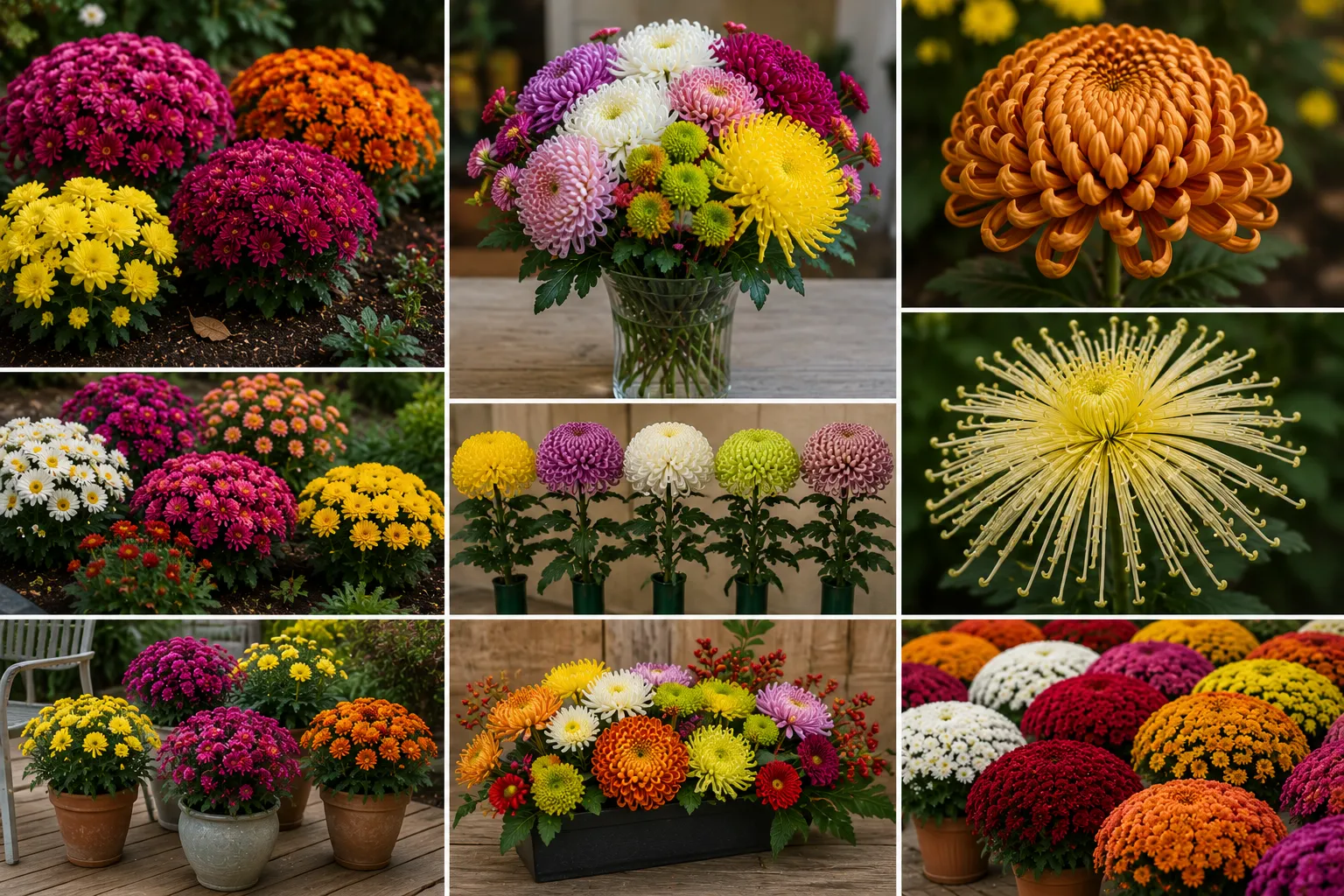
Decorative (Class 4), Pompon (Class 6), and Single/Semi-Double (Class 7) are the 3 best choices for garden use. All 3 types are available as hardy perennial cultivars in USDA Zones 4 to 9, require minimal maintenance, and return reliably each year when planted in spring.
Hardy garden mums — the ones that actually come back every year — need to be planted in spring, not fall. Fall-planted mums from nurseries are usually florist types that have already bloomed and lack the root establishment to survive winter. Planting chrysanthemums at the right time is the single biggest factor in whether they return as perennials.
Cut Flower Types
Reflex (Class 2), Spider (Class 11), Quill (Class 10), and Pompon (Class 6) are the 4 types most used as cut flowers. Spray chrysanthemums — a stem type rather than a bloom class — produce 5 to 10 smaller blooms per stem and dominate the commercial cut flower trade. Standard chrysanthemums produce one large bloom per disbudded stem.
Cut chrysanthemums last 10 to 21 days in a vase with clean water, recut stems, and no direct heat or sunlight. They are among the longest-lasting cut flowers commercially available.
Exhibition Types
Irregular Incurve (Class 1), Regular Incurve (Class 3), Spider (Class 11), and Brush and Thistle (Class 12) are the primary exhibition classes. Exhibition mums require disbudding, staking, precise feeding schedules, and — for many types — greenhouse growing conditions. They are not suited to low-maintenance garden planting.
The National Chrysanthemum Society runs competitive shows every autumn where growers exhibit blooms judged on size, symmetry, stem quality, and adherence to class form standards.
Container and Patio Types
Cushion mums — a marketing term for compact decorative and pompon types — are the best chrysanthemums for containers. They grow 30 to 45 cm (12 to 18 inches) tall and wide, require no staking, and produce masses of blooms through the fall season. Choose hardy cultivars, not florist types, if you want the plant to overwinter in its container.
Chrysanthemum Types by Cold Hardiness
Hardiness is one of the most misunderstood aspects of chrysanthemum selection. There are 3 distinct hardiness groups:
Hardy Perennial Types — USDA Zones 4 to 9
Hardy garden mums return reliably each spring when planted in the right conditions. The hardiest cultivars — including the Mammoth series and Korean types (Chrysanthemum zawadskii) — survive USDA Zone 3 winters with minimal protection. Korean chrysanthemums are native to Siberia, Mongolia, and northern China. They produce daisy-like blooms in late summer, bloom earlier than other classes, and tolerate heavier soils and more neglect than exhibition types.
- Hardiest types: Korean (C. zawadskii), Mammoth series, ‘Clara Curtis’, ‘Sheffield Pink’
- Key requirement: Plant in spring, not fall. Roots must establish all summer for winter survival.
Moderately Hardy Types — USDA Zones 5 to 9
Most decorative, pompon, and single/semi-double types are hardy in Zones 5 to 9 with spring planting. They survive Zone 5 winters reliably but may need a light mulch layer in Zone 5 and 6 after the ground freezes. These are the chrysanthemums sold at mainstream garden centers as “hardy mums” in spring.
Tender Exhibition and Florist Types — Annual Use
Spider mums, most irregular incurve types, and florist decorative mums are tender and will not survive outdoor winters in most of North America. They are grown as annuals outdoors, in greenhouses, or as temporary indoor color. The fall mums sold in full bloom at grocery stores in September are almost always this type.
The complete explanation of these 3 types — including how to tell them apart at the nursery — is covered in the chrysanthemum complete care and growing guide.
Chrysanthemum Color Varieties
Chrysanthemums come in every color except true blue — the full spectrum from white, cream, and pale yellow through gold, orange, bronze, red, burgundy, pink, purple, lavender, and near-black. Bi-color and gradient cultivars produce two-tone blooms, and some cultivars change color slightly as the bloom ages.
Color classification by type:
- White and cream: ‘Anastasia White’, ‘Snowflake’, ‘White Spider’ — used in sympathy floristry and wedding work
- Yellow and gold: ‘Bola de Oro’, ‘Golden Cascade’, ‘Mammoth Yellow Quill’ — classic autumn garden color
- Bronze and orange: ‘Bronze Elegance’, ‘Hillside Sheffield Pink’ — peak autumn palette
- Red and burgundy: ‘Red Bronze’, ‘Garnet’ — deep rich tones, strong cut flower performance
- Pink and lavender: ‘Clara Curtis’, ‘Grandchild’, ‘Mary Stoker’ — softer tones for cottage gardens
- Bi-color (spoon tip): ‘Matchsticks’ — gold-yellow tubes with fiery red spoon tips
How to Choose the Right Chrysanthemum Type
Choosing the wrong type is the most common chrysanthemum mistake. Match the type to the intended use before selecting a cultivar or color:
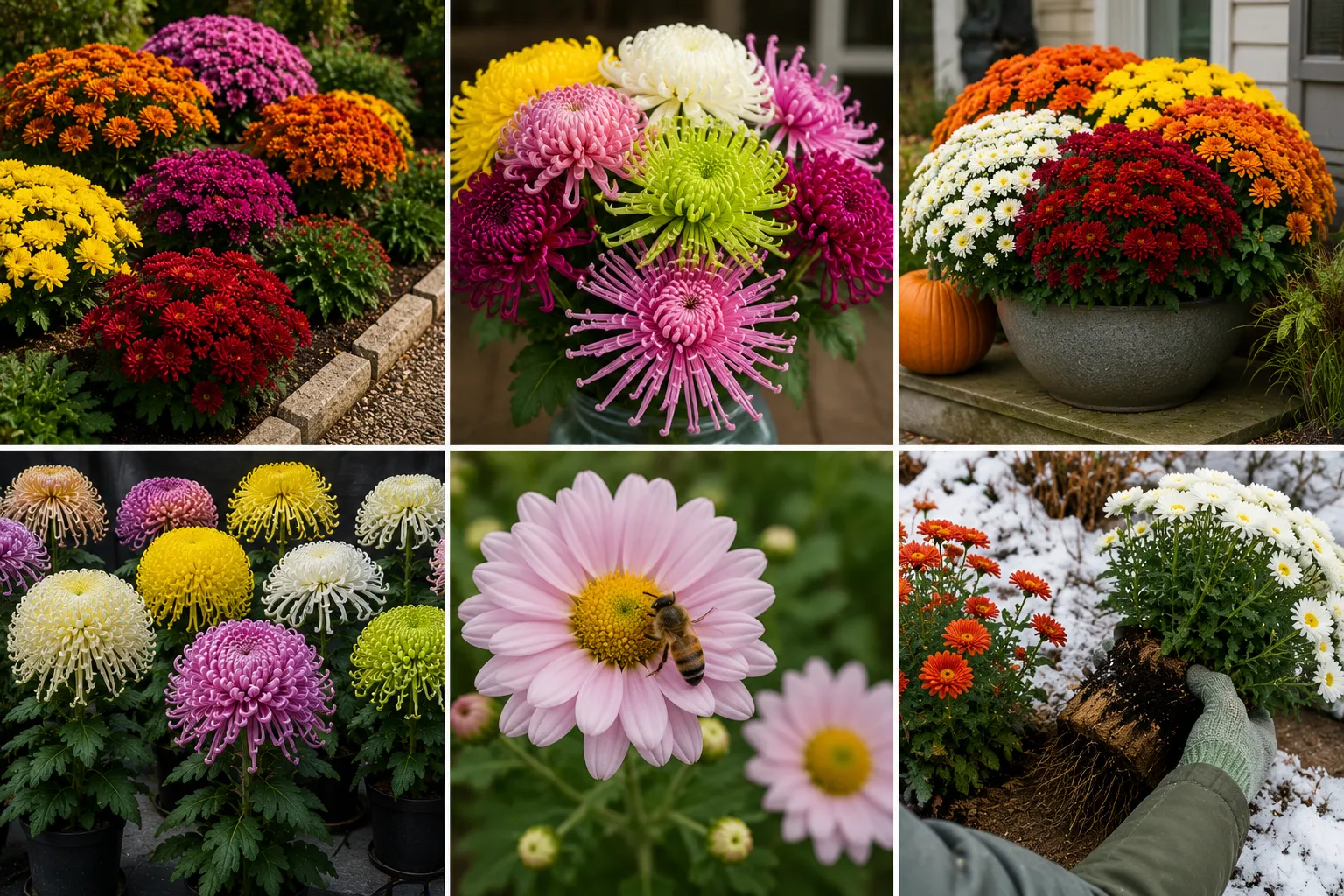
- For a low-maintenance garden that returns every year: Choose hardy decorative, pompon, or single/semi-double types. Plant in spring.
- For cut flowers with long vase life: Choose reflex, pompon, or spider types. Source from specialist growers for best stem length.
- For fall seasonal color in containers: Choose cushion/compact decorative types. These work as annuals; select hardy types if you want them to return.
- For exhibition and show gardens: Choose irregular incurve, regular incurve, or spider types. Requires disbudding, staking, and controlled growing conditions.
- For pollinators and wildlife gardens: Choose single or semi-double types only. The open center disc is accessible to bees and hoverflies — all other types block pollinator access.
- For cold climates (Zone 4 and colder): Choose Korean types (Chrysanthemum zawadskii) or Mammoth series cultivars. These are the only types that reliably survive severe winters.
Frequently Asked Questions
What is the difference between garden mums and florist mums?
Garden mums are hardy perennials bred for outdoor survival in USDA Zones 4 to 9. Florist mums are tender cultivars forced to bloom under controlled greenhouse light conditions. Both are Chrysanthemum morifolium hybrids and often belong to the same NCS bloom class — the difference is hardiness, not flower form. Florist mums sold in fall at stores will not survive outdoor winters.
Which chrysanthemum type lives the longest in a vase?
Pompon and reflex types last the longest as cut flowers — typically 14 to 21 days with clean water, recut stems, and cool temperatures away from direct sun. Spider mums and decorative types average 10 to 14 days. Single types last the shortest — 7 to 10 days — because their open centers lose moisture faster.
What is the easiest chrysanthemum to grow?
Hardy decorative and pompon types are the easiest to grow successfully as garden perennials. They need full sun, well-drained soil, and a spring planting date. No disbudding, no staking, and no greenhouse required. The Mammoth series is specifically bred for extreme cold hardiness and minimal maintenance.
Are all chrysanthemum types edible?
No — only food-grade Chrysanthemum morifolium and Chrysanthemum indicum flowers are safe to consume. Exhibition and florist types are grown with pesticides not approved for food use. Chrysanthemum tea and culinary use require certified organic, food-grade dried flowers — never florist or nursery stock.
Do all chrysanthemum types bloom in fall?
No — Korean types (Chrysanthemum zawadskii) bloom in late summer, 4 to 6 weeks earlier than most garden mums. Standard garden decorative and pompon types bloom September through November. Exhibition types are often manipulated with artificial light to bloom on a precise schedule for show dates. A few specialty cultivars bloom in early spring.
Final Thoughts
All 13 chrysanthemum types share the same composite flower architecture — disc florets at the center, ray florets forming the bloom — but diverge dramatically in size, petal direction, hardiness, and intended use. Irregular incurve types produce the largest single blooms on earth at 8 inches across. Korean single types survive Zone 3 winters and spread naturally without any attention. Spider mums create dramatic cut flower displays that last three weeks in a vase.
The most useful thing to understand is the difference between hardy garden types and tender exhibition or florist types. That single distinction — more than any other factor — determines whether your chrysanthemums come back year after year or die with the first hard frost.
Pick the type that matches your actual goal. Then plant at the right time, in the right location, with the right spacing. Everything else follows.