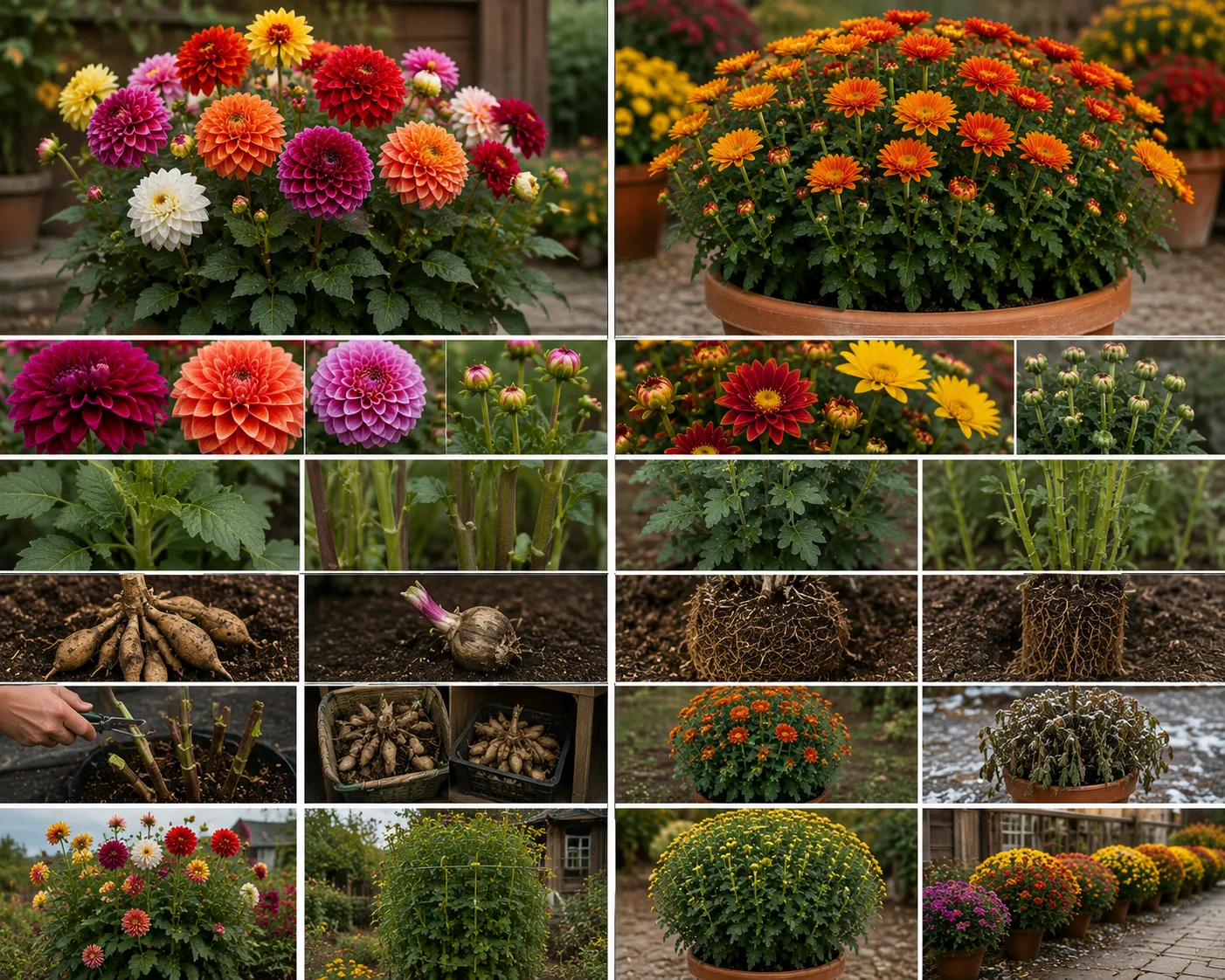
Dahlias and chrysanthemums are both members of the Asteraceae family, but 10 clear differences separate them — in root structure, bloom size, hardiness, bloom trigger, fragrance, winter care, vase life, pollinator value, edibility, and cultural symbolism. Knowing which flower fits your goals saves time, money, and the frustration of a plant that performs poorly in your conditions.
Both flowers bloom from summer into fall, share similar color ranges, and appear in nearly every garden center across the US — which is exactly why gardeners confuse them. Up close, a decorative dahlia and a chrysanthemum incurve look almost identical. The differences that actually matter for growing them are below the soil, in the calendar, and in how each plant responds to cold.
This article covers all 10 differences with specific measurements, USDA zone guidance, and a full comparison table. For a deeper look at the individual chrysanthemum varieties mentioned here, the complete guide to chrysanthemum types covers all 13 NCS-defined classes. For care tips that extend bloom time on both flowers, the chrysanthemum blooming guide has detailed seasonal timing.
Dahlia vs Chrysanthemum — Quick Comparison
The table below covers the 10 most important differences at a glance. Detailed explanations follow each point.
| Category | Dahlia | Chrysanthemum |
| Botanical family | Asteraceae — genus Dahlia (40+ species) | Asteraceae — genus Chrysanthemum (30+ species) |
| Origin | Mexico and Central America (Aztec cultivation) | China and East Asia (3,000+ years cultivation) |
| Root type | Tuberous — thick fleshy storage roots | Fibrous crown — spreading rhizomatous root clumps |
| Plant height | 1 to 6+ ft (30 cm to 1.8+ m); tall types need staking | 6 in to 3 ft (15 cm to 90 cm); compact and bushy |
| Bloom diameter | Less than 1 in to 12+ in (2.5 cm to 30+ cm) | 1 to 6 in (2.5 cm to 15 cm) |
| Bloom season | Midsummer (July) through first frost | Late summer to fall (Aug–Nov) |
| Bloom trigger | Day-length independent (not photoperiodic) | Short-day plant — blooms when nights exceed 9.5 hrs |
| USDA hardiness | Zones 8–11 in ground; Zones 3–7 lift tubers | Zones 5–9 as perennial; Zone 4 with heavy mulch |
| Fragrance | Virtually none in most varieties | Moderate to strong in most garden varieties |
| Vase life (cut flower) | 5 to 8 days | 10 to 21 days |
1. Root Structure — Tubers vs Fibrous Crown
Dahlias grow from tubers — fleshy, potato-like storage roots that must be dug up and stored indoors in USDA Zones 3 through 7 before the first frost. Chrysanthemums grow from a fibrous crown of roots that spreads slowly outward and survives winter in the ground in Zones 5 through 9 without digging.
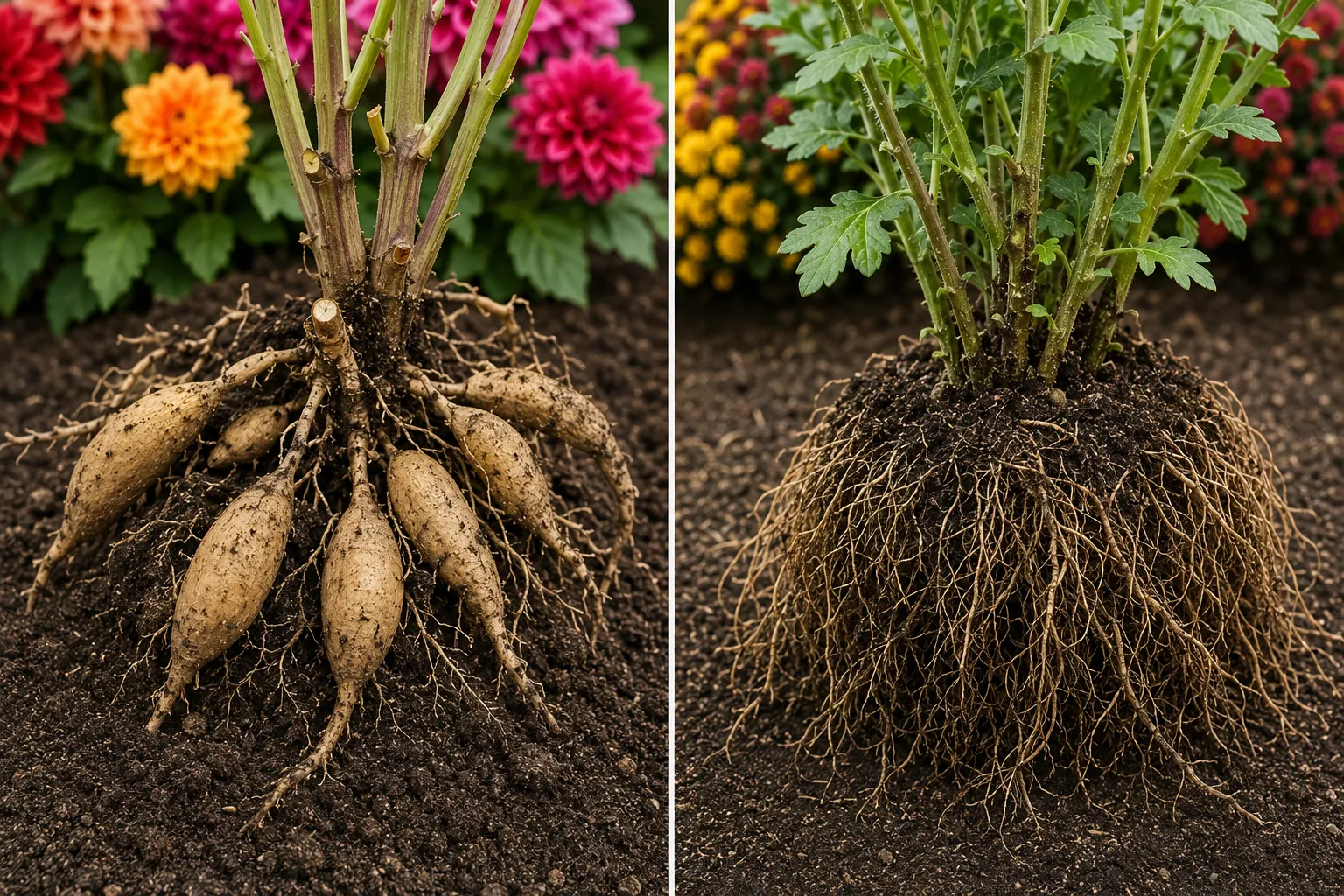
Dahlia tubers are grouped in clusters attached to a central stem. Each tuber stores enough energy to support a full plant the following season, which is why dahlia tubers are divided and sold individually as planting stock. A single dahlia plant produces 5 to 12 new tubers per season. Tubers must be stored at 40 to 50°F (4 to 10°C) in slightly moist peat or vermiculite through winter — too dry and they shrivel, too wet and they rot.
Chrysanthemum crowns spread 2 to 4 inches (5 to 10 cm) per year. Dividing chrysanthemum clumps every 2 to 3 years in spring keeps plants vigorous — older central sections become woody and produce fewer flowers. Discard the old center section and replant the younger outer shoots with roots attached. For step-by-step division timing, the shrub propagation guide covers the same division principles that apply to perennial clumps.
Practical takeaway: Choose chrysanthemums if you want a plant that returns every year without digging. Choose dahlias if you want maximum bloom size and are willing to lift and store tubers each fall in Zones 3 through 7.
2. Bloom Size — Compact Mums vs Dinner-Plate Dahlias
Chrysanthemum blooms range from 1 to 6 inches (2.5 to 15 cm) in diameter across all 13 NCS-defined classes. Dahlia blooms range from under 1 inch (2.5 cm) in pompon types to over 12 inches (30 cm) in dinner-plate varieties — a size range no other common garden flower matches.
The largest dahlia class — dinner-plate (also called giant decorative) — produces individual flowers wider than a standard dinner plate at 10 to 14 inches (25 to 35 cm) across. These require heavy staking, individual disbudding of all side buds to direct energy into one flower per stem, and protection from wind. ‘Café au Lait’, ‘Thomas Edison’, and ‘Penhill Dark Monarch’ are 3 widely grown dinner-plate varieties in the US.
Chrysanthemum size stays more consistent across variety types. Even the largest chrysanthemum class — irregular incurve — produces blooms of 5 to 6 inches (12 to 15 cm). Cushion mums, the most common garden type, produce 1 to 2 inch (2.5 to 5 cm) blooms in the hundreds per plant. For a full breakdown of sizes by chrysanthemum class, the chrysanthemum types guide lists each class with exact bloom size ranges.
3. Bloom Time — Dahlias Start Earlier and Last Longer
Dahlias begin blooming in July in most US zones and continue until the first killing frost — a bloom window of 3 to 4 months. Chrysanthemums begin blooming in late August at the earliest, with most garden varieties peaking in September and October — a bloom window of 6 to 10 weeks.
This difference matters most in short-season climates. In Zone 5, where the first hard frost arrives in early October, a dahlia planted in May has 4 full months of bloom. A chrysanthemum in the same garden has 6 to 7 weeks. In Zone 7 and warmer, chrysanthemums often bloom through November and occasionally into December in mild years, narrowing the gap considerably.
Dahlia bloom time is not fixed to a specific calendar date — dahlias bloom based on plant maturity, not day length. A tuber planted in April blooms in July. The same tuber planted in June blooms in September. Chrysanthemum bloom time is locked to shortening day length (photoperiodism) — no matter when chrysanthemums are planted, buds form only when nights consistently exceed 9.5 hours, which occurs in late August through September in most US locations.
4. Hardiness — Chrysanthemums Win in Cold Climates
Chrysanthemums survive winters as perennials in USDA Zones 5 through 9 in the ground with basic mulch protection. Dahlias are cold-hardy only in Zones 8 through 11 — in all colder zones, the tubers die in the ground when soil temperatures drop below 28°F (minus 2°C).
Gardeners in Zones 3 through 7 growing dahlias must dig tubers every fall after the first frost blackens the foliage, cure them at room temperature for 2 to 3 days to dry the cut surfaces, then store them at 40 to 50°F (4 to 10°C) through winter. Tubers that freeze go soft and are not viable for the following season. The annual digging, drying, and storage cycle adds 2 to 3 hours of work per plant per year.
Chrysanthemums in Zone 5 survive with a 4 to 6 inch (10 to 15 cm) layer of shredded leaf or straw mulch applied after the first hard frost. Zone 4 gardeners can overwinter chrysanthemums in an unheated garage or cold frame, potted up with roots intact. Hardy Korean chrysanthemum varieties — ‘Sheffield Pink’, ‘Ryan’s Pink’, and ‘Hillside Pink Sheffield’ — are the 3 most reliably perennial options for Zone 4 to 5 conditions.
5. Plant Height and Staking Needs
Chrysanthemums grow 6 inches to 3 feet (15 cm to 90 cm) tall and stay naturally compact and bushy without staking. Dahlias grow 1 foot to over 6 feet (30 cm to 1.8+ m) tall, and any variety over 3 feet (90 cm) requires staking to prevent wind damage and stem collapse at bloom time.
Stake dahlias at planting time — not after the plant has grown — to avoid root damage. Drive a 5 to 6 foot (1.5 to 1.8 m) wooden or metal stake 12 inches (30 cm) into the ground 4 to 6 inches (10 to 15 cm) from the tuber. Tie growing stems to the stake loosely every 12 to 18 inches (30 to 45 cm) of height using soft plant ties or pantyhose strips that do not cut into the stem.
Chrysanthemum height depends on whether pinching was done correctly in spring and early summer. Unpinched chrysanthemums grow tall and open, reaching 3 feet (90 cm) and flopping outward at bloom time. Chrysanthemums pinched twice — once in May and once in early July — stay compact at 18 to 24 inches (45 to 60 cm) and hold their shape without stakes. Tall-growing mum varieties like ‘Gethsemane Moonlight’ (yellow, 4 ft / 1.2 m) are the exception and benefit from light staking.
6. Care Requirements — Watering, Feeding, and Pinching
Dahlias need more water and fertilizer than chrysanthemums — water dahlias 1 to 2 inches (2.5 to 5 cm) per week and feed every 3 to 4 weeks with a balanced fertilizer. Chrysanthemums need 1 inch (2.5 cm) of water per week and 2 fertilizer applications per season — once in May with 20-20-20 and once in July switching to a low-nitrogen formula.
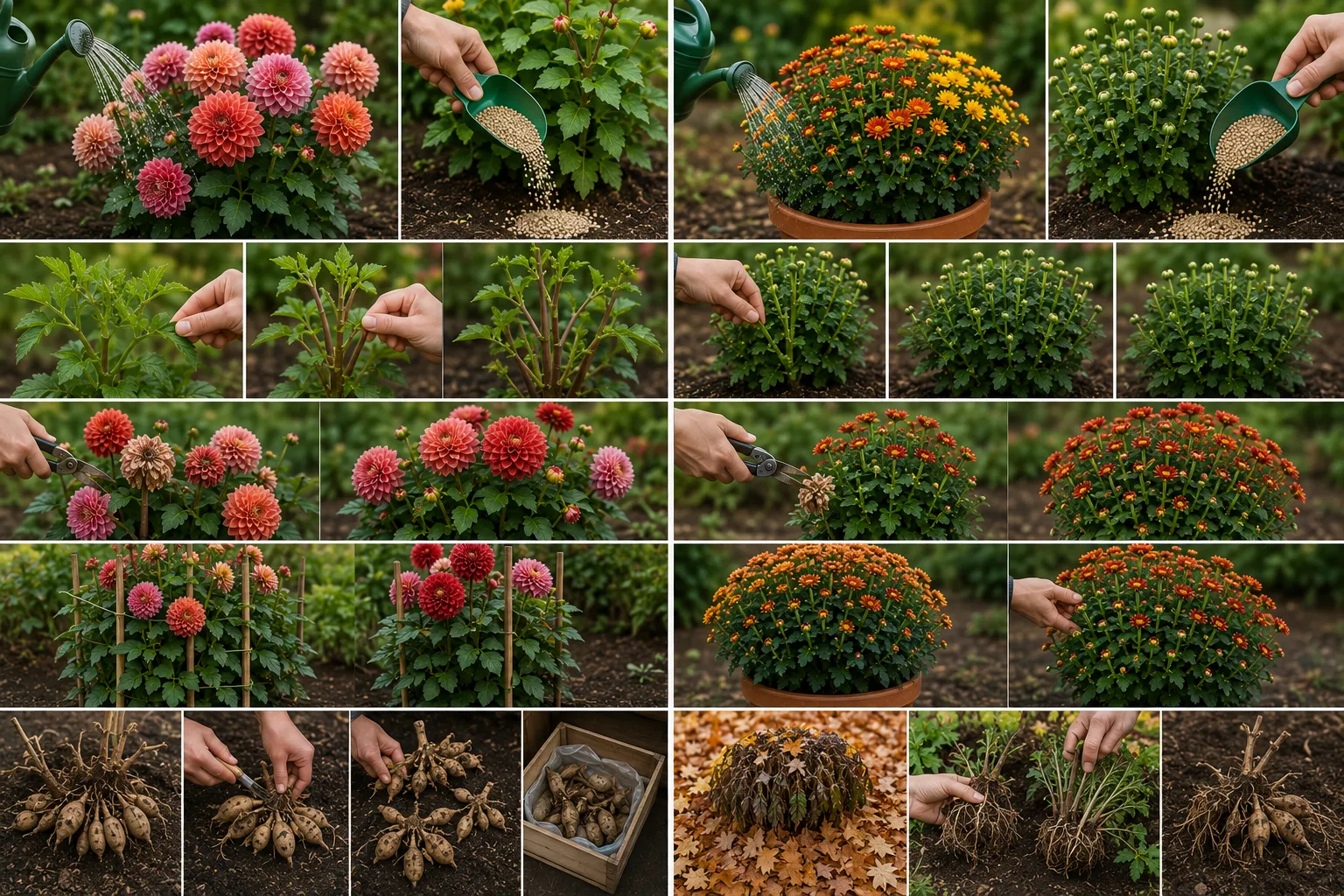
| Care Task | Dahlia | Chrysanthemum |
| Weekly water | 1–2 in (2.5–5 cm); more in heat | 1 in (2.5 cm); consistent moisture |
| Fertilizer schedule | Every 3–4 weeks, balanced NPK | May 15 (20-20-20) + July 15 (low-N) |
| Pinching | Pinch to 6 in (15 cm) once in spring | Pinch twice: May + early July (stop July 15) |
| Deadheading | Remove spent blooms 2–3x per week | Remove spent blooms every 3–4 days |
| Staking | Required for varieties over 3 ft (90 cm) | Not required for pinched plants |
| Winter care | Dig tubers in Zones 3–7; store at 40–50°F | Mulch 4–6 in after first frost (Zones 5–6) |
| Division | Divide tubers at planting each spring | Divide crown clumps every 2–3 years in spring |
7. Cut Flower Performance — Vase Life and Stem Strength
Chrysanthemums last 10 to 21 days in a vase — 2 to 3 times longer than dahlias, which last 5 to 8 days after cutting. This makes chrysanthemums the professional florist’s choice for arrangements that need to hold up over multiple days, while dahlias are used for high-impact same-day events where stem longevity is less critical.
Cut dahlias at the correct stage: harvest when the outer 2 rows of petals are fully open and the center is still slightly closed. Dahlias harvested too early collapse before opening. Cut stems in the early morning when carbohydrate levels are highest in the stem tissue. Immediately place cut dahlia stems in warm water — 100 to 110°F (38 to 43°C) — for 1 hour before arranging. This conditioning step adds 1 to 2 days of vase life compared to unconditioned stems placed directly in cold water.
Cut chrysanthemums last longest when stems are cut at a 45-degree angle and placed in clean water with a floral preservative containing sugar, biocide, and acidifier. Change the water every 2 to 3 days. Remove any foliage that falls below the water line immediately — submerged leaves rot within 24 hours and introduce bacteria that block water uptake through the stem.
8. Fragrance — Chrysanthemums Smell, Dahlias Do Not
Most chrysanthemum varieties produce a moderate to strong herbal-spicy fragrance, while the vast majority of dahlia varieties have no detectable scent. The chrysanthemum fragrance comes from camphor and terpenoid compounds in the leaves and petals — the same compounds responsible for the chrysanthemum’s traditional use in herbal teas and medicinal preparations in East Asian cultures.
Fragrance intensity varies by chrysanthemum class. Single and semi-double chrysanthemums (Class 7 per NCS classification) produce the strongest scent because the disc florets — which contain the highest concentration of aromatic compounds — are fully exposed. Highly incurved varieties like regular incurve mums (Class 3) have partially enclosed disc florets and produce a milder fragrance. The dahlia’s scentlessness is a fixed botanical trait — selective breeding has not produced fragrant dahlia varieties despite more than 200 years of dahlia hybridization.
9. Pollinator Value — Dahlias Lead for Open Blooms
Single and semi-double dahlia varieties with open centers attract more pollinators than most chrysanthemum forms because the dahlia disc florets are fully accessible to bees and butterflies. Fully double chrysanthemums — incurve and reflex classes — provide little to no nectar access for pollinators because the dense petal layers block entry to the disc florets entirely.
For maximum pollinator benefit from dahlias, grow open-centered varieties: ‘Bishop of Llandaff’ (red, single), ‘Karma Choc’ (dark purple-brown, semi-double), and ‘Yellow Hammer’ (yellow, single) are 3 reliable pollinator-supporting varieties. For chrysanthemums, single and anemone classes (Classes 7 and 8 per NCS) provide the best pollinator access. Both flowers bloom in fall when pollinator forage plants become scarce — even partially accessible blooms provide significant late-season value for honey bees building winter stores.
10. Cultural Uses — Medicine, Food, and Symbolism
Chrysanthemums have 3,000 years of documented use in food, medicine, and cultural symbolism — dahlias have a shorter history of cultural use outside ornamental cultivation and the Aztec’s original use of tubers as food. Both flowers carry cultural significance, but the chrysanthemum’s role extends further into medicine, cuisine, and national identity.
Chrysanthemum flowers are used in East Asian cuisine — petals are added to soups and salads in Chinese and Japanese cooking, and dried flowers are sold in Asian grocery stores across the US for brewing chrysanthemum tea (juhua cha). The flowers are rich in antioxidants and have been used in traditional Chinese medicine for 2,000 years to treat fever, headache, and hypertension. Chrysanthemums also produce pyrethrins — natural insecticidal compounds extracted from the flowers and used in commercial pest control products and pet flea treatments.
Dahlia tubers were cultivated by the Aztecs as a food crop before Spanish colonizers introduced the flower to Europe in the early 17th century. Raw dahlia tubers have a crisp, slightly sweet flavor similar to water chestnut or jicama and were eaten raw or cooked. The dahlia is Mexico’s national flower — officially designated in 1963. In Western wedding floristry, dahlias represent dignity, inner strength, and new beginnings. Chrysanthemums carry dual symbolism: longevity and joy in Asian cultures, and remembrance in many European traditions.
Dahlia or Chrysanthemum: Which Is Right for Your Garden?
The answer depends on 4 specific garden conditions. Match your situation to the recommendation below.
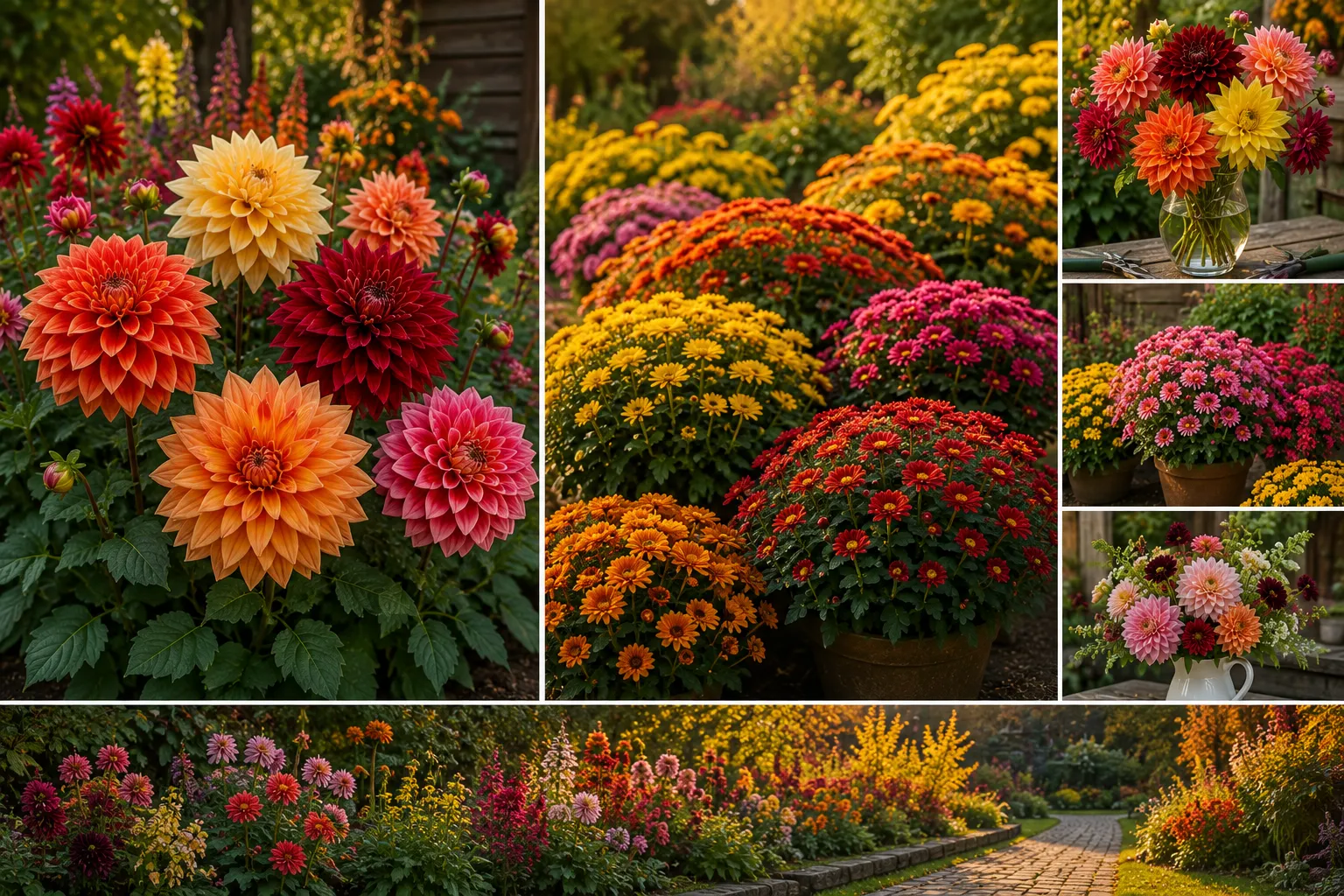
Choose chrysanthemums if:
- You garden in Zones 5 to 7 and do not want to dig and store plants every fall.
- You want low-maintenance fall color that returns reliably as a perennial year after year.
- You need long-lasting cut flowers that hold up for 2 to 3 weeks in a vase or arrangement.
- Your garden has limited space and compact, bushy plants that need no staking suit the layout better.
- You want fragrant flowers for garden enjoyment or for drying and using in herbal teas.
Choose dahlias if:
- You want the largest, most dramatic blooms possible — nothing else matches a 12-inch dinner-plate dahlia for visual impact.
- You garden in Zones 8 to 11 where tubers survive winter in the ground without digging.
- You want blooms from July through frost rather than the shorter chrysanthemum season of August through October.
- You grow cut flowers for events or floral design where large, dramatic blooms are the focal point of arrangements.
- You want to attract bees and butterflies with open-centered single and semi-double varieties all summer long.
Grow both: The most effective fall garden strategy is pairing early-season dahlias with mid and late chrysanthemums. Dahlias carry color from July through September. Chrysanthemums take over in October through November when frost kills the dahlias. The 2 flowers rarely compete because dahlias wind down just as chrysanthemums peak.
Frequently Asked Questions
Are dahlias and chrysanthemums the same flower?
No — dahlias and chrysanthemums are different genera within the Asteraceae family. Dahlias belong to the genus Dahlia (native to Mexico) and chrysanthemums belong to the genus Chrysanthemum (native to China). They are distant botanical relatives in the same family as daisies and sunflowers, but they differ in root type, bloom trigger, hardiness, fragrance, and winter care requirements.
Which flower is easier to grow — dahlia or chrysanthemum?
Chrysanthemums are easier to grow for most US gardeners in Zones 5 through 7 because they return as perennials without digging. Dahlias produce more dramatic blooms but require annual tuber lifting and storage in most US climates. In Zones 8 through 11, dahlias require no more effort than chrysanthemums because tubers survive winter in the ground.
Do dahlias and chrysanthemums bloom at the same time?
Partially — dahlias bloom from July through the first frost while chrysanthemums bloom from late August through November. The 2 flowers share an overlap period of roughly 6 to 8 weeks in September and October. Dahlias bloom earlier and chrysanthemums bloom later, making them complementary rather than competing plants in a fall garden.
Which lasts longer in a vase — dahlia or chrysanthemum?
Chrysanthemums last 10 to 21 days in a vase, compared to 5 to 8 days for dahlias. Chrysanthemums are the professional cut flower standard for longevity, which is why they are one of the most commercially grown cut flowers worldwide. Dahlias are favored for their bloom size and visual impact despite the shorter vase life.
Can dahlias and chrysanthemums be planted together?
Yes — dahlias and chrysanthemums grow well together in the same bed because their bloom windows stagger naturally rather than competing. Plant dahlias toward the back of a border where height and staking needs are less disruptive. Place cushion mums in front, where the compact form fills space neatly. Together, the 2 flowers deliver continuous color from July through November in most US zones.
Conclusion
Dahlias and chrysanthemums look similar enough to confuse at a garden center, but the 10 differences in this guide reveal two plants with very different growing requirements and strengths. The root structure difference alone determines the entire winter care routine: chrysanthemums stay in the ground and return in spring, dahlias go into a paper bag in the garage.
For gardeners in cold US climates — Zones 3 through 7 — chrysanthemums deliver reliable perennial color with minimal effort. For gardeners willing to invest in annual tuber storage in exchange for the most dramatic large-flowered display possible, dahlias are unmatched. Most experienced gardeners grow both, using the 3 to 4 month dahlia bloom window to carry summer color and the chrysanthemum season to close out fall with dense, long-lasting display that survives light frosts.
The decision rarely comes down to one flower or the other. Grow dahlias for July through September impact. Grow chrysanthemums for October through November color. Together, they cover the full late-season garden calendar from first summer heat through the last warm days before hard frost.