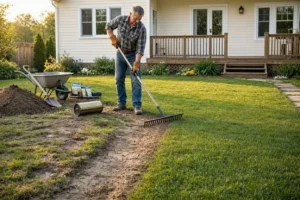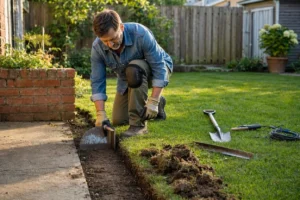
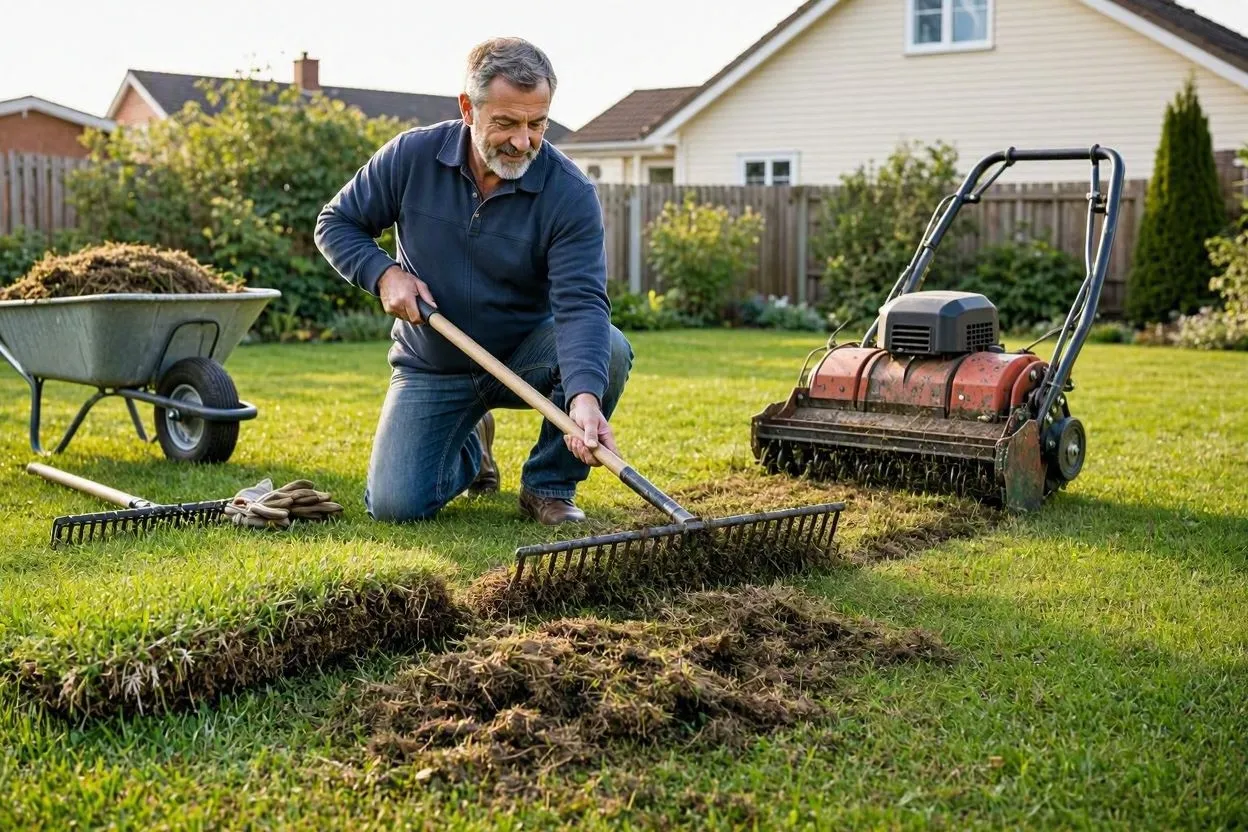
Thatching a lawn means removing the layer of dead stems and roots that builds up above the soil. The job follows five stages: measure the thatch, mow short, run a rake or dethatching machine over the turf, clear the debris, then overseed the thin spots. It only pays off when the thatch layer is thicker than ½ inch (1.3 cm) and the grass is actively growing. Get the timing wrong and a power rake will tear out more healthy turf than thatch, which is the single most common way this job backfires on homeowners.
This guide walks through how to thatch a lawn from diagnosis to full recovery: grass types, regional timing, which tool actually fits your lawn, realistic costs, and the aftercare that decides whether your yard comes back thicker or thinner. It also flags where the marketing around dethatching (especially liquid “dethatchers”) gets ahead of what university turf research actually supports.
What Does It Mean to Thatch a Lawn?
“Thatching” and “dethatching” a lawn are the same job. Both terms mean removing excess thatch from the turf. The confusion traces back to the thatching rake, a hand rake with sharp, curved steel tines. Its name stuck, and homeowners started calling the whole process “thatching” even though nobody is actually adding thatch to anything. British gardeners have a third word for it: scarifying. So if you searched “how to thatch a lawn,” you landed in the right place, but the technically correct term is dethatching (or lawn scarification, if you want to sound like a Royal Horticultural Society pamphlet).
What Is Lawn Thatch?
Thatch is a tightly woven layer of living and dead stems, crowns, roots, and runners sitting between the green grass blades and the soil surface. Penn State turfgrass researchers note that the plant parts most resistant to decay, like stem nodes, crowns, and roots, make up most of the layer, and roughly a quarter of thatch is lignin, a tough compound soil microbes struggle to break down. In plain terms: your lawn is generating organic debris faster than the microbial life in the soil can digest it, and that gap is what you’re feeling underfoot.
When Thatch Helps and When It Hurts
Thatch helps a lawn at ½ inch (1.3 cm) or less and starts damaging it beyond that depth. A thin layer works as natural mulch. Past ½ inch, the same material starts trapping water, fertilizer, and roots.
| Thatch depth | Effect on the lawn | Recommended action |
| Under ½ inch (1.3 cm) | Insulates soil, holds moisture, cushions foot traffic | No action needed |
| ½ to ¾ inch (1.3–1.9 cm) | Water and fertilizer collect in the thatch; roots begin growing upward | Core aerate, topdress, adjust care habits |
| Over ¾ inch (1.9 cm) | Roots grow in thatch; lawn dries out fast; disease and insect pressure rise | Power rake or verticut |
| 1 inch (2.5 cm) or more | Severe buildup; long recovery | Dethatch in stages or hire a pro |
Kansas State University’s turf team advises power-raking once thatch passes ¾ inch. Heavier layers need more patience. University of Missouri Extension warns that weak zoysia lawns carrying 1 inch or more of thatch may not fully recover within a year of intense mechanical dethatching.
What Causes Thatch Buildup?
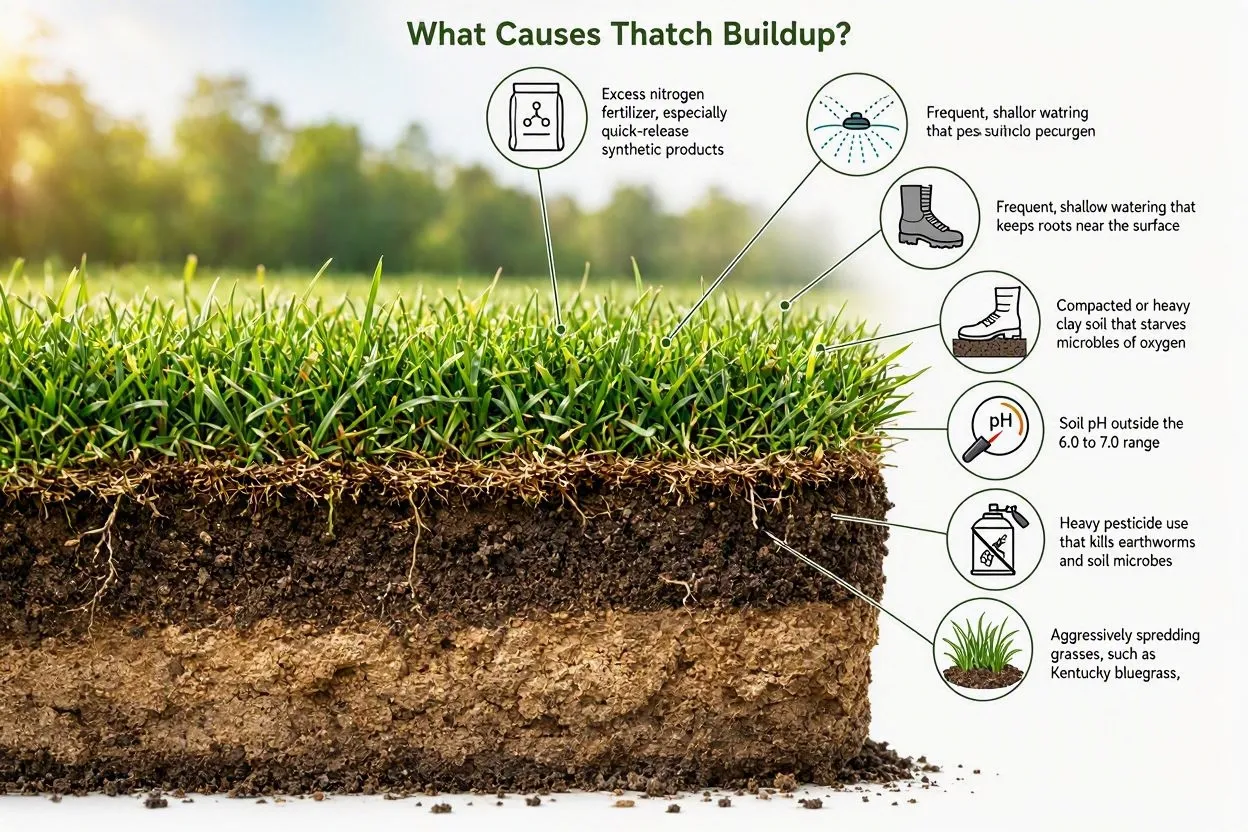
Fast top growth combined with slow decomposition causes thatch. The most common drivers are these:
- Excess nitrogen fertilizer, especially quick-release synthetic products
- Frequent, shallow watering that keeps roots near the surface
- Compacted or heavy clay soil that starves microbes of oxygen
- Soil pH outside the 6.0 to 7.0 range
- Heavy pesticide use that kills earthworms and soil microbes
- Aggressively spreading grasses, such as Kentucky bluegrass, Bermudagrass, and zoysiagrass
Grass clippings don’t belong on that list. Illinois Extension explains that clippings hold a lot of water and decompose quickly, provided you mow regularly and cut no more than one-third of the blade at a time.
How Do You Know If Your Lawn Needs Dethatching?
Your lawn needs dethatching if a soil plug shows more than ½ inch (1.3 cm) of brown, fibrous material between the grass blades and the soil. Symptoms point you toward a problem. A measurement confirms it.
Warning Signs of Excess Thatch
- A spongy, springy feel underfoot
- Water that puddles or runs off instead of soaking in
- Grass that wilts in summer heat despite regular watering
- Fertilizer and grub treatments that produce weak results
- Scalped patches after mowing, caused by mower wheels sinking into the thatch
- Roots growing in the brown layer instead of the soil
How to Measure Thatch With a Plug Test
- Cut a wedge 3 inches (7.6 cm) deep with a garden trowel or spade.
- Repeat in 3 to 4 spots across the lawn.
- Lift each wedge and look at its side profile.
- Measure the brown band between the green blades and the dark soil without squeezing it.
- Average the readings and press the plugs back into place.
Test sun and shade areas separately. A backyard under oak trees can read ¼ inch (0.6 cm), while a heavily fertilized front strip on the same property reads a full 1 inch (2.5 cm).
Which Grass Types Need Dethatching?
Spreading grasses, such as Kentucky bluegrass, creeping bentgrass, Bermudagrass, and zoysiagrass, need dethatching most often. Clump-forming grasses rarely build enough thatch to matter.
Cool-Season Grasses
- Kentucky bluegrass: High thatch risk. Dethatch in early fall.
- Creeping bentgrass: High thatch risk. Dethatch in early fall.
- Fine fescue: Moderate thatch risk. Use light raking only.
- Tall fescue: Low thatch risk. Dethatching is rarely needed.
- Perennial ryegrass: Low thatch risk. Dethatching is rarely needed.
Warm-Season Grasses
- Bermudagrass: High thatch risk. Dethatch after spring green-up.
- Zoysiagrass: High thatch risk. Dethatch with a shallow blade setting.
- St. Augustinegrass: Moderate thatch risk. Skip mechanical dethatching and use cultural controls.
- Centipedegrass: Low to moderate thatch risk. Skip mechanical dethatching and use cultural controls.
St. Augustinegrass deserves a separate warning. The grass spreads by thick surface runners (stolons), and a power rake or verticutter shreds those runners instead of lifting the thatch above them. On a St. Augustine lawn in Florida or coastal Texas, you’ll get better results by raising the mowing height to 3.5 to 4 inches (9–10 cm), cutting back on nitrogen, and topdressing with ¼ inch (0.6 cm) of compost.
When Is the Best Time to Dethatch a Lawn?
Dethatch cool-season lawns from late August through September and warm-season lawns from late May through June, after full green-up. Both windows match peak growth, so the turf fills back in within 3 to 6 weeks.
Cool-Season Lawns
Late summer to early fall is the best time to dethatch cool-season grass. Extension specialists at the University of Missouri favor early fall for cool-season lawns, and Illinois Extension points to late August for the best recovery and reseeding. Daytime highs of 60 to 75°F (16–24°C) push fast regrowth, and fewer weed seeds sprout in fall. Spring dethatching works in a pinch. Expect crabgrass to move into the exposed soil, though, and expect spring seedlings to struggle through their first summer.
Warm-Season Lawns
Late spring to early summer, once the lawn has fully greened up, is the best time to dethatch warm-season grass. Missouri Extension names mid-June as the preferred window for zoysiagrass and Bermudagrass, provided the lawn is actively growing. In practice, that means waiting until you’ve mowed at least twice after green-up and daytime highs hold between 80 and 95°F (27–35°C). Gulf Coast lawns reach that stage in May, while lawns in the transition zone (the band from Kansas to Virginia) often wait until mid-June.
When Not to Dethatch
- During winter or summer dormancy
- During drought or heat stress
- On waterlogged soil
- On sod or seeded turf less than 1 year old
- After a spring crabgrass preventer, if you plan to overseed: most pre-emergent labels require waiting 8 to 16 weeks before seeding, since the product is designed to stop grass seed from sprouting too
Which Dethatching Tool Should You Use?
Use a dethatching rake for small lawns with light thatch, a power rake for moderate thatch, and a vertical mower for thatch over ¾ inch (1.9 cm).
| Dethatching tool | Best for |
| Dethatching (thatching) rake | Light thatch and spot repairs on lawns under 1,000 sq ft (93 m²). Costs $40–$80 to buy. |
| Electric dethatcher/scarifier | Light thatch and routine upkeep on lawns of 1,000–5,000 sq ft (93–465 m²). Costs about $150 to buy. |
| Power rake | Moderate thatch of ½–¾ inch (1.3–1.9 cm) on lawns of 2,000 sq ft (186 m²) and up. Costs $15–$120 per day to rent. |
| Vertical mower (verticutter) | Heavy thatch over ¾ inch (1.9 cm) on lawns of any size. Costs $15–$120 per day to rent. |
| Core aerator | Thatch combined with compacted soil on lawns of any size. Costs $15–$120 per day to rent. |
Power rakes use rotating wire tines for lighter jobs, while vertical mowers (verticutters) use steel knife blades that slice through thick thatch and into the soil, according to Penn State Extension. Skip the “power rake” blades sold as rotary mower attachments, which University of Minnesota Extension calls ineffective and damaging to existing grass. For lots of half an acre (0.2 ha) or more, a tow-behind spring-tine dethatcher pulled by a riding mower removes light thatch faster than any walk-behind tool.
Whichever machine you rent, wear gloves, safety glasses, and hearing protection. Power rakes and verticutters throw debris and small rocks, and the rotating tines are not something you want near a hand, so always shut the machine off before reaching down to clear a jam. Most rental counters will walk you through blade depth on the spot; take them up on it, since a depth set too deep is a common reason a first-time dethatching job goes wrong.
How to Thatch a Lawn Step by Step
Dethatching breaks down into 7 steps. A crew with a power dethatcher finishes a 5,000-square-foot (465 m²) lawn in 1 to 3 hours; LawnStarter puts professional time for that lawn size in the same range, depending on thatch thickness and equipment. Doing it yourself with a rental machine takes longer once you add setup, a test pass, and cleanup, so block out a full morning rather than an hour before work.
Step 1: Call 811 and Flag Hazards
Call 811, the national “Call Before You Dig” line, 2 to 3 business days before using a verticutter. Vertical mower blades cut into the top ½ inch (1.3 cm) of soil, and shallow cable TV and irrigation lines sometimes run at that depth. Mark every sprinkler head, valve box, and buried dog fence with bright flags.
Step 2: Water the Lawn 1 to 2 Days Ahead
Soak the lawn with about 1 inch (2.5 cm) of water 1 to 2 days before dethatching, unless recent rain has done the work for you. Moist soil lets tines slice cleanly. Soggy soil tears up turf in clumps, and bone-dry ground bounces the machine.
Step 3: Mow to Half the Normal Height
Cut the grass to half its usual height, without going below the minimum for your grass type. A tall fescue lawn normally kept at 3.5 inches (9 cm) should drop to about 2 inches (5 cm). Bag these clippings. Short grass lets the tines reach the thatch and makes cleanup faster.
Step 4: Set the Blade Depth
Set the blades so they reach no deeper than ½ inch (1.3 cm) into the soil. Minnesota Extension recommends adjusting a vertical mower so the tines pull a small amount of soil up with the thatch debris. Ask the rental counter to set the blade spacing for your grass type: wider spacing (about 3 inches, or 7.6 cm) for Bermudagrass and zoysiagrass, and tighter spacing (1 to 2 inches, or 2.5–5 cm) for Kentucky bluegrass.
Step 5: Test a Small Area First
Run the machine over a 10-by-10-foot (3-by-3-meter) patch in a low-visibility corner before touching the front yard. Penn State advises getting a feel for the vertical mower somewhere out of sight, since removing too much thatch can badly thin the turf. Healthy grass should stay anchored while the brown layer lifts free.
Step 6: Make Your Passes
Make one pass in straight rows across the lawn, then add a second pass at a right angle only if heavy thatch remains. Keep the machine moving, because pausing in one spot gouges the soil. With a hand rake, dig the tines in and pull toward you in short, firm strokes, working one 4-by-4-foot (1.2-by-1.2-meter) section at a time.
Step 7: Rake Up the Debris
Rake up and remove every bit of loosened thatch the same day. Leaving it on the lawn smothers the grass underneath and blocks seed from reaching soil. A lawn sweeper or a mower with a bagger speeds this step on larger properties.
What to Do After Dethatching
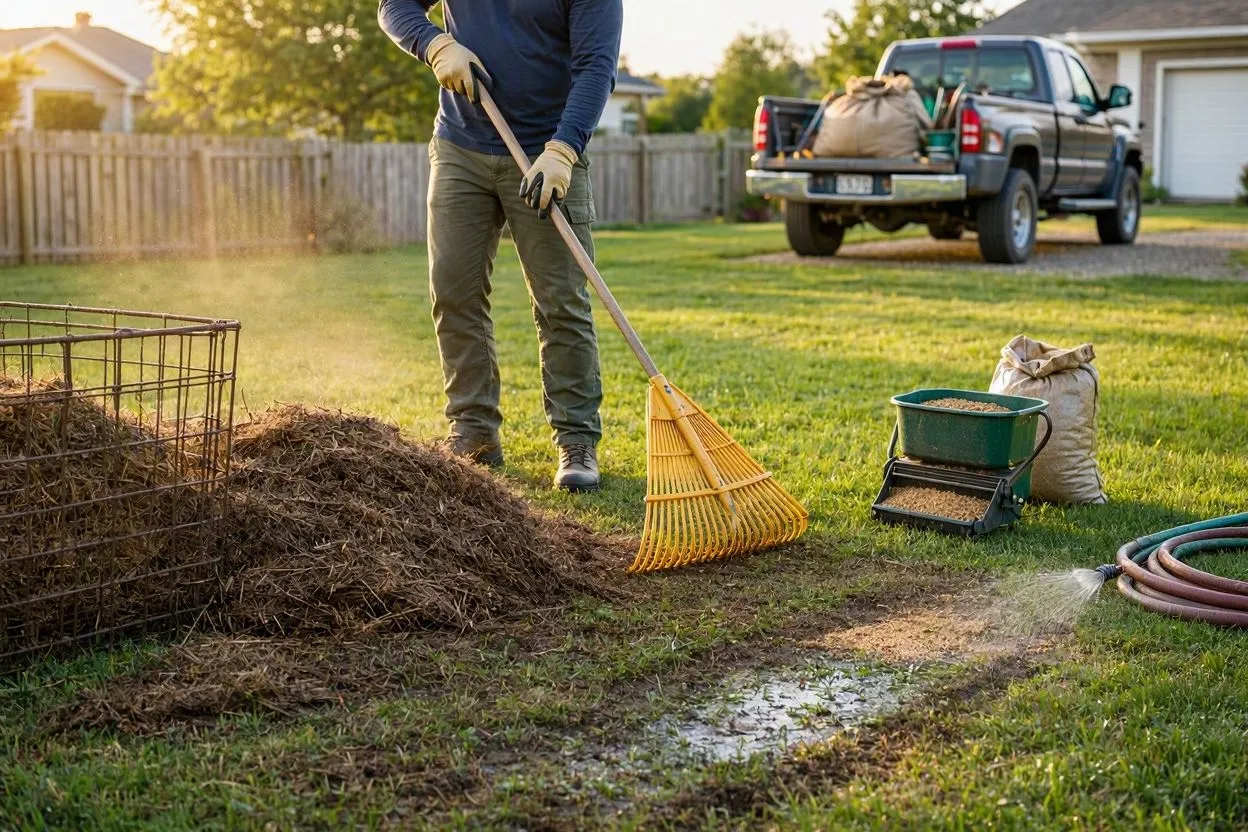
Clear the debris, overseed thin areas, apply starter fertilizer, and water daily until new seed sprouts. Everything can happen on the same afternoon. Oklahoma State University Extension notes that topdressing, reseeding, fertilizing, and lime or gypsum applications can all follow dethatching on the same day.
Clean Up and Compost the Thatch
Compost the removed thatch or take it to a municipal yard-waste site. Minnesota Extension points out that vertical mowing produces a large volume of debris, which you can haul to a county compost site or add to a backyard bin. Thatch is carbon-heavy, so mix each load with green material, such as fresh clippings or vegetable scraps, to help the pile heat up.
Overseed and Fertilize
Overseed cool-season lawns right after dethatching, while the soil is exposed. Spread tall fescue at 4 to 5 pounds per 1,000 sq ft (1.8–2.3 kg per 93 m²) or Kentucky bluegrass at 1 to 2 pounds per 1,000 sq ft (0.45–0.9 kg per 93 m²). Bermudagrass and zoysiagrass rarely need seed, since their runners fill bare spots within weeks.
Follow with a starter fertilizer instead of a standard lawn food. Starter blends feed roots, while high-nitrogen products push leafy top growth. Some states restrict phosphorus in routine lawn fertilizer to protect waterways, but most of those same laws carve out an exception for establishing new grass from seed, since phosphorus is what gets young roots going. Check your state’s rules before buying, since the exact list of restricted states changes.
Water for Recovery
Water newly seeded areas lightly once or twice a day until the seed germinates. Keep the top ½ inch (1.3 cm) of soil moist. Tall fescue sprouts in 7 to 14 days, while Kentucky bluegrass takes 14 to 30. After germination, shift to deep, less frequent watering of about 1 inch (2.5 cm) per week.
Lawn Recovery Timeline
| Time after dethatching | What to expect |
| Days 1–7 | Lawn looks thin, brown, and ragged |
| Weeks 2–3 | Tall fescue and ryegrass seedlings emerge; existing grass pushes new shoots |
| Weeks 3–5 | Warm-season runners cover most bare soil |
| Weeks 4–6 | First mow of new seedlings once they reach about 4 inches (10 cm) |
| Weeks 6–8 | Cool-season lawn returns to full density |
Dethatching vs. Core Aeration: Which Does Your Lawn Need?
Most lawns need core aeration more than dethatching, because aeration breaks down thatch and fixes the compacted soil that causes it. Missouri Extension notes that coring stresses the lawn less than power raking or vertical mowing and relieves soil compaction at the same time. Dethatching alone treats the symptom. University of Wisconsin–Madison Extension warns that thatch often returns soon after dethatching when the underlying soil compaction goes uncorrected.
| Factor | Dethatching | Core aeration |
| What it removes | Surface layer of thatch | Soil plugs, 2–3 inches (5–7.6 cm) deep |
| Stress on turf | High | Low to moderate |
| Fixes compaction | No | Yes |
| Best for | Thatch over ¾ inch (1.9 cm) | Thatch under ¾ inch plus compaction |
| Recovery time | 3–8 weeks | 1–2 weeks |
Lawns with both problems can get both treatments in one session. Dethatch first and core aerate second in most cases. For extreme buildup, Minnesota Extension suggests aerating before vertical mowing.
Do Liquid Dethatchers Work?
No. University research has not shown that liquid dethatchers remove a meaningful amount of thatch, despite how they’re marketed. These enzyme- and microbe-based sprays promise to digest thatch in place, and LawnStarter pricing data puts a treatment at $30 to $45, cheap enough that it’s tempting to just try one. Kansas State University’s turf resources note that organic thatch-reduction products are on the market, but the University of Illinois hasn’t studied their effectiveness. Extension services keep recommending power rakes, verticutters, and core aeration instead, which is a reasonable signal that the research hasn’t caught up to the marketing.
Topdressing is the proven alternative, and it’s less work than either option. Illinois Extension recommends spreading 1/8 to 1/4 inch (0.3–0.6 cm) of quality topsoil or compost over the thatch to introduce microorganisms that speed up decomposition naturally.
How Much Does Dethatching Cost?
For DIY pricing on a rake, electric dethatcher, or rental machine, see the tool comparison table above. Hiring it out is the other option: professional dethatching costs $100 to $600, and most homeowners pay about $180. Angi’s 2026 data puts the average at $180, with area-based pricing of $10 to $30 per 1,000 square feet.
Bundling saves money, since companies that already have a crew and equipment on site typically discount a combined dethatching-and-aeration visit versus booking the two separately. Hire a pro if the thatch layer exceeds 2 inches (5 cm): that depth usually needs several sessions spaced over a season, and a crew with commercial equipment will get through it in a fraction of the time a rental machine would take you. For anything under 1 inch on a lawn smaller than a quarter acre, renting equipment yourself is usually the better value.
How to Prevent Thatch From Coming Back
Prevent thatch by fertilizing moderately, watering deeply, mowing high, and aerating compacted soil once a year. Each habit either slows top growth or speeds decomposition:
- Fertilize by soil test. Minnesota Extension notes that fall fertilization in September produces less lush growth than spring feeding.
- Water deeply. Apply 1 inch (2.5 cm) per week in 1 or 2 sessions instead of daily sprinkles.
- Mow high. Keep grass at the top of its recommended range, and remove no more than one-third of the blade per cut.
- Aerate yearly. Core aerate clay or high-traffic lawns every fall for cool-season grass or every early summer for warm-season grass.
- Topdress after aerating. Spread 1/8 to 1/4 inch (0.3–0.6 cm) of compost to feed soil microbes.
- Test soil every 3 to 4 years. Apply lime or sulfur as needed to hold pH between 6.0 and 7.0.
- Protect soil life. Missouri Extension advises against broad pesticide use that cuts earthworm and soil microbe populations.
Common Dethatching Mistakes to Avoid
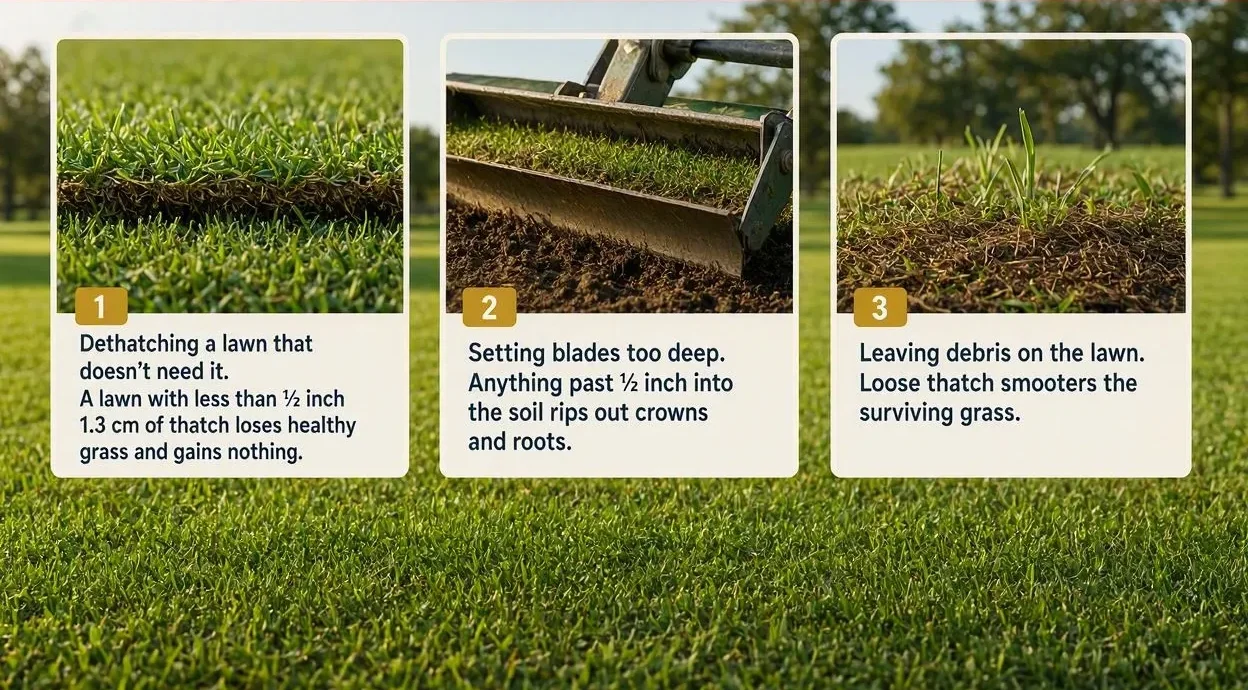
Beyond the timing mistakes already covered above (dethatching dormant, drought-stressed, or newly seeded turf), the mistakes that trip up most DIYers are:
- Dethatching a lawn that doesn’t need it. A lawn with less than ½ inch (1.3 cm) of thatch loses healthy grass and gains nothing.
- Setting blades too deep. Anything past ½ inch into the soil rips out crowns and roots.
- Leaving debris on the lawn. Loose thatch smothers the surviving grass and blocks seed-to-soil contact.
- Power-raking St. Augustinegrass or centipedegrass. Blades shred the surface runners that both grasses rely on.
- Treating dethatching as an annual chore. Only a plug test showing more than ½ inch of thatch justifies the stress.
Frequently Asked Questions
How often should you dethatch a lawn?
Every 1 to 3 years for thatch-prone grasses, based on an annual plug test. Tall fescue and perennial ryegrass lawns may never need dethatching. Angi places most lawns in the one-to-three-year range.
Can you dethatch a wet lawn?
No. Saturated ground lets tines rip out roots and leaves ruts. Wait until the soil feels moist but firm, typically 1 to 2 days after heavy rain.
Do grass clippings cause thatch?
No. Clippings contain mostly water and decompose fast when you mow often enough to remove one-third of the blade or less. Stems, crowns, and roots build thatch.
Can you dethatch and overseed in spring?
Yes, although fall gives cool-season lawns better results. Spring seedlings compete with crabgrass and summer heat, and you can’t apply most crabgrass preventers while new seed establishes.
How long does dethatching take?
A professional crew clears an average lawn in 1 to 3 hours. Doing it yourself with a rented power rake or verticutter usually takes a full morning once you factor in setup, a test pass, and hauling away the debris. A small yard with a hand rake can eat up an entire weekend if the thatch is thick.
Conclusion
Measure first, time the work to active growth, and only dethatch when the layer actually tops ½ inch (1.3 cm). Honestly, knowing when to skip the job matters more than knowing how to do it. Plenty of lawns will do better with yearly core aeration and a compost topdressing than with a power rake tearing through them. But for real buildup on Kentucky bluegrass, Bermudagrass, or zoysiagrass, a single well-timed pass with a verticutter, followed by overseeding and a starter fertilizer, brings back a dense stand fast. Dethatch a cool-season lawn in late August, and you should be looking at full density again by mid-October.