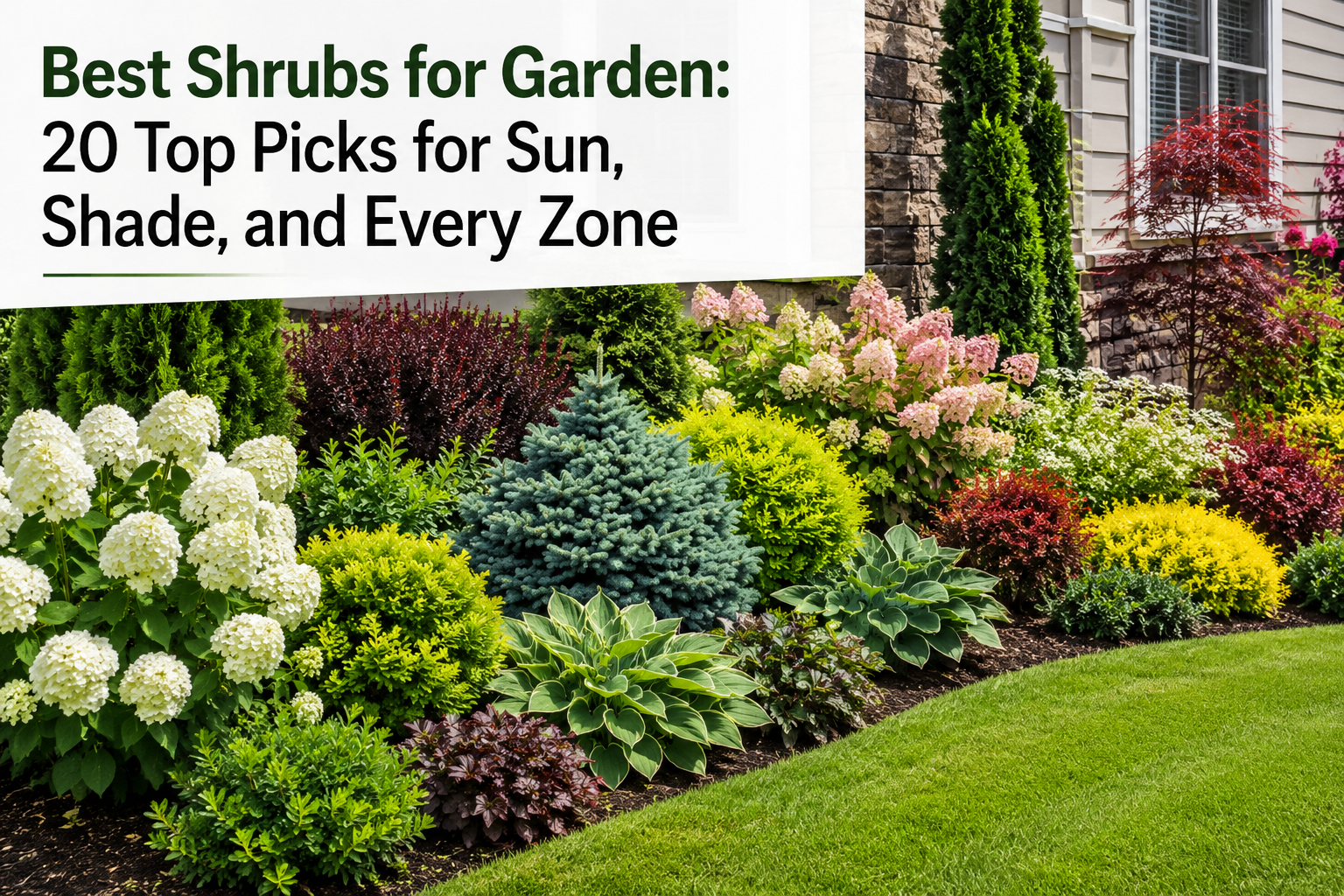
The right shrub in the right spot grows for 20–50 years with minimal effort. The wrong shrub in the wrong spot dies by year two, wastes money, and leaves a gap in your border. This guide matches shrubs to your actual garden conditions — sunlight hours, USDA hardiness zone, and purpose — so you choose once and plant right.
20 shrubs are covered below, organized by use case. Every entry includes mature size, zone range, sunlight requirement, and what it actually looks like through the seasons.
How to Choose Shrubs for Your Garden: 4 Factors

1. Match Shrub to Sunlight
Count direct sun hours between 9 AM and 5 PM on a clear day. This single measurement eliminates 80% of planting mistakes.
| Sunlight Level | Hours of Direct Sun | Example Shrubs |
| Full sun | 6+ hours | Roses, spirea, butterfly bush, barberry |
| Part sun / part shade | 3–6 hours | Hydrangea, weigela, viburnum, forsythia |
| Full shade | Under 3 hours | Rhododendron, pieris, mahonia, leucothoe |
2. Know Your USDA Hardiness Zone
Every shrub has a minimum winter temperature it survives. A zone 6 shrub dies in a zone 4 garden. Check your zone at the USDA Plant Hardiness Zone Map before buying anything. UK gardeners: most of the UK sits in zones 8–9.
3. Check Mature Size Before Planting
A shrub labelled 3 ft (90 cm) at the garden center can reach 8 ft (2.4 m) at maturity. Check the mature height and spread — not the nursery pot size. Plant the shrub where it has room to reach full size without pruning to control it.
Spacing rule: plant shrubs at half their mature spread apart. Two shrubs with a 6 ft (1.8 m) mature spread go 3 ft (90 cm) apart at planting.
4. Test Soil pH
Most shrubs thrive at pH 6.0–7.0. Acid-lovers — rhododendrons, azaleas, camellias — need pH 4.5–6.0. Planting an acid-lover in alkaline soil produces yellow leaves and no flowers, no matter how well you water and feed. A basic soil test ($15–$20 / £12–£16) tells you pH before you waste money on the wrong plants.
20 Best Shrubs for Garden by Category
Flowering Shrubs: 7 Best Picks
1. Hydrangea (Hydrangea spp.)
Hydrangeas are the most popular flowering shrubs in North America and the UK for good reason. Large flower heads in white, pink, blue, or purple last from July through October. Dried heads persist through winter and add structure even after colour fades.
- Zones: 3–9 depending on variety (paniculata types are hardiest — zones 3–8)
- Size: 2–8 ft (60 cm–2.4 m) tall and wide depending on cultivar
- Sun: Part shade to full sun — morning sun, afternoon shade is ideal in hot climates
- Best variety for most gardens: Limelight panicle hydrangea — zones 3–8, 6–8 ft (1.8–2.4 m), full sun to part shade, lime-green flowers turn pink-red in fall
Prune paniculata types in late winter or early spring. Never prune hydrangeas in fall — you remove next year’s flower buds on some varieties.
2. Forsythia (Forsythia × intermedia)
Forsythia flowers on bare stems in early March — weeks before any other shrub. It delivers yellow colour when gardens are still brown and lifeless. Easy to grow on any soil, in sun or shade.
- Zones: 5–8
- Size: 6–10 ft (1.8–3 m) tall, 10–12 ft (3–3.6 m) wide — give it room
- Sun: Full sun to part shade
- Maintenance: Cut one-third of the oldest stems to the ground after flowering each year — this keeps the plant compact and flowering strongly
Forsythia is unfashionable in some gardening circles. Plant it anyway. Nothing else gives that February-March colour in a zone 5 or 6 garden.
3. Weigela (Weigela florida)
Weigela produces trumpet-shaped pink, red, or white flowers in May and June, with a second flush in August. Modern compact cultivars fit small gardens and need zero pruning.
- Zones: 4–9
- Size: 2–10 ft (60 cm–3 m) depending on cultivar — ‘My Monet’ grows only 12–18 inches (30–45 cm) tall
- Sun: Full sun to part shade — full sun produces the most flowers
- Best variety: ‘Sonic Bloom Pink’ — reblooms all summer without deadheading, zones 4–8, 4–5 ft (1.2–1.5 m) tall
4. Spirea (Spiraea spp.)
Spirea covers itself in white or pink flowers in spring and offers coloured foliage — gold, orange, or burgundy — from spring through fall. One of the most reliable, trouble-free shrubs for any garden.
- Zones: 3–9
- Size: 2–5 ft (60 cm–1.5 m) tall and wide
- Sun: Full sun — reduced sun produces fewer flowers and less vivid foliage colour
- Best varieties: ‘Double Play Gold’ (golden foliage, pink flowers) or ‘Tor Birchleaf’ (white flowers, red-orange fall colour)
Cut spirea back hard — within 6–8 inches (15–20 cm) of the ground — every 3 years to rejuvenate old, woody plants.
5. Viburnum (Viburnum spp.)
Viburnum offers something in every season: fragrant white or pink flower clusters in spring, berries in fall that feed birds through winter, and coloured foliage in autumn. One of the most underused shrubs in domestic gardens.
- Zones: 2–9 depending on species
- Size: 4–15 ft (1.2–4.5 m) depending on species — choose the right species for your space
- Sun: Full sun to part shade
- Best for fragrance: Koreanspice viburnum (V. carlesii) — zones 4–8, 4–6 ft (1.2–1.8 m), intoxicating clove-like scent in April
- Best for berries: Arrowwood viburnum (V. dentatum) — zones 3–8, 6–10 ft (1.8–3 m), native, blue-black berries, fiery red fall colour
6. Butterfly Bush (Buddleja davidii)
Butterfly bush produces long flower spikes in purple, white, pink, or red from July through September. Named for its ability to attract 20+ butterfly species. Extremely fast growing — reaches full size in one season.
- Zones: 5–9
- Size: 4–8 ft (1.2–2.4 m) tall and wide
- Sun: Full sun — needs 6+ hours for best flowering
- Pruning: Cut hard to 12 inches (30 cm) from the ground in early spring — this produces the strongest new growth and most flowers
Note: Buddleja is invasive in some US states and parts of the UK. Check local regulations. Sterile cultivars like ‘Miss Molly’ and ‘Pugster Blue’ are safe alternatives.
7. Rose of Sharon (Hibiscus syriacus)
Rose of Sharon flowers August through October — the latest-blooming flowering shrub in most gardens. Large hibiscus-like flowers in white, pink, purple, or bicolour keep the garden alive when everything else has finished.
- Zones: 5–9
- Size: 8–12 ft (2.4–3.6 m) tall, 6–10 ft (1.8–3 m) wide — plant as a specimen or tall informal hedge
- Sun: Full sun to part shade
- Maintenance: Prune in early spring before buds break — cut back to 2 buds per branch for the largest flowers
Evergreen Shrubs: 5 Best Picks for Year-Round Structure
The RHS recommends planting 60–80% of garden shrubs as evergreens. Evergreens provide structure in January that makes the garden look designed rather than abandoned. These 5 cover full sun to full shade.
8. Boxwood (Buxus sempervirens)
Boxwood is the most versatile evergreen shrub. Clipped or unclipped, as a low hedge, topiary ball, or loose specimen — it works in formal and informal gardens. Slow growth means you shape it once and maintain it with one annual trim.
- Zones: 5–9
- Size: 2–15 ft (60 cm–4.5 m) depending on cultivar — dwarf ‘Green Gem’ stays 2–3 ft (60–90 cm)
- Sun: Full sun to full shade — tolerates more shade than almost any other evergreen
- One annual trim in late spring is all maintenance needed
Box blight (Cylindrocladium) has become a serious problem in the UK and parts of the US. Choose blight-resistant cultivars: ‘Buxus sempervirens Blauer Heinz’ or switch to Ilex crenata as a blight-free alternative.
9. Holly (Ilex spp.)
Holly provides year-round glossy dark green foliage, winter berries that birds eat through January and February, and deer resistance that few other shrubs match. Female plants need a male nearby to produce berries.
- Zones: 3–9 depending on species — inkberry holly (Ilex glabra) is hardy to zone 3
- Size: 6–15 ft (1.8–4.5 m) depending on species
- Sun: Full sun to part shade
- Best garden holly: ‘Blue Princess’ (female, zones 3–7, 8–10 ft / 2.4–3 m) — pair with ‘Blue Prince’ male for berry production
10. Rhododendron and Azalea
Rhododendrons and azaleas are the same family. Both produce spectacular flower clusters in spring. Rhododendrons stay evergreen in all climates. Azaleas are evergreen in mild climates and deciduous in cold zones.
- Zones: 4–9 (most varieties) — PJM rhododendrons are hardy to zone 4
- Size: Rhododendrons 5–10 ft (1.5–3 m), azaleas 2–5 ft (60 cm–1.5 m)
- Sun: Part shade — 3–4 hours of morning sun, afternoon shade. Full shade reduces blooming
- Soil: Acid pH 4.5–6.0 is essential — alkaline soil causes yellow leaves and poor growth regardless of watering
If your soil is alkaline, plant rhododendrons in raised beds filled with ericaceous (acid) compost rather than amending soil — soil amendment rarely maintains the required pH long-term.
11. Pieris (Pieris japonica)
Pieris offers 3-season interest in one plant: cascading white flower clusters in March–April, vivid red or pink new foliage through spring, and dark evergreen leaves year-round. One of the best shade-tolerant flowering evergreens.
- Zones: 4–8
- Size: 3–8 ft (90 cm–2.4 m) tall — ‘Mountain Fire’ stays 3–4 ft (90 cm–1.2 m)
- Sun: Part shade — protect from strong afternoon sun which scorches leaves
- Soil: Acid pH 4.5–6.0, same as rhododendrons
- Zero pruning needed — deadhead old flowers in late spring if appearance matters to you
12. Mahonia (Mahonia aquifolium)
Mahonia flowers in February and March — yellow spikes that are among the first winter flowers in any garden. Glossy holly-like leaves turn reddish-purple in winter. Blue-black berries follow the flowers and attract birds.
- Zones: 5–9
- Size: 3–6 ft (90 cm–1.8 m) tall, spreads to 5 ft (1.5 m) wide
- Sun: Full shade to part shade — one of the best evergreens for deep shade
- Soil: Tolerates poor, dry soil better than almost any other evergreen shrub
Low-Maintenance Shrubs: 4 Best Picks
1. Smokebush (Cotinus coggygria)
Smokebush earns its name from the hazy, smoke-like plumes that cover the plant in summer. Purple-leaved cultivars like ‘Royal Purple’ hold their colour from April through October, then turn fiery orange-red in fall.
- Zones: 4–8
- Size: 10–15 ft (3–4.5 m) tall, 10–12 ft (3–3.6 m) wide as a specimen — cut hard in spring for a large-leaved foliage shrub at 6–8 ft (1.8–2.4 m)
- Sun: Full sun — shade reduces leaf colour intensity
- Maintenance: Zero required. Cut back hard every 2–3 years for larger leaves and more vivid colour
2. Barberry (Berberis thunbergii)
Barberry provides year-round colour with minimal effort. Yellow, orange, red, or purple foliage depending on cultivar. Extremely tough — survives poor soil, drought, and urban conditions that kill most shrubs.
- Zones: 4–8
- Size: 2–6 ft (60 cm–1.8 m) depending on cultivar — ‘Limoncello’ stays 3–4 ft (90 cm–1.2 m)
- Sun: Full sun to part shade — full sun produces the most intense leaf colour
- Deer resistant — sharp spines deter browsing effectively
Note: Berberis thunbergii is invasive in some US states. Check local regulations before planting. B. julianae (wintergreen barberry) is a deer-proof evergreen alternative with no invasive concerns.
3. Potentilla (Potentilla fruticosa)
Potentilla flowers from May through October — the longest blooming season of any shrub. Small buttercup-like flowers in yellow, white, or orange. Survives heavy clay, dry chalk, and neglect that kills softer plants.
- Zones: 2–7
- Size: 2–4 ft (60 cm–1.2 m) tall and wide
- Sun: Full sun — needs 6+ hours
- Maintenance: One light trim with shears in early spring. Nothing else needed
4. Cotoneaster (Cotoneaster franchettii)
Cotoneaster provides arching stems, small grey-green semi-evergreen leaves, white spring flowers, and masses of orange-red berries in fall and winter. Blackbirds and thrushes eat the berries from October onward.
- Zones: 5–8
- Size: 6–8 ft (1.8–2.4 m) tall, 8–10 ft (2.4–3 m) wide — works as an informal hedge or large specimen
- Sun: Full sun to full shade
- Soil: Tolerates heavy clay, dry conditions, and coastal exposure
Shrubs for Shade: 4 Best Picks
Most competitors list ‘shade shrubs’ without specifying whether they mean 3 hours of light or zero direct sun. These 4 shrubs are tested for genuine low-light conditions.
1. Leucothoe (Leucothoe fontanesiana)
Leucothoe is an arching, spreading evergreen that colours up in autumn — green leaves turn burgundy, bronze, and purple through winter, then return to green in spring. One of the few shrubs that performs in both deep shade and acidic boggy soil.
- Zones: 5–8
- Size: 3–6 ft (90 cm–1.8 m) tall, 6 ft (1.8 m) wide
- Sun: Part shade to full shade — best colour develops in part shade
- Soil: Acid, moist — does not tolerate dry conditions
2. Skimmia (Skimmia japonica)
Skimmia produces glossy green leaves year-round, white flower buds that open in spring, and red berries on female plants that persist through winter. A slow-growing, tidy shrub for shaded borders and containers.
- Zones: 6–9
- Size: 3–5 ft (90 cm–1.5 m) tall and wide — very slow growth
- Sun: Part shade to full shade — full sun scorches leaves
- Plant one male (‘Rubella’ — red buds) per 3 female plants for berry production
3. Oregon Grape (Mahonia aquifolium — compact forms)
The compact form of Oregon grape grows 3 ft (90 cm) tall and spreads slowly by suckers to form ground-covering colonies. Yellow flowers in March feed early bumblebees. Blue-black berries appear in summer. Tolerates dry shade under established trees where almost nothing else grows.
- Zones: 5–9
- Size: 3 ft (90 cm) tall, spreads 3–5 ft (90 cm–1.5 m) wide over time
- Sun: Full shade to part shade
- Soil: Dry to average — tolerates root competition under mature trees
4. Sarcococca (Sarcococca confusa — Sweet Box)
Sweet box is the best winter-flowering shade shrub. Small white flowers from December through February fill the garden with sweet vanilla fragrance. Tidy, slow-growing, compact — works under north-facing walls and deep shade positions.
- Zones: 6–9
- Size: 3–5 ft (90 cm–1.5 m) tall, 3–4 ft (90 cm–1.2 m) wide
- Sun: Full shade to part shade — performs in the deepest positions
- Maintenance: Zero. Does not need pruning
20 Shrubs for Garden: Quick Reference
| Shrub | Zones | Sun | Mature Size | Best For |
| Hydrangea | 3–9 | Part shade–full sun | 2–8 ft (0.6–2.4 m) | Flowering, long season |
| Forsythia | 5–8 | Full sun–part shade | 6–10 ft (1.8–3 m) | Early spring colour |
| Weigela | 4–9 | Full sun–part shade | 2–10 ft (0.6–3 m) | Summer flowers |
| Spirea | 3–9 | Full sun | 2–5 ft (0.6–1.5 m) | Coloured foliage + flowers |
| Viburnum | 2–9 | Full sun–part shade | 4–15 ft (1.2–4.5 m) | Fragrance + berries |
| Butterfly Bush | 5–9 | Full sun | 4–8 ft (1.2–2.4 m) | Pollinators, late summer |
| Rose of Sharon | 5–9 | Full sun–part shade | 8–12 ft (2.4–3.6 m) | Late summer flowering |
| Boxwood | 5–9 | Full sun–full shade | 2–15 ft (0.6–4.5 m) | Hedging, topiary |
| Holly | 3–9 | Full sun–part shade | 6–15 ft (1.8–4.5 m) | Berries, deer resistance |
| Rhododendron | 4–9 | Part shade | 5–10 ft (1.5–3 m) | Spring flowers, acid soil |
| Pieris | 4–8 | Part shade | 3–8 ft (0.9–2.4 m) | Spring + foliage colour |
| Mahonia | 5–9 | Full shade–part shade | 3–6 ft (0.9–1.8 m) | Winter flowers, shade |
| Smokebush | 4–8 | Full sun | 10–15 ft (3–4.5 m) | Foliage, fall colour |
| Barberry | 4–8 | Full sun–part shade | 2–6 ft (0.6–1.8 m) | Deer resistance, colour |
| Potentilla | 2–7 | Full sun | 2–4 ft (0.6–1.2 m) | Longest bloom season |
| Cotoneaster | 5–8 | Full sun–full shade | 6–8 ft (1.8–2.4 m) | Berries, wildlife |
| Leucothoe | 5–8 | Part–full shade | 3–6 ft (0.9–1.8 m) | Shade, winter colour |
| Skimmia | 6–9 | Part–full shade | 3–5 ft (0.9–1.5 m) | Shade, winter berries |
| Oregon Grape | 5–9 | Full–part shade | 3 ft (0.9 m) | Dry shade, ground cover |
| Sweet Box | 6–9 | Full–part shade | 3–5 ft (0.9–1.5 m) | Winter fragrance, shade |
How to Plant Shrubs: 5 Steps for Long-Term Success
Step 1 — Measure Your Space Before Buying
Use the ZonedGarden’s free Garden Area Calculator to measure your border or bed accurately before buying shrubs. Ordering soil, compost, or mulch without measuring leads to under- or over-ordering. The calculator handles rectangles, L-shapes, and circular beds and gives results in sq ft (ft²) and sq metres (m²).
Step 2 — Prepare the Planting Hole
Dig the hole twice as wide as the root ball but only as deep. Planting too deep kills more shrubs than any other mistake — the root flare (where roots meet stem) must sit at or slightly above soil level.
- Loosen soil at the base of the hole with a fork — compacted subsoil blocks root penetration
- Mix one-third compost into the removed soil before backfilling
- For acid-loving shrubs (rhododendrons, pieris), use ericaceous compost — no pH adjustment lasts long-term in the planting hole
Step 3 — Plant at the Right Depth
Set the shrub so the root flare is 1–2 inches (2.5–5 cm) above surrounding soil. Backfill in stages, firming each layer by hand. Water thoroughly to settle soil around roots.
Step 4 — Mulch Immediately
Apply 2–3 inches (5–7.5 cm) of bark mulch over the root zone — keeping mulch 2 inches (5 cm) away from the stem. Mulch suppresses weeds, retains moisture, and regulates soil temperature. Most newly planted shrubs that fail do so because the surrounding soil dries out before roots establish. Mulch prevents this.
Step 5 — Water Through the First Season
Most shrubs need watering every 5–7 days through their first summer if there is no significant rainfall — roughly 1 inch (25 mm) per week total. Year 2 onward: water only during extended drought. Established shrubs generally need no irrigation.
When to Prune Shrubs: 2 Simple Rules

Pruning at the wrong time removes flower buds and wastes a full season of blooming. Follow these 2 rules and pruning becomes straightforward.
Rule 1 — Spring-flowering shrubs (forsythia, weigela, lilac, viburnum): prune immediately after flowering. These shrubs set next year’s flower buds on wood grown after flowering. Prune in late summer, fall, or winter and you remove those buds.
Rule 2 — Summer and fall-flowering shrubs (hydrangea paniculata, spirea, rose of sharon, butterfly bush): prune in late winter or early spring before growth starts. These shrubs flower on new wood grown in the current season. Early spring pruning stimulates the strongest new growth and most flowers.
Evergreen shrubs with no ornamental flowers — boxwood, holly, yew — prune in late spring after new growth hardens. A second light trim in August keeps formal shapes tidy through winter.
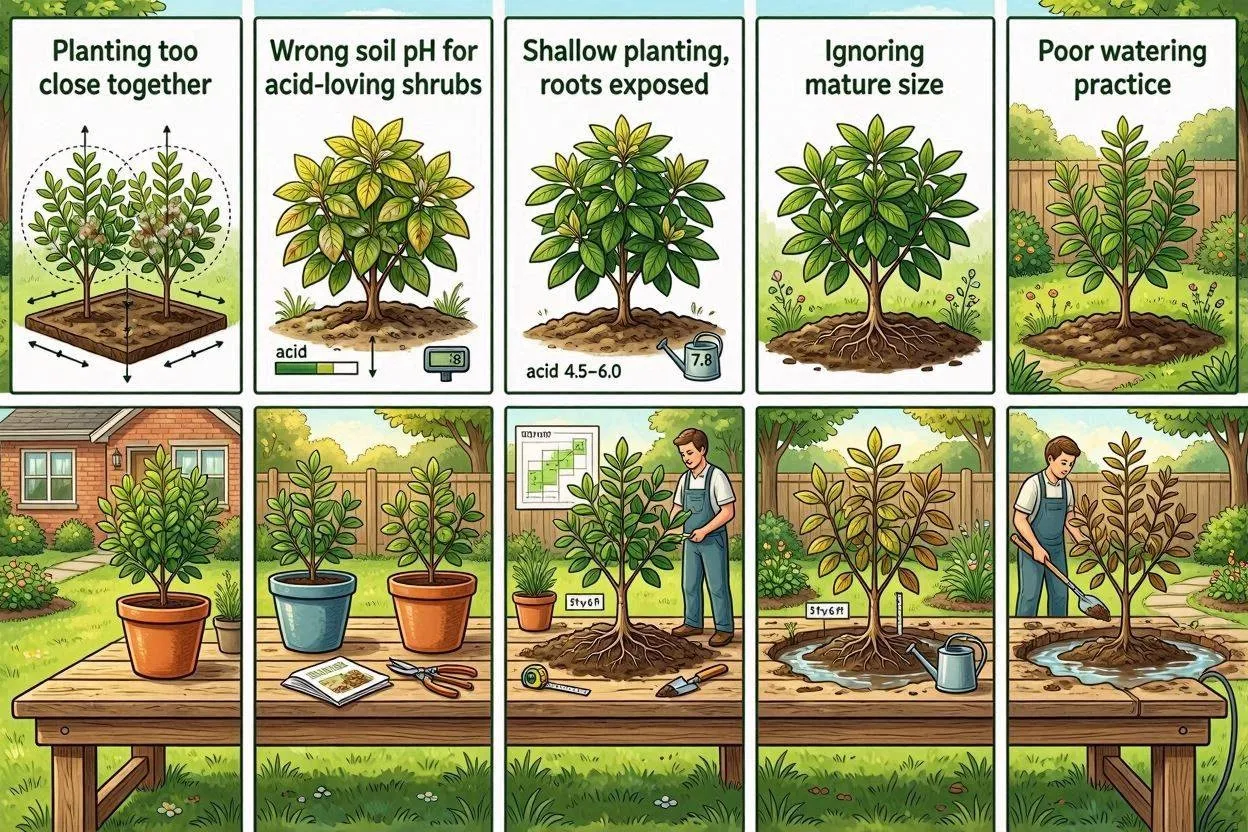
5 Common Shrub Planting Mistakes
- Planting too close together: a shrub that looks small at the garden center fills its full space within 5–7 years. Two shrubs planted 1 ft (30 cm) apart that mature to 4 ft (1.2 m) wide create a congested, disease-prone mass within a decade. Check mature spread before placing.
- Planting acid-lovers in the wrong soil: rhododendrons, azaleas, pieris, and camellias need acid soil (pH 4.5–6.0). Alkaline soil produces chlorotic (yellow) leaves and no flowers — the plant slowly declines. Test pH first. Plant in raised ericaceous beds if your soil is alkaline.
- Pruning spring-flowering shrubs in winter: forsythia, lilac, weigela, and viburnum set flower buds in summer on new growth. Winter pruning removes those buds. The shrub produces leaves but zero flowers for the entire season. Prune immediately after flowering instead.
- Ignoring mature size: a viburnum labelled ‘2–3 ft’ at the nursery may mean the current pot size, not the mature size. Viburnum lantana ‘Mohican’ reaches 6–8 ft (1.8–2.4 m) tall and wide. Read the plant label for mature dimensions, not the sales tag.
- Skipping mulch: the most preventable cause of shrub failure in the first year is soil moisture loss. Newly planted shrubs have limited root systems that cannot access deep soil water. A 2–3 inch (5–7.5 cm) mulch layer around the root zone prevents moisture loss, suppresses competing weeds, and moderates soil temperature.
Shrubs for Your Zone: Quick Zone-Based Guide
No competitor provides this. Every list above gives the same shrubs to zone 3 gardeners in Minnesota and zone 9 gardeners in Texas. These are zone-specific starting points.
| USDA Zone | Winter Low Temp | Top Shrub Choices |
| Zone 3 | -40°F to -30°F / -40°C to -34°C | Potentilla, arrowwood viburnum, spirea, forsythia ‘Meadowlark’ |
| Zone 4 | -30°F to -20°F / -34°C to -29°C | Hydrangea paniculata, weigela, barberry, smokebush, forsythia |
| Zone 5 | -20°F to -10°F / -29°C to -23°C | Most hydrangeas, pieris, holly, rhododendron PJM, mahonia |
| Zone 6 | -10°F to 0°F / -23°C to -18°C | Camellia (hardier types), skimmia, sweet box, leucothoe |
| Zone 7 | 0°F to 10°F / -18°C to -12°C | Camellia japonica, gardenia, butterfly bush, rose of sharon |
| Zone 8–9 (UK most zones) | 10°F to 30°F / -12°C to -1°C | Full range — nearly all shrubs listed above |
FAQs
What are the best low-maintenance shrubs for a garden?
The 5 lowest-maintenance garden shrubs are: potentilla (blooms May–October, needs one annual trim), cotoneaster (no pruning, wildlife value), mahonia (winter flowers, tolerates dry shade), sweet box sarcococca (zero maintenance, winter fragrance), and spirea (cut back hard every 3 years, coloured foliage all season). All are disease-resistant, undemanding about soil, and survive neglect.
What shrubs grow best in shade?
The 4 best shrubs for full shade are mahonia, sweet box (sarcococca), Oregon grape, and leucothoe. For part shade (3–4 hours of sun), add rhododendron, pieris, skimmia, and hydrangea macrophylla. All 8 perform in under 4 hours of direct sun.
What shrubs stay green all year?
Evergreen shrubs that stay green all year include boxwood, holly, mahonia, pieris, rhododendron, leucothoe, sweet box, and cotoneaster (semi-evergreen in cold zones). For the smallest garden, boxwood ‘Green Gem’ (2–3 ft / 60–90 cm) and skimmia (3–5 ft / 90 cm–1.5 m) provide compact, tidy year-round evergreen structure.
How far apart should I plant shrubs?
Plant shrubs at half their mature spread apart. A shrub with a 6 ft (1.8 m) mature spread goes 3 ft (90 cm) from its neighbour. For hedging, plant at one-third the mature spread for faster gap closure — expect overcrowding after 10–15 years but an established hedge sooner.
When is the best time to plant shrubs?
Spring (March–May) and fall (September–October) are best. Spring planting gives roots a full growing season to establish before winter. Fall planting works for most hardy shrubs — soil is still warm, air is cooler, and rainfall is higher. Avoid planting in summer heat or frozen winter ground. Container-grown shrubs can technically be planted year-round, but summer planting requires watering every 3–5 days.
Which shrubs increase home value most?
Foundation shrubs — evergreen boxwood, holly, and compact hydrangeas planted along the house front — increase perceived home value by contributing to curb appeal. A 2023 Clemson University study found mature foundation plantings increase property value by 5–12%. Specimen shrubs (large smokebush, viburnum) used as focal points add visual anchoring that real estate professionals specifically note in listing photography.
What is the difference between deciduous and evergreen shrubs?
Deciduous shrubs drop all leaves in fall and regrow them in spring — forsythia, spirea, weigela, barberry, viburnum, smokebush, and rose of sharon are deciduous. Evergreen shrubs keep their leaves year-round — boxwood, holly, rhododendron, pieris, mahonia, and sweet box are evergreen. Most gardens work best with a mix: evergreens provide winter structure, deciduous shrubs provide seasonal flowering and dramatic fall colour.