

Aerate cool-season grass in early fall — late August through October. Aerate warm-season grass in late spring — May through June. Both windows put aeration during active growth, so the grass repairs quickly and fills the holes with new root growth within 2–4 weeks.
| Key Takeaways ✓ Cool-season grass (fescue, bluegrass, ryegrass): aerate late August to October — fall is best. ✓ Warm-season grass (Bermuda, zoysia, St. Augustine): aerate May to June — late spring only. ✓ Never aerate dormant grass — it cannot recover and the holes invite weeds. ✓ Core aeration outperforms spike aeration. Core removes soil plugs; spike compacts soil further. ✓ Most lawns need aeration once per year. Clay soil and high-traffic lawns: twice per year. ✓ Signs your lawn needs aeration: hard soil, water pooling, footprints staying visible, thin patches. ✓ Always aerate on moist soil — water the lawn the day before or aerate after rain. |
1. Cool-Season Grass — Best Time to Aerate
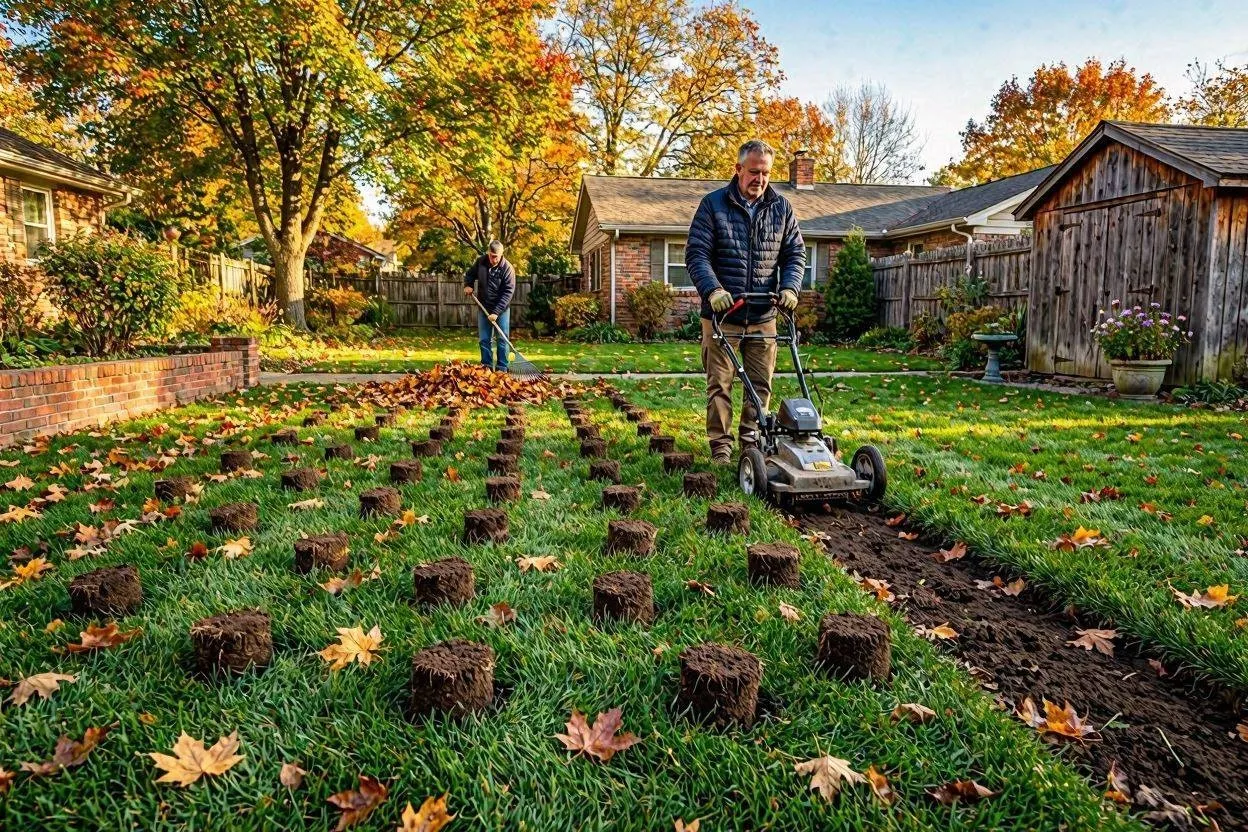
The best time to aerate cool-season grass is late August through October. Fall gives cool-season grasses — Kentucky bluegrass, tall fescue, fine fescue, perennial ryegrass — 6–8 weeks of active growth before winter dormancy. Roots repair the aeration holes fast and grow deeper before the ground freezes.
Why Fall Beats Spring for Cool-Season Lawns
Spring aeration works but carries 2 risks. First, aerating in spring opens the soil when crabgrass and annual weeds are germinating. The holes give weed seeds direct soil contact and better germination rates. Second, summer heat arrives within weeks of spring aeration — before the grass fully recovers from the stress.
Fall aeration avoids both problems. Weed pressure drops in fall. Soil temperatures stay between 50–65°F (10–18°C) — the ideal range for cool-season root growth. The grass fills aeration holes with new root growth before winter, making the lawn thicker and more resilient come spring.
Exact Fall Aeration Window by USDA Zone
| USDA Zone | Region | Best Aeration Window | Soil Temp Target |
| Zones 3–4 | Minnesota, Wisconsin, N. Michigan | Late August – mid September | 50–60°F / 10–16°C |
| Zones 5–6 | Ohio, Pennsylvania, Illinois | Early September – mid October | 55–65°F / 13–18°C |
| Zones 6–7 | Virginia, Kansas, N. Carolina | Mid September – late October | 55–68°F / 13–20°C |
| Zones 7–8 | Transition zone | October – early November | 55–70°F / 13–21°C |
Spring Aeration for Cool-Season Grass — When It Makes Sense
Spring aeration is the second-best option for cool-season grass — use it only when the lawn is severely compacted and fall isn’t possible. Aerate after at least 2 mowing sessions in spring (grass is actively growing) and before soil temperatures rise above 70°F (21°C). Avoid applying pre-emergent herbicide in the same week as spring aeration.
2. Warm-Season Grass — Best Time to Aerate
Aerate warm-season grass in late spring — May through June. Bermuda grass, zoysia grass, St. Augustine, centipede grass, and buffalo grass peak in summer. Aerating in May or June gives the grass the full summer growing season to recover and fill in the holes.
Why Late Spring Is the Only Safe Window
Warm-season grasses go dormant in fall and winter. Aerating dormant warm-season grass causes direct damage — the grass cannot recover, and the exposed soil becomes a weed seedbed. Never aerate warm-season grass after mid-August or before the lawn has fully greened up in spring.
The soil temperature target for warm-season aeration is 65–75°F (18–24°C). Below 65°F, warm-season roots grow too slowly to fill aeration holes before heat stress arrives. Check soil temperature with a soil thermometer 4 inches (10cm) deep before aerating.
Warm-Season Aeration Window by Grass Type
| Grass Type | Best Aeration Month | USDA Zones | Notes |
| Bermuda grass | May – June | Zones 7–10 | Most aggressive recovery — fills holes fastest |
| Zoysia grass | May – June | Zones 6–9 | Slower to recover than Bermuda — stick to May |
| St. Augustine grass | May – early June | Zones 8–10 | Does not tolerate drought stress after aeration |
| Centipede grass | Late May – June | Zones 7–9 | Low-traffic grass, aerate only when compaction confirmed |
| Buffalo grass | June | Zones 3–9 | Most drought-tolerant — aerate only in high-traffic areas |
3. Core Aeration vs Spike Aeration — Which One to Use
Use core aeration. Core aerators remove actual plugs of soil — hollow tines 0.5–0.75 inches (13–19mm) in diameter and 2–4 inches (5–10cm) deep. This creates real space for air, water, and nutrients to reach root zones. Spike aerators only poke holes and push soil sideways — this increases compaction in the soil around each hole.
| Method | How It Works | Effect on Compaction | Best For | Verdict |
| Core / plug aeration | Removes soil plugs — hollow tines | Reduces compaction directly | All lawns, especially clay soil | Best — always choose this |
| Spike aeration | Pokes holes — solid tines push soil aside | Can increase compaction | Loose, sandy soil only | Acceptable for light jobs only |
| Slicing aeration | Rotating blades cut through thatch | Mild compaction relief | Thatch reduction, light compaction | Good for thatch buildup |
| Liquid aeration | Surfactants applied to soil surface | Minimal long-term benefit | Not recommended by turf experts | Skip — no real compaction relief |
Core Aeration Plug Specs — What to Look For
Effective core aeration plugs should measure:
- Diameter: 0.5–0.75 inches (13–19mm)
- Depth: 2–4 inches (5–10cm) — deeper is better for compacted clay soil
- Spacing: every 2–3 inches (5–7.5cm) across the lawn — tighter spacing = more relief
Leave the soil plugs on the surface after aerating. They break down within 2 weeks and return nutrients and organic matter back to the soil. Run a lawn mower over them to speed up breakdown.
Rental Tip: Core aerator machines are available at Home Depot, Lowe’s, and most tool rental shops for $75–$120 per day. For lawns under 1,000 sq ft (93 sq m), a manual push-down core aerator costs $30–$50 and works well. For lawns over 5,000 sq ft (465 sq m), rent a motorized walk-behind unit.
4. 7 Signs Your Lawn Needs Aeration Now
These 7 signs mean soil compaction is already limiting root growth. Check at least 3 of these before aerating — if you confirm 3 or more, aerate as soon as the timing window opens.
Sign 1 — The Screwdriver Test Fails
Push a standard screwdriver 6 inches (15cm) into the soil by hand. If it goes in easily, compaction is not severe. If it resists or stops at 2–3 inches (5–7.5cm), the soil is compacted and aeration is needed. This is the single most reliable compaction test.
Sign 2 — Water Pools or Runs Off
Water should soak into healthy lawn soil within 2–3 minutes of watering. Pooling or runoff means the top layer of soil is too compacted to absorb water at a normal rate. The root zone gets less moisture despite regular irrigation — a direct cause of thin, stressed turf.
Sign 3 — Footprints Stay Visible
Walk across the lawn and look back. If footprints are still visible after 30 seconds, the grass lacks both moisture and root depth to spring back. Combined with the screwdriver test, this confirms compaction-driven stress.
Sign 4 — Thatch Layer Exceeds 0.5 Inches (13mm)
Cut out a 3-inch (7.5cm) deep plug of your lawn with a knife. Measure the brown spongy layer between the green grass and the soil. Thatch over 0.5 inches (13mm) thick blocks water, air, and nutrients from reaching roots — aeration breaks it up and helps it decompose faster.
Sign 5 — Lawn Gets Heavy Use
Children, pets, outdoor gatherings, and frequent foot traffic compact soil faster than a lawn that gets minimal use. High-traffic lawns often need aeration twice per year — once in fall for cool-season grass or once in spring for warm-season, and a second pass 6 months later in the areas with heaviest use.
Sign 6 — Lawn Was Established Over Poor Soil
Lawns installed over fill soil, sand, or clay subsoil compact faster than lawns grown in native topsoil. Sod installation is the most common cause — the fine-textured sod soil sits on coarser subsoil, disrupting drainage and causing compaction at the interface layer. Annual aeration is essential for these lawns.
Sign 7 — Grass Looks Thin Despite Fertilizing and Watering
Compacted soil blocks nutrient and water uptake even when both are applied correctly. If fertilizer and watering are not improving the lawn’s density or color, compaction is likely preventing those inputs from reaching the roots. Aerate first — then re-evaluate fertilizer and water response.
5. How to Aerate Your Lawn — 7-Step Process
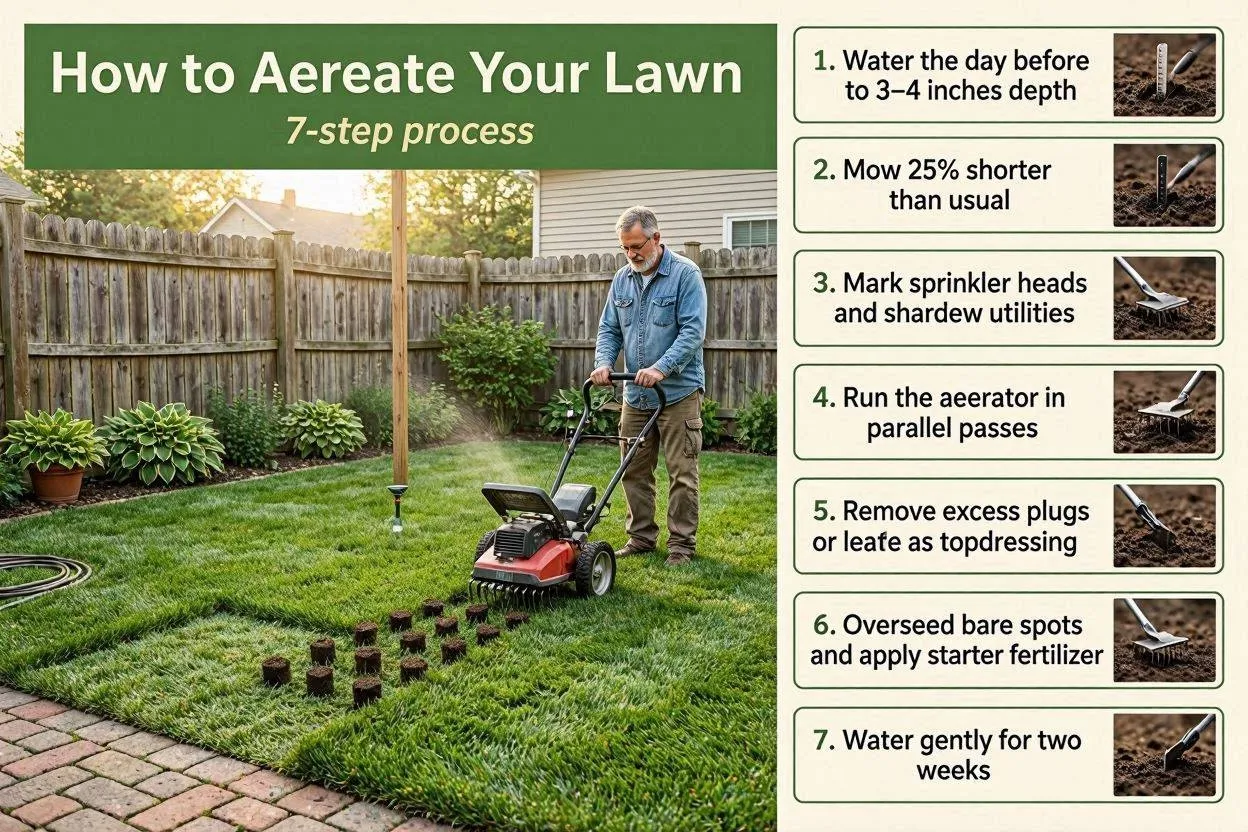
Proper preparation and technique determine how much benefit aeration delivers. Follow these 7 steps for best results.
- Water the lawn the day before aerating. The soil should be moist 3–4 inches (7.5–10cm) deep — not soggy, not dry. Dry soil resists the tines; waterlogged soil smears rather than producing clean plugs.
- Mow slightly shorter than your normal cutting height — about 25% lower. This gives the aerator tines better contact with the soil surface.
- Mark all sprinkler heads, irrigation lines, utility flags, and buried cables with small flags or spray paint. Core aerators can shear sprinkler heads and puncture shallow lines.
- Set the aerator to remove plugs 2–4 inches (5–10cm) deep. Make at least 2 passes over compacted areas — once in one direction and once perpendicular. Single-pass aeration leaves too much distance between holes.
- Focus extra passes on high-traffic zones: pathways, play areas, areas near gates, and spots where puddles form regularly. Leave lightly used or shaded areas to single-pass coverage.
- Leave the soil plugs on the lawn surface. Break them up with a lawn mower pass or the back of a rake once they dry. They return organic matter and microbes to the soil.
- Overseed immediately after aerating if the lawn is thin. Aeration holes give grass seed direct soil contact and shelter from wind and birds — germination rates improve by 30–50% compared to overseeding without aeration.
After Aeration Care: Water the lawn lightly every day for the first 5–7 days after aerating and overseeding. Apply a starter fertilizer (high phosphorus) within 48 hours of aeration to support new root growth. Do not apply pre-emergent herbicide for 8–10 weeks after overseeding.
6. Aerate and Overseed — The Best Combination
Aeration and overseeding together produce results neither achieves alone. Aeration holes give seed direct contact with the soil. Seeds fall into the holes, get shelter from drying wind, and access moisture from deeper in the soil profile. Germination rates increase significantly compared to overseeding bare soil.
Best Time to Aerate and Overseed by Grass Type
| Grass Type | Aerate + Overseed Window | Soil Temp for Germination | Time to Establishment |
| Kentucky bluegrass | Late August – mid September | 50–65°F / 10–18°C | 14–30 days |
| Tall fescue | Late August – October | 50–65°F / 10–18°C | 7–14 days |
| Perennial ryegrass | Late August – October | 50–65°F / 10–18°C | 5–10 days |
| Fine fescue | September – October | 45–65°F / 7–18°C | 10–21 days |
| Bermuda grass | May – June | 65–75°F / 18–24°C | 10–30 days |
| Zoysia grass | Late May – June | 65–75°F / 18–24°C | 14–21 days |
Overseeding Rate After Aeration
Use 50–75% of the standard seeding rate when overseeding into an existing lawn after aeration. The existing turf fills gaps alongside the new seed. Overseeding at full rate wastes seed and creates overcrowding.
- Cool-season overseeding: 3–5 lbs per 1,000 sq ft (1.5–2.5 kg per 93 sq m)
- Warm-season overseeding: 1–2 lbs per 1,000 sq ft (0.5–1 kg per 93 sq m)
7. How Often to Aerate Your Lawn
Most lawns need aeration once per year. That single annual session relieves compaction, reduces thatch, and improves nutrient and water uptake enough to maintain healthy turf through a full growing season.
| Lawn Condition | Aeration Frequency | Reason |
| Normal residential lawn, loam soil | Once per year | Standard maintenance — fall for cool-season, spring for warm-season |
| Heavy clay soil | 1–2x per year | Clay compacts faster and needs more frequent relief |
| High foot traffic (kids, pets) | 1–2x per year | Physical compaction from activity accelerates faster than normal |
| Sandy soil, low traffic | Every 2 years | Sandy soil drains freely and resists compaction |
| New lawn on fill soil or sod | Once per year minimum | Sod layering causes persistent drainage problems |
| Golf course / sports turf | 3–5x per year | Professional turf under extreme wear — not applicable to home lawns |
| ⚠ Never: Do not aerate dormant grass, frozen soil, or waterlogged soil. Aerating dormant turf creates bare holes that weeds colonize before grass recovers. Aerating frozen soil destroys tines and produces no benefit. Waterlogged soil smears rather than creating clean plugs. |
8. Mistakes That Reduce Aeration Results
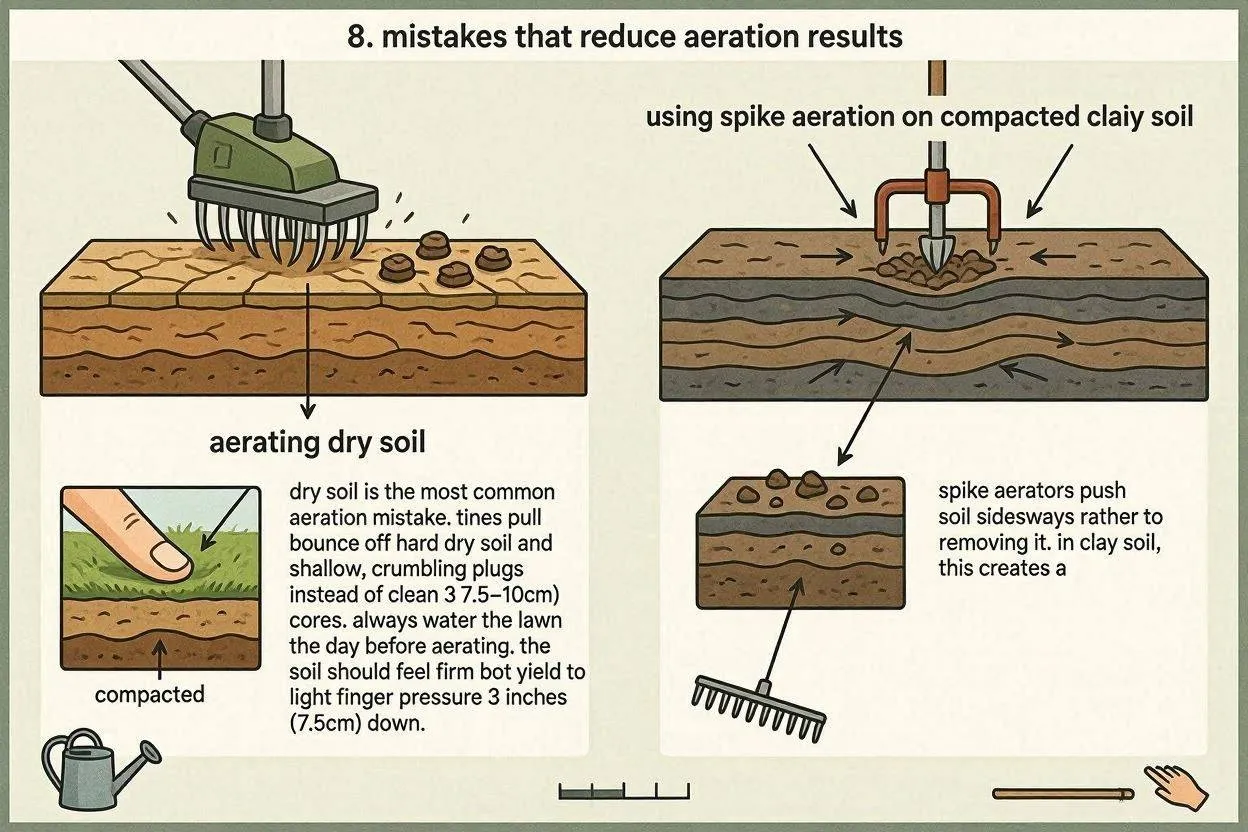
Aerating Dry Soil
Dry soil is the most common aeration mistake. Tines bounce off hard dry soil and pull shallow, crumbling plugs instead of clean 3–4 inch (7.5–10cm) cores. Always water the lawn the day before aerating. The soil should feel firm but yield to light finger pressure 3 inches (7.5cm) down.
Using Spike Aeration on Compacted Clay Soil
Spike aerators push soil sideways rather than removing it. In clay soil, this creates a harder, denser zone around each hole — making compaction worse, not better. Use a core aerator on clay soil. Spike aerators are acceptable only on loose sandy soil with minor surface issues.
Single-Direction Single Pass
One slow pass across the lawn leaves holes spaced 4–6 inches (10–15cm) apart. Make 2 perpendicular passes — once east-west, once north-south — for holes every 2–3 inches (5–7.5cm). The more holes per square foot, the greater the compaction relief and the better the overseeding results.
Not Marking Sprinkler Heads
Core aerator tines can shear sprinkler heads clean off if they’re not marked. Damaged sprinkler heads cost $15–$75 each to replace. Mark every head with a small flag or orange spray paint before starting. Include shallow drip irrigation lines and any outdoor lighting cables.
Aerating and Immediately Applying Pre-Emergent
A common misconception is that aerating breaks the pre-emergent herbicide barrier. Research from multiple university extension programs shows aeration does not reduce crabgrass control when a pre-emergent has already been applied. However, if you plan to overseed, do not apply pre-emergent — it prevents grass seed germination as effectively as weed seed germination.
9. Related Lawn Care Guides on ZonedGarden
Aeration works best as part of a complete lawn care system. These ZonedGarden guides cover the practices that pair directly with aeration:
Best Time to Water Lawn — Watering Schedule Guide — Water timing after aeration is critical for seed germination and root recovery. Learn the 6–10 a.m. watering rule, seasonal schedules, and how much water grass needs per week.
Garden Area Calculator — Calculate your lawn area before renting a core aerator or buying overseed. Know your exact square footage in square meters, square feet, or square yards in under 5 seconds.
Complete Lawn and Landscape Care at ZonedGarden.com — Daniel Copsey’s full resource library covering soil preparation, grass selection, pest management, and seasonal lawn care across all USDA hardiness zones.
Frequently Asked Questions
When is the best time to aerate your lawn?
The best time to aerate cool-season grass is late August through October. The best time to aerate warm-season grass is late spring — May through June. Both windows align aeration with active grass growth so the lawn recovers quickly and fills aeration holes with new root growth within 2–4 weeks.
Can you aerate in spring?
Yes for cool-season grass, but fall is better. Spring aeration on cool-season lawns opens the soil during prime weed germination season, giving crabgrass and annual weeds direct soil contact. If you must aerate in spring, do it after 2 mowing sessions and before soil temperatures exceed 70°F (21°C). For warm-season grass, spring is the correct primary window.
How often should you aerate your lawn?
Once per year covers most residential lawns. Lawns with heavy clay soil or high foot traffic from children or pets benefit from aeration twice per year — once in fall and once in spring. Sandy, low-traffic lawns may need aeration only every 2 years.
Is core aeration better than spike aeration?
Yes. Core aeration removes actual plugs of soil, creating real space for air, water, and nutrients to reach roots. Spike aeration pushes soil sideways with solid tines, which increases compaction in the soil around each hole rather than relieving it. Use core aeration on any lawn with noticeable compaction, especially clay soil.
Should you aerate before or after overseeding?
Aerate first, then overseed immediately after. Aeration holes give grass seed direct contact with soil, shelter from drying wind, and access to deeper soil moisture. Germination rates improve by 30–50% when overseeding into freshly aerated holes compared to broadcasting seed on bare soil surface.
How do I know if my lawn needs aeration?
Run the screwdriver test: push a standard screwdriver 6 inches (15cm) into the lawn soil by hand. If it resists, the soil is compacted. Additional signs include water pooling rather than soaking in, footprints staying visible for 30+ seconds, a thatch layer thicker than 0.5 inches (13mm), and grass that stays thin despite regular fertilizing and watering.
What do I do with the soil plugs after core aeration?
Leave them on the lawn surface. The plugs dry within 3–5 days and break down within 2 weeks, returning organic matter, microbes, and nutrients to the soil. Run a lawn mower over them once dry to speed up breakdown. Do not rake them up — they add real benefit to the lawn.
Can you aerate a dormant lawn?
No. Never aerate dormant grass. Dormant turf cannot repair the aeration holes, and the exposed bare soil becomes a seedbed for weeds. Always wait until the grass is actively growing before aerating — cool-season grasses must be visibly green and growing, and warm-season grasses must be fully greened up from winter dormancy.
How long after aeration does grass recover?
Cool-season grass fills aeration holes within 2–4 weeks during fall’s active growth period. Warm-season grass recovers in 2–3 weeks in late spring when growth is most vigorous. In both cases, consistent watering in the first 2 weeks after aeration is critical — the exposed soil in each hole dries out faster than the surrounding turf.
Conclusion: Aerate With the Grass, Not Against It
Timing is everything with lawn aeration. The same core aerator used at the wrong time stresses a lawn and opens the soil to weeds. Used at the right time — during active growth — it repairs within weeks and delivers months of improved root depth, water absorption, and turf density.
The rule is simple: aerate when the grass is growing fastest. For cool-season grass, that’s fall — late August through October. For warm-season grass, that’s late spring — May through June. Everything else — soil moisture, plug depth, overseed timing, post-aeration watering — builds on that foundation.
Aerate once a year at the right time, overseed into the holes, and water consistently for 2 weeks after. That three-part combination produces more lawn improvement than any other single maintenance practice.