
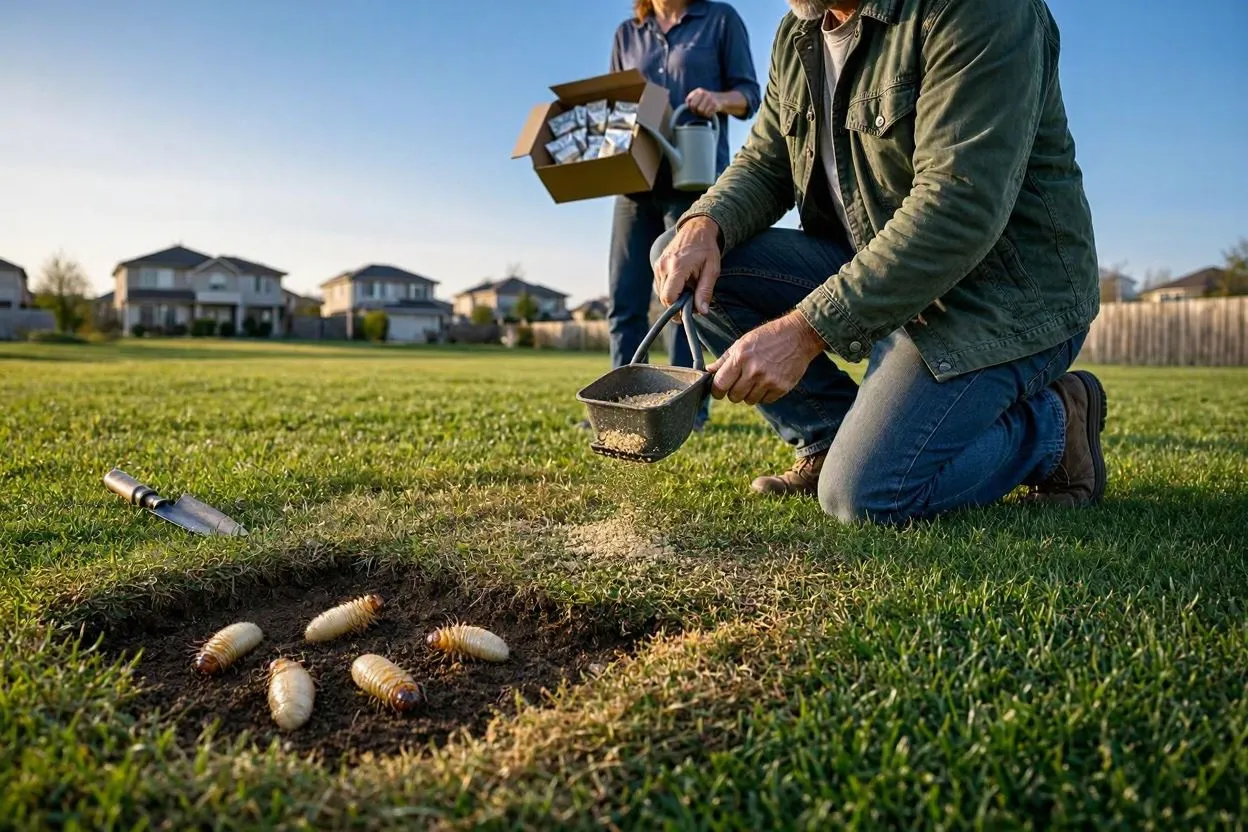
To treat grubs in a lawn, confirm 10 or more grubs per square foot (about 108 per m²) first, then apply a curative insecticide such as trichlorfon from mid-August to September, or a preventive one such as chlorantraniliprole or imidacloprid between April and mid-July. Water either product in with 0.25 to 0.5 inch (6 to 13 mm) of irrigation the same day. Timing decides everything. A preventive bag spread in October kills almost nothing, and a curative spread in June finds no grubs to hit.
This guide shows how to treat grubs in lawn turf across 4 US regions, from Cleveland bluegrass to Texas St. Augustinegrass, using field data from Ohio State, Michigan State and Texas A&M Extension. You’ll get count thresholds by grass type and product windows by month. There’s a repair plan too, and a clear answer if you’re reading this after the fall window has shut.
What Are Lawn Grubs?
Lawn grubs are the C-shaped, cream-white larvae of scarab beetles, and they kill grass by chewing through roots and crowns in the thatch layer. Each grub has a brown head and 6 true legs. Full-grown, the larvae measure 3/8 inch to 2 inches (1 to 5 cm), depending on species. Most species finish 1 generation per year: beetles lay eggs in moist soil in early summer, the young grubs feed hardest from late August into October, and falling temperatures push them 4 to 8 inches (10 to 20 cm) down for winter. Spring brings them back up. They feed briefly, pupate, and emerge as adult beetles around June.
6 Common Grub Species in US Lawns
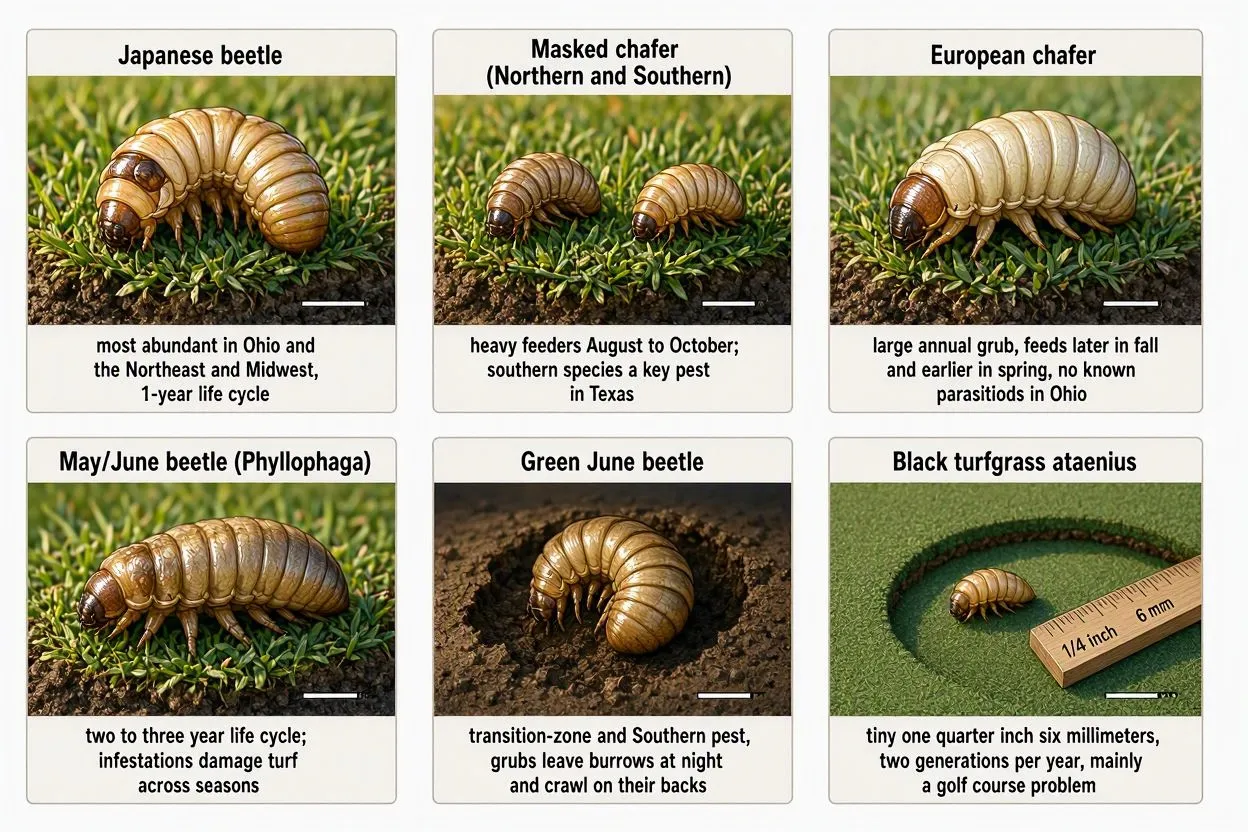
- Japanese beetle: the most abundant turf grub in Ohio and across the Northeast and Midwest, with a 1-year life cycle.
- Northern and southern masked chafer: heavy August-to-October feeders, and the southern masked chafer ranks as a key pest of Texas lawns.
- European chafer: a large annual grub that feeds later in fall and earlier in spring than other species, with no known parasitoids in Ohio.
- May/June beetle (Phyllophaga): a 2 to 3 year life cycle, so one infestation damages turf across several seasons.
- Green June beetle: a transition-zone and Southern pest whose grubs leave their burrows at night and crawl on their backs.
- Black turfgrass ataenius: a tiny 1/4 inch (6 mm) grub with 2 generations per year, mainly a golf course problem.
For most homeowners, species changes very little about chemical control. Biological products are different. Milky spore and Bt japonensis kill Japanese beetle grubs only, so a lawn full of masked chafers gets nothing from them.
How Do You Know If You Have Grubs?
You confirm grubs only by digging: cut a 1-square-foot (30 x 30 cm) flap of turf about 3 inches (7.5 cm) deep and count the white larvae. Brown patches alone prove nothing. Drought, chinch bugs, sod webworms, fungal disease and soil compaction all leave similar dead spots, and Ohio State Extension describes direct grub feeding as a near match for drought stress.
5 Visible Signs of Grub Damage
- Irregular brown patches that show up between mid-August and October and spread week by week.
- Spongy turf that gives underfoot because tunneling has loosened the root zone.
- Loose sod that lifts by hand with few or no roots attached.
- Overnight digging by skunks, raccoons, moles and crows.
- Low beetle flights over the lawn in June and July, the egg-laying period.
Overnight digging is the weakest clue here. Skunks and raccoons eat earthworms and other soil insects too, and UNH Extension sees plenty of torn-up lawns with no grub problem underneath.
How to Count Grubs per Square Foot
To count grubs, sample several 1-square-foot spots along the edge of the brown area, where live larvae are still feeding.
- Cut 3 sides of a 12 x 12 inch (30 x 30 cm) square with a flat spade, about 3 inches (7.5 cm) deep.
- Fold the flap back and break apart the root zone and the top 2 inches (5 cm) of soil.
- Count every grub, including small larvae under 1/4 inch (6 mm).
- Repeat every 10 to 15 feet (3 to 4.5 m) in a grid, the spacing Ohio State recommends for home lawns.
- Press the flap back down and water it so the roots reattach.
Jot each count on a rough sketch of your yard. That sketch turns into your treatment map, so you spot-treat the hot zones instead of buying product for the whole property.
How Many Grubs per Square Foot Need Treatment?
Most cool-season lawns need treatment at 10 or more grubs per square foot, and drought-stressed or underfed lawns need it at 6. Grass type shifts that number. So does the grub species.
| Grass type or grub species | Damage threshold (grubs per sq ft) | Source |
| Kentucky bluegrass, perennial ryegrass | 8 to 10 | Dr. David Shetlar, Ohio State entomologist |
| Tall fescue | 12 to 14 | Dr. David Shetlar |
| Most cool-season lawns, annual grub species | 10+ | Ohio State Extension |
| Illinois home lawns | about 12 | Illinois Extension |
| Texas lawns in grub-prone sites | 5 to 10 | Texas A&M AgriLife Extension |
| Asiatic garden beetle | 18 to 20 | LawnStarter |
| Black turfgrass ataenius | 30 to 80 in spring, 15 to 40 in summer | Ohio State Extension |
Below the threshold, fix the turf instead of chasing the grubs. UNH Extension recommends mowing at 3 inches (7.5 cm) or higher, testing soil every 2 to 3 years and overseeding thin spots in fall. A deep root system shrugs off light feeding. Skunks complicate the picture, though: Illinois Extension notes that they dig even at low grub counts, so animal damage can show up well before the turf threshold.
How to Treat Grubs in Lawn: Preventive vs. Curative
Preventive products kill next season’s grubs as they hatch, while curative products kill the grubs feeding in your soil right now. Mixing up the two is the top reason grub control fails. Each type works only inside its own window.
| Factor | Preventive | Curative |
| Target | Newly hatched grubs | Large grubs already feeding |
| Active ingredients | Chlorantraniliprole, imidacloprid, thiamethoxam, clothianidin | Trichlorfon, carbaryl (clothianidin at higher rates) |
| Application window | April to mid-July | Mid-August to September; spring before early May |
| Residual in soil | Up to 8 to 12 weeks | A few days |
| Typical control | High when timed to egg hatch | Variable, as low as 20 to 25% |
| Best fit | Lawns with a history of damage | Confirmed counts above threshold |
Preventive Grub Control
Apply preventive grub control before eggs hatch, between April and mid-July depending on the active ingredient. Systemic ingredients soak into the root zone and wait there. Chlorantraniliprole and clothianidin persist up to 12 weeks, so Ohio State clears them for application from late May, while imidacloprid and thiamethoxam last about 8 weeks and shouldn’t go down before mid-June. Michigan State pushes chlorantraniliprole even earlier, to April or May. The reason is physical: that molecule binds to thatch and needs extra weeks to reach July’s feeding zone.
Bees get a break with chlorantraniliprole. UNH Extension points out that the US Environmental Protection Agency (EPA) classifies it as a low-risk pesticide because of its low toxicity to pollinators, which the neonicotinoids can’t claim.
Preventive products won’t rescue a lawn in fall. Spread one in September and the big third-stage grubs under your sod survive it.
Curative Grub Control
Use a curative product when you’ve confirmed 10 or more grubs per square foot between mid-August and late September. Trichlorfon, sold as Dylox and as BioAdvanced 24 Hour Grub Killer Plus (9.3% granules), kills on contact, as does carbaryl (Sevin). Neither lasts more than a few days in soil. Results swing hard: UNH Extension has recorded control as low as 20 to 25%, and every week of delay sends grubs deeper, farther from the chemical.
Two habits lift your odds. On dry soil, irrigate the day before so the product soaks down instead of sitting in parched thatch. Right after spreading, water in another 0.5 inch (13 mm). Michigan State adds a follow-up rule worth taping to the garage wall: after any curative rescue, schedule a preventive application the next summer, or the infestation returns.
Which Grub Killer Works Best?
Chlorantraniliprole is the best preventive grub killer for most homeowners, and trichlorfon is the best curative one. UNH Extension found chlorantraniliprole controls every white grub species found in New Hampshire, plus webworms and armyworms. Trichlorfon acts fastest on larvae already feeding.
| Active ingredient | Type | Example products | When to apply | Soil residual |
| Chlorantraniliprole | Preventive | Scotts GrubEx, Acelepryn | April to late May | Up to 12 weeks |
| Clothianidin | Preventive (curative at higher rates) | Arena | Late May onward | Up to 12 weeks |
| Imidacloprid (0.25% granules) | Preventive | BioAdvanced Season-Long Grub Control, Merit | June 1 to July 15 | Up to 8 weeks |
| Thiamethoxam | Preventive | Meridian | Mid-June onward | Up to 8 weeks |
| Trichlorfon (9.3% granules) | Curative | Dylox, BioAdvanced 24 Hour Grub Killer Plus | Mid-August to September; spring before early May | A few days |
| Carbaryl | Curative | Sevin | Mid-August to September | A few days |
Skip any bag whose only active ingredient is a pyrethroid. Michigan State lists 6 that fail on grubs: bifenthrin, lambda-cyhalothrin, gamma-cyhalothrin, deltamethrin, cyfluthrin and permethrin. Ohio State explains why. Pyrethroids bind to thatch and organic matter before they reach the soil, so in combination products only the neonicotinoid does any grub work. Read the active ingredient panel on the back, not the claims on the front.
When to Apply: How to Treat for Grubs in Lawn by Month and Region
Apply preventive products from April to mid-July and curative products from mid-August to September, with the exact weeks set by when beetles fly in your region.
| US region | Main grub species | Preventive window | Curative window |
| Upper Midwest and Northeast (MI, MN, NH, NY) | Japanese beetle, European chafer | Chlorantraniliprole April to May; imidacloprid June 1 to July 15 | Mid-August to September; stop by early October |
| Ohio Valley and Lower Midwest (OH, IL, IN, PA) | Japanese beetle, masked chafer | Late May to mid-July | Mid-August to September |
| Transition zone (KY, VA, NC) | Green June beetle, Japanese beetle, masked chafer | At local egg hatch (ask your county Extension office) | Late summer or fall, while grubs are small |
| South and Texas | May/June beetle, southern masked chafer | June in South Texas, early July in North Texas | August, while grubs are young and near the surface |
Calendars drift in an odd year. A cold spring delays beetle flights by weeks, so watch for the first Japanese beetles chewing roses or linden leaves; eggs hatch 1 to 2 weeks after females start laying. Peak egg-laying in Illinois runs from late June to mid-July, which makes early July a dependable check-in for most of the Midwest.
Is It Too Late to Treat Grubs in October?
Yes, in most northern states, because grubs move below the reach of curative products after early October. University of Minnesota Extension advises against grub treatments past early October for that reason. Dig a test square before you decide. If grubs still sit in the top 2 inches (5 cm), a trichlorfon application watered in with 0.5 inch (13 mm) reaches them. Deeper than that, save your money: rake out dead turf, reseed where your area still allows germination, and mark a spring count on the calendar.
How to Treat Active Grubs in Lawn: Cleveland, Ohio Timing
To treat active grubs in Cleveland, Ohio lawns, spread trichlorfon from mid-August through September and water it in with 0.25 to 0.5 inch (6 to 13 mm) of irrigation, the range Ohio State Extension recommends. Northeast Ohio lawns take most of their grub damage between August and October. Japanese beetles and masked chafers cause most of it statewide, per Ohio State’s March 2026 fact sheet (ENT-0107).
Prevention in Cuyahoga County runs on a tight schedule. Cleveland-area lawn programs target the last 2 weeks of June and the first 2 weeks of July, after adult beetles emerge in late June and before eggs hatch, and lawns in Lakewood, Westlake, Mentor and Strongsville follow the same window.
Statewide, the answer to how to treat active grubs in lawn Ohio turf comes from Ohio State’s residual data: chlorantraniliprole or clothianidin from late May, imidacloprid or thiamethoxam from mid-June, and trichlorfon in late summer. Two Ohio-specific warnings apply. Heavy July watering draws egg-laying females, since their eggs need moist soil to hatch, so let a healthy lawn run slightly dry through mid-July if you can tolerate some tan color. Japanese beetle bag traps backfire too, because Ohio State found they pull in more beetles than they catch.
How to Treat Grass Grub in Lawns Without Chemicals
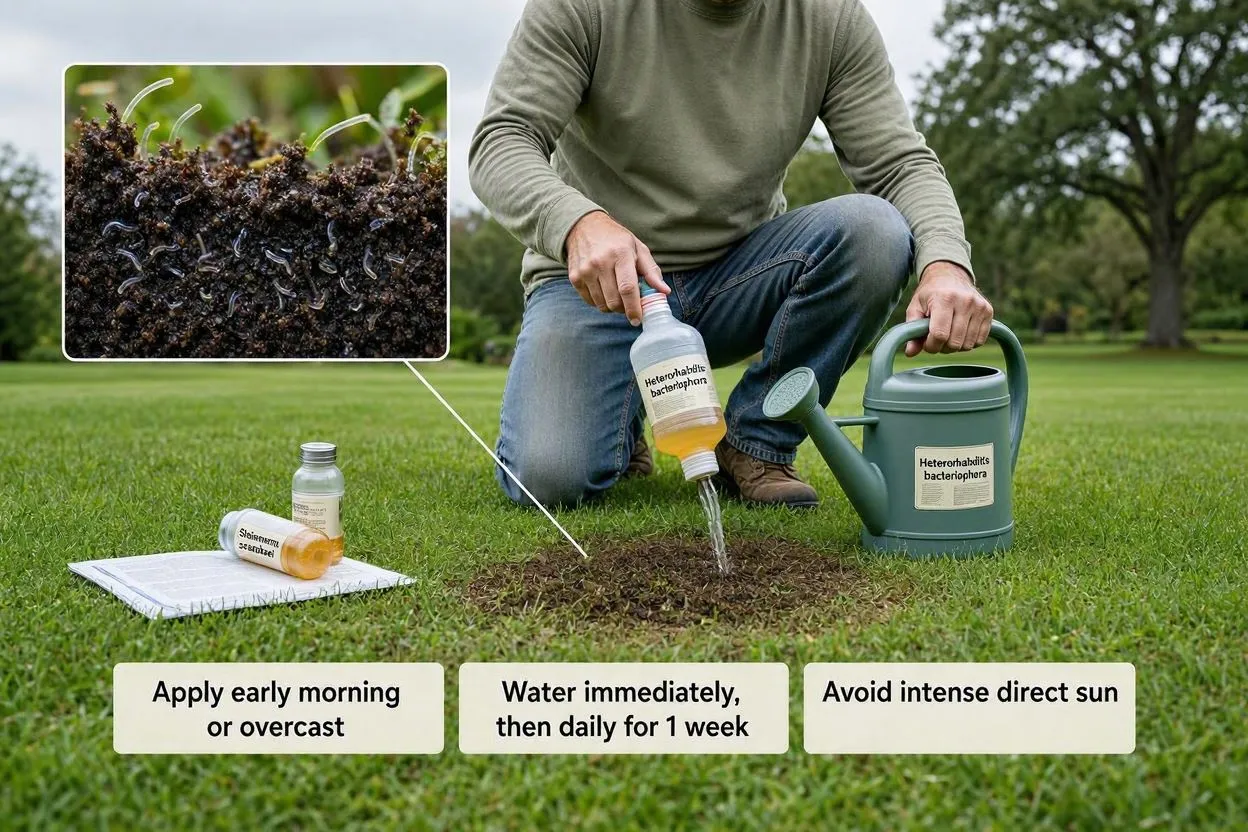
Beneficial nematodes are the most effective natural grub treatment, giving 60 to 100% control when applied to moist soil at the right time. That range comes from Dr. David Shetlar, who adds that the learning curve is steep. Heterorhabditis bacteriophora is the most widely sold species. Steinernema scarabaei stands out for a different reason: Ohio State found it keeps killing mature grubs, which most nematodes can’t.
Placement matters as much as product. UNH Extension reports that intense direct sun kills nematodes within a minute, so release them early in the morning or on an overcast day, water immediately, and keep watering daily for 1 week, as Ohio State advises.
| Natural option | Grubs controlled | Realistic result | Main drawback |
| Beneficial nematodes | Most common species, varies by nematode | 60 to 100% | Daily watering for 7 days, no midday sun |
| Milky spore (Paenibacillus popilliae) | Japanese beetle only | 20 to 25% infection at best | Takes years to build up; fails in cold northern soils |
| Bt galleriae or Bt japonensis | Btg: white grubs; Btj: Japanese beetle only | Effective when matched to species | Requires species ID first |
| Fungi (Metarhizium, Beauveria) | Many species | Weak | Binds to thatch before reaching grubs |
| Summer dormancy | All egg-laying species | Fewer eggs survive | Tan lawn through July and August |
Milky spore deserves extra caution in the North. UNH Extension cites research showing spring soils in northern New England stay too cold for it to work, and Ohio State notes infected grubs take about 4 weeks to die. Dish soap doesn’t belong on any list, because the solution never reaches larvae in the root zone, and none of the 6 Extension sources behind this guide recommend neem oil for white grubs.
How to Apply Grub Control Step by Step
To apply grub control, mow first, spread granules on dry grass at the label rate, then water in 0.25 to 0.5 inch (6 to 13 mm) the same day. These 7 steps cover both product types.
- Mow the lawn so no clover or dandelions are blooming, which keeps bees away from treated turf.
- Dethatch or core-aerate when thatch tops 0.5 inch (13 mm), since thick thatch traps insecticide before it reaches the soil.
- Set your spreader to the setting printed on the bag, because the Federal Insecticide, Fungicide, and Rodenticide Act (FIFRA) makes every pesticide label a legal document.
- Treat only the zones your count flagged, since grubs often occupy a small part of the lawn.
- Water in 0.25 to 0.5 inch (6 to 13 mm) right away; on large lawns, Illinois Extension recommends treating one section, watering it, then moving to the next.
- Keep kids and pets off the area until the grass dries completely.
- Dig 2 test squares 10 to 14 days after a curative application to confirm the kill.
Measuring half an inch is easy. Set an empty tuna can on the lawn and run the sprinkler until it fills to the 0.5 inch (13 mm) line, which takes roughly 30 to 60 minutes with most sprinklers.
Green June beetle grubs break the watering rule. NC State Extension says carbaryl aimed at them shouldn’t be watered in, because those grubs come to the surface at night. Rake up the dead ones before mowing, since Ohio State warns their scent glands produce a foul smell and the bodies can clog a mower deck.
Is Grub Killer Safe for Pets, Kids and Bees?
Yes, once the product has been watered in and the grass is completely dry, if you follow the label. The National Pesticide Information Center (NPIC) gives the standard rule for labels without a reentry time: water granules in and let the lawn dry before people or pets return, and let sprays dry fully. Rain within a few days resets the clock, so keep dogs off until the grass dries again.
Pollinators need 2 extra steps. Mow off flowering weeds before any application, and watch for drift onto blooming shrubs or garden beds when wind picks up. UNH Extension adds a point most product bags skip: if only one section of the lawn has grubs, there’s little reason to treat the whole yard. A handful of states restrict retail neonicotinoid lawn products, so check with your state department of agriculture before buying imidacloprid. Store leftovers in the original container, away from children and pets.
How to Repair a Lawn After Grub Damage
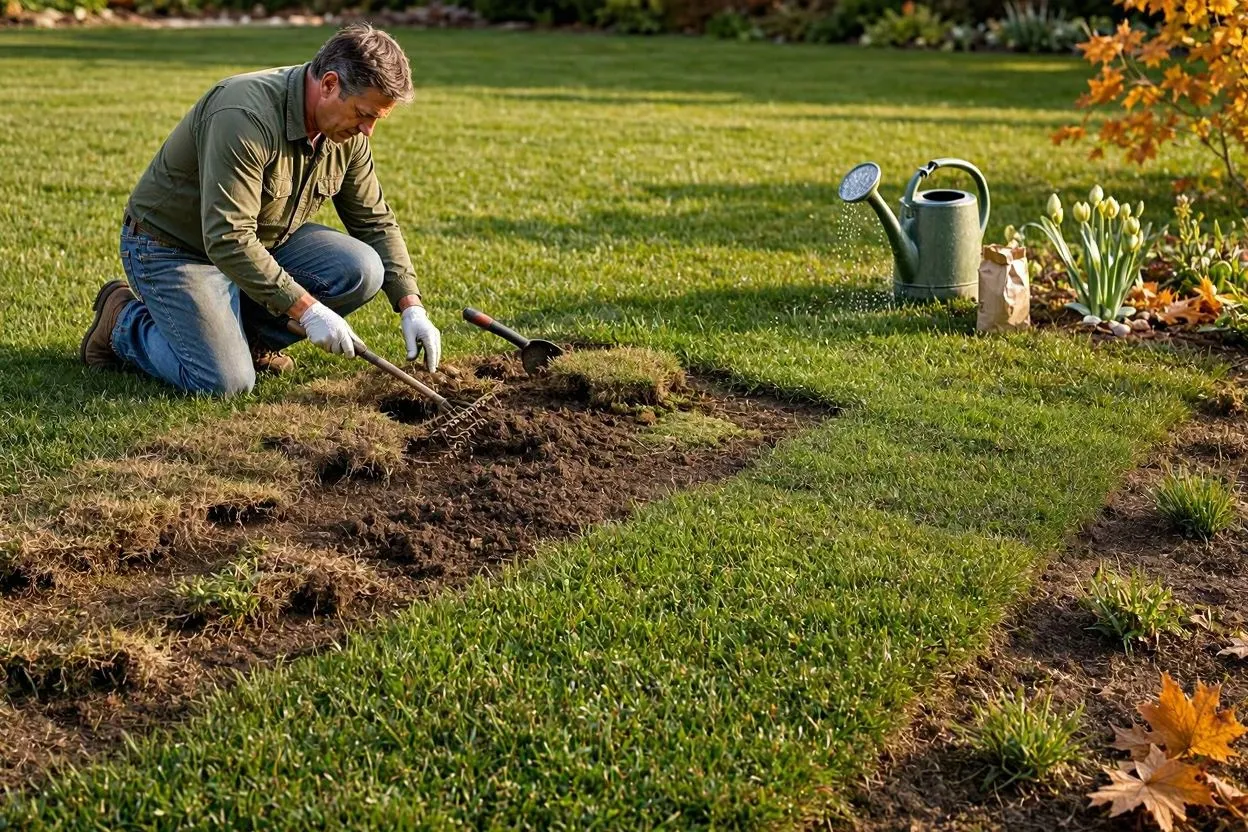
Repair grub damage by raking out dead turf, loosening the top inch (2.5 cm) of soil, and reseeding or resodding once the grubs are under control. Partly chewed turf usually regrows with steady watering and a light feeding. Patches that lift with no roots attached won’t recover by themselves.
Timing depends on grass type. Cool-season lawns reseed best in early fall, which UNH Extension prefers over spring. Patches found too late for fall seeding can wait, because grub feeding tapers off before pupation, and University of Maine Extension notes new grass can go in safely by the end of May. Warm-season St. Augustinegrass and Bermudagrass patches fill in best with sod or plugs once spring soil warms.
The repair is a chance to change grass. Warm-season grasses tolerate grubs better than cool-season types, and tall fescue is the most grub-tolerant cool-season option. Mow St. Augustinegrass at 2 to 4 inches (5 to 10 cm), the height Texas A&M AgriLife recommends, and mow cool-season turf at 3 inches (7.5 cm) or more so roots reach deeper than grubs feed.
Do You Need to Treat for Grubs Every Year?
No, because yearly preventive treatment only pays off on lawns with a history of damage or counts above threshold. Michigan State calls the treat-every-year belief erroneous. Its advice is direct: after several years of treating with no grubs in your lawn or your neighbor’s, stop.
Knowing how to treat grubs in lawn turf also means knowing when to hold off. Spot treatment based on counts cuts insecticide use, and Ohio State notes it protects the natural enemies already working your soil, including Tiphia and Scolia wasps and tachinid flies. A pollinator strip or flower bed gives those predators food and a refuge away from treated areas.
FAQs
Does GrubEx kill existing grubs?
No. GrubEx contains chlorantraniliprole, a preventive ingredient aimed at newly hatched larvae. Big grubs chewing roots in September survive it, so a fall rescue calls for trichlorfon or carbaryl instead.
How long does grub killer take to work?
Trichlorfon kills feeding grubs within days, and visible turf improvement follows in 7 to 10 days. Preventive products act on a delay, killing young larvae as eggs hatch through July and August.
Can you treat grubs in the spring?
Yes, but spring treatment rarely pays off. Grubs are large in April, feed briefly and pupate by early June. Illinois Extension discourages it, and Michigan State limits spring use to trichlorfon or carbaryl before early May.
Will Dawn dish soap kill lawn grubs?
No. Soapy water stays in the thatch and never reaches larvae feeding 1 to 3 inches (2.5 to 7.5 cm) down. Labeled insecticides or beneficial nematodes are the options that reach the root zone.
Will my lawn grow back after grub damage?
Yes, when roots are only partly eaten. Regular watering and a light fertilizer bring that turf back within weeks. Patches lifting with zero roots need raking, then fresh seed or sod.
Conclusion
The fastest way to treat grubs in a lawn is to count first and match the product to the month. Dig 1-square-foot samples, compare the count to your grass type’s threshold, then pick chlorantraniliprole in spring, imidacloprid in early summer or trichlorfon in late summer. Water every application in the same day.
That sequence is how to treat grubs in lawn turf without wasting product in quiet years. Cleveland homeowners and Texas homeowners use the same steps on different calendars, and both get better results from a June beetle check than from a September panic. If you’re past the window this fall, rake out the dead patches, reseed where you can, and put a grub count on next June’s calendar.