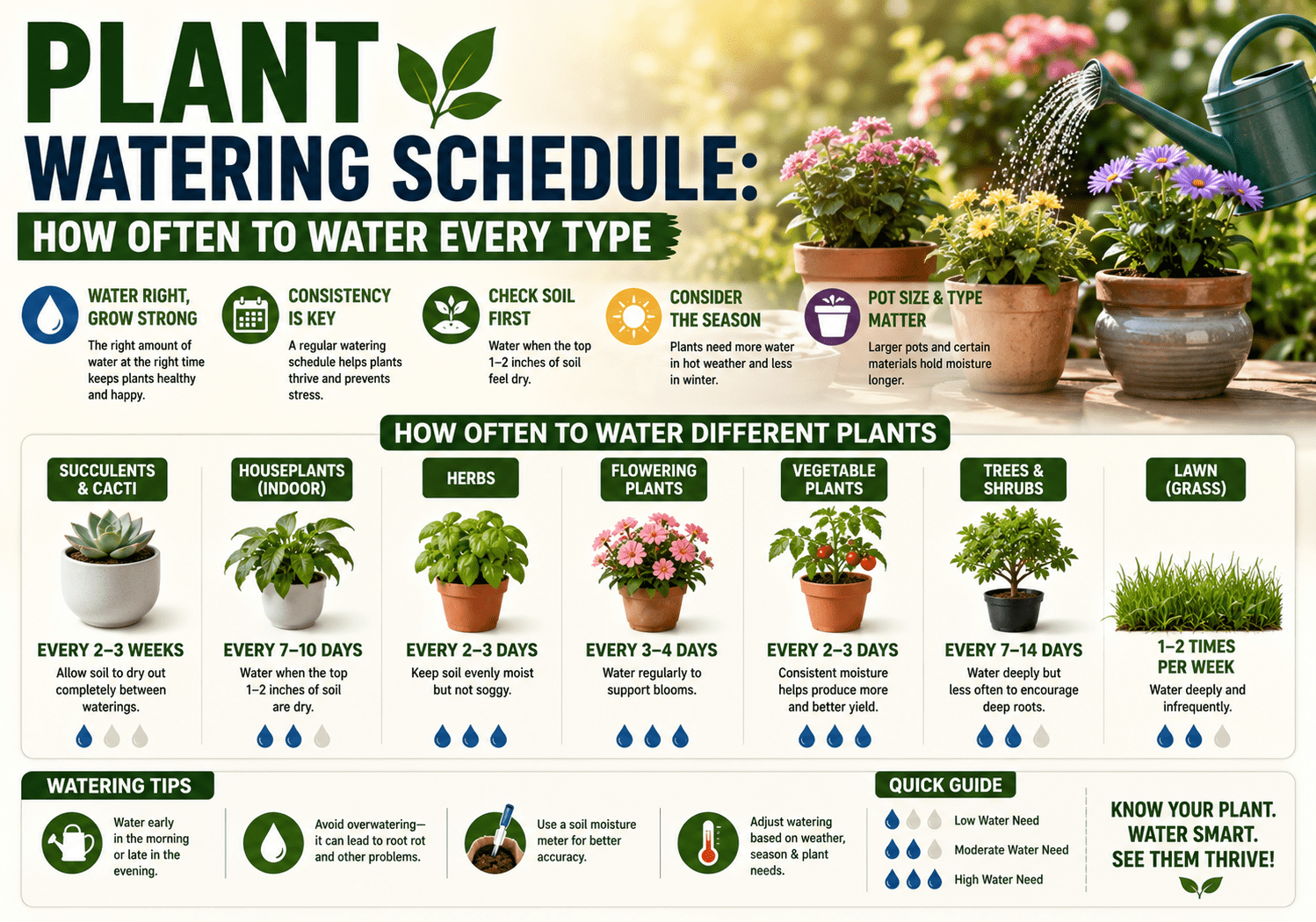
Overwatering is the single most common cause of houseplant death — not drought. A University of Maryland Extension study confirms that the majority of potted plants are lost to either overwatering or underwatering, with overwatering being the greater threat. The reason most people get it wrong is simple: they water on a fixed schedule instead of reading the plant and soil.
This guide gives you a complete plant watering schedule organized by plant type — succulents, tropical houseplants, vegetables, outdoor shrubs, and trees — with exact frequencies, seasonal adjustments, and the 3 soil tests that tell you in seconds whether watering is actually needed.
Every frequency in this guide is a starting point. The finger test or moisture meter reading overrides any calendar.
The Rule That Applies to Every Plant
Water deeply and infrequently. This applies to succulents, vegetables, trees, and tropical houseplants equally — the depth and interval vary, but the principle does not. Shallow, frequent watering keeps roots in the top inch of soil. Deep, spaced-out watering pushes roots downward, creating plants that handle drought, heat, and irregular schedules far better.
When you water, water until it drains from the bottom of the pot or until you have applied the full target volume to in-ground plants. Then wait. The waiting period — not the watering itself — is what most schedules get wrong.
3 Soil Tests That Replace Any Fixed Schedule

Use one of these before every watering session. They override the calendar.
- Finger test. Push your finger 1 to 2 inches into the soil (deeper for large pots). Dry soil means water now. Slightly moist soil means wait 1 to 2 more days. Wet soil means skip the session and check again tomorrow.
- Chopstick / skewer test. Insert a plain wooden chopstick or bamboo skewer to the bottom of the pot. Leave it for 10 minutes. A clean, dry stick means the soil is dry through. A damp or soil-stained stick means moisture is still present — skip watering.
- Moisture meter test. Insert the probe into the root zone (not just the surface). A reading of 1 to 2 means water immediately (succulents wait for 1). A reading of 3 to 4 means water most houseplants now. A reading of 5 or above means the soil is still moist — wait. Ferns and tropical plants can be watered at 4 to 5.
The pot weight test is a fourth option for container plants. Lift the pot immediately after watering and feel its weight. Lift it again a few days later. A noticeably lighter pot means the soil has dried and watering is due. After 2 to 3 weeks you build an accurate sense of each pot’s dry versus wet weight.
Plant Watering Schedule by Plant Type
The table below gives baseline frequencies for the most common plant categories. All frequencies assume room temperature indoors (65–75°F / 18–24°C) or average summer outdoor conditions unless noted.
| Plant Type | Spring / Summer | Autumn / Fall | Winter | Soil Test Target |
| Succulents & Cacti | Every 14–21 days | Every 3–4 weeks | Every 4–6 weeks | Moisture meter: 1–2 |
| Tropical Houseplants (Monstera, Philodendron) | Every 7–10 days | Every 10–14 days | Every 14–21 days | Moisture meter: 3–4 |
| Ferns & Calathea | Every 5–7 days | Every 7–10 days | Every 10–14 days | Moisture meter: 4–5 |
| Peace Lily / Pothos / Dracaena | Every 7–14 days | Every 14 days | Every 14–21 days | Top inch dry |
| Snake Plant / ZZ Plant | Every 14 days | Every 3 weeks | Every 4–6 weeks | Top 2 inches fully dry |
| Vegetables (in-ground) | 3x per week, 1–1.5 in/week | 1–2x per week | Minimal / stop at frost | Soil moist 3–4 inches deep |
| Container Vegetables | Daily in heat (>85°F) | Every 2–3 days | Every 3–5 days | Check daily; top inch dry |
| Annual Flowers (outdoor) | 2–3x per week | 1–2x per week | Stop at first frost | Top inch dry |
| Perennial Shrubs (established) | Every 7–14 days | Every 2–3 weeks | Once/month in mild climates | Top 2–3 inches dry |
| Newly Planted Shrubs | 2–3x per week | Once per week | Once per week until freeze | Root ball stays moist |
| Established Trees (2+ years) | Every 2 weeks | Once per month | None needed | Soil moist at drip line |
| Newly Planted Trees | 2–3x per week (first 4 weeks) | Once per week | Once per week until freeze | Root ball consistently moist |
Succulent & Cactus Watering Schedule
Succulents store water in their leaves, stems, and roots. Their biggest threat is wet soil, not dry soil. The correct method is soak and dry: water thoroughly until it drains from the drainage hole, then allow the soil to dry completely before watering again.
In summer, most indoor succulents need water every 14 to 21 days. In winter, reduce to every 4 to 6 weeks. The moisture meter target is 1 to 2 — do not water at 3 or above. Terracotta pots dry out faster than ceramic or plastic and may need watering slightly more frequently.
Never use a spray bottle on succulents. Misting wets the surface without reaching the root zone and promotes rot at the soil level. Always water at the base, thoroughly, and then stop.
Pot material affects drying speed significantly. A succulent in terracotta may need water every 10–14 days in summer. The same plant in a glazed ceramic pot may need 18–21 days. Check with the chopstick test rather than relying on calendar days alone.
Tropical Houseplant Watering Schedule
Tropical plants (Monstera, Philodendron, Pothos, Ficus) originate in environments with regular rainfall. They prefer consistent moisture but must never sit in waterlogged soil. The target is moist but not wet: the top inch of soil should dry between sessions, but the root zone should not dry out completely.
High-Frequency Tropicals (Every 5–7 Days)
Ferns, Calathea, Peace Lily, and Alocasia prefer consistently moist soil. Their leaves wilt visibly within 24 to 48 hours of the soil drying out. Water when the moisture meter reads 4 to 5 or when the top inch feels barely dry to the touch. In summer, this is typically every 5 to 7 days.
Standard Tropicals (Every 7–14 Days)
Monstera, Philodendron, Pothos, and Dracaena tolerate brief dry spells. Water when the top 1 to 2 inches of soil are dry. In active growth (spring through summer), this is typically every 7 to 10 days. In winter, extend to 14 to 21 days as growth slows and evaporation decreases.
Low-Frequency Tropicals (Every 14–21 Days)
Snake Plants, ZZ Plants, and Cast Iron Plants are adapted to irregular moisture and store water in their rhizomes. Let the top 2 inches of soil dry completely before watering. Overwatering these species causes root rot faster than any other common houseplant. In winter, stretch intervals to 4 to 6 weeks.
How to Adjust Your Plant Watering Schedule by Season
Most plants use significantly more water between March and September during active growth. From October through February, growth slows and water demand drops by 30 to 50%. Using the same watering schedule year-round is one of the most common causes of winter root rot in houseplants.
| Season | Indoor Plants | Outdoor Plants | Key Adjustment |
| Spring | Gradually increase from winter schedule | Supplement only if 5+ days without rain | Resume normal watering as new growth appears |
| Summer | Peak frequency; check every 2–3 days | 3x/week for vegetables; 2x for shrubs | Container plants may need daily watering in heat >90°F |
| Autumn | Reduce by ~30%; stop fertilising | 1–2x/week; newly planted trees: keep weekly | Continue watering trees until ground freezes |
| Winter | Reduce 30–50%; check soil before every session | Stop most outdoor irrigation; monthly in mild zones | Biggest risk is overwatering — cool temps slow evaporation |
Most plants grow actively from March through September and use water at 2 to 3 times their winter rate. Reduce watering frequency — not session duration — as temperatures drop. The soil should be checked before every winter watering session regardless of the calendar date.
Vegetable Garden Watering Schedule
Vegetables are among the thirstiest plants and the least forgiving of irregular watering. Most vegetables need 1 inch of water per week, delivered in 2 to 3 deep sessions rather than daily light sprinklings. In peak summer heat (above 85°F / 29°C), this rises to 1.5 inches per week.
Always water vegetables at the base, not overhead. Wet foliage overnight invites fungal diseases, particularly on tomatoes and squash. Drip irrigation or soaker hoses deliver water directly to the root zone, reducing disease risk and cutting water waste by 30 to 50% compared to overhead sprinklers.
| Vegetable | Water Per Week | Critical Stage | Notes |
| Tomatoes | 1.5–2 inches | Flowering & fruiting | Inconsistent watering causes blossom end rot and cracking |
| Peppers | 1–1.5 inches | Flowering | Reduce watering to intensify flavour in hot peppers |
| Courgette / Squash | 1.5–2 inches | Pollination period | Water at base only; wet leaves trigger powdery mildew |
| Cucumbers | 1.5 inches | Fruiting | Bitter cucumbers are almost always caused by irregular watering |
| Lettuce / Leafy Greens | 1–1.5 inches | Germination | Keep soil consistently moist; drying out triggers bolting |
| Beans | 1 inch | Flowering | Overwatering pre-flowering delays production |
| Root Vegetables (Carrot, Beet) | 1 inch | Germination and bulking | Irregular watering causes splitting and forking |
| Herbs (Basil, Parsley) | 1 inch | Throughout season | Container herbs may need daily watering in summer |
New seedlings are the exception to the deep-and-infrequent rule. Water seedlings twice per day until they have established 2 to 3 true leaves, then transition to the standard schedule for that vegetable.
Outdoor Plant Watering Schedule: Shrubs and Trees
Newly Planted Shrubs (First Growing Season)
Newly planted shrubs have a compressed root ball that cannot yet access moisture from surrounding soil. Water 2 to 3 times per week for the first 4 to 6 weeks, applying a volume equal to the original pot size. After the first 6 weeks, reduce to once per week. Continue weekly watering through the entire first growing season — do not rely on rainfall alone unless more than 1 inch falls in a single day.
Water at the base of the plant, not the leaves. Use a slow stream that allows water to penetrate to the depth of the root ball rather than running off the surface. Smaller accent shrubs need 1 to 2 gallons per session; larger shrubs need 3 to 5 gallons.
Established Shrubs (2+ Years)
Established shrubs have root systems that extend well beyond the original planting hole and can access deeper soil moisture. Most need supplemental watering only once every 7 to 14 days during dry summer periods. Allow the top 2 to 3 inches of soil to dry between sessions. Stop watering when rainfall covers the weekly need.
Newly Planted Trees (First 3 Years)
The University of Minnesota Extension recommends watering newly planted trees at a rate of 1 gallon per inch of trunk diameter, 2 to 3 times per week through the first growing season. A tree with a 2-inch trunk caliper needs approximately 2 gallons per session. Apply water slowly at the drip line (outer edge of the canopy), not at the trunk.
| Tree Stage | Weeks 1–4 | Weeks 5–8 | Months 3–12 | Year 2–3 |
| Summer planting | Every 1–2 days | Every 3–4 days | Once per week | Every 2 weeks |
| Spring / Autumn planting | Every 3–4 days | Every 6–7 days | Once per week | Every 2–3 weeks |
| Volume per session | 1 gal per inch of trunk diameter | Same | Same | Reduce as established |
Established Trees (2+ Years)
Established trees rarely need supplemental watering except during extended drought. During dry periods, water deeply every 2 weeks during the growing season. Large trees need 10 to 20 gallons per session, applied slowly with a soaker hose at the drip line. A brief 5-minute sprinkle does not count as watering — it wets only the surface without reaching the root zone.
Container and Potted Plant Watering Schedule
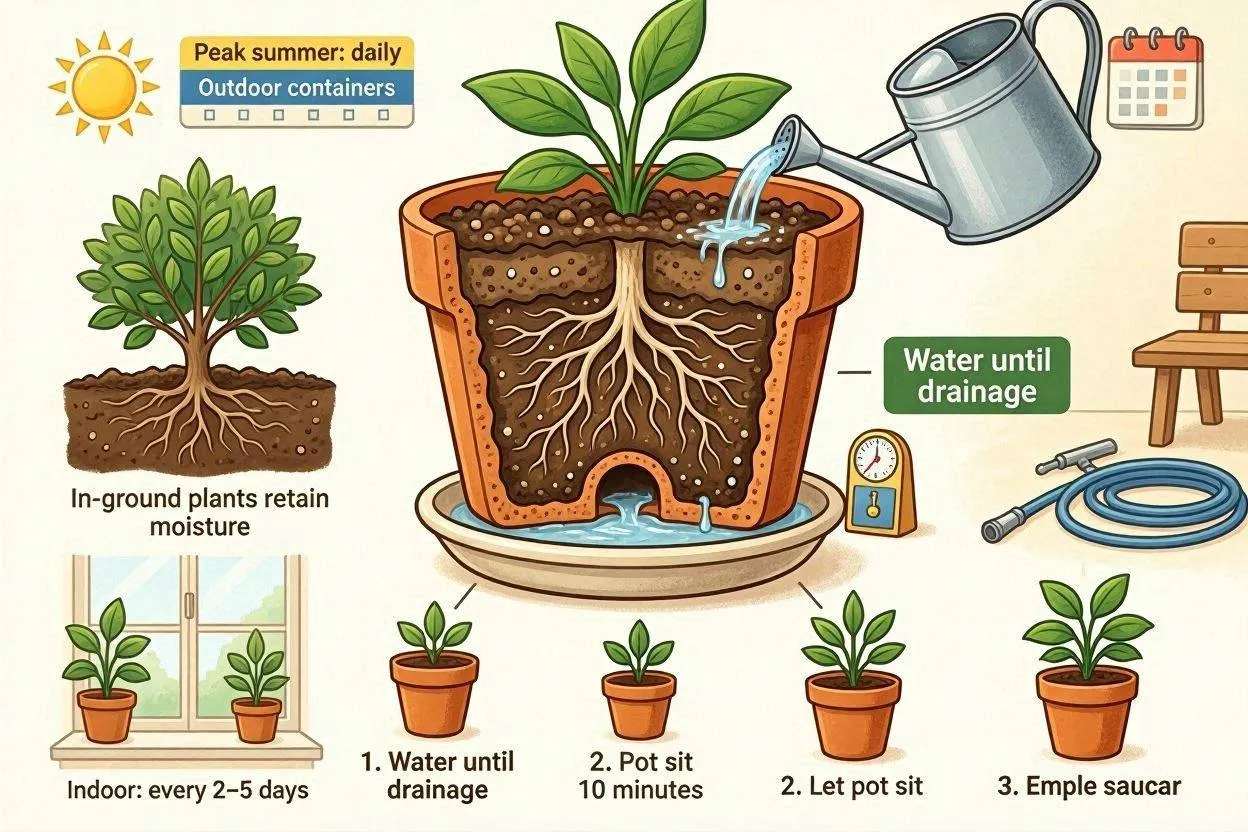
Container plants dry out dramatically faster than in-ground plants because their root zone is finite and exposed on all sides to temperature change. In peak summer, outdoor containers may need daily watering. Indoor containers have more stable conditions but still dry faster than garden beds.
The correct method for all container plants: water slowly until water drains from the bottom drainage hole. Let the pot sit in the drained water for 10 to 15 minutes to allow the soil to absorb what it needs. Then empty the saucer. Never let pots sit in standing water — roots suffocate within 24 to 48 hours in waterlogged conditions.
Pot Material and Its Effect on Watering Frequency
Pot material changes how quickly soil dries and therefore how often you need to water. This is one of the most overlooked variables in any plant watering schedule.
| Pot Material | Drying Speed | Watering Adjustment | Best For |
| Terracotta / Unglazed Clay | Fast (porous walls lose moisture) | Water ~25% more often than plastic | Succulents, cacti, overwatering-prone plants |
| Plastic | Slow (retains moisture well) | Standard baseline frequency | Tropical houseplants, ferns |
| Glazed Ceramic | Moderate | Close to plastic; check soil regularly | Most indoor plants |
| Fabric / Grow Bags | Very fast (air-prunes roots) | Check daily in summer; water 30–40% more often | Vegetables, tomatoes, peppers |
| Metal / Tin | Heats quickly in sun | Water more frequently in direct sun; watch for root heat stress | Short-term use only outdoors |
Bottom Watering: A Better Method for Many Houseplants
Bottom watering means placing the pot in a tray of water and allowing the soil to absorb moisture from the drainage holes upward. The technique encourages roots to grow downward toward the moisture and avoids disturbing the soil surface or compacting potting mix.
How to bottom water correctly: fill a tray, sink, or basin with 2 to 3 inches of room-temperature water. Place the pot in the water. Leave it for 20 to 45 minutes, depending on pot size. The soil will visibly darken and feel moist to the touch at the surface when it has absorbed enough. Remove the pot and allow excess water to drain before returning it to its position.
Bottom watering is particularly effective for: African Violets (which develop brown spots when water touches their leaves), succulents in small pots, any plant with a tendency to develop fungus gnats (which breed in consistently wet surface soil), and plants with dense root systems that make top watering difficult to distribute evenly.
Do not bottom water exclusively without occasional top watering. Top watering flushes accumulated mineral salts from tap water out of the pot. Exclusive bottom watering allows salts to build up at the surface, eventually causing root burn. Flush the pot with top watering every 4 to 6 weeks.
Signs Your Plant Needs More Water — or Less
Both overwatering and underwatering cause yellowing and wilting. Checking the soil condition immediately tells you which problem you have. Treatment is opposite: underwatered plants need water immediately; overwatered plants need the irrigation stopped and often need repotting into dry soil.
| Indicator | Overwatered Plant | Underwatered Plant |
| Leaf colour | Yellow, pale, or translucent — especially at base | Dull green, blue-gray, then brown and crispy |
| Leaf texture | Soft, mushy, or dropping without yellowing first | Wilted, crispy, curling inward |
| Soil condition | Wet, spongy, may smell sour; mold on surface | Bone dry, pulling away from pot edges, cracked surface |
| Root check | Brown, mushy roots — classic root rot | Fine, dry, brittle roots |
| Other signs | Fungus gnats, mushrooms, fungal patches on soil | Leaves feel lighter than normal; pot lifts easily |
| Immediate fix | Stop watering; move to bright indirect light; check roots; repot into dry soil if root rot present | Water thoroughly until drainage runs clear; increase frequency by 2–3 days |
6 Plant Watering Schedule Mistakes That Kill Plants
- Watering on a fixed schedule regardless of soil condition. Temperature, humidity, light, and pot size all change how quickly soil dries. A Tuesday/Friday schedule that worked in summer will overwater the same plant in winter. Always check soil before watering.
- Watering the soil surface only. Brief surface watering wets only the top half-inch. Roots in the middle and bottom of the pot stay dry. Water slowly until drainage runs from the bottom — that confirms moisture has reached the root zone.
- Leaving plants sitting in water. Water standing in the saucer for more than 30 minutes begins to suffocate roots by displacing oxygen. Empty the saucer after every watering session.
- Using cold water on tropical plants. Cold tap water can cause temperature shock that shows up as brown or pale patches on tropical leaves. Use room-temperature water. If tap water is heavily chlorinated, leave it in an open container overnight before using.
- Not adjusting for winter. Cool temperatures, lower light, and reduced air circulation all slow evaporation dramatically. Most houseplants need 30 to 50% less water from October through February. Keeping summer frequency through winter is the single most common cause of overwatering.
- Potting plants without drainage holes. Without a drainage hole, applied water accumulates at the bottom of the pot and creates an anaerobic zone that causes root rot within days of overwatering. If a decorative pot has no drainage hole, use it as an outer cover over a standard nursery pot with drainage.
How to Build a Weekly Plant Watering Schedule
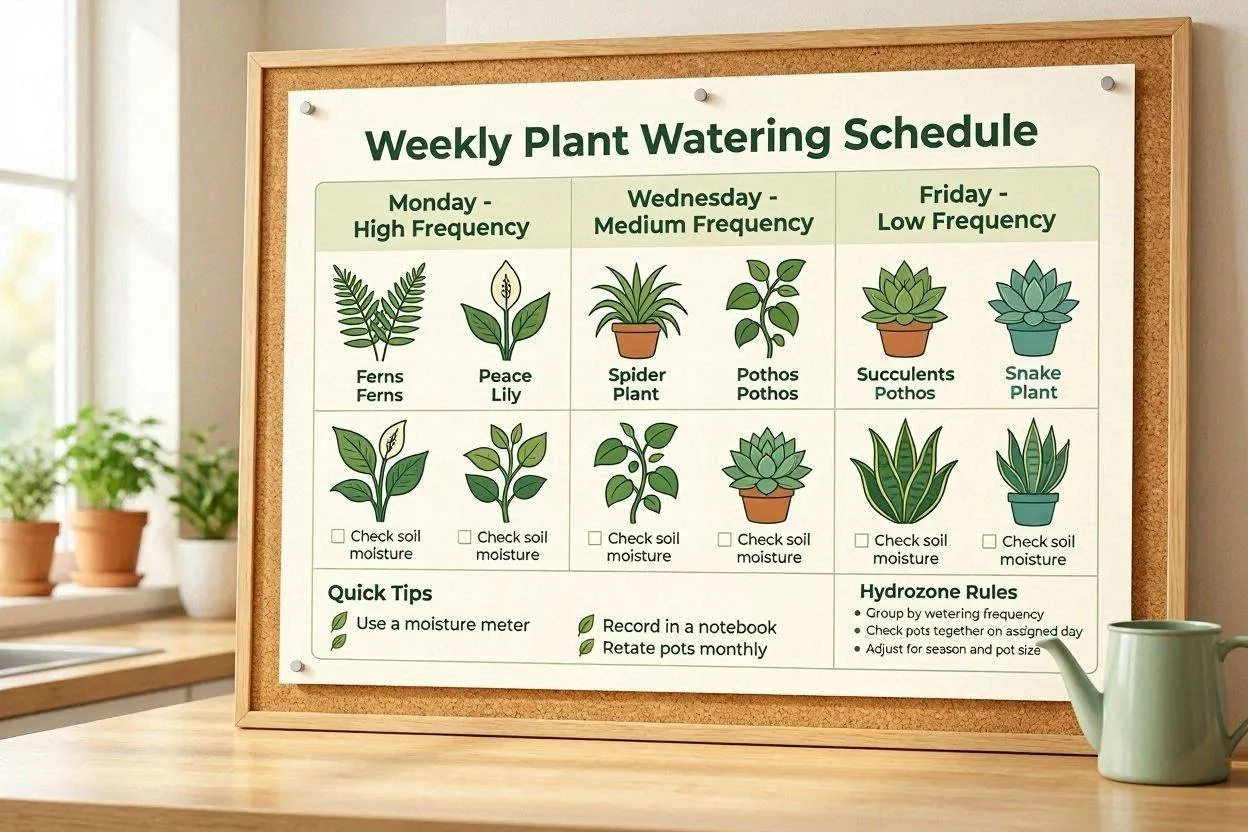
For households with multiple plants, grouping by water need creates a manageable weekly routine. Watering 15 different plants individually every day is unsustainable — grouping eliminates redundancy and reduces both the time spent and the risk of skipping sessions.
The Hydrozone Method for Houseplants
Group plants by watering frequency and check them together on fixed days:
- Monday group: High-frequency plants — ferns, peace lilies, calathea, maidenhair fern. Check and water if the top inch is dry.
- Wednesday / Thursday group: Standard tropicals — monstera, philodendron, pothos, spider plant. Check and water if the top 1 to 2 inches are dry.
- Every 2 weeks group: Low-water plants — snake plant, ZZ plant, hoya, cast iron plant. Check with chopstick or moisture meter before watering.
- Monthly group: Succulents and cacti. Check moisture meter — only water if reading is 1 to 2.
Put a small sticker or tag on each pot with its group letter. After 2 to 3 weeks of checking, the groups naturally self-correct as you learn which individual plants dry faster or slower than average.
FAQ: Plant Watering Schedule
How do I know if I’m overwatering my plants?
Yellow leaves combined with wet, spongy soil is the clearest sign. Confirm with the finger test — if the soil is moist 2 inches deep and the plant still looks unwell, overwatering is the cause. Stop watering immediately, check the roots for rot, and repot into dry fresh soil if the roots are brown and mushy.
Should I water my plants on a schedule or based on soil moisture?
Soil moisture, always. A fixed schedule ignores the variables that actually drive plant water needs — temperature, humidity, light, season, pot material, and plant size. Use a schedule as a reminder to check plants, not as an instruction to water regardless of conditions.
What is the best time of day to water plants?
Early morning — before 9 AM — is best for outdoor plants. Morning watering reduces evaporation and gives foliage time to dry before nightfall, preventing fungal disease. For indoor plants, time of day matters less than in gardens, but morning is still preferable to allow the soil surface to dry partially during the day.
How much water should I give each plant?
For potted plants: water until it drains from the drainage hole, then stop. For in-ground plants: apply enough to wet the soil to the depth of the root zone — 6 to 8 inches for most garden plants, 10 to 12 inches for shrubs and trees. The tuna can test (place a container in the garden and run the sprinkler) measures exactly how long it takes to deliver 1 inch of water.
Do plants need more water in summer?
Yes. Higher temperatures, longer days, and faster evaporation all increase water demand during summer. Most houseplants need water 2 to 3 times more frequently in summer than in winter. Container plants outdoors in temperatures above 85°F (29°C) may need daily watering.
Can I use tap water on my plants?
Yes, for most plants. Let tap water sit in an open container overnight to off-gas chlorine if your water is heavily treated. Plants sensitive to fluoride (peace lily, spider plant, dracaena) may develop brown leaf tips over time with regular tap water — switching to filtered water or rainwater typically resolves this.
What happens if I forget to water my plants for a week?
For drought-tolerant plants (succulents, ZZ plant, snake plant) — nothing significant. For tropical houseplants — wilting and leaf drop may occur but the plant usually recovers with a thorough watering. For vegetables and seedlings — serious damage can occur within 48 to 72 hours in summer heat. Check soil immediately and water deeply if dry; avoid overcompensating with excess water.
The Schedule That Fits Every Plant
There is no single watering schedule that fits every plant. There is one method: check the soil, apply the right amount, and wait long enough for the soil to dry to the appropriate level before watering again.
Use the plant type table as your starting point. Use the seasonal adjustment column to modify it as temperatures change. Use the finger test, chopstick test, or moisture meter before every session to confirm the soil actually needs water.
Do those three things consistently — check, water correctly, wait — and overwatering and underwatering both become easy to avoid.