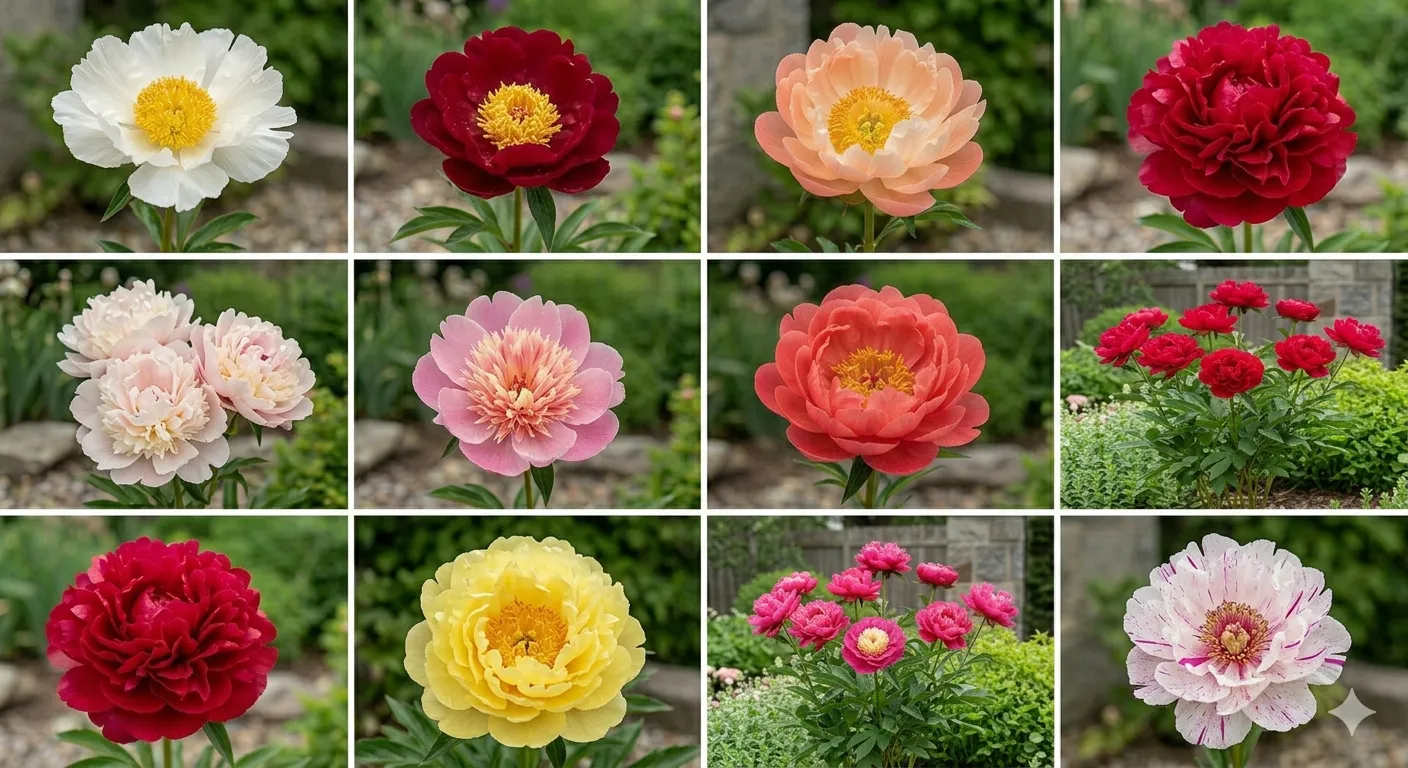
Peonies bloom for 2 to 3 weeks every spring, but a well-planted peony lives for 50 to 100 years. Pick the wrong type and it sits in the ground for three seasons without a single flower. Pick the right one and it rewards you with dinner-plate-sized blooms every May without much work at all.
This guide covers the 3 main types of peonies, 5 flower forms, and 12 top varieties with USDA hardiness zones, fragrance ratings, bloom times, and staking needs — everything you need to make one decision and plant it right.
The 3 Main Types of Peonies
Herbaceous Peonies
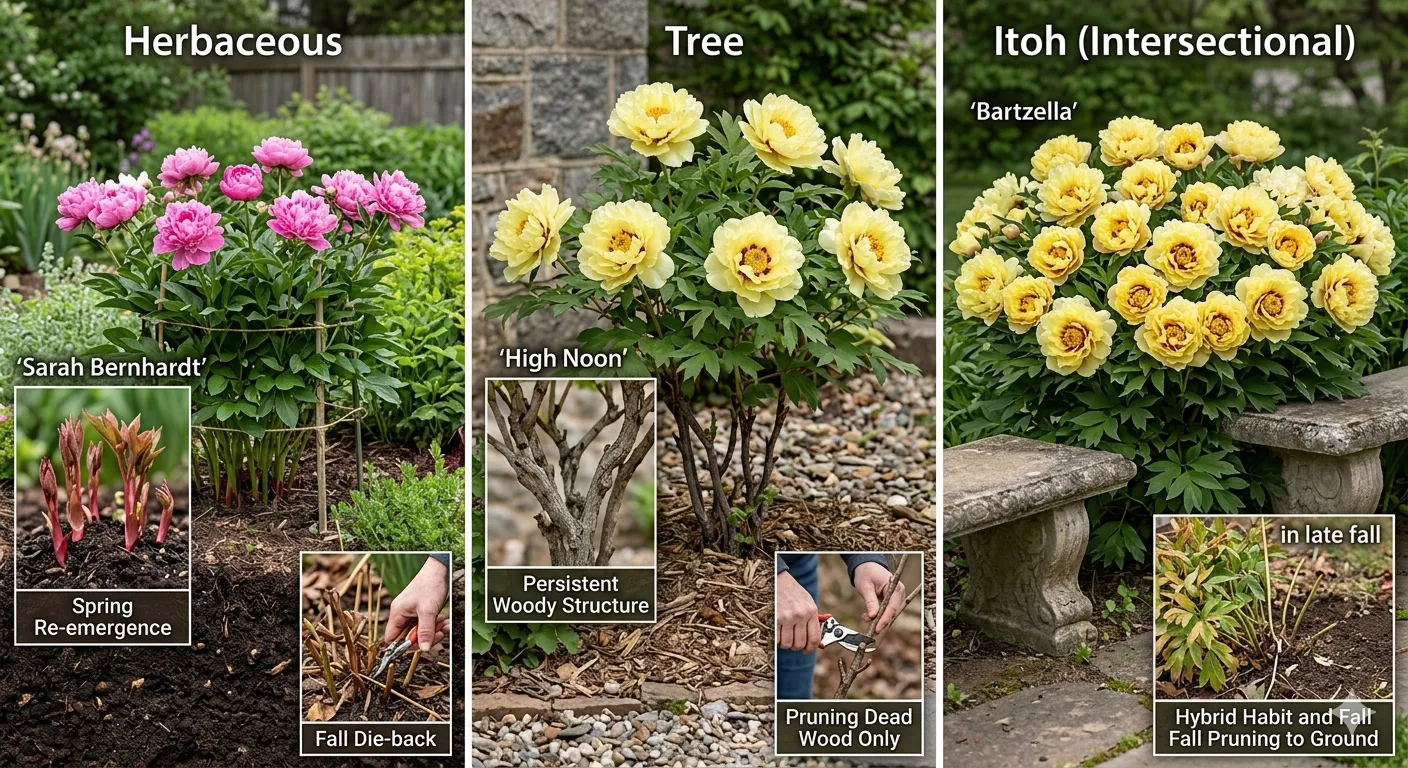
Herbaceous peonies are the most common type grown in US gardens. Most come from Paeonia lactiflora, a Chinese species introduced to Europe in the 1800s. Every fall, herbaceous peonies die back completely to the ground. Every spring, they push up fresh stems from the crown.
They grow 2 to 3 feet (60–90 cm) tall, thrive in USDA Zones 3–8, and need 6 hours of full sun daily. Cold winters help herbaceous peonies — the chilling period triggers stronger spring blooms.
Popular herbaceous varieties: Sarah Bernhardt, Festiva Maxima, Karl Rosenfield, Bowl of Cream.
Tree Peonies
Tree peonies keep their woody stems year-round — they never die back. Paeonia suffruticosa varieties grow 4 to 6 feet (120–180 cm) tall and produce flowers up to 12 inches (30 cm) wide. Tree peonies tolerate more heat than herbaceous types, making them better suited for Zones 4–9.
Pruning rule: Only remove dead or damaged wood in fall after leaves drop. Never cut green stems.
Notable tree peony varieties: High Noon (soft yellow), Shimadaijin (reddish-purple), Hana-Kisoi (light pink).
Itoh (Intersectional) Peonies
Itoh peonies are a cross between herbaceous and tree peonies, first developed by Japanese breeder Toichi Itoh in 1948. They combine large tree peony flowers with the herbaceous growth habit — dying back in fall and returning each spring.
Itoh peonies bloom later than herbaceous types (early June in most US zones), extending the total peony season by 2 to 3 weeks. They produce 30 to 50 flowers per plant in a single season, compared to 5 to 10 on a typical herbaceous plant. Strong woody stems mean most Itoh varieties need no staking at all.
Widely available Itoh varieties: Bartzella (yellow), Julia Rose (apricot-pink), Cora Louise (white with lavender flares).
Best Peony Type by USDA Zone
Matching peony type to USDA zone is the single biggest factor in whether a peony blooms or fails.
| Zone | Region | Best Type | Notes |
| Zones 3–4 | Minnesota, Montana, Wisconsin | Herbaceous only | Itoh needs 4 in. mulch protection. Tree peonies rarely survive Zone 3. |
| Zone 5 | Chicago, Denver, Kansas City | All 3 types | Itoh peonies need mulching in harsh winters. |
| Zone 6 | Washington DC, St. Louis, Nashville | All 3 types | Best zone for maximum bloom production. |
| Zone 7 | Charlotte, Dallas, Atlanta | Itoh preferred | Herbaceous still blooms but produces fewer flowers. Tree peonies do well with afternoon shade. |
| Zone 8 | Houston, Savannah, Portland OR | Itoh only | Herbaceous varieties fail without sufficient cold hours. Choose Bartzella, Cora Louise, or Julia Rose. |
| Zone 9 | Los Angeles, Phoenix, Miami | Tree peonies only | Standard herbaceous do not grow in Zone 9. Pre-chilled bare roots give 1 season only. |
5 Peony Flower Forms Explained
Knowing the flower form helps you choose the right peony before you spend $15 to $80 on a bare root.
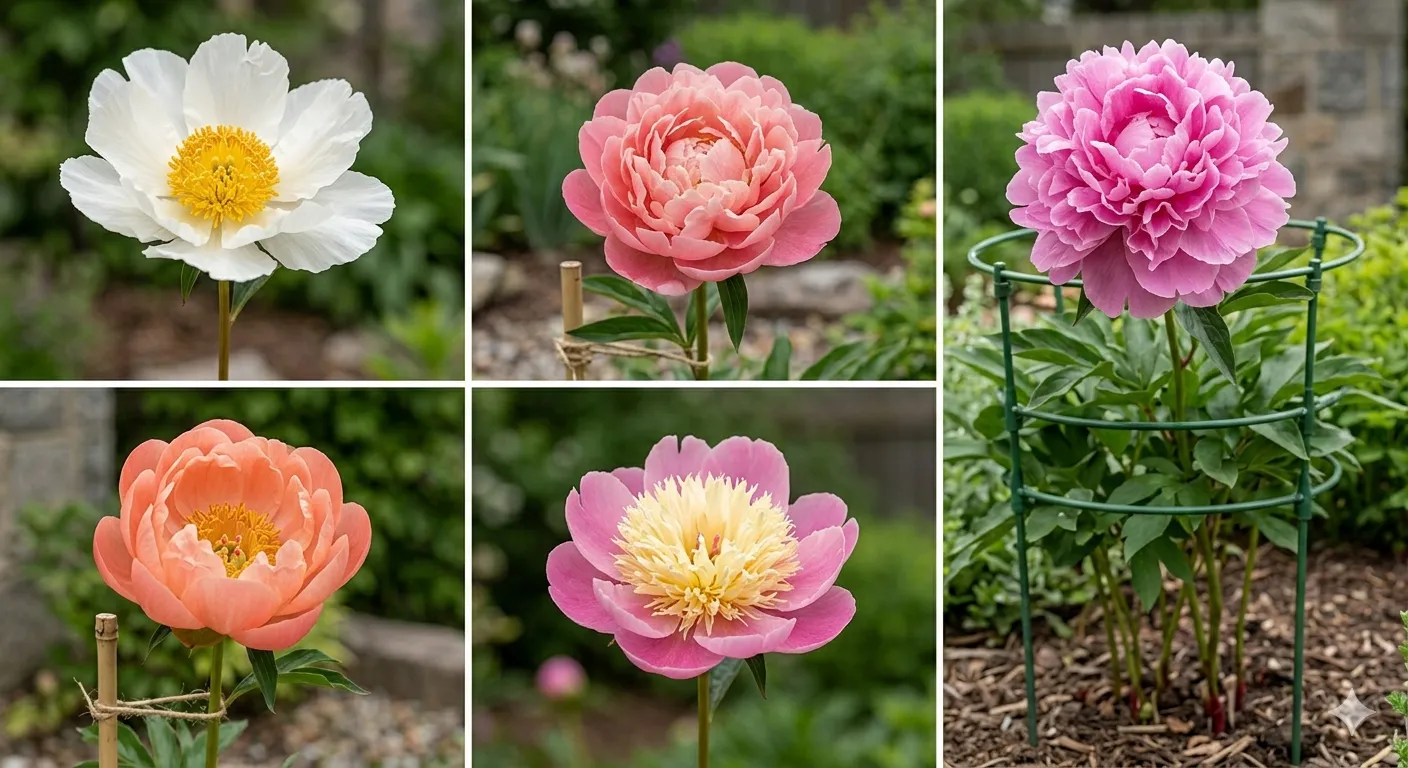
Single — 5 to 10 petals surrounding a visible center of golden stamens. Examples: Scarlett O’Hara, Krinkled White. No staking needed.
Semi-double — Multiple petal rows with partially visible stamens. Examples: Coral Charm, Coral Sunset. Moderate staking.
Double — Fully packed petals, hidden stamens, heavy blooms. Examples: Sarah Bernhardt, Festiva Maxima. Staking always required.
Bomb — Dense mounded center petals inside a ring of flat guard petals. Examples: Red Charm, Monsieur Jules Elie. Staking required.
Japanese/Anemone — Single outer petals with a transformed center of narrow petal-like staminodes. Examples: Bowl of Beauty, Do Tell. Rarely needs staking.
12 Best Peony Varieties for US Gardens
Sarah Bernhardt
The best-selling peony variety in the US since the early 1900s. Double blooms open soft pink with slightly deeper pink at the petal bases, reaching 6 to 8 inches (15–20 cm) across. Fragrance is strong and sweet — rated 5/5 by the American Peony Society (APS).
| Detail | Spec |
| Type | Herbaceous (Paeonia lactiflora) |
| Zones | 3–8 |
| Height | 28–36 inches (70–90 cm) |
| Bloom time | Mid-season (late May) |
| Staking | Yes |
| Fragrance | 5/5 |
Garden tip: Plant in a sheltered spot away from wind. Heavy rain collapses unsupported stems within hours.
Festiva Maxima
Large white double blooms with red flecks at the petal centers — a combination no other common peony replicates. Introduced in 1851, it remains one of the most planted peonies in American cottage gardens.
| Detail | Spec |
| Type | Herbaceous (Paeonia lactiflora) |
| Zones | 3–8 |
| Height | 30–36 inches (75–90 cm) |
| Bloom time | Early-to-mid season |
| Staking | Yes |
| Fragrance | 4/5 |
Garden tip: Plant red geraniums nearby to echo the red flecks and create a cohesive color story.
Coral Charm
Opens deep coral-orange and fades to soft peach as petals age — two color effects from one plant. Holds the APS Award of Landscape Merit and consistently tops wholesale cut flower demand lists in the US.
| Detail | Spec |
| Type | Herbaceous (Paeonia) |
| Zones | 3–8 |
| Height | 28–32 inches (70–80 cm) |
| Bloom time | Early season |
| Staking | Sometimes |
| Fragrance | 2/5 |
Garden tip: One of the first herbaceous peonies to bloom each spring — pair it with mid and late varieties for a 6-week color window.
Bartzella
The most popular yellow peony in the US, producing 6 to 8 inch (15–20 cm) semi-double yellow blooms with a red flare at the base. As an Itoh hybrid, it blooms 2 to 3 weeks after herbaceous peonies fade, extending garden color into early June.
| Detail | Spec |
| Type | Itoh hybrid |
| Zones | 4–9 |
| Height | 24–30 inches (60–75 cm) |
| Bloom time | Late season |
| Staking | No |
| Fragrance | 4/5 |
Garden tip: In Zones 4–5, mulch the crown with 3 to 4 inches (7–10 cm) of straw in November. Remove mulch in early April.
Red Charm
Deep red bomb-form blooms on stems strong enough to skip staking — rare for a double-form red peony. Flowers reach 7 inches (18 cm) across. Won the APS Gold Medal in 1956 and remains the reference standard for red peonies.
| Detail | Spec |
| Type | Herbaceous |
| Zones | 3–8 |
| Height | 28–34 inches (70–85 cm) |
| Bloom time | Early season |
| Staking | Rarely |
| Fragrance | 3/5 |
Garden tip: One of the first peonies to bloom each spring — plant it alongside later-season varieties to extend color through June.
Bowl of Cream
Holds the APS Gold Medal. Pure white double blooms up to 10 inches (25 cm) wide — no other white peony matches this bloom size consistently.
| Detail | Spec |
| Type | Herbaceous (Paeonia lactiflora) |
| Zones | 3–8 |
| Height | 30–36 inches (75–90 cm) |
| Bloom time | Mid-season |
| Staking | Yes |
| Fragrance | 3/5 |
Garden tip: White peonies brown faster in full afternoon sun. Plant where morning sun and afternoon shade protect petals, especially in Zones 6–8.
Karl Rosenfield
Bright magenta-red double blooms on some of the strongest stems of any peony variety. Stems rarely need staking despite heavy 6-inch (15 cm) blooms.
| Detail | Spec |
| Type | Herbaceous (Paeonia lactiflora) |
| Zones | 3–8 |
| Height | 28–34 inches (70–85 cm) |
| Bloom time | Mid-season |
| Staking | Rarely |
| Fragrance | 3/5 |
Garden tip: Karl Rosenfield and Sarah Bernhardt are the 2 most requested varieties at US garden centers — plant both for a pink-and-red spring combination.
Duchess de Nemours
Pure white double blooms with the strongest fragrance of any white peony variety — rated 5/5. Introduced in 1856, this heirloom cultivar performs reliably across all of Zones 3–8. Flowers open creamy white, turning pure white within 2 days.
| Detail | Spec |
| Type | Herbaceous (Paeonia lactiflora) |
| Zones | 3–8 |
| Height | 28–32 inches (70–80 cm) |
| Bloom time | Early-to-mid season |
| Staking | Yes |
| Fragrance | 5/5 |
Garden tip: Florists prefer Duchess de Nemours over Bowl of Cream specifically for its fragrance in wedding arrangements.
Coral Sunset
Opens vivid coral-pink and fades to soft cream by day 4, giving two distinct color phases per bloom. Semi-double form on sturdy stems. One of the earliest peonies to bloom — flowers appear in late April in Zones 6–7.
| Detail | Spec |
| Type | Herbaceous (Paeonia lactiflora) |
| Zones | 3–8 |
| Height | 28–34 inches (70–85 cm) |
| Bloom time | Early season |
| Staking | No |
| Fragrance | 2/5 |
Garden tip: Pair Coral Sunset (early) with Sarah Bernhardt (mid) and Bartzella (late) for a 6-week consecutive bloom window in one bed.
Monsieur Jules Elie
A bomb-form pink peony introduced in 1888 that still outsells most modern varieties. Large fragrant blooms reach 8 inches (20 cm) across. Stems are strong for a bomb-form variety, needing support only in wet seasons.
| Detail | Spec |
| Type | Herbaceous (Paeonia lactiflora) |
| Zones | 3–8 |
| Height | 30–36 inches (75–90 cm) |
| Bloom time | Early-to-mid season |
| Staking | Sometimes |
| Fragrance | 5/5 |
Garden tip: The oldest variety on this list — plant Monsieur Jules Elie if you want a reliable crowd-pleaser with intense fragrance.
Buckeye Belle
Dark velvet-red semi-double blooms on short, sturdy stems that need no staking. A lower-maintenance red alternative to Karl Rosenfield. Flowers open to reveal a bright yellow center bowl — the contrast draws attention in any garden.
| Detail | Spec |
| Type | Herbaceous |
| Zones | 3–8 |
| Height | 24–28 inches (60–70 cm) |
| Bloom time | Early-to-mid season |
| Staking | No |
| Fragrance | 2/5 |
Garden tip: At 24 inches (60 cm) tall, Buckeye Belle is the best red peony choice for front-of-border planting.
Do Tell
An anemone-form peony with soft pink outer petals and a raspberry-lemon staminode center that looks unlike any other peony. Thin red stems carry blooms that move in wind without falling. Produces more flowers per plant than most double-form peonies.
| Detail | Spec |
| Type | Herbaceous (Paeonia lactiflora) |
| Zones | 3–8 |
| Height | 24–30 inches (60–75 cm) |
| Bloom time | Mid-season |
| Staking | No |
| Fragrance | 2/5 |
Garden tip: Do Tell sells fastest at farm stands and farmers markets — buyers ask about it specifically because the flower form is unfamiliar to them.
Full Variety Comparison Table
| Variety | Type | Color | Bloom Time | Fragrance | Zones | Staking |
| Sarah Bernhardt | Herbaceous | Soft pink | Mid | 5/5 | 3–8 | Yes |
| Festiva Maxima | Herbaceous | White/red flecks | Early-mid | 4/5 | 3–8 | Yes |
| Coral Charm | Herbaceous | Coral to peach | Early | 2/5 | 3–8 | Sometimes |
| Bartzella | Itoh | Butter yellow | Late | 4/5 | 4–9 | No |
| Red Charm | Herbaceous | Deep red | Early | 3/5 | 3–8 | Rarely |
| Bowl of Cream | Herbaceous | Pure white | Mid | 3/5 | 3–8 | Yes |
| Karl Rosenfield | Herbaceous | Magenta-red | Mid | 3/5 | 3–8 | Rarely |
| Duchess de Nemours | Herbaceous | Pure white | Early-mid | 5/5 | 3–8 | Yes |
| Coral Sunset | Herbaceous | Coral to cream | Early | 2/5 | 3–8 | No |
| Monsieur Jules Elie | Herbaceous | Deep pink | Early-mid | 5/5 | 3–8 | Sometimes |
| Buckeye Belle | Herbaceous | Dark red | Early-mid | 2/5 | 3–8 | No |
| Do Tell | Herbaceous | Pink/raspberry | Mid | 2/5 | 3–8 | No |
Peony Bloom Season Calendar
Plant at least 1 early, 1 mid, and 1 late variety to keep peonies blooming for 6 consecutive weeks.
| Season | Timing (Zone 5) | Varieties |
| Early | Late April – May 10 | Coral Charm, Red Charm, Coral Sunset, Buckeye Belle |
| Mid | May 10 – May 25 | Sarah Bernhardt, Festiva Maxima, Karl Rosenfield, Do Tell |
| Late | May 25 – June 10 | Bowl of Cream, Bartzella, Duchess de Nemours, Monsieur Jules Elie |
Zones 6–7 bloom 10 to 14 days earlier. Zones 3–4 bloom 10 to 14 days later. Itoh varieties like Bartzella always bloom last regardless of zone.
Which Peonies Don’t Need Staking
9 varieties grow on stems strong enough to hold blooms upright without support:
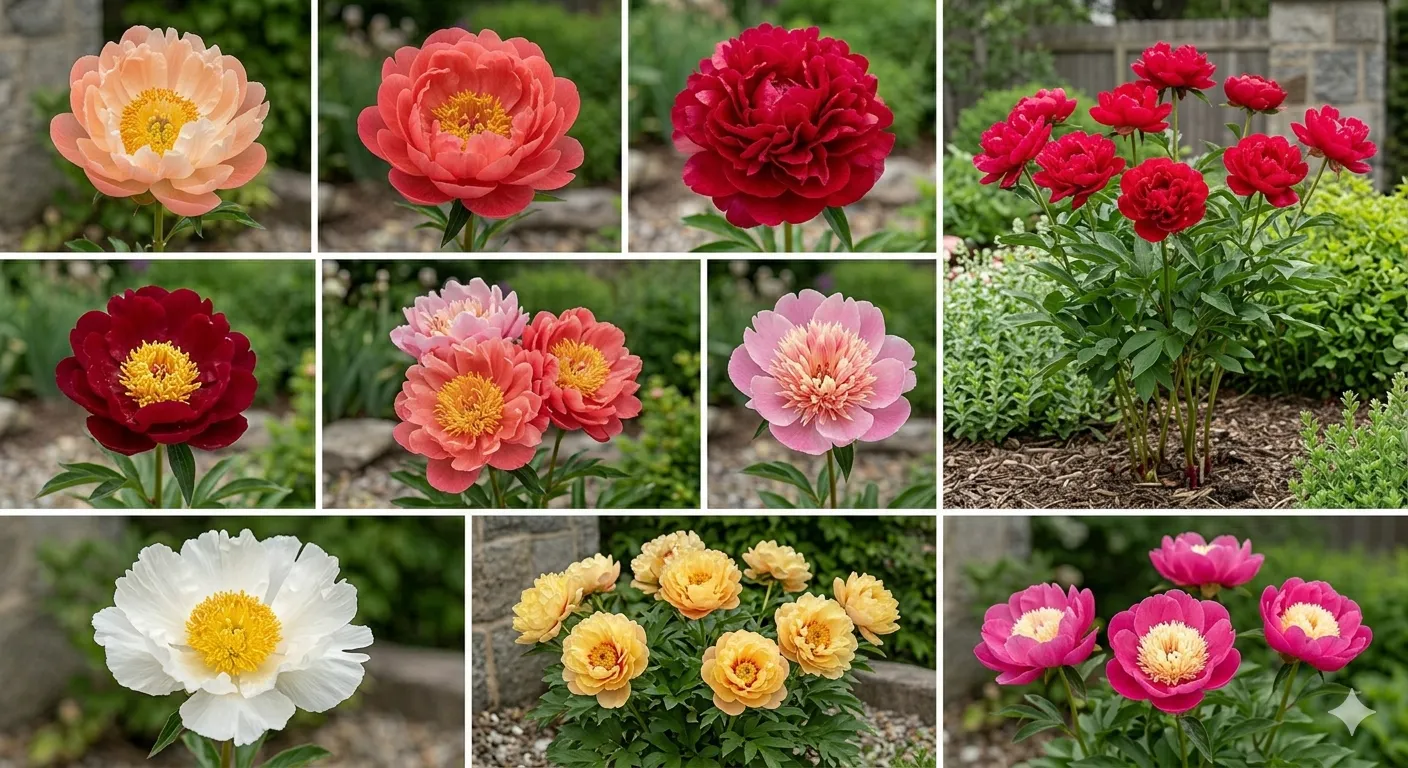
- Coral Charm
- Coral Sunset
- Red Charm
- Buckeye Belle
- Do Tell
- Scarlett O’Hara
- Krinkled White
- Bartzella (all Itoh types)
- Bowl of Beauty
Double-form peonies (Sarah Bernhardt, Bowl of Cream, Festiva Maxima) always need staking. Install a peony cage or 3-ring support ring in early April before stems reach 6 inches (15 cm) tall.
Most Fragrant Peony Varieties Ranked
Plant high-fragrance peonies within 4 feet (1.2 m) of a seating area, pathway, or open window. Fragrance disperses quickly outdoors beyond that distance.
| Fragrance Rating | Variety | Color |
| 5/5 — Intense | Sarah Bernhardt | Soft pink |
| 5/5 — Intense | Duchess de Nemours | Pure white |
| 5/5 — Intense | Monsieur Jules Elie | Deep pink |
| 4/5 — Strong | Festiva Maxima | White with red flecks |
| 4/5 — Strong | Bartzella | Yellow |
| 3/5 — Moderate | Red Charm | Deep red |
| 3/5 — Moderate | Bowl of Cream | Creamy white |
| 2/5 — Mild | Coral Charm | Coral-orange |
| 2/5 — Mild | Coral Sunset | Coral-pink |
| 2/5 — Mild | Buckeye Belle | Dark red |
Best Variety for Beginners
Karl Rosenfield is the best starting variety. Strong stems rarely need staking, deep red blooms appear reliably from year 2, and the plant tolerates Zones 3–8 without special care.
Two close alternatives:
- Coral Sunset — coral, no staking, consistent blooms from year 2
- Buckeye Belle — dark red, no staking, front-of-border height
Order bare roots in August through September for fall planting — fall-planted peonies establish faster than spring-planted ones and bloom 4 to 6 weeks sooner in year 2.
FAQ
What is the difference between herbaceous, tree, and Itoh peonies?
Herbaceous peonies die back to the ground every fall. Tree peonies keep their woody stems year-round and grow 4 to 6 feet tall. Itoh peonies are a hybrid — they die back like herbaceous types but produce tree peony-sized flowers and need no staking.
Which peony type grows best in Zone 7 or 8?
Itoh peonies. Herbaceous peonies need at least 500 cold hours below 40°F (4°C) in winter. Itoh varieties like Bartzella, Cora Louise, and Julia Rose need fewer cold hours and perform in Zones 7–9 where herbaceous types fail.
Do peonies bloom the first year after planting?
No. Most peonies produce few or no flowers in years 1 and 2. Full bloom production starts in year 3. The plant spends the first 2 years establishing roots.
How long do peony blooms last on the plant?
7 to 10 days per bloom, depending on temperature. Cool springs (55–65°F / 13–18°C) extend blooms to 10 days. Heat above 80°F (27°C) shortens blooms to 4 to 5 days.
Which peony is best for a beginner?
Karl Rosenfield — strong stems, no staking needed, reliable red blooms from year 2, hardy in Zones 3–8.
Conclusion
Choosing the right peony variety before you plant is the decision that determines everything that follows — whether the plant blooms reliably from year 2, whether it needs staking after every rainstorm, whether it survives your zone’s winters without special treatment.
The most important filters are zone suitability and staking needs. If you are in Zone 7 or 8, skip herbaceous varieties and go straight to Itoh types like Bartzella or Cora Louise. If you want low-maintenance plants that hold themselves upright, choose Coral Charm, Coral Sunset, Red Charm, or Buckeye Belle. If fragrance is the priority, Sarah Bernhardt, Duchess de Nemours, and Monsieur Jules Elie are in a different category from everything else on this list.
Plant at least one early, one mid-season, and one late variety. In Zone 5, that combination gives you continuous blooms from late April through mid-June — six weeks from a single garden bed that requires almost no work after the first two years.