

Most gardens grow the same 10 plants. Petunias, marigolds, hostas — reliable, pretty, and absolutely everywhere. Every neighbor has them. Every garden center sells them. And every garden that only grows them looks the same. But if you want a garden people stop their car to look at, a garden guests talk about for weeks after visiting, you need plants that genuinely break the mold.
These 5 unusual plants do exactly that. Each one offers something no common garden plant delivers — jet-black blooms that smell like a vampire’s parlor, leaves that fold shut when you touch them, pitchers that digest live insects, flowers that open only at midnight, and rootstocks that lie dormant for months before erupting into 5-foot theatrical drama. All 5 are real plants. All 5 are growable by an everyday gardener with ordinary tools.
This guide covers the full picture for each plant: what makes it unusual, exact care requirements, hardiness zones, common mistakes, companion planting ideas, seasonal care calendar, and where to buy. By the end, you’ll know which plants suit your garden and exactly how to grow them successfully.
Why Grow Unusual Plants? The Real Reasons Beyond Novelty
Unusual plants are not just conversation starters — though they are exceptional at that. There are 4 practical reasons serious gardeners choose them over standard varieties.
1. They Attract Specific Pollinators Standard Plants Miss
Dragon Arum attracts carrion beetles and blowflies — pollinators that common flowers never reach. Pitcher plants create micro-habitats for specific aquatic insects inside their traps. Bat Flower draws sphinx moths and long-tongued bees. A diverse pollinator population makes your entire garden more productive, including vegetable beds and fruit trees nearby.
2. They Fill Difficult Spots Where Normal Plants Fail
Sarracenia pitcher plants thrive in wet, boggy, nutrient-poor soil — conditions that kill most ornamentals instantly. Dragon Arum tolerates dry, rocky, poor soil under trees where nothing else will grow. Fishbone Cactus thrives in low-light indoor corners. Each unusual plant solves a specific garden problem that standard varieties cannot.
3. They Create Year-Round Structure
Most common annuals are purely seasonal. Unusual plants — particularly specimen plants like Dragon Arum (with its snakeskin-patterned stems and autumn berry clusters) and Pitcher Plants (with their architectural pitchers persisting through winter) — provide structural interest across all 4 seasons. A well-chosen unusual plant earns its space 365 days a year.
4. They Teach You Genuine Botany
Growing a carnivorous plant forces you to understand soil chemistry, water quality, and nutrient cycling. Growing a touch-sensitive plant reveals how plants process environmental signals. Growing a night-blooming cactus teaches you about pollination timing and temperature cycling. Unusual plants make every gardener more knowledgeable — not just about the plant, but about how all plants work.
Plant 1: Bat Flower (Tacca chantrieri)
Bat Flower — The Most Dramatic Houseplant You Can Grow Indoors
The Bat Flower produces jet-black blooms measuring 12 inches (30 cm) across, with whisker-like bracts extending up to 28 inches (71 cm) in length. No other common houseplant comes close to this level of visual drama. Native to the tropical forests of Southeast Asia — primarily Thailand, southern China, and Malaysia — Tacca chantrieri grows naturally on shaded forest floors where humidity stays above 70% year-round.
The dark purple-black spathe fans out like bat wings around a central flower cluster of dozens of tiny individual blooms. A white variety — Tacca integrifolia — produces identical whisker formations with white petals veined in deep purple, growing up to 4 feet (120 cm) tall. Both species stop visitors in their tracks without exception.
What Makes Bat Flower Unusual
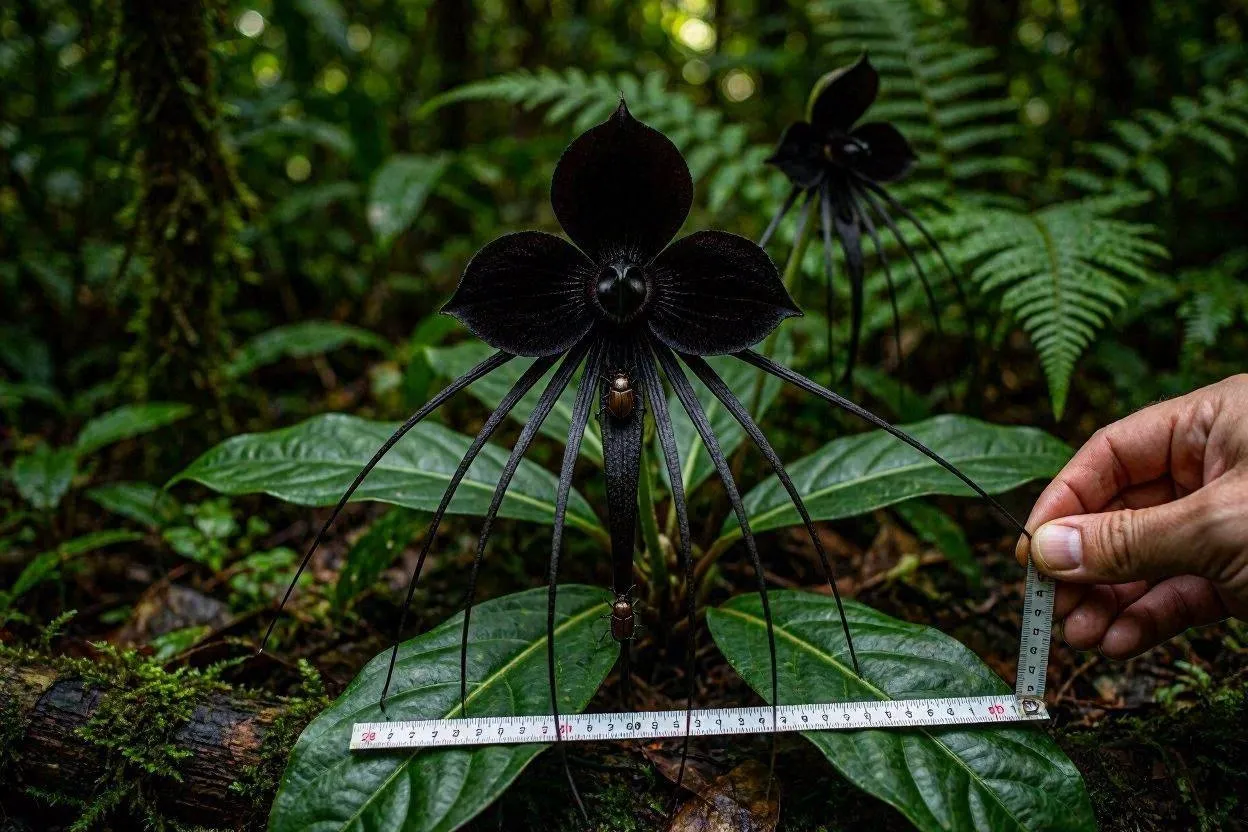
3 specific features separate Bat Flower from every other common houseplant:
- Color: True black flowers are exceptionally rare in the plant kingdom. Bat Flower achieves it. The dark pigmentation serves an evolutionary purpose — attracting specific beetle pollinators in low-light forest conditions.
- Scale: The 28-inch (71 cm) whisker filaments hanging from each bloom are modified bracts — structural leaf tissue transformed into dramatic display organs over millions of years of evolution.
- Atmosphere: A blooming Bat Flower in a well-designed room creates a visual impact that no standard tropical houseplant matches. Garden designers use it specifically as a statement anchor in interior plant displays.
Quick Reference Guide
- Scientific Name: Tacca chantrieri (Chan’s Tacca)
- Family: Taccaceae (now classified under Dioscoreaceae)
- USDA Hardiness Zones: 10–12 outdoors; grown in containers in Zones 4–9 and brought indoors before first frost
- Mature Height: 2–3 feet (60–90 cm) indoors; up to 4 feet (120 cm) in ideal outdoor conditions
- Bloom Season: Late spring through late summer — typically May through September
- Bloom Duration: Individual flowers last 2–3 weeks; multiple blooms appear sequentially through the season
- Light Requirement: Bright indirect light — 3–4 hours of filtered morning light is ideal; never direct afternoon sun
- Humidity Requirement: 50–80% relative humidity (critical for success)
- Soil pH: 6.0–6.5 (slightly acidic)
- Water Source: Filtered or rainwater preferred; tap water acceptable in most areas
Soil and Potting Requirements
Bat Flower needs a rich, moisture-retentive mix that also drains freely. The ideal mix combines 40% quality potting soil, 30% peat moss or coco coir, 20% perlite, and 10% aged compost. This replicates the humus-rich, moist-but-aerated forest floor where Tacca naturally grows.
Pot size matters more than most gardeners realize. Use a container only 2–3 inches (5–7 cm) wider than the root ball. Oversized pots hold excess moisture around the roots and dramatically increase the risk of root rot. Terracotta pots help regulate moisture but require more frequent watering. Glazed ceramic pots retain moisture longer — ideal for lower-humidity environments.
⚠️ Important: Never use standard cactus mix or sandy soil for Bat Flower. These mixes drain too fast, drying out the roots before the plant can absorb sufficient moisture.
Watering Schedule and Technique
Water Bat Flower when the top inch (2.5 cm) of soil feels dry to the touch. In summer during active growth, this typically means watering every 3–4 days. In winter, reduce watering to once every 7–10 days as the plant slows its growth cycle.
The correct technique is bottom watering — place the pot in a tray of water for 20–30 minutes, allowing the soil to absorb moisture from below. This encourages deep root growth and prevents the crown of the plant from staying wet, which causes crown rot.
Humidity — The Single Most Important Factor
Humidity below 40% causes the leaf tips to brown and the flower buds to drop before opening. This is the most common reason Bat Flowers fail indoors. 5 proven methods to maintain adequate humidity:
- Pebble tray method: Fill a wide tray with pebbles, add water to just below the top of the pebbles, and sit the pot on top. As the water evaporates, humidity rises around the plant.
- Grouping: Position Bat Flower among other humidity-loving plants — they create a shared humid microclimate through transpiration.
- Room humidifier: The most reliable method. A small ultrasonic humidifier placed 3–4 feet from the plant maintains consistent humidity without effort.
- Bathroom placement: A north or east-facing bathroom window provides both filtered light and consistent humidity from daily showers — the easiest location for success.
- Regular misting: Mist the leaves — not the flowers — every morning with room-temperature water. Avoid misting in the evening, as wet leaves overnight invite fungal disease.
Fertilizing for Maximum Blooms
Feed Bat Flower every 4 weeks from March through September using a balanced liquid fertilizer (10-10-10 or 20-20-20) diluted to half strength. Switch to a phosphorus-heavy fertilizer (such as 5-10-5) in early spring to encourage more flower buds. Phosphorus directly stimulates root development and bud formation.
Stop fertilizing entirely from October through February. The plant enters a semi-dormant phase and cannot process nutrients effectively. Fertilizing during dormancy causes salt buildup in the soil, which burns the roots.
Seasonal Care Calendar
- Spring (March–May): Resume watering and fertilizing. Move plant to brighter position. New growth begins appearing from the rhizome.
- Summer (June–August): Peak growing and blooming season. Maintain consistent humidity and moisture. Watch for spider mites in hot, dry conditions.
- Autumn (September–November): Reduce watering frequency as growth slows. Stop fertilizing by end of October. Move container plants indoors before temperatures drop below 50°F (10°C).
- Winter (December–February): Minimal watering. Keep in bright indirect light. Maintain minimum temperature of 60°F (16°C). The rhizome rests underground — do not panic if foliage dies back completely.
Common Problems and Fixes
- Brown leaf tips: Humidity too low. Increase to above 50% using one of the methods above.
- Bud drop before opening: Sudden temperature change or humidity drop. Keep temperature stable above 65°F (18°C) and maintain high humidity.
- Yellow leaves: Overwatering or insufficient light. Check soil moisture — if soggy, allow to dry before watering again. Move to a brighter position.
- No new growth in spring: Rhizome may be dormant but alive. Wait until May before assuming the plant is dead. Scratch the rhizome surface — if green underneath, it’s alive.
- Spider mites: Common in dry, warm conditions. Spray the undersides of leaves with insecticidal soap solution weekly for 3 weeks.
Companion Plants for Bat Flower
Pair Bat Flower with plants that share its humidity and indirect-light requirements, creating a cohesive tropical display:
- Caladium ‘White Christmas’ — the white and green patterned leaves make the black Bat Flower blooms look even more dramatic
- Calathea orbifolia — large, silver-striped leaves complement the dark drama of Tacca
- Ferns (Boston, Bird’s Nest) — ferny texture contrasts beautifully with Bat Flower’s broad flat leaves
- Peace Lily — similar humidity requirements, white flowers create color contrast in the same display
Plant 2: Dragon Arum (Dracunculus vulgaris)
Dragon Arum — The 5-Foot Garden Drama Queen That Blooms for 3 Days
Dragon Arum is the most theatrically dramatic hardy perennial available to gardeners in Zones 5–9. The 5-foot (150 cm) burgundy-black spathe — a large hood-like modified leaf — unfurls in late spring around a central spike (spadix) that glows deep purple-maroon. For exactly 3 days after opening, the flower emits a powerful odor of rotting meat. This smell attracts the blowflies and carrion beetles that pollinate it. On day 4, the smell disappears entirely and the plant continues its season cleanly.
Native to the Mediterranean — from Greece and the Balkans to the Canary Islands — Dragon Arum (also called Voodoo Lily or Dragon Lily) grows from a large corm (underground storage organ) that can reach the size of a grapefruit in mature plants. The stems themselves are spectacular before the flower appears: mottled black-white like a serpent’s skin, rising from deeply lobed, dark green leaves.
What Makes Dragon Arum Unusual
Most gardeners who see Dragon Arum for the first time assume it’s a photograph that has been digitally altered. The combination of 4 features creates a plant unlike anything else in temperate gardening:
- Scale: The spathe reaches 24 inches (60 cm) in length and the total plant height hits 4–5 feet (120–150 cm), creating genuine landscape drama.
- Color: Near-black burgundy coloring is exceptionally rare among hardy perennials. The spadix deepens to near-black at its tip.
- Pattern: The mottled snake-skin pattern on the stem — black blotches on cream — makes the plant architecturally interesting for the 6–8 weeks before blooming even begins.
- Strategy: Using mimicry of death and decay for pollination is one of evolution’s most cunning botanical strategies. Understanding why this plant evolved this way makes growing it a genuinely educational experience.
Quick Reference Guide
- Scientific Name: Dracunculus vulgaris
- Family: Araceae (same family as peace lily and calla lily)
- USDA Hardiness Zones: 5–9
- Mature Height: 3–5 feet (90–150 cm)
- Bloom Season: May–June (late spring)
- Smell Duration: 3 days only — manageable outdoors
- Autumn Interest: Bright orange-red berry clusters on upright stems after flowering
- Light Requirement: Full sun to partial shade (minimum 4 hours direct sun)
- Soil Preference: Well-draining; tolerates poor, rocky, and dry soil; excellent under deciduous trees
- Drought Tolerance: High once established — goes dormant in summer heat
Planting Instructions
Plant the corms in autumn — September through November — for spring blooms. Correct planting depth is critical: set corms 4–6 inches (10–15 cm) deep, with the flat side down and any visible growing points facing upward. If you cannot identify an obvious growing point, plant the corm sideways — it will orient itself correctly.
Space corms 12–18 inches (30–45 cm) apart. Dragon Arum spreads slowly by producing offset corms, so leaving adequate spacing allows the clump to develop naturally over 3–5 years without crowding.
⚠️ Important: All parts of Dragon Arum are toxic if ingested — the berries, leaves, and sap contain calcium oxalate crystals. Keep away from children and pets. Wear gloves when handling corms or cut stems as the sap causes skin irritation in sensitive individuals.
Soil and Location Requirements
Dragon Arum is remarkably adaptable to difficult conditions. It thrives in 3 situations where most ornamentals struggle:
- Dry shade under trees: One of very few dramatic flowering perennials that tolerates dry root competition from large trees. The summer dormancy aligns perfectly with summer drought.
- Rocky slopes: Excellent on dry, sloped banks where poor drainage and erosion prevent most planting. The deep corm anchors well in loose soil.
- Mediterranean-style gardens: Combines naturally with lavender, rosemary, Cistus, ornamental grasses, and Agapanthus in hot, dry summer conditions.
Managing the 3-Day Smell
The smell of Dragon Arum in full bloom is genuinely strong — somewhere between rotting meat and very overripe garbage. Managing it is simple:
- Plant at least 15 feet (5 meters) from any seating area, dining space, or open window.
- Position on the downwind side of a path so prevailing breezes carry the scent away from the house.
- Mark the bloom date — once you know your plant’s microclimate, it blooms within the same 2-week window each year. Plan outdoor events around this window.
- The smell disappears by day 4. If the 3-day period is genuinely problematic, you can cut the spadix before it opens — the plant will still produce berries and next year’s corm will be unaffected.
Pro Tip: Plant Dragon Arum at the far end of a garden where its dramatic spike draws the eye from a distance. The 3-day smell becomes a talking point when guests make the journey to see it up close — a genuine garden event.
After Flowering — Autumn Berry Display
After the flower fades, Dragon Arum produces a dense cluster of bright orange-red berries on a bare upright stem. This fruiting stage — appearing from August through October — provides a second season of ornamental value and is highly attractive to birds. The berries ripen progressively from green to orange-red, creating a slow-motion color show through late summer.
The above-ground stems die back completely in mid-summer. Mark the location with a plant label or stake so you don’t accidentally dig through the corm during summer garden work.
Propagation — Building a Colony
Dragon Arum produces offset corms naturally over 3–4 years. To propagate: lift the clump in autumn after the foliage dies back. Gently separate the offset corms — these are smaller corms attached to the main corm. Replant immediately at the correct depth. New plants grown from offsets typically bloom in their second year.
Dragon Arum also grows readily from seed. Fresh seeds — collected from the orange-red berries in autumn — germinate in spring if sown immediately outdoors. Seedling plants take 3–4 years to reach flowering size.
Best Garden Combinations
- Euphorbia characias — architectural silver-green spurge tolerates the same dry conditions and provides contrasting color
- Acanthus mollis (Bear’s Breeches) — bold, glossy leaves create dramatic foliage contrast
- Allium ‘Purple Sensation’ — tall purple globes bloom around the same time as Dragon Arum, extending the drama
- Ornamental grasses (Stipa, Pennisetum) — flowing grass texture softens the stark architectural quality of the Dragon Arum stem
Plant 3: Northern Pitcher Plant (Sarracenia purpurea)
Northern Pitcher Plant — A Native Carnivore That Survives Zone 2 Winters
Sarracenia purpurea is the hardiest carnivorous plant on earth, surviving average minimum winter temperatures of -50°F (-46°C) in Zone 2 conditions. It is also native to North America — growing naturally in bogs from Newfoundland to Florida. This means it evolved specifically for North American conditions, and it thrives with far less effort than tropical carnivorous plants imported from Borneo or Southeast Asia.
The pitcher-shaped traps — formed from modified leaves — fill naturally with rainwater. Downward-pointing hairs inside the pitcher prevent insect escape. Digestive enzymes (primarily proteases) in the pitcher fluid break down the trapped insects over several days, releasing nitrogen that the plant absorbs. A single pitcher plant eliminates hundreds of insects per season, providing meaningful pest control in bog gardens and rain gardens.
What Makes Pitcher Plant Unusual
Sarracenia purpurea stands out from all other garden plants on 3 specific counts:
- It eats animals: No other common garden plant captures and digests live animals. The engineering of the trap — attracting insects with nectar, trapping them with directional hairs, digesting them with enzymes — is one of evolution’s most elegant plant adaptations.
- It thrives in impossible conditions: Waterlogged, nutrient-poor, acid soil kills virtually every ornamental plant. Pitcher plants love these exact conditions. They occupy garden spaces that have no other suitable planting options.
- It provides 4-season interest: Spring brings wine-red new pitchers. Summer adds tall-stalked nodding flowers in crimson and gold. Autumn turns the pitchers deep burgundy. Winter reveals the skeletal architecture of dried pitchers against snow — genuinely beautiful in a stark way.
Quick Reference Guide
- Scientific Name: Sarracenia purpurea
- Common Names: Northern Pitcher Plant, Purple Pitcher Plant
- Family: Sarraceniaceae
- USDA Hardiness Zones: 2–9
- Mature Size: 8–16 inches (20–40 cm) tall, spreading to 12–18 inches (30–45 cm) wide
- Bloom Season: May–June; flowers appear before pitchers fully develop
- Flower Description: Single crimson and yellow nodding flowers on 12–18 inch (30–45 cm) stalks
- Light Requirement: Full sun — minimum 6 hours of direct sun daily; more sun = deeper pitcher coloration
- Water Requirement: Distilled water, rainwater, or reverse osmosis water ONLY
- Soil Requirement: 50% sphagnum peat moss + 50% horticultural perlite — no fertilizer ever
The 3 Non-Negotiable Rules for Pitcher Plant Success
These 3 rules apply to Sarracenia without exception. Breaking any one of them kills the plant within weeks:
Rule 1: Never Use Tap Water
Tap water contains dissolved minerals — calcium, magnesium, chlorine, fluoride — in concentrations that are harmless to most plants but lethal to carnivorous plants. Pitcher plants evolved in mineral-free rainwater environments. The mineral buildup from tap water accumulates in the soil over weeks, raising the electrical conductivity (EC) to levels that burn the roots.
Use only: distilled water (sold at supermarkets for $1–2 per gallon), collected rainwater, or water from a reverse osmosis (RO) system. Measure water conductivity with an EC meter if uncertain — below 50 microsiemens per centimeter (μS/cm) is safe.
Rule 2: Never Use Regular Potting Soil
Standard potting mixes contain added fertilizers, bark, limestone, and wetting agents — all toxic to carnivorous plants. Use a 50/50 mix of long-fiber sphagnum peat moss and horticultural-grade perlite. No amendments. No compost. No fertilizer. This exact mix replicates the pH 3.5–5.0 acid bog environment where Sarracenia naturally grows.
Rule 3: Never Fertilize
Carnivorous plants evolved in nutrient-poor environments specifically because they developed the ability to get nutrients from insects. Their root systems cannot process concentrated fertilizer. Adding even a half-strength liquid fertilizer causes root burn within 1–2 weeks. The plant feeds itself through its pitchers — your only job is to provide clean water and sunlight.
Tray Watering Method — The Correct Technique
Sit the pitcher plant’s container in a tray filled with 1–2 inches (2.5–5 cm) of distilled water year-round during the growing season. The roots wick moisture from below. This replicates the permanently waterlogged bog conditions the plant evolved in. Never allow the tray to dry completely during the growing season (March through October).
In winter, reduce the water level to just a shallow film — enough to keep the soil barely moist but not flooded. The plant needs cold dormancy at below 40°F (4°C) for 3–5 months. Move outdoor pots to an unheated garage, cold frame, or cool basement. For Zone 4 and warmer, leaving the pot outdoors with light mulch cover is sufficient.
Why Cold Dormancy Is Essential
Sarracenia purpurea absolutely requires a cold dormancy period each winter. Plants kept warm year-round gradually weaken, produce smaller pitchers, and stop flowering within 2–3 seasons. The cold period allows the plant to reset metabolic processes, consolidate root energy, and prepare for vigorous spring growth.
During dormancy, the above-ground pitchers die back. This is normal. New pitchers emerge in March–April when temperatures consistently rise above 50°F (10°C). Do not attempt to keep the plant green through winter — dormancy is not a sign of ill health, it is a biological requirement.
Creating a Bog Garden for Pitcher Plants
A dedicated bog garden is the most effective way to grow multiple Sarracenia species alongside other carnivorous plants. To build a container bog garden:
- Select a wide, shallow container — 18–24 inches (45–60 cm) diameter, 8–12 inches (20–30 cm) deep. Drill no drainage holes.
- Fill with a 50/50 sphagnum peat and perlite mix to within 2 inches (5 cm) of the rim.
- Saturate the mix with distilled water until it runs freely from the bottom.
- Plant Sarracenia crowns (rhizomes) just at the soil surface — do not bury deeply.
- Position in full sun and maintain 1–2 inches of distilled water in the tray at all times.
💡 Pro Tip: Add Sundews (Drosera rotundifolia) as groundcover companions in your bog garden. They thrive in identical conditions, provide interesting sticky red glands, and fill the spaces between pitcher plants beautifully.
Companion Carnivorous Plants
- Sarracenia flava (Yellow Trumpet Pitcher) — tall yellow pitchers provide height contrast alongside S. purpurea
- Drosera rotundifolia (Common Sundew) — low-growing rosette with sticky red glands; identical growing requirements
- Pinguicula vulgaris (Common Butterwort) — flat rosette of sticky leaves catches fungus gnats; thrives in same bog conditions
Plant 4: Fishbone Cactus (Selenicereus anthonyanus)
Fishbone Cactus — The Cactus That Blooms at Midnight With Vanilla Perfume
Fishbone Cactus produces 5-inch (13 cm) flowers that open only at night, last exactly 12–14 hours, and fill a room with a powerful vanilla-citrus fragrance. The flowers appear in late summer and autumn, opening between 10 PM and midnight, and closing by early morning. They do not reopen. Each bloom is a once-per-night, once-per-season event — making the experience of watching one open in real time genuinely memorable.
Also known as Ric Rac Cactus, Zigzag Cactus, or Rick Rack Orchid Cactus, Selenicereus anthonyanus is native to the cloud forests of southern Mexico. Unlike desert cacti, it is an epiphyte — growing attached to trees in humid tropical forests rather than in dry sandy soil. This origin explains why it behaves so differently from the cacti most gardeners know.
What Makes Fishbone Cactus Unusual
4 qualities make Selenicereus anthonyanus genuinely different from every other popular houseplant:
- Sculptural stems: The deeply lobed, flat stems alternate left and right in a mathematically precise fish-skeleton pattern. Each lobe is a modified leaf. The overall effect is architectural — more like a living sculpture than a conventional plant.
- Nocturnal blooming: The flowers specifically evolved to attract night-flying moths. Opening at 10–11 PM and closing by morning, they reward gardeners who stay up to witness the event.
- Fragrance: Very few houseplants produce significant fragrance. Fishbone Cactus produces a powerful, complex vanilla-citrus scent detectable across a room during its blooming window.
- Low-light tolerance: True desert cacti need direct sun. As a forest epiphyte, Fishbone Cactus thrives in the bright indirect light conditions that are realistic in most homes — near a north or east-facing window.
Quick Reference Guide
- Scientific Name: Selenicereus anthonyanus (formerly Cryptocereus anthonyanus)
- Common Names: Fishbone Cactus, Ric Rac Cactus, Zigzag Cactus, Rick Rack Orchid Cactus
- Family: Cactaceae
- USDA Hardiness Zones: 10–12 outdoors; grown as a houseplant in all zones
- Stem Length: Trailing stems reach 3 feet (90 cm) per stem; multiple stems per plant
- Bloom Season: Late summer to autumn — August through November
- Bloom Opening Time: 10:00 PM – 12:00 AM
- Bloom Duration: 12–14 hours only; closes by 8–10 AM the following morning
- Fragrance: Strong vanilla-citrus, detectable at 10+ feet
- Light Requirement: Bright indirect light; tolerates lower light than most cacti
- Humidity: 40–60% relative humidity for vigorous growth
Soil and Potting — Critical Differences From Desert Cacti
Fishbone Cactus comes from humid, bark-rich forest conditions — not sand. The correct potting mix is completely different from standard cactus mixes:
- Correct mix: 50% regular potting soil + 30% orchid bark chips + 20% perlite
- Incorrect mix: Standard cactus/succulent mix — too sandy, drains too fast, dries the roots out
Choose a pot with drainage holes. Hanging baskets — either wire baskets lined with coco fiber or plastic hanging pots — are ideal because they allow the trailing stems to cascade freely, showing off the zigzag structure to full effect. The trailing stems can reach 3 feet (90 cm) in length, creating a dramatic hanging display.
Watering — Balancing Cactus and Tropical Needs
The watering schedule sits between a desert cactus (very dry) and a tropical houseplant (consistently moist). Water thoroughly when the top 2 inches (5 cm) of soil feel dry. This typically means:
- Spring/Summer (growing season): Water every 7–10 days
- Autumn (bloom preparation): Reduce to every 12–14 days
- Winter (rest period): Water every 3–4 weeks — enough to prevent shriveling
The stems themselves store water, giving visual cues: plump, firm stems indicate good hydration; flattened or slightly shriveled stems signal it’s time to water.
How to Trigger Blooming
Fishbone Cactus needs a specific environmental trigger to set flower buds. Without it, many plants grown in stable indoor conditions never bloom. The trigger is a combination of temperature drop and reduced watering:
- In early October, move the plant to a cooler location where night temperatures drop to 55–60°F (13–16°C). An unheated spare room, garage, or cool hallway works well.
- Simultaneously reduce watering to every 3 weeks. The plant should experience mild stress — not drought, just reduced moisture.
- Maintain this cooler, drier regime for 4–6 weeks.
- When small, pinkish bud nubs appear on the stem edges — typically in November — return the plant to its normal warm position and resume regular watering.
- Buds develop over 3–5 weeks. Set a phone alarm for 10 PM on the night the bud reaches full size — the flower opens that evening.
⚠️ Important: Once a flower bud appears, do not move the plant. Relocation after bud set causes the buds to drop before opening — one of the most frustrating experiences in Fishbone Cactus growing.
Propagation From Stem Cuttings
Fishbone Cactus is one of the easiest houseplants to propagate. Cut a healthy stem segment 4–6 inches (10–15 cm) long. Allow the cut end to dry (callous) for 24–48 hours at room temperature — this prevents rot. Insert the calloused end 1–2 inches into lightly moist potting mix. Place in bright indirect light and maintain humidity around 50%.
Roots develop in 3–4 weeks. The first visual sign is new growth appearing from the stem — this confirms successful rooting. New plants grown from cuttings typically reach blooming size in 2–3 years.
Display Ideas for Maximum Impact
- Hang in a macrame planter near a north or east-facing window — the cascading zigzag stems create a living curtain effect
- Mount on a cork board or piece of bark as an epiphyte display — replicate its natural tree-growing habitat
- Place on a high shelf and allow stems to trail downward — the architectural zigzag pattern looks striking at eye level when viewed from below
- Group with other forest cacti like Rhipsalis and Epiphyllum for a coherent epiphytic plant collection
Plant 5: Sensitive Plant (Mimosa pudica)
Sensitive Plant — The Interactive Plant That Folds When You Touch It
Touch a leaf of Mimosa pudica and it folds shut within 2 seconds. Shake the stem and every leaflet on the entire plant closes simultaneously. This rapid movement is called thigmonasty — a response to physical stimulus driven by water pressure changes in specialized cells called pulvini at the base of each leaflet. The plant reopens fully in 10–30 minutes after assessing that no continuing threat is present.
This behavior evolved as a defense against grazing animals and strong wind. The folding leaves expose sharp thorns on the stem, making the plant unpalatable to most insects and animals. It also makes the plant appear to wilt suddenly — confusing herbivores into moving on. In a garden setting, it creates an interactive experience that no other commonly available plant provides.
Mimosa pudica also produces small, fluffy pink pompom flowers from June through August, attracting butterflies, bees, and hoverflies. The flowers are 0.5 inches (1.3 cm) in diameter and appear in clusters of 2–6 at leaf axils throughout the summer. The total package — ferny foliage, touch response, pink flowers, and pollinator attraction — makes this a genuinely multi-functional plant.
What Makes Sensitive Plant Unusual
- Rapid plant movement: Mimosa pudica moves visibly in real time — a capability associated with animals, not plants. The complete fold-and-reopen cycle demonstrates fundamental plant biology in a way no textbook can match.
- Adaptation and learning: Research published in scientific journals has shown that Mimosa pudica can learn to distinguish harmless from harmful stimuli. Plants repeatedly dropped from a safe height learn to stop folding in response to that specific stimulus — a basic form of plant memory.
- Accessibility: Unlike many unusual plants, Mimosa pudica grows from seed in 10–14 days and flowers within 3 months. The cost of entry is minimal — a packet of seeds costs less than a cup of coffee.
- Sensory education value: No plant more effectively communicates the concept of plant biology to children, classroom visitors, or garden tour groups. The immediate, visible response to touch creates genuine wonder in people of all ages.
Quick Reference Guide
- Scientific Name: Mimosa pudica
- Common Names: Sensitive Plant, Touch-Me-Not, Shame Plant, Humble Plant, Sleeping Grass
- Family: Fabaceae (legume family — same as beans and peas)
- USDA Hardiness Zones: 9–11 as a perennial; Zones 4–8 as an annual or container houseplant
- Mature Height: 12–24 inches (30–60 cm) outdoors; 8–15 inches (20–38 cm) indoors
- Bloom Season: June–August (pink spherical flowers, 0.5 inch / 1.3 cm diameter)
- Touch Response: Folds within 2 seconds; reopens in 10–30 minutes
- Light Requirement: Full sun — 6–8 hours direct sunlight; stronger response in bright light
- Soil Preference: Poor to average, well-draining; tolerates sandy soil; dislikes heavy clay
- Water Requirement: Moderate; water when top inch of soil is dry; drought-tolerant once established
- Nitrogen Fixation: Yes — like all legumes, fixes atmospheric nitrogen through root nodules, improving soil fertility
Growing From Seed — Step by Step
Mimosa pudica is almost always started from seed. The seed coat is hard — soaking before planting dramatically improves germination rates.
- Soak seeds in warm (not boiling) water for 24 hours before planting. The seeds will swell visibly.
- Fill small pots or seed trays with a standard seed-starting mix. Sow seeds at a depth of 0.25 inches (6 mm) — just barely covered.
- Maintain soil temperature at 70–80°F (21–27°C). A heat mat placed under the tray speeds germination significantly.
- Seeds germinate in 10–14 days. The seedlings are immediately recognizable — tiny pairs of compound leaves that already respond to touch at the 2-leaf stage.
- Transplant to individual 4-inch (10 cm) pots when seedlings have 2–3 sets of true leaves.
- Move outdoors after all frost risk has passed and nighttime temperatures stay consistently above 50°F (10°C).
💡 Pro Tip: Grow Mimosa pudica in a small terracotta pot on a dining table or beside a front door where guests inevitably encounter it. The moment someone discovers the touch response without being told about it is one of gardening’s great small pleasures.
Touch Response — The Science Behind It
The movement mechanism involves 3 components working together in under 2 seconds:
- Physical stimulus (touch, wind, vibration, or sudden temperature change) stimulates receptor cells in the pulvinus — a specialized hinge joint at the base of each leaflet.
- The receptor cells trigger an electrical signal that travels through the plant stem at approximately 1–2 centimeters per second — surprisingly fast for plant tissue.
- The signal causes potassium ions to rapidly exit cells on one side of the pulvinus. Water follows the ions by osmosis, reducing turgor pressure on that side. The leaflet collapses toward the low-pressure side — folding shut.
Reopening occurs when the cell turgor pressure gradually restores through ion pump activity. The full reopen takes 10–30 minutes depending on temperature and light — both of which affect the speed of ion transport.
Care Through the Seasons
- Early Spring (indoor start): Sow seeds 6–8 weeks before last frost date. Maintain 75°F (24°C) soil temperature for optimal germination.
- Late Spring (transplanting): Move outdoors after frost. Harden off over 7–10 days — start with 2 hours of outdoor light per day, increasing gradually.
- Summer (peak growth): Water consistently; feed monthly with balanced fertilizer; deadhead spent flowers to extend bloom season.
- Autumn (Zone 9–11): Plant continues as a perennial. Cut back by one-third after first flush of flowers to encourage bushy regrowth.
- Winter (Zone 9–11 only): Plant goes semi-dormant. Reduce watering. Protect from frost. New growth returns in spring from the woody base.
- Winter (Zone 4–8 as annual): Plant dies with first frost. Save seeds for next year — collect seed pods when they turn brown and papery.
Growing Sensitive Plant Indoors Year-Round
In any USDA zone, Mimosa pudica makes an excellent houseplant with the right conditions. The 3 critical indoor requirements:
- Maximum light: A south-facing window providing 5–6 hours of direct sun is ideal. Plants with less light grow leggy and show a weaker touch response. Supplement with a grow light (16 hours on, 8 hours off) if window light is inadequate.
- Warmth: Keep above 65°F (18°C) year-round. Cold drafts from windows in winter cause leaf drop. Position away from air conditioning vents in summer.
- Pot rotation: Rotate the pot 90 degrees every week so all sides of the plant receive equal light exposure. This prevents the one-sided, leggy growth that plagues indoor specimens.
Best Garden Uses for Sensitive Plant
- Sensory gardens — particularly those designed for children, people with visual impairments, or therapeutic garden programs
- Container displays on patios, front steps, and outdoor dining areas where guests will interact with the plant
- School and educational gardens — no other plant demonstrates plant biology as immediately and clearly
- Border edging in Zones 9–11 where it grows as a low perennial groundcover with attractive ferny foliage
- Hanging baskets — the arching stems with finely divided leaves create a soft, textural effect
All 5 Unusual Plants Compared — Which One Suits Your Garden?
Use this comparison to match the right unusual plant to your specific conditions and goals.
- Best for Zone 2–9 (cold climates): Northern Pitcher Plant (Sarracenia purpurea) — the only one on this list that survives extreme cold without protection.
- Best for beginners: Sensitive Plant (Mimosa pudica) — lowest cost, easiest to grow, fastest results, grown from a $2 seed packet.
- Most dramatic outdoor garden impact: Dragon Arum (Dracunculus vulgaris) — nothing else in a temperate garden produces a 5-foot black-purple bloom.
- Best statement houseplant: Bat Flower (Tacca chantrieri) — the black blooms with 28-inch whiskers create an indoor focal point no other plant matches.
- Best for night-time garden experience: Fishbone Cactus (Selenicereus anthonyanus) — the midnight blooming with vanilla fragrance is a unique sensory experience.
- Best educational plant: Sensitive Plant (Mimosa pudica) — demonstrates plant biology, chemistry, and adaptation in real time.
- Best for difficult wet conditions: Pitcher Plant (Sarracenia purpurea) — transforms boggy, waterlogged areas that nothing else will survive.
- Lowest ongoing maintenance: Dragon Arum — plant the corm once, mark its location, and it returns reliably every spring for decades.
7 Common Mistakes Growing Unusual Plants — and How to Avoid Each One

Mistake 1: Treating All Unusual Plants the Same Way
These 5 plants have radically different requirements. Pitcher plant care kills a Bat Flower. Bat Flower care kills a Pitcher Plant. Before purchasing any unusual plant, understand its specific origin — tropical forest, Mediterranean dry slope, or North American bog — and replicate those conditions as closely as possible.
Mistake 2: Using Tap Water on Carnivorous Plants
This single mistake accounts for the majority of failed carnivorous plant attempts. Invest in a gallon of distilled water ($1 at any supermarket). The cost is negligible. The impact on plant health is dramatic and immediate.
Mistake 3: Insufficient Light for Sensitive Plant
Mimosa pudica in low light grows leggy, produces few flowers, and shows a sluggish, barely visible touch response. The plant is far more impressive in full sun — 6+ hours daily. In low light, the novelty disappears within weeks.
Mistake 4: Moving Fishbone Cactus After Bud Set
Selenicereus anthonyanus drops its flower buds when moved after they appear. Place the plant in its final blooming location before the buds appear and leave it there until after flowering is complete.
Mistake 5: Planting Dragon Arum Too Close to Seating
The 3-day smell of Dragon Arum is genuinely unpleasant at close range. A 15-foot (5-meter) minimum distance from seating, dining areas, and open windows prevents the brief bloom odor from becoming a problem.
Mistake 6: Skipping Cold Dormancy for Pitcher Plants
Sarracenia purpurea kept warm year-round weakens over 2–3 seasons and eventually stops producing new pitchers and flowers. Cold dormancy is a biological requirement, not optional. 3–5 months below 40°F (4°C) resets the plant’s seasonal clock.
Mistake 7: Giving Up on Bat Flower in Winter
Bat Flower rhizomes survive winter dormancy even when all above-ground growth dies back completely. The rhizome can remain dormant underground for 4–5 months. Wait until May before concluding a Bat Flower has died — scratch the rhizome surface with a fingernail. Green tissue underneath means the plant is alive.
Where to Find These 5 Unusual Plants
Big-box garden centers stock almost none of these plants. Here are the 5 most reliable sources:
1. Specialty Online Nurseries
Search by botanical name (not common name) for the most accurate results. Common names vary widely by region — ‘Sensitive Plant’ could refer to 3 different species depending on the seller. Botanical names are universal and precise.
2. Carnivorous Plant Societies
The International Carnivorous Plant Society (ICPS) and the North American Sarracenia Conservancy (NASC) maintain lists of specialist nurseries that sell tissue-cultured, ethically sourced Sarracenia plants. Avoid wild-collected specimens — many carnivorous plant species are endangered and wild collection is illegal in most states.
3. Tropical Plant Facebook Groups and Reddit Communities
r/RareHouseplants, r/TropicalPlants, and dedicated Facebook groups for Bat Flower and Fishbone Cactus are active communities where collectors regularly sell or trade divisions and cuttings at reasonable prices. Sellers are typically knowledgeable enthusiasts, not commercial nurseries, providing better care advice with purchases.
4. Seed Suppliers
Mimosa pudica and Dragon Arum both grow readily from seed at a fraction of the cost of potted plants. Trusted seed suppliers include Baker Creek Heirloom Seeds, Strictly Medicinal Seeds, and Trade Winds Fruit for tropical species. Always sow seeds fresh for the best germination rates.
5. Botanical Garden Plant Sales
Many botanical gardens hold annual plant sales in spring. These events regularly include unusual and rare species that commercial nurseries never stock. The plants are typically grown and propagated on-site by knowledgeable staff, and prices are often lower than specialist online nurseries.
Building a Cohesive Unusual Plant Collection — 3 Garden Theme Ideas
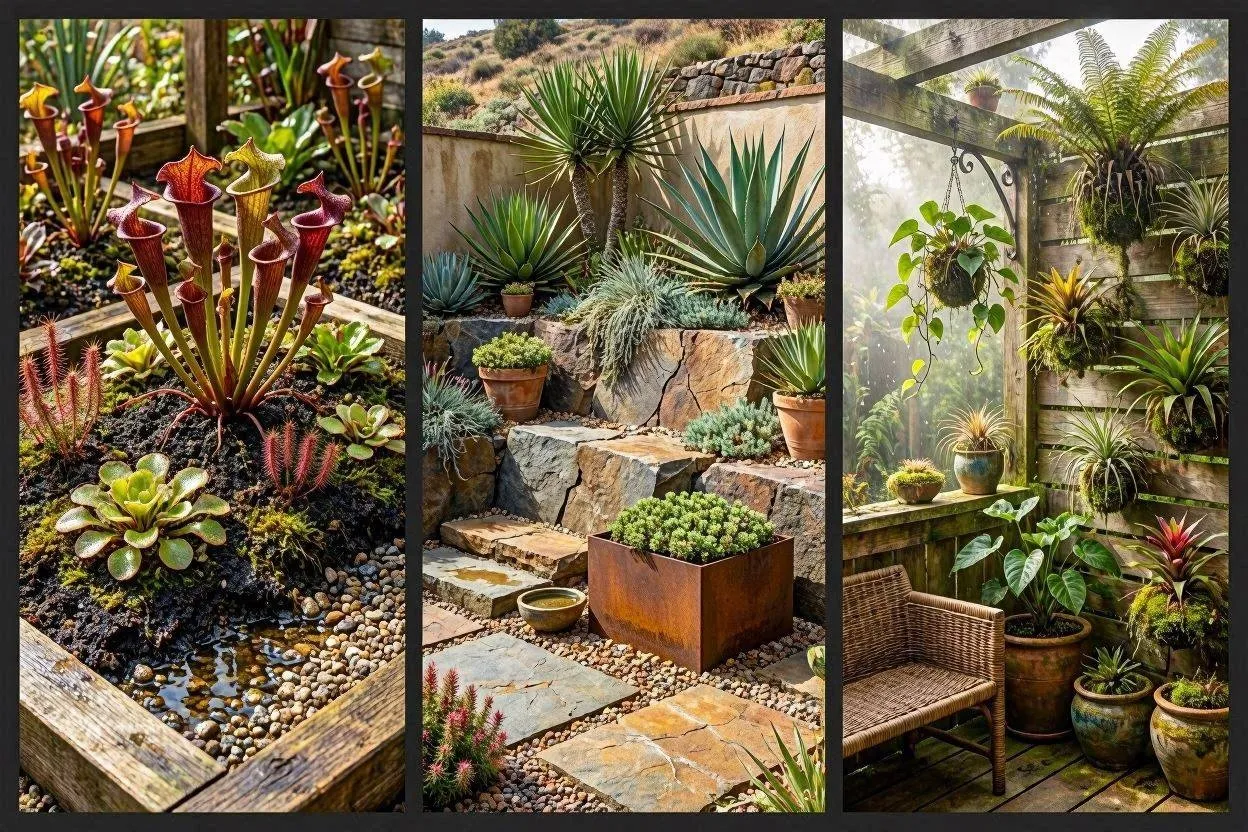
Theme 1: The Carnivore Garden
Create a dedicated bog garden featuring carnivorous plants from multiple continents. Combine Sarracenia purpurea (North America) with Pinguicula grandiflora (Europe) and Drosera capensis (South Africa). All require identical growing conditions — wet, acid, nutrient-poor soil in full sun. The visual contrast between Sarracenia’s tall pitchers, Pinguicula’s flat rosettes, and Drosera’s sticky tendrils creates a fascinating multi-layered display.
Theme 2: The Sensory Evening Garden
Design a garden specifically for evening enjoyment. Fishbone Cactus provides midnight blooming with vanilla fragrance. Add white-flowering Nicotiana (tobacco plant) and night-blooming jasmine for a garden that reaches its peak between 9 PM and midnight. Position low solar path lights to illuminate the architectural stem shapes after dark.
Theme 3: The Mediterranean Drama Garden
Combine Dragon Arum with Euphorbia characias, Acanthus mollis, giant Allium, and ornamental grasses in a dry, sunny border. These plants share similar requirements — poor, well-draining soil, summer drought tolerance, and full sun — and their combined textures create a garden with year-round architectural interest requiring minimal irrigation or maintenance.
Frequently Asked Questions About Unusual Plants
What exactly makes a plant ‘unusual’?
An unusual plant has at least 1 quality that clearly and immediately separates it from the common plants most gardeners grow — an unexpected bloom color or form, a behavioral response to environmental stimuli, a carnivorous feeding mechanism, a remarkable fragrance, a growth habit that defies typical plant form, or an origin story so specific it transforms the experience of growing it. All 5 plants in this guide meet at least 2 of these criteria.
Are unusual plants harder to grow than common garden plants?
No — not as a category. Mimosa pudica and Dragon Arum are as easy to grow as most common annuals and perennials. Pitcher plants have 3 strict rules but require minimal active care once those rules are followed. The Bat Flower is the most demanding plant on this list, requiring consistent humidity. Difficulty is specific to each plant, not a property of being unusual.
Which of these 5 plants is the best starting point for someone new to unusual plants?
Sensitive Plant (Mimosa pudica) is the best first choice. A seed packet costs under $3. Germination takes 10–14 days. The touch response appears at the seedling stage. Flowers arrive within 3 months. No specialist soil, water, or equipment is needed. The immediate, visible reward — watching leaves fold in real time — provides the motivation to explore more challenging unusual plants.
Can I grow all 5 of these unusual plants in Zone 6?
Yes, with the right approach. Dragon Arum and Pitcher Plant are fully hardy to Zone 5–6. Mimosa pudica grows as an annual in Zone 6, completing its full life cycle in a single season. Bat Flower and Fishbone Cactus grow as container houseplants brought indoors before first frost — typically from mid-October through late April in Zone 6.
Do any of these unusual plants have fragrance?
Yes — 2 do. Fishbone Cactus produces a powerful vanilla-citrus fragrance during its 12-hour nocturnal bloom. Dragon Arum produces a very different fragrance — the smell of rotting meat — for exactly 3 days to attract its specific pollinators. The first is a pleasure; the second is manageable outdoors with correct plant placement.
How do I find my USDA Hardiness Zone?
Enter your zip code at the official USDA Plant Hardiness Zone Map (planthardiness.ars.usda.gov) for a precise zone reading. Understanding your hardiness zone is the single most important factor in choosing plants that survive long-term — the core principle behind everything published at ZonedGarden.com.
Is Dragon Arum safe around pets and children?
No. All parts of Dragon Arum — berries, leaves, sap, and corm — contain calcium oxalate crystals that cause intense irritation to mouth, throat, and digestive tissue if ingested. The bright orange-red berries are particularly attractive to children and animals. Plant Dragon Arum only in areas inaccessible to pets and young children, or choose one of the other 4 plants on this list if this is a concern.
Can Pitcher Plants be grown indoors?
Yes, with sufficient light. A south-facing window providing 6+ hours of direct daily sun works for Sarracenia purpurea indoors. Supplement with a full-spectrum grow light (6500K, 16 hours on/8 hours off) in lower-light situations. The cold dormancy requirement — 3–5 months below 40°F (4°C) — can be provided by moving the plant to an unheated garage, cold basement, or enclosed porch for the winter months.