Soil guideline values (SGVs) are scientific trigger levels that show when chemicals in soil may pose a risk to human health. The Environment Agency derived them from soil geochemistry, toxicology, and exposure science, and land professionals use them to screen sites during contaminated land assessments. A result below the SGV means the risk to health is minimal. A result above it means the site needs a closer look, not automatic cleanup.
Soil isn’t a uniform material. It forms over thousands of years through the weathering of parent rock, the buildup of organic matter, and the ongoing chemical exchange between mineral particles, water, and air, a process called pedogenesis. That formation history determines how tightly a soil holds onto arsenic, cadmium, nickel, and other trace elements, which is exactly why guideline values exist: to translate soil chemistry into a number regulators, developers, and homeowners can act on.
This guide covers the published SGV table, the difference between SGVs and Category 4 Screening Levels (C4SLs), and what to do when your soil report shows an exceedance.
What Are Soil Guideline Values?
Soil guideline values are concentrations of a contaminant in soil, measured in milligrams per kilogram (mg/kg), below which long-term exposure poses minimal risk to human health. One kilogram equals 2.2 pounds, so 32 mg/kg of arsenic means 32 milligrams in every 2.2 pounds of soil.
SGVs deal with chronic exposure — contact with soil over years or decades through 3 main pathways: swallowing soil particles, breathing in dust, and skin contact. Children swallow more soil than adults because they play on the ground and put hands in their mouths. SGVs account for this by treating a young child as the critical receptor on residential land.
Soil chemistry shapes the actual risk. Clay content, pH, and organic matter control how tightly a soil binds metals like arsenic and cadmium, while sandy soils and low pH let contaminants move more freely toward groundwater. The geology beneath a site matters too: some UK soils carry naturally elevated arsenic or nickel from the parent rock and mineral deposits they weathered from, with no industrial pollution involved.
SGVs do not cover short-term poisoning, fire risk, explosion risk, water pollution, or harm to wildlife and plants. Separate assessments handle those.
What Are Soil Guideline Values?
An SGV is a concentration of a contaminant in soil, measured in milligrams per kilogram (mg/kg), below which long-term exposure poses minimal risk to human health. One kilogram equals 2.2 pounds, so 32 mg/kg of arsenic works out to 32 milligrams in every 2.2 pounds of soil.
SGVs deal with chronic exposure: contact with soil over years or decades through swallowing soil particles, breathing in dust, and skin contact. Children swallow more soil than adults do, since they play on the ground and put their hands in their mouths, so SGVs treat a young child as the critical receptor on residential land.
Soil chemistry shapes the actual risk on top of this. Clay content, pH, and organic matter control how tightly a soil binds metals like arsenic and cadmium, while sandy, low-pH soils let contaminants move more freely toward groundwater. Geology matters too. Some UK soils carry naturally elevated arsenic or nickel from the parent rock they weathered out of, with no industrial pollution involved at all.
Soil horizon depth plays a role as well. The topsoil (A horizon), subsoil (B horizon), and underlying parent material (C horizon) each retain contaminants differently, because clay mineralogy and organic carbon in the upper horizons bind metals far more tightly than the sandier, mineral-poor layers below. Cation exchange capacity, a measure of how many metal ions a soil’s clay and organic fraction can hold, is probably the single biggest driver of whether a contaminant stays put or leaches toward groundwater.
SGVs don’t cover short-term poisoning, fire risk, explosion risk, water pollution, or harm to wildlife and plants. Separate assessments handle those.
Who Publishes SGVs and How Are They Calculated?

The Environment Agency publishes SGVs using the Contaminated Land Exposure Assessment (CLEA) model, which combines two things: health criteria values (toxicological limits such as the tolerable daily intake a person can absorb over a lifetime without harm) and exposure estimates (how much soil a person on that land actually contacts each day through ingestion, inhalation, and skin contact).
The model runs conservative assumptions on purpose. It assumes a person lives on the site for years, plays or gardens in the soil, and eats vegetables grown in it where relevant. Real-world exposure usually comes in lower, which builds a safety margin into every SGV. The approach draws on environmental science, toxicology, and soil geochemistry, the same disciplines behind drinking water standards and air quality limits.
The legal backdrop is Part 2A of the Environmental Protection Act 1990, the regime local authorities use to identify and deal with contaminated land in England and Wales.
Soil Guideline Values Table (Published SGVs)
The Environment Agency published SGVs for a small set of contaminants, mainly heavy metals and metalloids that persist in soil for decades. The table below shows the headline figures in mg/kg of dry soil.
| Contaminant | Residential | Allotments | Commercial |
| Arsenic | 32 | 43 | 640 |
| Cadmium | 10 | 1.8 | 230 |
| Nickel | 130 | 230 | 1,800 |
| Mercury (inorganic) | 170 | 80 | 3,600 |
| Selenium | 350 | 120 | 13,000 |
These figures reflect soil geochemistry as much as toxicology. Arsenic and nickel are lithogenic elements naturally present in bedrock and released through millennia of chemical weathering, which is why background concentrations vary by region depending on the underlying geology; chalk, clay, and igneous terrain each produce different baseline levels.
Always check figures against the original Environment Agency SGV reports before using them in a formal assessment, since withdrawals and updates apply to some substances. SGV reports also exist for organic compounds, including benzene, toluene, ethylbenzene, xylene, phenol, and dioxins.
Notice the pattern: allotment values sit lowest for metals that plants absorb readily, like cadmium, because people eat crops grown in that soil. Commercial values sit highest because workers spend fewer hours on site and rarely touch the soil directly.
The Three Land-Use Scenarios SGVs Cover

SGVs exist for residential, allotment, and commercial land use. Each scenario models a different person, exposure time, and pathway mix.
Residential
The critical receptor is a young child aged 0–6. The model assumes daily contact with garden soil throughout childhood, and two versions exist: with plant uptake (the family grows vegetables) and without.
Allotments
The model assumes an adult and child regularly eat home-grown produce, including root vegetables like carrots and potatoes that draw metals up from the soil. Produce consumption drives the exposure here, which is why the allotment SGV for cadmium drops all the way to 1.8 mg/kg.
Commercial
The receptor is an adult working indoors roughly 8 hours a day. Exposure is limited, so commercial values run 20 to 40 times higher than residential figures.
Pick the scenario that matches the site’s current or planned use. If a site mixes uses, flats above shops, for instance, apply the more protective residential values.
What Happens If Soil Guideline Values Are Exceeded?
An exceedance triggers further assessment, not automatic remediation. SGVs are screening tools built on cautious assumptions, so a result above the SGV just means the cautious model can’t rule out risk. Nothing more.
The next step is a detailed quantitative risk assessment (DQRA). A consultant replaces the generic assumptions with site-specific facts: actual soil type and mineralogy, real exposure patterns, leaching behaviour, and bioaccessibility testing that measures how much of the metal the human gut can actually absorb from that particular soil matrix. Many sites that fail the generic screen pass the DQRA and need no cleanup at all.
Remediation happens when the DQRA confirms an unacceptable risk. Options include removing hotspot soil, capping it with clean cover layers of 300–600 mm (12–24 inches), or treating it on site.
SGV vs C4SL: Which One Should You Use in 2026?
Use Category 4 Screening Levels (C4SLs) where they exist, and SGVs or other generic assessment criteria for everything else. Defra introduced C4SLs in 2014 for six substances: arsenic, benzene, benzo(a)pyrene, cadmium, hexavalent chromium, and lead.
The two systems differ in one key way. SGVs mark the level of “minimal risk.” C4SLs mark a slightly higher level of “low risk” that’s still acceptable under Part 2A policy. C4SLs also add a fourth land use, public open space, that SGVs never covered.
Most UK consultants now screen with C4SLs first, fall back on SGVs where no C4SL exists, and use published values from bodies such as LQM/CIEH (Land Quality Management / Chartered Institute of Environmental Health) for whatever’s left. State which criteria you used in your report. Regulators check.
No SGV for Lead, Copper, or Zinc? Here’s What to Use Instead
No published SGV exists for lead, copper, or zinc, three of the most common contaminants on UK brownfield sites. The Environment Agency withdrew the old lead value and never finalised replacements for copper and zinc.
Use these alternatives instead:
- Lead: the C4SL, set at 200 mg/kg for residential land with home-grown produce.
- Copper and zinc: LQM/CIEH Suitable 4 Use Levels (S4ULs), the industry-standard criteria most consultants apply.
- Anything else with no published value: a site-specific assessment using the CLEA model.
This gap trips up developers who download the SGV reports, find no lead figure, and assume no limit applies. A limit applies. It just lives in a different document.
A Homeowner’s Guide to Contaminated Garden Soil
Yes, homeowners can act on SGVs without hiring a consultant first. If your house sits on former industrial land, near an old gasworks, or on filled ground, here’s what to do:
- Check the history for free. Old Ordnance Survey maps at your local library or online archives show past uses of your plot.
- Test the soil. A UKAS-accredited laboratory tests a garden soil sample for the standard metals suite for £30–£80 ($40–$100), plus a basic texture test (sand, silt, clay ratio) that shows how easily contaminants might migrate.
- Compare results against residential SGVs and C4SLs. Use the “with plant uptake” values if you grow vegetables.
- Reduce exposure while you investigate. Wash home-grown produce, cover bare soil with grass or mulch, and grow food in raised beds with 400 mm (16 inches) of clean imported topsoil.
Most gardens pass. Urban soils often carry slightly elevated lead from decades of leaded petrol, and floodplain gardens sometimes hold metals deposited in alluvial sediment over centuries. Raised beds solve both problems for a few hundred pounds.
How a Site Assessment Works: From Desk Study to Remediation

To assess a site against soil guideline values, follow the standard 4-step process:
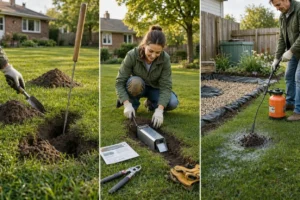
- Desk study. A consultant reviews historical maps, geology records, and past planning files to flag likely contaminants. Cost: £500–£1,500 ($650–$1,900).
- Site investigation. Engineers drill boreholes or dig trial pits to log the soil profile, topsoil, subsoil, made ground, and natural strata, then send samples from each layer to an accredited laboratory. Cost: £2,000–£10,000 depending on site size.
- Risk assessment. The consultant screens results against C4SLs, SGVs, and S4ULs, then runs a DQRA on any exceedances.
- Remediation strategy. If required, the consultant designs the cleanup and agrees it with the local authority before work starts.
The full process takes 4–12 weeks for a typical housing plot. Skipping it risks planning refusal, since local authorities demand contamination reports for development on any site with an industrial past.
FAQs
What are soil guideline values in simple terms?
Safety thresholds for chemicals in soil. A concentration below the SGV poses minimal risk to human health over long-term exposure.
Is exceeding a soil guideline value dangerous?
Not automatically. It means the cautious screening model can’t rule out risk, so the site needs a detailed, site-specific assessment before anyone concludes there’s actual danger.
Are SGVs still used in the UK?
Yes, alongside newer criteria. Consultants screen with C4SLs for the six substances they cover and apply SGVs or LQM/CIEH values for the rest.
Why is there no soil guideline value for lead?
The Environment Agency withdrew the old lead value because the toxicology changed. The C4SL of 200 mg/kg for residential land replaced it in 2014.
How much does soil testing against SGVs cost?
A single laboratory metals test costs £30–£80 for homeowners and typically reports results alongside basic soil properties like pH and texture, since both affect how mobile a contaminant is in the ground. A full professional site assessment for development, including borehole logging and soil profile description across multiple horizons, runs £2,500–£12,000 depending on site size.
Conclusion
Soil guideline values remain the starting point for every UK land contamination check, but they work as a screen, not a verdict. A result below the SGV closes the question. A result above it opens a detailed assessment that most sites pass once real-world conditions replace the cautious assumptions.
Three things are worth keeping in mind. Match the value to the land use, residential, allotments, or commercial, since the numbers differ by a factor of up to 40. Screen with C4SLs where they exist, because the 2014 values for arsenic, lead, cadmium, benzene, benzo(a)pyrene, and hexavalent chromium reflect newer science. And treat a missing SGV as a signpost, not a green light: lead, copper, and zinc all have limits, just published in the C4SL and S4UL documents instead.
Whether you’re developing brownfield land or growing tomatoes in a city garden, the process stays the same: check the history, test the soil, compare against the right criteria, and act on evidence rather than fear.