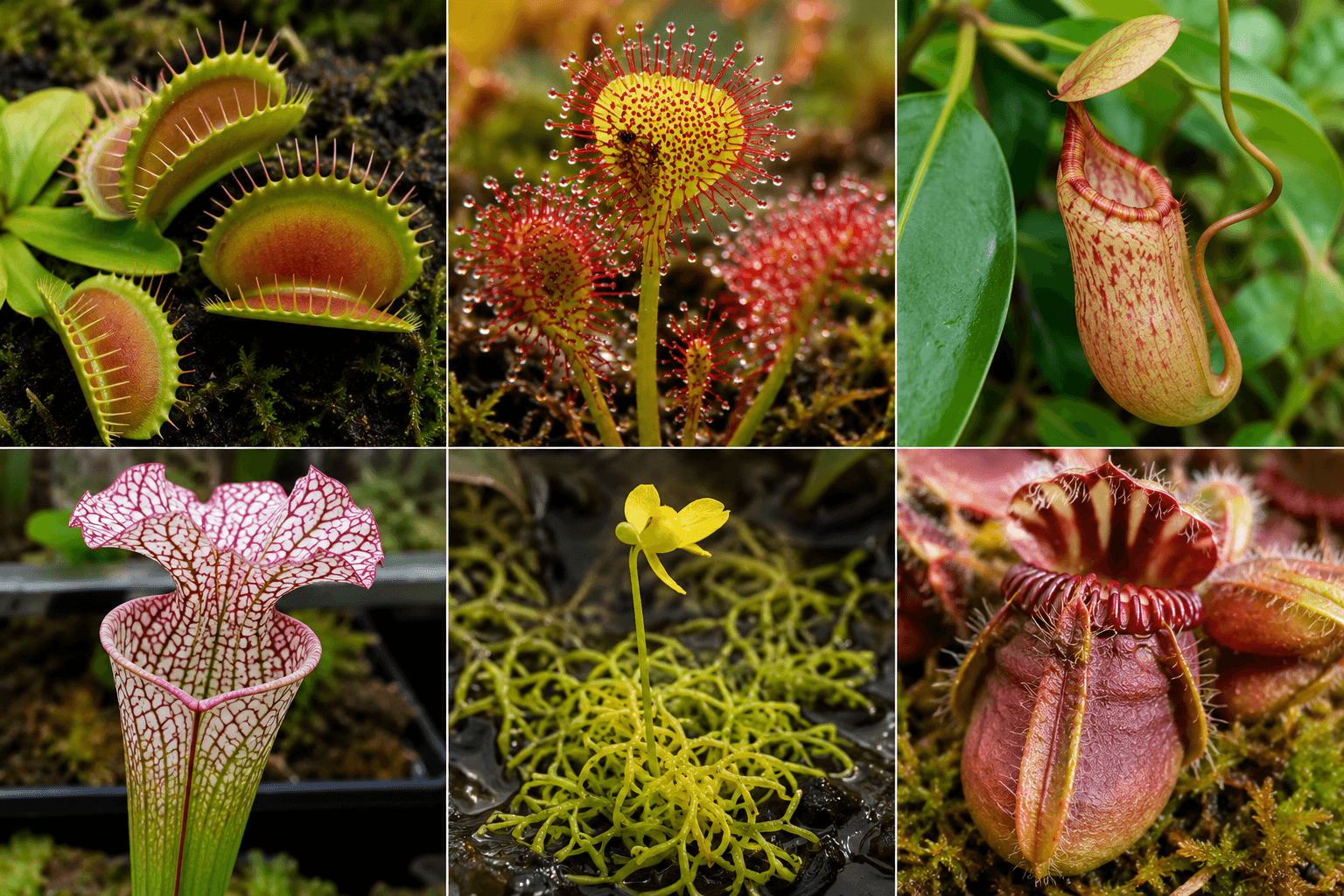
The top 10 carnivorous plants are: Venus Flytrap, Tropical Pitcher Plant (Nepenthes), North American Pitcher Plant (Sarracenia), Sundew (Drosera), Cobra Lily, Butterwort, Bladderwort, Albany Pitcher Plant, Waterwheel Plant, and Rainbow Plant.
These plants evolved in nutrient-poor bogs and wetlands worldwide. They trap insects — and sometimes frogs, lizards, or small rodents — to extract nitrogen and phosphorus their soil cannot provide. Each species uses 1 of 5 trapping mechanisms: pitfall traps, snap traps, flypaper traps, bladder traps, or lobster pot traps.
This guide covers every plant’s trap type, prey, native habitat, care requirements (light, water, soil), and beginner difficulty — so you can choose the right one and keep it alive.
Why Carnivorous Plants Evolved to Eat Insects
Carnivorous plants grow in 4 conditions: waterlogged soil, high acidity (pH 4.0–6.0), low nitrogen, and low phosphorus. These conditions prevent most plants from surviving. Carnivorous plants solved this problem over millions of years — they evolved trap structures from modified leaves to supplement photosynthesis with insect-derived nutrients.
There are over 750 recognised carnivorous plant species across 12 plant families, according to the International Carnivorous Plant Society (ICPS). Carnivory evolved independently at least 6 times in unrelated plant lineages — a remarkable example of convergent evolution.
All carnivorous plants share 3 traits: they attract prey, trap it, and absorb nutrients from digested organic matter. Beyond that, their mechanisms differ dramatically.
1. Venus Flytrap (Dionaea muscipula)
Trap Type: Snap trap | Native: North and South Carolina, USA | Difficulty: Moderate
The Venus flytrap is the most famous carnivorous plant on earth. Its hinged leaves form a jaw-like snap trap with 3 to 6 trigger hairs on each lobe. When prey touches 2 hairs within 20 seconds, the trap snaps shut in under 100 milliseconds — one of the fastest movements in the plant kingdom.
The plant then produces digestive enzymes and acids that liquefy the insect’s soft tissue over 5–12 days. Only the exoskeleton remains when the trap reopens. Each trap operates 3–5 times before dying; the plant grows new traps continuously.
Venus flytraps eat flies, ants, beetles, and spiders — not just flies despite the name. In the wild, they grow in the longleaf pine savannas of the Carolinas, one of the most threatened ecosystems in North America.
How to Grow Venus Flytrap
- Light: Full sun — minimum 6 hours direct sun daily; use a south-facing windowsill
- Water: Distilled or rainwater only — 0 ppm minerals; use tray method, keep 1/4 inch (0.6 cm) water in saucer at all times
- Soil: 1:1 sphagnum peat moss and perlite — no fertiliser, no compost, no garden soil
- Dormancy: Required — 3 to 4 months at 35–50°F (2–10°C) in winter; traps die back but plant survives
- Do not trigger traps manually — each trap has a 3–5 closure lifetime; unnecessary triggering weakens the plant
2. Tropical Pitcher Plant (Nepenthes)
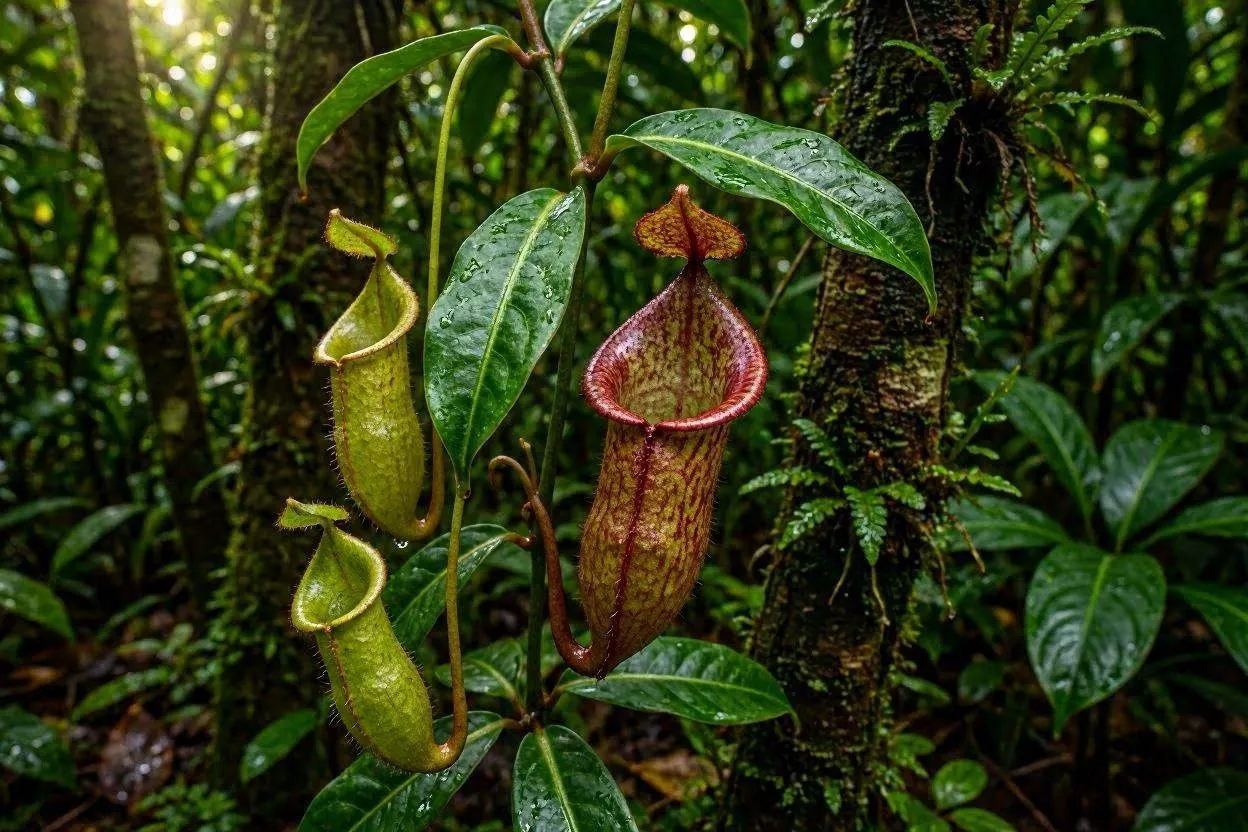
Trap Type: Pitfall trap | Native: Borneo, Sumatra, Southeast Asia | Difficulty: Easy to Moderate
Nepenthes produces hanging, jug-shaped pitchers filled with digestive fluid. Insects are attracted by nectar secreted along the peristome (the slippery rim), slip into the pitcher, and drown in the enzyme-rich liquid below. Larger species — particularly Nepenthes rajah — are documented trapping animals as large as shrews, frogs, and lizards.
Nepenthes rajah holds up to 3.5 litres (0.9 gallons) of digestive fluid, the largest pitcher of any carnivorous plant species.
Over 170 Nepenthes species exist. Hybrid cultivars like Nepenthes ‘Ventrata’ are the most beginner-friendly, tolerating household conditions without specialised setups.
How to Grow Nepenthes
- Light: Bright indirect light — no harsh direct midday sun; 4–6 hours daily minimum
- Water: Distilled or rainwater; keep soil moist but not waterlogged — no tray method needed for Nepenthes
- Soil: 1:1 sphagnum peat moss and perlite for fast drainage
- Humidity: 60–80% ideal; mist leaves daily or use a pebble tray with water
- No dormancy required — grows year-round, making it ideal for indoor growing
- Fill pitchers with distilled water if they dry out; they produce digestive enzymes independently
3. North American Pitcher Plant (Sarracenia)
Trap Type: Pitfall trap | Native: Eastern North America | Difficulty: Easy
Sarracenia produces upright, tube-shaped pitchers that collect rainwater mixed with digestive enzymes. Nectar lines along the pitcher hood attract insects downward. Downward-pointing hairs inside the tube prevent escape, and insects eventually fall into the pool of digestive liquid at the base.
8 Sarracenia species exist, ranging from the compact Sarracenia purpurea (purple pitcher plant) to the tall Sarracenia flava (yellow pitcher plant) reaching 80 cm (31 inches). All are native to North American bogs from the Gulf Coast to Newfoundland.
Sarracenia purpurea is the most widely grown species — cold-hardy, forgiving, and one of the best starter plants for beginners.
How to Grow Sarracenia
- Light: Full sun — 6+ hours daily; grows excellently outdoors in summer
- Water: Distilled or rainwater, tray method; keep 1/2 inch (1.2 cm) water in saucer during growing season
- Soil: 1:1 sphagnum peat moss and sharp sand
- Dormancy: Hardy varieties require winter dormancy at 32–50°F (0–10°C); reduce watering; keep just moist
- Outdoors-friendly: Sarracenia grows well in bog gardens, pond edges, or outdoor containers in USDA zones 6–9
4. Sundew (Drosera)
Trap Type: Flypaper trap | Native: Worldwide — 50% of species in Australia | Difficulty: Easy
Sundews use sweet, sticky mucilage — secreted from glandular tentacles on their leaves — to attract and ensnare insects. The glistening droplets resemble dewdrops in sunlight, giving the plant its name. Once an insect lands, the tentacles slowly coil inward over 15–30 minutes, pressing the insect against digestive glands.
Drosera is the largest carnivorous plant genus with over 250 species. The Cape Sundew (Drosera capensis) is the most recommended beginner species — fast-growing, vigorous, and extremely forgiving of imperfect conditions.
How to Grow Sundews
- Light: Full sun — 6+ hours; Cape Sundew also tolerates bright artificial light
- Water: Distilled or rainwater; tray method; keep consistently moist
- Soil: 1:1 sphagnum peat moss and perlite
- Feeding: Allow natural catching; supplement with freeze-dried bloodworms once per month indoors
- Cape Sundew (Drosera capensis) does not require dormancy — ideal indoor year-round plant
5. Cobra Lily (Darlingtonia californica)
Trap Type: Pitfall trap | Native: Northern California and Southern Oregon, USA | Difficulty: Advanced
The Cobra Lily is named for its hooded pitcher shape and twin fang-like appendages resembling a rearing cobra. It lures insects into its pitcher with nectar, then disorientates them with translucent light-transmitting windows near the top of the hood. Insects mistake the windows for exits and exhaust themselves trying to escape before falling into the digestive fluid below.
Unlike other pitcher plants, Darlingtonia does not produce its own digestive enzymes. It relies on symbiotic bacteria already present in its pitcher fluid to break down captured prey.
How to Grow Cobra Lily
- Light: Full sun to partial shade — morning sun with cool afternoon shade preferred
- tWater: Cold water is critical — Darlingtonia roots must stay cool (under 55°F / 13°C); use ice cubes in tray during hot summers
- Soil: Pure live sphagnum moss or 1:1 peat and perlite; excellent drainage essential
- Humidity: High humidity required — 70%+ ideal
- Not recommended for beginners — requires precise cool-root managemen
6. Butterwort (Pinguicula)
Trap Type: Flypaper trap | Native: North America, Europe, Mexico | Difficulty: Easy
Butterworts produce flat, fleshy leaves coated in two types of glands: stalked glands that produce sticky mucilage to trap insects, and sessile glands that secrete digestive enzymes. The leaves often curl slightly at the edges when prey is caught, improving contact with the digestive glands.
Pinguicula moranensis and Pinguicula ‘Weser’ are popular indoor varieties. Butterworts are particularly effective at catching fungus gnats, fruit flies, and small mosquitoes — making them a natural pest control plant for kitchen windowsills.
How to Grow Butterworts
- Light: Bright indirect to partial direct sun — 4–5 hours; tolerates artificial grow lights
- Water: Tray method; let soil dry slightly between waterings — more drought-tolerant than most carnivorous plants
- Soil: Mix of perlite, vermiculite, and a small amount of peat moss; or crushed pumice
- Mexican Pinguicula species do not require dormancy; temperate species die back to a small winter resting bud
- Excellent beginner plant — tolerates lower humidity than other carnivorous plants
7. Bladderwort (Utricularia)
Trap Type: Bladder trap (suction) | Native: Worldwide — every continent except Antarctica | Difficulty: Easy
Bladderworts use the fastest trapping mechanism of any carnivorous plant. Their tiny bladder-traps create an internal vacuum by pumping out water. When microscopic prey triggers the hair-like sensors near the trapdoor, the bladder snaps open and sucks in the prey along with surrounding water in under 10 milliseconds — faster than most camera shutters.
Utricularia vulgaris (common bladderwort) is a free-floating aquatic species. Over 233 Utricularia species exist — both aquatic and terrestrial. Aquatic species are the simplest to grow, requiring nothing more than a container of pure water and sunlight.
How to Grow Bladderwort
- Aquatic species: Place in a container of distilled or rainwater with 6+ hours of direct sun
- Terrestrial species: Grow in very wet, pure sphagnum moss
- No soil preparation needed for aquatic varieties
- Feed on water fleas (Daphnia) and other small aquatic invertebrates naturally
- One of the easiest carnivorous plants to maintain — requires minimal intervention
8. Albany Pitcher Plant (Cephalotus follicularis)
Trap Type: Pitfall trap | Native: Southwest Australia (endemic) | Difficulty: Advanced
Cephalotus follicularis is the only species in its family and one of the most visually striking carnivorous plants in existence. It produces 2 types of leaves: small non-carnivorous leaves for photosynthesis, and hairy pitfall-trap pitchers with a toothed peristome that prevents insect escape. The pitchers reach only 5 cm (2 inches) in height but are densely detailed.
Cephalotus is endemic to a tiny region of southwest Australia near Albany — its entire wild range spans less than 400 kilometres squared. It is challenging to grow due to specific temperature and humidity requirements.
How to Grow Albany Pitcher Plant
- Light: Bright indirect light — avoid harsh direct sun that scorches small pitchers
- Water: Distilled or rainwater; slightly drier than most carnivorous plants — allow soil surface to dry slightly
- Soil: 2:1 sphagnum peat moss and perlite; excellent drainage
- Temperature: Cool conditions preferred — 50–75°F (10–24°C); avoid summer heat above 85°F (29°C)
- Humidity: 60–70%; terrariums recommended for stable conditions
9. Waterwheel Plant (Aldrovanda vesiculosa)
Trap Type: Snap trap (aquatic) | Native: Europe, Africa, Asia, Australia | Difficulty: Advanced
The Waterwheel Plant is the aquatic equivalent of the Venus flytrap — a free-floating water plant with wheel-like whorls of snap-trap leaves. Each whorl holds 6–9 snap traps that fire within 10–20 milliseconds when triggered by water fleas, mosquito larvae, and small aquatic invertebrates.
Aldrovanda vesiculosa is a single-species genus and one of the rarest aquatic carnivorous plants. It grows rootless, floating in clean freshwater across multiple continents. The plant is critically endangered in Europe due to wetland drainage and water quality degradation.
How to Grow Waterwheel Plant
- Container: Large aquarium or outdoor pond with clean, acidic water
- Water: Pure rainwater or reverse osmosis (RO) water; pH 4.5–6.5; no tap water
- Light: Full sun — 6+ hours direct sunlight for vigorous growth
- Temperature: Warm water preferred — 68–82°F (20–28°C)
- Very sensitive to water chemistry — recommended for experienced growers only
10. Rainbow Plant (Byblis)
Trap Type: Flypaper trap | Native: Western and Northern Australia | Difficulty: Moderate
Rainbow Plants are named for the iridescent shimmer of their mucilage-coated leaves in sunlight, which creates a multicoloured rainbow effect. Like sundews, Byblis uses sticky glands on tapered leaves to catch small insects. Unlike sundews, however, the leaves cannot move — they rely entirely on the adhesive strength of the mucilage.
Byblis liniflora is the most widely grown species — an annual that grows quickly from seed and produces delicate lilac flowers throughout its lifespan. All 7 Byblis species are found only in Australia.
How to Grow Rainbow Plant

- Light: Full sun — 6+ hours; outdoor growing produces the best mucilage production and insect capture
- Water: Distilled or rainwater; tray method; keep consistently moist
- Soil: Sphagnum peat moss with added perlite
- Byblis liniflora: Grow as an annual — sow from seed each spring; plants die after flowering
- Seeds benefit from smoke treatment or gibberellic acid (GA3) to break dormancy — soak in 200 ppm GA3 solution for 24 hours before sowing
Quick Reference: Top 10 Carnivorous Plants at a Glance
| Plant | Trap Type | Native Region | Difficulty | Needs Dormancy | Best For |
|---|---|---|---|---|---|
| Venus Flytrap | Snap | USA (Carolinas) | Moderate | Yes | Beginners (with care) |
| Nepenthes | Pitfall | Southeast Asia | Easy–Mod | No | Indoor growing |
| Sarracenia | Pitfall | Eastern N. America | Easy | Yes | Outdoor bog gardens |
| Sundew (Drosera) | Flypaper | Worldwide | Easy | Some species | Beginners |
| Cobra Lily | Pitfall | Oregon & California | Advanced | Yes | Experienced growers |
| Butterwort | Flypaper | Americas, Europe | Easy | Some species | Pest control indoors |
| Bladderwort | Bladder | Worldwide | Easy | No | Aquatic setups |
| Albany Pitcher | Pitfall | SW Australia | Advanced | Mild | Collectors |
| Waterwheel Plant | Snap (aquatic) | Eurasia, Australia | Advanced | Yes | Experienced growers |
| Rainbow Plant | Flypaper | Australia | Moderate | No (annual) | Outdoor season plants |
Universal Care Rules for All Carnivorous Plants

These 5 rules apply to every carnivorous plant. Ignore any one of them and the plant will decline or die.
1. Use Only Mineral-Free Water
Tap water kills carnivorous plants over weeks to months. Standard tap water in most areas contains 200–400 parts per million (ppm) of dissolved minerals. Carnivorous plants need water below 50 ppm TDS (total dissolved solids). Use distilled water, reverse osmosis (RO) water, or collected rainwater exclusively.
2. Use Nutrient-Poor, Acidic Soil
Never use regular potting compost, garden soil, or any fertiliser on carnivorous plants. The standard carnivorous plant soil mix is 1 part sphagnum peat moss to 1 part perlite or horticultural sand. This replicates the acidic, low-nutrient bog conditions these plants evolved in.
3. Provide Maximum Light
Carnivorous plants need 6+ hours of direct sun daily. A south-facing windowsill is the minimum indoors. Weak, pale growth and loss of pitcher formation or trap colour indicate insufficient light. Use full-spectrum grow lights if natural light is limited — position them 6 inches (15 cm) above the plant.
4. Use the Tray Watering Method
Sit pots in a shallow tray and keep 0.5–1 inch (1.2–2.5 cm) of distilled water in the tray at all times during the growing season. Carnivorous plants evolved in perpetually waterlogged bogs. They tolerate wet feet; they cannot tolerate drought. Reduce tray depth in winter during dormancy.
5. Never Fertilise
Carnivorous plants get all required nitrogen and phosphorus from captured insects. Fertiliser burns their roots and causes rapid decline. If growing indoors without insect access, supplement feeding with 1 small freeze-dried bloodworm per trap per month — nothing more.
Frequently Asked Questions
Are carnivorous plants dangerous to humans?
No. All carnivorous plants are completely harmless to humans. The largest species — Nepenthes rajah — traps small vertebrates like rats, but poses no risk to people. Even Venus flytrap trigger pressure is too weak to break human skin.
Can carnivorous plants survive without insects?
Yes. Carnivorous plants photosynthesize like all other plants — insects are a nutrient supplement, not a primary energy source. Without any insect feeding, they grow more slowly and produce fewer traps or pitchers. Feeding once per month indoors is sufficient.
Why is my Venus flytrap turning black?
4 main causes: tap water mineral buildup, insufficient light, natural trap death after 3–5 closures, or the start of winter dormancy. Black traps during growing season signal a care problem. Black traps in autumn through winter are normal dormancy behaviour.
What is the easiest carnivorous plant for beginners?
Cape Sundew (Drosera capensis) is the easiest — fast-growing, forgiving, requires no dormancy, and thrives on a sunny windowsill with distilled water. Sarracenia purpurea (purple pitcher plant) and Nepenthes ‘Ventrata’ are the next best beginner options.
Can I grow carnivorous plants in a terrarium?
Yes — with species-specific exceptions. Nepenthes, Butterwort, Cape Sundew, and Cephalotus thrive in high-humidity closed or open terrariums. Venus flytrap and Sarracenia need open-air conditions and winter dormancy outside a terrarium. Never mix temperate and tropical species in the same terrarium.
Do carnivorous plants need bugs to survive?
No. They use photosynthesis as their primary energy source. Insects provide nitrogen and phosphorus for leaf and trap development — not calories. Outdoor plants catch enough insects naturally. Indoor plants benefit from supplemental freeze-dried insect feeding once monthly.