
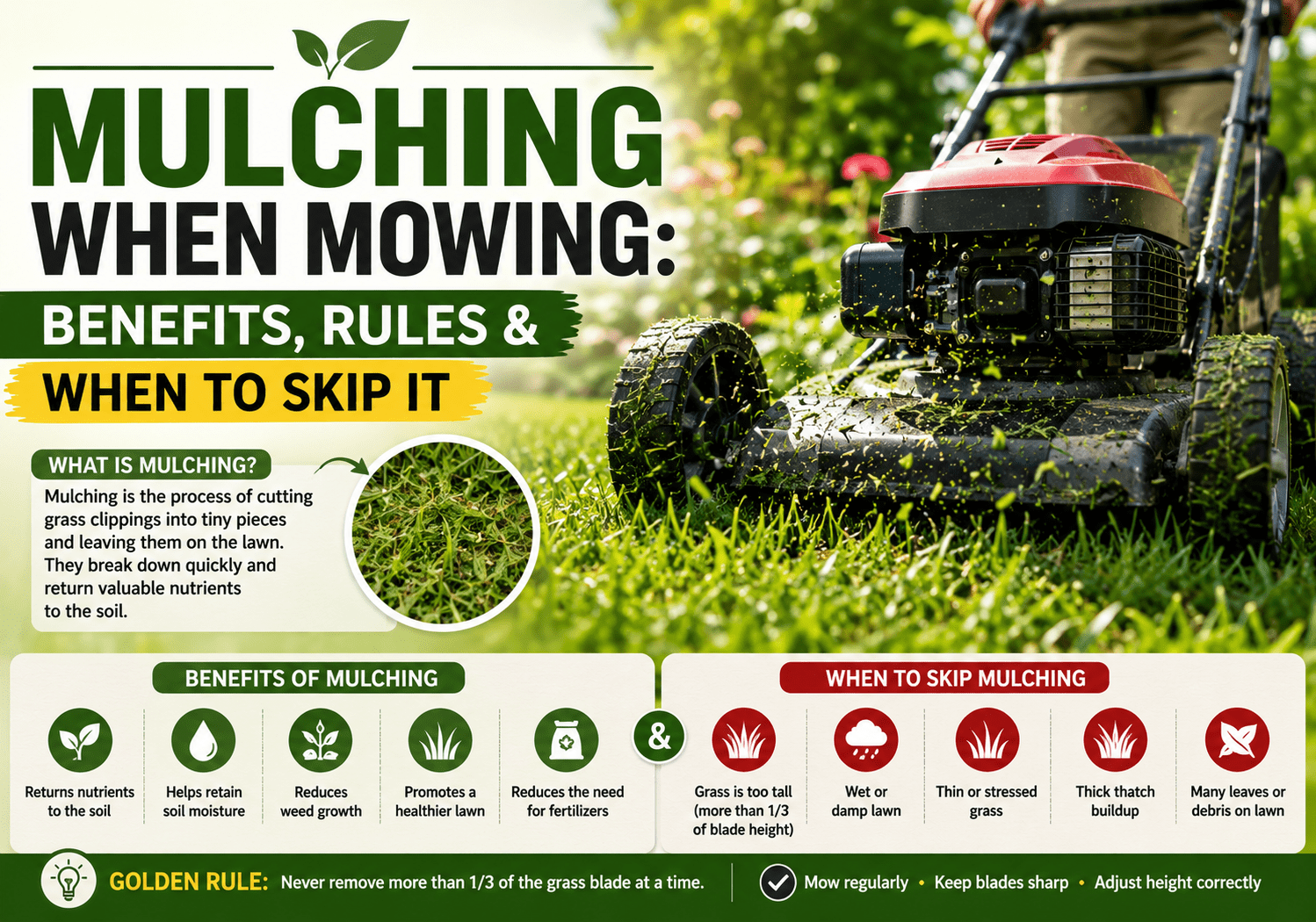
Mulching when mowing means leaving finely shredded grass clippings on your lawn instead of bagging them. Those clippings break down within 1-2 weeks and return nitrogen, phosphorus, and potassium directly back into the soil — the same 3 nutrients found in store-bought fertilizer.
Purdue University Extension research shows that leaving clippings on the lawn returns up to 25% of your lawn’s annual nutrient needs at zero cost. That is a meaningful reduction in fertilizer spending for any homeowner.
This guide covers exactly how to mulch correctly, when conditions make mulching harmful instead of helpful, and how the one-third rule determines whether your clippings decompose cleanly or sit on top of the grass and cause damage.
What Happens When You Mulch While Mowing
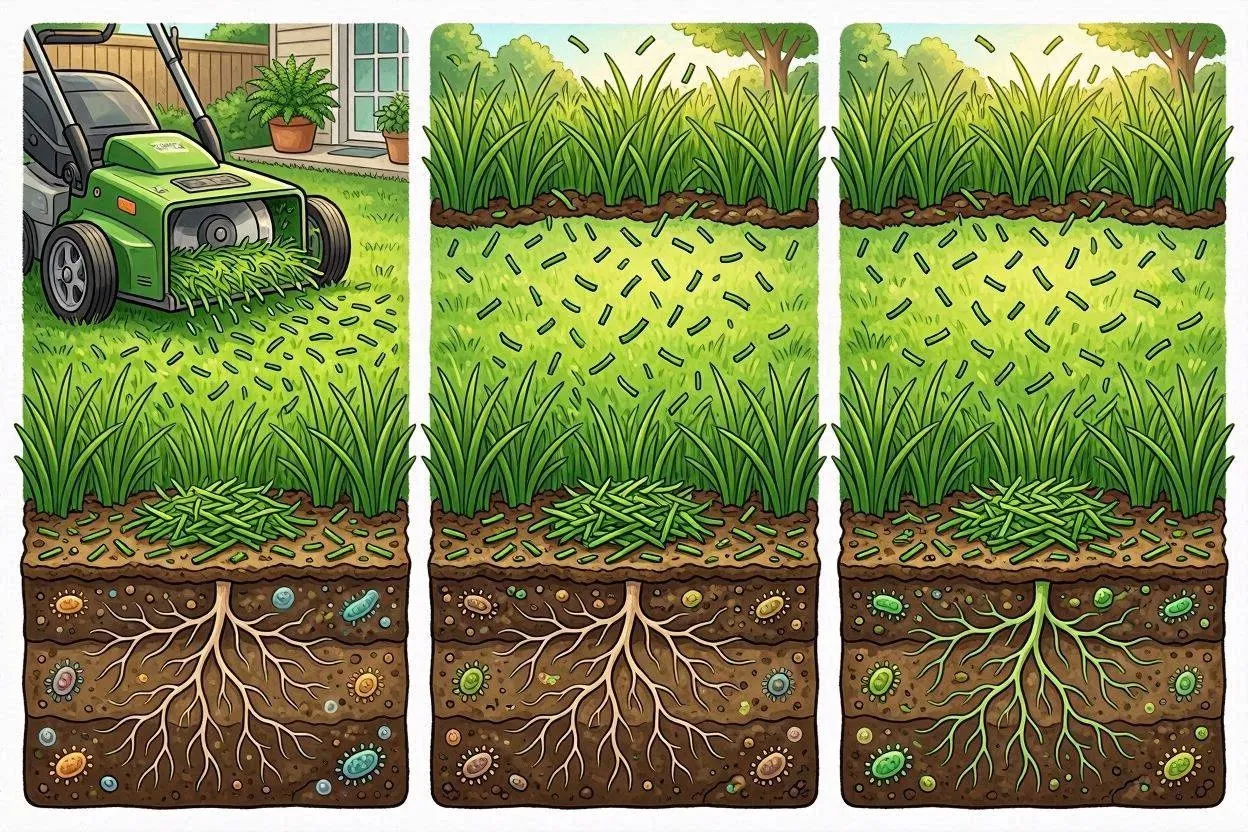
A mulching mower re-cuts grass clippings 2-3 times inside the deck before dropping them onto the lawn. The resulting pieces are under 1 inch (2.5 cm) long — small enough to fall through the grass canopy and reach the soil surface directly.
Once on the soil, 3 things happen quickly:
- Decomposition begins within 24-48 hours. Soil bacteria and microorganisms break down the clippings, releasing stored nitrogen, phosphorus (P), and potassium (K) — the same N-P-K ratio printed on fertilizer bags.
- Moisture is retained longer. The thin layer of clippings slows surface evaporation, keeping the root zone moist during hot weather. Lawns that are mulched consistently need less frequent watering.
- Microbial activity increases. The organic matter feeds beneficial soil microbes, which in turn break down existing thatch and improve soil structure over time.
University of Missouri Extension: grass clippings contain 4% nitrogen, 2% potassium, and 1% phosphorus by weight. Returning them to the lawn each mow adds up to 1 pound (0.45 kg) of nitrogen per 1,000 sq ft (93 sq m) per year.
5 Real Benefits of Mulching When Mowing
1. Free Natural Fertilizer — No Extra Products Needed
Grass blades are 85% water by composition. The remaining 15% is organic matter packed with nitrogen, phosphorus, and potassium. Mulching returns all of that to the soil every single mow.
Studies from Purdue University Extension confirm that grasscycling (returning clippings to the lawn) covers up to 25% of annual nitrogen requirements. On a 5,000 sq ft (465 sq m) lawn that requires 5 lbs (2.3 kg) of nitrogen per year, mulching saves roughly 1.25 lbs (0.57 kg) of applied fertilizer annually.
STIGA reports that mulching mowers provide approximately 30% of the total nutrients your grass needs to thrive throughout the growing season.
2. Improved Soil Health and Microbial Activity
As clippings decompose, they feed the bacteria and earthworms living in the top 2-4 inches (5-10 cm) of soil. Those microorganisms are the same ones responsible for breaking down thatch naturally.
A 4-year study by the University of Natural Resources and Life Sciences in Vienna-Essling compared mulched and non-mulched lawns of identical size. The mulched lawn showed significantly better grass density, soil structure, and growth rate than the non-mulched control — without any additional fertilizer.
3. Better Moisture Retention During Dry Periods
Mulched clippings form a light top layer that slows surface evaporation. During summer heat, this reduces moisture loss by keeping the root zone cooler and more humid between waterings.
Lawns mulched consistently through the growing season hold moisture longer after rain, reducing the frequency of irrigation needed — a measurable saving in water costs during dry months.
4. Thatch Myth — Mulching Does Not Cause Thatch
No. Mulching does not cause thatch buildup. This is the most persistent myth in lawn care, and it is flat wrong.
Thatch is a layer of dead roots, stems, and rhizomes that accumulates between the soil and living grass. Fresh grass clippings are 85% water and decompose quickly. They never reach the density or toughness required to form thatch.
In fact, the increased microbial activity from mulching actively breaks down existing thatch layers. The only time mulching contributes to surface buildup is when clippings are too long — which the one-third rule prevents entirely.
Snapper confirms: thatch is caused by dead roots and stems, not mulched clippings. Sharp blades and regular mowing frequency are the 2 factors that prevent thatch formation.
5. Less Work, Less Waste, Lower Cost
Stopping to empty a grass bag takes 3-5 minutes per collection. On a 45-minute mow, that adds up to 15-20 minutes of extra work. Mulching eliminates every collection stop.
The EPA reported that in 2015, yard trimmings including grass clippings accounted for nearly 35 million tons of waste, with 11% going to landfills. Mulching removes clippings from that waste stream entirely.
The One-Third Rule: The Most Important Rule in Mulching
The one-third rule states that you should never cut more than one-third of the grass blade height in a single mowing session. This single rule determines whether your mulching succeeds or damages the lawn.
Here is how the math works in practice:
| Grass Type | Ideal Height | Mow When Reaches | Cut Down To | Max Clipping Length |
| Kentucky Bluegrass (cool-season) | 2.5–3.5 in (6–9 cm) | 3.75–5.25 in (10–13 cm) | 2.5–3.5 in (6–9 cm) | 1.25–1.75 in (3–4 cm) |
| Tall Fescue (cool-season) | 3–4 in (8–10 cm) | 4.5–6 in (11–15 cm) | 3–4 in (8–10 cm) | 1.5–2 in (4–5 cm) |
| Perennial Ryegrass (cool-season) | 2.5–3.5 in (6–9 cm) | 3.75–5.25 in (10–13 cm) | 2.5–3.5 in (6–9 cm) | 1.25–1.75 in (3–4 cm) |
| Bermuda Grass (warm-season) | 1–1.5 in (2.5–4 cm) | 1.5–2.25 in (4–6 cm) | 1–1.5 in (2.5–4 cm) | 0.5–0.75 in (1–2 cm) |
| Zoysia Grass (warm-season) | 1.5–2 in (4–5 cm) | 2.25–3 in (6–8 cm) | 1.5–2 in (4–5 cm) | 0.75–1 in (2–2.5 cm) |
| St. Augustine Grass (warm-season) | 2.5–4 in (6–10 cm) | 3.75–6 in (10–15 cm) | 2.5–4 in (6–10 cm) | 1.25–2 in (3–5 cm) |
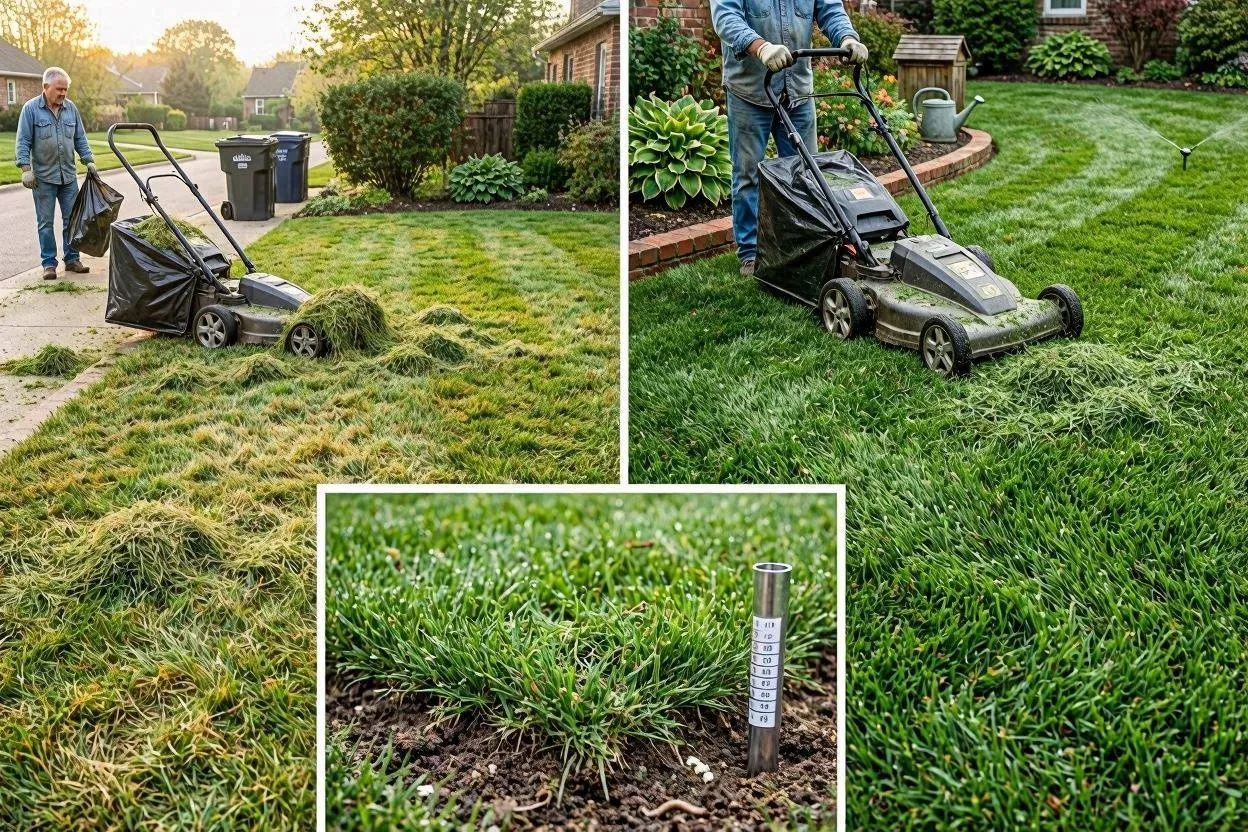
When you follow the one-third rule, clippings are short enough to fall through the grass canopy and reach the soil within 24 hours. Clippings under 1 inch (2.5 cm) long decompose in 1-2 weeks without any visible surface buildup.
When you violate the one-third rule, clippings are too long and heavy to fall through. They mat together on the surface, block sunlight, trap moisture, and create conditions for fungal disease.
How to Mulch When Mowing: 5 Steps That Get It Right
Step 1: Check Grass Height Before You Start
Measure the current grass height with a ruler. If the grass is more than 50% above your target height, mulching will produce clippings that are too long to decompose cleanly. Bag the first cut, then switch to mulching once you are back on schedule.
Mow every 7-10 days during the growing season. This frequency keeps clippings consistently short and ensures they decompose between sessions.
Step 2: Confirm the Grass Is Dry
Mow only when the grass is completely dry. Wet clippings clump together into dense mats that stick to the underside of the mower deck and fall in thick piles across the lawn. Those piles block air and sunlight, creating yellow patches and increasing fungal disease risk.
If your lawn is shaded heavily, the grass stays wet longer after rain. Wait a full day after rain before mulching in heavily shaded areas.
Step 3: Use a Mulching Mower or Fit a Mulching Kit
A mulching mower uses a curved blade design and a closed discharge chute to re-cut clippings multiple times before releasing them. The result is fragments under 0.5 inches (1.3 cm) long — small enough to fall directly to soil level.
Standard side-discharge mowers return larger, coarser clippings that take longer to break down and remain visible on the surface. A mulching conversion kit — typically a plug for the discharge chute and a mulching blade — costs between $20-$60 (£16-£48) and converts most standard rotary mowers.
Keep mulching blades sharp. Dull blades tear grass instead of cutting it cleanly, which stresses the grass and produces ragged clippings that decompose more slowly. Sharpen blades every 20-25 hours of mowing time.
Step 4: Mow at the Right Height for Your Grass Type
Set your mower deck to the target height for your specific grass type before starting. Cutting cool-season grasses too short removes the leaf surface needed for photosynthesis and weakens the root system. Cutting warm-season grasses too tall reduces the lawn’s density and creates conditions where weeds establish more easily.
[INTERNAL LINK — anchor: “how to choose the right mowing height” → https://zonedgarden.com/lawn-mowing-height-guide] The correct mowing height by grass type prevents stress, improves density, and maximizes the quality of mulched clippings.
Step 5: Vary Your Mowing Pattern Each Session
Mowing in the same direction every time compacts the soil in parallel lines and causes grass to lean in one direction. Alternating the mowing pattern — perpendicular to the previous session, or in a diagonal — prevents soil compaction and distributes clippings more evenly across the lawn surface.

When NOT to Mulch: 6 Situations That Require Bagging
Mulching improves lawn health under normal conditions. In 6 specific situations, mulching makes things worse.
- Grass is overgrown (more than 50% above target height): Long clippings cannot penetrate the canopy. They pile on the surface, smother grass, and create yellow bare patches. Bag the cut and return to regular mulching the following session.
- Grass is wet: Wet clippings clump, mat down, and block airflow. They also increase the risk of fungal disease spreading across the lawn. Wait until the grass is fully dry.
- Lawn has a visible disease or fungal infection: Mulching spreads disease spores across the full lawn with every pass. Bag all clippings and dispose of them away from garden beds. Do not compost diseased clippings.
- Lawn has weeds that have gone to seed: Mulching distributes weed seeds evenly across the entire lawn. Bag and dispose of clippings until weeds are controlled.
- Lawn was recently treated with herbicide: Some herbicide residues persist in grass clippings for several weeks after application. Check the product label for a specified clipping disposal period before mulching. Never use herbicide-treated clippings as vegetable garden mulch.
- Heavy autumn leaf cover (over 50% leaf coverage): Light leaf coverage under 50% can be mulched into the lawn successfully. Heavier coverage produces clippings too thick to decompose before the next mowing session, smothering grass over winter.
Herbicide note: Several common lawn weedkillers — including some broadleaf herbicides — can persist in clippings for 1-4 mowing sessions. The University of Minnesota Extension recommends consulting the product label before using treated clippings as mulch around vegetables, flowers, or trees.
Mulching Leaves in Autumn: A Competitor Gap Nobody Covers
Mulching fallen leaves into your lawn in autumn is one of the most underused lawn care techniques available. No significant competitor article addresses this specifically — and the results are well-documented.
University of Missouri Extension research shows that mulching tree leaves back into lawn recycles nutrients that tree roots extracted from deep soil layers and made available at the surface. Those nutrients — calcium, magnesium, and micronutrients not typically found in grass fertilizers — become available to shallow turfgrass roots after decomposition.
The same research confirms that mulching leaves into lawns has no detrimental effects on thatch or soil pH when done correctly.
Here is how to mulch leaves correctly in autumn:
- Check leaf coverage first. Mulch when leaves cover less than 50% of the lawn surface. Above 50% coverage, the layer becomes too thick to decompose before winter.
- Raise mowing height slightly. Increase deck height by 0.5 inches (1.3 cm) when mulching heavy leaf debris to reduce strain on the mower motor and blade.
- Mow in a grid pattern. Cover the lawn in 2 perpendicular passes to chop leaf debris into the smallest possible fragments before they settle into the grass.
- Increase mowing frequency in peak leaf fall. Weekly mulch mowing during peak leaf drop prevents single-session accumulation that becomes too thick to process effectively.
Michigan State University research confirms that mulching fallen leaves into turf does not increase thatch, does not change soil pH significantly, and reduces the need for autumn fertilizer applications.
Mulching vs Bagging: When to Choose Each
| Situation | Mulch | Bag | Reason |
| Grass at correct height, dry | ✓ YES | No | Clippings short enough to decompose in 1-2 weeks |
| Grass overgrown (>50% above target) | No | ✓ YES | Long clippings mat and smother grass |
| Wet grass after rain | No | ✓ YES | Wet clippings clump and cause yellow patches |
| Lawn has visible disease | No | ✓ YES | Mulching spreads disease spores across lawn |
| Weeds have gone to seed | No | ✓ YES | Seeds redistribute across the full lawn |
| Recent herbicide application | No | ✓ YES | Check label — residues persist 1-4 mowings |
| Leaf coverage under 50% | ✓ YES | No | Leaves add calcium and micronutrients to soil |
| Leaf coverage over 50% | No | ✓ YES | Layer too thick — smothers grass over winter |
| Final mow of the season | ✓ YES | Optional | Short clippings decompose over winter — reduces buildup |
Mulching Blades vs Standard Blades: What the Difference Means
A mulching blade has a curved cutting edge with additional cutting surfaces along the blade body. This design keeps grass clippings circulating inside the mower deck longer, re-cutting each piece 2-3 times before it falls.
Standard blades cut grass once and expel clippings immediately through the side or rear discharge chute. The clippings are coarser, longer, and less evenly distributed.
The practical difference in mulching results:
| Feature | Mulching Blade | Standard Blade |
| Clipping size | Under 0.5 in (1.3 cm) | 0.5–2 in (1.3–5 cm) |
| Decomposition time | 5–14 days | 14–28 days |
| Surface visibility after mowing | Nearly invisible | Visible, sometimes clumped |
| Nitrogen return per mow | Maximum (full cut) | Reduced (coarser pieces, slower release) |
| Works well in tall grass | No — clogs more easily | Better suited for overgrown grass |
| Price range | $15–$40 (£12–£32) | $10–$30 (£8–£24) |
For homeowners committed to mulching consistently, a dedicated mulching blade on a compatible mower produces the cleanest results. If mowing intervals are irregular and grass often grows tall between cuts, a standard blade handles overgrown conditions better.
FAQ: Mulching When Mowing
Does mulching when mowing cause thatch?
No. Thatch forms from dead roots, stems, and rhizomes — not from grass clippings. Fresh clippings are 85% water and decompose in 1-2 weeks. Mulching actually reduces thatch by increasing microbial activity in the soil.
How often should I mow if I want to mulch?
Every 7-10 days during the growing season. This keeps the grass within the one-third rule consistently, which ensures clippings stay short enough to decompose before the next session.
Can I mulch wet grass?
No. Wet clippings clump into thick mats that block sunlight and airflow. They create yellow patches and raise the risk of fungal infection. Wait until the grass is completely dry before mulching.
Do I need a special mower to mulch?
Not necessarily. A mulching conversion kit — a discharge chute plug and a mulching blade — converts most standard rotary mowers. Expect to spend $20–$60 (£16–£48). A purpose-built mulching mower produces finer clippings and better results, but is not required to start.
How much fertilizer does mulching replace?
Mulching returns up to 25% of annual nitrogen requirements and saves up to 1 pound (0.45 kg) of nitrogen per 1,000 sq ft (93 sq m) per year. It does not replace a full fertilizer program, but it reduces the quantity of applied fertilizer needed each season.
Should I mulch in autumn or bag the leaves?
Mulch leaves when coverage is under 50% of the lawn surface. Above 50%, the layer becomes too thick and smothers grass. Lightly covered lawns benefit from the calcium and micronutrients that tree leaves add to the soil when decomposed.
Will mulched grass clippings make my lawn look messy?
No, if you follow the one-third rule. Clippings under 1 inch (2.5 cm) fall through the grass canopy and become invisible within 24 hours. Visible clipping buildup only occurs when clippings are too long — which happens when mowing frequency drops below the one-third rule threshold.
The Simple Rule That Makes Mulching Work
Mulch when the grass is dry, at the right height, and on a regular 7-10 day schedule. Follow the one-third rule — never remove more than one-third of the blade height per mow. Keep the mulching blade sharp.
Do those 3 things consistently and mulching returns 25% of your lawn’s nitrogen needs for free, improves soil structure over each growing season, and eliminates the time and effort spent collecting and disposing of clippings.