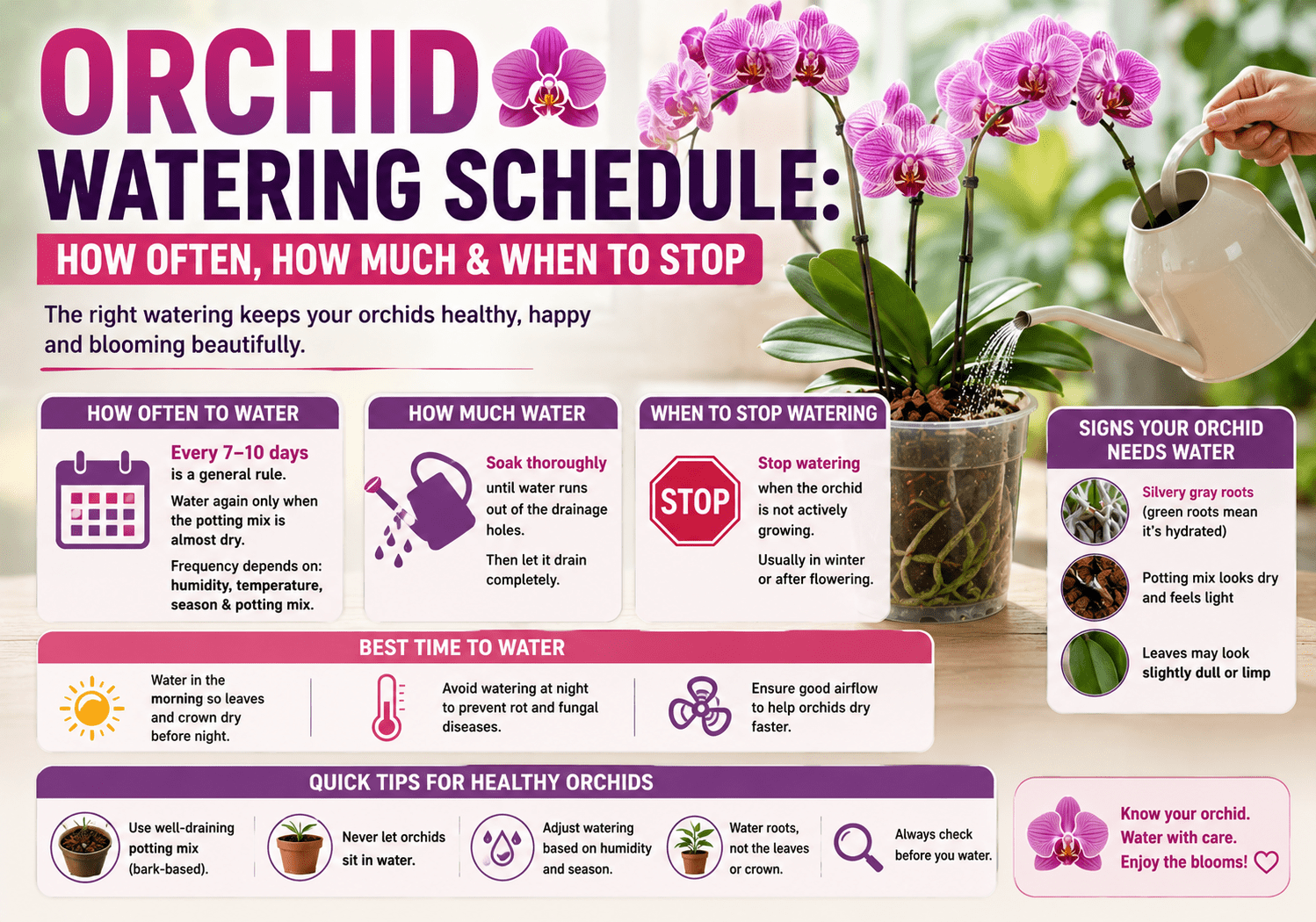
The correct orchid watering schedule is once every 7 days in summer and once every 10-14 days in winter for most Phalaenopsis orchids grown indoors in bark medium. That schedule changes based on pot material, room humidity, the season, and whether the orchid is actively growing or dormant.
Overwatering kills more orchids than any other cause. The roots of most orchid species — including the Phalaenopsis and Dendrobium varieties sold in garden centres — are adapted to dry out completely between waterings. They are epiphytes: plants that grow on trees in the wild, where their roots are exposed to air, rain, and fast-drying conditions.
This guide gives you an exact week-by-week watering routine, a seasonal schedule broken down by month, and the specific warning signs that tell you whether your orchid is getting too much or too little water.
What Happens When You Water an Orchid Correctly
Orchid roots are covered in a spongy layer called velamen — a silvery-white tissue that absorbs water rapidly when it comes into contact with moisture. When healthy, dry velamen appears silvery-white or grey. After correct watering, it turns bright green within minutes as it fills with moisture.
That colour change is the most reliable watering indicator available. Once the roots return to silver-grey — typically within 7-10 days — the orchid is ready to be watered again.
Three things happen correctly when the watering schedule is right:
- Root velamen absorbs moisture rapidly, turning bright green within 2-3 minutes of contact with water.
- Excess water drains completely through drainage holes within 15-20 minutes, leaving roots moist but not waterlogged.
- Roots dry to silver-grey within 7-10 days, triggering the next watering cycle naturally.
University of Florida IFAS Extension: Phalaenopsis orchids in bark medium require watering every 5-12 days depending on environmental conditions. The single most reliable indicator is root colour — silver-grey means dry, bright green means adequately moist.
Orchid Watering Schedule by Season
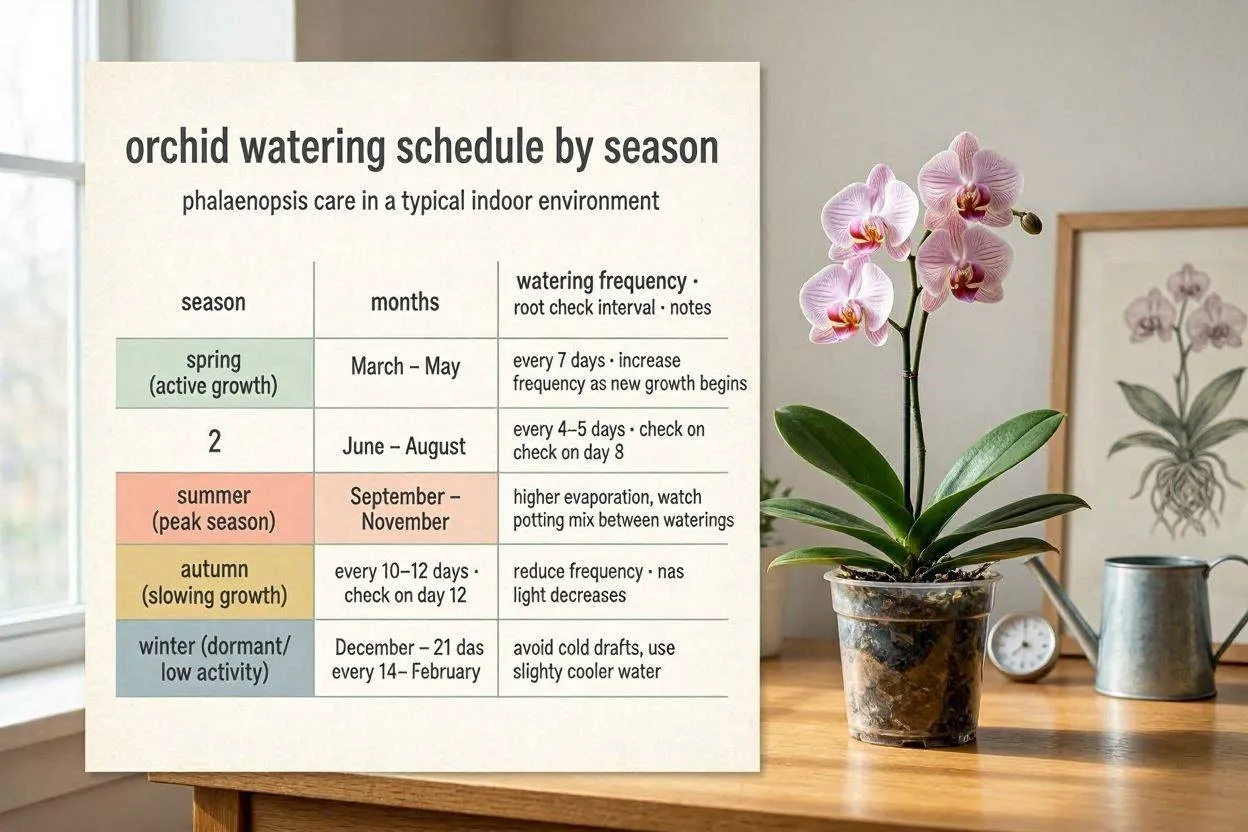
The orchid watering frequency changes significantly between summer and winter because evaporation rates, light levels, and growth activity all shift. This is the schedule for Phalaenopsis orchids — the most widely grown type — in a typical indoor environment.
| Season | Months | Watering Frequency | Root Check Interval | Notes |
| Spring (active growth) | March – May | Every 7 days | Check on day 5 | Increase frequency as new growth begins |
| Summer (peak season) | June – August | Every 5-7 days | Check on day 4 | Hot rooms may require watering every 5 days |
| Autumn (slowing) | September – November | Every 7-10 days | Check on day 6 | Reduce as temperatures drop and light fades |
| Winter (semi-dormant) | December – February | Every 10-14 days | Check on day 8 | Many orchids enter rest phase — do not force growth |
These intervals are starting points, not fixed rules. Always confirm by checking root colour or using the finger test (described in the How-To section below) before watering regardless of what the calendar says. A cool, humid room will push watering frequency toward the longer end of each range. A warm, dry room with direct sun will push it toward the shorter end.
5 Factors That Change Your Orchid Watering Frequency

1. Pot Material — The Single Biggest Variable
The container your orchid grows in affects how quickly the medium dries out more than any other factor.
| Pot Type | Drying Speed | Watering Frequency Adjustment | Best For |
| Clear plastic pot | Moderate | Use standard schedule above | Phalaenopsis — visible roots help confirm moisture level |
| Terracotta / clay pot | Fast | Water 1-2 days earlier than schedule | Orchids in humid environments — clay wicks moisture |
| Glazed ceramic pot | Slow | Water 2-3 days later than schedule | Dry, heated rooms — retains moisture longer |
| Bark basket / open mount | Very fast | Water daily or mist twice daily | Vandas and species that need constant air circulation |
| Sphagnum moss medium | Very slow | Water every 14-21 days | Check moisture 2 inches (5 cm) deep before watering |
Terracotta pots are the most forgiving choice for beginners because fast drying reduces overwatering risk significantly. Clear plastic pots are ideal for experienced growers who want to monitor root health visually.
2. Potting Medium — Bark vs Moss vs Semi-Hydro
Most orchids sold in garden centres and supermarkets come in bark mix — chunky pieces of fir bark that allow excellent air circulation around roots. Bark dries predictably and forgives inconsistent watering.
- Bark medium: Dries in 7-10 days in most indoor conditions. Most reliable medium for beginners.
- Sphagnum moss: Retains water for 14-21 days. Deceptively dry on the surface while staying wet at the core — probe 2 inches (5 cm) deep before watering.
- Semi-hydroponic (LECA): Roots sit above a water reservoir. Top up reservoir every 7-10 days; flush completely once per month.
- Mixed bark and perlite: Dries slightly faster than pure bark — water every 6-9 days in summer.
3. Room Humidity and Temperature
Orchids are tropical plants. They grow best between 65-85°F (18-29°C) with humidity between 50-70%. Most homes fall below that humidity range, especially in winter when central heating dries the air.
Low humidity accelerates evaporation from both the potting medium and the roots themselves. In a dry room with humidity below 40%, watering frequency may need to increase by 1-2 days compared to the standard schedule.
Grouping orchids together raises local humidity as plants release moisture through their leaves. A humidity tray — a shallow tray filled with pebbles and water, placed below the pot — raises local humidity by 5-10% without wetting the roots directly.
4. Light Level and Seasonal Day Length
More light means faster growth, faster evaporation, and higher water demand. A Phalaenopsis placed in a south-facing window in July will dry out faster than the same plant in a north-facing spot in December.
During short winter days, many orchid species enter a semi-dormant state. Metabolic activity slows, growth stops, and water needs drop significantly. Continuing a summer watering schedule through winter is a common cause of root rot in otherwise healthy orchids.
5. Orchid Species — Different Genera, Different Needs
| Species | Watering Frequency (Summer) | Watering Frequency (Winter) | Key Requirement |
| Phalaenopsis (Moth Orchid) | Every 5-7 days | Every 10-14 days | No standing water in crown — causes crown rot |
| Dendrobium | Every 5-7 days | Every 14-21 days (dry rest needed) | Requires distinct dry winter rest to trigger blooming |
| Cattleya | Every 7-10 days | Every 14-21 days | Must dry completely between waterings |
| Cymbidium | Every 5-7 days | Every 7-10 days | Higher water needs — tolerates consistently moist bark |
| Vanda | Daily watering or misting | Every 2-3 days | Bare root — requires frequent moisture and high humidity |
| Oncidium | Every 7-10 days | Every 14 days | Allow full dry-out between waterings |
How to Water Orchids Correctly: The 5-Step Routine

Step 1: Perform the Finger Test Before Every Watering
Do not water on a fixed date without checking the medium first. Insert a clean finger 1 inch (2.5 cm) into the potting bark. If you feel any moisture at all — do not water. Wait 2 more days and check again.
For orchids in clear plastic pots, check root colour instead. Silver-grey roots mean the orchid is dry and ready for water. Bright green or white roots still have moisture and do not need water yet.
Step 2: Use the Right Water Type
The type of water used for orchids affects long-term root and leaf health. Tap water in many areas contains chlorine, fluoride, and dissolved minerals that accumulate in bark medium over time, eventually raising salt concentration to harmful levels.
- Rainwater: Naturally soft, slightly acidic (pH 5.5-6.5), and free of dissolved minerals.
- Distilled water: Good option. No minerals, no chlorine. Slightly too pure — add a very dilute orchid fertilizer once per month.
- Filtered water: Carbon filtration removes chlorine and reduces mineral content.
- Tap water (left to stand overnight): Leaving tap water uncovered for 24 hours allows chlorine to evaporate. Fluoride does not evaporate — relevant if you grow Paphiopedilum orchids, which are fluoride-sensitive.
- Softened water: Ion exchange softening replaces calcium and magnesium with sodium, which damages orchid roots over time.
The ice cube method — placing 3 ice cubes on the bark weekly — is widely recommended on social media but is not supported by horticultural research. Ice-cold water stresses tropical roots adapted to warm rain. Use room-temperature water at a full soak instead.
Step 3: Water Thoroughly — Soak, Do Not Drizzle
Take the pot to a sink and run lukewarm water (65-75°F / 18-24°C) through the bark for 30-60 seconds. Water should flow freely from every drainage hole. This flushes accumulated salts and mineral deposits from the medium and ensures the entire root system is moistened, not just the surface layer.
Do not drizzle a small amount of water on top. Partial watering leaves the lower roots consistently dry while the surface medium stays wet — the worst of both conditions.
For bottom watering: place the pot in 1-2 inches (2.5-5 cm) of room-temperature water for 10-15 minutes, then lift out and allow to drain completely. Bottom watering is especially effective for orchids in sphagnum moss.
Step 4: Remove All Standing Water from the Crown
Never allow water to sit in the crown of a Phalaenopsis orchid — the central cup formed by the base of the leaves where the stem emerges. Standing water in the crown causes crown rot within 24-48 hours, which kills the growing point of the plant and is almost always fatal.
After watering, tip the pot gently to allow crown water to drain, or use a paper towel to absorb any water sitting in the crown. This takes 10 seconds and prevents the most common cause of orchid death after overwatering.
Step 5: Allow Complete Drainage Before Returning to Display
Place the pot on a rack or in the sink for 15-20 minutes after watering. All excess water must drain before the pot is returned to a decorative cache pot or drip tray. Orchid roots sitting in stagnant water at the base of a cache pot will begin to rot within days.
Never use a cache pot without a drainage layer. Place a layer of pebbles in the bottom of any decorative outer pot to keep the orchid pot elevated above any water that drains into it.
Overwatering vs Underwatering: Symptoms Side by Side
Telling the difference between an overwatered and underwatered orchid is the most important diagnostic skill in orchid care. The symptoms overlap in some areas and look very similar to a beginner.
| Symptom | Overwatering | Underwatering |
| Roots | Brown, mushy, soft — rot present. Dead tissue does not recover. | White or silvery. Flat, shrivelled, or wrinkled. Firm when pressed. |
| Leaves | Yellow, soft, and limp. May develop dark spots or appear glassy. | Wrinkled, leathery, or accordion-pleated along the length. |
| Medium moisture | Always wet or damp to the touch at depth | Completely dry throughout — bone dry when probed |
| Potting medium | Often compacted, smells musty or sour — breaking down | May be pulling away from pot edges — fully dried out |
| New growth | Stunted or absent. Root tips blackened. | Stunted but firm. Root tips still white or green. |
| Crown/base | Soft, dark discolouration at stem base — crown rot | No discolouration — crown firm and healthy |
| Immediate action | Remove from pot, cut all brown roots, repot in fresh bark, reduce watering schedule | Soak pot in room-temperature water for 30 minutes, then drain |
Oregon State University Extension: The number one cause of orchid failure in home environments is overwatering combined with insufficient drainage. Before increasing watering frequency, check root condition directly — soggy medium that feels dry on the surface is a reliable sign of compacted, waterlogged bark.
Month-by-Month Orchid Watering Schedule
This schedule is calibrated for Phalaenopsis orchids in bark medium, grown indoors in a typical home with central heating in winter and ambient summer temperatures.
| Month | Watering Interval | Growth Stage | Additional Notes |
| January | Every 12-14 days | Dormant / rest | Reduce water — do not fertilise |
| February | Every 10-14 days | Rest ending | Watch for new root tips — increase slightly if roots are active |
| March | Every 7-10 days | Active growth begins | Resume light fertilising every other watering |
| April | Every 7 days | Active growth | Increase frequency if new leaves are forming |
| May | Every 6-7 days | Strong growth | Monitor closely — evaporation increases with longer days |
| June | Every 5-7 days | Peak season | Check roots every 4 days — hot rooms dry bark faster |
| July | Every 5-7 days | Peak season | Increase misting on very hot days (above 85°F / 30°C) |
| August | Every 5-7 days | Peak season | Maintain summer schedule through month end |
| September | Every 7-10 days | Growth slowing | Begin reducing fertiliser — reduce watering frequency |
| October | Every 7-10 days | Pre-dormancy | Many Phalaenopsis begin spiking — maintain consistent moisture |
| November | Every 10-12 days | Entering rest | Reduce watering — cool nights trigger blooming spike |
| December | Every 12-14 days | Dormant / blooming | Water only when roots are fully silver-grey |
Frequently Asked Questions
How often should I water a Phalaenopsis orchid?
Water a Phalaenopsis orchid every 5-7 days in summer and every 10-14 days in winter when grown in bark medium in a typical indoor environment. Always confirm by checking root colour (silver-grey = dry, bright green = moist) rather than relying solely on a fixed schedule.
Can I use tap water for orchids?
Yes, in most cases. Allow tap water to sit in an open container for 24 hours before use to allow chlorine to evaporate. Rainwater and filtered water are better options for long-term health, particularly in hard water areas where mineral deposits build up in bark medium over multiple months.
Should I mist my orchid instead of watering?
No — misting is not a substitute for proper watering. Misting raises local humidity temporarily but does not deliver enough moisture to the roots for effective hydration. Mist leaves and aerial roots for humidity benefits only. Water the root system through the bark on the schedule above.
Why are my orchid roots turning brown?
Brown, soft orchid roots indicate root rot caused by overwatering or poor drainage. Remove the orchid from its pot, trim all brown and mushy roots back to healthy white or green tissue using sterilised scissors, dust cut ends with cinnamon (a natural antifungal), and repot in fresh bark medium. Reduce watering frequency by 2-3 days and ensure the pot has adequate drainage holes.
What does a healthy orchid watering routine look like day to day?
For a Phalaenopsis in bark medium in summer, a correct routine looks like this:
- Day 1 (Watering Day): Water thoroughly in the sink for 45-60 seconds. Drain completely. Remove crown water. Return to position.
- Day 3: Check root colour through clear pot. Roots should be transitioning from green to silver. No action needed.
- Day 5: Roots should be silver-grey or nearly so. Perform finger test in bark. If dry: water today. If slightly moist: wait 1-2 days.
- Day 7 (Standard Watering Day): Roots fully silver-grey. Bark dry at 1-inch depth. Water thoroughly and repeat cycle.
Key Takeaways
The correct orchid watering schedule for Phalaenopsis grown indoors is every 5-7 days in summer and every 10-14 days in winter. Root colour is the most reliable guide — silver-grey means dry and ready to water, bright green means moisture is still present.
Pot material and growing medium affect drying speed more than any other variable. Terracotta dries fastest and forgives overwatering mistakes. Sphagnum moss retains moisture longest and requires careful probing before every watering.
Overwatering kills more orchids than any other cause. The ice cube method is not a valid watering technique for tropical roots. A thorough soak followed by complete drainage — allowing roots to dry fully before the next water — is the routine that matches how orchids grow in their natural habitat.
Always remove water from the crown of Phalaenopsis orchids after watering. Crown rot is rapid, almost always fatal, and entirely preventable with a 10-second post-watering check.