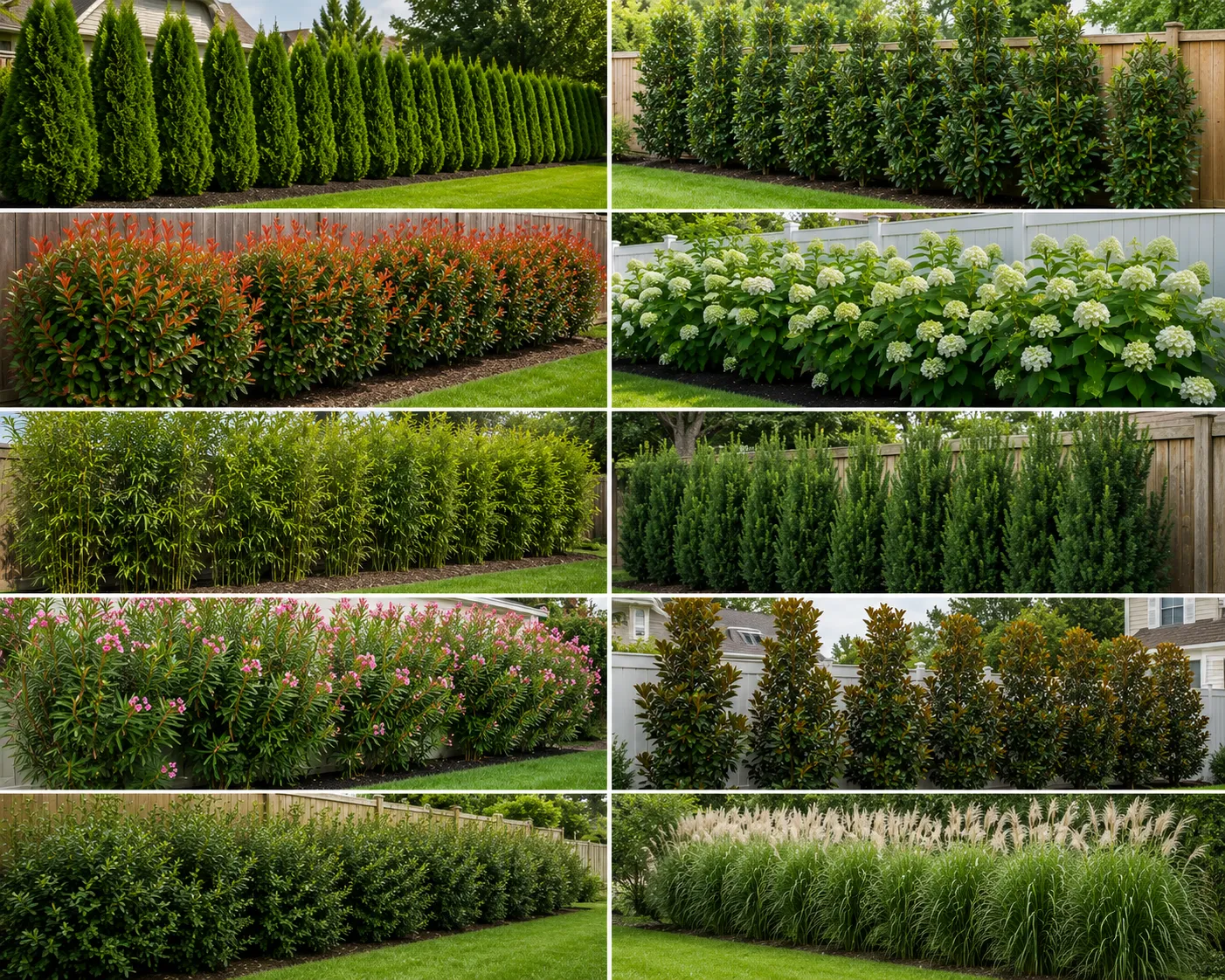
The best shrubs for a privacy fence are Emerald Green Arborvitae, Skip Laurel, Green Giant Arborvitae, Holly, Boxwood, Juniper, Lilac, Viburnum, Rose of Sharon, and Forsythia. Each blocks sightlines effectively when planted at the right spacing — but the right choice depends on your USDA zone, lot size, and whether you need year-round coverage.
A privacy fence alone tops out at 6 ft (1.8 m) in most neighborhoods. Shrubs planted along that fence push your screen to 12, 15, even 20 ft (3.6–6 m) — far beyond what any fence ordinance allows. They also absorb noise, block wind, and attract birds and pollinators in ways wooden boards never will.
This guide covers 10 shrubs with specific heights, widths, growth rates, USDA zone ranges, and spacing recommendations — so you plant once and get the screen you actually need.
Quick Reference: 10 Best Privacy Shrubs at a Glance
| Shrub | Type | Height | Growth Rate | Best For | USDA Zones |
|---|---|---|---|---|---|
| Emerald Green Arborvitae | Evergreen | 10–15 ft (3–4.5 m) | 6–9 in/yr | Narrow lots, formal hedges | 3–8 |
| Green Giant Arborvitae | Evergreen | 30–40 ft (9–12 m) | 3–5 ft/yr | Large borders, fast screens | 5–9 |
| Skip Laurel | Evergreen | 10–18 ft (3–5.5 m) | 2–3 ft/yr | Shade tolerance, dense hedge | 6–9 |
| Holly (Ilex) | Evergreen | 8–15 ft (2.4–4.5 m) | 1–2 ft/yr | Year-round + wildlife | 5–9 |
| Boxwood | Evergreen | 3–8 ft (0.9–2.4 m) | 3–6 in/yr | Low formal hedges | 5–9 |
| Juniper | Evergreen | 4–15 ft (1.2–4.5 m) | 1–2 ft/yr | Drought-prone areas | 3–9 |
| Lilac | Deciduous | 8–15 ft (2.4–4.5 m) | 1–2 ft/yr | Fragrance + seasonal screen | 3–7 |
| Viburnum | Deciduous/Evg. | 6–12 ft (1.8–3.6 m) | 1–2 ft/yr | Flowers, berries, birds | 4–9 |
| Rose of Sharon | Deciduous | 8–12 ft (2.4–3.6 m) | 1–2 ft/yr | Late summer blooms | 5–9 |
| Forsythia | Deciduous | 6–10 ft (1.8–3 m) | 2–3 ft/yr | Spring color, fast screen | 5–8 |
How to Choose the Right Shrub for Your Privacy Fence
4 factors determine which privacy shrub works for your yard. Get these right before buying a single plant.
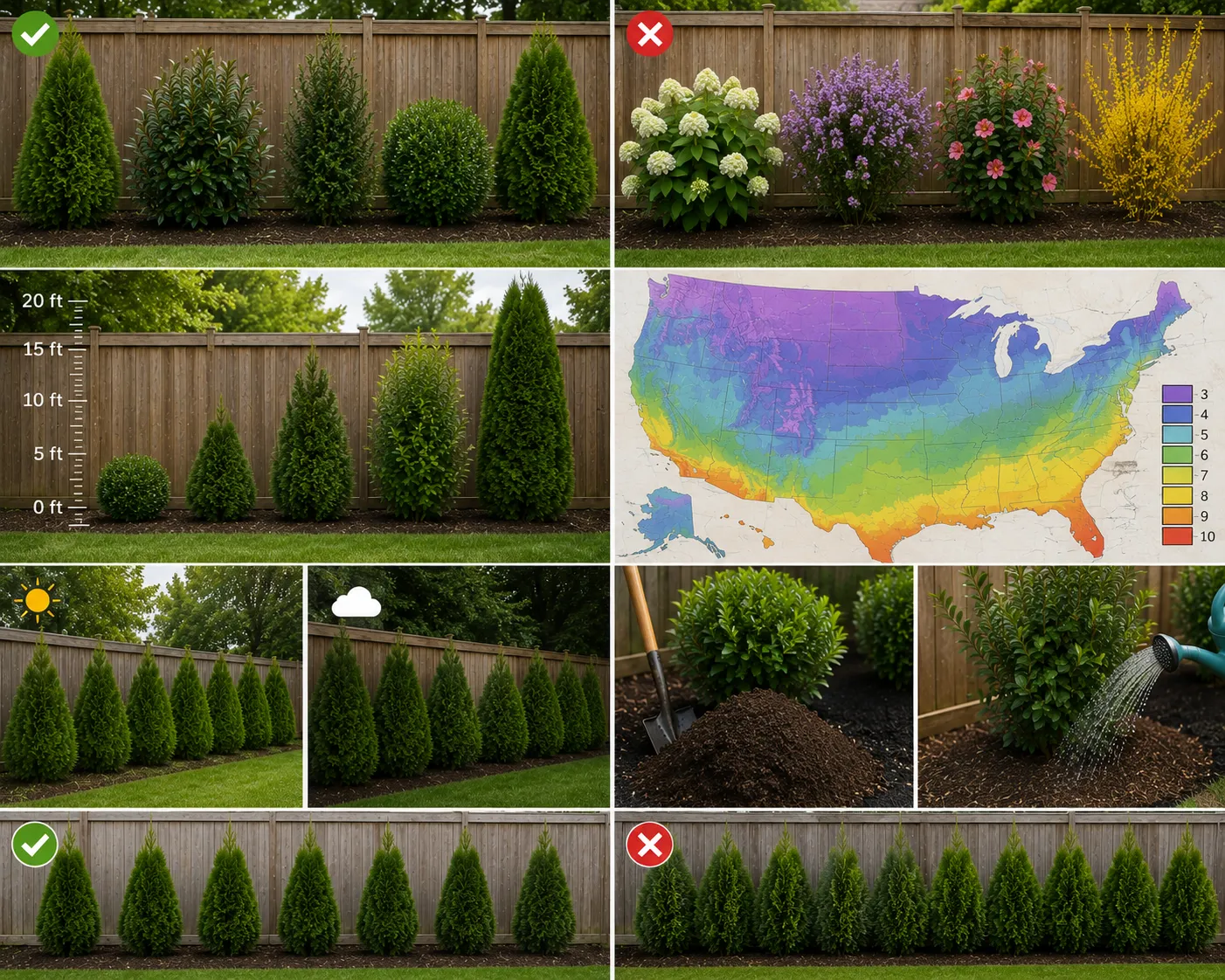
1. Evergreen vs. Deciduous
Evergreen shrubs — Arborvitae, Skip Laurel, Holly, Boxwood, Juniper — keep their foliage all year. They give you 365-day screening, which matters most if neighbors can see your yard in winter.
Deciduous shrubs — Lilac, Viburnum, Rose of Sharon, Forsythia — drop their leaves in fall. They deliver better flowers, fall color, and wildlife value, but leave gaps from November through March in most zones. Plant them in a double staggered row to maintain winter density.
2. Growth Rate and Mature Height
Fast growers like Green Giant Arborvitae add 3–5 ft (90–150 cm) per year. They create a screen in 2–3 seasons but require consistent pruning to stay manageable. Slow growers like Boxwood add just 3–6 inches (7–15 cm) per year — better for formal low hedges where size control matters.
Match the mature height to your need. A 6 ft (1.8 m) fence with 12 ft (3.6 m) Skip Laurel behind it creates an 18 ft (5.4 m) combined screen. That stops second-floor sightlines completely.
3. Your USDA Hardiness Zone
Every shrub has a USDA zone range. Planting outside that range means the shrub dies in winter cold or struggles in summer heat. Check your zone at the USDA Plant Hardiness Zone Map before purchasing. Most of the continental US falls in zones 4–8.
4. Sun, Soil, and Water
Most privacy shrubs want full sun to partial shade (4–6+ hours of direct sunlight daily). Skip Laurel and Holly tolerate deeper shade better than Arborvitae or Juniper. Soil drainage matters more than soil type — waterlogged roots kill even the hardiest shrubs. Amend clay soils with compost before planting, or choose raised beds for heavy drainage areas.
5 Best Evergreen Shrubs for Privacy Fence
Evergreen shrubs provide year-round screening. These 5 are the most reliable performers along fence lines across most US zones.
1. Emerald Green Arborvitae (Thuja occidentalis ‘Smaragd’)
Emerald Green Arborvitae is the most popular privacy shrub in North America — and for good reason. Its narrow, pyramidal form reaches 10–15 ft (3–4.5 m) tall and just 3–4 ft (0.9–1.2 m) wide, making it ideal for tight fence lines with limited depth.
- Hardiness — USDA Zones: 3–8
- Speed — Growth rate: 6–9 inches (15–23 cm) per year
- Light — Sun: Full sun to partial shade
- Planting — Spacing for solid hedge: 2–3 ft (60–90 cm) on center
- Soil — Soil: Well-drained; tolerates most soil types including clay with amendments
Plant Emerald Green Arborvitae 2–3 ft (60–90 cm) apart for a tight, gap-free screen. At 3 ft spacing, 10 plants cover 30 ft (9 m) of fence. The dense, bright-green foliage stays vibrant year-round without browning in winter — a common issue with other arborvitae varieties.
Deer note
Deer browse Emerald Green Arborvitae heavily in zones 4–6 where winter food is scarce. Use deer repellent spray through the first 2 winters, or switch to Boxwood or Juniper in high-deer areas.
2. Green Giant Arborvitae (Thuja standishii × plicata)
Green Giant Arborvitae is the fastest-growing privacy shrub available, adding 3–5 ft (90–150 cm) per year. It reaches 30–40 ft (9–12 m) tall at maturity — use it where you need maximum height screening above a standard 6 ft (1.8 m) fence.
- Hardiness — USDA Zones: 5–9
- Speed — Growth rate: 3–5 ft (90–150 cm) per year
- Light — Sun: Full sun to partial shade
- Planting — Spacing: 5–6 ft (150–180 cm) apart for hedge; 8–10 ft (240–300 cm) for natural row
- Bonus — Pest and disease resistant; not palatable to deer
Green Giant is best for large properties with 8+ ft (2.4 m) of depth behind the fence. In smaller yards, the mature size becomes a maintenance burden within 5–7 years. For narrow lots, Emerald Green is the better choice.
3. Skip Laurel (Prunus laurocerasus ‘Schipkaensis’)
Skip Laurel delivers the densest broadleaf evergreen hedge available. Its large, glossy leaves create an impenetrable screen that reaches 10–18 ft (3–5.5 m) tall and 5–7 ft (1.5–2.1 m) wide. It outperforms Arborvitae in shade — a major advantage for fence lines that face north or sit under tree canopy.
- Hardiness — USDA Zones: 6–9
- Speed — Growth rate: 2–3 ft (60–90 cm) per year
- Light — Sun: Full sun to deep shade — best shade tolerance of any privacy shrub
- Planting — Spacing: 3–4 ft (90–120 cm) apart for solid hedge
- Bonus — Fragrant white flowers in spring; red berries in fall
Skip Laurel is the top pick for zone 6–9 gardeners with shaded fence lines. The large leaf surface area also makes it a better noise buffer than needle-leaf evergreens — relevant for fence lines near roads or neighbors.
4. Holly (Ilex species)
Holly is one of 3 privacy shrubs that adds serious ornamental value — year-round glossy foliage, brilliant red berries in fall and winter, and an impenetrable structure that deters intruders as effectively as a physical barrier.
- Hardiness — USDA Zones: 5–9 depending on variety; Inkberry Holly to zone 3
- Speed — Growth rate: 1–2 ft (30–60 cm) per year
- Light — Sun: Full sun to partial shade
- Planting — Spacing: 3–4 ft (90–120 cm) for hedge; use upright columnar varieties for fence lines
- Varieties — Best varieties for hedges: Sky Box, Blue Princess, Nellie Stevens, Hick’s Yew Holly
Most female Holly varieties need a male pollinator planted within 50 ft (15 m) to produce berries. One male plant pollinates up to 5 females. Plant at a 1:5 male-to-female ratio when planting a full hedge row.
5. Juniper (Juniperus species)
Juniper is the most drought-tolerant privacy shrub on this list. Once established — typically after 1 full growing season — upright juniper varieties survive with zero supplemental watering in most US climates. Use upright columnar varieties like ‘Blue Arrow’ or ‘Sky Rocket’ for fence lines.
- Hardiness — USDA Zones: 3–9 depending on variety
- Speed — Growth rate: 1–2 ft (30–60 cm) per year
- Light — Sun: Full sun — poor tolerance for shade
- Planting — Spacing: 3–4 ft (90–120 cm) apart for column varieties
- Soil — Soil: Tolerates poor, rocky, sandy, and dry soils — the most adaptable of all privacy shrubs
Blue-green foliage adds color contrast alongside darker Arborvitae or Laurel hedges. Juniper produces small berries that attract cedar waxwings, robins, and other birds — a wildlife benefit most pure-privacy shrubs skip.
5 Best Deciduous Shrubs for Privacy Fence
Deciduous shrubs lose leaves in winter but deliver flowers, fragrance, wildlife habitat, and fall color that no evergreen matches. Plant in double staggered rows for winter density.
6. Lilac (Syringa vulgaris and species)
Lilac forms a tall, dense summer screen reaching 8–15 ft (2.4–4.5 m) tall while delivering one of the strongest fragrances in the garden. The bloom period runs 2–3 weeks in spring. For zone 3–7 gardeners who want a flowering privacy hedge, Lilac is the top choice.
- Hardiness — USDA Zones: 3–7 (compact varieties like Miss Kim to zone 3)
- Speed — Growth rate: 1–2 ft (30–60 cm) per year
- Light — Sun: Full sun — minimum 6 hours for best bloom and density
- Planting — Spacing: 5–6 ft (150–180 cm) apart for informal hedge
- Care — Prune immediately after flowering to preserve next year’s bloom buds
Lilac attracts bees, butterflies, and hummingbirds during bloom. Dense branching provides good winter screening even without leaves in zones 5–7 where branching thickens over time.
7. Viburnum (Viburnum species)
Viburnum is the most versatile deciduous privacy shrub — several varieties are semi-evergreen in zones 7–9, others fully deciduous in zones 4–6. Arrowwood Viburnum (V. dentatum) grows 6–10 ft (1.8–3 m) tall with clusters of white spring flowers and vivid blue berries in fall that attract birds.
- Hardiness — USDA Zones: 4–9 depending on variety
- Speed — Growth rate: 1–2 ft (30–60 cm) per year
- Light — Sun: Full sun to partial shade
- Planting — Spacing: 3–4 ft (90–120 cm) for dense hedge
- Varieties — Best varieties: Arrowwood, Korean Spice, Snowball, Linden Viburnum
Korean Spice Viburnum (V. carlesii) produces intensely fragrant pinkish-white flowers in spring. For gardeners who want fragrance and privacy from the same plant, it rivals Lilac and handles partial shade better.
8. Rose of Sharon (Hibiscus syriacus)
Rose of Sharon blooms from mid-July through September — later than almost any other flowering privacy shrub. The upright form reaches 8–12 ft (2.4–3.6 m) tall with a spread of just 4–6 ft (1.2–1.8 m), making it one of the narrowest deciduous options for tight fence lines.
- Hardiness — USDA Zones: 5–9
- Speed — Growth rate: 1–2 ft (30–60 cm) per year
- Light — Sun: Full sun to partial shade
- Planting — Spacing: Plant 2–3 ft (60–90 cm) apart in a double staggered row for a dense summer-fall screen
- Bonus — Flowers in white, pink, purple, or bicolor; attracts hummingbirds
Rose of Sharon self-seeds prolifically. Deadhead spent flowers before seed pods form, or plant sterile varieties like ‘Lil’ Kim’ or ‘Blushing Bride’ to eliminate unwanted seedlings.
9. Forsythia (Forsythia x intermedia)
Forsythia is the fastest-growing deciduous privacy shrub, adding 2–3 ft (60–90 cm) per year and forming an impenetrable thicket within 2–3 seasons. Bright yellow flowers erupt across every branch in early March before any leaves appear — the first color in the late-winter garden.
- Hardiness — USDA Zones: 5–8
- Speed — Growth rate: 2–3 ft (60–90 cm) per year — fastest deciduous option
- Light — Sun: Full sun to partial shade
- Planting — Spacing: 4–5 ft (120–150 cm) apart for natural hedge
- Care — Prune right after flowering to control size; never prune in fall or you remove next year’s blooms
Dense arching branches provide reasonable winter screening even without leaves. Forsythia works best in the back row of a mixed planting, with evergreen shrubs at the front for year-round coverage.
10. Boxwood (Buxus sempervirens)
Boxwood is the standard for formal low privacy hedges — it tolerates shearing into crisp geometric shapes better than any other shrub. Use it along fence lines where you need a tidy 3–6 ft (0.9–1.8 m) formal boundary, not a tall screen.
- Hardiness — USDA Zones: 5–9
- Speed — Growth rate: 3–6 inches (7–15 cm) per year — slowest on this list
- Light — Sun: Full sun to partial shade
- Planting — Spacing: 1–2 ft (30–60 cm) apart for formal clipped hedge
- Zone tip — Avoid English Boxwood in zone 5 — it suffers winter burn; use Green Gem or American Boxwood instead
Shrub Spacing Guide for Privacy Fence Planting
Spacing determines how quickly your hedge closes in and how dense it becomes. Tighter spacing costs more upfront but fills gaps in 1–2 seasons instead of 3–4.
| Shrub | Spacing for Dense Hedge | Spacing for Natural Screen |
|---|---|---|
| Emerald Green Arborvitae | 2–3 ft (60–90 cm) apart | 4–5 ft (120–150 cm) apart |
| Green Giant Arborvitae | 5–6 ft (150–180 cm) apart | 8–10 ft (240–300 cm) apart |
| Skip Laurel | 3–4 ft (90–120 cm) apart | 5–6 ft (150–180 cm) apart |
| Boxwood | 1–2 ft (30–60 cm) apart | 2–3 ft (60–90 cm) apart |
| Juniper (upright) | 3–4 ft (90–120 cm) apart | 4–5 ft (120–150 cm) apart |
| Viburnum | 3–4 ft (90–120 cm) apart | 5–6 ft (150–180 cm) apart |
Plant in a single row for formal hedges where depth is limited. Use a double staggered row — offset by half the spacing distance — for faster density and better winter screening with deciduous shrubs.
How to Plant Shrubs Along a Privacy Fence
Follow these 5 steps for shrub establishment success.
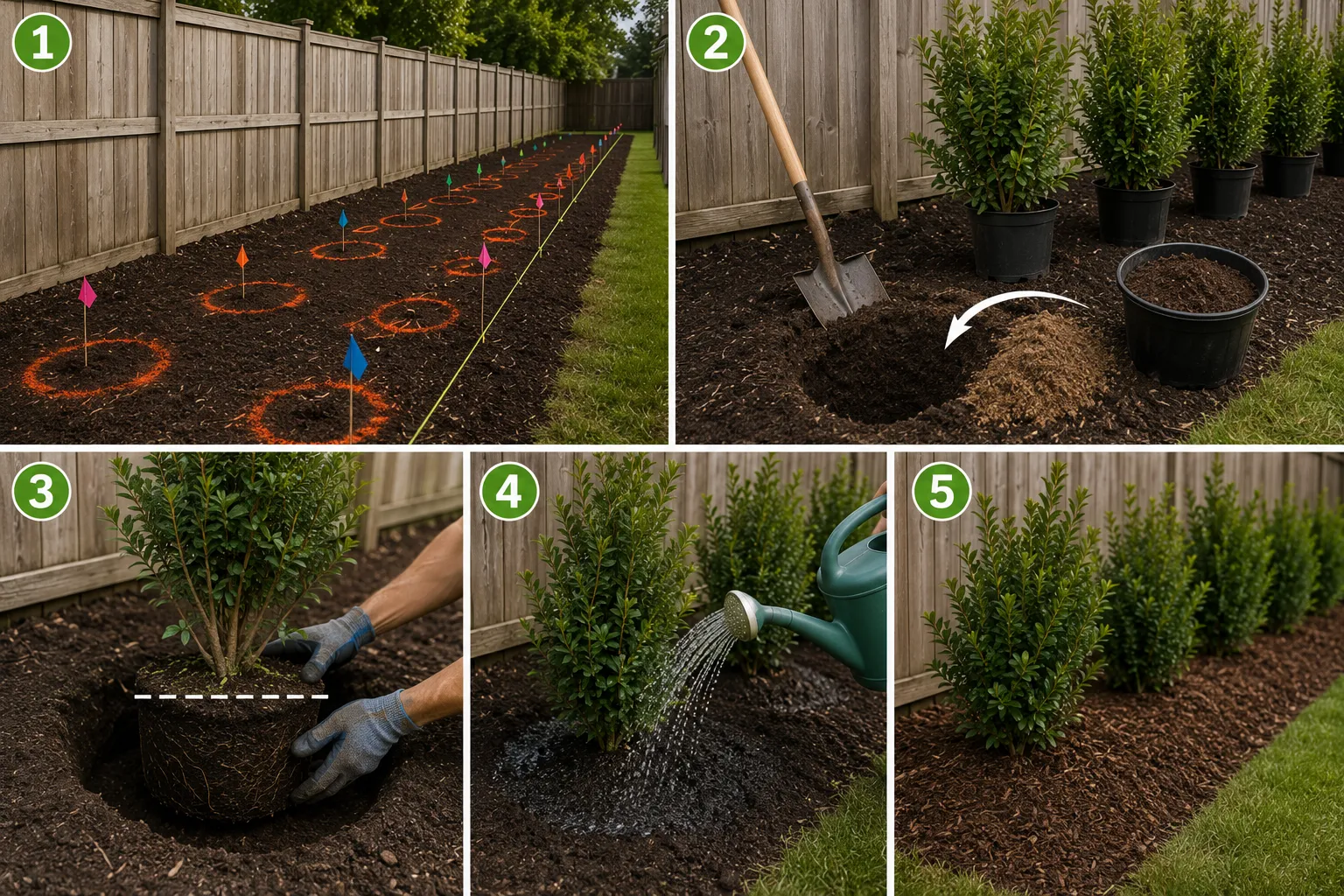
Step 1 — Measure and Mark
Mark planting holes with spray paint or stakes before digging. Stand at your neighbor’s property line and check sightlines — identify the exact gaps you need to close at 5 ft (1.5 m) and 10 ft (3 m) height. Plant shrubs to target those gaps first.
Step 2 — Prepare the Soil
Dig each hole 2–3 times wider than the root ball and equal depth. Mix removed soil with compost at a 50/50 ratio. In clay-heavy soil, add coarse sand or perlite to improve drainage. Poor drainage is the single leading cause of shrub death in the first year.
Step 3 — Plant at the Right Depth
Set the root ball so the top sits level with or 1–2 inches (2.5–5 cm) above the surrounding soil grade. Planting too deep suffocates roots. The root flare — where the trunk widens at the base — should always sit above soil level.
Step 4 — Water Thoroughly
Water each shrub with 2–3 gallons (7.5–11 liters) immediately after planting. Keep soil consistently moist — not waterlogged — for the first full growing season. Most shrubs need 1 inch (2.5 cm) of water per week, either from rain or irrigation.
Step 5 — Mulch the Base
Apply 2–3 inches (5–7.5 cm) of mulch in a circle 2–3 ft (60–90 cm) wide around each shrub. Keep mulch 3–4 inches (7.5–10 cm) away from the trunk to prevent rot. Mulch retains moisture, regulates soil temperature, and suppresses weeds that compete with newly planted roots.
3 Most Common Privacy Shrub Mistakes
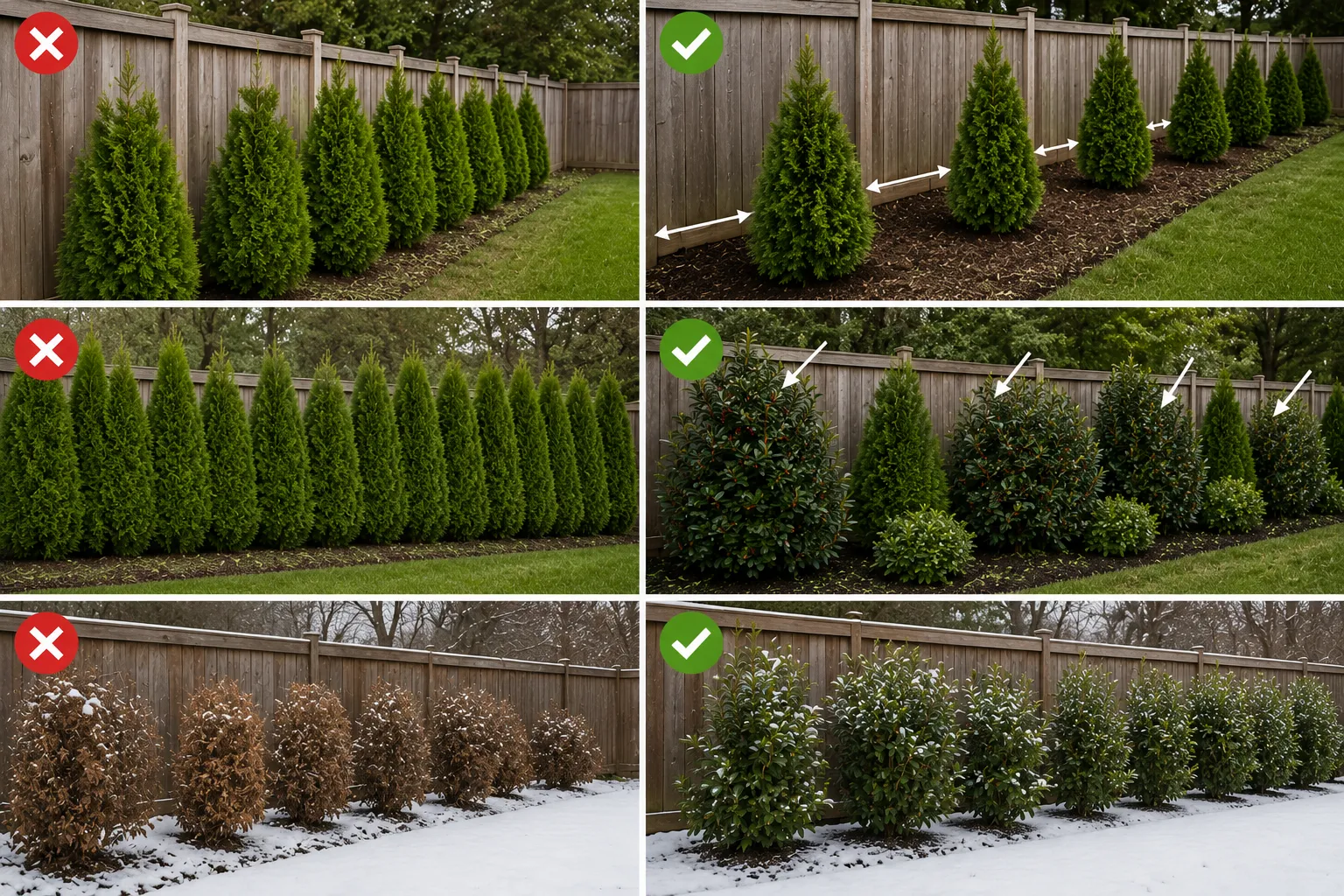
Planting Too Close to the Fence
Most gardeners plant shrubs 12–18 inches (30–45 cm) from the fence. That is not enough. Arborvitae and Skip Laurel need 3–4 ft (90–120 cm) of depth to grow their full width without butting against the fence boards. Allow full mature width plus 12 inches (30 cm) clearance from the fence face.
Choosing Only One Species
A single-species hedge is vulnerable to disease. Boxwood blight, Arborvitae spider mites, and laurel shothole disease can wipe out an entire row. Plant at least 2–3 species in alternating groups for resilience. Mixing Holly with Arborvitae, or Viburnum with Skip Laurel, gives you redundancy without losing visual cohesion.
Skipping the Zone Check
Planting a zone 7 shrub in zone 5 ends in dieback every winter. Always confirm USDA zone compatibility before purchasing. The most commonly mis-zoned privacy shrub is Skip Laurel — gardeners in zones 4–5 plant it expecting English Laurel performance, only to see winter damage. In zone 5, use Emerald Green Arborvitae or Holly instead.
Frequently Asked Questions
What is the fastest-growing shrub for a privacy fence?
Green Giant Arborvitae is the fastest-growing privacy shrub, adding 3–5 ft (90–150 cm) per year. It creates a functional screen in 2–3 seasons. For a deciduous option, Forsythia grows 2–3 ft (60–90 cm) per year and fills in quickly, though it loses leaves in winter.
What shrubs grow tall enough to block a second-floor view?
Green Giant Arborvitae (30–40 ft / 9–12 m), Skip Laurel (10–18 ft / 3–5.5 m), and Nellie Stevens Holly (15–25 ft / 4.5–7.6 m) all reach heights that block second-floor windows. Plant Green Giant for the fastest height gain.
What is the best low-maintenance privacy shrub?
Juniper is the best low-maintenance privacy shrub. After the first season, it requires minimal watering, no feeding, and only light annual pruning. Emerald Green Arborvitae is a close second — slow enough that it rarely needs trimming and tolerates most soil conditions.
How far from a fence should I plant privacy shrubs?
Plant privacy shrubs at least 3 ft (90 cm) from the fence — more for large species. Green Giant Arborvitae needs 6–8 ft (1.8–2.4 m) from the fence at maturity to develop fully. Check the mature spread of each variety before setting your planting line.
Can I plant privacy shrubs along a shared fence with neighbors?
Yes — plant on your side of the property line. Confirm the boundary before digging. Most local ordinances allow shrubs of any height on private property unless an HOA (Homeowners Association) rule limits hedge height. Check HOA guidelines before planting tall-growing species like Green Giant Arborvitae.
What privacy shrubs work in full shade?
Skip Laurel tolerates full shade better than any other privacy shrub on this list. Holly and Viburnum also perform well in partial to full shade. Avoid Arborvitae, Juniper, Forsythia, and Lilac in low-light conditions — they produce sparse, weak growth without adequate sun.
Final Thoughts
The best shrubs for a privacy fence depend on 3 factors: your USDA zone, how much height you need, and whether you want year-round coverage. For most homeowners, Emerald Green Arborvitae gives the best combination of density, manageable size, and cold hardiness across zones 3–8. For faster results, Green Giant Arborvitae has no equal.
Mix evergreen and deciduous species for a hedge that provides screening, flowers, fragrance, and wildlife habitat across all four seasons. Plant at the correct spacing — not what looks right today, but what fills the space at mature size — and your privacy screen will close in faster and stay healthier for decades.
For zone-specific plant recommendations tailored to your growing area, explore our plant guides by USDA zone — you’ll find the right match for every corner of your garden.