
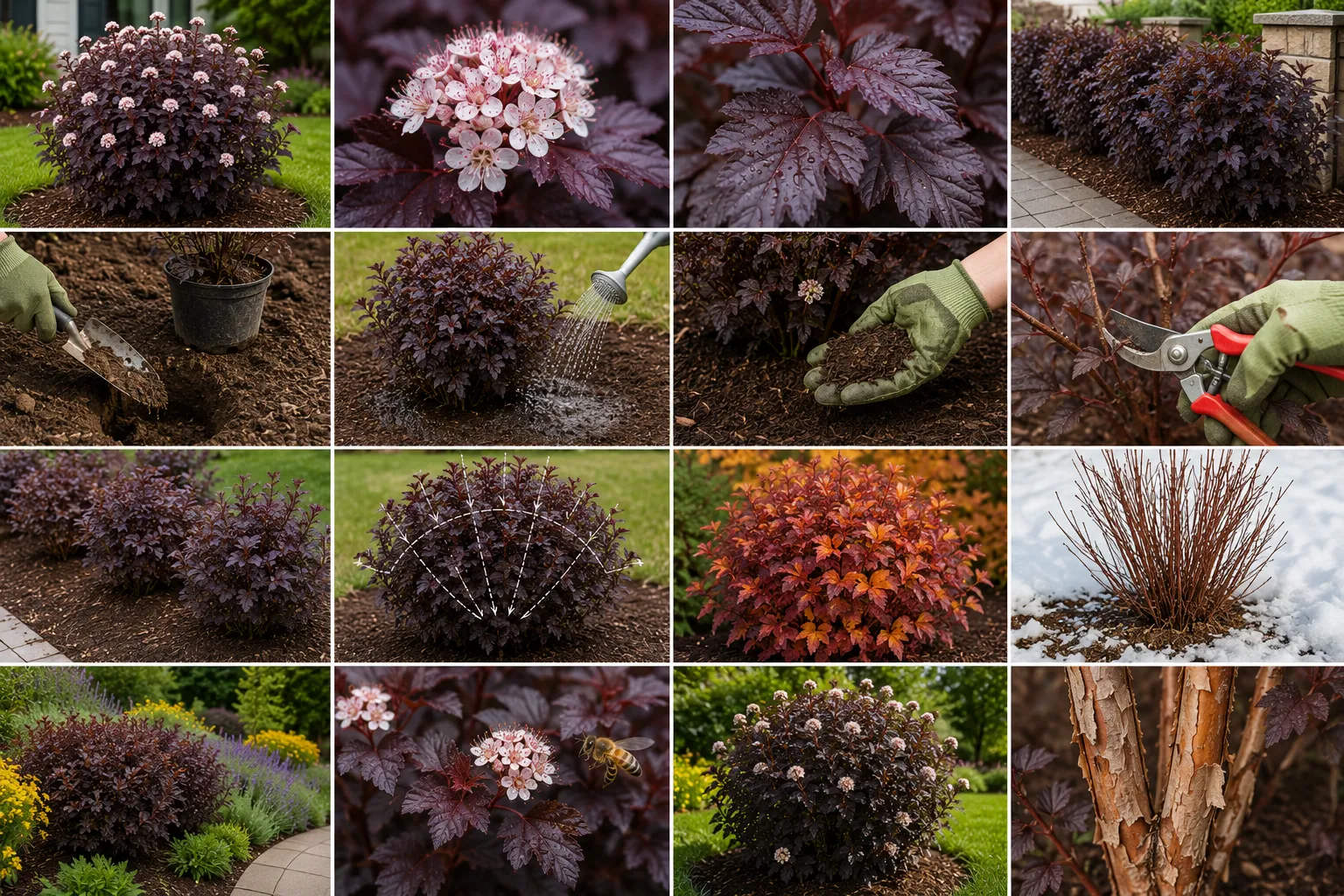
Little devil ninebark care is straightforward — this compact shrub thrives in full sun to partial shade, tolerates drought once established, and needs fertilizer only every 2–3 years. Physocarpus opulifolius ‘Donna May’, sold as Little Devil ninebark, reaches just 3–4 feet (0.9–1.2 m) tall and wide, making it one of the easiest dwarf shrubs for borders, containers, and foundation plantings across USDA hardiness zones 3–8.
Unlike its larger relatives — Diabolo ninebark, Coppertina ninebark, and Summer Wine ninebark — Little Devil holds a naturally tidy shape with minimal intervention. Follow these specific care steps and this shrub delivers deep burgundy foliage from spring through fall, pinkish-white flower clusters in June, and exfoliating tan bark for winter interest.
Quick-Reference Care Table for Little Devil Ninebark
Use this table to track all care tasks, timing, and tools in one place.
| Task | Timing | Tool / Method | Difficulty |
| Watering (first year) | Weekly, April–October | Soaker hose, 1 in (2.5 cm) per week | Easy |
| Watering (established) | Monthly or during drought | Deep watering at base only | Easy |
| Mulching | Early spring, annually | 3 in (7.5 cm) organic mulch ring | Easy |
| Fertilizing | Every 2–3 years, March | Slow-release 10-10-10 granular fertilizer | Easy |
| Light pruning / deadheading | After bloom, June–July | Bypass pruners, snip 0.25 in (6 mm) below bloom | Easy |
| Renewal pruning | Every 3–5 years, late winter | Loppers, remove 1/3 oldest stems at base | Moderate |
| Pest / disease check | Monthly, May–September | Visual inspection, neem oil if needed | Easy |
| Winter prep | October–November | Light mulch layer 2 in (5 cm) at base | Easy |
How to Choose the Right Sun and Soil for Little Devil Ninebark Care
Sun Requirements: Full Sun Produces the Deepest Burgundy Color
To get the deepest burgundy foliage, plant Little Devil ninebark in a spot receiving at least 6 hours of direct sunlight daily. Partial shade (3–5 hours of sun) is tolerable, but leaf color shifts from dark burgundy toward olive-green. Color fade is the most common complaint from gardeners who plant this shrub under a tree canopy or on a north-facing wall. Move a container-grown specimen to a sunnier position and burgundy coloring returns within 4–6 weeks.
Soil Type and pH: What Little Devil Ninebark Tolerates vs. Prefers
Little devil ninebark grows in clay, loam, rocky, or sandy soil, provided drainage is adequate. Standing water kills roots within 2 weeks — avoid low-lying spots where water pools after rain. Preferred soil pH is 5.5–7.0 (slightly acidic to neutral). Test your soil with a digital pH meter or inexpensive test strips from brands such as Luster Leaf Rapitest or MySoil before planting. Amend soil pH below 5.0 by adding 5 lbs (2.3 kg) of ground limestone per 100 sq ft (9.3 sq m). For heavy clay, mix 2–3 inches (5–7.5 cm) of compost into the planting hole to improve drainage before setting the root ball.
Gardeners looking for dwarf shrubs for small gardens will find Little Devil ninebark a top performer in both in-ground and container settings.
How to Plant Little Devil Ninebark Correctly in 2026
To plant Little Devil ninebark, dig a hole twice the width and equal depth of the root ball. Space shrubs 4 feet (1.2 m) apart for mass plantings, or 3 feet (0.9 m) apart for a low border hedge. Set the crown of the root ball level with or 0.5 inches (1.3 cm) above ground level — never below — to prevent crown rot.
Follow these 5 steps for successful establishment:
- Step 1 — Dig hole 24 inches (60 cm) wide by 12 inches (30 cm) deep for a standard 2-gallon container plant.
- Step 2 — Loosen roots gently if root-bound, then set plant in hole at correct depth.
- Step 3 — Backfill with native soil mixed with 25% compost. Do not add fertilizer at planting — roots need 4–6 weeks to settle.
- Step 4 — Water thoroughly to collapse air pockets: apply 2 gallons (7.6 L) slowly around the base.
- Step 5 — Apply 3 inches (7.5 cm) of organic mulch — shredded bark or wood chips — in a ring 2 inches (5 cm) away from the stem to prevent rot.
Best planting months in zones 5–8 are April–May or September–October. In zones 3–4, plant in May after final frost. Container-grown Little Devil ninebark transplants successfully any time the ground is workable.
How to Water Little Devil Ninebark at Every Growth Stage
Watering Newly Planted Little Devil Ninebark (Year 1)
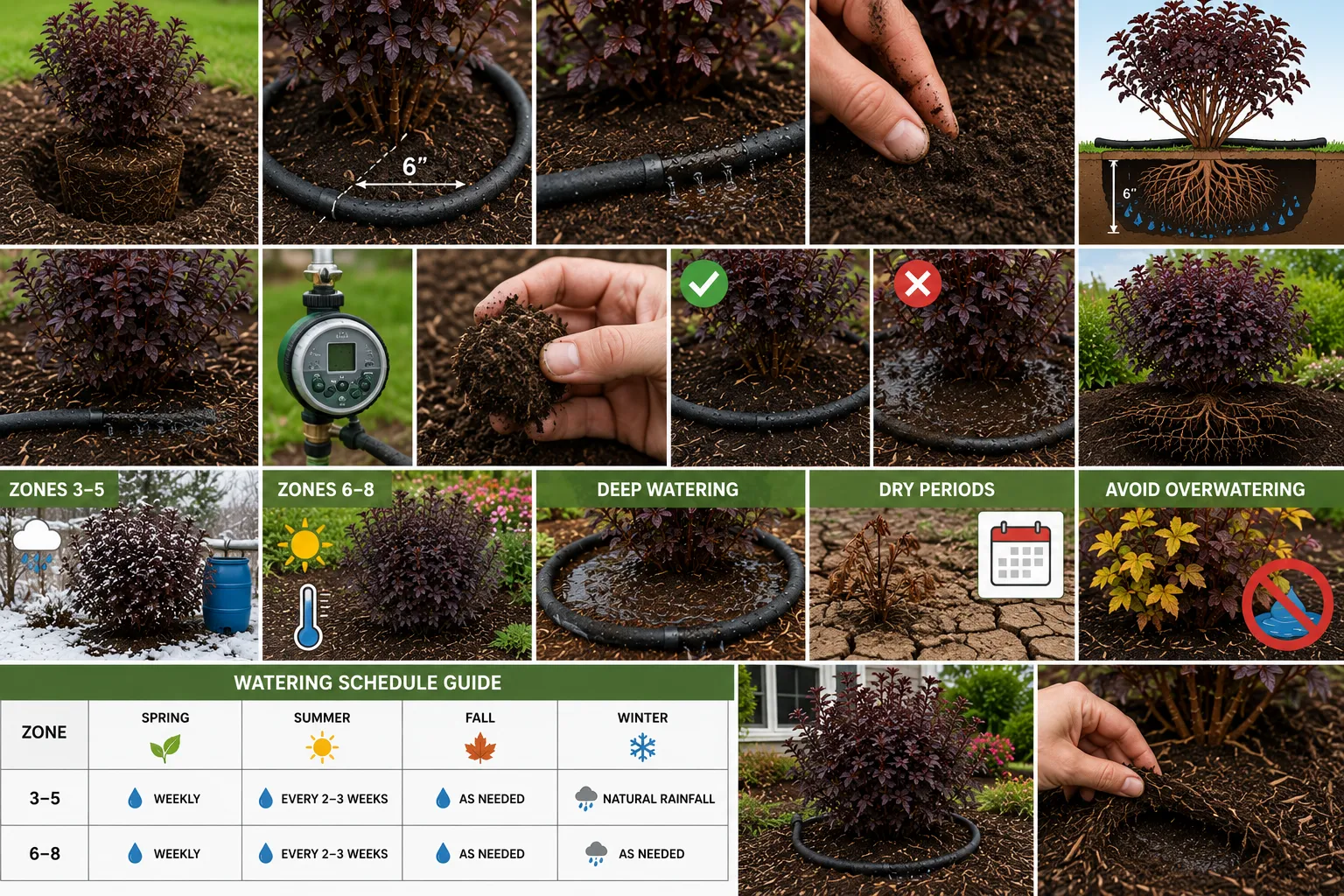
To establish a new plant, water Little Devil ninebark once per week during the growing season, delivering 1 inch (2.5 cm) of water per session. Use a soaker hose placed 6 inches (15 cm) from the stem base — this keeps foliage dry and reduces fungal disease risk. Run the soaker hose for 30–45 minutes on standard residential water pressure to reach 6 inches (15 cm) soil depth. Check moisture with your finger: soil at 2 inches (5 cm) depth should feel moist but not soggy before each watering.
Watering Established Little Devil Ninebark (Year 2 Onward)
Established Little Devil ninebark is drought-tolerant and needs supplemental water only during extended dry periods of 3+ weeks. In zones 3–5, natural rainfall of 12 inches (30 cm) or more annually covers the plant’s needs without irrigation. In zones 6–8 with hot summers, water deeply once every 2–3 weeks from June through August. Overwatering — more than 2 inches (5 cm) per week on established plants — causes yellowing leaves and root rot faster than drought does.
A watering schedule guide helps you plan irrigation by zone and season so you water only when the plant actually needs it.
Little Devil Ninebark Fertilizer: How Much and How Often
Little Devil ninebark needs fertilizer every 2–3 years in early spring (March), not annually. Apply a slow-release granular 10-10-10 fertilizer — such as Osmocote Smart-Release Plant Food or Espoma Plant-tone — at 0.5 lbs (227 g) per 10 sq ft (0.93 sq m) around the drip line. Work fertilizer lightly into the top 1 inch (2.5 cm) of soil, then water thoroughly to activate. Annual fertilizing produces excessive, floppy branch growth that weakens the natural rounded form. Skip fertilizer entirely in the first year after planting — the root system is not ready to process it efficiently.
Little Devil Ninebark Pruning: How to Prune Without Damaging the Plant
Light Pruning and Deadheading After Bloom
To deadhead Little Devil ninebark, snip spent flower clusters 0.25 inches (6 mm) below the bloom base using clean bypass pruners such as Felco F-2 or Fiskars Steel Bypass. Complete light pruning immediately after flowering ends in late June or early July. Do not prune after mid-August — late cuts stimulate new growth that fails to harden before the first frost, leaving stems vulnerable to dieback. Little Devil ninebark blooms on old wood, so any summer pruning beyond deadheading reduces next year’s flower count.
Renewal Pruning Every 3–5 Years
To renew an older Little Devil ninebark, remove one-third of the thickest, oldest stems at ground level in late winter (February–March), before new growth begins. Use loppers with 1-inch (2.5 cm) cutting capacity for stems thicker than 0.5 inches (1.3 cm). Removing old stems redirects energy to younger, more vigorous shoots and restores the plant’s compact rounded shape. Full ground-level renovation — cutting all stems to 6 inches (15 cm) — is an option for severely overgrown plants, but the shrub takes 2 full growing seasons to rebuild its ornamental value afterward. Avoid renovation pruning on plants younger than 4 years.
For broader guidance on timing and technique, the pruning deciduous shrubs resource covers tool selection, seasonal windows, and common mistakes across shrub types.
Seasonal Little Devil Ninebark Care Calendar
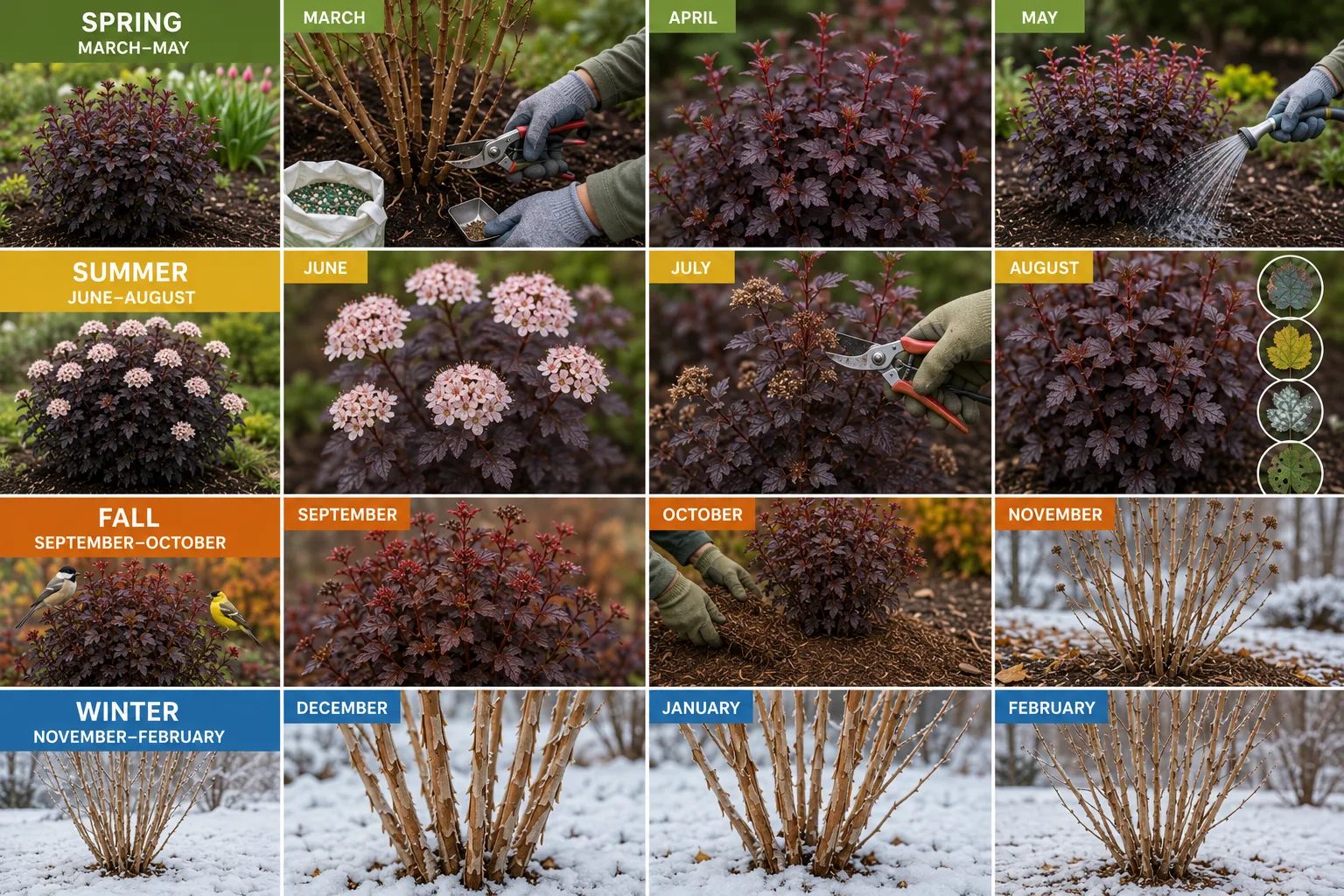
Spring Care (March–May)
March: Apply slow-release fertilizer (every 2–3 years only). Conduct renewal pruning before bud break. Refresh mulch ring to 3 inches (7.5 cm) deep.
April–May: New burgundy foliage emerges. Monitor for powdery mildew on inner branches — improve airflow by removing 2–3 crossing stems if needed. Water newly planted shrubs weekly.
Summer Care (June–August)
June: Pinkish-white flower clusters appear and last 2–3 weeks. Enjoy the show — no action needed. Deadhead spent blooms in late June to maintain appearance.
July–August: Limit pruning to deadheading only. Water established plants during drought periods exceeding 3 weeks. Inspect foliage monthly for 4 signs of stress: leaf scorch (brown edges), yellowing, powdery coating, or unusual leaf drop.
Fall and Winter Care (September–February)
September–October: Red seed capsules develop and provide wildlife food for birds including finches and chickadees. Apply a light 2-inch (5 cm) mulch layer at the base before the ground freezes in zones 3–5.
November–February: Exfoliating tan bark provides winter structure. No action needed in zones 6–8. In zones 3–4, burlap wrap is not necessary — this shrub is cold-hardy to -40°F (-40°C) without protection.
3 Common Little Devil Ninebark Problems and How to Fix Them
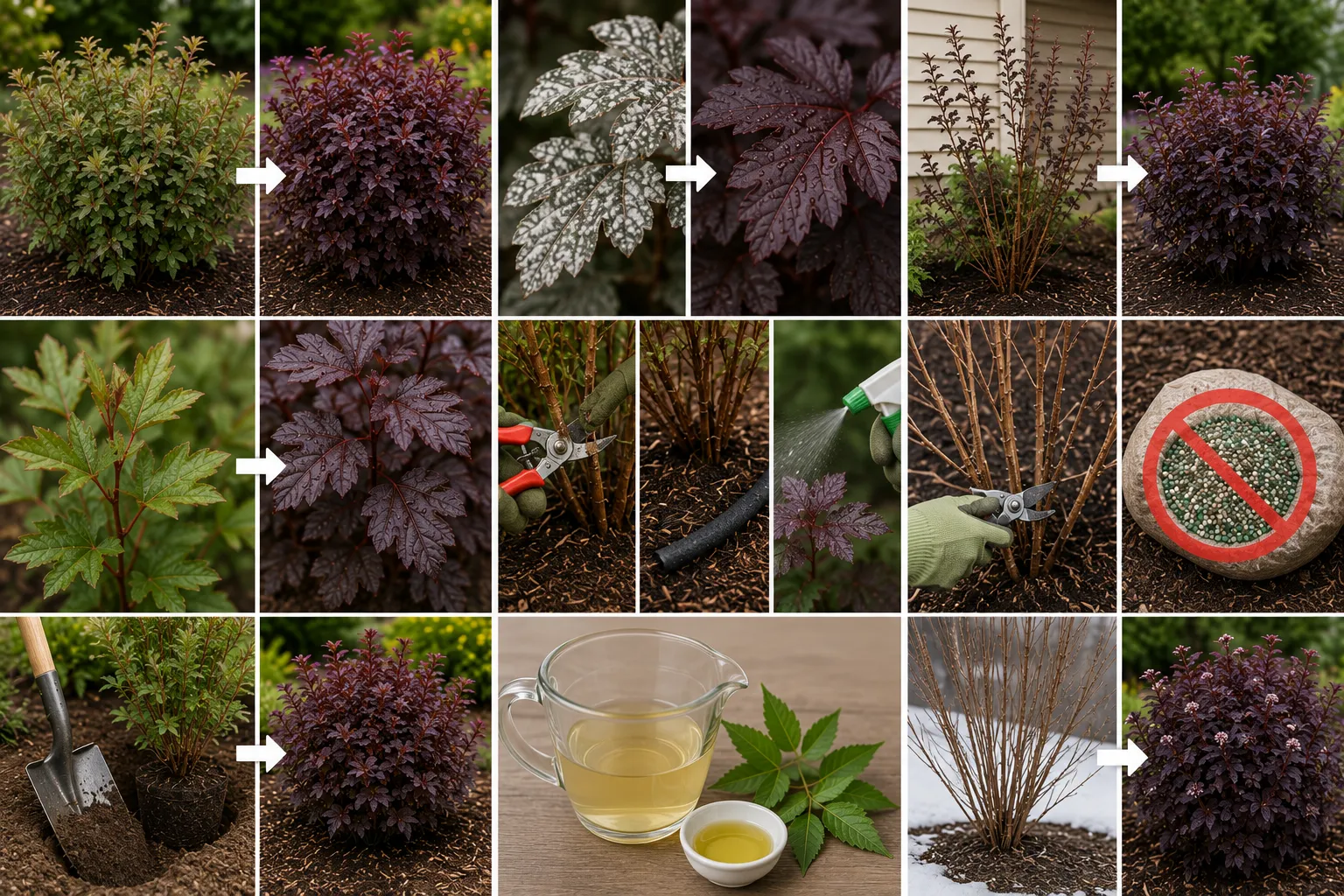
Problem 1 — Foliage turns green instead of burgundy.
Cause: Insufficient sunlight — fewer than 4 hours of direct sun per day. Fix: Transplant to a sunnier location in early fall. Color improvement appears within 4–6 weeks of adequate sun exposure.
Problem 2 — Powdery white coating on leaves.
Cause: Powdery mildew from poor air circulation or overhead watering. Fix: Remove 2–3 densely packed inner stems to improve airflow. Switch to soaker hose irrigation. Apply neem oil spray — 2 tablespoons (30 ml) per gallon (3.8 L) of water — every 7 days for 3 applications. Little Devil is mildew-resistant, so severe infections are rare.
Problem 3 — Shrub grows tall and leggy with sparse branching.
Cause: Insufficient sun or over-fertilizing creating excessive vertical growth. Fix: Conduct renewal pruning in late winter to remove the oldest one-third of stems. Reduce fertilizer to every 3 years. In full sun, Little Devil ninebark maintains its compact 3–4 ft (0.9–1.2 m) form naturally.
Best Companion Plants for Little Devil Ninebark in 2026
Pair Little Devil ninebark with plants that contrast its burgundy foliage or match its low-maintenance needs:
- Rozanne Geranium — lavender-blue flowers from June–October contrast directly with burgundy leaves at the border edge.
- Incrediball Hydrangea — large white blooms in July–August complement the scale and color of Little Devil without competing for space.
- Karl Foerster Feather Reed Grass — upright gold stems in fall create a 3-season textural contrast behind the rounded shrub form.
- Knock Out Rose — red blooms repeat all season alongside burgundy foliage for a high-contrast planting that requires identical sun and water conditions.
- Walker’s Low Catmint — low, spreading habit fills the foreground with purple-blue flowers while Little Devil holds the midground structure.
Avoid planting Little Devil ninebark within 4 feet (1.2 m) of aggressive spreaders such as Japanese barberry (Berberis thunbergii) or invasive burning bush (Euonymus alatus).
Frequently Asked Questions About Little Devil Ninebark Care
How fast does Little Devil ninebark grow?
Little Devil ninebark grows 6–12 inches (15–30 cm) per year until it reaches its mature size of 3–4 feet (0.9–1.2 m) tall and wide. Growth rate slows naturally once the shrub fills its allotted space.
Does Little Devil ninebark need to be pruned every year?
No — Little Devil ninebark does not need annual pruning. Light deadheading after bloom improves appearance, but the shrub holds a tidy compact shape without regular cutting. Renewal pruning every 3–5 years maintains vigor.
Is Little Devil ninebark deer-resistant?
Yes — Little Devil ninebark is deer-resistant due to its bitter-tasting foliage. Deer avoid the plant in most regions, though severe winter food shortages in zones 3–4 can push deer to sample any available vegetation.
Can Little Devil ninebark grow in a container?
Yes — Little Devil ninebark thrives in a container of at least 15 gallons (57 L) with drainage holes. Use a well-draining potting mix such as Miracle-Gro Performance Organics. Container plants need water every 3–5 days in summer and benefit from annual repotting into a slightly larger pot.
When does Little Devil ninebark bloom?
Little Devil ninebark blooms in June, producing small pinkish-white flower clusters at the branch tips. Flowers last 2–3 weeks and are followed by red seed capsules that persist into fall.
Start Growing Little Devil Ninebark This Season
Little devil ninebark care demands very little but returns outstanding year-round garden value. Plant in 6+ hours of full sun, water weekly during the first growing season, skip annual fertilizing, and prune only after bloom or during late-winter renewal. With burgundy foliage from April through November, June flower clusters, and exfoliating winter bark, this compact deciduous shrub earns its place in every zone 3–8 landscape.
Ready to find the right shrubs matched to your exact USDA hardiness zone? Browse the full dwarf shrubs collection at Zoned Garden to discover zone-appropriate options hand-picked for your growing conditions.