
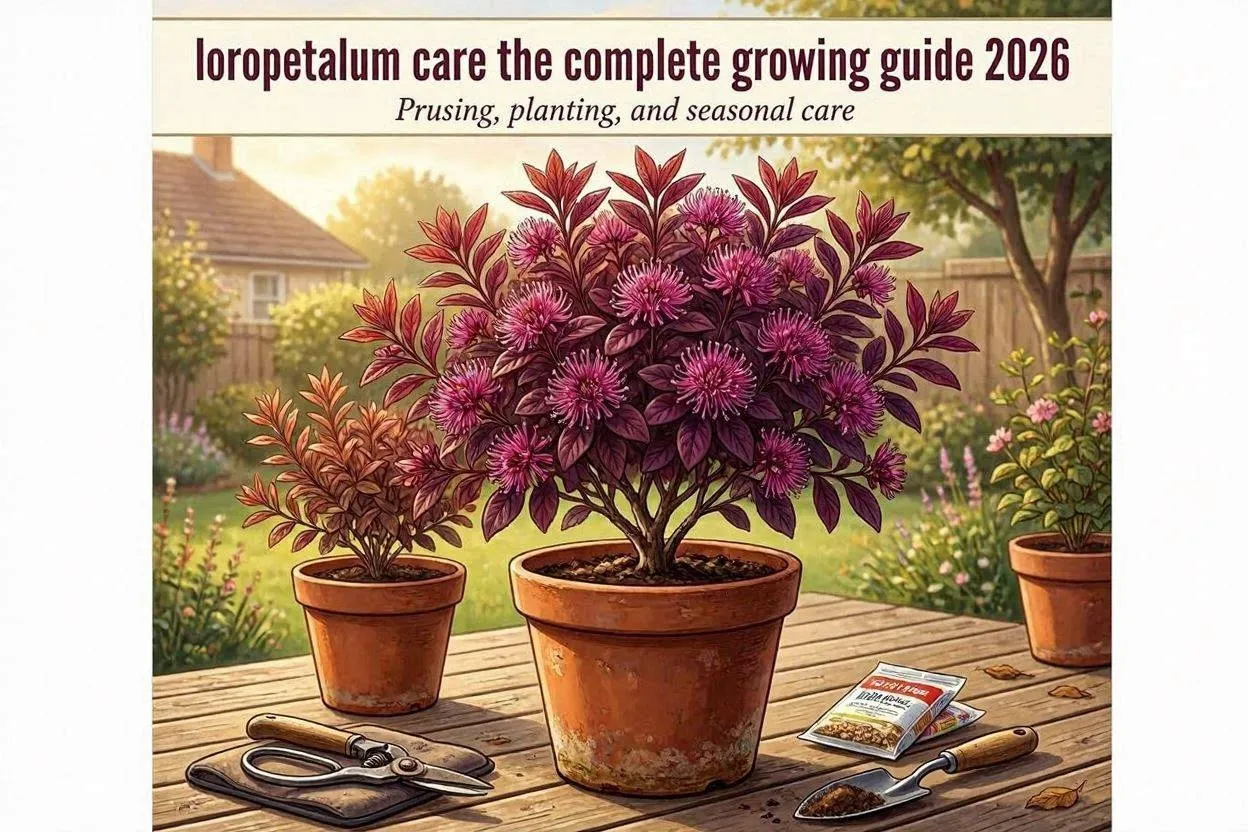
Loropetalum care requires partial to full sun, acidic well-draining soil (pH 4.0–6.5), and pruning only after the spring bloom flush ends — those 3 conditions keep the fringe flowers vivid and the purple or burgundy foliage saturated year-round. Plant loropetalum correctly in USDA Hardiness Zones 7b–9b and the shrub rewards you with almost no maintenance for years.
This guide covers every step of growing loropetalum: variety selection, soil preparation, watering, fertilizing, pruning timing, common problems, and zone-matched winter protection.
Loropetalum Care Quick-Reference Table
This table maps every care task to the correct timing, method, and difficulty level.
| Task | Timing | Method | Difficulty | Notes |
| Planting | Spring or fall | Loosen soil 12 in (30 cm), amend with compost | Easy | Zones 7b–9b outdoors |
| Watering (new plant) | 2–3x per week, 2–3 months | Deep soak, let top 2 in (5 cm) dry | Easy | Critical first season |
| Watering (established) | Once per week or less | Deep, infrequent; skip during rain | Easy | Drought-tolerant once set |
| Fertilizing | Every 2 months, spring–fall | Acid-loving slow-release granular | Easy | Never in winter |
| Pruning (light) | Right after spring bloom | Tip-prune by 1/4 to shape | Easy | Preserves next season buds |
| Pruning (hard) | Late winter / early spring | Cut back by 1/3 before new growth | Moderate | Resets overgrown plants |
| Mulching | Spring & fall | 2–3 in (5–7.5 cm) organic layer | Easy | Keep away from stem |
| Winter protection (Zone 7) | Before first frost | Mulch roots 3–4 in (7.5–10 cm) | Easy | Cover with burlap if <0°F |
What Loropetalum Is and How It Grows

Loropetalum belongs to the genus Loropetalum in the family Hamamelidaceae [witch hazel family]. The 2 species grown in gardens are Loropetalum chinense — white-flowered with green foliage — and Loropetalum chinense var. rubrum — pink-to-red-flowered with purple or burgundy foliage. The species name comes from the Greek words loron (strap) and petalon (petal), describing the plant’s narrow fringe-like flower petals.
Both species are evergreen to semi-evergreen shrubs. Loropetalum chinense grows 10–20 feet (3–6 m) tall and wide without pruning. Most garden cultivars of var. rubrum reach 3–8 feet (0.9–2.4 m), though the species form can top 15 feet (4.5 m). Loropetalum is native to China, Japan, Thailand, Taiwan, and India, and was introduced to the United States in 1908. Purple-foliaged forms only became commercially available in the late 1980s after the U.S. National Arboretum introduced the cultivars Blush and Burgundy.
5 Loropetalum Sizes and Forms to Know
Choose your cultivar based on the mature size your space allows:
- Dwarf groundcover (1–2 ft / 30–60 cm tall): Purple Pixie — hot pink blooms, intense purple foliage, spreads 4–5 ft (1.2–1.5 m)
- Compact mounding (3–4 ft / 0.9–1.2 m): Purple Daydream — dark pink flowers, dark purple foliage, 3.5 ft (1 m) tall by 7 ft (2.1 m) wide after 5 years
- Medium shrub (4–6 ft / 1.2–1.8 m): Crimson Fire — neon pink flowers, reddish-purple leaves, dense mounding habit
- Large shrub (6–8 ft / 1.8–2.4 m): Plum Delight — dark rose flowers, plum-bronze foliage, arching branches
- Tree form (10–20 ft / 3–6 m): Zhuzhou Fuchsia — blackish maroon foliage, can be limbed up into a small tree or espaliered
How to Choose the Right Sun Exposure for Loropetalum Care
To grow loropetalum with rich foliage color, place the plant where it receives at least 4 hours of direct sun daily, with morning sun and afternoon shade as the preferred exposure. Loropetalum tolerates full sun in Zones 7–8 but benefits from afternoon shade in Zones 9–11 where summer temperatures regularly exceed 95°F (35°C).
Insufficient sun causes 2 visible problems: foliage shifts from deep purple or burgundy toward green, and bloom count drops significantly. Both are reversible — move the plant to a sunnier spot or prune nearby trees to restore light.
Full shade (under 4 hours of direct sun) causes leggy, open growth with sparse flowers and faded leaf color. Loropetalum does not recover its color in deep shade regardless of other care adjustments.
Loropetalum Care Starts with the Right Soil
Loropetalum grows best in rich, loamy, well-draining soil with a pH of 4.0–6.5. Soil pH above 6.5 prevents the plant from absorbing iron and magnesium, causing chlorosis — a yellowing of leaves between the veins while the veins themselves stay green.
Before planting, test your soil pH with a digital pH meter or a home test kit. Adjust alkaline soil by working elemental sulfur into the top 8 inches (20 cm) at the rate of 1 lb per 10 sq ft (0.45 kg per 0.9 sq m). Repeat testing every 2 years, as pH creeps upward naturally in many regions.
Loropetalum tolerates clay soil better than many shrubs, but clay holds moisture and slows drainage. In heavy clay, raise the planting bed 4–6 inches (10–15 cm) above the surrounding grade, or work in 3 inches (7.5 cm) of coarse compost to improve structure. Avoid planting in low spots where water collects after rain.
How to Prepare the Planting Hole
To plant loropetalum in the ground, dig a hole 2–3 times as wide as the root ball and exactly as deep. Setting the plant too deep buries the crown and causes stem rot. The top of the root ball should sit at or slightly above the surrounding soil surface.
Backfill with the original soil — do not amend the planting hole with potting mix or peat. Amended holes create a sponge effect where roots circle instead of spreading outward. Apply 2–3 inches (5–7.5 cm) of organic mulch, such as pine bark or shredded hardwood, in a ring starting 3 inches (7.5 cm) from the stem.
Loropetalum grows well in both spring and fall. Spring planting allows establishment before summer heat. Fall planting in Zones 8–9 gives the root system a full cool season to spread before the first hot summer. Learn how other acid-loving shrubs handle fall planting in the eclipse hydrangea care guide.
How to Water Loropetalum Without Causing Root Rot
To water newly planted loropetalum, soak the root zone deeply 2–3 times per week for the first 2–3 months. After the plant establishes, reduce watering to once per week during the growing season. Established loropetalum in the ground needs water only during extended dry periods of 2 or more weeks without rain.

Container-grown loropetalum dries out faster than in-ground plants. Check container soil every 2 days during summer. Water when the top 2 inches (5 cm) feel dry, not on a fixed schedule. Always water until the liquid drains freely from the pot base — partial watering leaves dry pockets in the root zone.
Signs of overwatering include yellow leaves, soft brown stems at the base, and a sour smell from the soil. Signs of underwatering include wilted or crispy leaf edges and dry soil below 2 inches (5 cm) depth. Overwatering causes more loropetalum deaths than any other care mistake.
How to Water Loropetalum in Winter
To water loropetalum during winter, apply water only during extended dry spells when no rain has fallen for 3 or more weeks. Reduce watering frequency to once every 10–14 days for container plants. Never fertilize from November through February — cold-season fertilizing stimulates soft new growth that freezes easily.
Loropetalum Care: Fertilizer Schedule for Vivid Foliage and Blooms
Feed loropetalum every 2 months from spring through fall with a slow-release, acid-forming fertilizer formulated for acid-loving plants — such as Espoma Holly-Tone (4-3-4) or Miracle-Gro Azalea, Camellia, Rhododendron (30-10-10 water-soluble). Stop fertilizing completely from November through February.
High-nitrogen fertilizers push excessive leaf growth and reduce flower count. Choose a balanced or phosphorus-forward formula to support both foliage color and bloom production. Apply granular fertilizers at the drip line — the outer edge of the canopy — not directly against the main stem.
If leaves show chlorosis (yellow between green veins), the soil pH is too high or iron is unavailable. Apply chelated iron foliar spray at 2 tsp per quart (10 ml per liter) of water, directly to the foliage every 2 weeks for 4 applications. Test and lower soil pH to the 4.0–6.5 range to prevent recurrence.
For a side-by-side comparison of acid-plant fertilizer timing, the crape myrtle guide outlines a similar seasonal schedule for another warm-climate flowering shrub.
How to Prune Loropetalum Without Losing Next Season’s Blooms
To prune loropetalum correctly, wait until the spring bloom flush finishes completely before cutting. Loropetalum sets flower buds on wood from the previous season — pruning before or during bloom removes those buds and eliminates flowering for the current year.
Tip-prune stems back by one-quarter after spring bloom to maintain shape and encourage branching. This light pruning produces denser growth without sacrificing the following season’s buds. Remove dead, damaged, or crossing branches at any time of year — those cuts do not affect bloom timing.
Avoid pruning in late summer or fall. Fall pruning stimulates tender new growth that fails to harden before winter in Zones 7–8, increasing cold damage risk. Prune hedges no more than twice per year: once right after spring bloom and once again in early summer if needed for size control.
How to Prune Loropetalum into Tree Form
To train loropetalum as a small tree, select 1–3 strong main stems and remove all lower branches gradually over 2–3 years. Remove the lowest branches first, cutting flush to the trunk. Expose 3–5 feet (0.9–1.5 m) of clear trunk over multiple seasons rather than all at once.
Large cultivars like Zhuzhou Fuchsia and Burgundy reach 15–20 feet (4.5–6 m) and work well as tree-form specimens. Compact cultivars like Purple Pixie and Crimson Fire stay too low for tree form — use large-growing types for this technique.
How to Fix an Overgrown Loropetalum
To rejuvenate an overgrown loropetalum, cut all stems back by one-third in late winter before new growth begins. The plant regrows vigorously from established roots and resumes normal flowering the following spring. Cutting back by more than half at once stresses the plant — use the one-third rule and repeat the following year if more size reduction is needed.
Loropetalum Care by USDA Zone and Winter Protection
Loropetalum is reliably winter-hardy in USDA Hardiness Zones 7b–9b. In Zone 7a, the plant survives with root mulching. In Zone 6 and colder, grow loropetalum in containers and move the plant indoors before the first frost.
In Zone 7, apply a 3–4 inch (7.5–10 cm) layer of pine bark mulch over the root zone before the first hard freeze. If temperatures fall below 0°F (-18°C), wrap the shrub loosely in burlap to buffer cold wind. Remove burlap as soon as temperatures consistently stay above 32°F (0°C) in late winter.
In Zones 8–9, loropetalum needs no winter protection. Foliage may thin slightly in cold winters but the plant remains evergreen. Water once monthly if rainfall is under 1 inch (2.5 cm) per month during the dormant season.
In Zone 10 and warmer, loropetalum grows year-round without dormancy. Partial afternoon shade prevents leaf scorch during peak summer heat. Compared to how vitex tree care handles Zone 10 conditions, loropetalum needs slightly more moisture but the same reduced winter care approach.
How to Propagate Loropetalum from Cuttings
To propagate loropetalum, take 6-inch (15 cm) semi-hardwood cuttings in summer from the tips of current-season growth. Choose shoots that are soft at the tip and woodier at the base — those are semi-hardwood cuttings with the highest rooting success rate.
Strip leaves from the bottom half of each cutting. Dip the cut end in rooting hormone powder (IBA [indole-3-butyric acid] at 0.3%). Insert the cutting 2 inches (5 cm) deep into a 50:50 mix of perlite and peat or coconut coir. Cover with a plastic bag or humidity dome to maintain moisture around the leaves.
Place cuttings in bright indirect light at 65–75°F (18–24°C). Roots develop in 4–6 weeks. Tug the cutting gently — resistance means roots have formed. Transplant rooted cuttings into individual 4-inch (10 cm) pots with acid potting mix and grow indoors for 6 weeks before planting out.
How to Fix the 4 Most Common Loropetalum Care Problems

1. Purple Leaves Turning Green
Green foliage on a purple-leaved cultivar signals insufficient sun or soil pH above 6.5. Move the plant to a site with 4+ hours of direct sun. Test soil pH and lower it to the 4.0–6.5 range using elemental sulfur. Full foliage color returns within one full growing season once light and pH are corrected.
2. No Flowers in Spring
Missing spring blooms result from pruning in fall or winter, which removes pre-formed flower buds. The plant cannot rebloom on wood that was cut off. Prune only after the spring bloom ends. Bloom recovery happens the following spring once the correct pruning schedule is followed.
3. Yellow Leaves with Green Veins (Chlorosis)
Chlorosis indicates iron or magnesium deficiency caused by high soil pH. Apply chelated iron foliar spray at 2 tsp per quart (10 ml per liter) of water every 2 weeks for 4 applications. Test and lower soil pH to 4.0–6.5 using elemental sulfur at 1 lb per 10 sq ft (0.45 kg per 0.9 sq m). Chlorosis clears within 4–6 weeks of treatment.
4. Spider Mites and Aphids
Spider mites appear as fine webbing on leaf undersides, especially during hot, dry weather. Aphids cluster on new growth tips in spring. Dislodge both pests with a strong blast of water from a garden hose. For persistent infestations, apply neem oil (2 tbsp / 30 ml per gallon / 3.8 liters of water) or insecticidal soap (1 tbsp / 15 ml per quart / 0.95 liters of water) at dusk to avoid foliage burn. Repeat every 7 days until infestation clears.
Frequently Asked Questions About Loropetalum Care
Does loropetalum grow well in containers?
Yes. Loropetalum grows well in containers, and container growing is the recommended approach for gardeners in Zone 6 and colder. Choose a pot 2–3 times the size of the root ball with drainage holes. Use an acid-forming potting mix and fertilize every 2 weeks with a diluted acid-plant fertilizer during the growing season.
How fast does loropetalum grow?
Loropetalum grows at a moderate rate of 12–24 inches (30–60 cm) per year under good conditions. Large cultivars like Zhuzhou Fuchsia grow faster than compact types like Purple Pixie. Growth slows significantly in full shade, compacted soil, or alkaline soil above pH 7.0.
Can you keep loropetalum small with pruning?
Yes. Pruning loropetalum after each spring bloom flush and once in early summer keeps most cultivars 30–50% smaller than their unpruned mature size. Dwarf cultivars like Purple Pixie and Purple Daydream need almost no pruning to stay compact.
Why is my loropetalum losing its purple color?
Purple color fades when the plant receives under 4 hours of direct sun or when soil pH rises above 6.5. Move the plant to a sunnier location, or prune surrounding plants to let more light through. Test soil pH and apply elemental sulfur if the reading is above 6.5. Color deepens again within one full growing season after corrections are made.
When does loropetalum bloom?
Loropetalum blooms primarily in late winter to early spring — typically February through April depending on the zone. Some cultivars, including Ever Red and Plum Delight, produce a secondary bloom flush in fall. The plant does not flower in summer or winter in most climates.
Grow Loropetalum Right and It Rewards You Every Season
Loropetalum thrives when you match the soil pH to the 4.0–6.5 range, place the shrub where it receives 4+ hours of direct sun, and prune only after the spring bloom ends.
Apply an acid-forming slow-release fertilizer every 2 months through the growing season, water deeply but infrequently once the plant establishes, and address chlorosis immediately with chelated iron.
Follow those steps and loropetalum delivers vivid fringe flowers each spring alongside saturated purple or burgundy foliage for the rest of the year.