
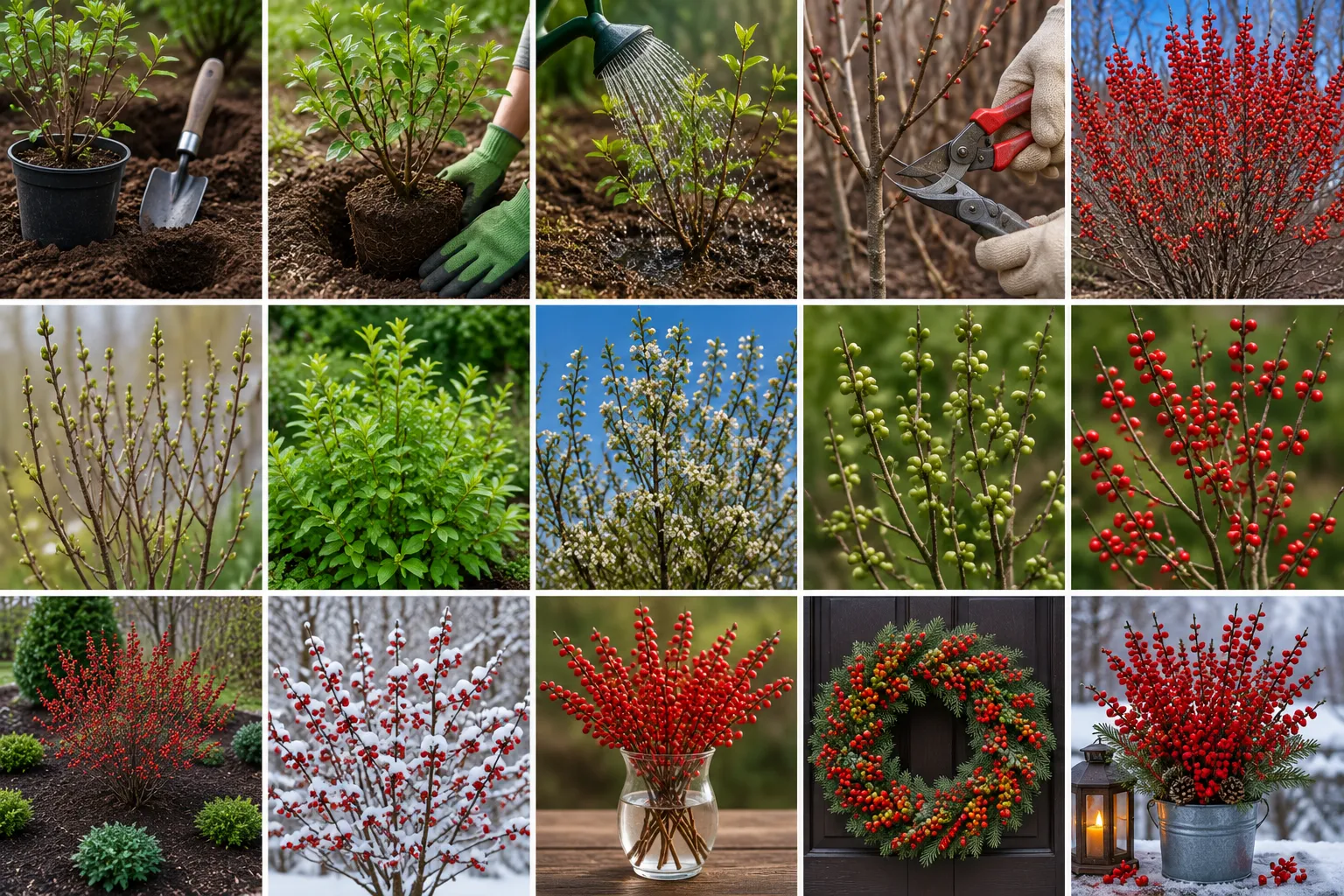
Winterberry needs moist, acidic soil with a pH of 5.5 to 6.4, full sun to partial shade, and a male pollinator planted within 50 feet (15 m) to produce its signature red berries. Get these 3 conditions right and the plant takes care of itself for the next 20 years.
Winterberry (Ilex verticillata) is a deciduous holly native to eastern North America. Unlike classic Christmas holly, winterberry drops its leaves every fall, which means the bare branches show off bright red or yellow berries from October through February. Birds eat the berries. You get a garden that looks alive in the dead of winter.
This guide covers every step: variety selection, planting depth, soil pH, watering by season, fertilizing schedule, and pruning rules that protect next year’s berry crop. You also get a troubleshooting section for the 4 problems that stop most winterberry plants from fruiting.
What Is Winterberry and Why Does It Need Special Care?
Winterberry is a dioecious shrub, meaning individual plants are either male or female, and only female plants grow berries. A garden with only female plants produces flowers but never fruit. A garden with both sexes, planted close enough for pollination, produces a full berry display.
The shrub grows natively in swamps, riverbanks, and pond edges across a range stretching from eastern Canada through the southern United States and into Texas. That native habitat explains 2 things about winterberry care: the plant tolerates wet soil better than most shrubs, and it strongly prefers acidic conditions over neutral or alkaline soil.
Winterberry grows in USDA Hardiness Zones 3 to 9, which covers most of the continental United States. Mature size ranges from 3 feet (0.9 m) for dwarf cultivars to 15 feet (4.5 m) for the native species. Growth rate is slow, typically 1 to 2 feet (30-60 cm) per year.
Berries form between April and July, just after the plant pushes new leaves. The fruit stays green through summer, then shifts to bright red, orange, or yellow once temperatures drop in early fall. Birds rely on this late fruit supply heavily — more than 40 species feed on winterberry through the coldest months, which makes the shrub a functional wildlife planting as well as an ornamental one.
3 traits separate winterberry from other landscape shrubs: it tolerates wet, swampy ground better than almost any ornamental alternative, it drops every leaf each fall to fully expose the berry display, and it produces no fruit at all without a second plant of the opposite sex nearby. Skipping any one of these facts during planning leads directly to the most common complaint gardeners report — a healthy shrub with zero berries.
How to Choose the Right Winterberry Variety for Your Garden
To choose the right winterberry variety, match a female berry-producing cultivar with a compatible male pollinator that blooms during the same window. Bloom timing matters more than name similarity.
Female Varieties That Produce Berries
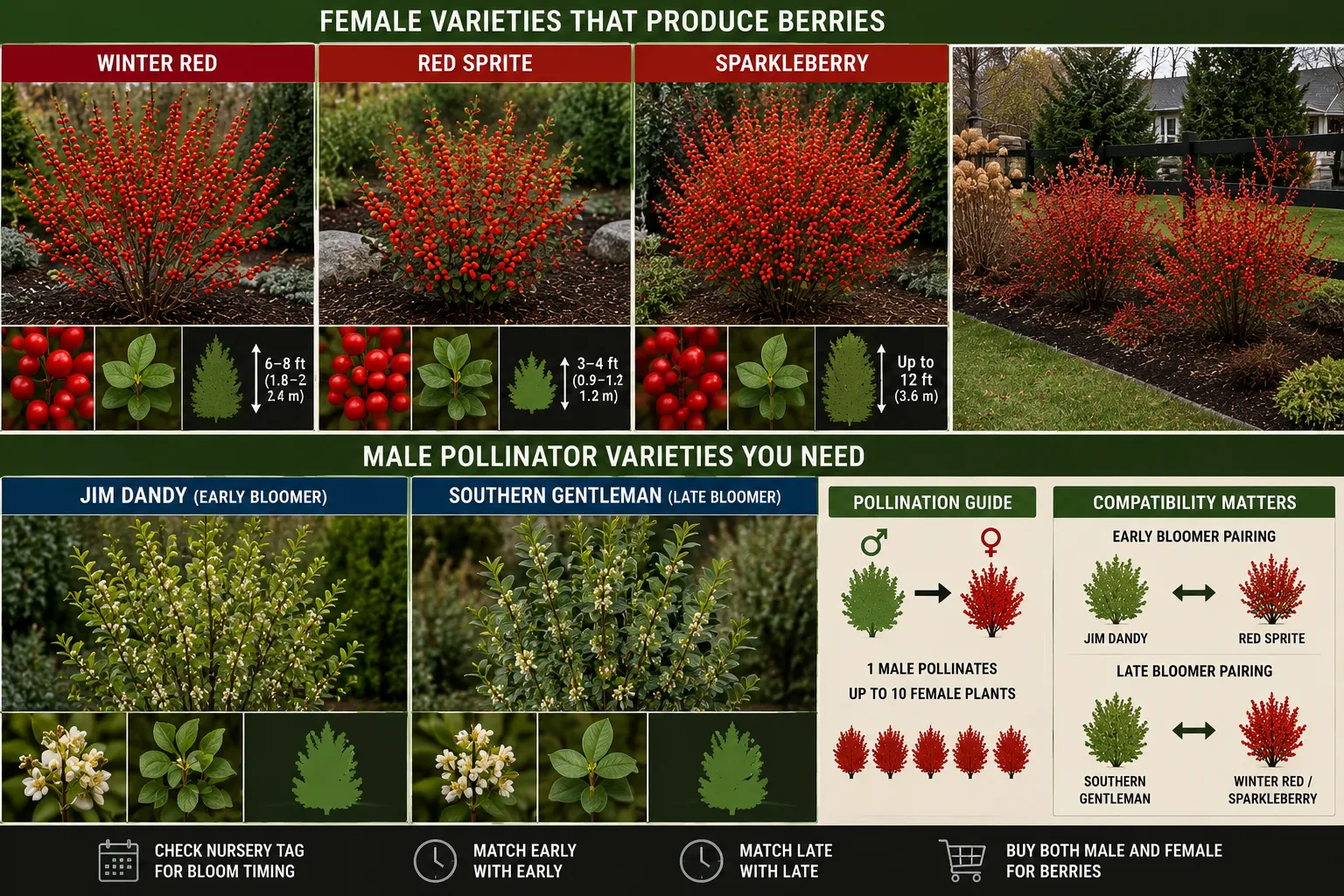
Female winterberry plants carry the berries gardeners want. 3 reliable varieties dominate the market:
- Winter Red — large red berries, grows 6 to 8 feet (1.8-2.4 m), heavy fruit production
- Red Sprite — compact at 3 to 4 feet (0.9-1.2 m), suited to small yards and containers
- Sparkleberry — early bloomer, large berry clusters, grows up to 12 feet (3.6 m)
Male Pollinator Varieties You Need
Male winterberry plants produce no berries but supply the pollen females need. 2 standard pairings work across most garden centers:
- Jim Dandy — early bloomer, pairs with Red Sprite and other early-flowering females
- Southern Gentleman — late bloomer, pairs with Winter Red and Sparkleberry
One male plant pollinates up to 10 female plants. Always check the nursery tag for bloom timing before buying — early and late bloomers do not pollinate each other even when planted side by side.
How to Plant Winterberry for Maximum Berry Production
To plant winterberry for maximum berry production, dig a hole twice the width of the root ball and water consistently through the first growing season.
Best Planting Time and Soil Depth
Late fall and early spring both work as planting windows. Fall planting lets roots establish before summer heat arrives. Spring planting works in colder zones where the ground freezes early.
- Dig a hole 8 inches (20 cm) deep and twice the width of the root ball
- Loosen the soil at the bottom to encourage downward root growth
- Mix compost into the removed soil at a 50/50 ratio
- Set the shrub at the same depth it sat in the nursery container
- Backfill, then water deeply to remove air pockets
Spacing Male and Female Plants Correctly
Space individual winterberry shrubs 3 to 5 feet (0.9-1.5 m) apart for a hedge effect, or wider for standalone specimens. Plant the male pollinator within 50 feet (15 m) of every female — closer spacing improves pollination rates in windy or low-bee-activity locations.
What Soil and Light Conditions Does Winterberry Need?
Winterberry needs acidic, loamy soil with a pH between 5.5 and 6.4, and at least 4 to 6 hours of direct sun daily for the strongest berry production. Light shade is tolerated but reduces flower count, which means fewer berries by winter.
Soil texture matters less than soil chemistry. Light sandy soil and heavy clay both support healthy winterberry as long as organic matter is mixed in and the pH stays acidic. Neutral or alkaline soil causes yellowing leaves even when watering and sunlight are correct.
Test soil pH before planting using a home soil test kit. If the reading sits above 6.5, mix in elemental sulfur or an acidifying amendment before backfilling the hole. A 2–3-inch (5-7.5 cm) layer of organic mulch options such as pine bark hold acidity and moisture better than hardwood or cedar mulch, which run closer to neutral ph.
Sun exposure directly controls flower count, and flower count controls berry count. A winterberry planted in full sun produces noticeably more blooms than the same variety in partial shade, even when soil conditions match exactly. Light shade still works for foliage health but expect a thinner berry display by October. Avoid deep shade entirely — flowering drops sharply and the plant survives without ever fruiting well.
Drainage matters as much as moisture. Winterberry tolerates occasional standing water far better than most shrubs, but constantly waterlogged soil with no oxygen exchange still causes root stress over time. A planting site with moderate drainage and consistent moisture, rather than a true bog, produces the strongest long-term growth.
How to Water Winterberry Through Each Season
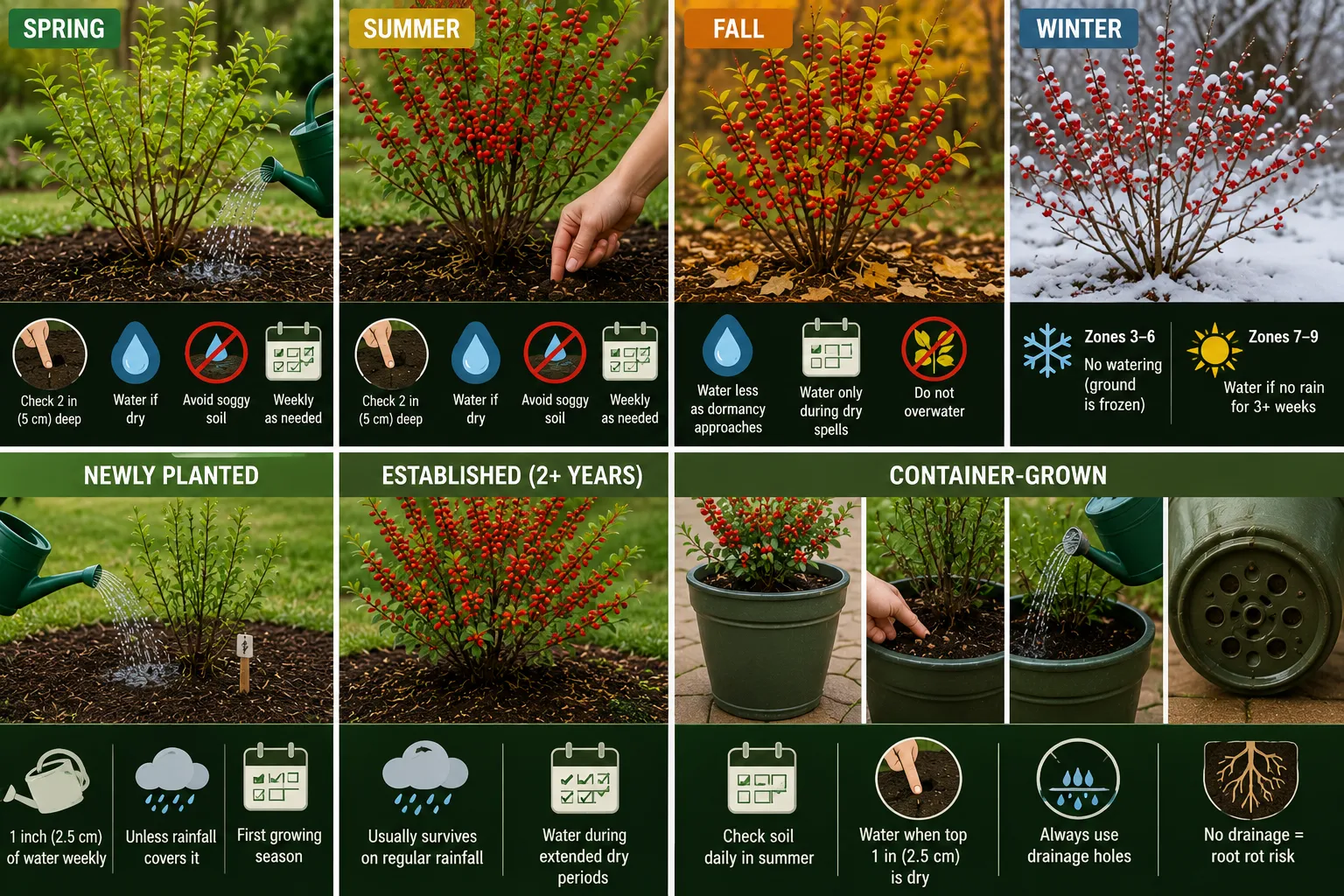
Newly planted winterberries need 1 inch (2.5 cm) of water weekly during the first growing season unless natural rainfall already covers that amount. Established plants, generally those past their second year, survive on regular rainfall in most climates.
Spring and summer require the closest attention. Check soil moisture by pushing a finger 2 inches (5 cm) into the ground near the root zone. Dry soil at that depth means it is time to water. Wet, soggy soil signals overwatering, which leads directly to root rot.
Fall watering tapers off as the plant moves toward dormancy. Winter watering stops entirely in Zones 3 through 6, where the ground freezes. In Zones 7 through 9, water occasionally during dry winter spells if no rain falls for 3 or more weeks.
Container-grown winterberry needs a different rhythm than in-ground plants. Pots hold far less moisture reserves, so check soil daily during summer heat and water whenever the top 1 inch (2.5 cm) feels dry. Use a container with drainage holes — without them, water collects at the base and causes the same root rot risk as overwatering in the ground.
Does Winterberry Need Fertilizer and Pruning?
Winterberry needs minimal fertilizer but specific pruning timing — feed it 3 to 4 times during the growing season, and prune only in early spring before new growth appears.
Fertilizing Schedule for Acidic Soil
Apply a fertilizer formulated for acid-loving plants, such as Espoma Holly-Tone, starting in April and continuing through mid-July. Stop fertilizing after mid-July to avoid pushing tender new growth that cannot harden off before frost.
- April — first application after new leaves emerge
- May to June — second and third applications, 4 to 6 weeks apart
- Mid-July — final application of the season
A yearly top-dressing of compost works as an alternative to granular fertilizer in soil already rich in organic matter.
Established winterberry, generally plants past their third growing season, needs less feeding than younger shrubs. Replacing the top 2 inches (5 cm) of soil with fresh compost once a year often supplies enough nutrition on its own, since winterberry draws most of its energy from sunlight rather than soil inputs.
Why Pruning Timing Determines Your Berry Crop
Winterberry blooms on old wood, which means the plant forms next year’s flower buds during late summer of the current year. Pruning in spring after buds form removes the upcoming berry crop entirely.
The correct window is early spring, before any new growth appears and before buds swell. At this stage, only dead, damaged, or crossing branches should come off. Avoid shaping cuts that remove healthy wood, since every cut removes potential flower buds.
Apply fresh mulch ring correctly around the base after pruning to protect roots and retain moisture through the rest of spring.
How to Fix the 4 Most Common Winterberry Problems
To fix common winterberry problems, match the symptom to its exact cause before changing your care routine — most fixes take 1 simple adjustment.
Problem 1: No Berries Despite Healthy Growth
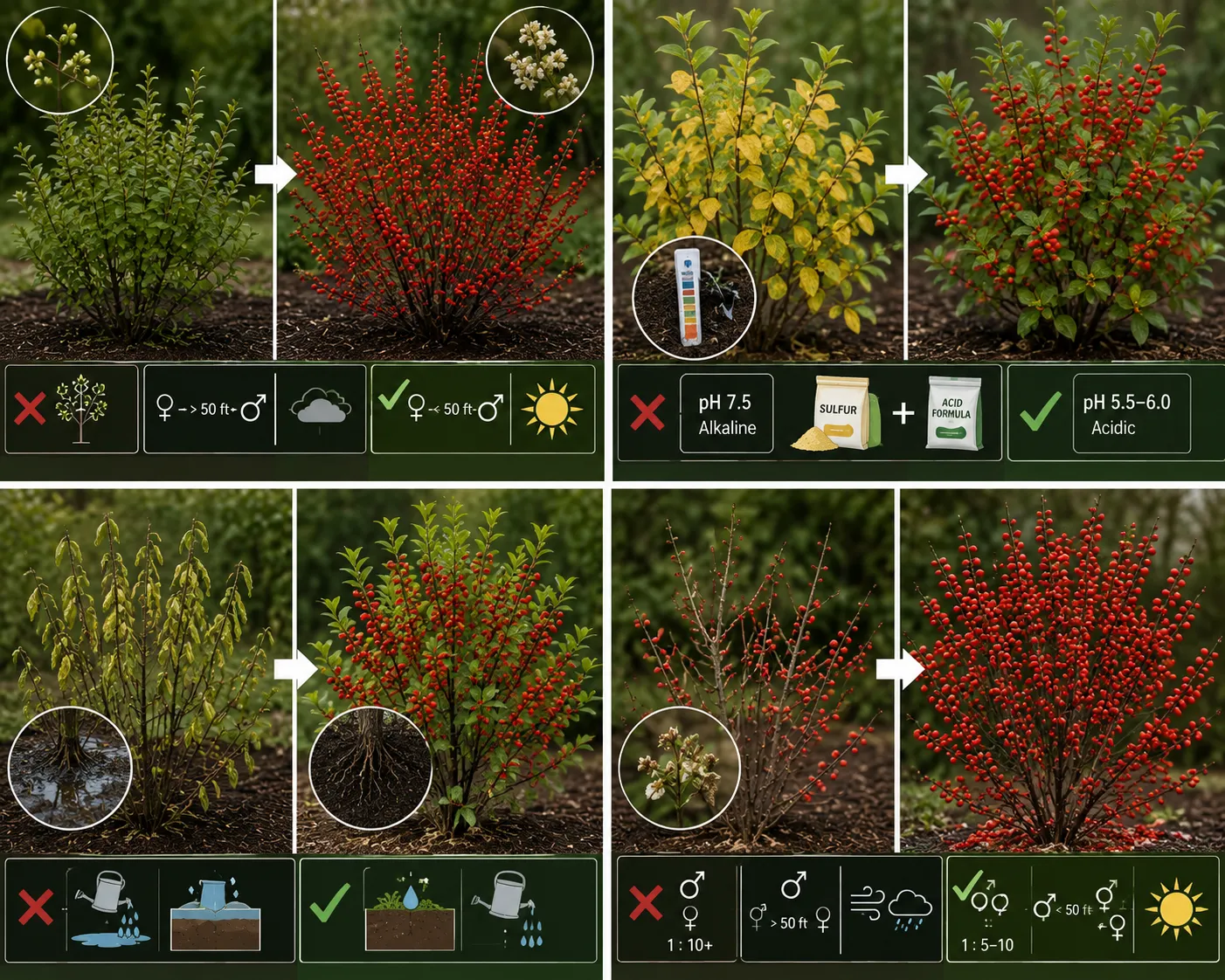
No berries usually means no male pollinator, an incompatible bloom time, or excessive shade.
Confirm a male plant sits within 50 feet (15 m) and shares the same early or late bloom group as the female. Move the plant to a location with at least 4 hours of direct sun if shade is the cause.
Problem 2: Yellowing Leaves
Yellowing leaves point to alkaline soil, overwatering, or nutrient deficiency, in that order of likelihood.
Test soil pH first. A reading above 6.5 starves the plant of iron even when iron is present in the soil. Acidify with sulfur and apply an acid-formulated fertilizer to correct yellowing within 1 growing season.
Problem 3: Root Rot and Wilting
Root rot comes from soggy, poorly drained soil sitting around the root ball for extended periods.
Replace waterlogged soil with fresh, well-draining material mixed with organic matter. Reduce watering frequency and confirm the planting site does not collect standing water after rain.
Problem 4: Sparse or Patchy Fruiting
Sparse fruiting signals too few male plants, a male planted too far away, or storm damage to spring flowers.
Increase the male-to-female ratio if 1 male currently serves more than 10 female plants. Move the male closer if distance exceeds 50 feet (15 m). Wind and rain during the spring bloom window can also reduce pollination naturally — this resolves the following year without intervention.
Quick-Reference Winterberry Care Schedule
Use this table to track every winterberry task by season.
| Task | Timing | Method | Difficulty |
| Plant winterberry | Late fall or early spring | Dig hole twice the width of root ball, 8 in (20 cm) deep | Easy |
| Water new plants | Weekly, year 1 | 1 in (2.5 cm) water unless rainfall covers it | Easy |
| Fertilize | April through mid-July | Acid fertilizer like Holly-Tone, 3-4 times per season | Easy |
| Mulch | Spring and fall | 2-4 in (5-10 cm) layer at the drip line | Easy |
| Prune dead wood | Early spring before buds swell | Cut to live tissue only, avoid old wood | Moderate |
| Check pollination | After bloom, midsummer | Confirm 1 male within 50 ft (15 m) of females | Moderate |
Frequently Asked Questions About Winterberry Care
Does winterberry need a male and female plant to produce berries?
Yes. Only female winterberry plants grow berries, and they need a nearby male within 50 feet (15 m) for pollination to occur.
Is winterberry safe for pets and children?
No. Winterberry fruit is toxic if ingested. Contact Poison Control at (800) 222-1222 immediately if a child or pet eats any part of the plant.
Can winterberry grow in clay soil?
Yes. Winterberry tolerates clay soil as long as compost is mixed in and the soil stays acidic, with a pH between 5.5 and 6.4.
How tall does winterberry grow?
Winterberry ranges from 3 feet (0.9 m) for dwarf varieties like Red Sprite to 15 feet (4.5 m) for the native species and Sparkleberry.
Should I prune winterberry every year?
No. Winterberry needs only occasional removal of dead or damaged wood in early spring. Annual shaping cuts reduce the following season’s berry crop.
Final Care Notes
Winterberry rewards correct setup more than ongoing effort. Get the soil pH, sun exposure, and male-female pairing right at planting, and the shrub produces a reliable berry display every winter for 20 years or more.
Pair your winterberry planting with an Eclipse Hydrangea Care guide if you are building a full acid-loving shrub bed — both plants share the same soil pH range and make strong companions in a winter-interest garden.