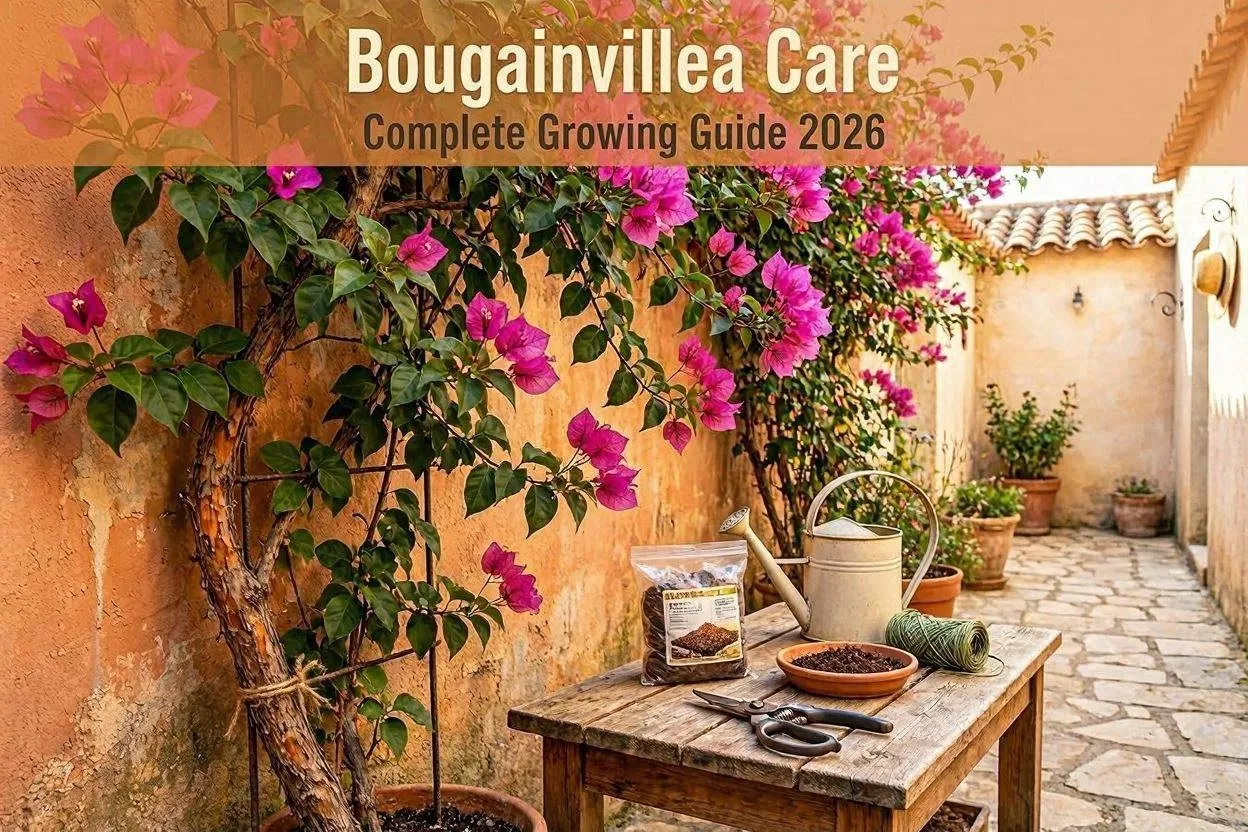
Bougainvillea care requires full sun (6+ hours daily), well-draining soil, and deep but infrequent watering — those 3 conditions drive the vivid bract color this plant is known for. Get them right and bougainvillea rewards you with multiple bloom flushes per year across USDA Hardiness Zones 9–11.
This guide covers every step of growing bougainvillea: choosing the right variety, planting, watering, fertilizing, pruning, training, troubleshooting, and overwintering in colder zones.
Bougainvillea Care Quick-Reference Table
Use this table to match every care task to its correct timing, method, and difficulty level.
| Task | Timing | Method | Difficulty | Notes |
| Planting | Spring (after last frost) | Full sun, loosen soil 12–18 in (30–46 cm) | Easy | Zones 9–11 outdoors |
| Watering (new plant) | Every 3–4 days | Deep soak, let soil dry between | Easy | Reduce once established |
| Watering (established) | Every 7–10 days | Deep, infrequent | Easy | Drought-tolerant |
| Fertilizing (in-ground) | Spring & fall | Low-N formula 5-10-10 | Easy | Skip in summer heat |
| Fertilizing (container) | Every 7–14 days | Diluted liquid feed | Moderate | High demand in pots |
| Pruning | After bloom flush / late winter | Cut back by 1/3 | Moderate | Promotes new growth |
| Training to trellis | Spring–summer | Tie canes horizontally | Moderate | Horizontal = more blooms |
| Overwintering (cold zones) | Fall (before first frost) | Move indoors, bright window | Moderate | Keep above 40°F / 4°C |
What Bougainvillea Actually Is and How It Grows
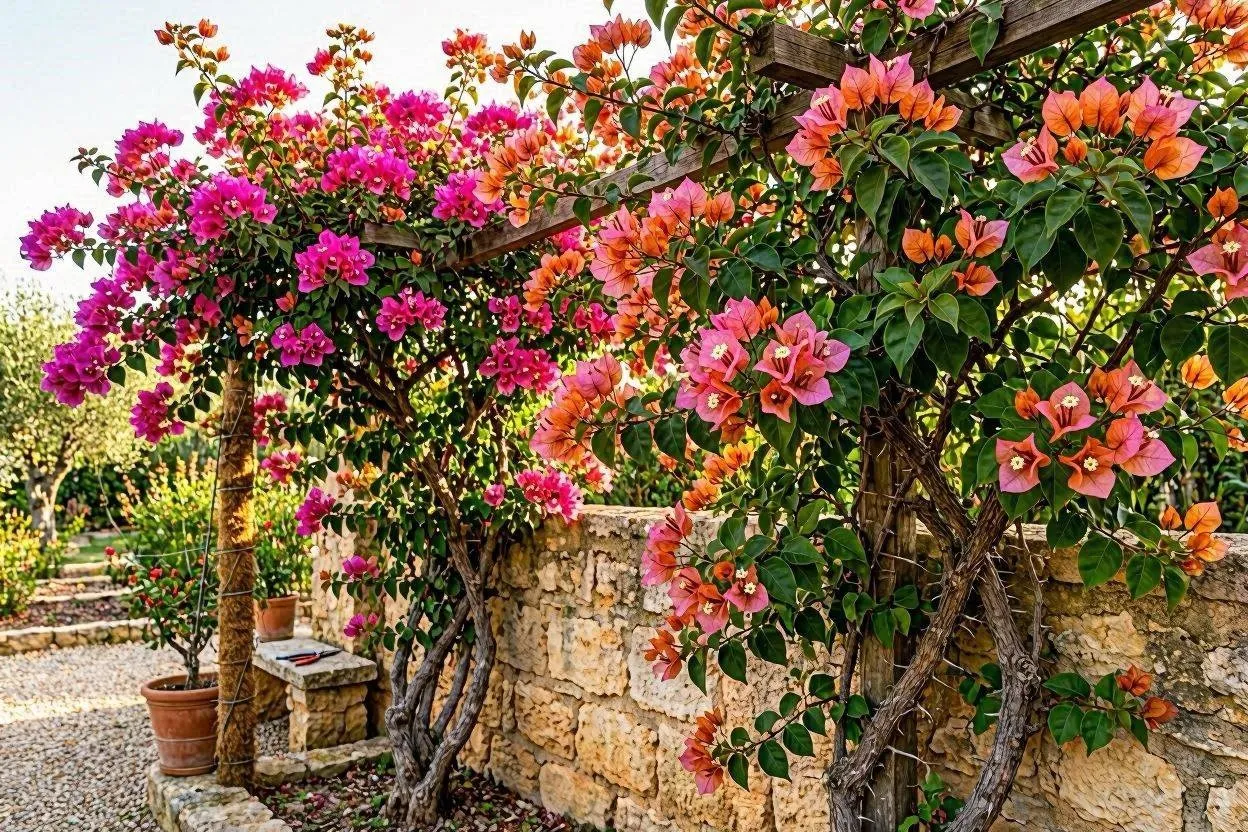
Bougainvillea belongs to the genus Bougainvillea in the family Nyctaginaceae. The 2 most common species grown in gardens are Bougainvillea glabra and Bougainvillea spectabilis. Both produce colorful bracts — modified leaves that surround the tiny white true flowers at their center.
The plant grows as a woody vine, reaching 15–40 feet (4.5–12 m) in ideal outdoor conditions. Bougainvillea does not cling or twine — it climbs by leaning and hooking its thorns into support structures. You must tie and guide bougainvillea manually.
Bougainvillea is a bloom-on-new-wood plant. Every time the plant produces new growth, it sets the stage for the next bloom flush. This fact governs the pruning and fertilizing schedule.
3 Growth Forms You Can Choose
Bougainvillea grows in 3 main forms depending on how you train and prune it:
- Climbing vine — tied to a trellis, fence, arbor, or pergola
- Compact shrub — pruned hard each season into a rounded, self-supporting bush
- Container plant — grown in a pot and moved indoors for winter in colder regions
Compact cultivars like Juanita Hatten and Bambino Baby Victoria stay under 3 feet (90 cm). Vigorous cultivars like Barbara Karst and San Diego Red reach 20+ feet (6 m).
How to Give Bougainvillea the Right Amount of Sun
To grow bougainvillea with maximum color, plant it in a spot that receives at least 6 hours of direct sunlight per day. Less sun produces fewer bracts and weak growth.
South-facing or west-facing walls absorb and radiate heat, which bougainvillea prefers. A spot near a hot driveway, stone wall, or brick fence works well in Zones 7–8 where extra warmth extends the growing season.
Plant bougainvillea away from overhead trees that cast afternoon shade. Bougainvillea flowers directly in proportion to sun hours — a plant receiving 8 hours per day blooms more heavily than one receiving 6.
Bougainvillea Care Starts with the Right Soil
Bougainvillea grows best in fast-draining, slightly acidic soil with a pH of 5.5–6.5. Heavy clay soils cause root rot, which kills the plant faster than almost any other mistake.
Before planting, loosen the soil to a depth of 12–18 inches (30–46 cm). Mix in one part coarse perlite or coarse sand to improve drainage. For container planting, use a cactus-and-succulent potting mix, or standard potting soil amended with 30% perlite.
Never add moisture-retaining crystals or dense peat to the planting hole. Bougainvillea roots need oxygen between waterings — waterlogged soil cuts off oxygen and invites fungal root rot.
How to Plant Bougainvillea in a Container
To plant bougainvillea in a container, choose a pot no more than 2 inches (5 cm) wider than the root ball. Bougainvillea blooms more freely in a slightly root-bound condition. A pot that is too large holds excess moisture and delays flowering.
Use a pot with drainage holes. Place a crape myrtle guide approach to container drainage — a layer of coarse gravel at the base reduces pooling without blocking the drain hole. Repot every 3–4 years in spring.
How to Water Bougainvillea Without Triggering Root Rot
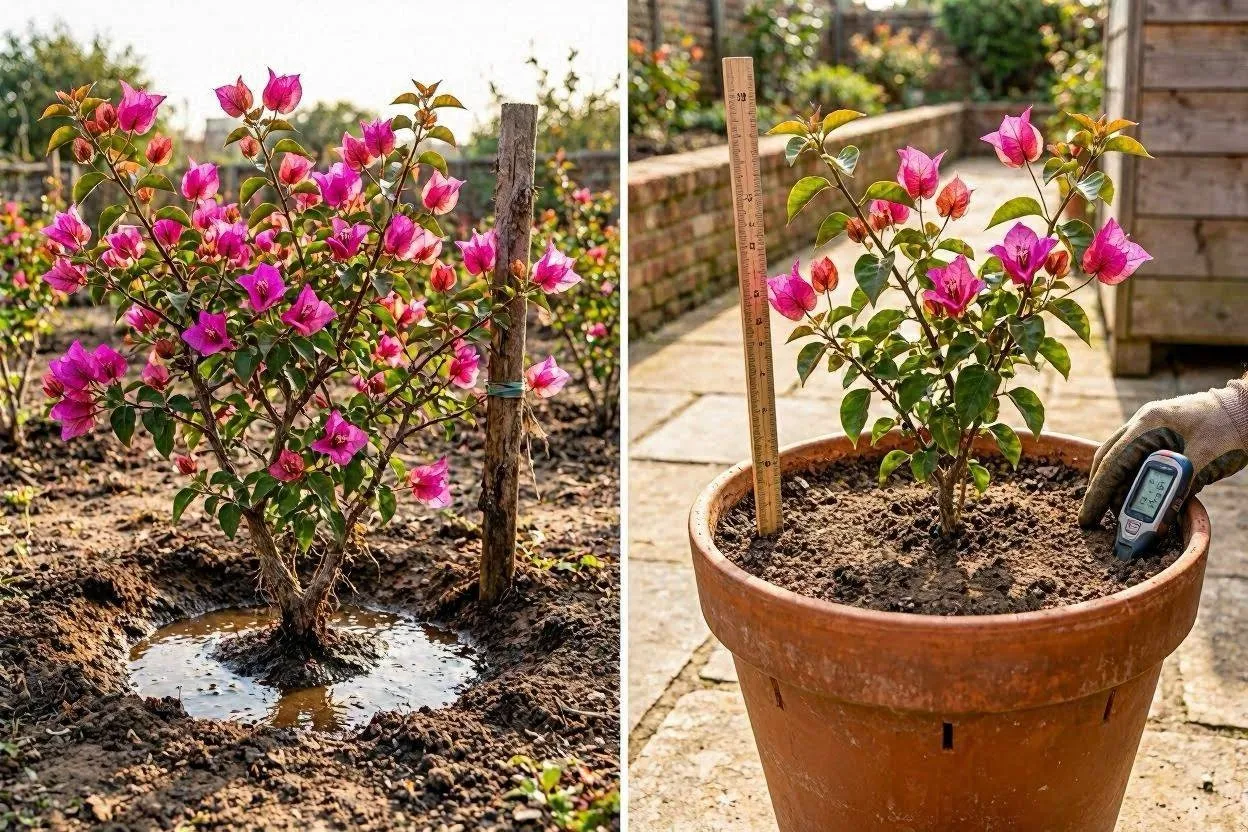
To water bougainvillea correctly, soak the root zone deeply, then wait until the top 2 inches (5 cm) of soil are dry before watering again. This cycle stresses the plant mildly and triggers bract production.
New transplants need water every 3–4 days for the first 4 weeks. After bougainvillea establishes, water every 7–10 days during summer. Container plants dry out faster than in-ground plants — check container soil every 2–3 days during hot weather.
Signs of overwatering: yellow leaves, soft stems, and leaf drop without flowering. Signs of underwatering: brown leaf edges, wilting at midday even in mild temperatures. Overwatering is the most common bougainvillea care mistake.
How Drought Stress Triggers Blooming
To trigger a bloom flush, reduce watering deliberately for 3–4 weeks before the desired bloom period. Bougainvillea responds to mild drought stress by redirecting energy from leaf production to bract formation.
Research from the University of Florida found bougainvillea flowers most profusely under high nitrogen feeding combined with 15 hours of darkness per 24-hour cycle. For home gardeners, the practical trigger is simply reducing water and cutting nitrogen fertilizer as summer heat peaks.
Bougainvillea Care: Fertilizer Schedule for Maximum Blooms
Feed in-ground bougainvillea twice per year — once in spring and once in fall — with a low-nitrogen, high-phosphorus fertilizer such as 5-10-10. High nitrogen pushes leaf growth and suppresses bract formation.
Container bougainvillea requires feeding every 7–14 days during the active growing season (spring through early fall). Use a water-soluble fertilizer diluted to half the label rate. Stop feeding container plants in October and resume in March when new growth appears.
Garden-grown bougainvillea in the ground does not need weekly feeding. The larger root system accesses nutrients from a broader soil zone. Skip fertilizer from June through August in hot climates — heat combined with nitrogen pushes soft, lush growth that is vulnerable to pests and cold damage.
For bloom-specific feeding, switch to a fertilizer with an NPK ratio near 6-30-30 for 4 weeks before the expected bloom flush. Phosphorus and potassium support flower bud development without stimulating excess foliage.
How to Prune and Train Bougainvillea for More Blooms
To prune bougainvillea for maximum blooms, cut stems back by one-third after each bloom flush ends. This removes spent growth and stimulates the new wood that carries the next set of bracts.
Hard pruning — cutting stems back by half or more — is best done in late winter or early spring before the main growth season. Hard pruning resets the plant shape, improves airflow, and produces a concentrated burst of new growth covered in bracts.
Always wear thick gardening gloves. Bougainvillea thorns are sharp enough to pierce skin through lightweight gloves. Use bypass pruners (such as Fiskars PowerGear2 or Felco F-2) for stems under 0.5 inch (1.3 cm), and loppers for anything thicker.
How to Train Bougainvillea on a Trellis
To train bougainvillea on a trellis, guide main canes horizontally or diagonally rather than straight up. Horizontal canes produce more lateral shoots, and lateral shoots are where bracts develop.
Tie canes with soft plant ties or garden twine — never wire, which cuts into bark as the stem thickens. Re-tie loosened sections every 6–8 weeks during the growing season. A bougainvillea trained horizontally along a fence produces 3–4 times more blooms than one allowed to grow straight up.
For a well-trained climber, see how the same lateral-shoot principle applies to vitex tree care — another blooms-on-new-wood plant that rewards structured pruning and training.
Bougainvillea Care by USDA Zone and Overwintering
Bougainvillea is reliably winter-hardy in USDA Hardiness Zones 10–11. In Zone 9, the plant survives with light frost protection but may die back to the ground below 28°F (-2°C). In Zones 7–8, grow bougainvillea in containers and bring the plant indoors each fall.
Move container bougainvillea indoors before the first frost date in your region. Place the plant in a south-facing window that receives 6+ hours of direct light. If natural light is insufficient, add a full-spectrum grow light positioned 12 inches (30 cm) above the canopy.
Keep indoor temperature above 40°F (4°C) at all times. Bougainvillea dies when exposed to temperatures below 30°F (-1°C) for more than a few hours. Water the plant sparingly indoors — approximately once every 10–14 days, allowing the soil to dry completely between waterings. Stop fertilizing from October through February.
How to Revive Bougainvillea After Winter
To revive bougainvillea after winter, move the plant outdoors gradually once night temperatures stay above 50°F (10°C). Place the plant in dappled shade for the first 5 days, then move it to full sun. This acclimatization prevents leaf scorch on growth that developed under lower indoor light.
Prune back any winter-damaged stems to living green tissue. Resume watering on a 7–10 day cycle. Begin fertilizing with a diluted half-strength balanced fertilizer (10-10-10) once the plant shows 1 inch (2.5 cm) of new growth.
How to Fix the 4 Most Common Bougainvillea Care Problems
Bougainvillea is resilient against most pests and diseases, but 4 problems appear frequently:
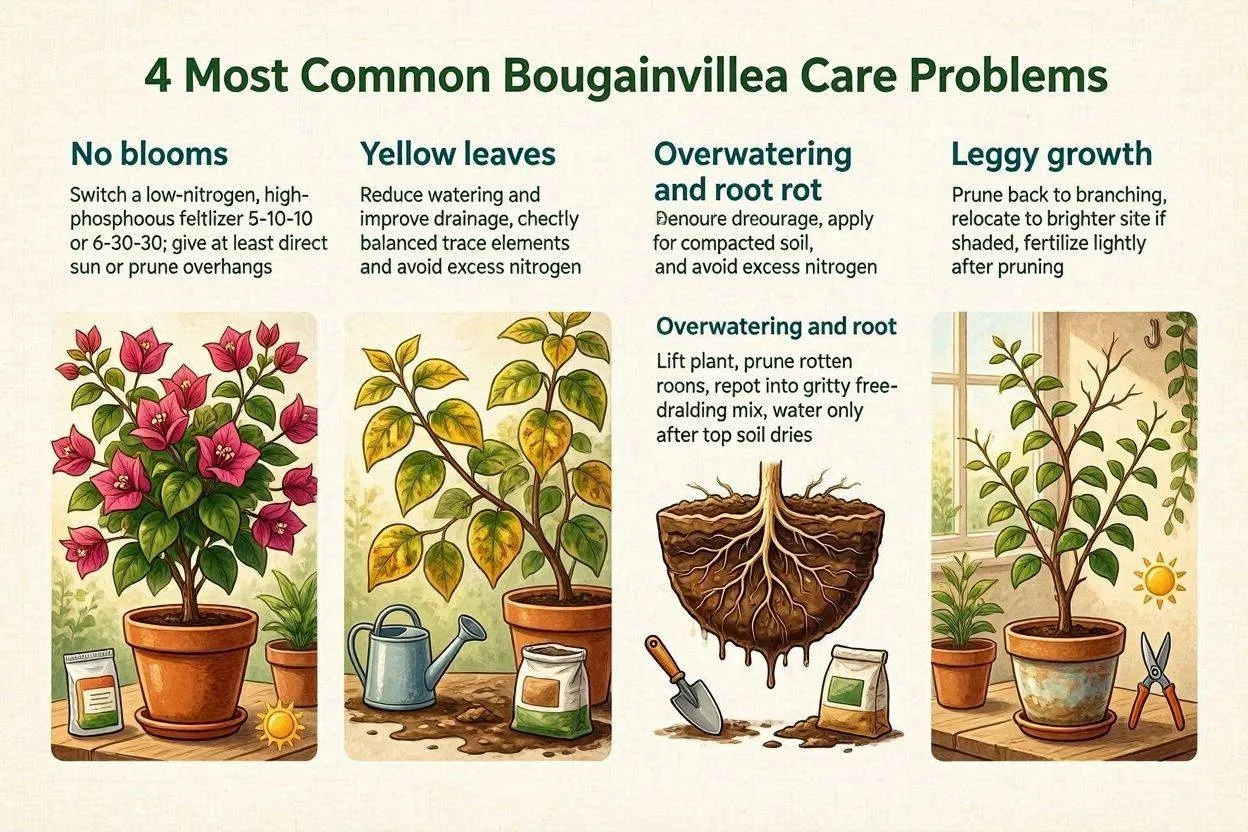
1. No Blooms Despite Healthy Leaves
The cause is excess nitrogen or insufficient sun. Switch from a high-nitrogen fertilizer to a low-nitrogen, high-phosphorus formula (5-10-10 or 6-30-30). If the plant gets under 6 hours of direct sun, relocate it or prune back overhanging branches to expose it to full sun.
2. Yellow Leaves
Yellow leaves signal overwatering or iron chlorosis — a mineral deficiency in alkaline soil. Let the soil dry completely before the next watering. If soil pH exceeds 6.5, apply chelated iron foliar spray (2 tsp / 9 ml per quart of water) directly to the leaves every 2 weeks for 4 applications.
3. Aphids and Mealybugs
Spray affected areas with insecticidal soap solution (1 tablespoon / 15 ml per quart of water) or neem oil (2 tablespoons / 30 ml per gallon of water). Apply at dawn or dusk to avoid burning foliage in direct midday sun. Repeat every 7 days until all signs of the infestation are gone.
4. Leaf Drop After Repotting or Moving
Bougainvillea drops leaves in response to root disturbance and changes in light levels. This is a temporary stress response, not a sign of death. Keep the plant in its new position, maintain consistent watering, and avoid fertilizing for 6 weeks. New growth appears once the root system reestablishes.
For a comparison of how other flowering plants respond to transplant stress, see the eclipse hydrangea care guide — which covers a similarly stress-sensitive blooming plant.
Frequently Asked Questions About Bougainvillea Care
Does bougainvillea grow well in containers?
Yes. Bougainvillea grows well in containers, and container growing is the recommended approach for gardeners in Zones 7–9. Use a pot 2 inches (5 cm) wider than the root ball, fast-draining cactus mix, and fertilize every 7–14 days during the growing season.
How often should you prune bougainvillea?
Prune bougainvillea after each bloom flush ends, which typically means 2–3 times per year. Light tip pruning (removing the top 2–4 inches / 5–10 cm of stems) encourages branching. Hard pruning by one-half is done once per year in late winter.
Why does bougainvillea drop leaves after watering?
Leaf drop after watering indicates overwatering. Bougainvillea roots need oxygen between waterings. Water only when the top 2 inches (5 cm) of soil are dry. Reduce watering frequency and check that the pot or planting site drains freely.
Can bougainvillea survive frost?
No, bougainvillea cannot survive hard frost. Temperatures below 30°F (-1°C) damage top growth, and temperatures below 25°F (-4°C) kill the root system. In Zone 9, cover the plant with frost cloth when a freeze is forecast. In Zones 7–8, move the plant indoors before the first frost date.
What fertilizer NPK ratio is best for bougainvillea blooms?
A 5-10-10 or 6-30-30 NPK ratio produces the best bloom results for bougainvillea. High phosphorus (the middle number) and high potassium (the third number) support flower bud development. High nitrogen (the first number) suppresses flowering and pushes leaf growth instead.
Start Growing Bougainvillea Right This Season
Bougainvillea thrives when you give it full sun, fast-draining soil, and a dry-down cycle between waterings. Prune after each bloom flush, train canes horizontally, and use a low-nitrogen fertilizer to keep bract color intense through multiple cycles each year. Follow the zone-specific overwintering steps if you garden in Zones 7–9, and your bougainvillea will return season after season.