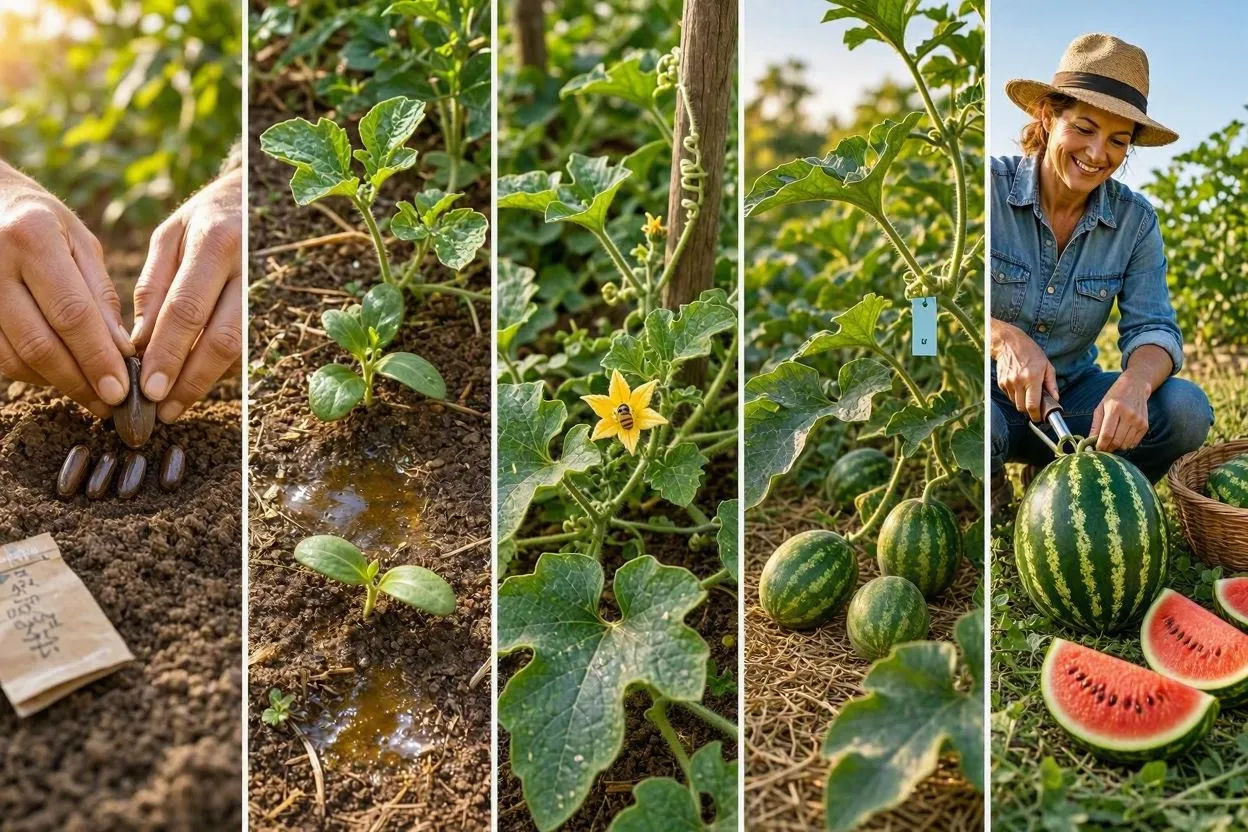
Growing watermelon (Citrullus lanatus) takes 80 to 120 days from planting to harvest, depending on the variety, and rewards patient gardeners with juicy, sweet, vitamin-rich fruit that beats anything sold at a grocery store produce aisle. This guide covers how to grow watermelon at every stage: soil prep, spacing, pollination, and pruning, and it ends with the exact signs that tell you a melon is ready to cut.
Three conditions decide whether a watermelon vine thrives or stalls: heat, space, and consistent moisture. Miss any one of them and flowers drop, fruit stays small, or vines rot before they ever set a melon fit for the kitchen table. Learning how to grow watermelon successfully means hitting all three at the right stage, starting with timing.
When to Plant Watermelon?
Plant watermelon outdoors once soil temperature holds above 70°F (21°C), usually two weeks after your region’s last frost date. Cold soil rots seeds before they germinate and stunts transplants for weeks afterward. A soil thermometer pushed 2 inches (5 cm) into the bed gives a far more reliable reading than air temperature alone.
Gardeners in northern states with short growing seasons should start seeds indoors 3 to 4 weeks before the last frost date, using peat pots that transplant without disturbing the roots. Warm-climate growers in USDA (United States Department of Agriculture) zones 8 through 10 can direct-sow as early as mid-April. Hold off if nighttime temperatures still dip below 50°F (10°C). Watermelon seedlings exposed to cold nights rarely recover their growth rate even after conditions warm back up.
Black plastic mulch laid over the bed a week before planting raises soil temperature by several degrees and can shave 7 to 10 days off the wait. Floating row covers add frost protection for early transplants but need to come off once male and female flowers appear, since pollinating insects can’t reach covered blossoms.
How to Prepare the Soil for Watermelon
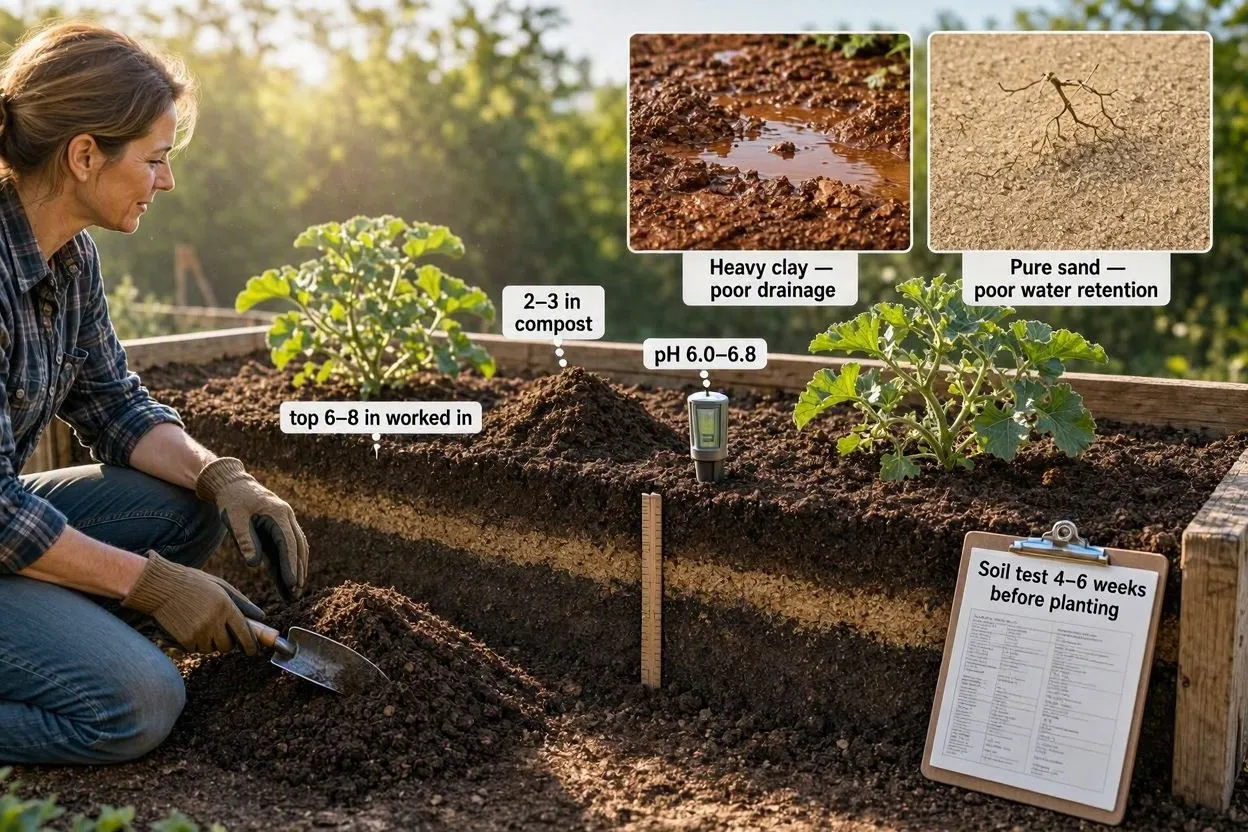
Watermelon grows best in loose, well-drained soil with a pH between 6.0 and 6.8, enriched with 2 to 3 inches (5 to 7.6 cm) of compost worked into the top 6 to 8 inches (15 to 20 cm). Heavy clay holds water around the roots and encourages rot. Pure sand drains too fast to keep vines fed through a 90-day fruiting cycle.
A soil test taken 4 to 6 weeks before planting shows exactly what a bed needs. Gardeners without test results can still improve fertility by mixing in aged manure or a balanced organic fertilizer at planting time. Watermelon plants pull heavily on nitrogen, phosphorus, and potassium throughout the season, and thin soil shows up fast as pale leaves and stunted vines.
Raised beds warm faster than in-ground rows, which matters most for gardeners north of USDA zone 6. Fill a new bed with 50% topsoil, 30% compost, and 20% coarse material such as perlite or coarse sand, so drainage stays sharp without the soil drying out between waterings. Good soil is what turns a vine into a fruit-heavy harvest, since watermelon pulls most of its sugar and water content straight from what’s available at the root.
How Far Apart to Space Watermelon Plants
Space watermelon plants 3 to 5 feet (0.9 to 1.5 meters) apart in rows set 7 to 10 feet (2.1 to 3 meters) apart, since vines can spread 10 to 20 feet (3 to 6 meters) in a single season. Crowded plants compete for light and airflow, raising the risk of fungal disease on the lower leaves.
Traditional growers plant in hills instead of straight rows. Each hill holds 6 to 8 seeds sown ½ inch (1.3 cm) deep, thinned down to the strongest 2 to 3 seedlings once true leaves appear. Space hills at least 6 feet (1.8 meters) apart, measured center to center.
Bush varieties change these numbers entirely. Cal Sweet Bush, for example, grows on vines under 24 inches (61 cm) long and fits in a 3-foot (0.9-meter) container, one of the few watermelon cultivars suited to patios and tight raised beds.
Can You Grow Watermelon in a Raised Bed or Container
Yes, watermelon grows well in a raised bed if you plant it at the bed’s edge and let the vines trail outward over the pathway, keeping only the root zone inside the bed. This method lets gardeners grow watermelon alongside other crops instead of dedicating an entire bed to one sprawling plant.
Compact and bush varieties extend the option to containers. Bush Sugar Baby and Cal Sweet Bush both stay under 3 feet (0.9 meters) of vine length and produce full-size, table-ready fruit in a 5-gallon (19-liter) or larger container, provided the container gets at least 8 hours of direct sun daily. A single well-fed container plant can still supply enough fresh fruit for a small household’s summer snacking.
Raised beds carry one real advantage over in-ground rows: faster soil warming. A raised bed can run 5 to 10°F (3 to 6°C) warmer than surrounding ground soil in early spring, letting gardeners in cooler zones plant watermelon 1 to 2 weeks earlier than a traditional row allows.
How to Plant Watermelon From Seed or Transplant
Direct-sow watermelon seeds ½ to 1 inch (1.3 to 2.5 cm) deep once soil temperature clears 70°F (21°C), or set out transplants with 2 to 3 true leaves after hardening them off for 5 to 7 days. Direct-sown plants generally outperform transplants, because watermelon roots resent disturbance. A seedling that loses even a few root hairs during transplant can lag a full week behind a direct-sown neighbor.
Seeds germinate in 4 to 12 days at proper soil temperature. Cooler soil slows germination and raises the odds of rot before sprouting. Use 3-inch (7.6 cm) biodegradable pots that go straight into the ground if starting seeds indoors, since bare-root transplanting sets growth back by 7 to 10 days in most cases.
Water the planting hole thoroughly before setting in a transplant, then water again right after backfilling. Skipping that second watering leaves air pockets around the roots that dry out fast in warm soil.
How Much Water Does Watermelon Need
Watermelon needs about 1 to 2 inches (2.5 to 5 cm) of water per week, delivered in one or two deep soakings rather than frequent shallow watering. Deep watering pushes roots downward, where plants can reach moisture during dry spells. Shallow, frequent watering keeps roots near the surface and leaves plants more vulnerable to drought stress.
Soaker hoses or drip irrigation outperform overhead sprinklers for watermelon, since wet foliage spreads fungal disease. Water in the morning if you’re using any overhead method at all, giving leaves time to dry before evening. Vines wilting slightly at midday in full sun is normal; vines still wilted at 7 p.m. signal a genuine watering problem.
Cut watering back sharply during the final 1 to 2 weeks before harvest. Withholding water at this stage concentrates sugars in the fruit, while heavy watering right before picking dilutes flavor and can split ripe melons open on the vine. This final dry-down is one of the biggest factors separating a bland, watery melon from one with dense, sweet flesh at the table.
How to Fertilize Watermelon Through the Growing Season
Feed watermelon with a nitrogen-heavy fertilizer during the first 3 to 4 weeks of growth, then switch to a phosphorus- and potassium-heavy formula once flowering begins. Nitrogen builds the leafy vine structure a plant needs before it can support fruit. Too much nitrogen after flowering starts pushes leaf growth at the expense of blossoms and fruit set.
A slow-release granular fertilizer applied at planting covers the early nitrogen phase without much follow-up work. Switch to fish emulsion, kelp meal, or a bloom-formula fertilizer once the first yellow flowers open, applied every 1 to 2 weeks in a ring 12 to 18 inches (30 to 46 cm) from the base of each plant.
Stop fertilizing entirely 1 to 2 weeks before expected harvest. A vine still pushing new leafy growth at that point is spending energy on foliage instead of ripening fruit. Potassium plays a key role in the sugar accumulation that shapes how sweet the final produce tastes.
How Watermelon Pollination Works
Watermelon plants produce separate male and female flowers on the same vine, and only bees moving pollen between them can set fruit. Male flowers open first, sometimes a full week before any female blossoms appear. Their natural drop-off after opening doesn’t signal a problem with the plant. Female flowers carry a small swollen bulb at the base that becomes the fruit once pollinated successfully.
Even seedless watermelon varieties need pollination to trigger fruit development, despite producing no viable seeds themselves. Growers planting seedless types must interplant a standard seeded variety nearby to supply fertile pollen, since seedless plants can’t complete the process on their own.
Hand-pollination solves the problem for gardeners seeing flowers but no fruit. Use a small paintbrush to transfer pollen from a male flower’s center directly onto a female flower’s stigma between 6 and 10 a.m., when pollen viability peaks. This step matters most in cool, cloudy spring weather, when bee activity drops and natural pollination slows down.
How to Prune Watermelon Vines
Prune watermelon to one main vine around day 40 of growth if you want fewer, larger fruit, or leave multiple vines if you’d rather have more, smaller melons. A single-vine plant typically produces 2 to 3 large fruit per season. A multi-vine plant can produce 4 to 6 smaller ones from the same root system.
Weekly light pruning keeps plants healthier no matter which method you choose. Remove any leaves showing yellowing, browning, or fungal spotting, since damaged foliage pulls energy away from fruit development without contributing sugar production in return. Avoid heavy pruning close to harvest: leaves shade developing fruit from sunscald and keep feeding sugars into the melon until the moment growers cut it.
Sharp, clean pruning shears prevent the ragged cuts that invite disease into a vine. Wipe blades with rubbing alcohol between plants when working through a bed with any sign of fungal infection.
Common Watermelon Pests and Diseases
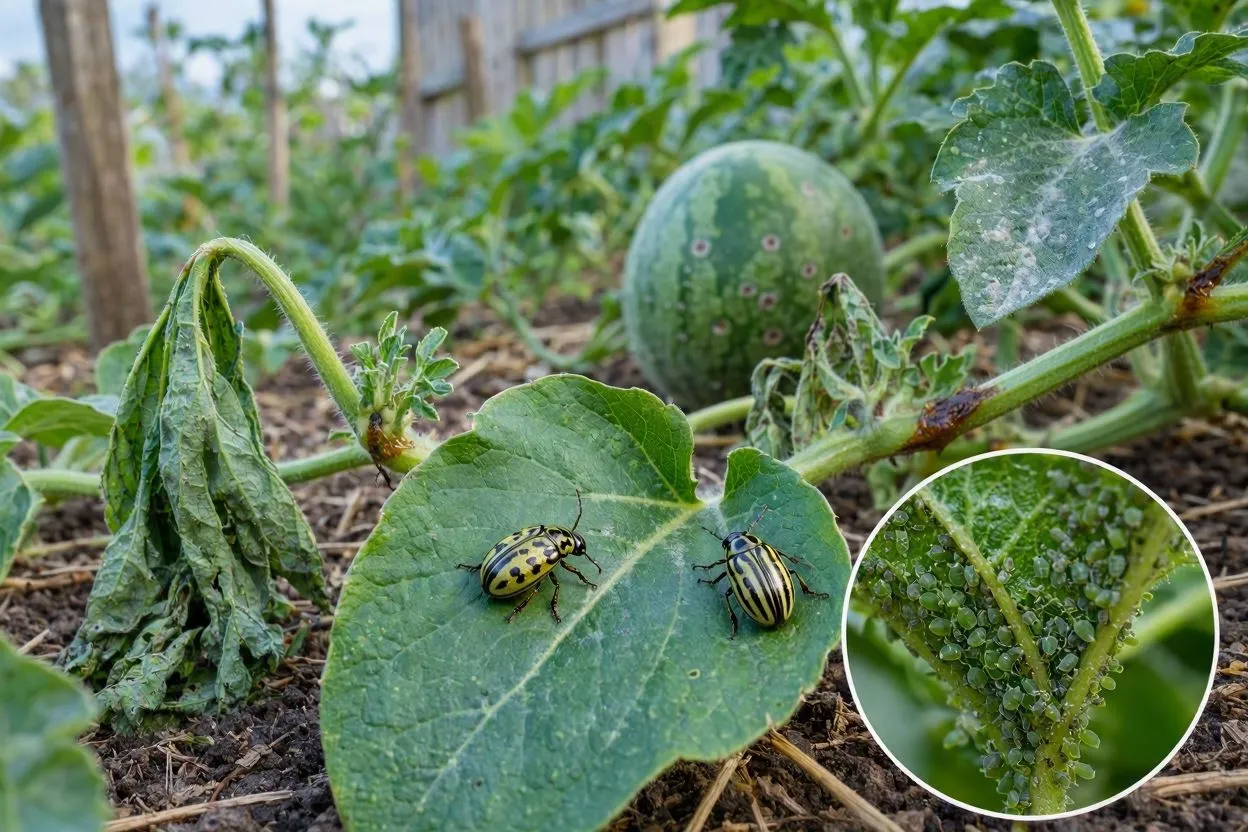
Cucumber beetles and melon aphids cause the most damage to home watermelon crops, while downy mildew, powdery mildew, anthracnose, and gummy stem blight account for most disease losses. Spotted and striped cucumber beetles feed on leaves and transmit bacterial wilt, a disease with no cure that collapses vines within days of infection.
Inspect leaf undersides every few days during the first month after planting, since aphid colonies build fast and hide from casual glances. Insecticidal soap controls light aphid infestations without harming pollinators, provided you spray in the evening after bees have finished foraging for the day.
Fungal diseases spread through wet foliage, so drip irrigation and morning watering cut infection risk more than any fungicide applied after symptoms appear. Alternaria leaf spot and downy mildew both start as small yellow or brown spots on lower leaves. Catching them within the first week and removing affected foliage often stops the spread before it reaches the fruit.
How to Tell When a Watermelon Is Ripe
A ripe watermelon shows four signs at once: a yellow, not white, ground spot where it touched the soil; a dried and browned tendril nearest the fruit stem; dull rather than shiny skin; and a deep hollow sound when tapped. A dull thump alone can also mean an overripe, mushy melon, so cross-check it against the ground spot and tendril rather than trusting the tap test by itself. A perfectly ripe melon delivers crisp, deep-red flesh loaded with natural sugars.
Days-to-maturity listed on a seed packet gives a starting window, but weather shifts that number by a week or more in either direction. Crimson Sweet typically matures in 80 to 85 days; a personal-size variety like Sugar Baby can be ready in as few as 75.
Watermelon stops ripening the moment growers cut it from the vine. A melon picked too early stays underripe and bland permanently. Unlike tomatoes or bananas, there’s no post-harvest ripening stage, which makes getting the timing right more important with this fresh-eating fruit than with almost any other garden produce.
How to Harvest and Store Watermelon
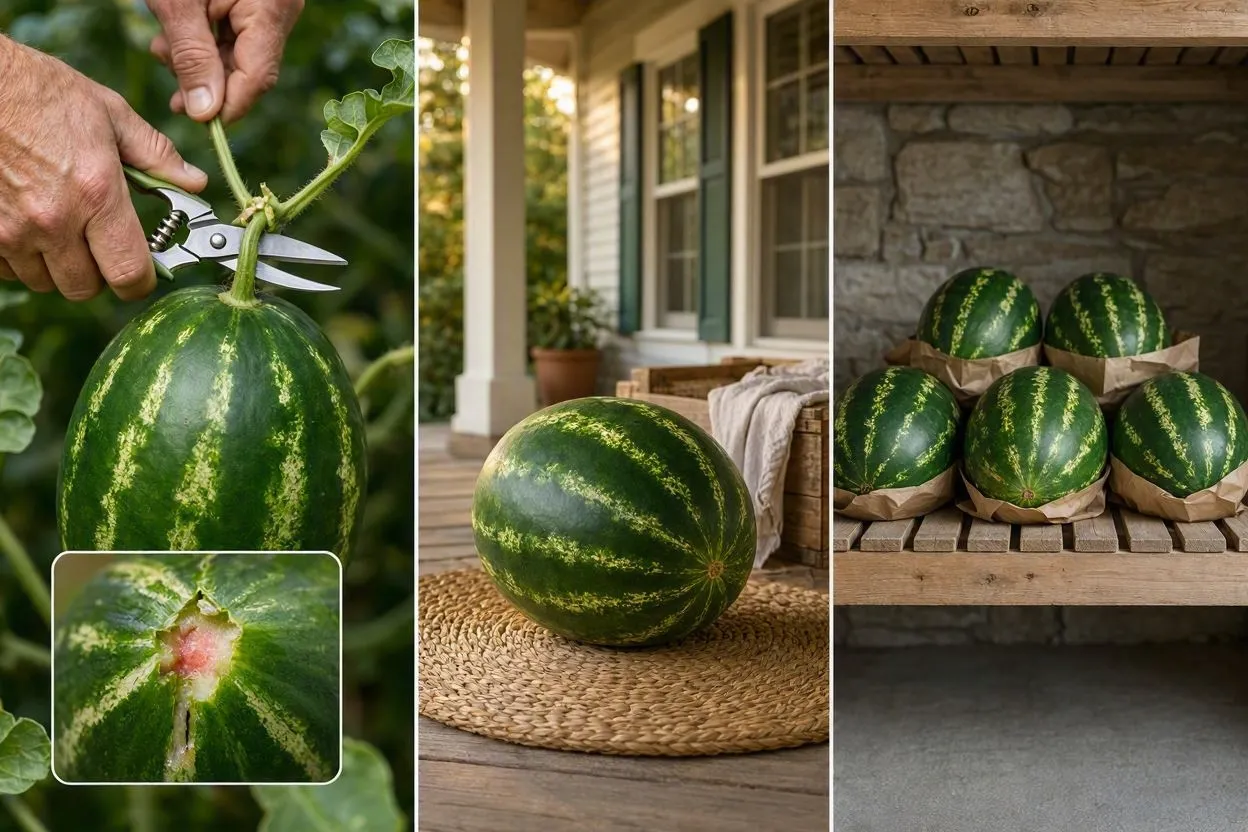
Cut watermelon from the vine with a sharp knife or pruning shears, leaving 2 inches (5 cm) of stem attached, rather than twisting or pulling the fruit free. Pulling a ripe watermelon can tear the rind at the stem end, opening a path for bacteria that shortens storage life within days.
An uncut watermelon keeps for 2 to 3 weeks at room temperature in a cool, shaded spot, and up to 3 weeks if held between 50 and 60°F (10 to 15.5°C). Wrap the remaining flesh tightly and refrigerate it once cut, since cut watermelon holds quality for only 3 to 5 days before texture and flavor start to decline.
One healthy plant typically yields 2 to 4 fruits across a season. A single Crimson Sweet vine in good soil with steady watering can produce three 15- to 25-pound (6.8- to 11.3-kg) melons, enough sweet, homegrown fruit to share at the table or give away to neighbors, before the growing season ends.
How to Save Watermelon Seeds
Save watermelon seeds by scooping them from a fully ripe melon, rinsing off the pulp in a strainer, and drying them on a paper plate or coffee filter for 5 to 7 days before storage. Seeds saved this way stay viable for up to 5 years when kept in an airtight container in a cool, dark location.
Cross-pollination is the main risk to seed purity. Separate different watermelon varieties by as much distance as your garden allows, since bees routinely carry pollen several hundred feet, or hand-pollinate and bag individual flowers if you’re growing more than one type and want true-to-type seed the following year.
A single fruit produces enough viable seed to plant next season, though collecting from 5 to 10 plants when possible keeps genetic diversity higher. That diversity helps a home-saved variety hold its vigor and disease resistance over repeated generations, rather than narrowing and weakening the way seed from one isolated plant can over time.
Frequently Asked Questions
How long does watermelon take to grow?
Watermelon takes 80 to 120 days from planting to harvest. Personal-size varieties mature faster, often in 75 to 85 days, while large traditional types need the full 100-plus days to reach peak sweetness.
Do watermelons need full sun?
Yes, watermelon needs 8 to 10 hours of direct sunlight daily. Less light slows vine growth, delays flowering, and produces smaller, less sweet fruit even in otherwise good soil.
Can watermelon grow on a trellis?
Yes, watermelon vines can climb a trellis, but fruit over 5 pounds (2.3 kg) needs a sling for support. Smaller varieties like Sugar Baby trellis more successfully than large traditional cultivars.
Why are my watermelon flowers falling off without fruit?
Early male flowers naturally drop after opening and don’t indicate a problem. Insufficient pollination or extreme heat above 95°F (35°C) is the likely cause if female flowers drop without fruiting.
Does watermelon get sweeter after picking?
No, watermelon stops ripening once cut from the vine. Sugar content locks in at harvest, unlike climacteric fruit such as bananas or tomatoes that keep ripening after picking.
Is watermelon a fruit or a vegetable?
Botanically, watermelon is a fruit, since it develops from a pollinated flower and carries seeds, though it belongs to the same family as cucumbers and squash. In the kitchen, most people treat it as fresh fruit, eating it raw, blended into juice, or tossed into a produce-heavy summer salad.
What can I do with a homegrown watermelon?
Sliced, cubed, or juiced, watermelon works as a low-calorie, high-water-content snack, and it holds up well in fruit salads, smoothies, and summer produce platters once chilled.
Conclusion
Growing watermelon comes down to four things: warm soil, enough space, steady water, and the right fertilizer switch at flowering. Every technique in this guide, raised-bed edge planting, hand pollination, and reading the ground spot at harvest, solves one of those core requirements instead of adding complexity for its own sake. Get the timing and spacing right, check all four ripeness signs together instead of trusting the tap test alone, and a single well-tended vine will reward you with two to four sweet, juicy melons, homegrown fruit ready for the table, before the season ends.