To grow grapes in a home garden, plant a hardy variety in full sun with well-drained soil, space vines 6 to 8 feet (1.8 to 2.4 meters) apart, water deeply during the first two years, and prune hard every winter to keep the vine productive. Grapes (Vitis vinifera and related cold-hardy hybrids) are woody perennial vines that suit a backyard fence, patio arbor, or garden trellis, and most varieties produce their first small harvest within one to three years of planting. Gardeners in the United States and the United Kingdom (UK) can grow grapes in open garden beds, in large patio containers, or under glass, as long as the planting site gets at least 6 to 8 hours of direct sun a day.
The sections below cover variety selection, garden planting, watering, pruning, pest control, propagation, and harvest timing, with specific numbers drawn from university extension research and gardening societies on both sides of the Atlantic.
What You Need Before You Start Growing Grapes
A home garden needs full sun, well-drained soil, and open space before you put a single grape vine in the ground. A garden bed with less than 6 hours of direct sun daily will produce weak growth and sour, underripe fruit, so shade is the first thing to rule out when scouting a planting spot. Climate matters just as much as sun, since the right cultivar changes by hardiness zone, and each vine needs a support structure strong enough to carry mature growth, which gets heavy fast. A single vine trained over a patio pergola or garden arbor can weigh several hundred pounds (over 100 kilograms) once fully grown, so a flimsy fence post won’t hold up past year three.
| Requirement | Guideline | Notes |
| Sunlight | 6 to 8 hours direct sun daily | Less sun means weak growth and sour, underripe fruit |
| Soil pH | 6.0 to 7.0 | Heavy clay or waterlogged garden beds will rot the roots within a season |
| Vine spacing | 6 to 8 feet (1.8 to 2.4 meters) | Measured between vines along a fence, trellis, or row |
| Support structure | Sturdy fence, trellis, pergola, or arbor | Must hold several hundred pounds (over 100 kilograms) once mature |
| US climate zone | USDA zones 4 through 10 | Zone 3 to 4: cold-hardy hybrids like Frontenac or Marquette. Zone 7 to 10: classic varieties like Cabernet Sauvignon or Thompson Seedless |
| UK site guidance | Warm, sheltered, south-facing spot | RHS recommendation, since most of the UK sits outside the reliable outdoor ripening range without one |
How to Choose the Right Grape Variety
To choose the right grape variety, match your climate zone first, then pick based on how you plan to use the fruit, fresh eating, juice, jelly, or wine. Skipping this order causes most first-time failures, because a Thompson Seedless vine planted in Minnesota will die in the first hard freeze no matter how well it’s cared for.
- Table grapes for fresh eating: Reliance, a sweet seedless red that fruits early and tolerates cooler UK summers; Thompson Seedless, a mild greenish-gold variety that thrives in hot, dry climates like Arizona; and Sovereign Coronation, an RHS Award of Garden Merit (AGM) winner with dark blue-purple, musky-sweet fruit that performs well in British gardens.
- Cold-hardy varieties for northern gardens: Frontenac, Marquette, and LaCrescent, developed by the University of Minnesota, survive winters down to negative 30 degrees Fahrenheit (negative 34 degrees Celsius) and still produce respectable fruit and juice.
- Warm-climate varieties: Cabernet Sauvignon, Grenache, and Pinot Noir need a longer, hotter growing season to ripen fully and suit gardens in warmer USDA zones.
- Dual-purpose varieties: Concord, developed in Massachusetts in the 1840s, works for fresh eating, juice, and jelly, and remains one of the most cold-hardy seeded grapes available for northern gardens.
How to Plant Grape Vines Step by Step
To plant grape vines, set bare-root stock in early spring, after the soil can be worked but before new growth starts, and set potted vines any time from spring through fall. Bare-root vines arrive dormant and need extra prep that potted ones don’t.
Follow these steps for bare-root planting:
- Soak the roots in a bucket of clean water for 3 to 4 hours before planting.
- Dig a hole wide enough to spread the roots out fully, without bending or crowding them.
- Trim any broken or excessively long roots back to healthy tissue with clean shears.
- Position the vine so the graft union sits 4 to 6 inches (10 to 15 centimeters) above the finished soil level.
- Backfill with the original soil, firming gently as you go, and water immediately with at least 2 gallons (7.6 liters).
- Mound loose soil over the newly planted vine to protect it from drying out, then remove the mound once green shoots appear.
If you’re planting more than one vine, space them 6 to 8 feet (1.8 to 2.4 meters) apart in a row, and leave 8 feet (2.4 meters) between rows if you want equipment or a wheelbarrow to pass through. Mulch isn’t recommended right at the base of a new vine, since grape roots prefer warm soil and mulch keeps the ground too cool during the critical first growing season.
How to Grow Grapes in Containers or a Greenhouse
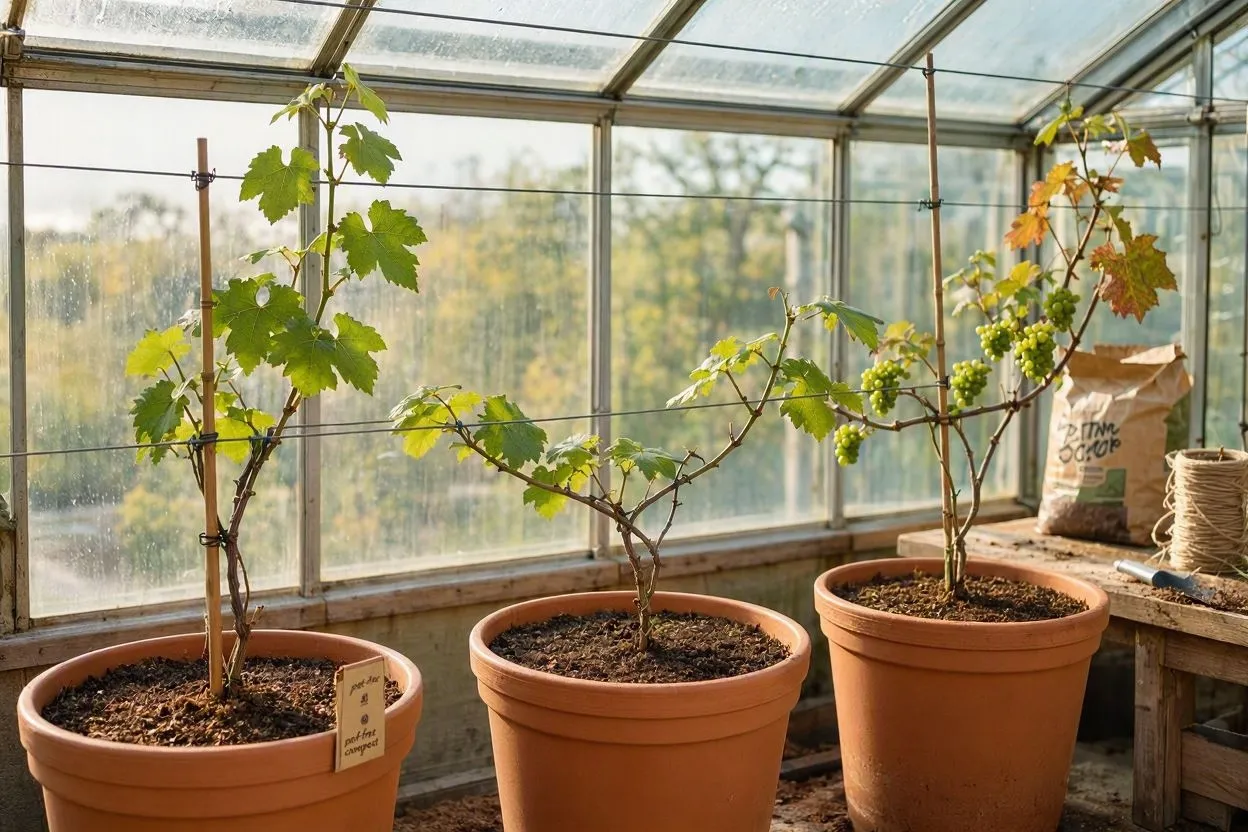
To grow grapes in a container or greenhouse, use a pot at least 12 inches (30 centimeters) wide and deep, or train the vine along horizontal wires under glass. Gardeners without in-ground space can still get a real harvest this way, and it’s a common approach for UK growers whose outdoor summers run too cool for dessert varieties.
Container vines need a soil-based, peat-free compost and a single-stem “standard” training method to stay compact. Water them often, since pot-bound roots dry out fast, and leave the pot outside in winter cold for four to six weeks even with a heated greenhouse nearby, because the vine needs that chill to flower well in spring. Greenhouse vines can go inside the structure or just outside it, with the trunk fed in through a gap near the base; planting outside cuts watering, since the roots stay in open ground while the fruiting canes get the warmth of the glass. Keep vents open through summer and autumn. Still, humid air is exactly what powdery mildew needs to spread, so airflow protects both pollination and plant health.
How Much Water and Fertilizer Grape Vines Need
New grape vines need roughly 5 gallons (19 liters) of water per week during the first two growing seasons, applied directly to the root zone rather than over the leaves. Wetting the foliage encourages fungal disease, so drip irrigation or a soaker hose works far better than an overhead sprinkler. Fertilizer needs to stay light by comparison: a spring application of compost around the base covers most young vines, and feeding should stop entirely once the grapes start to ripen, since extra nutrients at that stage can dull the fruit’s flavor.
| Growth Stage | Watering | Fertilizer |
| Year 1 to 2 (establishing) | About 5 gallons (19 liters) per week to the root zone | Compost around the base each spring |
| Year 2+ outdoor, average rainfall | Little to no supplemental watering needed | Compost application through year 3, then only if growth looks weak |
| Arid climate | Deep watering as needed for drought | 10 ounces (280 grams) of balanced 10-10-10 fertilizer per vine annually, doubled every 3 years until full size |
| Container or greenhouse vines | Regular manual watering all season, since pot-bound roots dry out fast | High-potassium liquid feed every 2 to 3 weeks starting a month after spring growth begins; stop once fruit starts to ripen |
| Mature vines, well-drained soil | Little to no irrigation except during extended drought | Fertilizer rarely needed once established |
How to Prune and Train Grape Vines
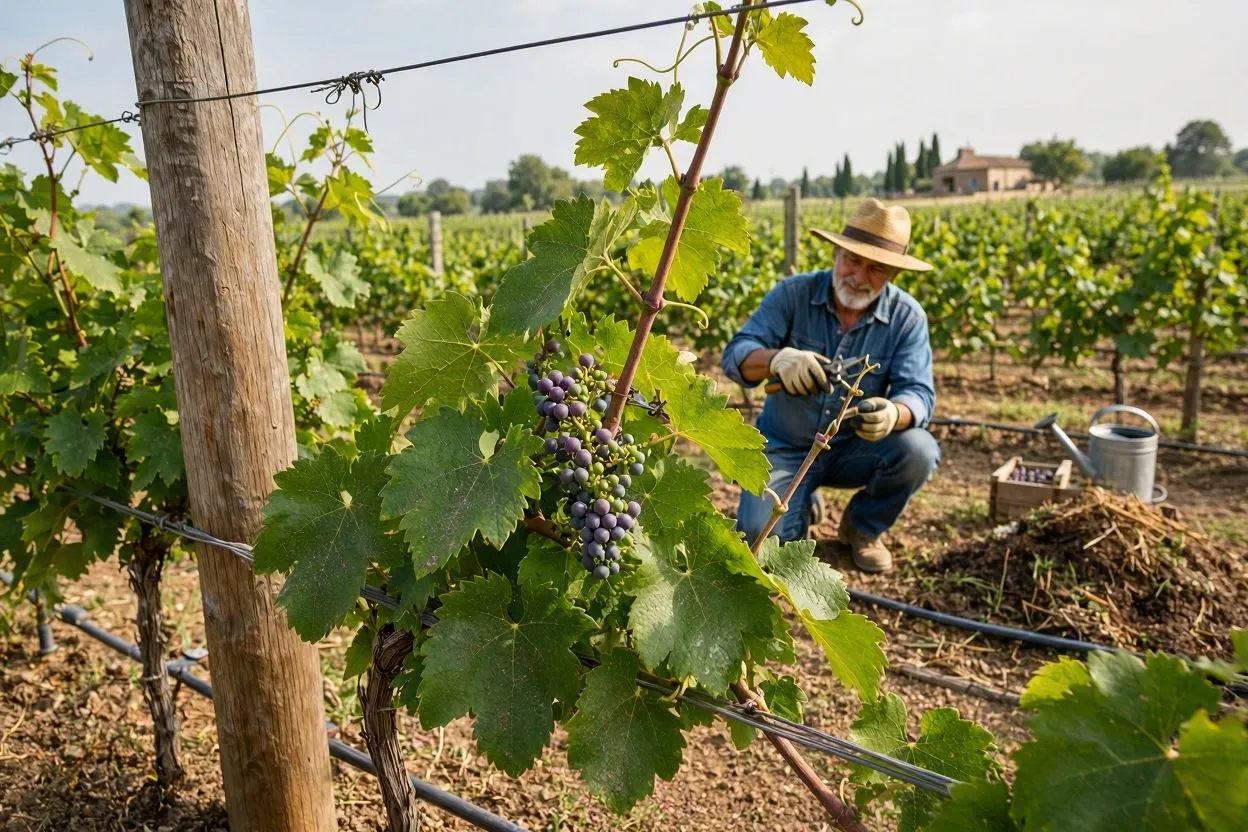
To prune and train grape vines, cut them back hard every winter while they’re fully dormant, removing 80 to 90 percent of the previous year’s growth to keep the plant productive. New growers are often shocked by how much gets cut away, but grape fruit only on new shoots that grow from last season’s wood, not on old branches, so heavy pruning is what forces the vine to keep producing quality fruit instead of just leaves.
Year One Pruning
Select the single healthiest cane after the first growing season and remove all others down to the base. Tie that cane to a stake and let it grow straight upward, then cut back the top once it reaches pencil thickness, forcing the plant to develop lateral shoots the following year.
Year Two and Beyond
Train lateral shoots along a trellis or wire fence once the trunk reaches the height you want. Two main training systems dominate home and commercial growing: the cordon (rod and spur) method, which keeps the vine to one or two permanent arms with short fruiting spurs, and the Guyot method, common in vineyards and allotments, which replaces the fruiting canes entirely each winter. Table and juice grape varieties can carry 40 to 60 buds per vine after pruning, while wine grape varieties should be cut back to just 20 to 30 buds, since a lighter fruit load concentrates sugar and flavor.
Inherited an overgrown vine from a previous homeowner? Cut it back to a single trunk in stages over two winters rather than all at once, and if the wood is mostly dead, cutting the entire vine down to a few inches above ground will trigger vigorous new suckers you can retrain from scratch.
Grapevine Growth Timeline: When to Expect Fruit
Most grape vines produce their first small harvest one to three years after planting, with full production arriving by year four or five. The exact timeline depends on variety, climate, and how aggressively you prune in the early years.
Year one focuses entirely on root and trunk development, and any flowers that appear should be removed so the plant’s energy goes into establishing rather than fruiting. Year two allows the trunk to reach its trellis height. By year three, a well-established vine can usually carry three small bunches without stress, and RHS guidance for UK gardeners recommends about five bunches in year four, increasing further once the vine is fully mature and settled into its spot in the garden.
Common Grape Pests and Diseases (and How to Control Them)
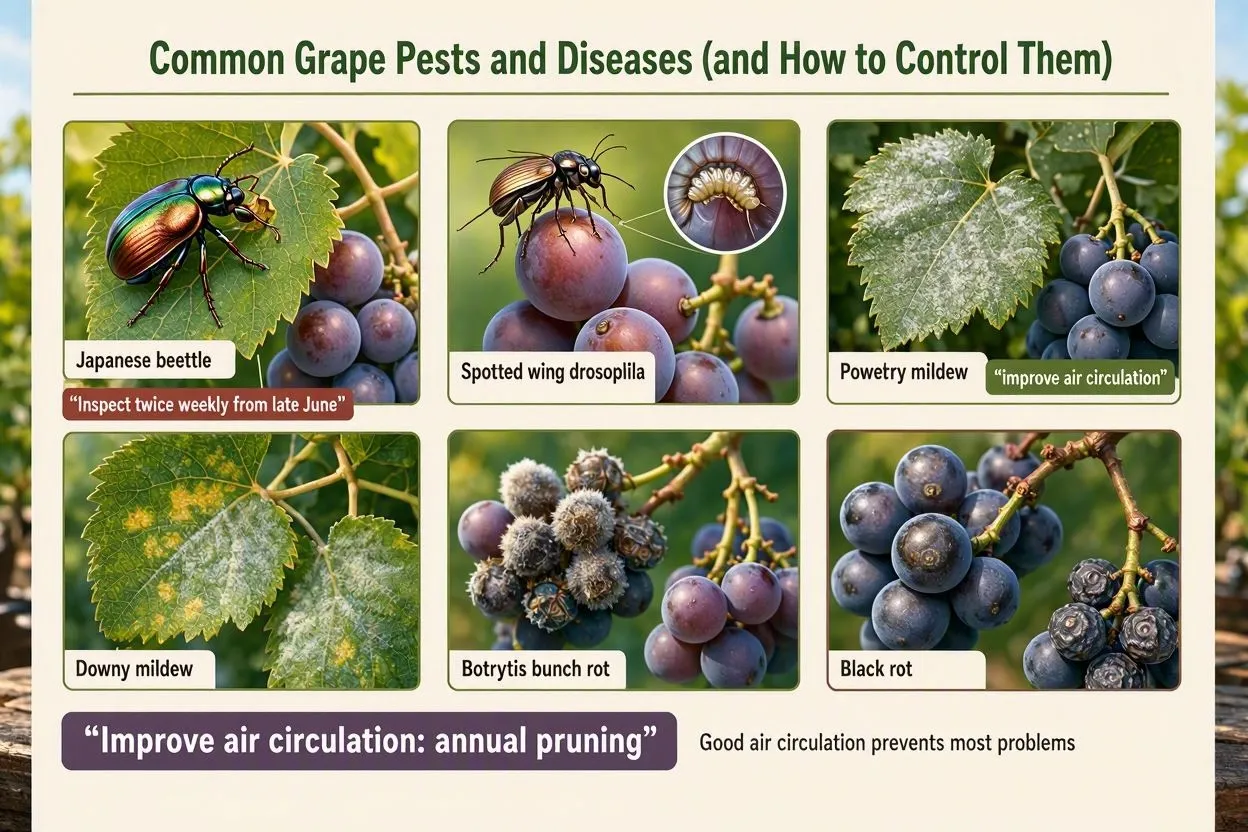
Six pests and diseases cause most of the damage seen on home grape vines: Japanese beetles, spotted wing drosophila, powdery mildew, downy mildew, Botrytis bunch rot, and black rot. Good air circulation prevents most of them, which is one more reason annual pruning matters beyond just fruit production.
- Japanese beetles chew lace-like holes in leaves from late June through August; check plants at least twice a week and knock beetles into soapy water rather than spraying broadly.
- Spotted wing drosophila, an invasive fruit fly, targets ripening berries and should be reported to local agricultural authorities when found in large numbers.
- Powdery mildew shows up as a white, dusty coating on leaves and fruit, and it splits berries and blotches their color if infection hits during ripening.
- Downy mildew causes brown, withering lesions on leaves and a white downy coating on infected shoots, and it spreads fastest in humid weather.
- Botrytis bunch rot moves berry to berry within a cluster once fruit begins ripening, and thinning bunches to improve airflow is the most effective non-chemical defense.
- Black rot turns berries light brown before they shrivel into hard, black, mummified fruit, with infection risk highest from bloom through the following six weeks.
Organic control methods work for most home gardens: weekly sulfur or Bordeaux mixture sprays through spring and summer keep mildew in check, and raking up fallen leaves and fruit each autumn removes the places where fungal spores overwinter. Bird netting protects ripening clusters from the single most common late-season loss, since birds will strip a vine bare in a day or two if fruit is left uncovered.
One threat has nothing to do with pests or fungus: herbicides. Grapevines are highly sensitive to 2,4-D and dicamba, common ingredients in store-bought lawn weed killers, and drift from a neighbor’s yard can deform leaves and knock flower clusters off a vine that was never sprayed directly.
How to Propagate Grapes From Cuttings
To propagate grapes from cuttings, take hardwood sections from healthy, pencil-thick canes in late autumn or winter, while the vine is fully dormant. This is the cheapest way to expand a home vineyard, since a single mature vine can supply dozens of cuttings each year.
Cut 8 to 12 inch (20 to 30 centimeter) sections from the previous season’s growth, making a straight cut just below a bud at the base and an angled cut above a bud at the top, so you can tell top from bottom later. Store cuttings in slightly damp sand in a cool, frost-free spot over winter, then plant them outdoors in spring once the danger of frost has passed, burying two-thirds of each cutting with at least one bud above the soil line. Growing from seed is technically possible but rarely worth it, since seedling vines take years longer to fruit and often produce lower-quality grapes than their parent plant.
When and How to Harvest Grapes
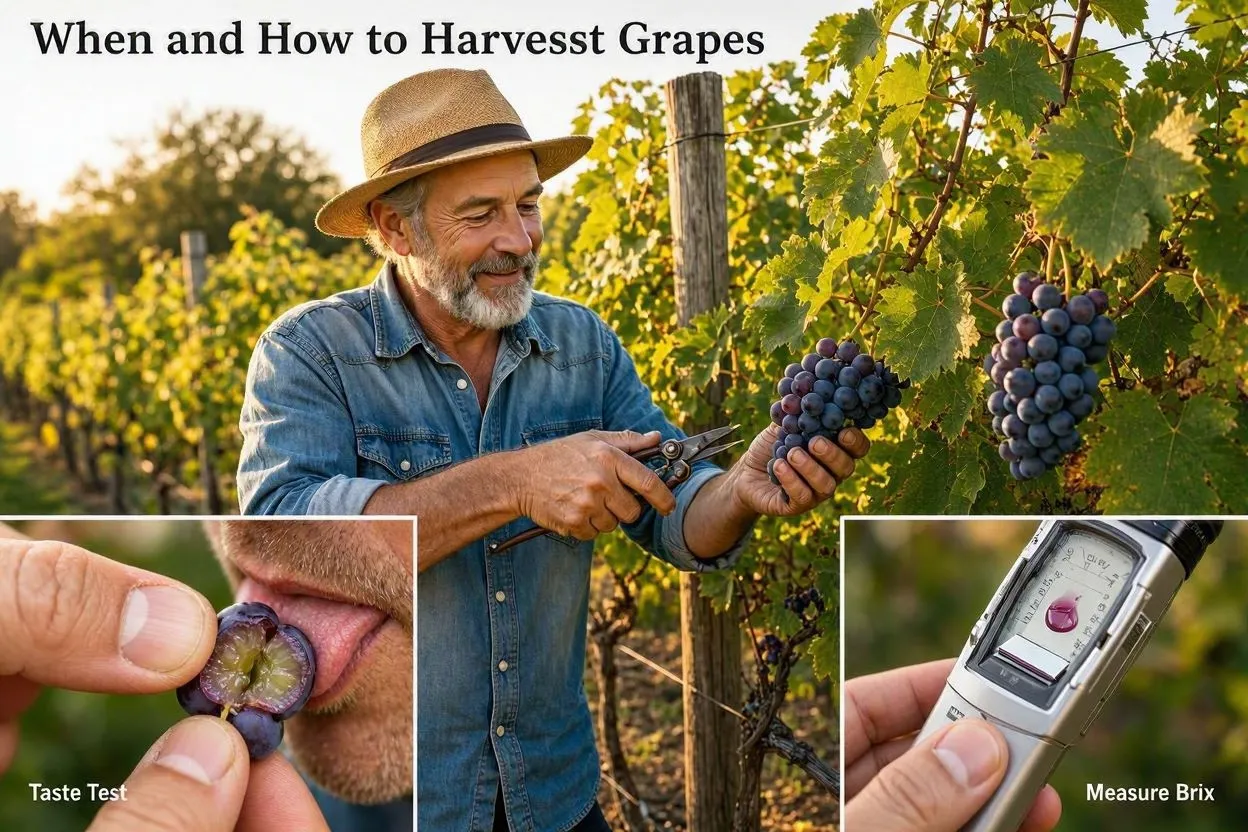
Grapes are ready to harvest when they taste sweet and full-flavored, not simply when their color changes, since many varieties turn color well before they’re actually ripe. Tasting a few berries from different parts of the cluster is the single most reliable ripeness test available to a home gardener.
Garden growers can also check ripeness with a simple refractometer, a handheld tool that measures sugar content on a scale called Brix. Most fresh-eating and jelly varieties taste best somewhere in the mid-teens to low twenties on that scale, though taste testing remains the easiest method for anyone without specialized equipment. Seeds turning brown inside the berry is another reliable sign that a cluster is ready to come off the vine.
To harvest, clip whole clusters with garden pruning shears or scissors rather than pulling by hand, which tears the stem and shortens storage life. Handle clusters gently, remove any discolored or damaged berries, and cool the fruit as soon as possible after picking. Stored in a refrigerator at a steady temperature and covered loosely with plastic to reduce moisture loss, most homegrown grapes keep for one to two weeks.
What It Costs to Start a Grape Garden at Home
A single grape vine for the home garden costs $15 to $40 (about £12 to £32) to buy and plant, while a small backyard planting of 6 to 10 vines along a fence or trellis typically runs $150 to $500 including support materials. Costs scale with trellis quality, irrigation setup, and whether vines are bought bare-root or potted.
A basic garden trellis built from wood posts and galvanized wire costs far less than a formal vineyard structure and works just as well for a handful of backyard vines. Bare-root vines cost less than potted ones but arrive only during the dormant planting window, while container-grown vines from a local garden center cost more but can go in the ground almost any time of year. Ongoing yearly costs stay low after the first two seasons, limited mostly to compost, occasional fertilizer, and netting to protect ripening fruit from garden birds.
FAQs
Do grape vines need full sun to produce fruit?
Yes. Grapes need at least 6 to 8 hours of direct sun daily to ripen properly; partial shade produces weak growth and sour, underdeveloped fruit regardless of variety or soil quality.
Can grapes grow in cold climates like Minnesota or the UK?
Yes. Cold-hardy hybrids such as Frontenac and Marquette tolerate temperatures down to negative 30°F (-34°C), while UK growers succeed with sheltered, south-facing sites or greenhouse cultivation.
How long does a grape vine take to produce fruit?
Most vines yield a small first harvest within one to three years of planting, with full production typically arriving by year four or five under proper pruning and care.
Is grape vine fruit safe for pets?
No. Grapes and grape leaves are toxic to dogs and can cause kidney damage; keep pets away from vines and fallen fruit, and contact a veterinarian immediately if ingestion occurs.
Do grape vines need a second plant nearby for pollination?
No. Nearly all grape varieties are self-fertile and pollinate through wind and insect activity, so a single vine can produce fruit without a second plant nearby.
Conclusion
Growing grapes successfully comes down to four decisions made in the right order: pick a variety suited to your climate zone, plant it in full sun with well-drained soil, water deeply while the roots establish, and prune hard every single winter without exception. Skip the pruning step and a vine will still grow, just not fruit well, since grapes bear only on new wood from the previous season. A well-sited vine, whether planted against a fence in Minnesota, trained along greenhouse wires in Yorkshire, or grown in a half-barrel in Arizona, will keep producing for decades once established, often outliving the gardener who planted it.