
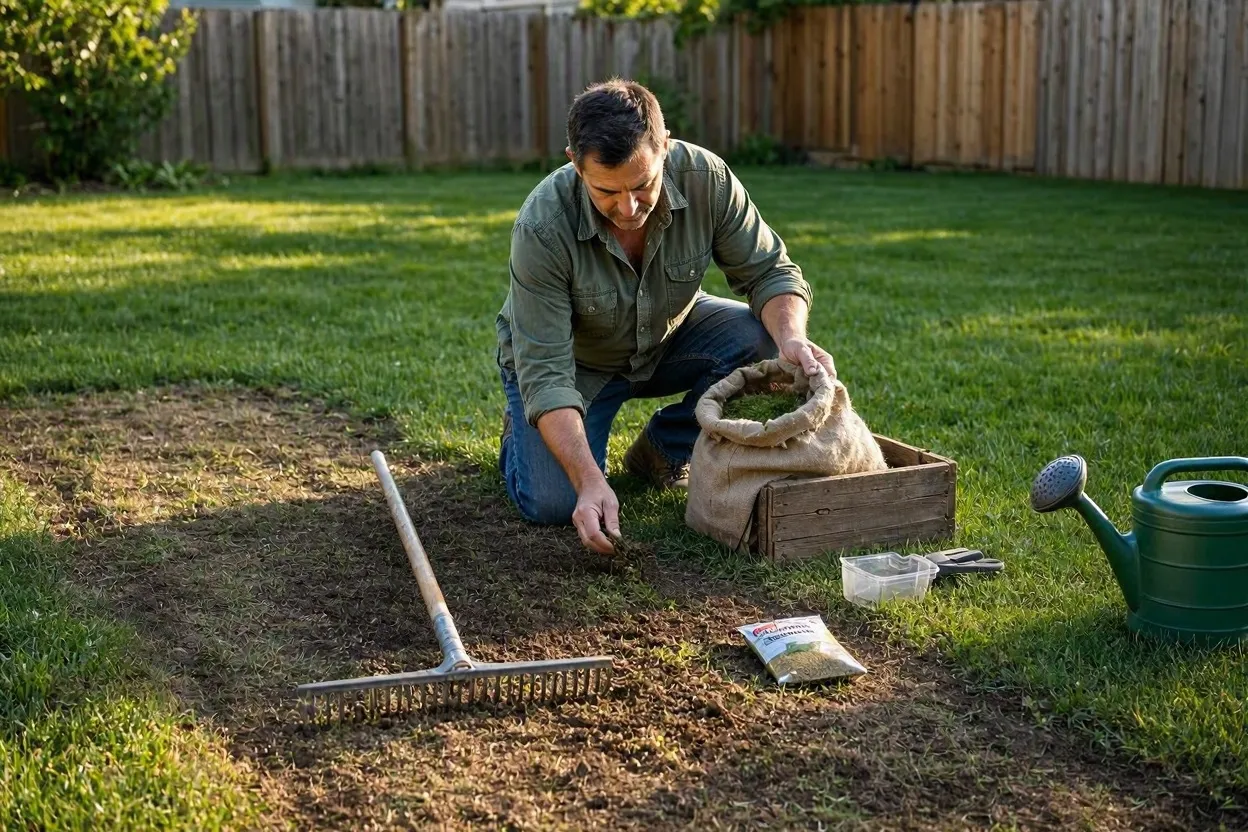
To reseed a lawn, test the soil, remove dead grass and weeds, loosen the top 2 to 3 inches (5 to 7.5 cm) of soil, spread grass seed at the rate listed on the label, apply starter fertilizer, then water lightly once or twice a day until the seedlings reach 1 inch (2.5 cm) tall. Cool-season lawns do best seeded in early fall, roughly 6 to 10 weeks before the first frost. Warm-season lawns need late spring to early summer, once nighttime temperatures hold above 65 to 70°F (18 to 21°C). Get the timing wrong, and even perfect technique won’t save the seed.
Reseeding isn’t the same job as overseeding, and mixing up the two wastes both seed and time. The sections below walk through each stage: prep, seeding, feeding, watering, and the regional timing that determines whether any of it actually works.
What Does It Mean to Reseed a Lawn?
Reseeding a lawn means killing off the existing grass and weeds, then planting new seed on bare soil to build the lawn from scratch. It’s a full reset, not a touch-up. Homeowners reach for this option when more than half the yard is dead, weed-choked, or made up of a grass species that never suited the site in the first place.
The process differs from ordinary lawn care because nothing gets saved. Old turf gets stripped or chemically killed, roots and thatch get cleared, and the soil underneath gets prepped as if it were a brand-new lot. A backyard with heavy clover invasion covering 60% of the surface area is a textbook reseeding case. A yard with a few thin patches near the mailbox isn’t; that calls for a lighter touch.
Reseeding vs. Overseeding vs. Patch Repair: Which One Do You Need?
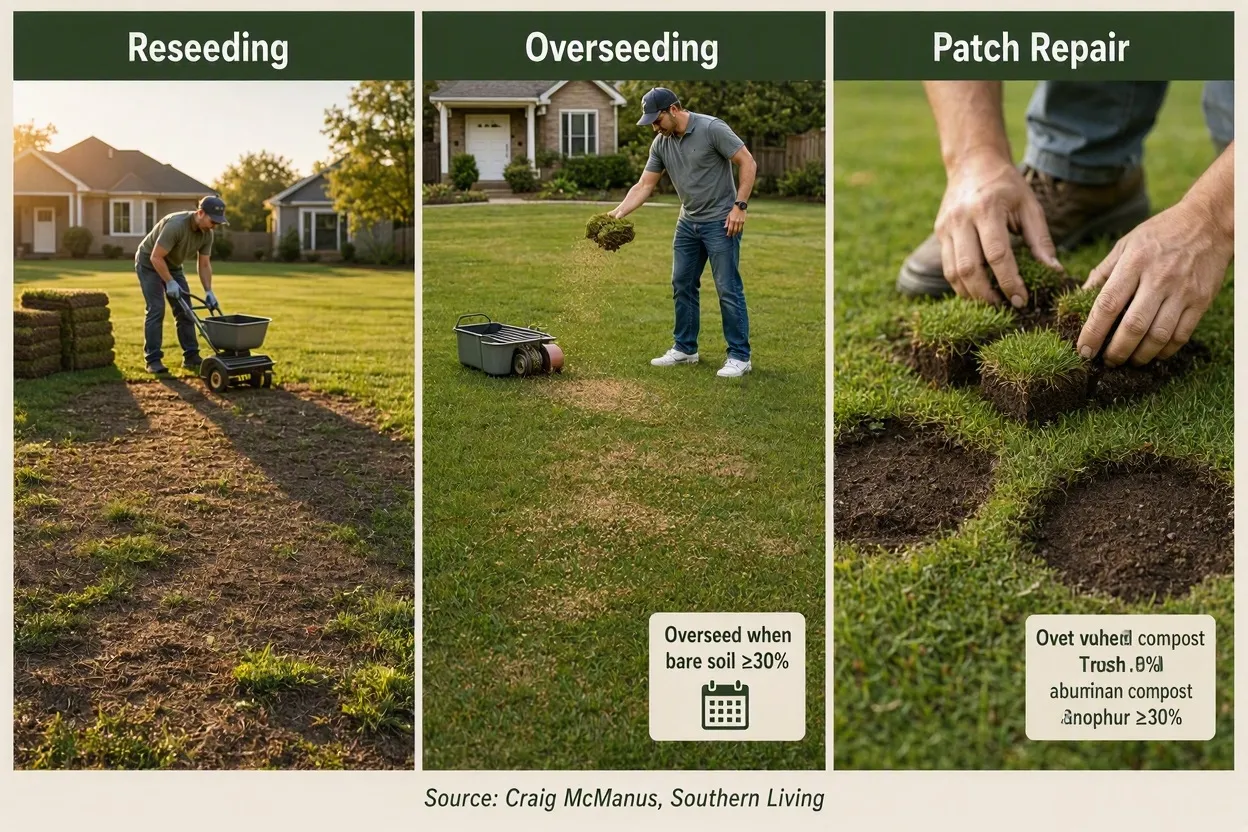
Use reseeding if more than 50% of the lawn is bare or weedy, overseeding if the lawn is thin but mostly intact, and patch repair if only a few isolated spots are affected. Southern Living’s lawn-expert source, Craig McManus, puts a number on it: once bare soil covers 30% or more of a cool-season lawn, it’s time to overseed; once it hits 50%, start over completely.
Overseeding spreads new seed directly over living turf without disturbing the soil. It’s routine maintenance, done annually in many regions to keep density up and crowd out weeds before they establish. Patch repair, by contrast, targets a handful of dead spots, maybe from a dog run or a leaking hose, and doesn’t touch the rest of the yard at all.
Three factors decide which category a lawn falls into:
- The percentage of bare or dead soil visible from a standing height
- Whether the existing grass species still matches the site’s sun, soil, and climate conditions
- How the lawn is used, since high-traffic areas wear out faster and may need full renovation sooner
Get this call wrong, and the fix backfires. Overseed a lawn that actually needs full reseeding, and the new grass competes against surviving weeds for water and light, then loses. That’s a common reason homeowners try “how to reseed a lawn” instructions and see disappointing results: they were solving the wrong problem.
When Is the Best Time to Reseed a Lawn?
The best time to reseed a lawn depends entirely on grass type: cool-season grasses go in during early fall, while warm-season grasses go in during late spring to early summer. Miss the window in either direction, and germination rates drop sharply, sometimes to the point where the whole project has to be repeated.
Cool-Season Grass Timing (US Northern States, UK, Germany, France, Canada)
Kentucky bluegrass, tall fescue, fine fescue, and perennial ryegrass all count as cool-season species. Sow them roughly 6 to 10 weeks before the average first frost date. In much of the northern and mid-Atlantic US, that lands between mid-August and mid-October. UK gardeners typically get similar results from late August through September, while Germany and France see a comparable early-autumn window, though it shifts slightly warmer or cooler by region. Ontario and the Canadian Prairies generally need seeding wrapped up by early September, since the growing season closes faster there than farther south.
Spring works too, but it’s the weaker option. Grass seeded in spring has less time to build a deep root system before summer heat arrives, and young seedlings handle drought stress poorly. If fall isn’t possible, aim for the earliest workable spring soil temperature instead of waiting for warmer, drier weather.
Warm-Season Grass Timing (US Southern States, Brazil)
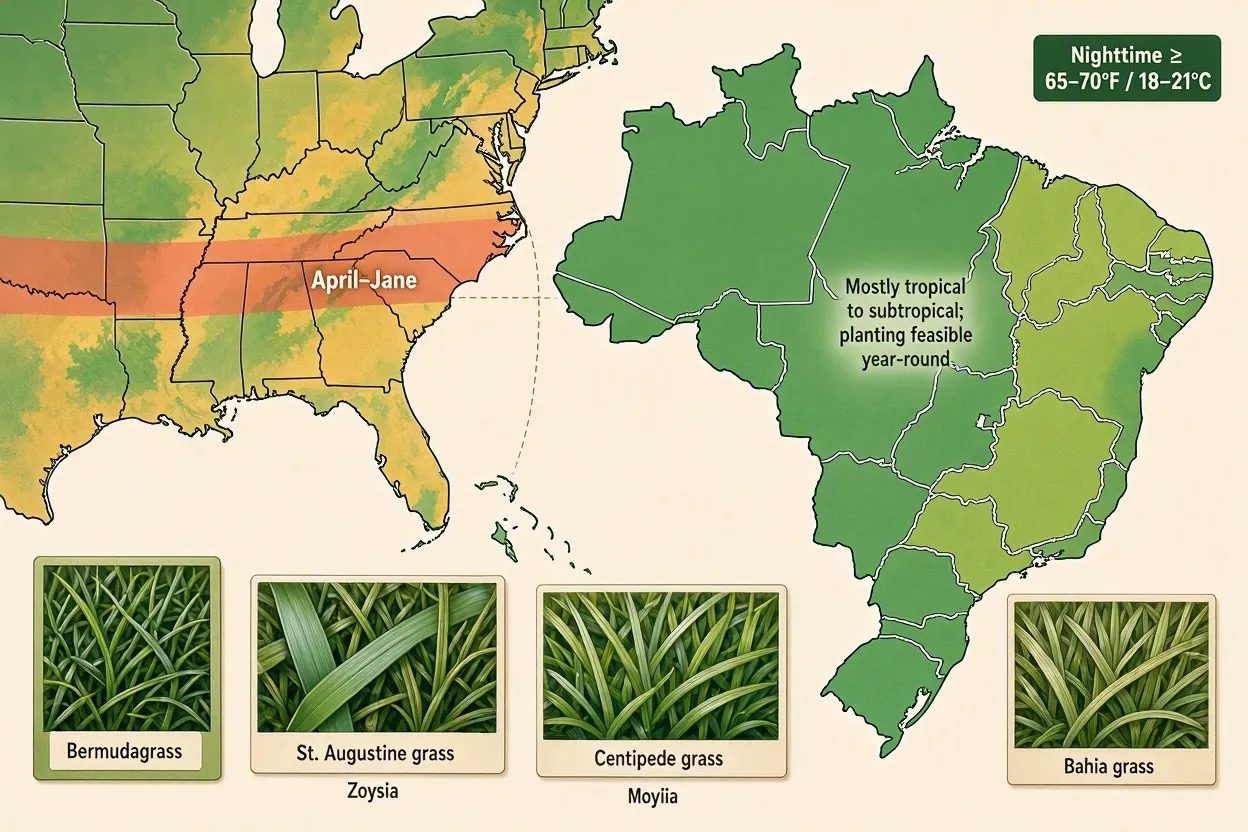
Bermudagrass, zoysia, St. Augustine grass, centipede grass, and Bahia grass belong to the warm-season group. These need soil that’s already warmed up, so late spring through early summer is the target window, once nighttime temperatures hold consistently above 65 to 70°F (18 to 21°C). Southern US states typically hit that mark from April through June.
Brazil’s climate runs mostly tropical to subtropical, which means warm-season species such as Paspalum notatum, Zoysia japonica, and various Bermuda cultivars perform reliably across most of the year in the warmer central and northern regions. Southern Brazil, where temperatures dip more in winter, still favors the same late-spring planting logic used in the US South.
How to Reseed a Lawn: Step-by-Step
To reseed a lawn from start to finish, follow seven steps: test the soil, choose seed, kill off old growth, spread the seed, fertilize, water consistently, and mow at the correct height once the grass establishes. Skipping any one of these steps, especially soil prep, tends to show up later as patchy, uneven growth.
Step 1: Test and Prepare the Soil
Grab a soil test kit or send a sample to a local extension office before buying a single bag of seed. Most turfgrass species want a neutral pH, somewhere close to 6.0 to 7.0. If the results come back acidic or alkaline, work in the recommended lime or sulfur amendment weeks before seeding, since those products need time to shift pH.
Once the chemistry checks out, till or dig the ground to a depth of about 3 inches (7.5 cm), then rake it smooth. Work in compost or topsoil at this stage, and shape the contours so water drains away from the house rather than pooling in low spots.
Step 2: Choose the Right Grass Seed
Match the seed species to the site’s climate zone and sun exposure, not the other way around. Grass seed labels list several pieces of information required by law in most regions: the percentage of the named variety by weight, other crop content, weed seed percentage, inert material, and the germination rate. A higher germination percentage means more of the seed in the bag will actually sprout, so it’s worth paying attention to that number even on a slightly pricier bag.
For lawns that see kids, dogs, or regular foot traffic, look specifically for seed labeled with high traffic tolerance. Shady yards need a shade-tolerant fescue blend instead of a full-sun mix, which will thin out fast under trees no matter how well it’s watered.
Step 3: Kill Off Existing Grass and Weeds (Full Renovation Only)
Skip this step if the project is overseeding rather than a full reseed. For a genuine renovation, a nonselective herbicide applied on a dry, wind-free day clears the ground fastest, typically within 10 to 14 days. Chemical-free alternatives exist too: covering the area with clear plastic sheeting for 6 to 8 weeks solarizes the soil using trapped heat, while layering wet newspaper under mulch smothers grass and weeds over roughly the same timeframe, adding organic matter to the soil as it breaks down.
Step 4: Spread the Seed
Fill a broadcast spreader or hand spreader and set it to the rate printed on the seed label; new-lawn rates run higher than overseeding rates, so double-check which number applies. Sow half the seed walking in one direction across the yard, then the second half walking perpendicular to the first pass. That crisscross pattern prevents the thin streaks that show up when a spreader is only run one way.
Rake lightly afterward to work the seed roughly 1/8 to 1/4 inch (3 to 6 mm) into the soil surface, then cover with a thin layer of weed-free straw or a seed blanket to hold moisture and stop wind or birds from scattering it.
Step 5: Apply Starter Fertilizer
Starter fertilizer supplies the nitrogen-phosphorus-potassium (N-P-K) blend young roots need to establish quickly, and it should go down right after seeding, not days later. Skip any weed preventer at this stage; pre-emergent herbicides block seed germination just as effectively as they block weeds, so that product waits until after the new grass has been mowed at least four times.
Step 6: Water on a Consistent Schedule
Keep the top layer of soil consistently moist, never soggy, until seedlings reach about 1 inch (2.5 cm) tall. That usually means light watering once or twice daily for the first two to three weeks. Once the grass hits that height, cut back to once a day, then transition to deeper, less frequent watering, around 1 inch (2.5 cm) per week, once it’s mowed a few times.
Morning watering beats evening watering here, since wet grass sitting overnight invites fungal disease.
Step 7: Mow at the Right Height
Wait until new grass reaches 2.5 to 3 inches (6 to 7.5 cm) before the first cut, and never remove more than one-third of the blade length in a single pass. Cutting too early or too short stresses the shallow, still-developing root system and can undo weeks of careful watering.
How Much Grass Seed Do You Need?
Grass seed coverage rates vary by species, but most cool-season new-lawn blends call for 4 to 8 lbs (1.8 to 3.6 kg) per 1,000 sq ft (93 m²), while overseeding rates run about half that. A 5,000 sq ft (465 m²) yard seeded with tall fescue at 6 lbs per 1,000 sq ft would need roughly 30 lbs (13.6 kg) of seed total.
Warm-season species like Bermudagrass typically need less by weight, often 1 to 2 lbs (0.45 to 0.9 kg) per 1,000 sq ft, since the seed itself is smaller. Always check the specific product label rather than relying on a general rule, since blends and mixes vary.
How Long Does It Take Grass Seed to Germinate?
Germination time depends on species: perennial ryegrass sprouts in 5 to 10 days, tall fescue in 7 to 14 days, Kentucky bluegrass in 14 to 30 days, and Bermudagrass in 10 to 30 days. Soil temperature drives most of that variation; warmer soil speeds things up within each species’ range, while cool, wet soil slows germination and raises the risk of seed rot.
Full establishment, meaning a lawn thick enough to handle regular foot traffic, generally takes 6 to 10 weeks from seeding for cool-season grasses and slightly less for fast-establishing warm-season species under ideal summer conditions.
Common Reseeding Mistakes to Avoid
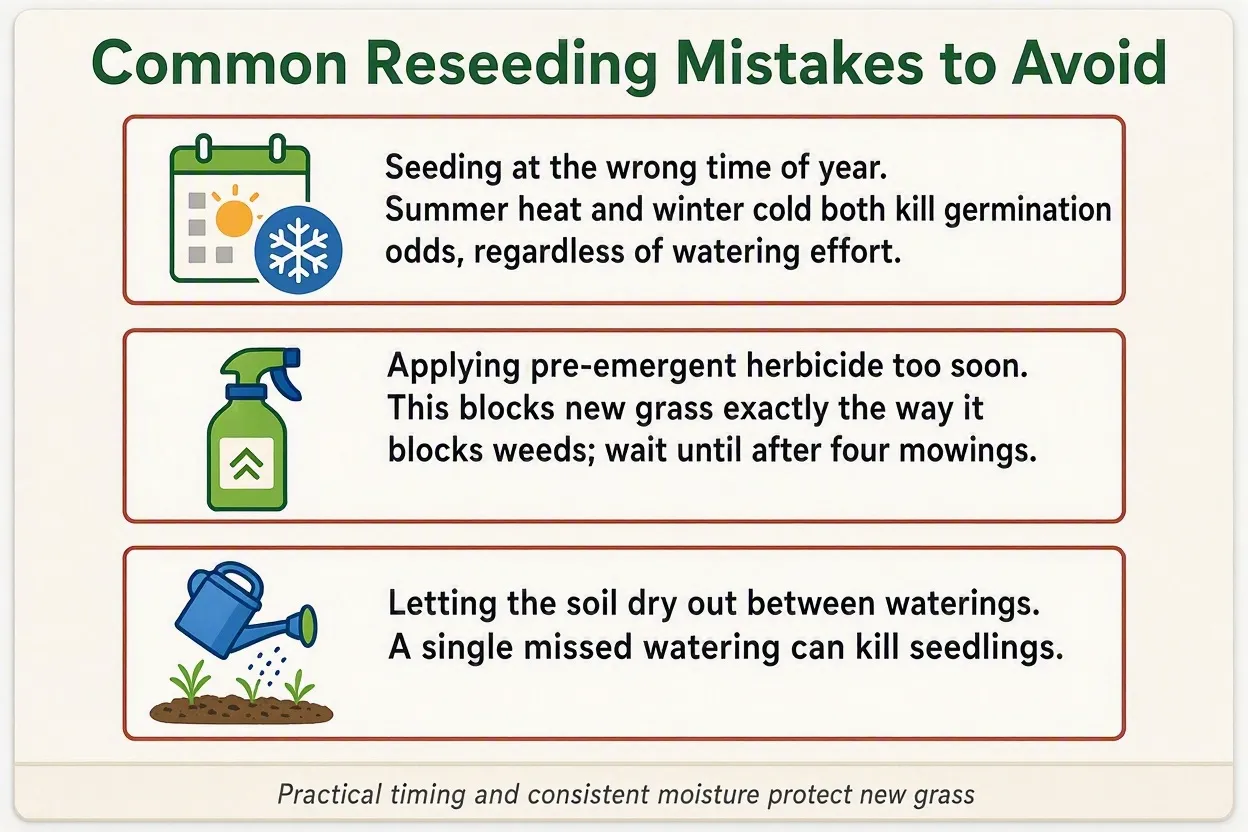
Even careful homeowners run into the same handful of problems, and most trace back to timing or moisture, not the seed itself.
- Seeding at the wrong time of year. Summer heat and winter cold both kill germination odds, regardless of watering effort.
- Applying pre-emergent herbicide too soon. This blocks new grass exactly the way it blocks weeds; wait until after four mowings.
- Letting the soil dry out between waterings. A single missed watering day during the first week can kill germinating seed that’s already started to sprout.
- Skipping the soil test. Seed thrown onto compacted or wrong-pH soil struggles no matter how good the germination rate on the label looked.
- Mowing too early or too short. New roots aren’t anchored deeply enough yet to survive aggressive cutting.
Bird predation deserves a specific mention here too. Uncovered seed on bare soil is an easy meal, and a thin straw layer or seed blanket solves most of that problem without any extra cost.
Grass Seed Types by Region
| Region | Common Species | Typical Seeding Window |
| US North / Midwest | Kentucky bluegrass, tall fescue, perennial ryegrass | Late August to mid-October |
| US South | Bermudagrass, zoysia, St. Augustine, centipede | April through June |
| UK | Perennial ryegrass, fine fescue | Late August through September |
| Germany / France | Tall fescue, ryegrass blends | Early September |
| Canada | Kentucky bluegrass, fescue blends | Mid-August through early September |
| Brazil | Paspalum notatum, Zoysia japonica, Bermuda cultivars | Year-round in warm regions; late spring in the South |
Knowing how to reseed a lawn well means matching this table to the actual site conditions, not just the calendar page. A shady yard in a warm-season region, for example, may still need a fescue patch mix even where Bermudagrass dominates the rest of the lawn.
FAQs
Does grass seed need to be covered with soil?
Yes. A thin layer, about 1/8 to 1/4 inch (3 to 6 mm), improves seed-to-soil contact and protects against wind, birds, and drying out before germination.
Can you reseed a lawn without killing the old grass first?
No, not for a full reseed. Overseeding skips that step, but true reseeding requires clearing dead or unwanted turf so new seedlings aren’t competing for light and space.
How soon can you walk on a newly reseeded lawn?
Wait until after the third or fourth mow, generally 6 to 8 weeks post-seeding. Foot traffic before then compacts soil and can uproot shallow, developing seedlings.
Is fall or spring better for reseeding a lawn?
Fall wins for cool-season grasses since seedlings get a full growing season before summer heat. Spring works only when fall planting wasn’t possible.
Why isn’t my grass seed germinating?
Wrong soil temperature, inconsistent watering, or old seed with a low germination rate are the three most common causes. Check the seed label’s tested date first.
Conclusion
Getting a lawn back from bare, weedy, or thin is mostly a matter of sequence: test the soil, match the seed to the climate, clear what needs clearing, then water on schedule without skipping days. Every regional detail in this guide, from UK autumn planting windows to Brazil’s year-round warm-season options, exists to answer one practical question homeowners actually have: when and how do I start? Follow the steps in order, respect the timing for the local grass type, and the lawn does the rest on its own.