
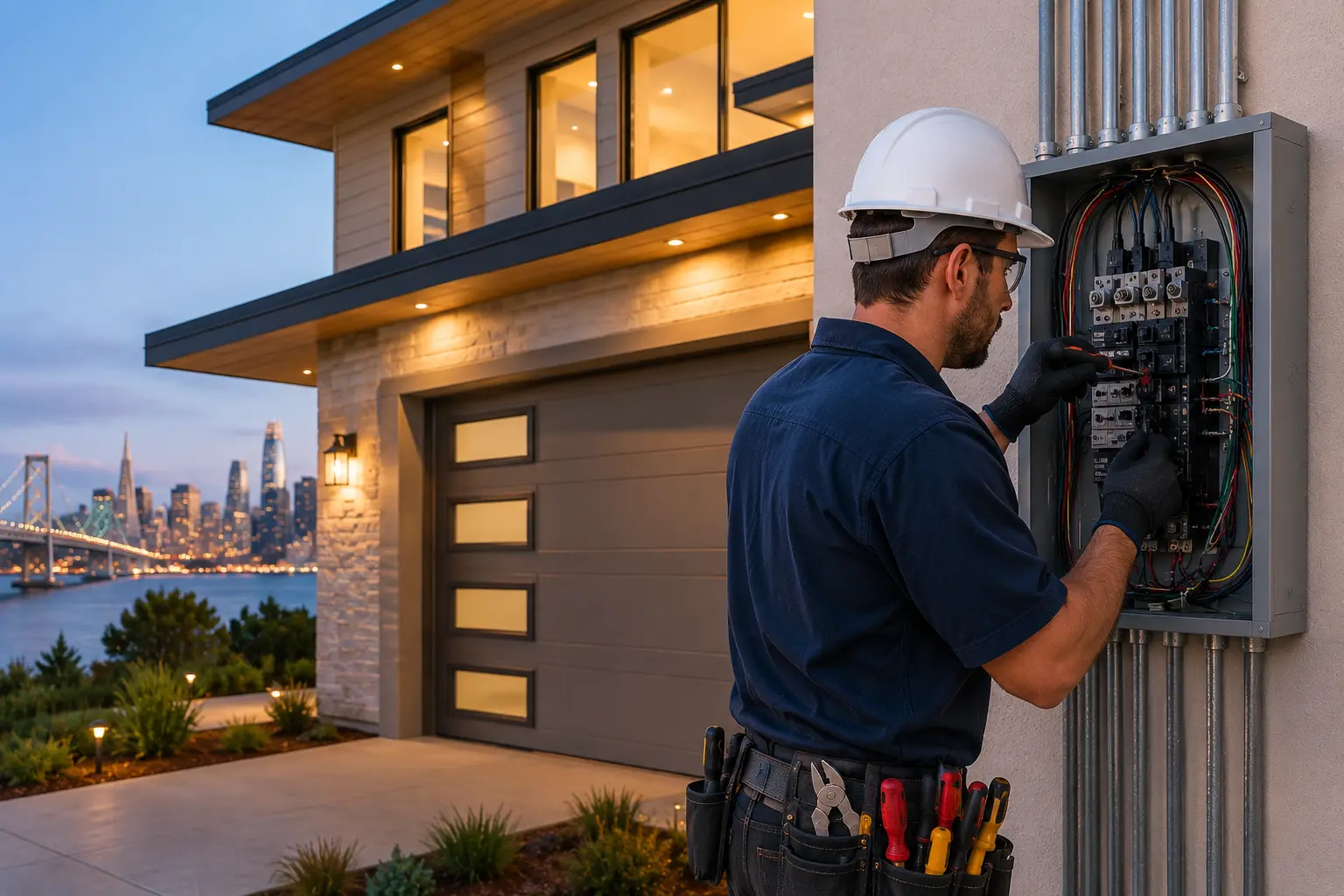
Electrical services in the Bay Area cover panel upgrades, home rewiring, EV charger installation, emergency repairs, and code compliance work, all performed by C-10 licensed contractors. Homeowners usually call for these services when a panel can’t handle new appliances, when wiring predates 1960, or when PG&E flags a safety issue during an inspection. Prices run from $150 for a basic outlet repair to $4,500 for a full 200-amp panel replacement. Licensed electricians across Alameda, Contra Costa, and San Mateo counties typically respond to emergency calls within 1 to 4 hours.
What Electrical Services in the Bay Area Include
Panel upgrades, rewiring, EV charger installation, lighting and outlet work, safety inspections, and emergency repairs make up the six categories most homeowners run into. Most contractors handle all six under one roof, though a few, like Gill’s Electric, go further and offer specialized work such as thermographic surveys and insurance-related remediation. Homeowners comparing quotes often start by browsing electrical services in the Bay Area to see how contractors in their county price out these categories before committing to one.
Housing stock across the region drives a lot of this demand. Homes in Berkeley, Oakland, and San Francisco often date back to the 1920s through the 1950s, so aluminum wiring and knob-and-tube systems still turn up regularly. Take a 1948 bungalow in Rockridge: it’s not unusual for that home to still be running on 60-amp service, well under the 100-amp minimum most local codes now require once central air and modern appliances enter the picture.
Signs a Bay Area Home Needs Electrical Services
Six signs point to a home needing electrical services: frequent breaker trips, flickering lights, warm outlets, burning smells, a panel that hums or buzzes, and outlets missing GFCI (Ground Fault Circuit Interrupter) protection in wet areas. When several of these show up alongside an older panel, the problem is rarely cosmetic. It usually means undersized wiring or a failing breaker, and that calls for a professional diagnosis rather than a quick DIY fix.
A breaker tripping twice a week under normal use is a good example. That pattern often means a circuit is carrying more load than it was built for, and putting off the repair only raises the fire risk over time.
Electrical Panel Upgrades: 100A vs. 200A vs. 400A
A 200-amp panel covers most Bay Area single-family homes, while 400-amp service gets reserved for houses adding an EV charger, a heat pump, and battery backup all at once. Panel sizing comes down to total household load, not square footage.
Here’s how the three common sizes break down:
- 100 amps: Enough for smaller homes without central AC, EV charging, or electric heating. Common in properties under 1,500 square feet (139 square meters).
- 200 amps: The standard for most new installations and remodels, supporting central air, an electric range, and one EV charger.
- 400 amps: Necessary when a household stacks EV charging, heat pump heating and cooling, and solar-plus-battery storage on the same property.
An undersized panel becomes a bottleneck fast. Say a homeowner adds a Level 2 EV charger to a 100-amp panel already running a dryer and central AC. The panel can’t absorb that extra draw, so an upgrade becomes mandatory before the charger can go in safely.
EV Charger Installation as Part of Electrical Services in the Bay Area
Level 2 EV charger installation in the Bay Area runs $800 to $2,500, including a dedicated 240-volt circuit and permit. Final cost depends on how far the panel sits from the charger, whether the panel has open breaker slots, and local permit fees, which shift from city to city.
Tesla, ChargePoint, and JuiceBox show up most often in residential installs across the region. A charger mounted 15 feet (4.6 meters) from the panel lands on the low end of that price range. A detached-garage install 60 feet (18 meters) out, one that needs trenching, pushes the job toward the top.
Home Rewiring and Knob-and-Tube Replacement
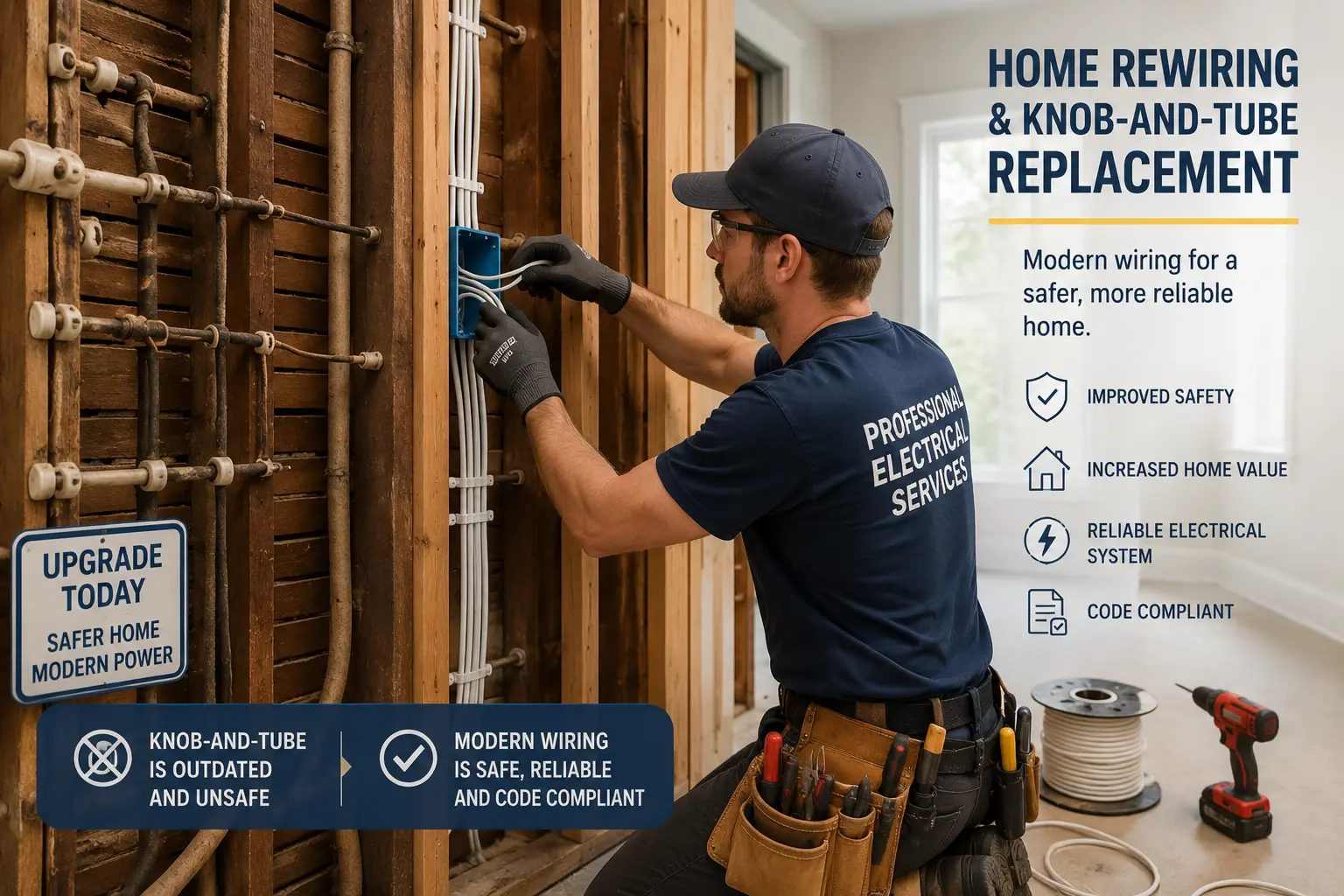
Full home rewiring costs $8,000 to $20,000 for an average 2,000-square-foot (186-square-meter) Bay Area home, depending on wall access and the type of wiring being replaced. Knob-and-tube systems, still present in an estimated 15% of pre-1950s homes in San Francisco and Oakland, have no ground wire and can’t support GFCI protection safely. That’s why insurers frequently require replacement before renewing a policy.
Partial rewiring costs considerably less. One kitchen remodel, for instance, typically runs $1,500 to $4,000 depending on how many new circuits the job adds.
Emergency Electrical Services and PSPS Backup Power in the Bay Area
Emergency electrical services respond to power outages, exposed wiring, and electrical fires, usually within 1 to 4 hours across the Bay Area. Public Safety Power Shutoff (PSPS) events, called by PG&E during high wildfire-risk conditions, drive a large share of emergency backup-power calls every fall.
Homeowners in fire-prone areas like the Oakland Hills or parts of Napa County have started installing battery backup systems ahead of PSPS season instead of waiting for the next outage. Paired with a 200-amp panel, a whole-home backup battery keeps refrigeration, medical equipment, and basic lighting running through a shutoff that can stretch 24 to 48 hours.
What Electrical Services Cost in the Bay Area
Five categories cover most homeowner needs:
- Outlet or switch repair: $150 to $350 per unit.
- GFCI/AFCI (Arc Fault Circuit Interrupter) installation: $200 to $400 per circuit.
- 200-amp panel upgrade: $2,500 to $4,500, permit included.
- EV charger installation: $800 to $2,500.
- Full home rewire: $8,000 to $20,000.
Labor rates in the Bay Area sit at $100 to $200 per hour, above the California state average, pushed up by cost of living in counties like San Mateo and Marin. A licensed electrician working out of Concord will often quote lower hourly rates than one based in Palo Alto for the exact same job.
Licensing: What to Check Before Hiring for Electrical Services in the Bay Area
A California C-10 license is required for any electrical work valued over $500, and homeowners can verify one instantly through the CSLB (Contractors State License Board) website. The check takes under two minutes and confirms bond status, insurance, and any disciplinary history on file.
Union affiliation is worth checking too. Contractors tied to NECA (National Electrical Contractors Association) or IBEW (International Brotherhood of Electrical Workers) usually carry extra training certifications, and that matters most on complex commercial or industrial jobs.
Permits, Inspections, and PG&E Requirements
Most electrical work in the Bay Area requires a city or county permit, and panel upgrades need PG&E (Pacific Gas and Electric) approval under Rule 21 if they connect to solar or battery storage. Skipping the permit step creates two problems down the line. It can void insurance claims, and it can stall a home sale if the unpermitted work turns up during a real estate inspection.
For projects involving solar or battery storage, the contractor files an interconnection application with PG&E before starting the work, since approval can take anywhere from a few days to several weeks depending on the utility’s current backlog.
California’s Title 24 energy code also applies to lighting retrofits and new construction electrical work. It sets efficiency requirements for fixtures and controls, and a licensed electrician builds those into the project scope without being asked.
Rebates and Incentives for Electrical Services in the Bay Area
Three programs currently reduce the cost of electrification-related upgrades:
- TECH Clean California: Rebates for heat pump water heaters and HVAC systems that require a panel capacity upgrade.
- Federal EV charger tax credit (Section 30C): Covers up to 30% of EV charger installation costs, capped at $1,000 for residential installs.
- PG&E electrification rebates: Periodic rebates for panel upgrades that support new electric appliances, with availability shifting by program cycle.
Consider a homeowner installing a $2,000 EV charger. A $600 federal credit brings the net cost down to $1,400 before any state or utility rebate even applies.
How to Choose an Electrician for Electrical Services in the Bay Area
Five factors separate a reliable hire from a risky one: an active CSLB license, a published service area, transparent pricing or written estimates, verified insurance coverage, and a clear emergency response time. Any contractor who won’t provide a license number on request should be crossed off the list immediately.
Local experience carries more weight in the Bay Area than in most regions, given how sharply housing stock changes from block to block. An electrician who’s already rewired several homes in the same neighborhood, a cluster of 1930s houses in Alameda, say, will know what’s behind the walls before the panel cover even comes off.
FAQs
Is a permit required for a panel upgrade in the Bay Area?
Yes. Most cities require a permit for panel upgrades, and PG&E approval is also needed when the upgrade connects to solar or battery storage.
How long does EV charger installation take?
Most installations wrap up in 4 to 8 hours. Projects that need a panel upgrade or trenching can stretch to 2 full days.
Does homeowners insurance cover knob-and-tube wiring?
Rarely. Most California insurers require knob-and-tube replacement before issuing or renewing a policy, since the wiring lacks grounding and raises fire risk.
What size panel does a typical Bay Area home need?
A 200-amp panel suits most single-family homes. Households adding EV charging, heat pumps, and battery storage together often need 400 amps instead.
How fast can an electrician respond to an emergency?
Licensed electricians in the Bay Area typically respond within 1 to 4 hours. Response slows somewhat during PSPS season, when call volume spikes region-wide.
Conclusion
Electrical services in the Bay Area call for a C-10 licensed contractor, a permit for most work beyond minor repairs, and pricing that reflects the region’s older housing stock and higher labor costs. Homeowners who verify licensing through the CSLB, confirm panel capacity before adding an EV charger or heat pump, and plan backup power ahead of PSPS season sidestep most of the costly surprises that catch others off guard. A 200-amp panel, installed by a licensed electrician with real experience in the specific neighborhood, covers what most Bay Area households need for the next 15 to 20 years.