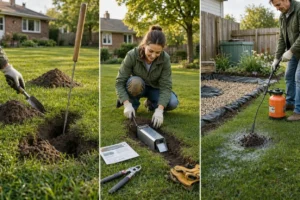
Most lawns need 20 to 30 minutes of watering per session, 2 to 3 times a week, to deliver the 1 to 1.5 inches (2.5 to 3.8 cm) of water grass needs weekly. The exact number changes with your grass type, soil, and sprinkler output, but that range covers most residential lawns across the US and Canada. Clay soil needs longer, slower sessions. Sandy soil drains fast and needs shorter, more frequent ones.
Watering sits at the center of any yard maintenance routine, right alongside mowing, aeration, and fertilizing. Get the schedule wrong and the rest of your lawn maintenance work, mowing height, fertilizer timing, weed control, works against you instead of with you.
How Long to Water Lawn
A standard sprinkler zone needs 20 to 30 minutes per watering session, run 2 to 3 times weekly, to reach 1 inch of water total. That’s the baseline nearly every turf expert and extension office agrees on. Push past 30 minutes on a single session, though, and you risk runoff before the water ever reaches the roots.
Three things shift that number: your grass species, your soil composition, and how fast your sprinkler actually puts out water. A rotor-style sprinkler head might apply 0.5 inches an hour. A fixed spray head can double that. Skip the guesswork and you’ll either drown your roots or starve them, so run a quick output test before locking in a schedule (more on that below).
Here’s the baseline breakdown:
| Sprinkler Output | Time to Deliver 1 Inch | 2x/Week Session | 3x/Week Session |
| 0.5 in/hr | 2 hours | 60 min | 40 min |
| 1 in/hr | 1 hour | 30 min | 20 min |
| 1.5 in/hr | 40 min | 20 min | 13 min |
| 2 in/hr | 30 min | 15 min | 10 min |
How to Measure Your Watering Time

Set out straight-sided containers, run your sprinkler for 20 minutes, then measure and multiply. Guessing wastes water and money. A five-minute test fixes that for good.
The Catch Can Test
To run the catch can test, place 6 to 8 empty tuna cans or similar flat-bottomed containers evenly across your lawn. Turn the sprinklers on and let them run for exactly 20 minutes, then grab a ruler. Measure the depth in each can, add the totals, and divide by the number of cans. That gives you the average depth for 20 minutes; multiply by 3 to get your hourly rate. A reading of 0.33 inches in 20 minutes, for instance, means your system delivers roughly 1 inch per hour.
Sprinkler coverage is rarely even across a whole yard. Cans near the edge often collect less water than cans in the middle, which is exactly why using several of them matters more than relying on just one.
The Screwdriver Test
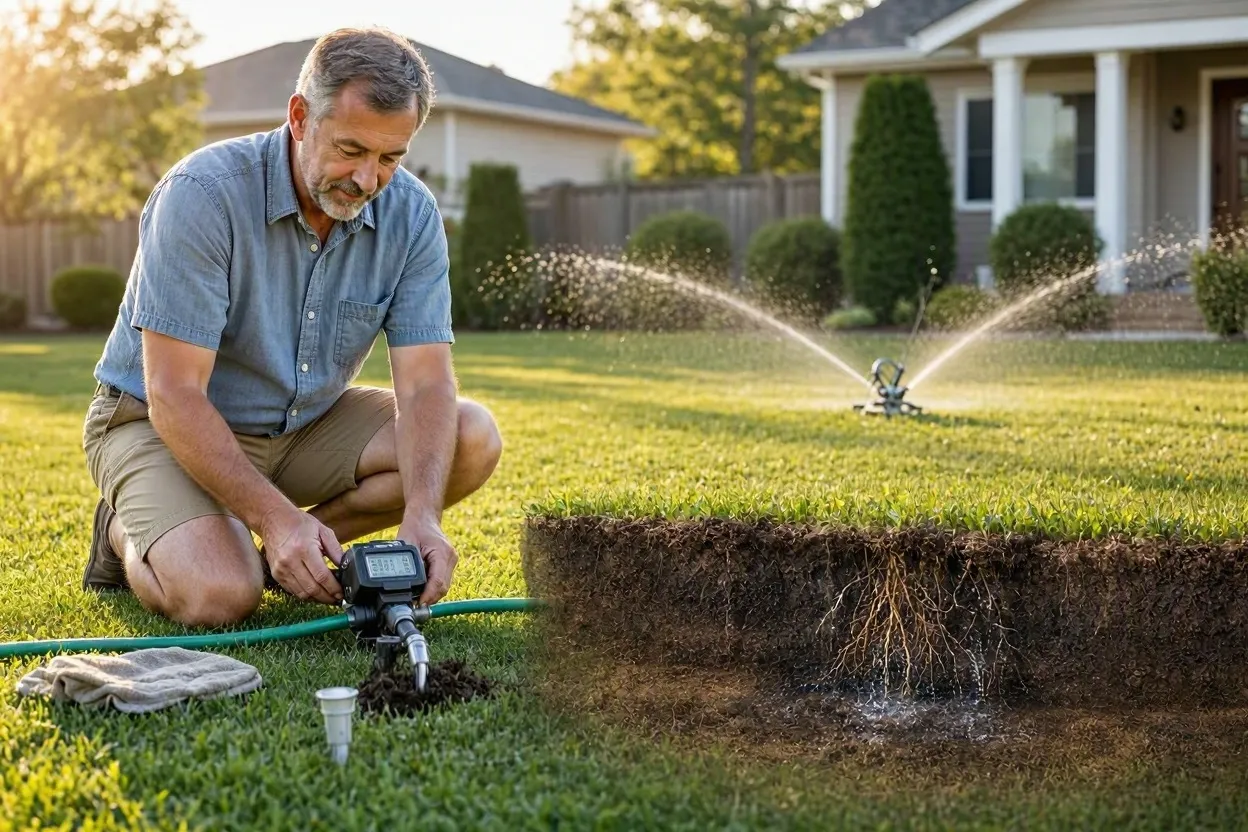
Push a long screwdriver into the soil after watering. If it slides in 6 to 8 inches without resistance, the root zone is soaked and you can stop. If it stalls at 2 or 3 inches, the water hasn’t reached where it needs to go, and you’ll need more time. Dry, compacted clay will resist the screwdriver even when the surface looks damp, so don’t judge by appearance alone.
The Math Method
For anyone with a sprinkler system and known flow rate, multiply your lawn’s square footage by 0.62 (the gallons needed for 1 inch of water per square foot). Divide that number by your system’s gallons-per-minute flow rate, and you get the exact minutes required. A 5,000-square-foot lawn needs roughly 3,100 gallons for a full inch; at 10 gallons per minute, that’s 310 minutes split across your zones.
How Long to Water Your Lawn by Grass Type
Warm-season grasses need about 20 minutes twice a week, and cool-season grasses need closer to 15 minutes three times a week. Root depth and drought tolerance drive that split, not just climate zone.
Warm-Season Grass
Bermuda, Zoysia, St. Augustine, and Centipede grass all fall into this category, and they share one trait: deep, drought-resistant root systems. These grasses hold up in July heat better than cool-season varieties.
- Frequency: Twice weekly
- Duration: 20 to 30 minutes per session
- Why: Deep roots pull moisture from lower soil layers, so infrequent, deep watering trains the roots to keep growing down instead of staying shallow.
Cool-Season Grass
Kentucky Bluegrass, Perennial Ryegrass, and Fine or Tall Fescue make up this group. Their root systems sit shallower, which means they dry out faster once temperatures climb.
- Frequency: Three times weekly
- Duration: 15 to 20 minutes per session
- Why: Shallow roots can’t reach reserve moisture the way warm-season grasses can, so more frequent, lighter sessions keep the blades from wilting between waterings.
Research from the United States Golf Association (USGA) puts cool-season peak water demand at 0.21 to 0.26 inches daily during the hottest stretch of summer, which is roughly double what warm-season turf needs on the same day.
How Long to Water Your Lawn by Soil Type
Clay soil needs about 40 minutes once a week using a cycle-and-soak method, while sandy soil needs around 15 to 20 minutes spread across three sessions. Soil structure controls how fast water moves down and how much it holds onto once it’s there.
| Soil Type | Frequency | Duration |
| Clay | Once weekly | 40 min (cycle and soak) |
| Loam | Twice weekly | 20 to 30 min |
| Sandy | 3x weekly | 15 to 20 min |
Clay particles pack tightly, so water sits on the surface and runs off long before it soaks 6 inches down. Break a 40-minute session into three 13-minute cycles with a 30-minute rest between each, and the soil absorbs far more of it. Sandy soil does the opposite: it drains so quickly that a single deep watering won’t hold moisture past a day or two, so smaller, more frequent sessions serve the roots better. Loam sits in the middle and needs the least adjustment from the baseline schedule.
Best Time of Day to Water Your Lawn
Water between 4 a.m. and 10 a.m. for the least evaporation and the lowest disease risk. Morning air is cooler, winds are usually calmer, and the sun hasn’t had time to pull moisture off the blades before it reaches the roots.
Afternoon watering loses up to half its volume to evaporation on a hot, sunny day. Evening watering isn’t much better, though for a different reason: grass blades stay wet overnight, and that damp environment is exactly what fungal disease needs to take hold. If morning watering genuinely isn’t possible, water between 4 and 6 p.m. so the blades have a few hours of daylight left to dry before dark.
How Long to Water a New Lawn or Grass Seed
New seed needs light watering 1 to 2 times daily for the first 2 to 3 weeks, then a gradual shift to deeper, less frequent sessions. Established watering rules don’t apply here, because germinating seed sits in the top half-inch of soil, not 6 inches down.
- Mist immediately after seeding. Keep the top inch of soil consistently moist, misting once or twice daily depending on heat and wind.
- Once shoots appear, extend watering to keep the top 2 inches moist until the grass reaches roughly 3 inches tall.
- Cut back to twice weekly once the lawn hits mowing height, soaking 6 to 8 inches deep to push the roots downward.
Skip a day of misting during germination and the top layer can dry out fast enough to kill the sprouting seed, so consistency matters more than volume in this stage.
Seasonal Watering Guide (USA & Canada)
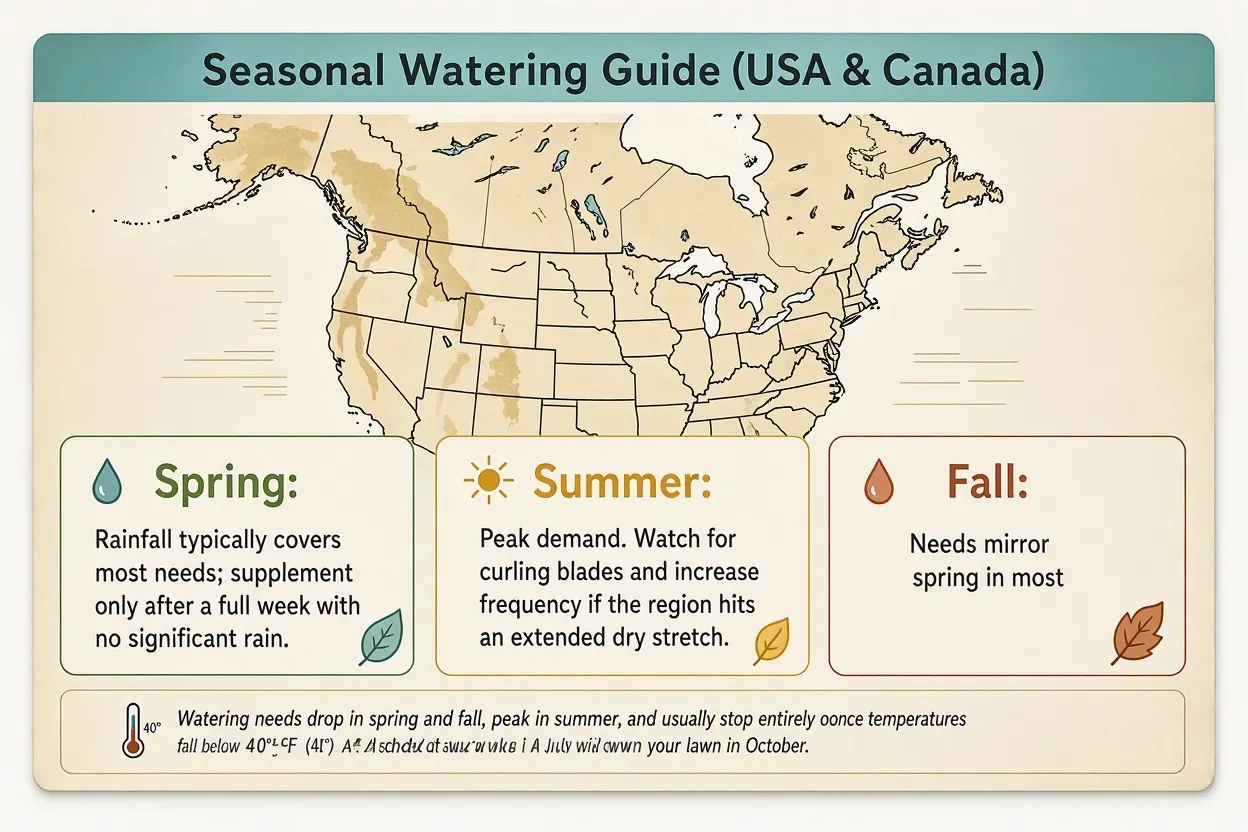
Watering needs drop in spring and fall, peak in summer, and usually stop entirely once temperatures fall below 40°F (4°C). A schedule that works in July will drown your lawn in October.
- Spring: Rainfall typically covers most needs; supplement only after a full week with no significant rain.
- Summer: Peak demand. Watch for curling blades and increase frequency if the region hits an extended dry stretch.
- Fall: Needs mirror spring in most of the US. In Canada’s Prairie provinces and parts of Ontario, cooler fall temperatures often mean watering wraps up by mid-September.
- Winter: Stop watering once soil temperatures drop below 40°F (4°C) or the ground starts to frost. In warmer US regions like the Southeast or Southwest, a monthly deep watering keeps dormant turf from fully dying back.
Canadian lawns, particularly in colder provinces, go dormant earlier than US lawns in similar latitudes because ground freeze arrives sooner. Adjust the fall cutoff by two to three weeks earlier if you’re gardening north of the border.
Signs You’re Overwatering or Underwatering
Soggy, spongy soil signals overwatering, while soil that resists a screwdriver and grass that stays flattened after a footstep signals underwatering. Yellowing grass can point to either problem, which is why checking the soil matters more than judging blade color alone.
Overwatering shows up as:
- Squishy, waterlogged ground that never fully dries between sessions
- Visible puddles or runoff during or after watering
- Mushroom growth or fungal patches
- A buildup of thatch that blocks water from reaching the roots
Underwatering shows up as:
- A dull, blue-gray tint across the lawn instead of vibrant green
- Footprints or mower tracks that stay visible for more than a few minutes
- Dry, cracked soil that pulls apart easily
- Stunted, sparse growth compared to the rest of the yard
Run the footprint test any time you’re unsure: walk across the grass, then look back. Healthy turf springs back within seconds. Grass that stays flattened is asking for water.
Watering Schedules and Local Guidelines
Many US and Canadian communities set specific days or hours for outdoor watering, especially during dry summer stretches. Building your yard maintenance calendar around these windows keeps your lawn on a consistent schedule instead of scrambling to catch up after a missed session. A quick check of your local water utility page before setting a sprinkler timer saves a rescheduled routine later. Some regions also offer rebates for smart controllers or drought-tolerant landscaping, worth folding into your seasonal lawn maintenance planning.
Common Watering Mistakes to Avoid
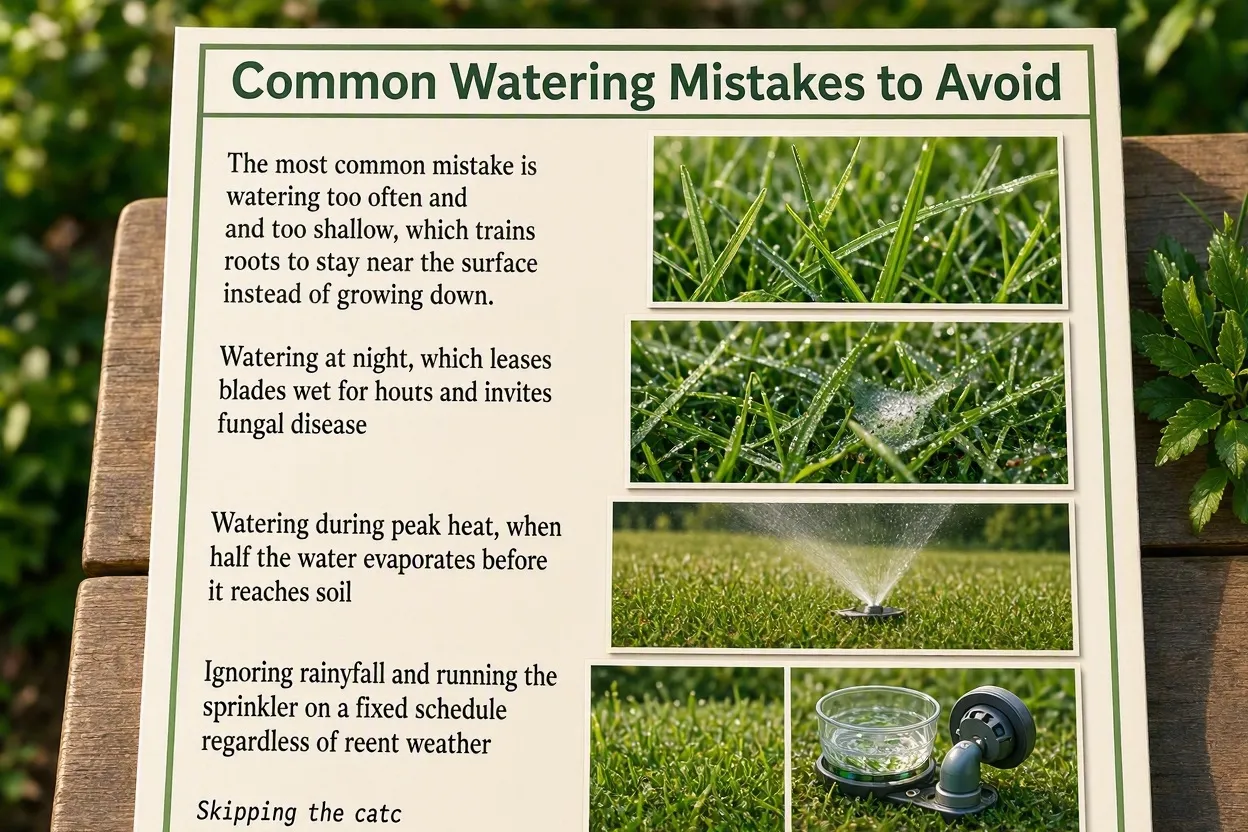
The most common mistake is watering too often and too shallow, which trains roots to stay near the surface instead of growing down. A few others show up just as frequently:
- Watering at night, which leaves blades wet for hours and invites fungal disease
- Watering during peak heat, when half the water evaporates before it reaches soil
- Ignoring rainfall and running the sprinkler on a fixed schedule regardless of recent weather
- Skipping the catch can test and guessing at sprinkler output, which leads to over- or under-watering by 30% or more
Fix these five habits and most lawn stress problems resolve within a growing season, without changing anything else about your yard maintenance routine.
Pair a solid watering schedule with regular mowing, seasonal aeration, and thatch control, and the whole lawn maintenance workload gets lighter. Grass with a steady root system needs less rescue work after heat waves, fewer reseeding passes in fall, and less troubleshooting overall.
FAQs
Is 30 minutes too long to water a lawn?
No. Thirty minutes suits most lawns on a twice-weekly schedule, delivering close to half an inch per session. Run a catch can test first if you have clay soil or high-output sprinklers to confirm water isn’t running off.
Should you water grass every day?
No. Daily watering trains shallow roots and increases disease risk. Deep watering 2 to 3 times weekly builds stronger, drought-resistant roots than daily light watering ever will.
How do you know if you’ve watered a lawn enough?
Check with a screwdriver. If it pushes 6 inches into the soil without resistance, the root zone has absorbed enough water for that session.
Can you overwater a new lawn?
Yes. New seed needs consistent moisture, not saturation. Puddling or soggy topsoil during germination can rot seed before it sprouts.
Does rain count toward a lawn’s weekly water?
Yes. Rainfall counts fully toward the 1 to 1.5 inch weekly target. Skip a scheduled watering session after any rainfall over 0.5 inches.
Conclusion
Most lawns need 20 to 30 minutes of watering, 2 to 3 times a week, to hit the 1 to 1.5 inches grass needs to stay healthy. That baseline shifts with grass type, soil, and sprinkler output, so a catch can test or screwdriver check settles the exact number for your yard in under 20 minutes. Get the timing right, water early in the morning, and skip sessions after rain, and the guesswork around how long to water your lawn disappears for the rest of the season.
Build that schedule into your broader yard maintenance plan, alongside mowing and seasonal aeration, and lawn maintenance stops being a weekly guessing game.