

The best time to transplant peonies is September through mid-October, 6 weeks before your first hard frost. This window lets peony roots settle into new soil before winter dormancy locks growth for the season.
Transplanting at the wrong time costs you 1–3 years of blooms. Transplant peonies in the right season and the plants recover quickly, producing flowers by the second or third spring after the move.
Why Fall Is the Right Season to Transplant Peonies
Peonies shut down aerial growth in late summer and redirect all energy into the root system. By September, the tuberous roots of a peony (Paeonia lactiflora) have fully recharged with stored carbohydrates for next spring.
Moving a peony in this state gives the plant 4–6 weeks of mild soil temperatures for root extension before the ground freezes. The crown stays cool and undisturbed through winter, allowing it to launch new growth the following April without setback.
Fall transplanting also reduces transplant shock because the plant is not actively flowering or pushing new shoots. Soil temperatures between 50°F and 60°F (10°C and 15.5°C) in September are ideal for root regeneration.
When to Transplant Peonies by USDA Hardiness Zone
The exact transplant date depends on your USDA Hardiness Zone. Count 6 weeks back from your average first fall frost date to find your transplant window.
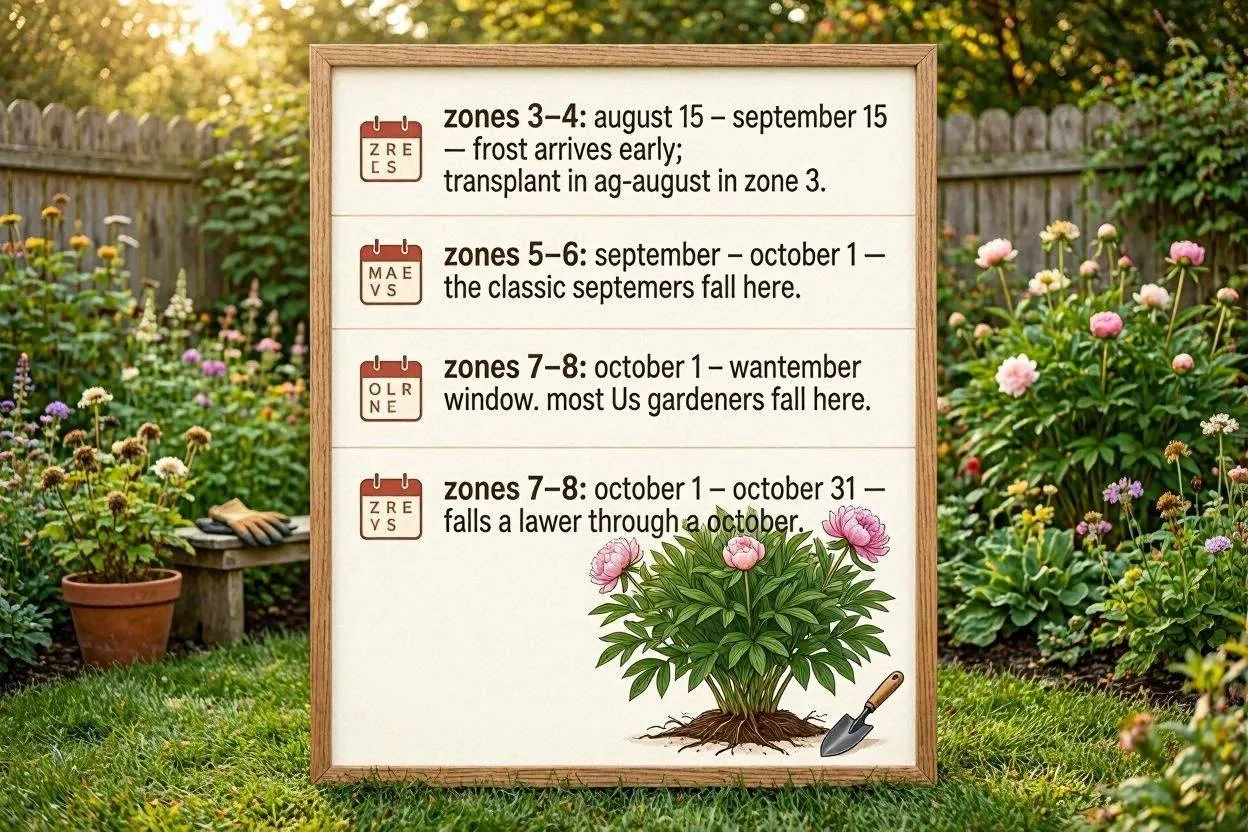
- Zones 3–4: August 15 – September 15 — Frost arrives early; transplant in mid-August in Zone 3.
- Zones 5–6: September 1 – October 1 — The classic September window. Most US gardeners fall here.
- Zones 7–8: October 1 – October 31 — Warmer falls allow a later move through October.
- Zone 9: October 15 – November 15 — Transplant in mid-fall; peonies struggle here anyway due to insufficient winter chill.
Peonies in USDA Zone 9 need a minimum of 400–500 chilling hours below 40°F (4.4°C) to bloom reliably. If you grow peonies in Zone 9, choose low-chill varieties such as ‘Coral Charm’ or ‘Gay Paree’ and transplant in October.
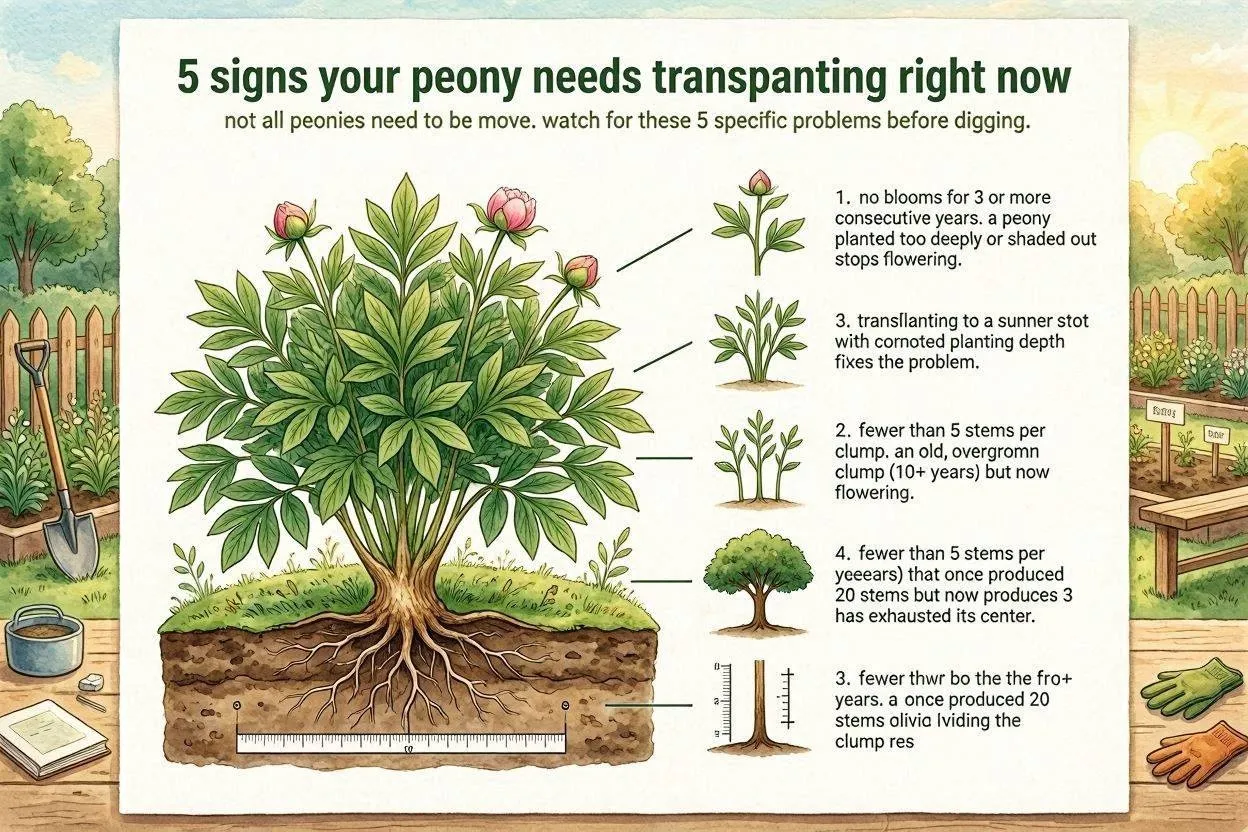
5 Signs Your Peony Needs Transplanting Right Now
Not all peonies need to be moved. Watch for these 5 specific problems before digging.
- No blooms for 3 or more consecutive years. A peony planted too deeply or shaded out stops flowering. Transplanting to a sunnier spot with corrected planting depth fixes the problem.
- Fewer than 5 stems per clump. An old, overgrown clump (10+ years) that once produced 20 stems but now produces 3 has exhausted its center. Dividing the clump restores vigor.
- Less than 6 hours of direct sun daily. A tree or building now shades the peony that was planted in full sun. Shade reduces blooms by 50–80%. Moving the peony solves this immediately.
- Stems that flop and need staking every year. Weak stems often signal overcrowding, shade, or high-nitrogen soil. Transplanting to a better site with balanced 10-10-10 fertilizer corrects stem strength.
- You are relocating or redesigning the garden. Peonies live 50–100 years. Move them once, position them correctly, and skip decades of problems.
How to Prepare Your Peony for Transplanting in 3 Steps
To prepare a peony for transplanting, complete these 3 steps in the week before you dig.
Step 1: Cut Back Foliage to 3 Inches (7.5 cm)
To cut back peony foliage, use clean bypass pruners and trim all stems to 3 inches (7.5 cm) above the soil line. Cutting back in September, after the leaves have yellowed but before the first frost, prevents botrytis blight [Botrytis paeoniae] from traveling from foliage into the crown. Remove all clippings from the garden bed immediately.
Step 2: Prepare the New Planting Site
To prepare the new planting site, dig a hole 12–18 inches (30–45 cm) deep and 24 inches (60 cm) wide before lifting the peony. Mix the removed soil with 2–3 shovelfuls of compost and a cup of bone meal fertilizer to build phosphorus for root development. Check the soil pH level: peonies need a pH of 6.0–7.0. Adjust acidic soil below pH 6.0 by incorporating 1 cup of garden lime per square foot.
For more on choosing the right peony type for your new location, read the peony bush care guide to confirm sun, spacing, and soil requirements.
Step 3: Water the Peony 24 Hours Before Digging
To make digging easier, water the peony thoroughly 24 hours before transplanting. Apply 1–2 gallons (3.8–7.5 liters) directly at the root zone. Moist soil clings to the roots during lifting and reduces air pocket formation around the tubers.
Peony Transplanting Quick-Reference Table
Use this table to match your situation to the correct transplant task, timing, and method.
| Task | Best Timing | Method | Difficulty |
| Transplant herbaceous peony | Sept–Oct (6 wks before frost) | Lift & replant with root ball | Moderate |
| Divide established clump | Sept–Oct after foliage dies | Cut roots into 3–5 eye sections | Moderate |
| Spring transplant (emergency) | Early spring, before shoots reach 2 in (5 cm) | Move as a whole root ball | Hard |
| Plant bare-root peony | Sept–Oct only | Set eyes 1–2 in (2.5–5 cm) deep | Easy |
| Replant after division | Same day as dividing | Mound soil method | Easy |
How to Dig and Transplant Peonies Without Damaging the Roots
To dig a peony, insert a garden fork or sharp spade 12–18 inches (30–45 cm) from the outermost stems. Push the fork straight down and lever the tool outward — never yank upward. Repeat on all 4 sides before lifting the clump to avoid snapping the brittle tuberous roots.
Lift the entire root ball and set it on a tarp. Rinse the roots with a garden hose to expose the pink growth buds, called eyes, on the crown. A healthy established clump contains 10–30 eyes. Each division for replanting needs a minimum of 3–5 eyes attached to a firm, fleshy root section.
How to Divide a Peony Clump into New Plants
To divide a peony clump, use a clean, sharp knife or spade and cut the clump into sections — each with 3–5 eyes and a firm root section at least 4 inches (10 cm) long. Disinfect the blade with a 10% bleach solution between cuts to prevent spreading botrytis blight.
Dust cut surfaces with powdered sulfur or let the cuts air-dry for 30 minutes before replanting. This step reduces rot in the freshly wounded tissue. Discard the woody, center section of very old clumps — that tissue produces fewer blooms than the outer divisions.
If you want to explore the full range of peony varieties available for replanting, the peony variety colors guide covers all 14 color options with named varieties for every bloom preference.
How to Set the Correct Planting Depth
To set the correct planting depth, position the peony division on a mound of amended soil inside the planting hole. Lay a straight stick or ruler across the hole and measure down to the base of the eyes. The eyes must sit exactly 1–2 inches (2.5–5 cm) below the soil surface. Eyes buried deeper than 2 inches (5 cm) fail to bloom — this is the single most common transplanting error.
In Zones 3–5, plant at 2 inches (5 cm) deep for frost protection. In Zones 6–8, plant at 1 inch (2.5 cm) deep.
Spread the roots evenly over the soil mound. Backfill with amended soil, firm down gently with both hands, and water deeply to eliminate air pockets. Add 2–3 inches (5–7.5 cm) of organic mulch — shredded bark or straw — over the crown to protect against frost heave.
When to Transplant Peonies in Spring and What to Expect
Spring transplanting is possible but produces worse results than fall transplanting. Move a peony in spring only when fall is not an option — for example, when a construction project forces an emergency relocation.
To transplant a peony in spring, move it before the new shoots reach 2 inches (5 cm) tall. At this stage the plant has not yet invested energy in leaf growth, and transplant shock remains manageable. A spring-transplanted peony skips blooming for 1–2 seasons longer than a fall-transplanted peony.
Never transplant a peony while it is actively flowering. Moving a blooming peony stresses the plant severely and causes complete bloom failure for 2–4 years.
When to Transplant Tree Peonies vs. Herbaceous Peonies
Tree peonies (Paeonia suffruticosa) require different handling than herbaceous peonies such as Paeonia lactiflora. Do not divide tree peonies — the woody shrub structure does not produce divisions that survive.
- Herbaceous peonies: Divide and transplant in September–October. Plants produce 3–5 new divisions from one mature clump.
- Tree peonies: Move as a whole root ball only — no division. Transplant in October in USDA Zones 4–7. Expect 2–3 years before blooms resume.
- Itoh (intersectional) peonies: Treat like herbaceous peonies for timing. Divide in September–October. Each division needs 3–5 eyes plus woody root stubs from the previous season.
Post-Transplant Peony Care: 4 Tasks to Speed Recovery
After transplanting, complete 4 care tasks to give the peony the fastest recovery possible.
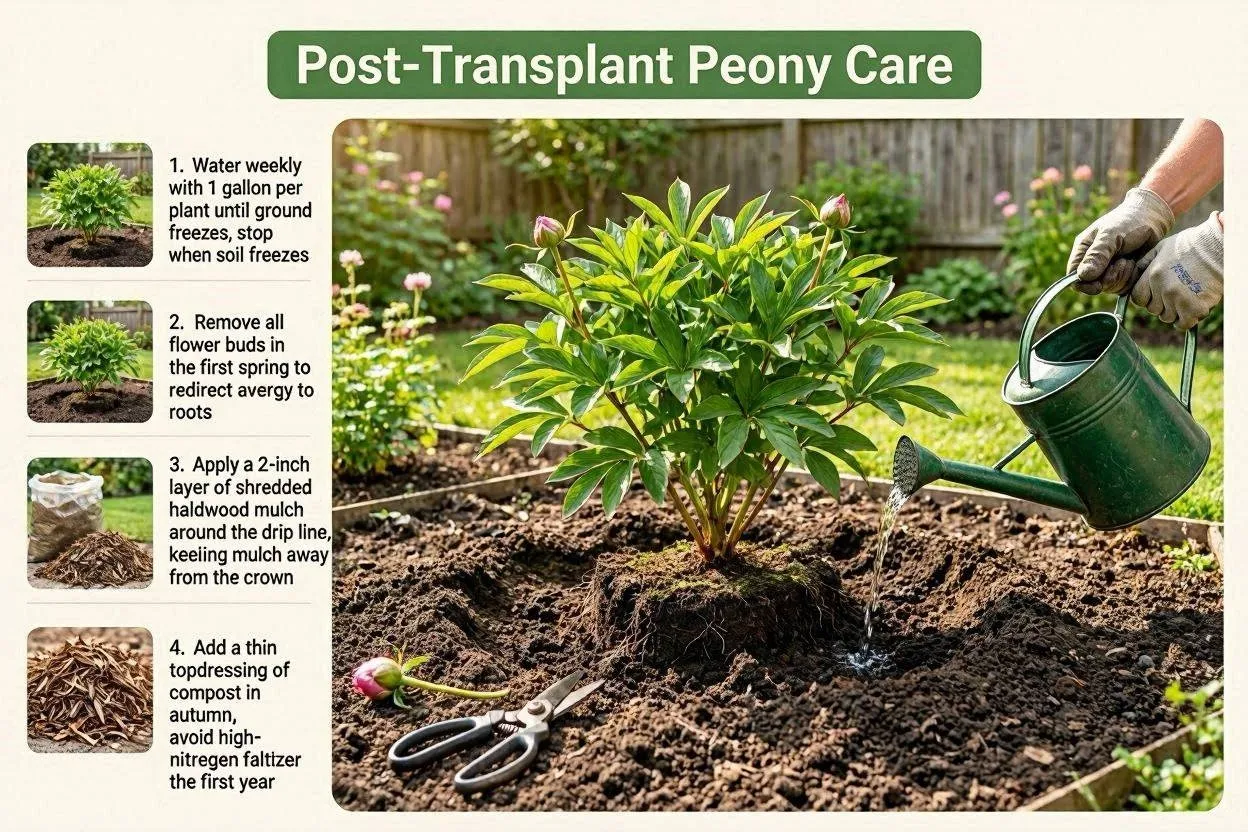
- Water weekly until the ground freezes. Apply 1 gallon (3.8 liters) per plant per week through October. Stop watering once the soil freezes.
- Remove all flower buds in the first spring after transplanting. Pinching off buds redirects energy from flower production into root development. This single action adds 12 months of root growth.
- Feed with low-nitrogen fertilizer in the second spring. Apply a 5-10-10 or bone meal fertilizer around the drip line in April of the second year. High-nitrogen formulas produce foliage at the cost of flowers.
- Top-dress with 1 inch (2.5 cm) of compost each fall. Work the compost gently into the soil surface. Avoid disturbing the crown. Compost improves drainage and feeds soil biology that supports root growth.
For complete fall garden preparation steps that include peony cutback timing, see the winterize your garden guide for a full seasonal checklist.
Why Transplanted Peonies Don’t Bloom for 1–3 Years
A transplanted peony skips blooming for 1–3 years because the plant prioritizes root rebuilding over flower production. The tuberous root system loses up to 40% of its absorbing root tips during digging.
The peony’s energy budget works as follows: root repair takes priority in Year 1, leaf canopy restoration takes priority in Year 2, and flower production resumes in Year 3 under normal circumstances. Fall-transplanted peonies cut 1 year off this timeline compared to spring-transplanted peonies because the roots establish over winter without competing with leaf growth.
3 common mistakes that extend the recovery period to 4 or more years:
- Planting eyes deeper than 2 inches (5 cm). Deep planting suppresses bud initiation regardless of how healthy the roots are.
- Transplanting in summer while the plant is in full leaf. Summer moves cause severe dehydration stress in the canopy before roots regenerate.
- Dividing a clump into pieces smaller than 3 eyes. Divisions with 1–2 eyes lack the carbohydrate reserves needed to re-establish quickly.
Frequently Asked Questions About When to Transplant Peonies
Can you transplant peonies in the fall in all US zones?
Yes, fall transplanting works in all US zones where peonies grow reliably — Zones 3 through 8. Adjust the timing to give 6 weeks of root-establishment time before your first hard frost. In Zone 9, transplant in October and choose low-chill varieties such as ‘Coral Charm’.
How long does it take a transplanted peony to bloom again?
A fall-transplanted peony typically blooms again in 2–3 years. Spring-transplanted peonies often take 3–4 years. Remove flower buds in the first spring after transplanting to reduce recovery time by one full season.
Should you water peonies immediately after transplanting?
Yes, water peonies deeply right after transplanting. Apply 2 gallons (7.5 liters) at planting to eliminate air pockets around the tubers. Continue weekly watering of 1 gallon (3.8 liters) per plant until the ground freezes.
Can you transplant a peony in summer?
No, do not transplant peonies in summer. Summer transplanting causes severe transplant shock because the plant loses water through its large leaf canopy faster than damaged roots can replace it. Bloom failure lasting 4 or more years is the typical result of a summer move.
How deep should peony eyes be planted after transplanting?
Peony eyes must sit 1–2 inches (2.5–5 cm) below the soil surface after transplanting. In Zones 3–5, plant at 2 inches (5 cm) for extra frost protection. In Zones 6–8, plant at 1 inch (2.5 cm). Eyes deeper than 2 inches (5 cm) produce foliage but never flower, no matter how fertile the soil.
Start Planning Your Peony Transplant for Fall 2026
Transplanting peonies delivers results when you match the timing to the plant’s biology. Lift and move herbaceous peonies such as ‘Festiva Maxima’, ‘Sarah Bernhardt’, or ‘Karl Rosenfield’ in September or October. Set the eyes at 1–2 inches (2.5–5 cm) deep, water weekly until frost, and remove the first-year buds. Your peony will return stronger, positioned in the right spot to bloom for the next 50–100 years.
Ready to master every aspect of peony care before your transplant day? Visit the complete peony bush care guide at Zoned Garden for planting depths, fertilizer schedules, disease prevention, and variety recommendations for every USDA zone.