
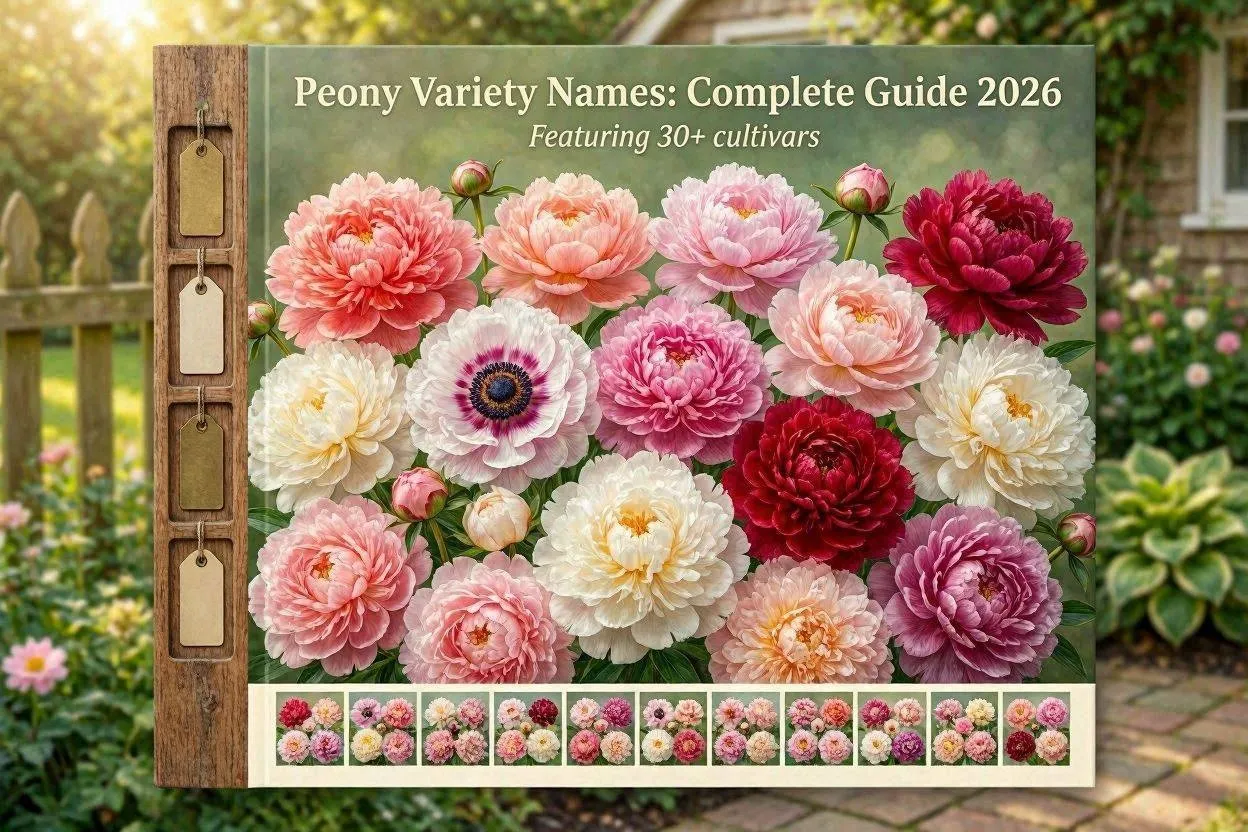
Peony variety names identify specific cultivated forms of Paeonia, and gardeners use them to select plants by bloom type, color, fragrance, and USDA hardiness zone. This guide covers 30+ named peony cultivars across 3 structural types and 5 bloom forms, with exact planting data for each.
Peonies in the genus Paeonia fall into 3 main groups: herbaceous peonies, tree peonies, and intersectional Itoh hybrids. Each group contains dozens of named cultivars suited to different climates, from USDA Zone 3 (where winters reach -40°F / -40°C) to Zone 8 (where winters stay above 10°F / -12°C).
What Are the 3 Main Peony Type Names You Need to Know?
The 3 main peony type names are herbaceous peony (Paeonia lactiflora), tree peony (Paeonia suffruticosa), and intersectional hybrid (Itoh peony). Each type has distinct growth habits, bloom seasons, and height ranges that affect how you use them in the garden.

Herbaceous Peony Names (Paeonia lactiflora)
Herbaceous peonies die back to the ground each winter and return from the roots each spring. They grow 2–3 feet (60–90 cm) tall and bloom in late spring from May through June. Named cultivars include Sarah Bernhardt, Karl Rosenfield, Duchesse de Nemours, and Festiva Maxima. These are the most widely grown peonies and the most common type sold as bare-root divisions.
Paeonia lactiflora cultivars thrive in USDA Zones 3–8. They require a cold dormancy period of at least 6 weeks below 40°F (4°C) to produce blooms the following spring. Gardeners in Zones 7–8 should select early-blooming lactiflora varieties to avoid heat interrupting bud development.
Tree Peony Names (Paeonia suffruticosa)
Tree peonies keep their woody stems through winter and bloom 3–4 weeks earlier than herbaceous types, typically in late April or early May. Tree peonies reach 4–7 feet (1.2–2.1 m) tall and wide. Named cultivars include Shimanishiki (red and white bicolor), Age of Gold (yellow semi-double), Hana Kisoi (pink double), and Rimpo (purple semi-double). Tree peonies suit USDA Zones 4–9.
Itoh Hybrid Peony Names (Intersectional Peonies)
Itoh hybrids cross herbaceous and tree peonies. Japanese hybridizer Toichi Itoh developed the first intersectional hybrid in 1948, and named cultivars now include Bartzella (yellow double), Garden Treasure (yellow semi-double), Lollipop (yellow with red center), and Hillary (peach-pink). Itoh peonies grow 2–3 feet (60–90 cm) tall, bloom for 3–4 weeks in late spring, and thrive in USDA Zones 4–9.
Bartzella has won the American Peony Society (APS) Gold Medal, which the APS awards to cultivars demonstrating exceptional bloom quality, growth habit, and landscape performance across multiple test sites.
What Are the 5 Peony Bloom Form Names and Their Named Cultivars?
The 5 peony bloom forms are single, Japanese, anemone, semi-double, and double (including bomb-type). Each form describes the petal arrangement of the flower head and directly affects cut flower performance, staking requirements, and visual style.
Single-Form Peony Names
Single peonies carry 1–2 rows of wide guard petals surrounding a central cluster of golden stamens. Named single cultivars include Sea Shell (shell-pink, 1937), Krinkled White (crepe-textured white), and Burma Ruby (scarlet-red, APS Gold Medal winner). Single-form peonies rarely need staking.
Japanese-Form and Anemone-Form Names
Japanese-form peonies carry large guard petals around a center of narrow, petal-like staminodes. Named Japanese cultivars include Bowl of Beauty (pink guards, cream staminodes), Do Tell (blush-pink guards, raspberry-cream staminodes), and Walter Mains (deep red guards, red-tipped staminodes). Anemone-form peonies have fluffy double centers without visible stamens; named examples include Gay Paree (carmine guards, white center) and Prairie Moon (pale cream, very fragrant).
Double and Bomb-Form Peony Names
Double-form peonies fill every part of the bloom with petals, hiding the stamens completely. Named double cultivars include Sarah Bernhardt (soft pink, 1906), Festiva Maxima (white with crimson flecks, 1851), and Duchesse de Nemours (pure white, APS Gold Medal). Bomb-form doubles carry a tall, rounded central mass of petals rising above the guard petals; named bomb cultivars include Red Charm (deep red), Monsieur Jules Elie (rosy pink), and Raspberry Sundae (cream and pink blend). Bomb-form peonies require staking because the dense central mass makes blooms heavy in rain.
For a detailed breakdown of every peony color within these bloom forms, visit the peony colors guide at Zoned Garden.
Peony Variety Names by Color: Pink, Red, White, Yellow, and Coral
Peony colors span 14 distinct families, and named cultivars exist in every shade except true blue (which the Paeonia genus cannot produce due to an absence of delphinidin pigments). The most common color groups contain the largest number of cultivar names.

Pink Peony Variety Names
Pink herbaceous peonies produce the most popular cultivar names for weddings and cut-flower sales. Named pink cultivars include Sarah Bernhardt (soft rose-pink double), Nick Shaylor (blush-pink double, 2-time APS Gold Medal winner), Pillow Talk (deep shell-pink bomb), Pink Hawaiian Coral (coral-pink semi-double), and Shirley Temple (soft pink fading to white). Plant pink lactiflora cultivars in full sun receiving at least 6 hours (183 days per year in Zones 4–7).
Red and Coral Peony Variety Names
Red and coral cultivars carry striking pigment intensity that distinguishes them in mixed borders. Named red cultivars include Karl Rosenfield (deep crimson double, 1908), Red Charm (deep red bomb, APS Gold Medal), and Burma Ruby (single scarlet). Named coral cultivars include Coral Charm (semi-double, opens coral and matures to peach, APS Gold Medal) and Coral Sunset (semi-double, coral fading to ivory). Coral Charm is the top-selling coral cultivar among U.S. cut-flower farmers.
Coral peonies change color over 5–7 days from bud to full bloom. Pick Coral Charm at the marshmallow stage (bud just showing color) to capture the most vivid coral tones in cut-flower arrangements.
White and Yellow Peony Variety Names
White peonies stay popular for wedding work. Named white cultivars include Duchesse de Nemours (double, lemon-cream center, strong fragrance), Festiva Maxima (white with red flecks, 1851, one of the oldest named cultivars still sold), and Krinkled White (single, crepe-textured petals). Yellow peonies exist almost exclusively as Itoh hybrids; named yellow cultivars include Bartzella (large double, lemon-yellow with red center flare) and Garden Treasure (semi-double, APS Gold Medal and RHS Award of Garden Merit).
Peony Variety Names Quick-Reference Table: Type, Season, Height & Use
Use the table below to compare the 5 main peony structural and bloom-season groupings side by side before selecting named cultivars for your garden.
| Peony Type | Bloom Season | Height | Best Use | Staking Needed |
| Herbaceous (Lactiflora) | Late spring (May–June) | 2–3 ft (60–90 cm) | Borders, cut flowers | Often yes (bomb types) |
| Tree Peony (Paeonia suffruticosa) | Early spring (April–May) | 4–7 ft (1.2–2.1 m) | Specimen plant, backdrop | No |
| Itoh (Intersectional) Hybrid | Late spring (May–June) | 2–3 ft (60–90 cm) | Mixed beds, long bloom | Rarely |
| Single-form Herbaceous | Mid-spring | 2–3 ft (60–90 cm) | Pollinator gardens | No |
| Bomb-form Double | Late spring | 2.5–3 ft (75–90 cm) | Cut flowers, bouquets | Yes |
Which Peony Variety Names Work Best for Beginners?
The 5 best peony variety names for beginners are Sarah Bernhardt, Festiva Maxima, Karl Rosenfield, Coral Charm, and Bartzella. Each one demonstrates consistent bloom performance across USDA Zones 4–7, tolerates average garden soil, and produces reliable flowers by the second or third season after planting.
To plant bare-root peony divisions, set the eyes (pink growth buds) no deeper than 1–2 inches (2.5–5 cm) below the soil surface. Deeper planting prevents flowering. Space each division 3 feet (90 cm) from neighboring plants to promote airflow and reduce botrytis blight (a fungal disease that blackens new stems and buds in wet spring weather).
For beginner gardeners growing herbaceous peonies for the first time, the bush peony growing guide at Zoned Garden covers soil preparation, fertilizing schedules, and division timing in full detail.
Why Sarah Bernhardt Stays the Top-Selling Peony Cultivar
Sarah Bernhardt outsells all other peony cultivar names globally because the variety combines 3 key traits: large double blooms reaching 6 inches (15 cm) across, strong fragrance, and disease resistance. The French hybridizer Lemoine introduced Sarah Bernhardt in 1906. The cultivar blooms reliably for 120-year-old plants, making it the longest-commercially-available named herbaceous peony cultivar. Gardeners in Zones 3–8 can grow Sarah Bernhardt without winter protection.
What Peony Variety Names Produce the Strongest Fragrance?
The 6 most fragrant peony cultivar names are Duchesse de Nemours (white, heavy rose scent), Festiva Maxima (white, rose-and-lily), Sarah Bernhardt (pink, sweet rose), Monsieur Jules Elie (pink, strong rose), Therese (pale pink, rose scent), and Madame de Verneville (white with red flecks). Single-form and some Japanese-form peonies, such as Krinkled White and Bowl of Beauty, carry lighter scents. The strongly fragrant lactiflora cultivars belong to the double and bomb forms.
Paeonia lactiflora carries fragrance due to monoterpene compounds, primarily geraniol and linalool, which are the same aroma chemicals responsible for rose and lily scent. Tree peonies and Itoh hybrids like Bartzella are often fragrance-free or only mildly scented.
How to Choose Peony Variety Names by USDA Hardiness Zone
To choose peony cultivars by USDA zone, match the variety’s rated cold tolerance to your zone’s average minimum winter temperature. Most herbaceous lactiflora cultivars survive down to Zone 3 (-40°F / -40°C). Tree peonies survive to Zone 4 (-30°F / -34°C). Itoh hybrids survive to Zone 4 (-30°F / -34°C).

Peony Variety Names for Cold Climates (Zones 3–4)
Gardeners in Zones 3–4 should plant named lactiflora cultivars with proven cold hardiness. The best choices include Festiva Maxima (Zone 3 rated), Karl Rosenfield (Zone 3 rated), Sarah Bernhardt (Zone 3 rated), and Red Charm (Zone 4 rated). Plant all bare-root divisions in September or October, at least 6 weeks before the ground freezes, so roots establish before winter.
Peony Variety Names for Warmer Climates (Zones 7–8)
Zones 7–8 gardeners succeed with early-blooming cultivars that finish before summer heat arrives. Named cultivars suited to warm climates include Coral Charm (early bloomer), Burma Ruby (early single), and Do Tell (early Japanese-form). Avoid late-blooming bomb cultivars like Raspberry Sundae in Zone 7b and warmer, since hot temperatures abort bud development before the petals open.
For garden planning across multiple climate zones, gardeners growing named rose peony cultivars can use the rose peony varieties guide at Zoned Garden to identify which rose-form peonies perform best alongside actual garden roses.
How to Extend Peony Season by Planting 3 Named Varieties at Different Bloom Times
To extend peony bloom season, plant 1 early-season variety, 1 midseason variety, and 1 late-season variety. This 3-cultivar combination delivers flowers from early May through late June in Zones 5–6, producing 7–9 weeks of continuous bloom instead of 7–10 days from a single variety.
- Early-season (late April–early May): Coral Charm, Burma Ruby, Do Tell
- Midseason (mid-May): Bowl of Beauty, Sarah Bernhardt, Karl Rosenfield
- Late-season (late May–June): Duchesse de Nemours, Festiva Maxima, Bartzella
The American Peony Society (APS) assigns each registered cultivar a bloom season designation — early, early-midseason, midseason, late-midseason, or late — based on performance at test gardens in multiple USDA zones. Always verify the APS bloom code for any named cultivar you plant, since supplier descriptions sometimes simplify the timing.
Frequently Asked Questions About Peony Variety Names
How many named peony cultivars exist?
The American Peony Society (APS) registers named herbaceous peony cultivars, and the registry lists over 6,000 named cultivars worldwide. Garden centers typically stock 20–100 cultivar names, while specialist peony nurseries carry 200–500.
Do all peony variety names have fragrance?
No. Fragrance varies by species and bloom form. Paeonia lactiflora cultivars (especially double and bomb types like Festiva Maxima and Duchesse de Nemours) carry the strongest fragrance. Itoh hybrids like Bartzella and Garden Treasure typically have little to no scent. Tree peonies carry light fragrance in some cultivars.
What is the oldest named peony cultivar still available?
Festiva Maxima, introduced in France in 1851, is the oldest widely available named peony cultivar. This double white herbaceous cultivar blooms reliably in Zones 3–8 and shows white petals with distinctive crimson flecks at the petal base. Nurseries have sold Festiva Maxima continuously for over 170 years.
Can you grow named peony varieties in containers?
Yes. Named herbaceous peony cultivars grow in containers with a minimum volume of 15 gallons (57 liters). Choose compact cultivars like Krinkled White or Miss America rather than large bomb-form varieties. Containers must receive 6 hours of direct sun daily and need watering twice per week in summer heat above 85°F (29°C). Move containers to an unheated garage in Zone 5 and colder to protect roots from repeated freeze-thaw cycles.
What does an APS Gold Medal mean for a named peony cultivar?
The APS Gold Medal is the highest award the American Peony Society grants to named peony cultivars. Gold Medal recipients show exceptional bloom quality, vigor, and garden performance across multiple U.S. test sites and climate zones. Named APS Gold Medal cultivars include Red Charm (1956), Garden Treasure (1996), and Coral Charm (1986). Choosing Gold Medal cultivars reduces selection risk for new peony growers.
Start Building Your Peony Collection With the Right Named Cultivars
Selecting peony variety names by bloom form, color, USDA zone, and fragrance narrows down a list of 6,000+ cultivars to the 5–10 varieties that will actually thrive in your garden. Start with proven Gold Medal winners like Coral Charm, Red Charm, and Festiva Maxima, then add specialty cultivars as you learn your site conditions. Plant bare-root divisions in September through October at 1–2 inches (2.5–5 cm) depth, space 3 feet (90 cm) apart, and expect full bloom performance in the second or third season.
For a deeper look at how each named cultivar fits into a complete growing system — including planting depth by zone, fertilizer timing, and dividing schedules — visit the bush peony growing guide at Zoned Garden.